generating the explanation.
To avoid the problems mentioned above, a tag-based statistical framework which is able
to perform understanding and reasoning with logic inference is proposed in this paper. It
analyzes the body and question texts into their associated tag-based3 logic forms, and then
performs inference on them. Comparing to those rule-based approaches, the proposed statistical approach alleviates the ambiguity resolution problem, and the tag-based approach also provides the flexibility of handling various kinds of possible questions with the same body logic form. On the other hand, comparing to those approaches not adopting logic inference, the proposed approach is more robust to the irrelevant information and could more accurately provide the answer. Furthermore, with the given reasoning chain, the explanation could be more easily generated.
Proposed Framework
The main contributions of our work are: (1) proposing a tag-based logic representation such that the system is more robust to the irrelevant information and could provide the answer more precisely; (2) proposing a unified statistical framework for performing reasoning from the given text.
(a) Math Word Problem Solver Diagram (b) Problem Resolution Diagram Figure 1. The block diagram of the proposed Math Word Problem Solver.
The block diagram of the proposed MWP solver is shown in Figure 1. First, every sentence in the MWP, including both body text and the question text, is analyzed by the
Language Analysis module, which transforms each sentence into its corresponding semantic
representation tree. The sequence of semantic representation trees is then sent to the Problem Resolution module, which adopts the logic inference approach to obtain the answer for each
question. Finally, the Explanation Generation (EG) module will explain how the answer is
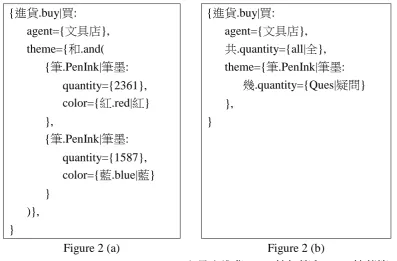
3 The associated modifiers in the logic form (such as verb(q1,進貨), agent(q1,文具店), head(n1p,筆), color(n1p,
where the argument “n1p”4 denotes “紅筆 (red pens)” due to the facts “head(n1p,筆)” and
“color(n1p,紅)”. Likewise, the quantity-fact “1587枝藍筆 (1587 blue pens)” is represented
by “quan(q2,枝,n2p)=1587”. The LFC also issues the utility call “ASK Sum(quan(?q,枝, 筆),verb(?q,進貨)&agent(?q,文具店))” (based on the assigned solution type) for the question. Finally, the IE will select out two quantity-facts “quan(q1,枝,n1p)=2361” and “quan(q2, 枝,n2p)=1587”, and then perform “Sum” operation on them to obtain “3948”.
If the question in the above example is “文具店共進貨幾枝紅筆 (How many red pens
did the stationer buy)?”, the LFC will generate the following facts and utility call for this new
question:
head(n3p,筆)&color(n3p,紅)
ASK Sum(quan(?q,枝,n3p),verb(?q,進貨)&agent(?q,文具店))
As the result, the IE will only select the quantity-fact “quan(q1,枝,n1p)=2361”, because the modifier in QLF (i.e., “color(n3p,紅)”) cannot match the associated modifier “藍 (blue)” (i.e., “color(n2p,藍)”) of “quan(q2,枝,n2p)=1587”. After performing “Sum” operation on it, we
thus obtain the answer “2361”. (We will skip EG due to space limitation. Please refer to [17]
for the details).
Preliminary Results
Currently, we have completed all the associated modules (including Word Segmenter,
Syntactic Parser, Semantic Composer, TC, LFC, IE, and EG), and have manually annotated
75 samples (in our elementary school math corpus) as the seed corpus (with syntactic tree,
semantic tree, logic form, and reasoning chain annotated). Besides, we have cleaned the
original elementary school math corpus and encoded it into the appropriate XML format.
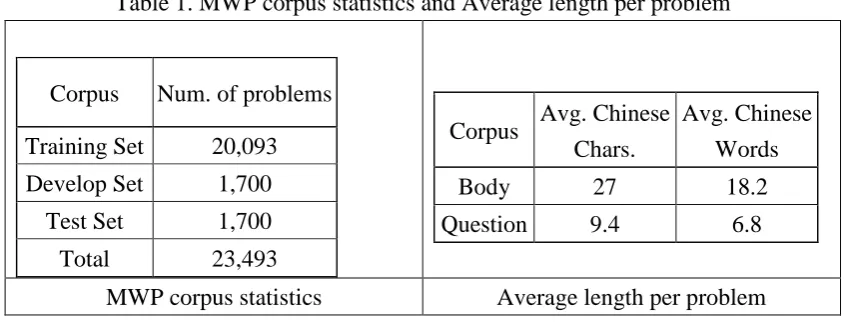
There are total 23,493 problems divided into six grades; and the average number of words of
the body text is 18.2 per problem. Table 3 shows the statistics of the converted corpus.
We have completed a prototype system and have tested it on the seed corpus. The
success of our pilot run has demonstrated the feasibility of the proposed approach. We plan to
use the next few months to perform weakly supervised learning [18] and fine tune the system.
4 The subscript “p” in “n1
p” indicates that “n1p” is a pseudo nonterminal derived from the nonterminal “n1”, which has four
[13] M.J. Hosseini, H. Hajishirzi, O. Etzioni, N. Kushman, Learning to Solve Arithmetic Word Problems with Verb Categorization, EMNLP, (2014).
[14] N. Kushman, Y. Artzi, L. Zettlemoyer, R. Barzilay, Learning to Automatically Solve
Algebra Word Problems, ACL, (2014).
[15] S.I. Roy, T.J.H. Vieira, D.I. Roth, Reasoning about Quantities in Natural Language,
TACL, 3 (2015) 1-13.
[16] S.J. Russell, Artificial Intelligence : A Modern Approach (3e) (2009).
[17] C.T. Huang, Y.C. Lin, K.Y. Su, Explanation Generation for a Math Word Problem
Solver, to be published at International Journal of Computational Linguistics and Chinese Language Processing (IJCLCLP), (2016).
[18] Y. Artzi, L. Zettlemoyer, Weakly supervised learning of semantic parsers for mapping