CSEIT1833224 | Received : 12 March 2018 | Accepted : 24 March 2018 | March-April-2018 [ (3 ) 3 : 802-811 ]
© 2018 IJSRCSEIT | Volume 3 | Issue 3 | ISSN : 2456-3307
802
A Review : Artificial Intelligence
Ramandeep Kaur
Swami Ganga Giri Janta Girls College, Raikot,Ludhiana, Punjab, India
ABSTRACT
In the future, intelligent machines will replace or enhance human capabilities in many areas. Artificial intelligence is the intelligence exhibited by machines or software. It is the subfield of computer science. Artificial Intelligence is becoming a popular field in computer science as it has enhanced the human life in many areas. Artificial intelligence in the last two decades has greatly improved performance of the manufacturing and service systems. Study in the area of artificial intelligence has given rise to the rapidly growing technology known as expert system. Application areas of Artificial Intelligence is having a huge impact on various fields of life as expert system is widely used these days to solve the complex problems in various areas as science, engineering, business, medicine, weather forecasting. The areas employing the technology of Artificial Intelligence have seen an increase in the quality and efficiency. This paper gives an overview of this technology and the application areas of this technology. This paper will also explore the current use of Artificial Intelligence technologies in the PSS design to damp the power system oscillations caused by interruptions, in Network Intrusion for protecting computer and communication networks from intruders, in the medical area medicine, to improve hospital inpatient care, for medical image classification, in the accounting databases to mitigate the problems of it and in the computer games.
Keywords : Artificial Intelligence, PROLOG, CLOS, Handwriting Recognition, Intelligent Robots, Speech Recognition, Health Monitoring, Drug Creation, Medical Robotics
I.
INTRODUCTION
I was coined by John McCarthy, an American computer scientist, in 1956 at The Dartmouth Conference where the discipline was born. Today, it is an umbrella term that encompasses everything from robotic process automation to actual robotics. It has gained prominence recently due, in part, to big data, or the increase in speed, size and variety of data businesses are now collecting. AI can perform tasks such as identifying patterns in the data more efficiently than humans, enabling businesses to gain more insight out of their data.
Artificial Intelligence is the science and engineering of making intelligent machines, especially intelligent computer programs. It is related to the similar task of
using computers to understand human intelligence, but AI does not have to confine itself to methods that are biologically observable. As a theory in the philosophy of mind, artificial intelligence (or AI) is the view that human cognitive mental states can be duplicated in computing machinery.
II.
WHAT IS ARTIFICIAL INTELLIGENCE
Artificial:-
The simple definition of artificial is that objects that are made or produced by human beings rather than occurring naturally.
Intelligence:-
The simple definition of intelligence is a process of entail a set of skills of problem solving, enabling to resolve genuine problems or difficulties that encounter and to create an effective product and must also entail the potential for finding or creating problems and thereby laying the groundwork for the acquisition of new knowledge.
Artificial Intelligence:-
Artificial intelligence is a branch of science which deals with helping machines find solution to complex problems in a more human like fashion. The generally involves borrowing characteristics from human intelligence and applying them as algorithms in a computer friendly way. A more or less or flexible or efficient approach can be taken depending on the requirements established, which influences how artificial intelligent behavior appears.
According to the father of Artificial Intelligence, John McCarthy, it is
―The science and engineering of making intelligent machines, especially intelligent computer programs‖.
Artificial Intelligence is a way of making a computer, a computer-controlled robot, or a software think intelligently, in the similar manner the intelligent humans think.
AI is accomplished by studying how human brain thinks and how humans learn, decide, and work while trying to solve a problem, and then using the outcomes of this study as a basis of developing whose primary control structure is depth-first search ancestor(A,B) :- parent(A,B) ancestor(A,B) :- parent(A,P), ancestor(P,B)
The principle behind Weak AI is simply the fact that machines can be made to act as if they are intelligent. For example, when a human player plays chess against a computer, the human player may feel as if the computer is actually making impressive moves. But the chess application is not thinking and planning at all. All the moves it makes are previously fed in to the computer by a human and that is how it is ensured that the software will make the right moves at the right times.
What is strong AI?
Applications of AI
AI has been dominant in various fields such as −
Gaming − AI plays crucial role in strategic games such as chess, poker, tic-tac-toe, etc., where machine can think of large number of possible positions based on heuristic knowledge.
Natural Language Processing − It is possible to interact with the computer that understands natural language spoken by humans.
Expert Systems − There are some applications which integrate machine, software, and special information to impart reasoning and advising. They provide explanation and advice to the users.
Vision Systems − These systems understand, interpret, and comprehend visual input on the computer. For example,
o A spying aero plane takes photographs,
which are used to figure out spatial information or map of the areas.
o Doctors use clinical expert system to
diagnose the patient.
o Police use computer software that can
recognize the face of criminal with the stored portrait made by forensic artist. Speech Recognition − Some intelligent systems
are capable of hearing and comprehending the language in terms of sentences and their meanings while a human talks to it. It can handle different accents, slang words, noise in the background, change in human‘s noise due to cold, etc.
Handwriting Recognition − The handwriting recognition software reads the text written on paper by a pen or on screen by a stylus. It can recognize the shapes of the letters and convert it into editable text.
Intelligent Robots − Robots are able to perform the tasks given by a human. They have sensors to detect physical data from the real world such as light, heat, temperature, movement,
sound, bump, and pressure. They have efficient processors, multiple sensors and huge memory, to exhibit intelligence. In addition, they are capable of learning from their mistakes and they can adapt to the new environment.
Medical Robotics: The medicine field has now completely dependent on the accurate robotics results. There is now vast change to be occurred in the medical field called Computer integrated surgeries which will be accurate, less surgical, fast operative, low costs and effective. Heavy Industries and Aeronautical: The
manufacturing of the machine tools, computer chips, car manufacturing has been now producing by automated and controlled robotics. The robot is now acting as the vehicle pilot to run a spacecraft into the space.
Drug Creation
Developing pharmaceuticals through clinical trials can take more than a decade and cost billions of dollars. Making this process faster and cheaper could change the world. Amidst the recent Ebola virus scare, a program powered by AI was used to scan existing medicines that could be redesigned to fight the disease.
The program found two medications that may reduce Ebola infectivity in one day, when analysis of this type generally takes months or years – a difference that could mean saving thousands of lives.
Precision Medicine
Health Monitoring
Wearable health trackers – like those from FitBit, Apple, Garmin and others – monitors heart rate and activity levels. They can send alerts to the user to get more exercise and can share this information to doctors (and AI systems) for additional data points on the needs and habits of patients.
Finance
AI is used in finance to secure and prevent fraud detection. Banks customs the artificial intelligence systems to establish operations and capitalize in stocks, and achieve properties. Applications surrounded in end-user devices with financial institution servers that are accomplished of examining enormous volumes of information, providing modified into financial advice, calculations. It helps to progress financial plans and methods to track their progress. It comprises several customized investment, opportunities, loans, rates and fees
Transport
Transportation is one of the challenging domain, because it has special characteristic complexity. It is molded up by geographically and functionally circulated heterogeneous elements, both artificial and human, with dissimilar decision-making abilities having mutual or individual goals, constructing its dynamics slightly uncertain .The balanced usage of transportation infrastructures on which they interact with the location must be achieved on a maintainable basis.AI ensures the productivity by making enhanced use of existing transportation infrastructure, including them with smarter, greener, safer, and more efficient technologies. The modern transportation systems are a natural ground to conceive, develop, test and apply AI techniques.
Military
AI is one of the applications which has grown worldwide, and took place also in military. The current use of AI not only limited battlefields, yet it is not a small part. AI makes more beneficiaries for military, especially by reducing life loss during war. One Example is to automate the long distance vehicles in different land shapes. The next is to build the solider robot that can identify enemies, which is capable of making decisions, follow orders and complete the mission successfully.
IV.
INDUSTRIAL APPLICATIONS OF
ARTIFICIAL INTELLIGENCE
1. Journalism
Fligure 1
In today‘s digital world, reading blogs and articles has become a common practice for most of us but hardly do we realize that some of them are actually written by machines. Although it can‘t be used for writing in-depth articles but the simple reports that don‘t require much analysis can be easily prepared by AI.
Companies like AP and Yahoo! are using AI to prepare simple reports related to sports and elections that would take a lot of time if done manually.
According to Automated Insights which
generation of fully automated writings and that too in different tones.
2. Entertainment
Figure 2
Use of Artificial Intelligence is quite popular in the entertainment industry. Whether it‘s the video games or music apps, we all are well aware of the concept. Talking about games, the idea is not new and is being utilized from the very beginning but today it has just grown exponentially. Games like Middle Earth, Far Cry are known for imparting personalities to the characters where they find objects, shoot, take cover and do everything possible for victory.
Similarly, for music and movies, the users are recommended to watch or listen to certain creations based on the decisions made in the past. If the user is frequently clicking on a specific genre then that will be regarded as the section that he/she may take interest in and it will be displayed in a separate section, saying ‗you may also be interested in‘.
3. Online Retail Stores
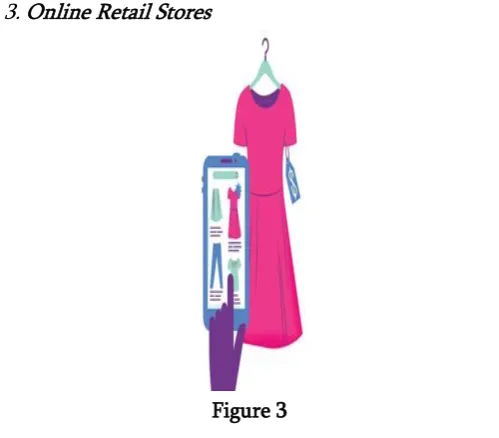
Figure 3
With the introduction of online retail stores, people have started making the online purchase a habit which is quite at its peak right now. These websites also use artificial intelligence in certain ways like recommending the customers what to purchase depending upon his/her past purchases or items put in the search box. Another way is providing chat bots for seeking guidance or for solving queries.
Reports say that AI is going to make shopping more personal for the shoppers and simplify things for the retailers. In the next few years, this technology will be playing a significant role in the retail industry. Well, it will be interesting to see what the future holds for the online retail stores.
4. Automobiles
It‘s a well-established fact that Google‘s Driverlesscars and Tesla‘s Autopilot features have already paved their way towards the introduction of AI in automobiles. Whether it‘s self-parking, detecting collision, blind spot monitoring, voice recognition, or navigation, it‘s almost like the car is acting as an assistant to the owner and teaching different ways of a safe driving.
Elon Musk, popularly known as the founder of Tesla Motors, tweeted that soon a day will come when people will be able to ‗Summon‘ their car wherever they want to and it will reach there on its own using navigation and track the location of the person. He is even working on introducing a fully automated transportation system that will use levitation for the commute.
5. Banking
Figure 5
Owing to the increase in the amount of financial data, a lot of financial services have resorted to Artificial Intelligence. Robots are much quicker in analyzing market data to forecast change in stock trends and manage finances as compared to the human counterparts. They can even use algorithms to offer suggestions to the clients involving simple problems.
Similarly, banks are using AI to keep a track of the customer base, addressing their needs, suggesting them about different schemes and what not. Often when there is a suspicious transaction from the users‘
account, they immediately get a mail to confirm that it‘s not an outsider who is carrying out that particular transaction.
6. Healthcare
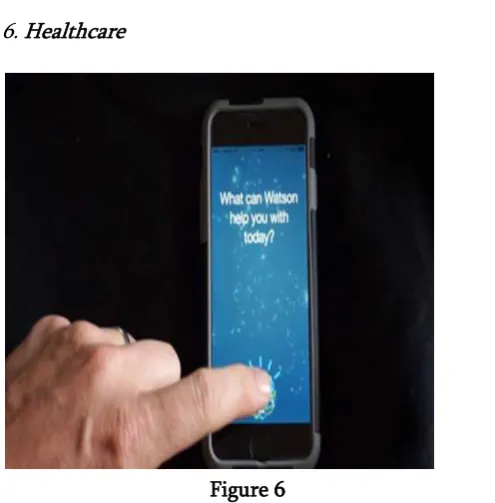
Figure 6
Artificial Intelligence is also performing a lot of important work for the healthcare industry. It is being used by doctors in assisting with the diagnosis and treatment procedures. This reduces the need for multiple machines and equipment which in turn brings down the cost.
7. Manufacturing
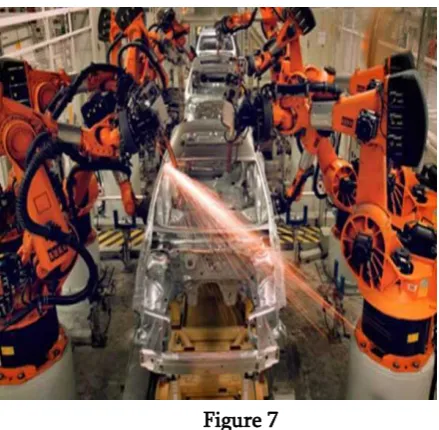
Figure 7
Manufacturing is one of the first industries that has been using AI from the very beginning. Robotic parts are used in the factories to assemble different parts and then pack them without needing any manual help. Right from the raw materials to the shipped final products, robotic parts play an imminent role in most of the entities.
However, artificial intelligence is going to make more modifications in a way that more complicated goods will be manufactured and assembled with the help of machines like automobiles and electronic goods.
8. Online Customer Service
Figure 8
Several websites offer customers to chat with their representative in case of a query or grievances. However, most of the time these are not humans; rather these are chat bots that are trained to respond
and extract the required knowledge from the site and present it to the customer.
These bots utilise natural language processing to interpret the customer‘s query by focusing on the keywords and then in response, the required data is fetched. However, it‘s not quite easy for a robot to understand it because there‘s a huge difference between the human and machine language. Reportedly, progress is being made on that front too and hopefully, soon we‘ll be having a robot that could communicate with humans on its own.
9. Home Appliances
Figure 9
All the smart devices and gadgets used in our daily lives that feature IT technology also make use of Artificial Intelligence. The technique is to learn the behavior and usage pattern shown by the user and then accordingly the appliance starts behaving in a similar manner on its own without needing any instructions.
10. Smartphone
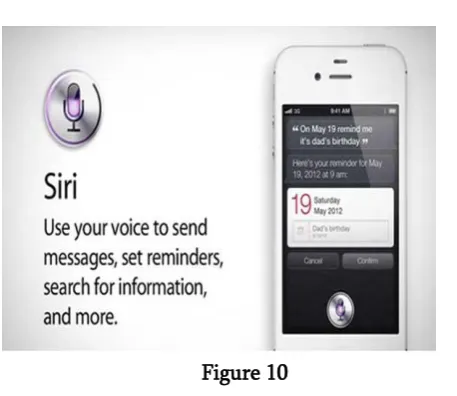
Figure 10
The most common application of AI can be seen in our mobile phones in the form of Virtual Personal Assistants. Siri, Cortana, and Google Now are some very commonly used digital assistants that are found in iOs, Android and Windows phones. These can answer whatever you ask them like ―What movie is going to be released this Friday?‖ or ―Who is Stephen Hawking?‖
These applications collect information in order to interpret what is being asked by the user and then the required data is fetched to suit the user‘s preferences. There is a huge amount of learning involved on the part of these assistants and a lot of information is tracked to ensure efficiency.
How Artificial Intelligence Works
AI works by combining large amounts of data with fast, iterative processing and intelligent algorithms, allowing the software to learn automatically from patterns or features in the data. AI is a broad field of study that includes many theories, methods and technologies, as well as the following major subfields:
Machine learning automates analytical model building. It uses methods from neural networks, statistics, operations research and physics to find hidden insights in data without explicitly being programmed for where to look or what to conclude.
A neural network is a type of machine learning that is made up of interconnected units (like neurons) that processes information by responding to external inputs, relaying information between each unit. The process requires multiple passes at the data to find connections and derive meaning from undefined data. Deep learning uses huge neural networks with many
layers of processing units, taking advantage of advances in computing power and improved training techniques to learn complex patterns in large amounts of data. Common applications include image and speech recognition.
Cognitive computing is a subfield of AI that strives for a natural, human-like interaction with machines. Using AI and cognitive computing, the ultimate goal is for a machine to simulate human processes through the ability to interpret images and speech – and then speak coherently in response.
Computer vision relies on pattern recognition and deep learning to recognize what‘s in a picture or video. When machines can process, analyze and understand images, they can capture images or videos in real time and interpret their surroundings.
Natural language processing (NLP) is the ability of computers to analyze, understand and generate human language, including speech. The next stage of NLP is natural language interaction, which allows humans to communicate with computers using normal, everyday language to perform tasks.
Negative Impacts of Artificial Intelligence
machines cost less than a human does to complete the same work.
Another factor is that when societies become too dependent on technology, humans begin to lose the skills that technology has replaced. Prior to pocket calculators, math problems were written out by hand. Students learned basic mathematical concepts that helped them solve complex problems. But now students use calculators to help them achieve their answers, and they are losing the ability to use their mathematic problem-solving skills. It doesn‘t stop there. Medical science proves that muscles that don‘t get enough exercise, break down and atrophy with time. The same happens to those skills and abilities no longer in use by humans because machines have taken over the heavy lifting.
Advantages and Disadvantages AI Advantages
1. With artificial intelligence, the probabilities of error are almost nil, which has better accuracy to be achieved.
2. Organizations custom the avatars that are
numerical assistants who interrelate with the users, thus saving the essential of human resources.
3. Robotic pets can help patients with despair and
also save them active.
4. Their job is almost infinite as the machines will
be able to do everything, essentially as they doesn‘t have any boundaries.
5. Can be able to complete work faster than a
human.
6. They need not stop at any time as the machines
no need to sleep, because they don‘t get ill, there is no need for breaks.
Disadvantages will finally lead to unemployment. People will be left with nothing to do. So much empty time may affect its destructive use.
3. Can be changed foremost to mass scale
destruction.
4. The malfunction can do the opposite of what
they are programmed to do
5. It has the efficiency to corrupt younger
generation.
6. The AI mainly lacks in human touch, since it
does not have the capacity to think, it can only function according to program.
V.
CLEARING THE PATH TO AN ARTIFICIAL
INTELLIGENCE FUTURE
Prepare the next generation for the Artificial Intelligence future—integrate human intelligence with machine intelligence so they can successfully co-exist, and reinforce the role of people to drive growth.
Encourage Artificial Intelligence-powered
regulation—update and create adaptive, self-improving laws to close the gap between the pace of technological change and the pace of regulatory response.
Advocate a code of ethics for Artificial Intelligence— ethical debates should be supplemented by tangible standards and best practices in the development and use of intelligent machines.
VI.
CONCLUSION
Artificial Intelligence and the technology are unique lateral of the life which continuously make attention and wonder us with the innovative ideas, topics, innovations, products etc…AI plans can overtake the human experts. Nowadays the great challenge of AI is to the catch methods of demonstrating the consistent data and understanding that people can be enable to carry out daily actions such as holding a wide-ranging conversation, or finding their way along a busy street. Conventional digital computers may be accomplished of running such programs, or we may essential need to develop new machines that can support the difficulty of human thought. This is not the conclusion of AI, there is further to originate after it, who recognizes what the AI can do for us in the future, perhaps it will be an entire culture of robots.
VII.
REFERENCES
[1]. http://www.webopedia.com/TERM/A/artifici al_intelligence.html
[2]. https://www.sciencedaily.com/terms/artificia l_intelligence.htm
[3]. https://en.wikipedia.org/wiki/Intelligence [4]. http://www.alanturing.net/turing_archive/pa
ges/reference%20articles/What%20is%20AI. html
[5]. http://artint.info/html/ArtInt_36.html [6].
http://artificialintelligence-notes.blogspot.in/2010/07/heuristicfunctions. html
[7]. http://www.britannica.com/topic/evaluation-function
[8]. https://praveen1302.wordpress.com/2014/02/
11/advantages-anddisadvantages-for-artificial-intelligence/
[9]. https://www.linkedin.com/pulse/pros-cons-artificial-intelligencemike-fekety
[10]. http://www.advancedmp.com/artificial-intelligence/
[11]. http://fsroundtable.org/cto-corner-artificial-intelligence-use-infinancial-services/