Interacting with a Virtual Conductor
Supervisors:
ir. Dennis Reidsma
prof. dr. ir. Anton Nijholt
dr. Zsófia Ruttkay
Pieter Bos
Contents
4 Human Conductors: How do they conduct? 23 4.1 Literature . . . 23
4.1.11.1 Facial Expression for Expression in Music or for Tutoring Pur-poses . . . 26
5.1 Features of the Conductor . . . 28
8.1.2 Dierences between playing with and without the conductor . . . 47
8.1.2.1 Playing two pieces with and without the conductor . . . 47
8.1.2.2 Playing the same piece with and without the conductor . . . . 47
8.1.3 Tempo and Dynamic Changes . . . 47
8.1.3.1 Playing a piece with unknown dynamic and tempo markings . 47 8.1.4 Correcting the tempo of musicians . . . 48
8.1.4.1 Let one player play too fast or too slow . . . 48
8.1.4.2 Introduce music which is suddenly more complicated . . . 48
9 Conclusions, Recommendations and Future Work 54
10 Activities related to the virtual conductor 56
Bibliography 57
A Interacting with a virtual conductor 60
B Detailed Explanation of the Audio Analysis Algorithms 67
D.1.7.2 experiment 1: . . . 97
D.1.7.3 experiment 2: . . . 97
D.1.7.4 experiment 3: . . . 97
D.1.8 Small things that went wrong . . . 97
D.1.9 Measuring the performance . . . 98
D.1.10 New experiments . . . 98
D.1.11 Question form . . . 98
D.1.12 Results of experiments . . . 98
D.1.12.1 Playing a piece with the conductor . . . 98
D.1.12.2 Experiment 1 . . . 98
D.1.13 Experiment 2 . . . 98
D.1.14 Experiment 3 . . . 99
D.2 Conclusion and recommendations . . . 99
D.2.1 Correction . . . 99
D.2.2 Beat patterns . . . 99
D.2.3 Appearance . . . 99
D.2.4 Dynamic indications . . . 99
Abstract
The task of conducting human musicians in a live performance by a computer has not yet been addressed extensively before. A few attempts exist at letting a computer perform this task, but there is no interactive virtual conductor who can conduct human musicians and can interact with these musicians.
The virtual conductor described in this report can conduct human musicians in a live perfor-mance interactively. The conductor can conduct 1-, 2-, 3- or 4-beat patterns. Tempo changes can be indicated in such a way that musicians can follow the change. Dynamics are supported by changing the amplitude of the conducting gestures, so that music that should be loud will make the conductor conduct bigger and music that should be played softly will be conducted smaller. These signals to musicians all are given before the actual change occurs, so that musicians are prepared that the tempo or dynamics will change. Accents are indicated by conducting the preparation of a beat bigger.
The conductor listens to the musicians as they play to follow their performance. He can track the beat of the musicians with a beat-tracker and can read along with the score as musicians play. For future reactions of the conductor, a chord detector has been designed and implemented, to allow the future conductor to detect wrong notes.
This information is used to interact with the musicians: if the musicians start playing slower or faster when they should not be, the conductor will notice this and try to correct this. First, the conductor will follow the musicians so they do not lose track, then the conductor will lead the musicians back to the original tempo.
The conductor has been evaluated several times with groups of human musicians. The musicians could follow the tempo and dynamic changes of the conductor reasonably well. The conductor could interact succesfully with the musicians, correcting their tempo if they played too fast or to slow. The musicians enjoyed playing with the virtual conductor and could see uses for it, especially if the conductor is further extended.
Samenvatting
Het dirigeren van muzikanten is tot nu toe een taak voorbehouden aan mensen. Er zijn een paar eerdere pogingen gedaan om een computer deze taak te laten verrichten, maar er geen interactieve virtuele dirigent die menselijke muzikanten kan dirigeren en ook interactie aan kan gaan met deze muzikanten.
De virtuele dirigent beschreven in dit afstudeerverslag kan dit wel. Deze dirigent kan 1, 2, 3 en 4 tellen in de maat slaan. Tempoveranderingen worden aangegeven en wel op zo'n manier dat de muzikanten dit kunnen volgens. Dynamiek wordt aangegeven door groter of kleiner te slaan en dynamiekveranderingen worden aangegeven voor ze daadwerkelijk van toepassing zijn, zodat de muzikanten hier op tijd op kunnen reageren. Op dezelfde manier worden ook accenten aangegeven.
De virtuele dirigent luistert ook naar de muziek die gemaakt wordt door de muzikanten. Met een tempo-detector kan de dirigent het tempo bijhouden van de muzikanten, zoals een mens die meetikt met muziek. Bovendien kan de dirigent meelezen met de partituur terwijl muzikanten spelen. Er is een akkoordendetector gebouwd die toekomstige versies van de dirigent in staat zal stellen om foute noten te detecteren.
Met behulp van deze informatie kan de dirigent interactief dirigeren. Als de muzikanten een ander tempo beginnen te spelen dan de dirigent dirigeert, zal de dirigent dit merken. Vervolgens zal de dirigent zijn tempo aanpassen en de muzikanten volgen, zodat de muzikanten niet de weg kwijt raken. Hierna leidt de dirigent de muzikanten terug naar het originele tempo, op een manier zodat de muzikanten het kunnen volgen.
De dirigent is meerdere malen geëvalueerd met menselijke muzikanten. De muzikanten kon-den de tempo en dynamiek-aanduidingen van de dirigent volgen. Ook als de aanduidingen op onverwachtse momenten kwamen konden de muzikanten na enige oefening deze aanduidingen volgen. De muzikanten vonden het leuk om met de dirigent muziek te maken en zagen nut-tige toepassingen voor de dirigent, bijvoorbeeld als repetitor bij ritmisch lasnut-tige passages voor kleine ensembles, of om met een opname mee te spelen.
Acknowledgements
1 Introduction
Recordings of orchestral music are said to be the interpretation of the conductor in front of the ensemble. A human conductor uses words, gestures, gaze, head movements and facial expressions to make musicians play together in the right tempo, phrasing, style and dynamics, according to his interpretation of the music. He or she also interacts with musicians: The musicians react to the gestures of the conductor, and the conductor in turn reacts to the music played by the musicians. The conductor not only leads the musicians through a performance, but should inspire them, tutor them and interact with them to together create a good music performance. This task asks for dierent approaches in dierent situations: when playing a piece of music for the rst time with amateur musicians is a very dierent task from a performance with a professional orchestra. Dierent kinds of music required dierent styles of music: romantic music requires a dierent approach than rhytmically complex modern music. How exactly a conductor does this diers from person to person and several styles of conducting could be identied.
2 Related Work
To our knowledge, our project is the rst interactive virtual conductor. However, several other virtual conductor projects have been found that synthesize conducting movements. [47] describes a virtual conductor that learns from real conductors. This conductor can learn conducting gestures with a kernel based hidden Markov model (KHMM). It is used as an example to show that KHMM's can be used to synthesize gestures. These movements are learned with as input a combination of movements from a real conductor and a synchronized recording of music. Loudness, pitch and beat are used to describe the music, positions and movement of several joints of the conductor as input for the movements. The model is then trained with this data and the result is a conductor who can conduct similar music - similar in time and tempo. Basic movements are used and style variations are shown. This conductor does not have automatic tempo tracking, the music is semi-automatically analyzed using the movements from the real conductor to track beats. This conductor cannot interact with musicians, it can only synthesize an animation from an annotated audio le. It is suggested to allow tempo changes by blending multiple trained models, however this has not been done. In [40] conductor movements are synthesized to demonstrate STEP, a VRML scripting language. Conducting movements are specied using a high-level scripting language, however nothing but the movements has been made.
A movie le of the Sony Qrio robot conducting the rst movement of Beethoven 5 with the Tokio Symphony orchestra has been found. It is not known how this robot does this.
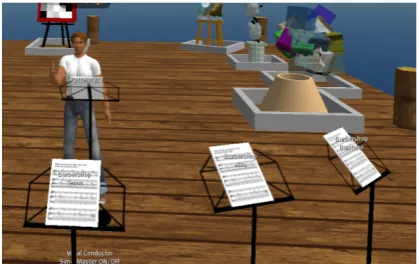
In the 'help island' of the online world second life a conductor is shown with a group of virtual barbershop singers. A screenshot is shown in Figure 2.1. The conductor can perform two dierent conducting patterns more or less in time with one piece of music. The parts can be 'sung' by other players by clicking on the music stands. The parts will be played back synchronized. The conducting movements are for decorative purposes only, the only aspect of the performance that can be changed by the conductor is moving to the next section in the music by clicking on the score. Although images of real sheet music are presented, the players do not have any control over the performance. Whether this small demo has been extended by second life players is not known due to the large size of this online world.
2.1 Conductor Following Systems
(a) second life conductor
(b) Sony qrio conducting
(c) kernel based HMM conductor
is reversed, a beat is registered. Bigger movements or directing towards sections makes the whole orchestra or just one section play louder. This is done to allow the system to be used by non-musicians. This is later extended in [28] with the possibility to detect real conducting gestures should an experienced conductor use their system. Other systems recognize more complex conducting gestures. In [23] and [29] neural networks are used to recognize gestures. In [31] a system has been made that allows manipulation of music using several gestures and movements, allowing precise control over the music being played. An analysis of conducting gestures is given. These gestures however are not limited to standard conducting gestures, several other gestures have been added to manipulate the music. In [21] a modular conductor following system is described that is independent of the input method. If new input methods should be available, new modules can be written to adapt the system to the newer input method.
2.2 Virtual Agents
Many examples can be found of embodied agents reacting to music. The virtual dancer, described in [38] is a system that lets a rap dancer move in time on music, interacting with a human dancer. The dancer reacts to audio inputwith the beat-tracker explained later in this report and uses computer vision to react on a human dancer. Other dancers like this exist, like Cindy as described in [18] or [44], which also makes use of the structure of music to plan and select its dance moves.
In [7] a system is presented that performs a traditional Chinese Lion dance in real time. The dancers can move on a rhythm, using beat detection to allow the input of drum rhythms by the user. The dancers can perform several dierent dances and the movements are specied using a high level language.
[30] describes Greta, an embodied conversational agent capable of showing emotions by means of facial expression. Greta's face has been linked to a system that detects emotion in music. Greta then adapts her facial expression to the music being played. Such a system could be directly used for the conductor, to show the emotion of the music being played.
2.2.1 Synthesizing Gestures
Synthesizing gestures for other purposes than conducting has been done many times before. In the eld of embodied conversational agents gesture synthesis systems have been developed, usually to support the conversational features of agents. Work done on synthesizing conducting gestures has been found before, as stated earlier in Chapter 2. Many other gesture synthesis systems exist however. Often these are used for lifelike embodied conversational agents to support speech. Often such a system has a high level language to describe gestures, like MURML in [46] or STEP in [40]. Such a language might be useful for the virtual conductor. Gestures and speech have to be coordinated, so often a planner is used for this purpose. A planner will also be needed for the conductor to determine when a beat will occur and when to gesture.
2.3 Listening to Musicians
Feature extraction
Figure 2.2: Division in parts of beat detectors
2.3.1 Beat Tracking Algorithms
Many beat tracking algorithms exist. Very few evaluations of the algorithms however exist. An overview of the eld is presented in [19]. This paper presents a qualitative comparison of what they call automatic rhythm description systems. These systems can be anything from a beat tracker, which tracks separate beats, a tempo induction algorithm, which computes the tempo of music, to a rhythm transcription system, which transcribed rhythms from an audio le. Many algorithms are compared, using one framework to compare the algorithms. The comparison is divided into several functional units. For beat detectors these units are feature extraction, pulse induction and pulse tracking. The second unit is also often called beat period tracking, while the third is often called beat phase tracking. The units are drawn schematically in gure 2.2 The rst step done by all the algorithms is creation of feature lists from audio. The input is processed and converted into a list of features. After this, pulses are detected from these features - the pulse induction step. The pulse induction step assumes a xed pulse period It detects this period in which pulses occur, sometimes in dierent metrical levels of periodicity - a measure, a beat and shortest occurring smallest note value. These levels are called respectively measure, tatum and tactus. The last step, pulse tracking, does not determine the period of pulses, but tracks the pulses themselves. It can be driven by the period of the pulse from the pulse induction algorithm or can be separate altogether. This division of parts is used by other authors as well [1, 18]. It will be used here as comparison for beat tracking algorithms. Beat tracking algorithms perform their work without prior knowledge of the piece being performed. However, they can be adapted to work so: for esxample, the relation between dierent metrical levels in the case of the conductor is already known, which means it can be used by a beat-tracker instead of trying to determine it from the music.
2.3.1.1 Feature Extraction
According to [19], the following features have been used for beat detection.
Onset Time The beginning of musical notes are used widely as features to nd beats, as in [1, 11, 18]. Many algorithms have been dened to detect onsets in music.
Duration Some systems use note duration, or the time between two onsets as a feature. [11] uses this feature.
Pitch Pitch is hardly ever used, according to [19].
Chords Two ways of using chords as a measure for beat detection are named: to count the number of simultaneous notes to identify accents and by detecting harmonic changes as evidence for a beat, as is done in [18].
Percussion Instruments If percussive instruments are present in the signal, those can be used to detect beats, as done in [18].
Frame Features Other than the other features mentioned before, some beat tracking systems, like [24, 41] use features from frames, rather than discrete note onsets, note duration or chord changes. A frame is a short period of audio from which features are processed. Usually consecutive frames overlap each other. As a feature for example the energy from a frame can be used, or the change in energy. Often the audio is split in multiple frequency bands before analysis. This is closely related to the onset detection: for example in [24] for every frame a number indicating accentuation is detected. [24] uses these features directly to calculate periodicity, while [1] uses these features for onset detection.
2.3.1.2 Pulse Induction or Beat Period Detection
For pulse induction, used methods include autocorrelation [1, 13], comb lter banks [24], inter onset interval clustering [11] and spectral product[1]. [24] notes that the performance of the dierent algorithms is very similar, while [1, 20] list dierences, although the dierences are not consistent with each other.
In the best perfoming algorithms, autocorrelation or a bank of comb lters is used [20]. Autocorrelation calculates the cross-correlation between expected pulses and detected pulses. It is computationally ecient, but does not preserve the phase of the tracked pulse, only the beat.
A bank of comb lters, as used by [24] and [41] on the other hand, uses many lters that each respond to periodic signals with one xed delay. For every to be detected tempo, one lter is used. Because one lter is required for each to be detected period, this method is computationally expensive. However, the phase of the detected period can be derived easily from the lter state. In fact, it can be used in combination with autocorrelation for beat phase detection, as done in [43].
2.3.1.3 Pulse Tracking of Beat Phase Detection
Pulse tracking can be done with cross-correlation between the expected pulses and the detected pulses [1], by probabilistic modeling [24] or is derived directly from the pulse induction step [41]. Very little is known about the performance dierences of the dierent algorithms.
2.3.2 Performance of the Algorithms
showing 85.01 percent accuracy in accuracy 2 and 67.29% accuracy 1. This algorithm also has the best robustness when noise was added to the audio les.
In this comparison, the framework given in [19] is used to try and compare dierent parts of the algorithm, but this proved to be impossible with their set of algorithms. To do this they suggest a more modular system in which multiple algorithms can be compared. A way to use multiple algorithms to track the beat is presented, showing an increase in accuracy when about equally well performing algorithms are combined.
2.3.2.1 Description of Separate Algorithms
This winning algorithm by Klapuri[24] works by using a bandpass lter with 36 bands on the audio signal. The audio is rst split into small overlapping frames, then the bandpass lter is applied to the frames. Accentuation is detected in these bands by means of a weighted dierentiation. The feature list generation of this algorithm is very similar to some other algorithms. When set with dierent parameters than Klapuri did, this is very similar to the algorithms presented in [41] and [1]. Then a bank of comb-lter resonators is used to detect periodicity in these accent bands. The periodicity in these accent bands is then combined. A discrete Fourier transform is applied to detect the period of the pulses. After this, a hidden Markov model is used to detect the tactus, tatum (beat) and the measure period from the signal. After the period is detected, the phase of these is detected, again with a hidden Markov model. This is the pulse tracking part of the system.
Dixon also submitted three algorithms in the quantitative comparison of algorithms. The rst two are described in [11]. He states that these two of his algorithms are not real time, but can be adapted to run real time. However, from e-mail conversations from Dixon it appeared that it is not feasible to adapt his implementation and that it may be better to use a dierent algorithm for real time tasks. These two algorithms use an energy based onset-detector, followed by an inter-onset interval clustering algorithm. A dierent algorithm by the same author [13] is also compared, using a band lter to split the signal in 8 frequency bands, then smooths and downsamples the signal and performs autocorrelation of the bands. From each band the peaks of the autocorrelation function are combined and the best is selected as a period. This algorithm can work in real time and while being much more simple, according to [20] performs better than the other two algorithms.
The system of Alonso [1] is also presented, performing fairly well. This beat detector uses an onset detection, similar to the frame based features of Klapuri, but in the frequency domain instead of time domain and with a FIR-lter to smooth the signal. The period is estimated using autocorrelation and spectral energy ux. The beat location is found using cross-correlation between the expected beat location and the found pulses. While [20] lists this algorithm with the spectral energy ux to be having a better performance in the experiment than the same algorithm with autocorrelation, the author of the algorithm in [1] mentions a better performance in his evaluation with autocorrelation.
The system of Scheirer in [41] is the predecessor of the system by Klapuri. It also works with a bandpass lter, smoothing this and calculating pulses from this. Pulse induction and pulse tracking is done by a comb lter which preserves the phase of the signal. The performance of the system seems to be less than that of the others, although this is an earlier approach, being the rst to use regularly sampled frame features to detect beats instead of using onset times. Also he introduced comb lter banks to perform pulse induction.
by using provisional beat times. The system then tries to nd dierent metrical levels, a measure, half-note and quarter-note level. The algorithm works real time and is used to make a virtual dancer move.
A new interesting algorithm is the algorithm by Seppanen[43]. They adapted the algorithm of Klapuri to work in mobile devices, by lowering the computational cost signicantly. To do this, the lters used are simplied greatly, the comb lters are replaced by autocorrelation with two comb lters for beat phase tracking and the music model used is greatly simplied, with minimal performance loss.
2.3.3 Score Following
Algorithms that follow a performance with knowledge of the score are called score following algorithms, or on-line tracking algorithms. Some of those algorithms require real time MIDI data instead of audio, like [34, 42]. These require an automated transcription system or MIDI instruments to work.
In [10] a score following system is described working on audio recordings. The recording is split into short segments of 0.25 seconds and for every part a chroma-vector is calculated. This vector contains the spectral energy in every pitch-class (C, C#, D, ... , B). Chroma vectors from a score le are made as well: by creating an audio le from a MIDI le and processing that or by putting the notes from the midi le into the chroma vectors directly.
The chroma vectors of both les are normalized and compared by means of euclidean dis-tance. The results are stored in a similarity matrix. Now a path is sought through the matrix, to realize a mapping from the recording to the score. This technique is called dynamic time warping. Because of this matrix, the algorithm does not work real time. However, the algo-rithm can be adapted and the technique of chroma vectors might be useful for following the score.
In [12] the dynamic time warping algorithm used in [10] is adapted for real time used, now called online time warping. The algorithm works by predicting the current location in the matrix and calculating the shortest path back. Only the part of the matrix close to the prediction is calculated to give the algorithm linear eciency. The given audio feature is not very eective, but the algorithm is, meaning that this can be eective when combined with a better audio feature, for example chroma vectors.
In [37] also a score following algorithm is described which works on polyphonic audio record-ings. The algorithm works on chord changes and searches through a tree with the dierent options to determine the tempo of the music being played. It was tested on orchestral classical music and worked accurately for at least a few minutes in most pieces before losing track of the music. The algorithm produces errors when no chord changes occur, on long tones. It is suggested that it should be possible to improve this.
There seems to be no score following algorithm that works completely without any problems, just like there is no beat detector without any problems. The algorithms do however come close and are certainly usable.
2.3.4 Expression Detection
Emotion Motion cues Music performance Cues Anger Large
Fast Uneven jerky
Loud Fast Staccato Sharp Timbre Sadness Small
Slow Even soft
Soft Slow Legato
Happiness Large
rather fast LoudFast Staccato
Small tempo variability
Table 2.1: Musicians' use of acoustic cues and motion cues when communicating emotion in music performance, from [14].
2.4 Analys of human conductor
Only a few studies have been performed in which the behaviour of human conductors is analyzed. In [35], the meaning of dierent gaze, head and face movements of a conductor are analyzed, obtained by analyzing video recordings. The goal is to create a lexicon of the conductors face. Part of such a lexicon was made and is included in table 2.2.
In [15], the eect of various left hand shapes on choral singers has been researched. Tapes with a conductor with dierent hand-shapes were presented to singers and they were asked to rate their vocal tension. It was found the hand-shapes used by the conductor could change the vocal tension signicantly.
In [45], dierent ways of indicating dynamic markings to musicians have been analyzed, by letting them sing with a video recording of a conductor, with a choir presented through headphones. The volume of the singers was measured. It was found that verbal instructions gave signicantly stronger eects than written instructions, gestural instructions and volume changes in the choir.
TYPE OF MEANING SIGNAL LITERAL
play Look at the choir You choir
When to play
Look down I am not alerted Do not start yet What sound
Loudness Frown I am determined(mental state) Play aloud Raised eyebrows I am startled
(emotion) It is too loud, playmore softly Left-right head
movements No! (not that loud) Play more softly Expression Inner eyebrows
raised I am sad Play a sad sound How to
Head nod Ok go on like this Closed eyes I'm relaxed
3 Research Question, Assignment
The assignment the virtual conductor consists of researching the possibilities of a virtual em-bodied agent capable of conducting a group of musicians in a live performance and designing and implementing this agent. The description of the assignment is split in three parts: move-ments of the conductor, knowledge of the music and feedback and reaction from the musicians. For a conductor capable of conducting musicians, a basic version of all three parts is neces-sary. The main focus, however, is chosen to be on the feedback from and reaction to the musicians. These parts are not entirely independent: for example, to be able to lead a musical performance and give feedback to the performers, the conductor has to posses knowledge of the piece to be played.
3.1 Knowledge of the Music Being Performed
A conductor conducts based on knowledge of the piece that will be played. A conductor knows how this piece is supposed to sound, what which people will play at which moment, what the tempo should be and where it should change and where time changes occur. A real conductor will gesture all of this to the musicians. Normally a conductor analyzes and uses sheet music to gather this knowledge. This sheet music will not strictly dene how the piece will be performed, interpretation by the conductor and musicians is done, for example on playing style, dynamics and tempo.
The virtual conductor has to store knowledge about a piece and analyze this to be able to translate this to conducting movements. Therefore, a component has to be designed and implemented to read digital sheet music les, perhaps in combination with recorded interpre-tations so he can acquire the knowledge about the to be played piece.
The basic information from which the virtual conductor can conduct is the number of bars, the time and tempo, from which the conductor can make basic conducting movements. The sheet music can further be analyzed for markings indicating aspects of the music such as dynamics, articulations and style. Finally, the notes being played can be analyzed, to nd phrasing, as well as the expression of the music. Chord changes, key and rhythm can contribute to this. To analyze this, some way of nding or storing expression in music has to be found.
The sheet music has to be stored in a known le format, preferably one that can be opened and edited by the major music notation programs.
3.2 Movements of the Conductor
From the knowledge of music, the conductor needs to synthesize movements and gestures to show the musicians how the music being played should be played. This means a component is necessary to synthesize conducting gestures from knowledge of music.
A possible extension is the adding of gestures for the left hand of the virtual conductor. With the right hand, a conductor will indicate the beat. The left hand can be used to signal when a musician, or group of musicians will have to start playing . It can also be used to indicate that a group of musicians has to play louder or softer, or dierent, or is just completely on the wrong track and should just stop.
A normal conductor will use more than arm gestures to conduct music. By looking at one or more musicians he can signal to separate performers. For a virtual conductor capable of signaling to separate performers, the conductor has to know where the musicians are. This could for example be accomplished with a camera, or by telling the conductor in another way where the musicians are located. Facial expressions could also be used - for example to indicate expression in music, but also to indicate someone is making mistakes. In such cases, the conductor can look angry, or smile at someone if they are playing well.
3.3 Interaction between Musicians and Conductor
Making gestures with knowledge of a piece of music however is not enough to make a realistic virtual conductor. The conductor should be able to react to the input, either music recorded beforehand or real-time musicians. The conductor has to be able to react to what the musicians do, to follow their interpretation of the music, but also to correct them if they make mistakes or to stop them when the performance goes wrong altogether. After such a stop, the conductor should be able to pick up the music at a previous point in the music and try again - perhaps conducting more clearly this time as to make sure the musicians do play correctly.
Ideally the conductor should be able to detect when the musicians start playing, in the most ideal case for all musicians separately. When there is a longer rest after which musicians start playing again, the conductor could indicate that they should start again. If the conductor can follow the score and detect which notes are being played as well, it might be able to detect mistakes in the performance and give feedback on this. This however is far from a simple task. The basic part of this can be a beat-detection and prediction algorithm. To provide feedback to the musicians, dierent gestures or facial expressions can be used. Extensions would be to implement a score following algorithm to better follow the score and perhaps nd out mistakes in the input. By detecting expression in what the musicians play and doing so in the analyzed music, the conductor could try and provide gestures and facial expressions to indicate the expression that should be played.
There will be a delay required for the processing of the music. This delay means some sort of scheduler will be necessary to plan the timing of the gestures in advance. The scheduler should not plan so far ahead that the conductor cannot react in time, but should also plan far enough ahead to compensate for the delay.
3.4 Type of Music, Number of Musicians and Input
In the ideal case, a virtual conductor would be able to conduct anything from two people to a whole orchestra, with just a single (stereo) microphone as the input source. Probably this is a too dicult setting for the virtual conductor. For the conductor to follow a whole orchestra he would need a quite complex beat following algorithm and it would be dicult to track what separate players do. Therefore, it might be easier to design the system to allow it to conduct a small group of musicians.
3.5 Focus of this Assignment
4 Human Conductors: How do they
conduct?
4.1 Literature
In literature, quite extensive descriptions of the tasks of a conductor can be found. A short description will be given here, based on several descriptions. A short description of conducting can be found in [6], a historical overview of conducting handbooks can be found in [16]
4.1.1 Dierent Conducting Gestures
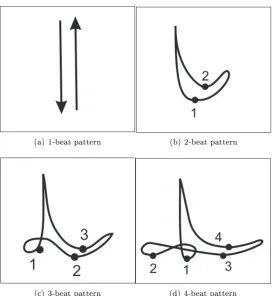
There are a few basic beat patterns on which conductors base their conducting. The most used are the 1-, 2-, 3- and 4-beat pattern. These beat patterns are illustrated in gure 4.1. Many variants of beat patterns can be found in literature. Several variations are known in several cultures and styles. A very torough description of these styles, current and throughout history, can be found in [16] These beat patterns can roughly be divided into several sections: the preparation and the actual beat. This preparation occurs before the actual beat and also during the upbeat. The preparation is thought of to be more important than the beat itself, because it tells the musicians when the next beat will be and in what tempo[36]. As such can be used to change the tempo.
4.1.2 1-Beat Pattern
The one beat pattern is used in music for fast 2 4-,
3 8- and
3
4-measures. A good example of
when this pattern can be used is in a waltz. The pattern is the most simple of the patterns and therefore also quite dicult to do well for a human - there is very little possibility of expression in a 1-beat gesture. The one beat pattern is a simple up-down movement. The movement must be like a stick bouncing on a timpani, or a bouncing ball. This means the vertical movement of the pattern can be approximated with a parabolic function.
4.1.3 2-Beat Pattern
The 2-beat pattern is mainly used for 2 4- and
2
2-measures and fast 4
4-measures. The movement
consists of two downward strokes, the rst from left to right and the second from right to left, if performed with the right hand. The lowest point of the second stroke is generally higher than the rst.
4.1.4 3-Beat Pattern
The 3-beat pattern is used for slower measures in 3, for example a 3
4-measure. It consists of
three downward strokes. All beats must be fairly elastic.
4.1.5 4-Beat Pattern
The 4-beat pattern is used for measures in 4, for example a 4
4-measure. The 4-beat pattern
(a) 1-beat pattern
1
2
(b) 2-beat pattern
1
2
3
(c) 3-beat pattern
1
2
4
3
(d) 4-beat pattern
1
2
4
3
2
1
4
3
Figure 4.2: Example of legato and staccato 4-beat pattern
4.1.6 5-, 6-, 7- and Other Beat Patterns
The other beat patterns of a human conductor will not be mentioned in detail here. 5-, 6-and 7-Beat patterns are used for music with a meter with 5, 6 or 7 beats. Other beat patterns also exist, like a three beat pattern where the rst and second beat take 2 eight notes and the third beat takes 3 eight notes. Many variations on this are possible.
4.1.7 Staccato/Legato Beat Patterns
According to [39], two main variants of these beat patterns exist: a legato and a staccato pattern. A human conductor can vary anywhere in between these two patterns to indicate any articulation in between staccato and legato. The dierence betwen these two patterns is shown in gure 4.2.
4.1.8 Left and Right Hand
A human conductor often uses his right hand to conduct a beat pattern and his left hand to communicate other messages to musicians. A conductor uses his left hand to make gestures indicating dynamics, indicating cues, to indicate expression and many more messages.
4.1.9 Gaze and Gesture Direction
A conductor can indicate cues in music to a complete group of musicians, to a subgroup or to just one musician. He does this mainly with gaze and gesture direction. If a conductor wants to indicate something to all of the musicians, he will usually not look at just one musician, but direct his gaze so that the entire group can see the gesture is meant for them. If however, the conductor wants a message to reach just one musician or a small group of musicians, he will conduct a gesture towards that musician or group of musicians, also looking at those musicians.
4.1.10 Dynamic Changes
4.1.11 Expression
A conductor will have a wide range of gestures and facial expressions to communicate expres-sion in music. First of all, a conductor can use facials expresexpres-sion: if he wants music to be played happy and light, it will usually help to look happy himself. If he wants music to be played in a sad way however, looking very happy will not have a good eect on the music.
Besides facial expression, he adapts his beat patterns for dierent styles. He can conduct smaller with light gentle movements to make the musicians play gentle music. He can conduct bigger and more dramatic for dramatic music and everything in between. He can conduct very clearly for rhythmically complex music, and make movements that no longer resemble the basic patterns for romantic music. This is usually eective on an orchestra, as it immediately knows in what style to play.
4.1.11.1 Facial Expression for Expression in Music or for Tutoring Purposes
When a conductor looks angry, he can mean two things: He either will mean that the music should be played in an angry way, or he will be angry at a particular musician or a group of musicians for something they do. For example, when someone plays far too loud, or plays a lot of wrong notes, a conductor might look angry at that particular person. He might look angry at a whole group to tell them this music should be played in an angry way, should contain the emotion anger. If facial expression is used, it should be clear what is meant with the facial expression.
4.1.12 Cues
A conductor can give a cue to a group of musicians or a musician to tell them they should start playing after for example a rest. He can do this by looking at the musicians and conducting towards them, making an accent in the conducting gestures. He can also put his left hand forward towards the musicians, palm up, to indicate it is their turn. This helps the musicians begin at the right time, but also helps them be convinced enough of their rst notes.
4.1.13 Dierent styles
Every conductor has its own conducting style, his own way of conducting musicians. The style variations consist of dierent gestures, dierent selection of beat patterns (For example, to conduct in 2 instead of 4), dierent left hand gestures, dierent facial expression. Also of course the interpretation of music by dierent conductors is dierent, leading to dierent performances. Conductors will also use words to inspire or correct musicians, this is of course also dierent for every conductor.
4.2 Conversations with a human conductor
During the process of creating the virtual conductor conversations have been held with a human conductor, Daphne Wassink. A summary will be presented here. During this talk, a working prototype of the conductor was shown, with less than ideal movements.
4.2.1 Movements
therefore is more important than the timing of the beat itself. A conductor can conduct with only the right hand. If the left hand has nothing to do at such a moment, it can go to a resting position, which is upper arm vertically, lower arm horizontally, resting against the body of the conductor.
If the size of the movements changes, the movements should be placed higher, closer to the face of the conductor. If the conductor wants to indicate pianissimo or even softer, the conducting movements may be indicated only with wrist or nger movements. The right hand movements should be slightly bigger than the left hand movements, but the downward movements should end at the same point for both hands.
4.2.2 Following and Leading Musicians
If musicians start to deviate from the tempo or start to play less in time, a conductor should conduct more clearly and bigger. The conductor should draw the attention of musicians, by leaning forward and conducting more towards the musicians as well. If musicians play well, the conductor can choose to conduct only with one hand, so he can conduct with two hands only when more attention from the musicians is required. Snapping ngers or tapping a baton on a stand can work to draw attention, but should be used sparingly or the musicians will grow too accustomed to this.
To correct the tempo of musicians, a conductor should rst follow the musicians, then lead them back to the correct tempo. Care should be taken that enough time is taken to follow the musicians, or they will not respond to the tempo correction in time and the conductor will no longer have his/her beats during the beats of the musicians.
Just changing the conducted tempo will not work to correct musicians. The musicians should be prepared beforehand that the tempo will change. A conductor should change the preparation of a beat to the new tempo, then change the conducted tempo after that beat. This should preferably be done on the rst beat of a measure. Care should be taken to keep each separate measure as constant as possible. Other than the rst beat in the measure, the tempo between two accents should be kept constant, for example between the rst and third beat of a four-beat measure.
5 Virtual Conductor: Analysis & Design
5.1 Features of the Conductor
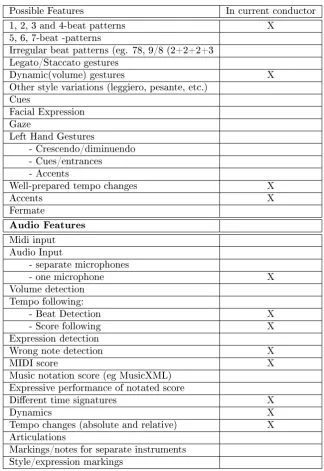
If a list would be made of everything a virtual conductor would ideally do, this list would be nearly endless. For this project, rst a list of basic features a conductor could have are listed. The features were selected so that they are feasible with the current state of the art. The features have been limited to the basic features of a conductor. The features for a complete conductor for this project are listed in table 5.1. Features that are listed are features that should be possible with the current state of the art. Then a subset was selected to be implemented.
5.1.1 Conducting Gestures
For the virtual conductor the most used conducting patterns were selected, the 1-, 2-, 3- and 4-beat patterns. The patterns should be well-formed, without undesired accentuation. It should be clear to musicians looking at the gestures which gesture it is and the dierent beats in the patterns should be identiable. The gestures should be adaptable in amplitude, tempo and timing. The adaptability in amplitude makes it possible to indicate dierent dynamic levels by conducting bigger or smaller. Beats can also be accentuated in this way, by conducting a beat and its preparation bigger than the others beats. The adaptability in timing allows for well-prepared tempo changes, by conducting the preparation of a beat in a dierent tempo, as well as tempo changes halfway a measure for means of feedback to musicians.
5.1.1.1 Starting and Stopping the Musicians
Starting and stopping conducting by a human conductor requires separate gestures. For the virtual conductor it was chosen to not use dierent gestures, but to conduct a full measure ahead in the start. If the music starts with an upbeat, a full measure will be conducted ahead, followed by the measure in which the upbeat occurs.
The end of a piece is marked by just stopping conducting. This limits the conductor in that music can not be easily stopped halfway. If the musicians however are told that at the end of a piece the conductor will just stop conducting at the last beat of the last bare, they can stop together with the conductor.
5.1.2 Audio Input and Analysis
5.1.3 Score-Input and Analysis
For the score input of the conductor, two basic formats could be chosen from: score data that already contains interpreted performance and expression information and score data that only contains the notes and indications. An example of the rst format is MIDI, which contains individual numerical values of volume for every note, as well as the exact tempo at every moment and the exact begin and end time of all notes.
A score format on the other hand, contains the same information as sheet music. Musicians interpret this sheet music with regards to tempo, volume, accents and timing and create music. An example of such a format is musicXML. The benet of such a format is freedom of notation and interpretation. However, for such a format, the virtual conductor would need to do this interpretation in order to be able to conduct it. This adds considerable complexity to the conductor.
For MIDI, tools are available to interpret sheet music les and generate expressive per-formances from them. Also a large selection of music is available in this format, many even already well-interpreted. The les can be easily modied in tempo or volume and MIDI sounds can be played back on every standard computer. It can be extended with extra messages and events, should the normal format not suce.
Therefore, MIDI score information was chosen as the le format for the virtual conductor. If necessary, this can be extended later to a dierent format. It is also possible to later create a tool which interprets and converts sheet music les to MIDI les for the virtual conductor, to allow for dierent expressive performances.
From this score le, tempo changes, dynamics, measure types and accents should be detected for use in the virtual conductor.
5.1.4 Feedback of the Conductor
The conductor will give feedback to the musicians in order to inuence them and to make them perform closer to the conductor's representation of the music. Originally a list of possible reactions was created to some basic detectable signals from the musicians. In table 5.2 the possible reactions of the conductor are listed to the performance errors. Just like the features, because of the complexity of the task and the dierent styles used by dierent conductors, a complete list of reactions would be very dicult. In the current version of the conductor, only reactions to playing too fast and too slow are implemented. This list is only meant as a guideline for possible basic functions and as a tool for selecting the functions.
5.1.5 Architecture of the Conductor
The conductor consists of ve main components: Audio Processing, Score Data, a Musician Evaluator, Conducting Planner and a Conducting Animator. This is schematically drawn in gure 5.1. The tasks of each part will be outlined here shortly.
The Audio Processing part will record and process the audio from the microphone input and will extract features from this. It keeps track of the performance of the musicians, with several possible audio analysis algorithms. This includes a beat detector, a score follower and a wrong note detector.
The Musician Evaluator compares the information from the Audio Processing to the infor-mation from the score. The tempo of the score is compared with the tempo of the performance. If the dierences are too big, these are reported to the conducting planner. The Musician Eval-uator can be extended to compare information from other audio analysis algorithms
Possible Features In current conductor 1, 2, 3 and 4-beat patterns X
5, 6, 7-beat -patterns
Irregular beat patterns (eg. 78, 9/8 (2+2+2+3 Legato/Staccato gestures
Dynamic(volume) gestures X
Other style variations (leggiero, pesante, etc.) Cues
Facial Expression Gaze
Left Hand Gestures
- Crescendo/diminuendo - Cues/entrances - Accents
Well-prepared tempo changes X
Accents X
Fermate
Audio Features Midi input Audio Input
- separate microphones
- one microphone X
Volume detection Tempo following:
- Beat Detection X
- Score following X
Expression detection
Wrong note detection X
MIDI score X
Music notation score (eg MusicXML) Expressive performance of notated score
Dierent time signatures X
Dynamics X
Tempo changes (absolute and relative) X Articulations
Markings/notes for separate instruments Style/expression markings
Problem Reaction In Conductor too slow rst conduct slower, then lead musicians X
too fast rst conduct faster, then lead musicians X too loud smaller moves or left hand gesture
too soft bigger gestures, or left hand gesture expression is not right show more expression
completely wrong notes stop conducting
out of tune/wrong notes or rhythms angry look/stop, mention that wrong notes have been played and play again
musicians don't start playing stop and try again, emphasize entrance musicians play when they should not if bad enough, stop and try again
Table 5.2: Possible feedback of the conductor to the musicians
Audio Processing Conducting
Planner
Audio Musician
Evaluation
Animation
Dynamic Markings Tempo Markings Score Information
Figure 5.1: Architecture of the virtual conductor
6 Audio Analysis
The virtual conductor needs to be able to listen to musicians to respond in a meaningful way to what the musicians play. Several audio analysis systems were implemented for this purpose: a beat detector, a score follower and a chord detector. In this chapter they will be discussed shortly. The beat detector is an implementation of the feature extraction algorithm from Klapuri's beat detector algorithm[24] and the music model from Seppänens algorithm.[43]. The score follower is an implementation of Simon Dixon's Online Time Warping algorithm from [12], but with audio features as mentioned by Dannenberg in [10]. The chord detector was developed by me, inspired by the constant Q transform [5] and the chroma vectors from Dannenberg [10].This is only a brief explanation of these algorithms, enough to understand the general idea of the audio analysis algorithms, without needing much knowledge about audio and signal processing to understand the general idea of the algorithms. A complete description of these algorithms can be found in Appendix B.
6.1 Beat Detector
From the comparison in chapter 2.3.1 a beat detector was rst selected and implemented to allow the virtual conductor to track tempo of musicians. The beat detector of Klapuri [24] was selected because it performed by far the best in the quantitative beat detector comparison in [20] and because it works in real time. This beat detector has several stages: an accentuation detector, a periodicity detector, a periodicity selector and a phase detector.
6.1.1 Accentuation Detector
The accentuation detector works by detecting accents in several frequency bands. An overview of the accentuation and periodicity detection is shown in gure 6.2. The audio signal is rst split into 36 frequency bands. In each of these bands accentuation is detected. This means that even for music with only subtle chord changes accentuation can be detected because accents will occur in dierent frequency bands when a chord change occurs. To detect these accents, the signal in each band is rst compressed and then smoothed using a lowpass lter. A dierentiation is performed, ignoring all negative values, to detect intensity changes in the signal.
These 36 bands are now summed into 4 accent bands. In these bands accents can be detected as high values. A plot is shown in gure 6.1(a) In these accents bands periodicity is detected. A bank of comb lters is used to detect periodicity. These lters each have a xed period. If now a signal is input which contains a frequency with that period, the lter will give a higher output than a signal without that specic periodicity. Now for every tempo that is to be detected, a comb lter is used. This produces output with peaks at every meaningful musical period, as can be seen in gure 6.1(b). The meaningful musical periods are usually inter-onset intervals, which can be seen as a measure of the duration of a note, or multiples of these values. This means that The beat, but also the measure, the shortest note and every note duration in between can be identied from this gure.
(a) 4 Accent bands during 'Hold the line' by Toto, higher band is higher fre-quency
(b) periodicity signal during 'Hold the line' by Toto, from 0 to 4 seconds, with peak pattern, tatum and beat shown
Figure 6.1: accent bands and periodicity signal
Now try to nd a pattern with regular intervals and pick the highest peak. However, a better solution is possible, taking primitive musical knowledge into account.
6.1.2 Music Model
To track tempo changes, a music model can be used. This is a probabilistic model that detects the most likely tempo for several metrical levels: the beat, the shortest identiable interval and the measure. Klapuri presents such a model in [24] in combination with his beat detector. This model however is rather complex and computationally intensive. Seppänen [43] provides a much simpler music model than that of Klapuri, mentioning the results are comparable to that of Klapuri. This music model was implemented.
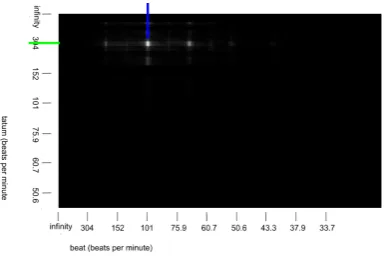
This model has primitive musical knowledge. First of all, it accounts for the knowledge that tempo usually is stable for a short period of time. It is unlikely that the tempo just changes every few beats. Therefore a tempo progression function is used, a Gaussian distribution. The distribution is centered around the last detected tempo. It is illustrated in gure 6.3.
Next, a model is used which takes the relation between the shortest identiable interval (the shortest note duration that can be heard) and the beat into account. For example, often the fastest note in music is a sixteenth note and the beat a quarter note. This means that the relation between the shortest identiable interval and the beat is 4.
Audio signal
FFT
Bandfilter
Logarithm
Lowpass filter
Weighted half wave rectified differentiation
sum
Comb filters
sum sum
Comb filters
sum
Comb filters
sum
Comb filters Logarithm
Lowpass filter
Weighted half wave rectified differentiation
…
36 frequency bands
4 accent bands
Periodicity signal
Figure 6.2: Beat Detector overview
Figure 6.3: Gaussian tempo progression function for tatum (above) and beat (below)
(a) prior knowledge matrix with tatum (green) and beat (blue) shown
6.1.3 Phase Detection
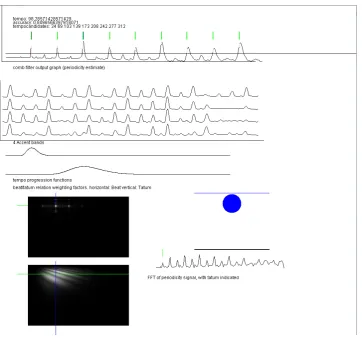
Now that the period of the beat is known, the phase can be detected. This is done by simulating the comb lters: The comb lter will have a higher signal at the moment of a beat and a lower signal when no beat occurs. The comb lter corresponding to the selected tempo can now be simulated up to one beat period in the future, by simply presenting it with a zero input and calculating its output. Now the highest value can be used as a prediction of a beat location. Because using this directly results in a rather unstable signal, the average of the last few beat positions can be used instead, producing a more stable beat phase.
The beat detector can plot its state while it is running. A screenshot can be seen in gure 6.5.
Figure 6.5: Beat Detector screenshot
6.1.4 Evaluation
Accuracy1 Accuracy2
three times, one half and one third of the tempo are also considered to be correct the tempo is detected correctly in 72.8% of the cases. As can be seen in table B.3, the algorithm indeed performs worse than the algorithm of Klapuri, which manages to detect almost all of the songs correctly with regards to accuracy2, but better than that of Scheirer. This means the music model from Seppänen performs less well than that of Klapuri, with the same audio features used as input.
6.2 Score Follower
The beat detector worked relatively well and easily recovers from errors. However, it can also easily be fooled and does not work well with legato music. Therefore a score follower was developed. The dynamic time warping technique was chosen as score following algorithm, because it is relatively easily implemented and promised good results. The dynamic time warping algorithm was rst used in [8] in 1978 for speech recognition. It is an algorithm to align two series of features in time. First, a cost function is dened. Then, a matrix is calculated which contains the value of the cost function for every possible combination of two features from both series in time. Now a path cost matrix is calculated, which for every cell contains the cost of the lowest cost path from the start of both features to the current location. This path can consist of diagonal, horizontal and vertical entries and its total cost is the sum of all the cells it has gone through. It is dened recursively in equation 6.1.
D(0,0) = 0
D(t, j) = min(2cost(u(t),x(j)) +D(t−1, j−1), cost(u(t),x(j)) +D(t, j−1),
cost(u(t),x(j)) +D(t−1, j)) (6.1) where u(t) andx(t)are the series in time corresponding to respectively the audio and the score,cost(a, b)is the cost function andDis the path cost matrix. Now a path is calculated through the matrix, from the end of both series in time back to the beginning, by calculating the lowest cost path through this matrix. This path is the alignment of both series in time.
This algorithm however, is unsuitable for real time use, because it has a quadratic time and space eciency and because both series have to be known beforehand to be able to use it. Simon Dixon adapted this algorithm for real time use, by predicting a current location in the score while the score follower is running. The path can then be calculated back to the start of the matrix from that location, and not the entire matrix has to be calculated, but just a small window in the matrix around the current and past predictions. This is accomplished by alternatingly calculating rows and columns of the path cost matrix. Now the algorithm has linear space and time eciency and can run realtime.
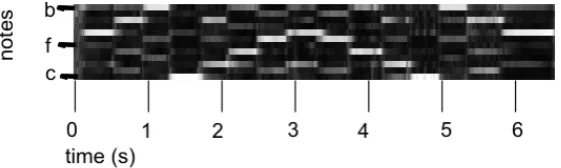
Figure 6.6: Chroma vector of a major scale played by a cello, white indicates higher value
Figure 6.7: Chroma vector of now is the month of maying
octaves closest to the nearest musical note is summed into one vector element. For example, all energy closest to 110Hz,220Hz, 440Hz and so on is summed into the vector element
corresponding to the note A. After this, the vector is normalized to make it insensitive to any dynamic changes. The result is a timbre-independent measure of similarity in music. Every 20 milliseconds such a vector is created. A visualization of chroma vectors is shown in gure 6.6 for a simple major scale played by a cello. The played notes can clearly be seen as the notes with the highest value.
For more complex music, the main notes can still be identied easily, as can be seen in gure 6.7.
For a score, a chroma vector can also easily be created. To create a score from a MIDI le, start with a vector with only zeros. Now for every note which is currently played, add it's volume to the corresponding vector element. Normalize the vector. the three rst overtones can be added for perhaps slightly better performance, but this is not necessary. This will ignore all onsets and decays of notes, which makes the representation of a MIDI le not only greatly simplied, but also timbre-independent. In gure 6.9, the chroma vectors of an audio le and the corresponding score are shown above each other. The similarities can easily be seen and it is very possible to match a recording and a MIDI le by just looking at the visualization of the chroma vectors. It is no surprise this feature works well with the online time warping algorithm. As a cost function, euclidean distance can be used. Unfortunately, evaluating the score following algorithm is no easy task because it requires annotating large parts of music. The score follower works very well on most classical music that was input, with small errors occurring mainly when the performers themselves making mistakes. A more detailed evaluation can be found in Appendix B.5.5.
6.2.1 Constant Q transform
Figure 6.8: Score follower state for `now is the month of maying', including path cost matrix, schematic representation of notes and chroma vectors
(a) Plot of Constant Q transform of Now is the
month of maying (b) plot of Constant Q Transform of a majorscale
Figure 6.10: Plots of constant Q transforms of Now is the month of maying and a scale played on a cello, white indicates higher value
separate Discrete Fourier Transforms for every element, with a varying window size. The window size is set such for every element that it contains exactly the same number of periods for that specic frequency, for all vector elements. This makes the quality of the transform constant and provides better detail in the chroma vector, and less noise. The detail can be improved further by calculating the constant Q transform with a quarter note instead of half note resolution, at the extra computational cost. The constant Q transform can be seen visualized for a short piece of Now is the month of maying and the same major scale played by a cello in gure 6.10.
6.3 A Simple Chord Detection Algorithm
From studying the chroma vectors it seemed possible to detect which notes were being played from these chroma vectors. After some initial experiments, this was conrmed and a simple algorithm was designed to do this. In this section, the algorithm will be explained and an evaluation of the algorithm will be presented.
6.3.1 The used algorithm
The used algorithm for detection is rather simple. It consists of a few steps:
1. Calculate the constant Q transform of the input audio every 23 ms 2. Low pass-lter the constant Q transform results
3. Calculate chroma vectors from the low passed CQT 4. Detect the strongest elements of the Chroma vector
Algorithm 1 Chord detection algorithm Iteration = 0;
Set that no notes have been detected ; If( harmonicContent ( chroma ) > c1) {
While harmonicContent ( chroma ) > c2 && iteration < maxIterations ) {
Find the value with index i with greatest strength (c, i) Mark this value as being a note ;
Lower the detected note value : Chroma [i] = chroma [i] * 0.25; Chroma ([( i +1) mod 12] = Chroma ([( i +1) mod 12] * 0.7;
Chroma ([( i +11) mod 12] = Chroma ([( i +11) mod 12] *0.7; Increment iteration ;
} }
frequencies in the passband are favored over others - otherwise notes at certain tempi might be more likely to be detected than other notes. Then the chroma vectors are calculated from the low-passed CQT.
To detect the strongest elements of the chroma vector, a simple algorithm is used. First a measure of the harmonic content is dened to detect the number of notes in the signal:
harmonicContent(c) =max(c)−min(c) (6.2) And also a function to determine the strength of a note i in the chroma vector c as a weighted sum of a note and its most present overtones:
strength(c, i) =c(i) +λ1c((i+ 4)12) +λ2c((i+ 7)12) (6.3)
Which is the energy of the note itself and its third and fth, which constitutes the rst, second, third, fourth, fth sixth and eight overtones of the note.
Then a number of iterations are run, as shown in Algorithm 1.
The rst check of the harmonic content detects whether there is noise or music. The second check detects whether more notes are present. If they are, the strongest of these notes is marked as a note. The chroma values of the note and its neighbors are decreased. The neighbors are decreased because they usually also contain some energy from the detected note. When the maximum number of iterations have been applied or there is not enough harmonic content left, the algorithm stops and returns the detected notes. The algorithm only has ve parameters: the minimal harmonic content c1 at the rst iteration, the minimal harmonic content c2 at
the other iterations, the maximum iterationsmaxiterationsand the value the detected note
and its upper and lower neighbouring notes are lowered with. The parameter settings are not critical and were found by trial and error.
6.3.2 Evaluation
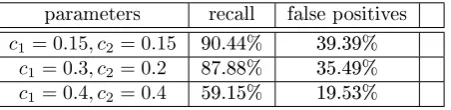
parameters recall false positives
c1= 0.15, c2= 0.15 90.44% 39.39%
c1= 0.3, c2= 0.2 87.88% 35.49%
c1= 0.4, c2= 0.4 59.15% 19.53%
Table 6.2: Chord detector evaluation results
timidity. The rst minute of the wave le obtained from timidity was then processed with the chord detector and the notes from the MIDI le were compared with the results from the chord detector every 23 ms. This was repeated at several parameter settings to try to discover the eect of the parameters of the algorithm on its performance. This evaluation shows that the recall can be over 90% with the correct parameter settings, but about one out of three found notes is incorrect. This means that most notes are detected, but with a high number of false positives. This can be contributed to the detection of overtones instead of notes, but also partly to the reverb that is introduced by timidity. This results in notes still being present while no longer being present in the MIDI le, which means they are detected when they should not be.
As expected, when the value of the parameters is increased, the recall gets lower, as well as the number of false positives. When the value of the parameters is decreased, the recall increases, as does the number of false positives. The results can be seen in table 6.2.
7 Implementation
The implementation of the virtual conductor based on the design mentioned before is explained in this chapter. First the gestures and the motion planner will be explained, after which the MIDI input will be discussed, followed by the tempo correction algorithm.
7.1 Conducting Gestures
The virtual conductor needs a repertoire of gestures to lead and interact with musicians. The four most basic conducting patterns were chosen to be included: a 1-, 2-, 3- and 4-beat pattern. The conducting gestures must be parametrized for tempo and amplitude, so the conductor can indicate dierent dynamics and tempo. The timing of the separate parts of the gestures must be adaptable as well, to be able to properly indicate tempo changes.
The conducting gestures were implemented using the HMI animation framework. This framework supports parametrized inverse kinematics. A function can be given for the path the hands of the hands of the virtual conductor follow. This path for the 3-beat pattern is shown in gure 7.1. This is done in combination with hermite splines. Every beat in these gestures is divided into 16th notes. For every 16th note a position of the hands is given. This is automatically interpolated to create a smooth conducting gesture. Care has to be taken that the movement occurs smoothly. The resolution of these splines is unfortunately xed: for some parts of the conducting gestures a position every 16th notes is required, where for other parts of the movement a position every eight note would be sucient. Because every 16th note has to be specied, care has to be taken that the movements still are smooth and don't suddenly go faster or slower. Failing to do so results in movements with accents on beats that should not have accents or just gestures that suddenly go faster and slower.
The movements should contain bounce-like movements near the beat point, as if the con-ductor is hitting a timpani, or like a bouncing ball. When designing conducting gestures, as a guideline can be used that for every beat point in the movement, the distance between the beat point and the next sixteenth note and the distance between the beat point and the previous sixteenth note should not dier much. If there is considerable dierence between those two distances, the motion will contain unwanted accelerations and decelerations and will not look smooth.
Motion capturing the movements from a real conductor was considered. The benet of motion capturing is that the movements will be very livelike. The problem of motion capturing is that the movements will not be parametrized and they will still have to be parametrized by hand. Because of this task it was decided to make the movements with hermite splines instead.
The 1-beat pattern was not implemented using Hermite splines but using a simple parabolic function. For this beat pattern, this resulted in a more lifelike pattern. The beat patterns are illustrated in gure 7.2.
7.2 Motion planning
Figure 7.1: Inverse kinematics with the HMI animation framework
gradually, during the course of one beat. For the current version of the conductor, this is sucient for movement planning. For more expressive conductors, the motion planning should be extended.Explanation of the conducting gestures, correction algorithms, animation, timing, dynamics, etc... interaction between virtual conductor and musicians Relation between how real conductor does this and virtual conductor does this.
7.3 Detecting features from MIDI data
MIDI data is stored in a MIDI le as a series of messages. A Measure type is dened, with a MIDI message, and a tempo, with another message, from which the conductor determines the tempo. The timing is then dened, at which then notes are turned on and o. In MIDI, only absolute tempo changes are supported. Ritenuto and accelerando are usually stored as a number of absolute tempo changes close to eachother. In the virtual conductor, relative tempo changes should not be prepared in the same way as absolute tempo changes. A series of small tempo changes after eachother is therefore detected as a relative tempo change, where a single tempo change is detected as an absolute tempo change, which is conducted with the correct preparation before the beat.
Volume information is also extracted. MIDI uses 16 channels. Each of these channels has a volume and every note in this channel has a volume as well. The volumes of the notes are multiplied with the volumes of their channels to get the resulting volume of a note. From this volume information the average volume is calculated, taking only the instruments into account that play at that moment. The conducting amplitude is set corresponding to this average volume. If the average volume suddenly changes with more than 25%, this is considered to be an accent or a sudden soft part and the amplitude setting is exaggerated at that point.
7.4 Tempo Correction Algorithms
1
(a) 1-beat pattern
1
2
(b) 2-beat pattern
1
2
3
(c) 3-beat pattern
4
3
2
1
(d) 4-beat pattern
music will most likely either go faster and faster until the musicians no longer can play this, or will come to a complete stop because the musicians keep going slower. A tempo correction algorithm is thus required, that can bring musicians back to the intended tempo without making the musicians keeping track of the conductor.
The rst approach at correcting the tempo of musicians was simple: as soon as it is detected that musicians play faster or slower than the ideal tempo, conduct at a tempo in between the tempo of the musicians and what the tempo should be. The musicians now should start playing closer to the tempo the music should have, which is detected, so the conductor starts conducting closer to the original tempo until the correct tempo is reached again. This means the conducted tempotc is dened in terms of the intended tempoti and the detected tempo
of the musicianstdwith:
tc=ti+ (1−λ)td (7.1)
Whereλdenes the amount of leading the conductor does. Ifλ is set to 0, the conductor
follows the musicians exactly. If λis set to 1, the musicians are ignored and the conductor
conducts at the intended tempoticonstantly.
Early tests with several individual musicians and the human conductor Daphne Wassink on a keyboard showed that this algorithm did work, but felt rather constricting. The conductor would either follow too little at rst or it would follow too much at the end, making the musicians lead the conductor instead of the other way around. An improved algorithm was then developed: First fo

![Table 2.2: Lexicon of the conductors face (from [35])](https://thumb-us.123doks.com/thumbv2/123dok_us/1043927.1130213/19.595.88.550.186.634/table-lexicon-conductors-face.webp)