
CSEIT1726322 | Received : 11 Dec 2017 | Accepted : 31 Dec 2017 | November-December-2017 [(2)6: 1254-1258]
International Journal of Scientific Research in Computer Science, Engineering and Information Technology © 2017 IJSRCSEIT | Volume 2 | Issue 6 | ISSN : 2456-3307
1254
Compression of Images using Hierarchical Correlation of
Wavelet Coefficients in Support Vector Machine Regression
Rajeswari R
Department of Computer Applications, Bharathiar University, Coimbatore, Tamilnadu, India
ABSTRACT
Support Vector Machine (SVM) based image compression technique which utilizes the neighborhood correlation of wavelet coefficients is suggested by Jiao et. al. But the neighborhood correlation does not take care of the relationship between inter scale coefficients. Hence, in this paper, regression which utilizes the hierarchical correlation of wavelet coefficients is proposed to improve the compression. Experiments show that the proposed method performs reasonably well compared to the method proposed by Jiao et. al.
Keywords : Compression, Hierarchical Correlation, Wavelet Coefficients, Support Vector Machine Regression
I.
INTRODUCTION
Image compression techniques are used to reduce the size of images without much degrading their quality for efficient storage and transmission. Transform based image compression techniques have been widely used in state-of-art image compression [1, 2], where the image is represented by a set of coefficients which are then coded using various entropy coding techniques [3, 4]. In the last decade wavelets have been widely used in image compression [5, 6, 7]. The reason for the wide use of wavelets in image coding is due to their ability to efficiently approximate smooth functions with point singularities [8].
In the past few years, image coding schemes based on Support Vector Machines (SVM) [9] for Regression have been proposed. In [10], the authors have proposed a novel algorithm which uses SVM learning to approximate Discrete Cosine Transform (DCT) coefficients. This method achieves better compression results compared to Joint Photographic Experts Group (JPEG). However, the reconstructed image has blocking artifact, especially for higher compression ratios. The wavelet transform has some advantages
over DCT such as superior compression,
multiresolution and minimal blocking artifacts. Hence, in [11] the authors have proposed a method to quantize
and approximate wavelet coefficients using SVM. This method achieves better compression ratios than the method proposed in [10]. As wavelet functions are isotropic, they do not efficiently represent the smoothness along edges in images. Ridgelet and curvelet transforms [12] are anisotropic and efficiently represent discontinuities along curves. These features of curvelets are utilized in [13]. In [13] the authors propose a novel scheme for image compression using second generation curvelet transform and SVM regression. These image coding techniques work based on the ability of support vector regression (SVR) to approximate functions using a small number of parameters such as signal samples or support vectors [14]. Authors in [11], proposed an image compression technique to approximate the wavelet coefficients by SVM and then encode the support vectors and their weights using runlength and arithmetic coding. They use three different scan orders for three different orientations to map the coefficient subblock to one dimension vector. These scan orders exploit the neighborhood correlation of wavelet coefficients in a subband. In [11], the authors have utilized the neighborhood correlation of wavelet coefficients to train the SVM.
proposed in [11]. The presented work is an improvement over the work presented in [11] in terms of compression ratio and peak-signal-to-noise ratio (PSNR).
The remainder of this paper is organized as follows: As the proposed method is based on SVM regression and Discrete Wavelet Transform (DWT), section II gives an overview of SVM regression and DWT. Section III describes the proposed method to compress images using hierarchical correlation of wavelet coefficients in SVM regression. Section IV presents the results of proposed method which are compared with the results given in [11]. Section V gives the concluding remarks.
II.
BACKGROUND
A. SVM Regression
SVM, a new machine learning method, was developed by Vapnik [9]. Since then, SVMs are widely used for learning from experimental data and for solving various classification, regression and density estimation problems [10]. Regression [15], which is based on function approximation, is a non-separable classification where each data can be considered as its own class [16].
In SVM regression, given a set of training points, the real function is approximated within a predefined error ε by choosing the minimum number of training points. The selected training points are called support vectors. The number of support vectors is usually less compared to that of the number of training points. This feature is utilized in compression. Increase in the value of ε reduces the requirement for the accuracy in approximation and thus decreases the number of support vectors. SVM regression approximates functions of the following form:
( ) ∑ ( ) (1)
The training points are given by
( ) ( ) ( ) where and . represents the number of support vectors and are the weights to be found and ( ) are the kernel functions. Vapnik’s linear loss function -insensitivity zone is used as a measure of the error of approximation
| ( )| { | ( )| | ( ) (2)
Thus, the loss is equal to zero, if the difference between the predicted ( ) and the measured value is less than . Vapnik’s -insensitivity function (2) defines an tube. A greater means a reduction in the requirements on the accuracy of approximation. This decreases the number of support vectors leading to compression.
A. Discrete Wavelet Transform
Multiresolution [17] provides tools to describe mathematical objects like images at different levels of resolutions. Let the function ( ) represent the scaling function. A scaling function at a certain scale can be expressed in terms of translated scaling functions at the next higher scale [18], which can be expressed by the following multi-resolution formulation:
(3)
In equation (3) and are scaling and translation parameters and , . According to the multi-resolution analysis for every scaling function there is a corresponding wavelet function which can be expressed in terms of scaling functions at the next higher scale. Hence the wavelet at level j can be written using:
(4)
A signal ( ) can be expressed in terms of scaling and wavelet functions as:
( ) ∑ ( ) ( ) ∑ ( ) ( )(5) If the scaling function ( ) and the wavelets ( )
are orthonormal, then the coefficients ( ) and
can be found by taking the inner products as given below:
( ) 〈 ( ) ( )〉
( ) 〈 ( ) ( )〉 (6) If ( ) and ( ) in the inner products are replaced
by suitably scaled and translated versions of (3) and (4), the following equations can be derived [18]:
( ) ∑ ( ) ( ) (7)
( ) ∑ ( ) ( ) (8)
In equation (7) the coefficients ( ) are the scaling filter or the low pass filter and in equation (8) the coefficients ( ) are the wavelet filter or the high pass filter. Hence, the coefficients ( ), represent the approximation coefficients and the coefficients ,
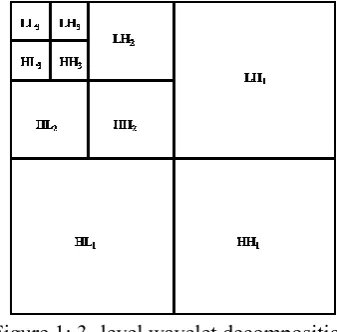
In image processing, 2-D decomposition of images can be easily extended from the 1-D decomposition if the wavelet transform is separable. When an is decomposed using one-scale wavelet transform, four finer scale subbands, labeled as and are obtained. The lowest frequency subband can be continuously decomposed to obtain four coarser scale subbands, viz., , , and . This method of decomposition is also called as the tree-decomposition mode. Figure 1 shows the result of a 3-scale wavelet transform based on a tree decomposition mode.
III.
COMPRESSION BY UTILIZING
HIERARCHICAL CORRELATION OF WAVELET
COEFFICIENTS IN SVM REGRESSION
Wavelet transform has space and frequency characteristics. The ability of wavelet coefficients to capture singularities in a signal with a few coefficients has enabled wavelets to be used for denoising, compression, estimation and other applications. The wavelet transform decorrelates the signal, but the coefficients still have significant interscale and intrascale dependencies. If the redundancy among wavelet coefficients is removed, further compression can be achieved. The approach presented in this paper follows the approach presented in [11], where SVM regression is used to remove the redundancies present in the wavelet coefficients and to achieve further compression. The method presented here is a slight modification of the work presented in [11]. In [11], the neighborhood correlation among wavelet coefficients in every scale and every orientation is utilized to make the SVM learn data dependency among those coefficients. In the proposed method, the correlation among wavelet coefficients in the same orientation, but in different scales is utilized to train the SVM regression.
Figure 1: 3- level wavelet decomposition
In a wavelet decomposition of an image, the number of child coefficients for each parent coefficient, at a given orientation, is four. The hierarchical correlation between subband coefficients can be characterized by a quadtree structure as shown in figure 2. The parent coefficient and the children coefficients are correlated. Generally, the linear correlation between the squares or magnitudes of a parent and child wavelet coefficients are high [19].
Figure 2: Hierarchical dependences in the tree-based organization of wavelet transform
The procedure for image compression proposed in this work is similar to the method proposed in [11] except that the scan order of wavelet coefficients to train the SVM utilizes the hierarchical correlation rather than utilizing the neighborhood correlation. Image is first decomposed using a 4 level wavelet transform. The wavelet coefficients are quantized using scalar quantization with a deadzone. coefficients are encoded using DPCM. The signs of wavelet coefficients are encoded separately. The wavelet coefficients at every scale and orientation are normalized. For every orientation and for every coefficient at the coarsest scale the hierarchical tree with this coefficient at root and its children coefficients as child nodes is considered. In order to generate the one-dimensional vector, the tree is scanned in a breadth first traversal order. First the root coefficient is considered, and then its children coefficients at the next scale are considered and so on till the finest level. A 4 level wavelet transform on image is taken. Hence for one coefficient in a given orientation at the coarsest scale there will be 85 nodes in the tree organization. The coefficients in the tree with the root as a single coefficient at the coarsest scale in one given orientation are mapped to a 85-dimension vector (Y). The pictorial representation of the scan order for a given coefficient at the coarsest level is depicted in figure 3. The coefficient 1 forms the root of the tree with four descendants 2, 3, 4 and 5 in the next finer scale. The position of the elements in Y form the vector X, which is also a 85-dimension vector. In the SVM regression X forms the input data and Y forms the output data. This arrangement of the wavelet coefficients and their positions are used to train the SVM. The weights and support vectors obtained are combined together. The weights are quantized, and then the weights and support vectors are encoded using run length and arithmetic coding. This process is repeated for every wavelet coefficient in every orientation at the coarsest
scale, i.e. at level 4.
Figure 3: Scan order based on hierarchical dependencies of wavelet coefficients
IV.
EXPERIMENTAL RESULTS
The proposed method is evaluated on three benchmark 512x512 grayscale images. The results are compared with the results of wavelet and SVM based image compression proposed in [11] which utilizes the neighborhood correlation. An objective measure of reconstructed image quality, PSNR in decibels [20] is used for comparison purposes and is defined as
(9)
where
∑ ∑ ( ̂)
(10)
where and ̂ are the original and reconstructed pixels repectively and the size of the image is .
The proposed method is implemented in MATLAB using LibSVM for SVM regression. Daubechies 9/7 wavelet is chosen in the implementation. Gaussian function is chosen as the regression kernel.
Table 1 compares the results of the proposed method and the method proposed in [11] in terms of PSNR for different compression ratio. It can be observed from the results that the proposed method outperforms the method proposed in [11] with an improvement of 0.1 dB – 1.0 dB.
TABLEI
RESULTS OF COMPRESSION USING PROPOSED METHOD IN TERMS OF COMPRESSION RATIO AND PSNR
Image Compression
Ratio
PSNR Method in
[11]
Proposed Method
Lena 18 27.01 27.39
20 26.71 26.86
22 26.16 26.35
Barbara 18 27.38 27.40
20 26.74 27.02
25 26.04 26.87
Mandrill 16 20.80 21.11
20 19.64 20.70
V.
CONCLUSION
The arrangement of the wavelet coefficients based on hierarchical correlation is utilized to improve the SVM based image compression method. This arrangement of wavelet coefficients makes SVM learn data dependency more efficiently by utilizing the intra-band and inter-scale dependencies. Experimental results show that the proposed method outperforms the method proposed by Jiao et. al.
VI.
REFERENCES
[1] G. Wallace, “The JPEG still picture compression standard”, Communications of the ACM, vol. 34, no. 1, 1991, pp. 30 – 44.
[2] D. Taubman, M. W. Marcellin, JPEG2000: Image Compression Fundamentals: Standards and Practices, Kluwer Academic Publishers, 2002.
[3] D. A. Huffman, “A method for the construction of minimum redundancy codes”, Proceedings of the IRE, vol. 40, 1951, pp. 1098 – 1101.
[4] N. Abramson, Information Theory and Coding, New York, McGraw-Hill, 1963.
[5] I. Daubechies, Ten Lectures on Wavelets, Society for Industrial Applied Mathematics, Philadelphia, USA, 1992.
[6] C. Chang and B. Girod, “Direction adaptive discrete wavelet transform for image compression”, IEEE Transactions on Image Processing, vol. 5, 2007, pp. 1289 – 1302.
[7] G. Liu, X. Zeng, F. Tian and et al, “A novel direction-adaptive wavelet based image compression”, International Journal of Electronics Communications, vol. 64, 2010, pp. 531 – 539.
[8] S. Mallat, “A theory for multiresolution signal decomposition: The wavelet representation”, IEEE Transactions on Pattern Analysis and Machine Intelligence, vol. 11, 1989, pp. 674 – 693.
[9] V. Vapnik, The nature of statistical learning theory, Springer, Verlog, 1995.
[10] J. Robinson and V. Kecman, “Combining support vector machine learning with the discrete cosine transform in image compression”, IEEE Transactions on Neural Networks, vol. 14, no. 4, 2003, pp. 950 – 958.
[11] R. Jiao, Y. Li, Q. Wang and B. Li, “SVM regression and its application to image compression”, International Conference on Intelligent Computing, Lecture Notes on Computer Science, vol. 3645, 2005, pp. 747 – 756.
[12] E. J. Candes and D. L. Donoho, “Curvelets – A surprisingly effective non-adaptive representation for
objects with edges”, In C. Rabut, A. Cohen and L. L. Schumaker (Eds.), Curves and Surfaces, Nashville, TN: Vanderbilt University Press, 2000, pp. 105 – 120. [13] Y. Li, Q. Yang and R. Jiao, “Image compression scheme based on curvelet transform and support vector machine”, Expert Systems with Applications, vol. 37, 2010, pp. 3063 – 3069.
[14] G. Camps-Valls, J. Gutierrez, G. Gomez-Perez and J. Malo, “On the suitable domain for SVM training in image coding”, Journal of Machine Learning Research, vol. 9, 2008, pp. 49 – 66.
[15] V. Vapnik, S. Golowich and A. Smola, “Support Vector Method for Function Approximation, Regression Estimation and Signal Processing”, Advances in Neural Information Processing Systems, Cambridge, MA: MIT Press, vol. 9, 1997.
[16] H. Drucker, C. J. C. BurgesL. Kaufmann, A. Smola and V. Vapnik, “Support Vector Regression Machines”, Advances in Neural Information Processing Systems, Cambridge, MA: MIT Press, pp. 155 – 161, 1997.
[17] Khalid Sayood, Introduction to Data Compression, Morgan Kaufmann Publishers, 2005.
[18] C. S. Burrus. R. A. Gopinath and H. Guo, Introduction to wavelets and wavelet transforms: A Primer, Upper Saddle River NJ (USA): Prentice Hall, 1998.
[19] J. M. Shapiro, “Embedded image coding using zerotrees of wavelet coefficients”, IEEE Transactions on Signal Processing, vol. 41, no. 12, 1992, pp. 3445 – 3462.
![Table 1 compares the results of the proposed method and the method proposed in [11] in terms of PSNR for different compression ratio](https://thumb-us.123doks.com/thumbv2/123dok_us/1025294.1127410/4.595.97.233.48.166/table-compares-results-proposed-method-proposed-different-compression.webp)
