GL `
AFF, a Large Versatile French Lexicon
Nabil Hathout, Franck Sajous, Basilio Calderone
CLLE-ERSS, CNRS & Universit´e de Toulouse {nabil.hathout, franck.sajous, basilio.calderone}@univ-tlse2.frAbstract
This paper introduces GL `AFF, a large-scale versatile French lexicon extracted from Wiktionary, the collaborative online dictionary. GL `AFF contains, for each entry, inflectional features and phonemic transcriptions. It distinguishes itself from the other available French lexicons by its size, its potential for constant updating and its copylefted license. We explain how we have built GL `AFF and compare it to other known resources in terms of coverage and quality of the phonemic transcriptions. We show that its size and quality are strong assets that could allow GL `AFF to become a reference lexicon for French NLP and linguistics. Moreover, other derived lexicons can easily be based on GL `AFF to satisfy specific needs of various fields such as psycholinguistics.
Keywords:Inflectional and phonological lexicon, free lexical resources, French Wiktionary
1.
Introduction
This article introduces GL `AFF,1 a large versatile French lexicon extracted from Wiktionnaire, the French edition of Wiktionary. Wiktionnaire contains more than 2 million ar-ticles, each including definitions, pronunciations, transla-tions and semantic relatransla-tions. GL `AFF aims to make this resource available for NLP systems and linguistic research in a workable format.
Some French morphological lexicons, such as Lefff (Cl´ement et al., 2004) and Morphalou (Romary et al., 2004), are freely available. These resources contain inflected forms, lemmas and morphosyntactic tags. They do not include, however, phonemic transcriptions that are necessary in phonology and in the design of tools such as phonetizers. Lexique (New, 2006), another free lexicon, contains phonemic transcriptions but has a restricted cov-erage. While this lexicon is popular in psycholinguistics, its sparsity in terms of inflected forms prevents its use in NLP. Resources that have both exploitable coverage and phonemic transcriptions, such as BDLex (P´erennou and de Calm`es, 1987), ILPho (Boula De Mareuil et al., 2000) or GlobalPhone (Schultz et al., 2013) are not free. Besides the cost, derivative works cannot be redistributed, which constitutes an impediment for collaborative research. As of today, no French lexicon meets all following require-ments: free license, wide coverage, and phonemic tran-scriptions. Wiktionnaire may be a candidate resource for the creation of such a lexicon. Wiktionary was first used for NLP by Zesch et al. (2008) to compute semantic relat-edness. Its potential as an electronic lexicon was first stud-ied for English and French by Navarro et al. (2009). Other works tackled data extraction from other language editions. Anton P´erez et al. (2011) describe the integration of the Portuguese Wiktionary and Onto.PT (Gonc¸alo Oliveira and Gomes, 2010). S´erasset (2012) built Dbnary, a multilin-gual network containing “easily extractable” entries. For French, the resulting graph includes 260,467 nodes. On-toWiktionary (Meyer and Gurevych, 2012), an ontology based on Wiktionary, and UBY (Gurevych et al., 2012), an alignment of 7 resources including WordNet, Germanet and
1GL `AFF is freely available at http://redac.
univ-tlse2.fr/lexicons/glaff_en.html
Wiktionary, constitute the most complete resources based on Wiktionary. A detailed characterization of the English and French editions of Wiktionary is given in (Sajous et al., 2010; Sajous et al., 2013b). These papers also present the extraction process of WiktionaryX,2an XML-structured lexicon containing definitions, semantic relations and trans-lations. GL `AFF is a new step focusing on the extraction of inflected forms and phonemic transcriptions that were ab-sent from the previous resource.
Wiktionary’s language editions are released as “XML dumps”, where only the macrostructure is marked by XML tags. The microstructure is encoded in a format called wi-kicode, whose syntax is not formally defined, evolves over time, and is not stable from one language edition to an-other. Due to this underspecified syntax, a parser has to expect multiple deviations from the “prototypical article” and must handle missing information, redundancy and in-consistency. For example, the gender or pronunciation may be missing in an inflected form’s article, but occur in the one dedicated to its lemma. Sometimes, contradictory in-formation may occur in both articles. To build GL `AFF, we designed an extractor that collects the maximum amount of information from Wiktionary’s articles (lemmas, inflected forms and conjugation tables) and applies a set of rules to output a structured and (as much as possible) consistent in-flectional and phonological lexicon.
2.
Resource description
GL `AFF contains more than 1.4 million entries including nouns, verbs, adjectives, adverbs and function words. As illustrated in Figure 1, each entry contains a wordform, a tag in GRACE format (Rajman et al., 1997), a lemma and an IPA transcription, when present in Wiktionnaire. En-tries also contain word frequencies computed over differ-ent corpora. Sajous et al. (2013a) give a first descrip-tion of GL `AFF. We characterize GL `AFF below in terms of coverage (section 2.1.) and phonemic transcriptions (sec-tion 2.2.). In sec(sec-tion 2.3., we present newly added features.
2WiktionaryX is freely available at: http://redac.
affluent|Afpms|affluent|a.fly.˜a|12|0.41|15|0.51|175|0.79|183|0.83|576|0.45|696|0.55
affluente|Afpfs|affluent|a.fly.˜at|0|0|0|0|2|0.00|183|0.83|9|0.00|696|0.55
affluentes|Afpfp|affluent|a.fly.˜at|1|0.03|15|0.51|1|0.00|183|0.83|22|0.01|696|0.55
affluent|Ncms|affluent|a.fly.˜a|22|0.76|38|1.31|232|1.05|444|2.02|1234|0.98|3655|2.91
affluents|Afpmp|affluent|a.fly.˜a|2|0.06|15|0.51|5|0.02|183|0.83|89|0.07|696|0.55
affluents|Ncmp|affluent|a.fly.˜a|16|0.55|38|1.31|212|0.96|444|2.02|2421|1.93|3655|2.91
affluent|Vmip3p-|affluer|a.fly|9|0.31|187|6.48|369|1.67|1207|5.49|500|0.39|1929|1.53
affluent|Vmsp3p-|affluer|a.fly|9|0.31|187|6.48|369|1.67|1207|5.49|500|0.39|1929|1.53
Figure 1: Extract of GL `AFF
Categorized inflected forms Categorized lemmas
Simples Non simples Total Simples Non simples Total
Lexique 147,912 4,696 152,608 46,649 3,770 50,419
BDLex 431,992 4,360 436,352 47,314 1,792 49,106
Lefff 466,668 3,829 470,497 54,214 2,303 56,517
Morphalou 524,179 49 524,228 65,170 7 65,177
GL `AFF 1,401,578 24,270 1,425,848 172,616 13,466 186,082
Table 1: Size of the lexicons (restricted to nouns, verbs, adjectives and adverbs).
2.1.
Coverage
GL `AFF differs from the lexicons currently used in NLP and psycholinguistics by its exceptional size. Table 1 shows the number of lemmas and inflected forms, simple (letters only) and non-simple (containing spaces, dashes or digits). GL `AFF contains 3 to 4 times more tokens and 3 to 9 times more forms. This size is an important asset when the lexi-con is used for research in derivational or inflectional mor-phology. It is also an advantage for the development of NLP tools as morphosyntactic taggers and parsers. The ta-ble also shows that GL `AFF contains numerous multi-word expressions (MWE) that can improve text segmentation and subsequent processing.
The following comparisons only concern nouns, verbs, ad-jectives and adverbs. They were carried out on simple in-flected forms and lemmas in order to ignore differences in the treatment of MWEs and corpora segmentation. MWEs (i.e. the 24 270non simpleforms –resp. 13 466non simple
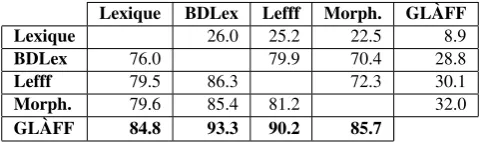
lemmas–) have been discarded from the version of GL `AFF presented in this paper and will be added in a future version. We first study the intersection of GL `AFF and other lexi-cons. We observe in Table 2 that the size of the intersections directly depends on that of the lexicons: the bigger a lexi-con, the larger its intersection with the other ones. The five lexicons fall into three groups. Lexique has a smaller cover-age. It only contains 9% of GL `AFF entries and 22% to 26% of the entries of other lexicons. BDLex, Lefff and Mor-phalou cover 76% to 80% of Lexique and 30% of GL `AFF in average. GL `AFF is clearly above with a coverage of 85% to 93%. Its coverage is 5% to 65% larger than the ones of the other lexicons.
GL `AFF is considerably larger than all other lexicons, which potentially is an asset. In order to check that this advantage is real (i.e. that having a greater number of lex-emes and inflected forms is actually useful), we compared the five lexicons to the vocabulary of three corpora of vari-ous types. LM10 is a 200 million word corpus made up of the archives of the newspaperLe Mondefrom 1991 to 2000.
The second corpus, containing 260 million word, consists of articles from the French Wikipedia. Finally, FrWaC (Ba-roni et al., 2009) is a 1.6 billion word corpus of French web pages (spidered from the.frdomain).
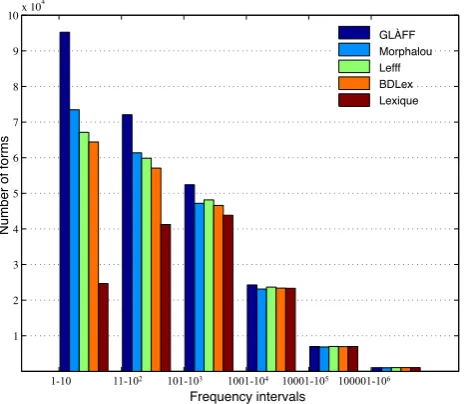
Table 3 shows the coverage of the five lexicons with re-spect to the three corpora. The vocabulary is restricted to the forms of frequency greater than or equal to 1, 2, 5, 10, 100 and 1000. The ranking of the corpora by coverage is the same for the five lexicons. Although their size af-fects the order, their nature is also crucial. For example, FrWaC being a collection of web pages, it contains a large number of “noisy” forms (foreign words, missing or extra spaces, missing diacritics, random spelling, etc.). Again, we see the division of lexicons into three groups. BDLex, Lefff and Morphalou have a quite close coverage. Lexique has the smallest coverage up to the 100 threshold. GL `AFF has the largest coverage for all corpora, except for LM10 at the 1000 threshold where it is surpassed by Lefff by 0.2%. For the other corpora and up to the 100 threshold, the size of GL `AFF explains its larger coverage with respect to the other lexicons (at the threshold 1, 14% to 53% larger for LM10 and 30% to 120% larger for FrWaC; at the thresh-old 10, 4% to 16% for LM10 and 15% to 47% for FrWaC). NLP tools that integrate GL `AFF should therefore offer an improved performance in the treatment of these corpora. Figure 2 compares the lexicons’ coverage from another per-spective: for each lexicon, it represents the number of forms having a corpus frequency within a given interval. We still
Lexique BDLex Lefff Morph. GL `AFF
Lexique 26.0 25.2 22.5 8.9
BDLex 76.0 79.9 70.4 28.8
Lefff 79.5 86.3 72.3 30.1
Morph. 79.6 85.4 81.2 32.0
GL `AFF 84.8 93.3 90.2 85.7
Threshold: frequency≥ 1 2 5 10 100 1000
1-10 11-102 101-103 1001-104 10001-106 1-10 11-102 101-103 1001-104 10001-105 100001-106
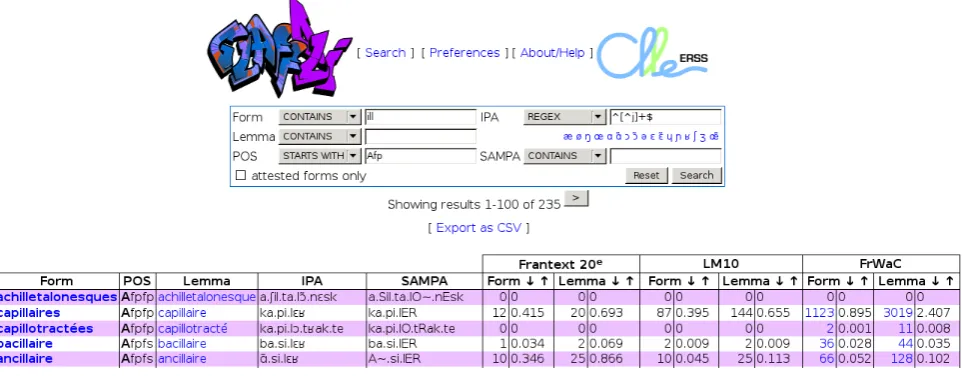
Figure 3: GL `AFFOLI, the GL `AFF OnLine Interface
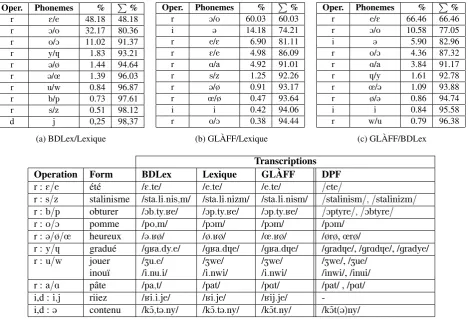
conventions tend to minimize.
2.3.
Additional features
Version 1.2 of GL `AFF comes with form and lemma fre-quencies (absolute and relative) computed over different corpora including LM10 and FrWaC (cf. Figure 1). Another novelty is the possibility of browsing GL `AFF on-line thanks to the GL `AFFOLI interface,3 as illustrated in Figure 3. This interface enables any user to build a mul-ticriteria query. Request fields may include wordform, lemma, part of speech and/or pronunciation written in IPA or SAMPA. These fields are matched against GL `AFF en-tries through regular expressions or operators such as is, contains, starts with, ends with, etc. depending on the user’s choice. Display is customizable and, when corpora frequencies are visible, the wordforms attested in FrWaC are linked to the NoSkecthEngine (Rychl´y, 2007) concor-dancer.
3.
Conclusion
We presented a new French lexicon built automatically from Wiktionary. This lexicon is remarkable for its size. It provides morphosyntactic descriptions for 1.4 million entries and phonemic transcriptions for 1.3 million of them. Despite its very large size, the overall quality of GL `AFF is very good as shown by various comparisons with similar resources including Lexique, Lefff and BDLex.
Among the directions for future research, we plan an evaluation of the contribution of GL `AFF to syntactic parsing using the Talismane parser (Urieli, 2013).
In the near future, we also plan to unify GL `AFF and Wik-tionaryX to give access to definitions and semantic rela-tions in addition to inflectional and phonological informa-tion. Such a resource will be useful for NLP but also for linguistic descriptions. More generally, multiple specific lexicons may be derived from GL `AFF, depending on the needs. For example, we illustrated in (Calderone et al.,
3http://redac.univ-tlse2.fr/glaffoli/
2014) how we have built a psycholinguistics-oriented lexi-con from GL `AFF by adding an extended set of features that are used to set up experimental material in this field.
4.
References
Anton P´erez, L., Gonc¸alo Oliveira, H., and Gomes, P. (2011). Extracting Lexical-Semantic Knowledge from the Portuguese Wiktionary. InProceedings of the 15th Portuguese Conference on Artificial Intelligence, EPIA 2011, pages 703–717, Lisbon, Portugal.
Baroni, M., Bernardini, S., Ferraresi, A., and Zanchetta, E. (2009). The WaCky wide web: a collection of very large linguistically processed web-crawled corpora. Language Resources and Evaluation, 43(3):209–226.
Boula De Mareuil, P., Yvon, F., D’Alessandro, C., Auberg´e, V., Vaissi`ere, J., and Amelot, A. (2000). A French Phonetic Lexicon with variants for Speech and Language Processing. In Proceedings of the Sec-ond International Conference on Language Resources and Evaluation (LREC 2000), pages 273–276, Athens, Greece.
Calderone, B., Hathout, N., and Sajous, F. (2014). From GL `AFF to PsychoGL `AFF: a large psycholinguistics-oriented French lexical resource. InProceedings of the 16th EURALEX International Congress, Bolzano, Italy. Cl´ement, L., Lang, B., and Sagot, B. (2004).
Morphol-ogy based automatic acquisition of large-coverage lex-ica. In Proceedings of the Fourth International Con-ference on Language Resources and Evaluation (LREC 2004), pages 1841–1844, Lisbon, Portugal.
Detey, S., Durand, J., Laks, B., and Lyche, C. (2010). Les vari´et´es du franc¸ais parl´e dans l’espace francophone. L’essentiel francais. Ophrys.
Gonc¸alo Oliveira, H. and Gomes, P. (2010). Onto.PT: Automatic Construction of a Lexical Ontology for Por-tuguese. InProceedings of 5th European Starting AI Re-searcher Symposium, pages 199–211, Lisbon, Portugal. Gurevych, I., Eckle-Kohler, J., Hartmann, S., Matuschek,
the European Chapter of the Association for Computa-tional Linguistics (EACL 2012), pages 580–590, Avi-gnon, France.
Martinet, A. and Walter, H. (1973). Dictionnaire de la Prononciation Franc¸aise dans son Usage R´eel. France Expansion.
Meyer, C. M. and Gurevych, I. (2012). OntoWiktionary – Constructing an Ontology from the Collaborative On-line Dictionary Wiktionary. In Pazienza, M. T. and Stellato, A., editors,Semi-Automatic Ontology Develop-ment: Processes and Resources, chapter 6, pages 131– 161. IGI Global, Hershey, PA, USA.
Navarro, E., Sajous, F., Gaume, B., Pr´evot, L., Hsieh, S., Kuo, I., Magistry, P., and Huang, C.-R. (2009). Wik-tionary and NLP: Improving synonymy networks. In
Proceedings of the 2009 ACL-IJCNLP Workshop on The People’s Web Meets NLP: Collaboratively Constructed Semantic Resources, pages 19–27, Singapore.
New, B. (2006). Lexique 3 : Une nouvelle base de donn´ees lexicales. In Verbum ex machina. Actes de la 13e conf´erence sur le Traitement Automatique des Langues Naturelles (TALN’2006), Louvain-la-Neuve, Belgique. P´erennou, G. and de Calm`es, M. (1987). BDLEX lexical
data and knowledge base of spoken and written French. In Proceedings of the European Conference on Speech Technology, ECST 1987, pages 1393–1396, Edinburgh, Scotland.
Rajman, M., Lecomte, J., and Paroubek, P. (1997). Format de description lexicale pour le franc¸ais. Partie 2 : De-scription morpho-syntaxique. Technical report, EPFL & INaLF. GRACE GTR-3-2.1.
Romary, L., Salmon-Alt, S., and Francopoulo, G. (2004). Standards going concrete: from LMF to Morphalou. In Zock, M. and Saint-Dizier, P., editors, COLING 2004 Enhancing and using electronic dictionaries, pages 22– 28, Geneva, Switzerland.
Rychl´y, P. (2007). Manatee/Bonito - A Modular Corpus Manager. In Proceedings of the 1st Workshop on Re-cent Advances in Slavonic Natural Language Process-ing, pages 65–70, Brno, Czech Republic.
Sajous, F., Navarro, E., Gaume, B., Pr´evot, L., and Chudy, Y. (2010). Semi-automatic Endogenous Enrichment of Collaboratively Constructed Lexical Resources: Piggy-backing onto Wiktionary. In Loftsson, H., R¨ognvalds-son, E., and Helgad´ottir, S., editors,Advances in Natu-ral Language Processing, volume 6233 ofLNCS, pages 332–344. Springer Berlin / Heidelberg.
Sajous, F., Hathout, N., and Calderone, B. (2013a). GL `AFF, un Gros Lexique `A tout Faire du Franc¸ais. In
Actes de la 20e conf´erence sur le Traitement Automa-tique des Langues Naturelles (TALN’2013), pages 285– 298, Les Sables d’Olonne, France.
Sajous, F., Navarro, E., Gaume, B., Pr´evot, L., and Chudy, Y. (2013b). Semi-automatic enrichment of crowd-sourced synonymy networks: the WISIGOTH system applied to Wiktionary. Language Resources and Eval-uation, 47(1):63–96.
Schultz, T., Vu, N. T., and Schlippe, T. (2013). Glob-alPhone: A multilingual text & speech database in 20
languages. InProceedings of Conference on Acoustics, Speech, and Signal Processing, pages 8126–8130, Van-couver, Canada.
S´erasset, G. (2012). Dbnary: Wiktionary as a LMF based Multilingual RDF network. InProceedings of the Eigth International Conference on Language Resources and Evaluation (LREC 2012), Istanbul, Turkey.
Urieli, A. (2013). Robust French syntax analysis: recon-ciling statistical methods and linguistic knowledge in the Talismane toolkit. Ph.D. thesis, Universit´e de Toulouse-Le Mirail.