Ping-pong Document Clustering using NMF and Linkage-Based Refinement
Hiroyuki Shinnou, Minoru Sasaki
Ibaraki University,
4-12-1 Nakanarusawa, Hitachi, Ibaraki, Japan 316-8511 shinnou, [email protected]
Abstract
This paper proposes a ping-pong document clustering method using NMF and the linkage based refinement alternately, in order to improve the clustering result of NMF. The use of NMF in the ping-pong strategy can be expected effective for document clustering. However, NMF in the ping-pong strategy often worsens performance because NMF often fails to improve the clustering result given as the initial values. Our method handles this problem with the stop condition of the ping-pong process. In the experiment, we compared our method with the k-means and NMF by using 16 document data sets. Our method improved the clustering result of NMF significantly.
1.
Introduction
Document clustering is the task of dividing a document’s data set into groups based on document similarity. This is the basic intelligent procedure, and is important in text mining systems (Michael W. Berry, 2003). As the specific application, relevant feedback in IR, where retrieved docu-ments are clustered, is actively researched (Hearst and Ped-ersen, 1996)(Kummamuru et al., 2004).
Non-negative Matrix Factorization (NMF) is a clustering method based on the dimensional reduction method, and is effective for the document clustering, in which a vector is high-dimensional and sparse. In this paper, we propose the ping-pong clustering method that NMF and the linkage based refinement are conducted alternately, in order to im-prove the initial clustering result generated by NMF. The ping-pong clustering consists of two clustering meth-ods to improve the given clustering result, and uses these two methods alternately to improve the clustering result step by step. The term “ping-pong clustering” is not used generally, but in the paper (Dhillon et al., 2002), this method was called by the “ping-pong strategy.” So in this paper, we name this method as “ping-pong clustering.” Each method in the ping-pong clustering can be used as a clustering method by itself. The ping-pong clustering pro-duces a better result than the single clustering method. The “local search” proposed by Dhillon is representative of the ping-pong clustering (Dhillon et al., 2002). That method combines the k-means and the “first-variation” to improve the clustering result. Ding showed that NMF and pLSI use the same object function, but their search methods are different. Thus, he proposed the ping-pong clustering to use them alternately (Ding et al., 2006). In this paper, we use NMF and the linkage based refinement for the ping-pong clustering. In this paper, we will refer to the linkage based refinement as “LBR” for short.
NMF is a dimensional reduction method(Xu et al., 2003). Let to be theterm-document matrix, consisting of rows (terms) andcolumns (documents). If the number of clusters is, NMF decomposes to the matrix and as follow:
where is, isand is the transposed
matrix of. And the matrix and are non-negative. In NMF, each dimensional column vector in is cor-respoing to the document. An actual clustering is usually conducted by using these reduced vectors. However, NMF does not need that clustering procedure. The reduced vector expresses its cluster because each column axis of repre-sents a topic of the cluster.
The matrix and can be obtained by using a simple iterative procedure with the initial matrix and (Lee and Seung, 2000). The initial matrix is corresponding to a clustering result. Thus, NMF can be regarded as the method to improve the given clustering result. That is, we can use NMF as a constitutive method of the ping-pong clustering. For document clustering, the ping-pong clus-tering using NMF hold great promise because NMF is ef-fective for document clustering.
LBR is the method to refine the clustering result. It was proposed in the paper (Ding et al., 2001) in order to re-fine the clustering result produced by the spectral clustering method, Mcut. LBR defines an object function to measure the refinement degree in the case that datain the cluster moves to the cluster . By using that object function, each data is reassigned to a cluster. LBR does not guar-antee to improve the value of the object function used in clustering, but is actually effective to refine the clustering result produced by the spectral clustering method (Ding et al., 2001). It should be considered that LBR is also effec-tive for the any clustering result. So we use LBR as another constitutive method of the ping-pong clustering.
A novelty of this research is the use of NMF in the ping-pong clustering. As previously mentioned, the ping-ping-pong clustering using NMF holds great promise. However, the ping-pong clustering using NMF has often negative effects because NMF does not always improve the given cluster-ing result. To overcome this problem, we devise the stop condition of the ping-pong. Concretely speaking, we judge whether the ping-pong stops or not, through the value of an object function of the clustering result produced by LBR. If the value is improved, we keep the ping-pong. Otherwise we stop the ping-pong, and output the clustering result that LBR produced in the previous application.
12.6
12.8
13
13.2
13.4
13.6
13.8
NMF-1
LBR-1
NMF-2
NMF-3
LBR-2
LBR-3
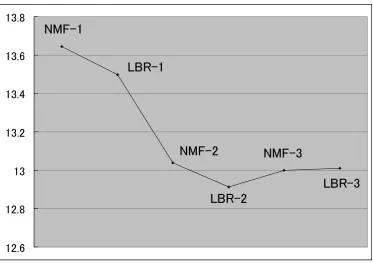
Figure 1: Value of the object function in the ping-pong clustering (1)
where the
means the complement of
. The smaller
is, the better it is.
Suppose the data is a member of the cluster . The
is defined as follows;
Now we define the
as follows:
In the case of
, the datais moved from the cluster to the cluster
.
After conducting the above procedure for all data, we get the new clustering result
. For this new clustering result, we iterate the above procedure. This iter-ation is stopped when the movement does not occur. Note that LBR can not always improve the value of the ob-ject function Eq.7. That is, LBR is a heuristic method to improve the clustering result.
4.
Ping-pong clustering
Our ping-pong clustering first conducts NMF, and get the clustering result. And then, the clustering result is im-proved by LBR. Using the imim-proved clustering result, the initial matrix and of NMF are constructed as fol-lows. If the cluster number of the-th data is clustered into the -th cluster in the improved clustering result. the-th row vector of the is constructed as follow:
is constructed by . Using above and as initial matrices, NMF is conducted. As such ways, our ping-pong clustering conducts NMF and LBR alternately.
It is ideal that both of NMF and LBR can improve the given clustering result, but it is not guaranteed. Especially NMF often fails to improve the clustering result. So it is hard to use NMF in the ping-pong clustering.
To overcome this problem, we devise the stop condition of the ping-pong. Concretely speaking, we evaluate the value of the object function Eq.7 for the clustering result pro-duced by LBR. If that value is improved, we keep the ping-pong process. Otherwise, we stop the ping-ping-pong process, and output the clustering result produced by the previous LBR.
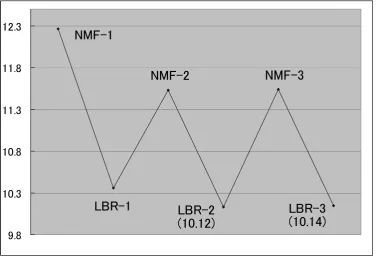
We show an example. The Figure 1 shows the result of our ping-pong clustering for the data set ‘tr12’ used in our experiment described in the next section. The vertical axis means the value of the object function (Eq.7).
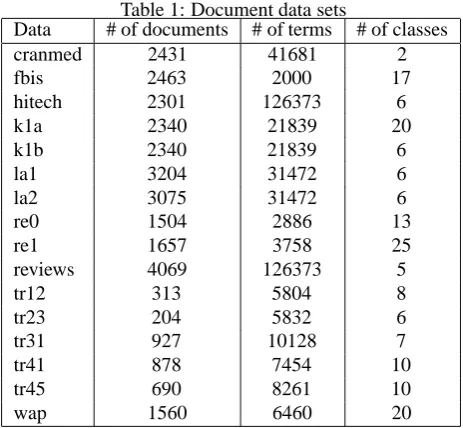
Table 1: Document data sets
Data # of documents # of terms # of classes
cranmed 2431 41681 2
fbis 2463 2000 17
hitech 2301 126373 6
k1a 2340 21839 20
k1b 2340 21839 6
la1 3204 31472 6
la2 3075 31472 6
re0 1504 2886 13
re1 1657 3758 25
reviews 4069 126373 5
tr12 313 5804 8
tr23 204 5832 6
tr31 927 10128 7
tr41 878 7454 10
tr45 690 8261 10
wap 1560 6460 20
Table 2: Experiment result
Data KM NMF NMF+LBR PP(NMF)
cranmed 0.106 0.748 0.067 0.055
fbis 0.330 0.383 0.360 0.358 hitech 0.597 0.724 0.678 0.679
k1a 0.403 0.384 0.370 0.352
k1b 0.306 0.277 0.233 0.218
la1 0.660 0.547 0.430 0.401
la2 0.620 0.565 0.411 0.413
re0 0.384 0.397 0.373 0.386
re1 0.391 0.355 0.310 0.316
reviews 0.406 0.602 0.323 0.323
tr12 0.641 0.424 0.406 0.357
tr23 0.484 0.473 0.382 0.399
tr31 0.373 0.393 0.327 0.310
tr41 0.381 0.269 0.277 0.242
tr45 0.473 0.254 0.210 0.247
wap 0.427 0.378 0.378 0.371
Average 0.436 0.448 0.346 0.339
6.
Discussions
The constitutive method of the ping-pong clustering needs following two conditions.
C1 The input is corresponding to a clustering result.
C2 The output is improved from the input.
Our ping-pong clustering uses NMF and LBR as the con-stitutive method. Both methods satisfy the condition C1. However the condition C2 is not always satisfied in both methods.
Comparing NMF and NMF+LBR, NMF+LBR has lower entropies than NMF in 14 out of 16 data sets, has the equal entropies in a data set ’wap’, and has the higher entropy than NMF in only one data set ‘tr41.’ Thus, this means that LBR almost satisfies the condition C2.
Next we checked whether NMF improved the clustering re-sult passed by the first LBR. Entropies are reduced for 5 out of 16 data sets, and increased for the rest 11 data sets. This
result means hat the NMF does not often satisfy the condi-tion C2.
This problem is caused by the object function (Eq.4) of NMF. The iteration of NMF algorithm improves the value of Eq.4 monotonically. However, the improvement of Eq.4 does not always mean the improvement of the clustering re-sult. This problem is just discussed in the paper (Shinnou and Sasaki, 2007). In this cause, it is hard to use NMF in the ping-pong clustering. To handle this problem, we de-vise the stop condition of the ping-pong.
We judge whether the ping-pong is stopped or kept, by eval-uating only the clustering result produced by LBR. There-fore, even if NMF does not improve the given clustering result, the negative effect for the final clustering result is little.
It is our future work to investigate the relation between the input of NMF and the accuracy of clustering.
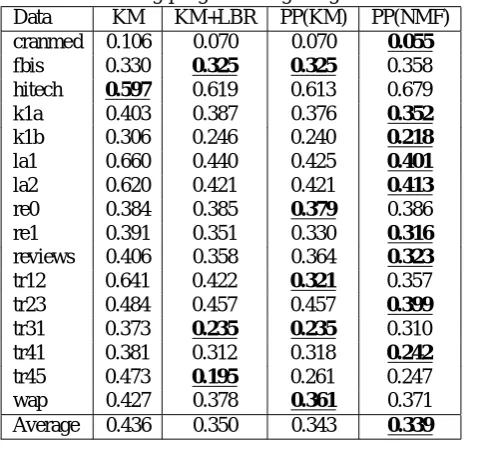
Table 3: Ping-pong clustering using k-means
Data KM KM+LBR PP(KM) PP(NMF)
cranmed 0.106 0.070 0.070 0.055
fbis 0.330 0.325 0.325 0.358
hitech 0.597 0.619 0.613 0.679
k1a 0.403 0.387 0.376 0.352
k1b 0.306 0.246 0.240 0.218
la1 0.660 0.440 0.425 0.401
la2 0.620 0.421 0.421 0.413
re0 0.384 0.385 0.379 0.386
re1 0.391 0.351 0.330 0.316
reviews 0.406 0.358 0.364 0.323
tr12 0.641 0.422 0.321 0.357
tr23 0.484 0.457 0.457 0.399
tr31 0.373 0.235 0.235 0.310
tr41 0.381 0.312 0.318 0.242
tr45 0.473 0.195 0.261 0.247
wap 0.427 0.378 0.361 0.371
Average 0.436 0.350 0.343 0.339
For reference, we tried the ping-pong clustering using k-means and LBR. Table 3 shows that result. In that table, “KM+LBR” and “PP(KM)” mean the result of LBR for the given clustering result produced by k-means and the result of the ping-pong clustering using k-means and LBR respec-tively.
Table 3 also shows that LBR almost satisfies the condition C2. The difference between NMF and k-means in the ping-pong clustering is subtle. In the above experiment, NMF was a little better than k-means.
However, NMF produces more informative result than k-means. For example, the matrix produced by NMF includes the degree that each data belongs to a cluster and the degree that each word relates to a cluster. If we improve the clus-tering result more, these information is useful.
In future, we will investigate the relation between the ini-tial value of NMF and accuracy of output, and use matrices produced by NMF in order to improve the clustering result.
7.
Conclusion
In this paper, we proposed the new ping-pong clustering us-ing NMF and LBR as constitutive methods, in order to im-prove the clustering result produced by NMF. Both NMF and LBR do not always improve the given clustering result. In actual, NMF cannot often do it, but LBR can almost do it. We devise the stop condition of the ping-pong to han-dle with this problem. In the experiment, we compared our method with the k-means and NMF using 16 document data sets, and evaluated clustering results by entropy. Our ex-periment showed that our method is effective. In future, we will investigate the relation between the initial value of NMF and accuracy of output, and use matrices produced by NMF in order to improve the clustering result.
Acknowledgements
This research was partially supported by the Ministry of Education, Science, Sports and Culture, Grant-in-Aid for Scientific Research on Priority Areas, Japanese Corpus , 19011001, 2007.
8.
References
Inderjit S. Dhillon, Yuqiang Guan, and J. Kogan. 2002. It-erative Clustering of High Dimentional Text Data Aug-mented by Local Search. In The 2002 IEEE
Interna-tional Conference on Data Mining, pages 131–138.
Chris Ding, Xiaofeng He, Hongyuan Zha, Ming Gu, and Horst Simon. 2001. Spectral Min-max Cut for Graph Partitioning and Data Clustering. In Lawrence Berkeley
National Lab. Tech. report 47848.
Chris Ding, Tao Li, and Wei Peng. 2006. Nonnegative Matrix Factorization and Probabilistic Latent Semantic Indexing: Equivalence, Chi-square Statistic, and a Hy-brid Method. In AAAI National Conf. on Artificial
Intel-ligence (AAAI-06).
Marti A. Hearst and Jan O. Pedersen. 1996. Reexamining the cluster hypothesis: Scatter/gather on retrieval results. In Proceedings of SIGIR-96, pages 76–84.
Krishna Kummamuru, Rohit Lotlikar, Shourya Roy, Karan Singal, and Raghu Krishnapuram. 2004. A Hierarchical Monothetic Document Clustering Algorithm for Sum-marization and Browsing Search Results. In
Proceed-ings of WWW-04, pages 658–665.
Daniel D. Lee and H. Sebastian Seung. 2000. Algorithms for non-negative matrix factorization. In NIPS, pages 556–562.
Michael W. Berry, editor. 2003. Survey of Text Mining:
Clustering, Classification, and Retrieval. Springer.
Hiroyuki Shinnou and Minoru Sasaki. 2007. Document clustering by Mcut+NMF (in Japanese). In 13th annaul
meeting of Natural Language Processing Association,
pages 558–561.
Wei Xu, Xin Liu, and Yihong Gong. 2003. Document clustering based on non-negative matrix factorization. In