Towards Heterogeneous Automatic MT Error Analysis
Jes ´us Gim´enez and Llu´is M`arquez
TALP Research Center, LSI Department Universitat Polit´ecnica de Catalunya Jordi Girona Salgado 1–3. 08034, Barcelona
jgimenez,lluism @lsi.upc.edu
Abstract
This work studies the viability of performing heterogeneous automatic MT error analyses. Error analysis is, undoubtly, one of the most crucial stages in the development cycle of an MT system. However, often not enough attention is paid to this process. The reason is that performing an accurate error analysis requires intensive human labor. In order to speed up the error analysis process, we suggest partially automatizing it by having automatic evaluation metrics play a more active role. For that purpose, we have compiled a large and heterogeneous set of features at different linguistic levels and at different levels of granularity. Through a practical case study, we show how these features provide an effective means of ellaborating interpretable and detailed automatic reports of translation quality.
1.
Introduction
Error analysis plays a very important role in the develop-ment cycle of current MT systems. In each loop of the cycle, prior to suggesting new improvement mechanisms, system developers must first have a clear idea of the kind of errors their system commits. However, performing an accurate error analysis is a slow and delicate process which requires intensive human labor. Part of the effort is devoted to high-level analysis which involves a precise knowledge of the architecture of the system under development, but there is also a heavily time-consuming low-level part of the process related to the linguistic analysis of translation qual-ity, which we believe that could be partially automatized. Our proposal consists in having automatic evaluation met-rics play a more active role in this part of the work. In our opinion, in the current error analysis scheme, evalua-tion metrics are only minimally exploited. They are used as quantitative measures, i.e., so as to identify low/high quality translations, but not as genuine qualitative measures which allow developers to automatically obtain detailed lin-guistic interpretations of the translation quality attained. This limited usage of automatic metrics for error analysis is a direct consequence of the shallow similarity assump-tions commonly utilized for metric development. Until very recently, most metrics were based only on lexical similar-ity. However, in the last few years, there have been several approaches based on similarity assumptions at deeper lin-guistic levels. For instance, we may find syntax-based met-rics (Liu and Gildea, 2005; Amig ´o et al., 2006; Mehay and Brew, 2007; Owczarzak et al., 2007), which compute sim-ilarities over dependency or constituency trees, metrics at the level of shallow-semantics, e.g., over semantic roles and named entities (Gim´enez and M`arquez, 2007), and metrics at the properly semantic level, e.g., over discourse repre-sentations (Gim´enez and M`arquez, 2008).
We suggest taking advantage of this recent progress achieved in automatic MT evaluation so as to conduct
het-erogeneous MT error analyses, i.e., analyses which take
into account features at different linguistic levels (e.g., lex-ical, syntactic, and semantic), and at different levels of granularity —from very fine aspects of quality, related
to how well certain linguistic structures are transferred, to coarser ones, related to how well the translation un-der evaluation complies with the expected overall lexi-cal/syntactic/semantic reference structure.
Relying on a rich variety of automatic partial quality fea-tures would allow developers to analyze the performance of their systems with respect to different quality dimensions and from different viewpoints, and, consequently, to have a more precise idea of what quality aspects require improve-ment. Besides, in this manner, they would be allowed to concentrate on high-level decisions.
The work described in this paper is ongoing. We have com-piled a large and heterogeneous set of partial features based on which we are currently conducting semiautomatic pro-cesses of error analysis over several test beds. Preliminary results show that heterogeneous error analyses provide an effective means of elaborating interpretable and detailed reports both at the sentence and document levels. In ad-dition, all the metrics used in this work have been made publicly available inside the IQMTframework for MT
eval-uation (Jes´us Gim´enez, 2007)1.
2.
A Heterogeneous Metric Set
For our experiments, we have compiled a rich set of met-ric variants at 5 different linguistic levels (lexical, shallow-syntactic, shallow-syntactic, shallow-semantic and semantic). Al-though from different viewpoints, and based on different similarity assumptions, in all cases, translation quality is measured by comparing automatic translations against a set of human reference translations. Below, we provide only a brief description. Extensive details may be found in the IQMTtechnical manual (Jes´us Gim´enez, 2007).
2.1. Lexical Similarity
WER. Word Error Rate (Nießen et al., 2000).
PER. Position-independent Word Error Rate (Tillmann et
al., 1997).
BLEU. Precision oriented (Papineni et al., 2001).
ReferY ence 1: Over 1000 monks and nuns , observers and scientists from over 30 countries and the host country attended the religious summit held for the first time in Myanmar which started today , Thursday .
2: More than 1000 monks , nuns , observers and scholars from more than 30 countries , including the host country , participated in the religious summit which Myanmar hosted for the first time and which began on Thursday .
3: The religious summit , staged by Myanmar for the first time and began on Thursday , was attended by over 1,000 monks an nuns , observers and scholars from more than 30 countries and host Myanmar .
4: More than 1,000 monks , nuns , observers and scholars from more than 30 countries and the host country Myanmar participated in the religious summit , which is hosted by Myanmar for the first time and which began on Thursday .
5: The religious summit , which started on Thursday and was hosted for the first time by Myanmar , was attended by over 1,000 monks and nuns , observers and scholars from more than 30 countries and the host country Myanmar .
Information: (1)Z subject: over/more than 1,000 monks and nuns, observers and scientists/scholars from over/more than 30 countries , and/including the host country action: attended/participated in object: the religious summit
(2)Z subject: the religious summit action: began/started temporal: on Thursday
(3)Z object: the religious summit action: hosted subject: by Myanmar mode: for the first time LinearB: 1000 monks from more than 30 States and the host State Myanmar attended the Summit , which began
on Thursday , hosted by Myanmar for the first time .
Best SMT: Religious participated in the summit , hosted by Myanmar for the first time began on Thursday , as an observer and the world of the 1000 monk nun from more than 30 countries and the host state Myanmar .
Table 4: Test case #637
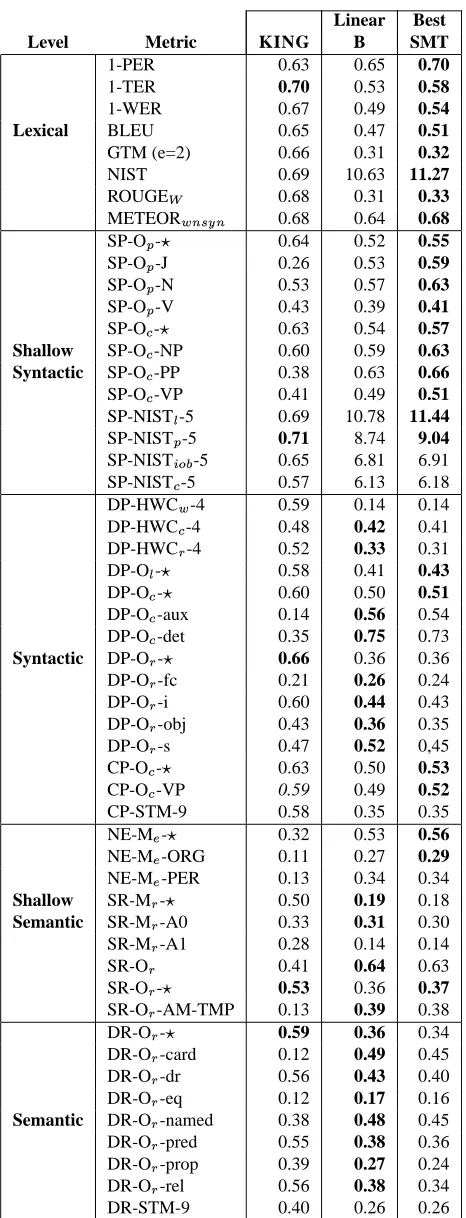
instance, if a metric obtains a KINGof 0.6, it means that in 60% of the test cases, it is able to explain by itself the difference in quality between manual and automatic trans-lations.
In the context of error analysis, KING serves as an esti-mate of the impact of specific quality aspects on the sys-tem performance. In that respect, it can be observed (Table 3, column 1) that metrics at the lexical, shallow-syntactic and syntactic levels attain slightly higherKINGvalues than metrics based on semantic similarities. We speculate that a possible explanation may be found in the performance of linguistic processors whose effectiveness suffers a sig-nificant decrease for deeper levels of analysis. Also, ob-serve that finer grained metrics such as‘SP-O[ -J’(i.e., lex-ical overlapping over adjectives), ‘NE-M\ -ORG’ (i.e., lex-ical matching over organization names) or ‘DR-O]-card’ (i.e., lexical overlapping over cardinal expressions) exhibit a much lower discriminative power. The reason is that they cover very partial aspects of quality.
3.4. Error Analysis at the Sentence Level
The heterogeneous set of metrics allows us to analyze dif-ferent dimensions of translation quality over individual test cases. In this manner, we can better search for problematic cases according to different criteria. For instance, we could seek translations lacking of subject (‘DP-^ ] -s’) and/or agent role (‘SR-^ ] -A0’). Or, at a more abstract level, by simul-taneously relying on syntactic and semantic metrics, we could, for instance, locate a subset of possibly well-formed translations (i.e., high syntactic similarity) which somehow do not match well the reference semantic structure (i.e., low semantic similarity).
A Case of Analysis
We have inspected particular cases. For instance, Table 4 presents the case of sentence 637 in which according to BLEUthe translation by Best SMT is ranked first, whereas according to human assessments the translation by LinearB is judged of a superior quality both in terms of adequacy and fluency. This case is deeply analyzed in Table 5. In
Linear Best Level Metric B SMT
Human Adequacy 3 2
Fluency 3.5 2
1-TER 0.53 0.51
Lexical BLEU 0.44 0.45
METEOR_>`$ab` 0.59 0.64 SP-O[ -c 0.52 0.51 Shallow SP-O[ -NN 0.67 0.38 Syntactic SP-O[ -NNP 0.60 0.75
SP-O[ -V 0.40 0.75
DP-HWC_ -4 0.17 0.16 DP-O] -c 0.46 0.44 DP-O] -mod 0.62 0.41 DP-O] -obj 0.29 0.00 DP-O] -pcomp-n 0.71 0.39 Syntactic DP-O] -rel 0.33 0.00 CP-Od-c 0.59 0.48 CP-Od-NP 0.59 0.55 CP-Od-PP 0.57 0.54 CP-Od-SB 0.73 0.00 CP-Od-VP 0.64 0.42
CP-STM-9 0.34 0.23
Shallow SR-O] 0.84 0.25 Semantic SR-O] -c 0.56 0.18 SR-O] -A0 0.44 0.10 SR-O] -A1 0.57 0.28 DR-O] -c 0.45 0.34 DR-O] -dr 0.57 0.40 Semantic DR-O] -nam 0.75 0.24 DR-O] -pred 0.44 0.45 DR-O] -rel 0.51 0.32
DR-STM-9 0.32 0.29
Table 5: Analysis of test case #637
LinearB: You should cooperate and support one another .
Best SMT: You that you will be more and more cooperative unit some of you and support each other .
Reference 1: You must be more united and more cooperative and you must support each other .
2: You must be more united and cooperative and supportive of each other .
3: You must be more united and cooperative and supportive of each other .
4: You have to be more united and more cooperative , and support each other .
5: You have to be more united and more cooperative and you have to support each other .
Table 6: Translation Case #149.
Linear Best Level Metric B SMT Human Adequacy 4 1.5
Fluency 5 1.5
1-PER 0.36 0.62
1-TER 0.36 0.49
Lexical BLEU 0.00 0.37
NIST 1.64 9.42
METEORe>f$ghAf 0.32 0.67 SP-ikj -l 0.25 0.46 Shallow SP-ikj -V 0.17 0.40 Syntactic SP-inm -l 0.19 0.43 SP-inm -NP 0.43 0.50 SP-i m-VP 0.14 0.40 DP-HWCe -4 0.07 0.12 Syntactic DP-HWCm-4 0.32 0.19 DP-HWCo -4 0.32 0.25
CP-STM-4 0.33 0.36
Shallow SR-p'o -l 0.14 0.67 Semantic SR-i o -l 0.10 0.75 DR-i o -l 0.17 0.26 DR-i o j -l 0.24 0.26 Semantic DR-io j -drs 0.27 0.30 DR-io j -pred 0.29 0.40 DR-i
o
j -rel 0.30 0.24
DR-STM-4 0.25 0.45
Table 7: Analysis of test case #149
to deal with differences in word ordering.
In contrast, scores conferred by metrics at deeper linguistic levels reveal, in agreement with human evaluation, that Lin-earB produced a more fluent (syntactic similarity) and ad-equate (semantic similarity) translation. Overall syntactic and semantic scores (e.g.,‘DP-Oo-l ,‘CP-STM-9’,‘SR-Oo-l , ‘DR-Oo -l and‘DR-STM-9’), all lower than 0.6, also indicate that important pieces of information were not captured or only partially captured.
Getting into details, by analyzing fine shallow-syntactic similarities, it can be observed, for instance, that, while LinearB successfully translated a larger proportion of sin-gular nouns, Best SMT translated more proper nouns and verb forms. Analysis at the syntactic level reports that Lin-earB captured more dependency relations of several types (e.g., word adjunct modifiers, verb objects, nominal com-plements of prepositions, and relative clauses), and trans-lated a larger proportion of different verb phrase types (e.g., noun, prepositional and verb phrases, and subordi-nated clauses). As to shallow-semantic similarity, it can be observed that the level of lexical overlapping over verb sub-jects and obsub-jects attained by LinearB is significantly higher.
At the semantic level, the discourse representation associ-ated to LinearB is, in general, more similar to the reference discourse representations. Only in the case of predicate conditions, both systems exhibit a similar performance.
Difficult Cases
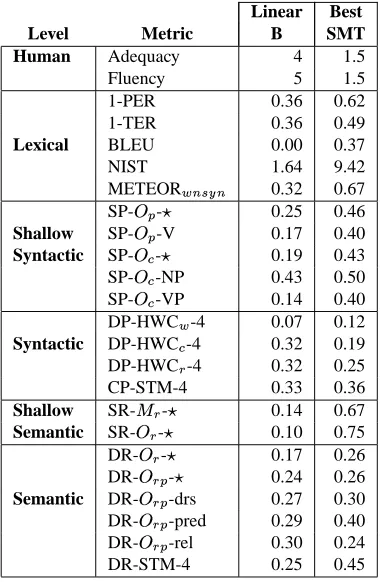
One of the main problems of current automatic MT evalu-ation methods is that their reliability depends very strongly on the representativity of the set of reference translations available. In other words, if reference translations cover only a small part of the space of valid solutions, the pre-dictive power of automatic metrics will decrease. This may be particularly dangerous in the case ofq -gram based met-rics, which are not able to deal with differences in lexi-cal selection. For instance, Tables 6 presents a case in which the LinearB is unfairly penalized by lexical metrics for its strong divergence with respect to reference transla-tions while the Best SMT system is wrongly favored for the opposite reason4.
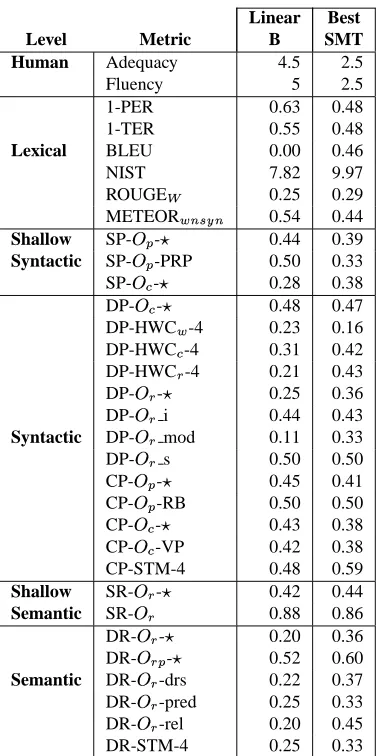
Metrics at deeper linguistic levels allow for partially over-coming this problem by inspecting syntactic and semantic structures. However, as it can be observed in the case se-lected, these structures may also exhibit a great variabil-ity. For instance, the translation by LinearB is considerably shorter than expected according to human references. Be-sides, while reference translations use “you must” or “you have”, the LinearB translation uses “you should”. Also, LinearB selected the verb form “cooperate” instead of “be more united and cooperative”, etc. Table 7 shows the scores conferred by several metrics. It can be observed how lex-ical metrics completely fail to reflect the actual quality of the LinearB output. Indeed, only some dependency-based metrics are able to capture its quality (e.g.,‘DP-HWCm’). In the case depicted in Table 8, differences are mostly re-lated to the sentence structure. Table 9 shows the scores conferred by several metrics. It can be observed, for in-stance, that several lexical metrics are able to capture the superior quality of the LinearB translation. In contrast, metrics at deeper linguistic levels do not reflect, in general, this difference in quality. Interestingly, only some syntax-based metrics confer a slightly higher score to LinearB (e.g., ‘SP-i j -l ’ ‘DP-HWCe -4’ ‘CP-i j -l ’ ‘CP-inm -l ’, etc.). All these metrics share the common property of comput-ing lexical overlappcomput-ing/matchcomput-ing over syntactic structures or grammatical categories.
4LinearB translation receives high scores from human
LinearB: It is important to analyze and address these problems properly .
Best SMT: It should be to analyze these problems and take them up properly .
Reference 1: We must analyze these problems and handle them correctly .
2: So we must analyze these problems and take them in the right way .
3: We must correctly analyze and properly handle these problems .
4: And so it is imperative that we analyze these problems and deal with them properly .
5: And so we must correctly analyze and properly handle these problems .
Table 8: Translation Case #728.
Linear Best Level Metric B SMT Human Adequacy 4.5 2.5
Fluency 5 2.5
1-PER 0.63 0.48
1-TER 0.55 0.48
Lexical BLEU 0.00 0.46
NIST 7.82 9.97
ROUGEr 0.25 0.29
METEORs>t$uvAt 0.54 0.44 Shallow SP-wkx -y 0.44 0.39 Syntactic SP-wkx -PRP 0.50 0.33 SP-wnz -y 0.28 0.38 DP-wz-y 0.48 0.47 DP-HWCs -4 0.23 0.16 DP-HWCz-4 0.31 0.42 DP-HWC{ -4 0.21 0.43 DP-w { -y 0.25 0.36
DP-w#{ i 0.44 0.43
Syntactic DP-w#{ mod 0.11 0.33
DP-w#{ s 0.50 0.50
CP-w x -y 0.45 0.41 CP-wx -RB 0.50 0.50 CP-w z-y 0.43 0.38 CP-wz-VP 0.42 0.38
CP-STM-4 0.48 0.59
Shallow SR-w { -y 0.42 0.44 Semantic SR-w#{ 0.88 0.86 DR-w{ -y 0.20 0.36 DR-w{9x -y 0.52 0.60 Semantic DR-w{ -drs 0.22 0.37
DR-w
{ -pred 0.25 0.33 DR-w{ -rel 0.20 0.45
DR-STM-4 0.25 0.33
Table 9: Analysis of test case #728
In order to deal with divergences between system outputs and reference translations, other authors have suggested taking advantage of paraphrasing support so as to extend the reference material (Russo-Lassner et al., 2005; Zhou et al., 2006; Kauchak and Barzilay, 2006; Owczarzak et al., 2006). We believe the two approaches could be combined.
4.
Conclusions and Future Work
We have presented a valid path towards heterogeneous au-tomatic MT error analysis. Our approach allows develop-ers to rapidly obtain detailed automatic linguistic reports on their system’s capabilities. Thus, human efforts may con-centrate on high-level analysis.Still, our proposal presents a limitation. It relies on a rich set of evaluation measures, most of which are based on
language dependent automatic linguistic processors which may not be always available and whose quality may vary5. However, in our opinion, although these resources may be expensive to produce, unlike manual evaluations, they of-fer the important advantage of being reusable along the de-velopment cycle as systems and metrics improve. Besides, they are useful for NLP applications in general.
For future work, we plan to enhance the interface of the evaluation tool, currently in text format, so as to allow for a fast and elegant visual access from different viewpoints cor-responding to the different dimensions of quality. Besides, evaluation measures generate, as a by-pass product, syntac-tic and semansyntac-tic analyses which could be displayed. This would allow users to separately analyze the translation of different types of linguistic elements (e.g., constituents, re-lationships, arguments, adjuncts, discourse representation structures, etc.). For instance, missing or partially trans-lated elements could appear highlighted in different colors.
Acknowledgements
This research has been funded by the Spanish Ministry of Education and Science, project OpenMT (TIN2006-15307-C03-02). Our NLP group has been recognized as a Qual-ity Research Group (2005 SGR-00130) by DURSI, the Re-search Department of the Catalan Government. We are grateful to the NIST MT Evaluation Campaign organizers, and participants who agreed to share their system outputs for the purpose of this research.
5.
References
Enrique Amig ´o, Julio Gonzalo, Anselmo Pe˜nas, and Felisa Verdejo. 2005. QARLA: a Framework for the Evalua-tion of Automatic SumarizaEvalua-tion. In Proceedings of the
43th Annual Meeting of the Association for Computa-tional Linguistics.
Enrique Amig ´o, Jes´us Gim´enez, Julio Gonzalo, and Llu´ıs M`arquez. 2006. MT Evaluation: Human-Like vs. Hu-man Acceptable. In Proceedings of the Joint 21st
Inter-national Conference on Computational Linguistics and the 44th Annual Meeting of the Association for Compu-tational Linguistics (COLING-ACL).
Satanjeev Banerjee and Alon Lavie. 2005. METEOR: An Automatic Metric for MT Evaluation with Improved Correlation with Human Judgments. In Proceedings of
ACL Workshop on Intrinsic and Extrinsic Evaluation Measures for MT and/or Summarization.
5Currently, most metrics are only available for English. Some
Chris Callison-Burch, Miles Osborne, and Philipp Koehn. 2006. Re-evaluating the Role of BLEU in Machine Translation Research. In Proceedings of EACL.
Simon Corston-Oliver, Michael Gamon, and Chris Brock-ett. 2001. A Machine Learning Approach to the Auto-matic Evaluation of Machine Translation. In
Proceed-ings of the 39th Annual Meeting of the Association for Computational Linguistics (ACL), pages 140–147.
George Doddington. 2002. Automatic evaluation of ma-chine translation quality using n-gram co-occurrence statistics. In Proceedings of the 2nd Internation
Confer-ence on Human Language Technology, pages 138–145.
Michael Gamon, Anthony Aue, and Martine Smets. 2005. Sentence-Level MT evaluation without reference trans-lations: beyond language modeling. In Proceedings of
EAMT, pages 103–111.
Jes´us Gim´enez and Llu´is M`arquez. 2008. On the Robust-ness of Linguistic Features for Automatic MT Evalua-tion. (Under submission).
Jes´us Gim´enez and Llu´ıs M`arquez. 2007. Linguistic Fea-tures for Automatic Evaluation of Heterogeneous MT Systems. In Proceedings of the ACL Workshop on
Sta-tistical Machine Translation, pages 256–264.
Jes´us Gim´enez. 2007. IQMT v2.1. Technical Man-ual (LSI-07-29-R). Technical report, TALP Research Center. LSI Department. http://www.lsi.upc.edu/˜nlp/-IQMT/IQMT.v2.1.pdf.
Hans Kamp. 1981. A Theory of Truth and Semantic Rep-resentation. In J.A.G. Groenendijk, T.M.V. Janssen, and M.B.J. Stokhof, editors, Formal Methods in the Study of
Language, pages 277–322. Mathematisch Centrum,
ad-dress = Amsterdam.
David Kauchak and Regina Barzilay. 2006. Paraphrasing for Automatic Evaluation. In Proceedings of the Joint
Conference on Human Language Technology and the North American Chapter of the Association for Compu-tational Linguistics (HLT-NAACL), pages 455–462.
Alex Kulesza and Stuart M. Shieber. 2004. A learn-ing approach to improvlearn-ing sentence-level MT evalua-tion. In Proceedings of the 10th International
Confer-ence on Theoretical and Methodological Issues in Ma-chine Translation.
Audrey Le and Mark Przybocki. 2005. NIST 2005 ma-chine translation evaluation official results. In Official
release of automatic evaluation scores for all submis-sions, August.
Chin-Yew Lin and Franz Josef Och. 2004a. Auto-matic Evaluation of Machine Translation Quality Using Longest Common Subsequence and Skip-Bigram Stat-ics. In Proceedings of the 42nd Annual Meeting of the
Association for Computational Linguistics (ACL).
Chin-Yew Lin and Franz Josef Och. 2004b. ORANGE: a Method for Evaluating Automatic Evaluation Metrics for Machine Translation. In Proceedings of the 20th
International Conference on Computational Linguistics (COLING).
Ding Liu and Daniel Gildea. 2005. Syntactic Features for Evaluation of Machine Translation. In Proceedings
of ACL Workshop on Intrinsic and Extrinsic Evaluation Measures for MT and/or Summarization.
Dennis Mehay and Chris Brew. 2007. BLEUATRE: Flat-tening Syntactic Dependencies for MT Evaluation. In
Proceedings of the 11th Conference on Theoretical and Methodological Issues in Machine Translation (TMI).
I. Dan Melamed, Ryan Green, and Joseph P. Turian. 2003. Precision and Recall of Machine Translation. In
Pro-ceedings of the Joint Conference on Human Language Technology and the North American Chapter of the As-sociation for Computational Linguistics (HLT-NAACL).
Sonja Nießen, Franz Josef Och, Gregor Leusch, and Her-mann Ney. 2000. An Evaluation Tool for Machine Translation: Fast Evaluation for MT Research. In
Pro-ceedings of the 2nd International Conference on Lan-guage Resources and Evaluation.
Karolina Owczarzak, Declan Groves, Josef Van Genabith, and Andy Way. 2006. Contextual Bitext-Derived Para-phrases in Automatic MT Evaluation. In Proceedings of
the 7th Conference of the Association for Machine Trans-lation in the Americas (AMTA), pages 148–155.
Karolina Owczarzak, Josef van Genabith, and Andy Way. 2007. Dependency-Based Automatic Evaluation for Ma-chine Translation. In Proceedings of SSST,
NAACL-HLT/AMTA Workshop on Syntax and Structure in Sta-tistical Translation, pages 80–87.
Kishore Papineni, Salim Roukos, Todd Ward, and Wei-Jing Zhu. 2001. Bleu: a method for automatic evaluation of machine translation, rc22176. Technical report, IBM T.J. Watson Research Center.
Grazia Russo-Lassner, Jimmy Lin, and Philip Resnik. 2005. A Paraphrase-Based Approach to Machine Trans-lation Evaluation. Technical report, University of Mary-land, College Park.
Matthew Snover, Bonnie Dorr, Richard Schwartz, Linnea Micciulla, , and John Makhoul. 2006. A Study of Trans-lation Edit Rate with Targeted Human Annotation. In
Proceedings of AMTA, pages 223–231.
C. Tillmann, S. Vogel, H. Ney, A. Zubiaga, and H. Sawaf. 1997. Accelerated DP based Search for Statistical Trans-lation. In Proceedings of European Conference on
Speech Communication and Technology.
Liang Zhou, Chin-Yew Lin, and Eduard Hovy. 2006. Re-evaluating Machine Translation Results with Paraphrase Support. In Proceedings of the Conference on
Empiri-cal Methods in Natural Language Processing (EMNLP),