Proceedings of Recent Advances in Natural Language Processing, pages 431–437,
Word Embeddings for Multi-label Document Classification
Ladislav Lenc†‡ ‡NTIS – New Technologies for the Information Society, University of West Bohemia,
Plzeˇn, Czech Republic
Pavel Kr´al†‡ †Department of Computer
Science and Engineering, University of West Bohemia,
Plzeˇn, Czech Republic
Abstract
In this paper, we analyze and evaluate word embeddings for representation of longer texts in the multi-label document classification scenario. The embeddings are used in three convolutional neural net-work topologies. The experiments are realized on the Czech ˇCTK and English Reuters-21578 standard corpora. We com-pare the results of word2vec static and trainable embeddings with randomly ini-tialized word vectors. We conclude that initialization does not play an important role for classification. However, learning of word vectors is crucial to obtain good results.
1 Introduction
Text classification (or categorization) is one of the core tasks in natural language processing (NLP) field. The applications of text classification are numerous as for instance sentiment analysis, au-tomatic categorization of e-mails or spam filter-ing. The main goal of document classification is to assign one or more labels to a given document. The categorization then helps the users to find ap-propriate documents. Nowadays, computers are heavily utilized for this task and can save a great amount of human labor.
In this paper, we concentrate on multi-label doc-ument classification which means that one docu-ment can belong to more classes simultaneously. More formally, given a set of documentsDand a set of all possible labelsCwe create a model that assigns a setCd⊂Cto the documentd∈D.
Multi-label classification is often solved using an ensemble of binary classifiers (Tsoumakas and Katakis, 2006). However, nowadays, neural nets outperform majority of artificial intelligence
ap-proaches including computer vision and natural language processing. Therefore, in this work we use different approaches based on convolutional neural nets (CNNs) which were already presented inKim(2014) andLenc and Kr´al(2017).
Usually, the pre-trained word vectors ob-tained by some semantic model (e.g. word2vec (w2v) (Mikolov et al., 2013a) or glove ( Penning-ton et al., 2014)) are used for initialization of the embedding layer of the particular neural net. These vectors can then be progressively adapted during neural network training. It was shown in many experiments that it is possible to obtain bet-ter results using these vectors compared to the ran-domly initialized vectors. Moreover, it has been proven that even “static” vectors (initialized by pre-trained embeddings and fixed during the net-work training) usually bring better performance than randomly initialized and trained ones.
However, the experiments were often realized on rather shorter texts and in single-label classifi-cation task. In this paper, we would like to analyze and evaluate the use of word embeddings for rep-resentation of longer texts in multi-label classifi-cation scenario. The embeddings are used in three different convolutional neural network topologies. The experiments are realized on the Czech ˇCTK and English Reuters-21578 standard corpora. The Czech language has been chosen as a represen-tative of highly inflectional Slavic language with a free word order. English is used to compare the results of our method with state of the art.
We compare the results with word2vec static and trainable embeddings with randomly ized word vectors. We conclude that the initial-ization does not play an important role for classi-fication of these documents. We further analyze and compare the word2vec embeddings with the learned ones from the semantic point of view and discuss the results.
The rest of the paper is organized as follows. The following section contains a short review of the usage of neural networks for document classi-fication including word embeddings. Section3 de-scribes topologies of the convolutional networks. Section 4 deals with experiments realized on the ˇCTK and Reuters corpora and then analyzes and discusses the obtained results. In the last section, we conclude the experimental results and propose some future research directions.
2 Related Work
Nowadays, neural nets belong to the state-of-the art approaches on many natural language process-ing tasks as for instance POS taggprocess-ing, chunkprocess-ing, named entity recognition, semantic role labeling or document classification (Collobert et al.,2011). First, we mention traditional feed-forward neu-ral nets as shown for instance in (Manevitz and Yousef, 2007). The authors obtain F-measure about 78% on the standard Reuters dataset with a simple multi-layer perceptron with three lay-ers. The standard backpropagation algorithm for multi-label learning of an MLP was improved in (Zhang and Zhou, 2006). The authors use a novel error function which gives better results on functional genomics text categorization.
Nam et al.(2014) propose a novel learning strat-egy of feed-forward nets for multi-label text clas-sification task. The authors use cross-entropy al-gorithm for training with rectified linear units ac-tivation (Srivastava et al., 2014). The documents are represented by tf-idf and multi-label classifi-cation is realized by a simple thresholding of the output layer. The networks are evaluated on sev-eral multi-label datasets and obtain results compa-rable with the state of the art.
Both, standard convolutional networks and re-current convolutional neural nets are also success-fully used for text categorization. The authors (Lai et al., 2015) demonstrated that recurrent CNNs outperform CNNs on four corpora in single-label document classification task.
Another CNN based method with word embed-dings as inputs (Kurata et al.,2016) leverages the co-occurrence of labels in the multi-label classi-fication. Some neurons in the output layer cap-ture the patterns of label co-occurrences, which improves the classification accuracy. This method is evaluated on the natural language query classi-fication in a document retrieval system.
An alternative multi-label classification ap-proach is proposed by Yang and Gopal (2012). The conventional representations of texts and cat-egories are transformed into meta-level features. These features are then utilized in a learning-to-rank algorithm. Experiments on six benchmark datasets show good abilities of this approach in comparison with other methods.
Three different types of word embeddings with CNNs are compared inKim(2014) on 7 NLP tasks including sentiment analysis and question classifi-cation. The author proposes a novel CNN topol-ogy and shows that word2vec initialization and a subsequent learning plays a crucial role for all sentence-level single-label classification tasks.
3 Network Topologies
In this section we describe the three CNN network topologies used in our experiments. The network inputs are the sequences of word indices into a vo-cabularyV of the size|V|. In order to ensure the fixed length, all documents are padded or short-ened to a specified lengthM. These are then rep-resented as real-valued word vectors of dimension Ein the embedding layer. The embedding layer is either initialized randomly or by pre-trained word vectors from word2vec1. In the case of word2vec
initialization, the layer is either further learned during the training process or is kept static. The in-put and the embedding layer is similar in all three following network topologies. The concrete val-ues of the main hyper-parameters of the following networks are specified in Section4.
3.1 Convolutional Network 1
This architecture was proposed inLenc and Kr´al
(2017) for multi-label document classification. The embedding layer is followed by a convo-lutional layer, where we useNC convolution
ker-nels of the sizek×1. It uses rectified linear unit (ReLU) activation function. The following layer performs max pooling over the lengthM−k+ 1
resulting inNC 1×E vectors. The output of this
layer is then flattened and connected with a fully connected layer withd1neurons. The output layer
uses sigmoid activation function and its size cor-responds to the number of categories|C|. The fi-nal result is obtained by thresholding of the output layer.
1It is possible to use other semantic model, however based
This architecture will hereafter be referenced as CNN1.
3.2 Convolutional Network 2
The second architecture is a modified version of a successful net proposed byKim(2014).
Contrary to the first topology, this network uses two-dimensional convolutional kernels of various widths. The sizes of the kernels arek×Ewhich means that it takes the whole length of the em-bedding. The original version is used for single-label classification and therefore it uses softmax activation function in the output layer. In our case, sigmoid is more appropriate due to the multi-label classification task. Similarly as in the previous topology, we also added one fully connected layer before the output. The output layer of the size|C|
is also thresholded to determine the set of assigned categories.
This network will be further called CNN2. The architecture is described in detail inKim (2014). The threshold values for both CNN1 and CNN2 are set on the development corpus.
3.3 Two-level CNN
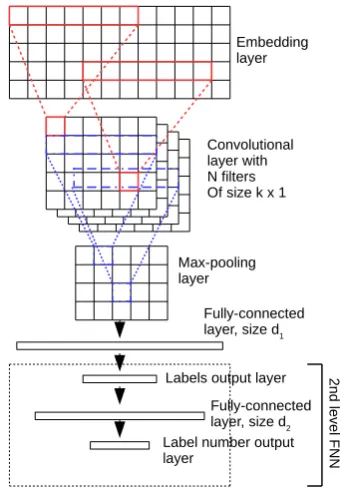
The first level of this network is the CNN1 topol-ogy described above. However, the output is not thresholded as in the former case. This net-work uses a multi-layer perceptron with one hid-den layer to predict the number of labels.
It takes the output of the CNN S and learns a functionl=f(S)that maps the vectorSto the number of relevant labelsl. The output layer has softmax activation. After determining the number of labels thel categories with the highest activa-tions are assigned to the document.
Figure1shows the architecture of this network where the CNN and 2nd-level FNN are merged. This topology will be hereafter referenced as 2L-CNN.
4 Experiments
This section describes first the tools and corpora used for evaluation of the approaches. Then we deal with the preprocessing stage and set-up of hyper-parameters of our networks. We describe further our experiments on Czech and English standard corpora and analyze the results.
4.1 Tools and Corpora
For implementation of all neural nets we used Keras tool-kit (Chollet, 2015) which is based on
Figure 1: Two-level CNN architecture (2L-CNN).
the Theano deep learning library (Bergstra et al.,
2010). It has been chosen mainly because of good performance and our previous experience with this tool. For evaluation of the multi-label document classification results, we use the standard recall, precision and F-measure (F1) metrics (Powers,
2011). The values are micro-averaged.
Word2vec vectors for Czech experiments are trained on Czech Wikipedia (Svoboda and Brychc´ın, 2016). For the English experiments we utilize the standard vectors trained on part of Google News dataset (Mikolov et al.,2013b).
4.1.1 Czech Text Document Corpus v 1.0
0 500 1000 1500 2000 2500
200 400 600 800 1000
Documents
Document length (words)
Figure 2: Document lengths in ˇCTK dataset.
0 500 1000 1500 2000 2500 3000
200 400 600 800 1000
Documents
Document length (words)
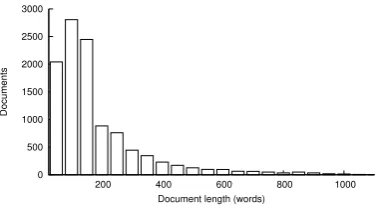
Figure 3: Document lengths in Reuters dataset.
4.1.2 Reuters-21578 English Corpus
The Reuters-215782 corpus is a collection of
21,578 documents. However, these documents in-clude examples with no topics and with errors. Therefore, we use the commonly utilized version where the training part is composed of 7769 doc-uments, while 3019 documents are reserved for testing. The number of possible categories is 90 and average label/document number is 1.23. Aver-age document length is 159. This dataset is used in order to compare the performance of our networks with the state of the art. Distribution of document lengths is shown in Figure3.
4.2 Preprocessing
The same preprocessing was performed for both Czech and English corpora. First we replaced all numbers in the texts by one common token “NUMERIC”. The following characters were re-moved: [.,- ?!#:%()+”] The texts were then low-ercased and a simple tokenization according to a space was done. To ensure a fixed length we either shortened the documents to a size of M = 400
or padded it by a token “PADDING” to the same length. We used two vocabulary sizes, namely 1000 and 20,000 most frequent words. Words not present in the vocabulary are replaced by an “OOV” (out of vocabulary) token.
2http://www.daviddlewis.com/resources/testcollections/
reuters21578/
4.3 Hyper-parameters Set-up
The embedding vector length is set to 300 in all cases to allow the utilization of the pre-trained vectors and for a straightforward comparison with the learned ones.
The first network (CNN1) uses 40 kernels of length 16 according to (Lenc and Kr´al, 2017). ReLU activation is used in convolutional layer. The following layer contains 256 neurons and the output layer has 37 or 90 neurons according to the used corpus.
The second network (CNN2) utilizes three ker-nel widthsk ∈3,4,5as proposed in (Kim,2014) (100 filters are used for each width). The convolu-tional layer is followed by a fully-connected layer with 256 neurons and the output layer is the same as in the previous case.
The two-level network (2L-CNN) merges the CNN1 network and an MLP with 100 neurons in the hidden layer and 8 neurons in the output layer indicating the number of assigned labels. The out-put layer uses softmax activation function.
All networks are trained for 20 epochs using adaptive moment estimation optimization algo-rithm (Kingma and Ba, 2014). Mean square er-ror loss function is used for the MLP determining the number of labels while binary cross-entropy is used for all CNNs.
4.4 Results on the Czech Corpus
We first present the results of the CNNs on the Czech Corpus (see Table 1). CNN1 and CNN2 are used with thresholding, the thresholds are set experimentally on the development set. Hyper-parameters of the 2L-CNN were also set on this set. The upper part shows the results for vocab-ulary size 1000 while the lower one uses 20,000 words.
This table shows that the size of the vocabu-lary plays an important role for document clas-sification. The second interesting observation is that the results of the usage of the embeddings for all networks are consistent. The lowest scores are in all cases obtained with w2v static embeddings while the best classification results are generally achieved with randomly initialized embeddings.
Method Prec. Recall F1[%]
Vocabulary size 1000
CNN1, w2v static 57.58 70.92 63.56 CNN1, random 71.56 70.84 71.20 CNN1, w2v trainable 72.97 70.02 71.47 CNN2, w2v static 63.86 75.19 69.07 CNN2, random 70.33 71.37 70.84 CNN2, w2v trainable 69.55 71.66 70.59 2L-CNN, w2v static 67.12 62.21 64.57 2L-CNN, random 75.24 68.20 71.55 2L-CNN, w2v trainable 75.76 66.97 71.10
Vocabulary size 20,000
CNN1, w2v static 64.89 79.88 71.61 CNN1, random 84.84 83.55 84.19 CNN1, w2v trainable 84.62 82.86 83.73 CNN2, w2v static 77.58 80.26 78.90 CNN2, random 80.36 79.59 79.97 CNN2, w2v trainable 79.83 80.96 80.39 2L-CNN, w2v static 76.36 70.20 73.15 2L-CNN, random 87.67 80.95 84.17 2L-CNN, w2v trainable 87.60 79.05 83.10
Table 1: Results of the CNNs on the Czech corpus.
Another interesting observation is that the role of training of the embeddings in the CNN2 is very small compared to the other two nets. The reason for this behavior can be different size and number of convolutional kernels.
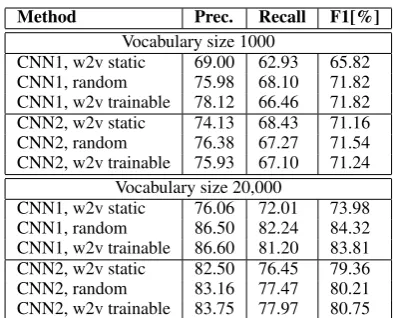
In the second experiment, we show in Table 2
the impact of the optimal thresholds for classifica-tion using CNN1 and CNN2 nets. This experiment is done in order to determine the threshold values for English corpus where the development set is missing. Moreover, we also would like to analyze the impact of this optimal value on classification. The thresholds are thus set on the whole corpus. As in the previous case, the upper section of the table uses the vocabulary size 1000 and the lower one 20,000.
We must note that these data cannot be pre-sented as “fair” results for the Czech dataset. However, our goal is to compare the different types of embeddings and this experiment well il-lustrates the ceiling which can be reached using a particular setting.
This experiment also shows that these results are comparable to the Table 1, therefore we can conclude that the threshold values set on develop-ment corpus are appropriate and that the methods are robust to the sub-optimally set thresholds. The second observation is that the behavior of all net-works with different kinds of embeddings is simi-lar as in the previous case.
Method Prec. Recall F1[%]
Vocabulary size 1000
CNN1, w2v static 69.00 62.93 65.82 CNN1, random 75.98 68.10 71.82 CNN1, w2v trainable 78.12 66.46 71.82 CNN2, w2v static 74.13 68.43 71.16 CNN2, random 76.38 67.27 71.54 CNN2, w2v trainable 75.93 67.10 71.24
Vocabulary size 20,000
CNN1, w2v static 76.06 72.01 73.98 CNN1, random 86.50 82.24 84.32 CNN1, w2v trainable 86.60 81.20 83.81 CNN2, w2v static 82.50 76.45 79.36 CNN2, random 83.16 77.47 80.21 CNN2, w2v trainable 83.75 77.97 80.75
Table 2: Results of CNN1 and CNN2 on the Czech corpus with optimal threshold values.
4.5 Results on the English Reuters Dataset
This experiment is realized in order to show the impact of the different embeddings on the stan-dard English corpus. We use the 300-dimensions English word2vec embeddings trained on Google News3.
This table shows that the role of the embeddings on English language is similar to the previous one, however it slightly differs in the case of the CNN2. This network gives comparable results for all embedding types. Moreover the best score is ob-tained with w2v static embeddings, however this difference is not statistically significant.
The behavior of the embeddings in the other two CNNs is similar as in the previous Czech ex-periments, where word2vec initialization does not play any positive role for classification. A rea-son for such difference in Czech and English could be caused by the quality of the word2vec embed-dings. The best performing network is the 2L-CNN with randomly initialized embeddings. The resulting F-measure is comparable to the value of 87.89% presented in (Nam et al.,2014).
4.6 Embedding Analysis
In this experiment we analyze the semantic simi-larity of the embedding vectors learned during the network training and compare them with the stan-dard word2vec vectors. We employ the cosine dis-tance to identify 5 most similar words.
We have chosen word “Brit´anie” (Britain) and show the most similar words both for Czech and English embeddings. The results of the Czech ex-periment are reported in Table4while the results
3https://code.google.com/archive/p/
Method Prec. Recall F1[%]
CNN1 w2v static 84.37 73.40 78.50 CNN1 random 87.26 86.14 86.69 CNN1 w2v trainable 90.63 82.18 86.20 CNN2 w2v static 89.42 78.34 83.51 CNN2 random 89.82 76.79 82.79 CNN2 w2v trainable 89.10 78.42 83.42 2L-CNN, w2v static 82.89 74.41 78.42 2L-CNN, random 90.39 84.96 87.59 2L-CNN, w2v trainable 91.03 82.39 86.50
Table 3: Results of the CNNs on the Reuters dataset, vocabulary size is set to 20,000.
Word Cos. Word Cos.
w2v (static) CNN1, random
Nˇemecko (Germany) 0.65 tˇret´ı (third) 0.20 usa 0.63 v´yroba (production) 0.19 velk´a (great) 0.60 hlavnˇe (mainly) 0.19 spojen´e (united) 0.59 Rusko (Russia) 0.18 Rusko (Russia) 0.58 procent (percent) 0.18
CNN2, random CNN2, w2v trainable
premi´er (p. minister) 0.51 nˇemecko (Germany) 0.51 vl´ady (governments) 0.49 vl´ada (government) 0.43 vl´ada (government) 0.48 Lond´yn (London) 0.40 ´ustavu (institute) 0.47 tun (tons) 0.39 vl´adn´ı
(governmen-tal) 0.46 prezidentdent) (presi- 0.38
Table 4: 5 closest words to “Brit´anie (Britain)” in Czech.
on English embeddings shows Table5. The upper part compares the word2vec (static) embeddings with the vectors learned by CNN1. The lower part then compares the randomly initialized em-beddings learned by CNN2 with vectors that were initialized by word2vec and progressively adapted during the training of CNN2.
Table 4 shows that all similarity values except CNN1 values are comparable. The CNN1 vec-tors differ significantly from the word2vec ones regarding the similarity values. We can observe similar results for both variants learned by CNN2. From the point of view of the semantic similar-ity of words, this experiment shows, that the lists of words differ and there is just only few common ones. On the other hand, the majority of words are for all cases really semantically close and related to the word Britain.
Table5shows the same experiment carried out with the English word2vec. There is again higher difference between word2vec and CNN1 vectors. However, the variants of CNN2 vectors differ more significantly than in the case of Czech em-beddings. This experiment shows, that the lists of words differ as in the previous case and that there is only few common ones.
Word Cos. Word Cos.
w2v (static) CNN1, random
mining 0.41 based 0.24
cents 0.39 tird 0.21
opec 0.38 statistics 0.18
gold 0.34 amount 0.16
quarterly 0.33 october 0.16
CNN2, random CNN2, w2v trainable
line 0.19 intervention 0.33
accord 0.19 october 0.33
estimates 0.18 adding 0.31
share 0.18 investment 0.30
same 0.16 ministers 0.29
Table 5: Closest words to “Britain” in English.
5 Conclusions and Future Work
This paper analyzed and evaluated word embed-dings in convolutional neural networks for repre-sentation of longer texts in multi-label classifica-tion task. Three different CNNs topologies were used. The experiments were realized on Czech
ˇCTK and English Reuters-21578 corpora.
We compared the results of word2vec static and trainable embeddings with randomly initial-ized word vectors. We concluded that initializa-tion does not play an important role for multi-label document classification in both languages. How-ever, learning of word vectors is crucial to obtain good classification score. This behavior should be justified by a sufficient amount of the relatively long documents. This fact improves the conver-gence of our models during training and also de-creases the impact of the particular words for the whole classification. We further analyzed both word2vec static and learned embeddings from the semantic point of view and discussed the results. We can conclude that although the semantically closest words differ significantly, they are all close from the semantic point of view.
In future work, we would like to study the im-pact of document length to the classification re-sults with randomly initialized embeddings and pre-trained word vectors. We could also have used different network topologies to further im-prove the performance of document classification. A subsequent analysis of the behavior of the em-beddings in these nets will be also realized. Acknowledgments
References
James Bergstra, Olivier Breuleux, Fr´ed´eric Bastien, Pascal Lamblin, Razvan Pascanu, Guillaume Des-jardins, Joseph Turian, David Warde-Farley, and Yoshua Bengio. 2010. Theano: a cpu and gpu math expression compiler. InProceedings of the Python for scientific computing conference (SciPy). Austin, TX, volume 4, page 3.
Franois Chollet. 2015. keras. https://github. com/fchollet/keras.
Ronan Collobert, Jason Weston, L´eon Bottou, Michael Karlen, Koray Kavukcuoglu, and Pavel Kuksa. 2011. Natural language processing (almost) from scratch. The Journal of Machine Learning Research 12:2493–2537.
Yoon Kim. 2014. Convolutional neural net-works for sentence classification. arXiv preprint arXiv:1408.5882.
Diederik Kingma and Jimmy Ba. 2014. Adam: A method for stochastic optimization. arXiv preprint arXiv:1412.6980.
Gakuto Kurata, Bing Xiang, and Bowen Zhou. 2016. Improved neural network-based multi-label classifi-cation with better initialization leveraging label co-occurrence. InProceedings of NAACL-HLT. pages 521–526.
Siwei Lai, Liheng Xu, Kang Liu, and Jun Zhao. 2015. Recurrent convolutional neural networks for text classification .
Ladislav Lenc and Pavel Kr´al. 2017. Deep neural networks for Czech multi-label docu-ment classification. CoRR abs/1701.03849. http://arxiv.org/abs/1701.03849.
L. Manevitz and M. Yousef. 2007. One-class document One-classification via neural net-works. Neurocomputing 70(7-9):1466–1481. https://doi.org/10.1016/j.neucom.2006.05.013.
Tomas Mikolov, Kai Chen, Greg Corrado, and Jeffrey Dean. 2013a. Efficient estimation of word represen-tations in vector space. InProceedings of Workshop at ICLR.
Tomas Mikolov, Ilya Sutskever, Kai Chen, Greg S Cor-rado, and Jeff Dean. 2013b. Distributed representa-tions of words and phrases and their compositional-ity. InAdvances in neural information processing systems. pages 3111–3119.
Jinseok Nam, Jungi Kim, Eneldo Loza Menc´ıa, Iryna Gurevych, and Johannes F¨urnkranz. 2014. Large-scale multi-label text classification - revisiting neu-ral networks. In Joint European Conference on Machine Learning and Knowledge Discovery in Databases. Springer, pages 437–452.
Jeffrey Pennington, Richard Socher, and Christopher Manning. 2014. Glove: Global vectors for word representation. In Proceedings of the 2014 Con-ference on Empirical Methods in Natural Language Processing (EMNLP). Association for Computa-tional Linguistics, Doha, Qatar, pages 1532–1543. http://www.aclweb.org/anthology/D14-1162. DMW Powers. 2011. Evaluation: From precision,
re-call and f-measure to roc., informedness, marked-ness & correlation. Journal of Machine Learning Technologies2(1):37–63.
Nitish Srivastava, Geoffrey E Hinton, Alex Krizhevsky, Ilya Sutskever, and Ruslan Salakhutdinov. 2014. Dropout: a simple way to prevent neural networks from overfitting. Journal of Machine Learning Re-search15(1):1929–1958.
Luk´aˇs Svoboda and Tom´avs Brychc´ın. 2016. New word analogy corpus for exploring embed-dings of czech words. CoRR abs/1608.00789. http://arxiv.org/abs/1608.00789.
Grigorios Tsoumakas and Ioannis Katakis. 2006. Multi-label classification: An overview. Interna-tional Journal of Data Warehousing and Mining 3(3).
Yiming Yang and Siddharth Gopal. 2012. Multilabel classification with meta-level features in a learning-to-rank framework. Machine Learning88(1-2):47– 68.