693
Generating Challenge Datasets for Task-Oriented Conversational Agents
through Self-Play
Sourabh Majumdar1, Serra Sinem Tekiro˘glu2, and Marco Guerini2
1The State University of New York, NY 14260, Buffalo, USA
2Fondazione Bruno Kessler, Via Sommarive 18, Povo, Trento, Italy
[email protected], [email protected]
Abstract
End-to-end neural approaches are becom-ing increasbecom-ingly common in conversa-tional scenarios due to their promising performances when provided with suffi-cient amount of data. In this paper, we present a novel methodology to address the interpretability of neural approaches in such scenarios by creating challenge datasets using dialogue self-play over mul-tiple tasks/intents. Dialogue self-play al-lows generating large amount of synthetic data; by taking advantage of the com-plete control over the generation process, we show how neural approaches can be evaluated in terms of unseen dialogue pat-terns. We propose several out-of-pattern test cases each of which introduces a nat-ural and unexpected user utterance phe-nomenon. As a proof of concept, we built a single and a multiple memory net-work, and show that these two architec-tures have diverse performances depend-ing on the peculiar dialogue patterns.
1 Introduction
In recent years, there has been an increasing re-search on neural approaches for conversational systems. Such approaches include the realiza-tion of full end-to-end systems (Serban et al.,
2016;Bordes et al.,2017), the capacity to incor-porate or query structured knowledge sources into neural architectures (Eric and Manning, 2017), the use of zero-shot learning or of synthetic di-alogues generation techniques to mitigate effort of domain portability (Zhao and Eskenazi, 2018;
Guerini et al., 2018). Although state-of-the-art neural models achieve high performances in many domains, the sheer size of data they require
repre-sents a bottleneck, especially for under-resourced dialogue domains. In addition, it is hard to inter-pret their behaviour since neural models are in-trinsically opaque. In this paper we propose a novel methodology to address the aforementioned problems by synthetically creating conversation datasets with peculiar characteristics. In partic-ular, we focus on (i) scalable and portable ap-proaches for generating dialogues from scratch in-volving complex and structured knowledge, and (ii) strategies for isolating and evaluating specific reasoning capabilities of neural architectures using synthetic challenge sets. To this end, we utilize dialogue self-play strategies (Shah et al., 2018) simulating task oriented dialogues between a con-versational agent and a user. Dialogue simulation grants complete control over the generated data al-lowing building special test cases, each of which introduces a natural and unexpected user utterance phenomenon, that has never been seen at training time. It should be noted that the use of natural data would requiremanualannotation/selection of ex-amples for each phenomenon of interest, making this goal intractable.
Another problem with current datasets is the lack of exhaustiveness: they usually focus on one specific domain intent. There are few datasets cov-ering multiple intents in the same scenario, but usually these intents are very different from one another – e.g. weather forecast and play music in a car scenario (Eric and Manning,2017). For this reason, we choose a compelling low resource dia-logue domain, i.e. Banking, that allows us to bring together multiple tasks (e.g. transfer money, check balance, block card).
2 Related Work
inves-tigating the learning capabilities of neural con-versational agents. For this reason, we will dis-cuss some artificial conversational datasets, test-ing strategies for dialogue models, and the main dialogue systems approaches.
Artificial Datasets.Many conversational datasets rely on crowd sourcing (Jurˇc´ıˇcek et al.,2011; Kel-ley,1984), cooperating corporations (Raux et al.,
2005), already available records (Lowe et al.,
2015; Danescu-Niculescu-Mizil and Lee, 2011), or participation with the real world (Yu et al.,
2015;Zue et al.,1994). Moreover, available task oriented dialogue datasets are mainly focused on very specific domains, such as restaurant reser-vation (Jurˇc´ıˇcek et al., 2011; Henderson et al.,
2014), flight booking (Zue et al.,1994), bus infor-mation systems (Raux et al.,2005) and giving di-rections to rooms in a hotel (Yu et al.,2015). Since the collection of whole dialogues is usually very expensive and time consuming, there have been efforts in building methodologies that allow fast and cheap data collection (Shah et al.,2018; Kel-ley,1984). Artificial data generation is an effec-tive methodology for obtaining well defined train-ing datasets. Bordes et al.(2017) uses a simulator for this purpose. Other approaches artificially out-line the conversational flow of their examples and then use crowdsourcing to convert dialogue turns into natural language (Shah et al.,2018).
Testing Neural Dialog Models. With the rise of Neural NLP, interpretability has become a major issue.Belinkov and Glass(To appear) survey var-ious methods addressing interpretability. In par-ticular, one line of research deals with challenge sets (Lehmann et al.,1996). While the majority of NLP datasets reflects a natural distribution of lan-guage phenomena, challenge sets are meant to re-strict their focus on a specific phenomenon (quan-tifiers, plurals, anaphora, etc.) at a time (Cooper et al., 1996). Analyzing the ability to deal with a specific phenomenon allows evaluating the sys-tems in a more principled way. Challenge datasets have been applied to diverse tasks, such as Nat-ural Language Inference (Wang et al., 2018) and Machine Translation (King and Falkedal, 1990). These datasets offer insight if a model is capable of handling a specific line of reasoning from train-ing data to specific structures at test time.
Methods for conversational scenarios. Many methods have been proposed to deal with conver-sational scenarios. Rule Based Systems are the
simplest to implement for the task oriented setting when the flow of the dialogue is already known. They tend to be highly brittle to patterns not seen during their construction or to porting to new do-mains (Marietto et al., 2013). Information Re-trieval Methods usually imply the two main ap-proaches, namely TF-IDF and Nearest Neighbor models (Isbell et al.,2000;Jafarpour et al.,2010;
Ritter et al.,2011;Sordoni et al.,2015). More re-cently,Neural Network Modelshave been heavily employed for conversational agents. Sequence-to-sequence models (Vinyals and Le, 2015) per-form well for short conversations but fail in longer ones (Hochreiter and Schmidhuber, 1997; Cho et al.,2014). Hierarchical Encoder Decoder Mod-els (Serban et al., 2016) are an extension of the sequence-to-sequence models. They handle the context in a separate RNN and use this context for response generation. Finally, Latent Variable Hi-erarchical Encoder Decoder models (Serban et al.,
2017) represent a further improvement of the Hi-erarchical Encoder Decoder Model. Other recent approaches have focused on Memory Networks, that use an external memory component build into the system to store long term contexts (Weston et al., 2014). In particular, end-to-end Memory Networks (Sukhbaatar et al., 2015), an extension where every component is trained in an end-to-end fashion, showed promising results in task oriented dialogues (Bordes et al.,2017).
3 Data Generation through Self-Play
Logical Form Example Annotation
BOT: How can I help you today ? BOT: How can I help you today ?
inform intent = transfer I need to send some money. inform intent = transfer{amount} I want to transfer{amount} inform intent = transfer{partner} Can I send money to{partner}?
inform intent = transfer{partner} {amount} I would like to send{amount}to{partner}.
BOT: Who is the recipient? BOT: Who is the recipient?
inform{partner} It is{partner}.
BOT: What is the transfer amount? BOT: What is the transfer amount?
inform{amount} Roughly{amount}.
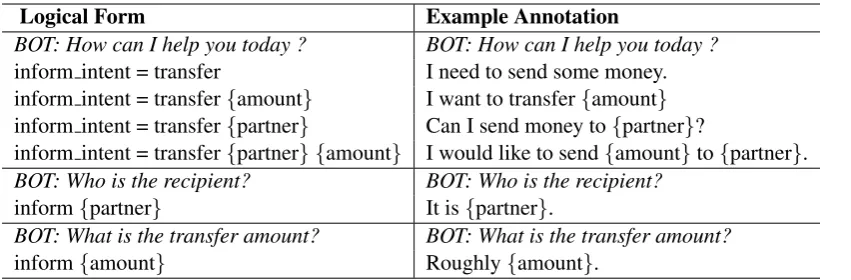
Table 1: Automatically generated logical forms provided to annotators and annotated template samples for a Money Transfer intent with 2 slots. Bot request is provided to annotators to give better context.
the user profile.
Therefore, every conversation is represented as an exchange of actions between the two agents. Each action contains the information on who per-formed it and what values the agent provided. For each dialog for a chosen intent, the respective sys-tem bot asks the relevant slots and the user bot provides the appropriate slot values. The system bot then checks the values provided and issues the next requests accordingly. Both API calls and slot requests are performed through actions. To vert these actions into actual dialogues, we con-ducted an annotation task with 5 annotators. First, we converted each possible action for all the in-tents into logical forms (uninstantiated pseudo-code) and asked the annotators to provide natural language templates for each logical form without changing the entity placeholders. We then used the language templates to create natural language utterances by replacing the placeholders with the actual values. In Table1, we give a few examples of the logical representations provided to annota-tors and the template they wrote. The conversion to the final plain text has been done by filling an-notated templates with a small KB (the user file). This approach is different from the one pro-posed byShah et al.(2018) that uses instantiated pseudo-code since the beginning: it requires much more data annotation and makes it more difficult to detach surface realization from dialogue struc-ture for building challenge sets.
The advantages of our synthetic data generation is twofold. First, it helps us to achieve a better coverage since reducing dialogues to an exchange of actions allows having a formal and simple visualization of all the generated dialogue flows -this is not the case with WoZ data collections (
Kel-ley,1984). Second, by instantiating each dialogue with different natural language templates, we can create dialogues that have the same structure but different wording.
3.1 The System and User Bot Design
We designed the user and the system bots using a finite state machine approach (Hopcroft et al.,
2001), assuming that each dialogue is a flow be-tween states and each utterance is a move from one state to the next. For our experiments, each of these states handles one particular slot. When-ever a user bot provides some information through its action, the system bot changes the state accord-ingly and performs its own action in response. The user bot then deals with the system action, per-forms its own and the cycle continues. The dia-logue concludes when the system bot reaches an end state and issues an end call action.
3.2 Banking Domain Intents
The user intents/tasks that the dialogues are built upon are in the Banking Domain. We selected sev-eral intents to create a dataset that contains: i) versations that are varied and diverse, and ii) con-versations that use similar sentences and slots but to complete different tasks.
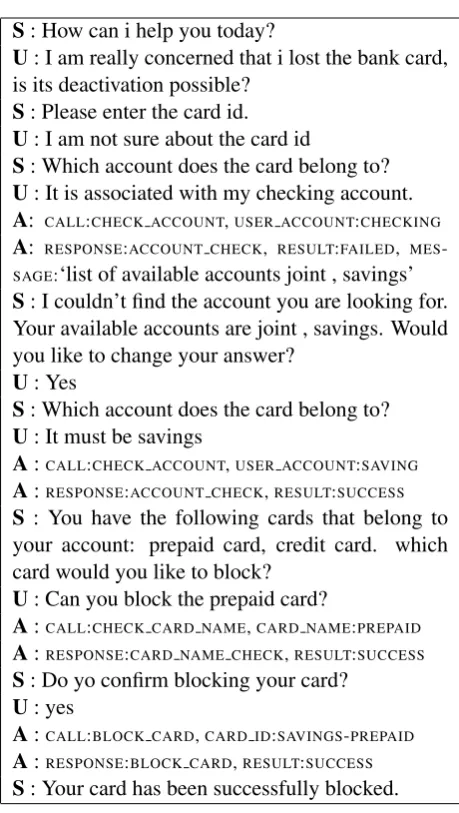
de-signed to handle all these possible cases. In Ta-ble2, we give an example dialogue to demonstrate how API intensive these dialogues might become. Note that, for each interaction we have a specific user profile, i.e. the possible entities for slots are predetermined. For example, “partner list” for money transfer is fixed, and a user cannot pro-vide a random name. Additionally, dialogues are formed with respect to policy restrictions such that i) the slots for each intent are asked in a strict or-der, ii) each slot value should be validated through an api call, iii) there are maximum 3 consecutive invalid user utterances after which the dialogue is terminated, iv) the final API call for intent exe-cution randomly returns a success or failure. The valid/invalid user utterances are chosen randomly in each turn. We now list the domain intents and their descriptions as follows:
Making a Transfer. In this intent, USERwants to transfer some money. The system is tasked to fill three slots i.euser account,partner nameand
amount.
Canceling a Transfer. This intent handles cases where USERwants to cancel a transfer made
ear-lier. The first required slot is thetransaction idand USERmay or may not recall it. If the transaction id cannot be filled,SYSTEMasks forpartner name
and checks for previous transactions.
Blocking a Card. The main slot required for this intent is thecard id. Similar to the canceling a transfer intent, there are two possible paths for the conversation flow. If USERcannot recall thecard id,SYSTEMasks another set of slots, which are the
user accountand thecard type.
Transaction History Query. This intent is for finding a transaction in USER’s transaction history by searching thenotefield. Notes are specific texts giving information about the transaction reason, such as “Salary” or “Electricity bill”.
Account Balance Query. To search for the ac-count balance, USERis asked to provide theuser accountname.
Account Limit Query. USER searches for the
maximum transferable amount from his/her ac-count. This intent, together with account balance, serves to evaluate the disambiguation performance of the conversational models when facing seman-tically similar intents - in fact their dialogue flow and required slots are identical.
S: How can i help you today?
U: I am really concerned that i lost the bank card, is its deactivation possible?
S: Please enter the card id.
U: I am not sure about the card id
S: Which account does the card belong to?
U: It is associated with my checking account.
A: CALL:CHECK ACCOUNT,USER ACCOUNT:CHECKING A: RESPONSE:ACCOUNT CHECK, RESULT:FAILED, MES-SAGE:‘list of available accounts joint , savings’
S: I couldn’t find the account you are looking for. Your available accounts are joint , savings. Would you like to change your answer?
U: Yes
S: Which account does the card belong to?
U: It must be savings
A:CALL:CHECK ACCOUNT,USER ACCOUNT:SAVING A:RESPONSE:ACCOUNT CHECK,RESULT:SUCCESS S : You have the following cards that belong to your account: prepaid card, credit card. which card would you like to block?
U: Can you block the prepaid card?
A:CALL:CHECK CARD NAME,CARD NAME:PREPAID A:RESPONSE:CARD NAME CHECK,RESULT:SUCCESS S: Do yo confirm blocking your card?
U: yes
A:CALL:BLOCK CARD,CARD ID:SAVINGS-PREPAID A:RESPONSE:BLOCK CARD,RESULT:SUCCESS S: Your card has been successfully blocked.
Table 2: A complete Block card example. U cor-responds to User, S to System, and A to API calls.
3.3 Challenge Test Set
ex-periments, we will disregard Out Of Vocabulary (OOV) cases, i.e. cases where entities of interest at test time are not seen at training time, e.g. the partner name “Michael”, (Bordes et al.,2017).
Out of Templates (OOT) Out of templates test case is constructed by sampling annotation tem-plates into training, development and test sets. By doing so, we can test whether the agent can handle user utterances in an unseen linguistic form.
Out of Pattern (OOP) Out of pattern test cases challenge the agents through the conversations with a structure (dialogue flow) that has not been seen during training. We have constructed five out of pattern cases for the challenge test set. To-gether with each OOP description, we provide an example, where the arrow indicates the answer of the system bot to be predicted, and the part in italic highlights the differences between training and test sets for readability purposes.
1. Turn Compression The training dialogue structure contains a confirmation step after each attempt to fill the current slot with an invalid value. Following a confirming answer from USER for changing the slot value, SYSTEMrepeats the slot filling question to USER. In the turn compression
challenge test case, we concatenate the confirma-tion and the new slot answers as the user utterance for the change confirmation question of SYSTEM.
The correct system utterance is the validation API call of the new value instead of the slot filling question again. Table3shows an example where SYSTEMasks if USERwants to change thepartner name, and during testing the user gives a confirm-ing answer together with the correctpartner name.
Sys: Partner name is incorrect, would you like to change it?
User:Yes
→Sys:What is the name of the recipient?
Sys: Partner name is incorrect, would you like to change it?
User:Yes, change it to Megan
→Sys:API PARTNER CHECKMegan
Table 3: Train/test excerpt of Turn Compression
2. New API The new API challenge is designed to evaluate the performance of an agent in terms of its ability of issuing the required API calls with ap-propriate slot values. To this end, we create intent
utterances in training data either without any extra slot value or odd number of slot values while in the new API challenge set, intent utterances con-tain only even number of slot values. See Table4
for an example.
Sys: How can i help you today ?
User: I want to see if my salary was credited →Sys: API CHECK SALARY
Sys: How can i help you today?
User: I want to see if my salary was credited from Facebook
→Sys: API CHECK SALARYFACEBOOK.
Table 4: Train and test excerpt of New API
3. Reordering The training dialogues have a particular slot filling order for each intent. In the reordering challenge set, on the other hand, the order of slots in dialogues is shuffled. The pur-pose of reordering is to evaluate whether an agent is able to generate the system utterance to fill the correct missing slot after all other slots for the cur-rent intent have been filled. In the example given in Table5, we show the correct system utterance of a new API challenge test case for the missing slot:user account.
User: I’d like to transfer some money.
Sys: From which account?
User: from Savings please.
Sys: Who is the recipient ?
User: It is Michael
→Sys:What is the amount?
User: I’d like to transfer some money.
Sys:What is the amount?
User: 100 euros.
Sys: Who is the recipient ?
User: It is Michael
→Sys:From which account?
Table 5: Train and test excerpt of Slots Reordering
4. Another Slot In a natural conversation, USER
can provide an utterance that is irrelevant to the current turn while including a slot value relevant to another one. Example dialogue excerpts for Making a Transfer intent with and without such
another slottest case are given in Table6.
Sys: What is the partner name ?
User:It is Michael.
→Sys:API PARTNER CHECKMichael
Sys: What is the partner name ?
User:Make the amount to be 10k euros .
→Sys:API AMOUNT CHECK10k euros
Table 6: Train/test excerpt for Another Slot case
changing turn, USERis expected to provide an ap-propriate value for the slot. In the audit more chal-lenge set, USER provides other slot values along
with the requested slot. We test if the system can recognize the changed slot value and issue the ap-propriate API calls for the slots given by USER. In the example test dialogue given in Table7, USER
changes the amount along with the partner name slot. The correct response of SYSTEM would be the API calls for the given partner name and the amount values.
Sys: What is the partner name ?
User:Change it to Michael.
→Sys:API PARTNER CHECKMichael
Sys: What is the partner name ?
User : Change it to Michael and make the amount to be 5k euros.
→Sys : API PARTNER CHECK Michael, AMOUNT CHECK10k euros
Table 7: Train and test excerpt of Audit more.
We should note that each OOP test can contain only one type of OOP, i.e only turn compression or only new API etc. However, in one dialog there may be more than one instance of the same OOP.
4 Neural Models
For our experiments, we focused on end-to-end Memory Networks (Sukhbaatar et al., 2015), which have been employed in various NLP tasks including non-goal-oriented (Dodge et al.,
2016) and goal-oriented (Bordes et al., 2017) dialogue systems. End-to-end memory networks exploit a memory component to store the dialog history, multiple memory look-ups (hops) as an attention mechanism, and short-term context to predict the next response. They yield promising performances in dialogue tasks outperforming some other end-to-end RNN based architectures. In addition, end-to-end memory networks have been shown to be able to perform non-trivial
operations such as issuing API calls to KBs (Bordes et al., 2017), which are a key element to our scenario. We implemented 2 variations of memory networks in order to test the feasibility of challenge set by analyzing the performance differences of the networks.
Single End-to-End Memory Network (SMN)
replicates the end-to-end memory network pre-sented by Bordes et al.(2017) trained on all dia-logues from all intents simultaneously.
Multiple End-to-End Memory Network
(MMN) is an ensemble of 6 different Memory Networks, each trained on a single intent and a7th Memory Network that has the task of selecting the appropriate one for the given dialogue. The training data for the 7th memory network is produced by appending a call-memory-network action after the user utterance that informs the intent in a dialog.
We implemented MMN and tested against SMN to investigate if sharing information from differ-ent intdiffer-ents plays a positive role or creates interfer-ence, especially for intents that contain the same slot types and have a high semantic similarity.
5 Experiments
We used a learning rate of 0.001, a batch size of 32, and maximum 20 epochs during the training of both networks. We set the embedding size to be 128 as it has been shown to perform good enough for most NLP problems (Bai et al., 2009). For memory networks we empirically used a memory size of 40 and 3 hops.
Accu-racy, which is the number of correct system re-sponses predicted out of all dialogue turns in the whole test set. Each response under test is com-pared to the predicted response by the model when given a dialogue memory, i.e. context, and a new user utterance.
Considering the banking domain and task sce-narios, for which it is almost impossible to record and collect real human interactions, we cannot perform an experiment on real life conversations. Although using WoZ technique and challenge pat-tern annotation could be applicable, it could not be guaranteed that we can collect reasonable amount of data for the same challenge pattern and we would be obliged to know every pattern in ad-vance. Therefore, we also employ dialogue syn-thesis for test/challenge set dialogues, which al-lows for a continuous challenge design by modi-fying the template combinations and dialogue pat-terns.
5.1 Test Cases and Results
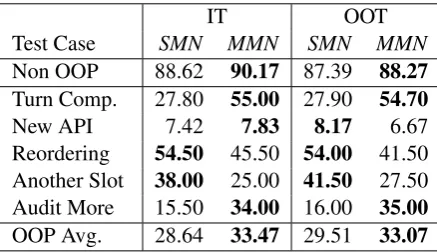
We compare the memory networks against the per-response accuracy for In Template (IT henceforth) and Out Of Template setting. In Table8, we show the test results of SMN and MMN models for IT and OOT configurations (including non-OOP and OOP test settings).
IT OOT
Test Case SMN MMN SMN MMN
Non OOP 88.62 90.17 87.39 88.27
Turn Comp. 27.80 55.00 27.90 54.70
New API 7.42 7.83 8.17 6.67 Reordering 54.50 45.50 54.00 41.50 Another Slot 38.00 25.00 41.50 27.50 Audit More 15.50 34.00 16.00 35.00
OOP Avg. 28.64 33.47 29.51 33.07
Table 8: In template non-challenge/OOP test results, OOT non-challenge/OOP test results in terms of per-response accuracy.
OOP impact. As expected, OOP cases represent a compelling challenge for our MNs, see Table8. When we compare the results of the non-OOP and the OOP cases, we observe drastic performance differences, both in IT (88.62 vs. 28.64, 90.17 vs 33.47) and OOT (87.39 vs. 29.51, 88.27 vs. 33.07) settings. Still, in some settings both MNs are able to show reasonable performances and different be-haviors on different challenge sets (reordering and
another slot for SMN, turn compression and audit more for MMN).
Single vs Multiple Memory Network. Con-cerning the IT cases, MMN slightly outperforms SMN in the non-challenge test setting. In addi-tion, it shows a substantial accuracy increase in turn compression and audit more OOP cases. On the other hand, SMN surpasses MMN in reorder-ing and another slot OOP challenges. A similar outlook of performances is observed for the OOT non-challenge and OOP cases aside from new api challenge, which turns out to be the most difficult OOP challenge and will be discussed later.
We observe that on average MMN outperforms SMN both in IT and OOT cases. One possi-ble explanation is based on how the memory net-work finds the correct response. The Single Mem-ory Network does so by incorporating all the in-tents in its selection of the responses. Therefore, it searches for more general responses while the Multiple Memory Network assigns the same task to a specialized Memory network, which is trained on that very specific intent. The specialized mem-ory network is better at finding the correct re-sponse since it is trained only on one particular in-tent data and its search space is implicitly reduced. As a particular OOP performance comparison, we noticed that SMN is better at selecting the right response during the reordering challenge, which evaluates the ability of the model in learning the necessary slots to accomplish an intent.
In template vs Out of Template. We found out that there is not a major difference between IT and OOT test case performances (slightly better for SMN and slightly worse for MMN). One possi-ble explanation is that the tests have not been con-ducted in an OOV setting. Therefore, the SMN and MMN may not learn the linguistic patterns to find entities (templates) but they directly learn to recognize the entities and to predict the API calls accordingly.
Per-Response Accuracy
Test Case SMN MMN
Turn Compression 29.61 55.16 Turn Compr. OOT 29.07 55.13
Audit More 10.50 15.02
Audit More OOT 10.90 15.43
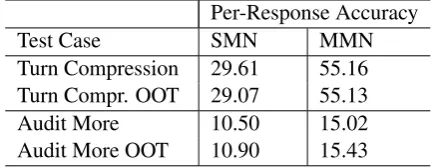
Table 9: Multiple Out of Pattern per Dialog
Sys: The partner name you provided is incor-rect, would you like to change ?
User: Yes, change it to Michael (first Occur-rence of Turn Compression)
Sys: Okay, your amount also exceeds the limit, would you like to change ?
User: Yes, It is 100 euros (The second occur-rence of turn compression)
Table 10: Example of Multiple OOP dialogue
for both the SMN and the MMN to handle the case of more than one OOP.
It can be seen that there is a drop in the per-formances of both MNs in Table 9 as compared to previous challenge tests, only for audit more. This drop can be attributed to the differences of the contexts of the conversations that are present in the memory while selecting the response. Since the context is the previous conversation until the chosen turn, for the first case, i.e. the first example in10, the context is a usual sub-dialogue pattern that is seen during the training. So the responsi-bility of the agent is to understand the new unseen compressed user utterance and choose the correct response. However, when we test the second turn compression in the same dialogue, i.e. the second turn in10where USERchanges the amount, the re-sponsibility of the agent is compounded by the fact that in addition to understanding the compressed turn, it has to reason about an unseen context pat-tern. In other words, the context also contains a form of turn that the agent has never seen during training, which is the first turn compression of the second example in Table10.
The Easiest and the Hardest Challenge Cases
Finally, to investigate the difficulty of challenges that we have introduced with each OOP case, we should focus our attention to the easiest and the hardest cases. We observe that out of all the OOP test cases (both in-template and OOT settings) both memory networks performed quite poorly on
handling new APIs. The results suggest that it is harder for the memory networks to interpret a new combination of slots and issue the related API calls. This could be partially explained by the po-sition of the new API cases in the dialogue. By design, new API cases happen at the beginning of the conversation (i.e. giving an intent together with unexpected slots, see example in Table 4). Therefore, the system has no context (no interac-tion memory) to reason on while selecting the re-sponse. On the contrary, for the easier turn com-pression case, the memory network is already ex-pecting a possible change in the slot value (e.g. “do you want to change the amount?”) in the fol-lowing turns, regardless of receiving it in the re-spective turn or in the next few. In fact, the net-work is already ‘primed’ on selecting an amount related API call. Consequently, the memory net-works have a better performance on turn compres-sion rather than new API challenge.
6 Conclusions and Future Work
In this paper, we explored some challenges connected to dataset creation for conversational agents and interpretability of neural models. In particular, we propose a methodology to create rich datasets for training end-to-end conversa-tional agents and challenge them on unseen pat-terns at test time. We then experimented with Memory Networks and investigated their perfor-mance on the custom test cases. The apparently low accuracy levels on unseen challenge cases suggest that the synthetic data and challenge gen-eration for low resource dialogue domains can act as a reasonable approximate to real life challenges in such domains. In other words, the more a dia-logue model is able to handle these diverse chal-lenges, the more it will be able to handle the unstructured or less structured dialogues in real human-machine interaction. As a future work we would like to test further neural models and cre-ate additional OOP challenge sets, even combin-ing additional configurations.
References
Anal-Iulian Vlad Serban, Alessandro Sordoni, Ryan Lowe, Laurent Charlin, Joelle Pineau, Aaron C Courville, and Yoshua Bengio. 2017. A hierarchical latent variable encoder-decoder model for generating di-alogues. InAAAI. pages 3295–3301.
Pararth Shah, Dilek Hakkani-T¨ur, Gokhan T¨ur, Ab-hinav Rastogi, Ankur Bapna, Neha Nayak, and Larry Heck. 2018. Building a conversational agent overnight with dialogue self-play. arXiv preprint arXiv:1801.04871.
Alessandro Sordoni, Michel Galley, Michael Auli, Chris Brockett, Yangfeng Ji, Margaret Mitchell, Jian-Yun Nie, Jianfeng Gao, and Bill Dolan. 2015. A neural network approach to context-sensitive gen-eration of conversational responses. arXiv preprint arXiv:1506.06714.
Sainbayar Sukhbaatar, Jason Weston, Rob Fergus, et al. 2015. End-to-end memory networks. InAdvances in neural information processing systems. pages 2440–2448.
Oriol Vinyals and Quoc Le. 2015. A neural conversa-tional model. arXiv preprint arXiv:1506.05869.
Alex Wang, Amapreet Singh, Julian Michael, Felix Hill, Omer Levy, and Samuel R Bowman. 2018. Glue: A multi-task benchmark and analysis platform for natural language understanding. arXiv preprint arXiv:1804.07461.
Jason Weston, Sumit Chopra, and Antoine Bordes. 2014. Memory networks.CoRRabs/1410.3916.
Zhou Yu, Dan Bohus, and Eric Horvitz. 2015. Incre-mental coordination: Attention-centric speech pro-duction in a physically situated conversational agent. In Proceedings of the 16th Annual Meeting of the Special Interest Group on Discourse and Dialogue. pages 402–406.
Tiancheng Zhao and Maxine Eskenazi. 2018. Zero-shot dialog generation with cross-domain latent ac-tions. arXiv preprint arXiv:1805.04803.