Ongoing Developments in Automatically Adapting Lexical Resources to the
Biomedical Domain
Dominic Widdows
1, Adil Toumouh
2, Beate Dorow
3, Ahmed Lehireche
21MAYA Design, Inc., Pittsburgh, Pennsylvania 2Computer Science Departement, University Djillali Liabes 3Institut f¨ur Maschinelle Sprachverarbeitung, Universit¨at Stuttgart
Abstract
This paper describes a range of experiments using empirical methods to adapt the WordNet noun ontology for specific use in the biomed-ical domain. Our basic technique is to extract relationships between terms using the Ohsumed corpus, a large collection of abstracts from PubMed, and to compare the relationships extracted with those that would be expected for medical terms, given the structure of the WordNet ontology. The linguistic methods involve the use of a variety of lexicosyntactic patterns, that enable us to extract pairs of coordinate noun terms, and also related groups of adjectives and nouns, using Markov clustering. This enables us in many cases to analyse ambiguous words and select the correct meaning for the biomedical domain. While results are often encouraging, the paper also highlights evident problems and drawbacks with the method, and outlines suggestions for future work.
1.
Introduction
Lexical resources such as ontologies are important for cre-ating knowledge-rich NLP applications. Because of this, large projects such as the Princeton WordNet have been funded for many years to build such resources manually. However, developers and knowledge engineers often find such general resources to be inappropriate for their needs when creating applications in specific domains, since they contain many senses that are not appropriate and actually misleading for their domain. In such circumstances, devel-opers often resort to the manual creation of completely new domain-specific resources. Not only is this a costly pro-cess, but it also prevents interoperation between NLP ap-plications in different domains and the gradual emergence of semantically stable standards. Ideally, it would be pos-sible for developers to automatically select those parts of a general resource that are appropriate for their needs, obtain-ing a ‘tailor-made’ lexical resource that maintains general interoperability without costly manual intervention. This paper describes automatic techniques for adapting the WordNet noun taxonomy (Fellbaum, 1998) to the medical domain, by comparing the available senses of nouns given by WordNet with the distribution of words in the Ohsumed corpus (Hersh et al., 1994), a large selection of documents from the PubMed catalogue. Though specific in nature, our experiments are based on a very small set of assump-tions about lexicosyntactic patterns in the English language, and thus there is hope that they may be easily adapted to other domains and other languages where lexicosyntactic patterns are a reliable guide to semantic usage.
2.
General Strategy of these Experiments
Since Aristotle wrote the Categories and the analytical works that introduced the study of logic, conceptual struc-tures describing things in the world have tended to focus on creating inheritance taxonomies. (For a thorough introduc-tion to this topic, see Sowa (2000).) Thus, the most widely studied relationship between concepts is the inheritance re-lationship between a more general class of objects and a more specific subclass, described as the ‘hyponymy’
rela-tionship in WordNet (Miller, 1998a). While other relation-ships have been considered at some length (see (Fellbaum, 1998), (Bean and Green, 2001)), the most comprehensive resources that combine both lexical and conceptual knowl-edge remain largely taxonomic, examples including Word-Net (used in our experiments) and EuroWordWord-Net (Vossen, 1998).
One well-developed family of empirical methods for find-ing relationships between concepts from texts that discuss those concepts is to use lexicosyntactic patterns. Such pattern-matching techniques were pioneered in the work of Hearst (1992), who noted that patterns like
“Asuch asB” and “Band otherA”
often indicate thatB is a kind ofA(sometimes written as the symbolic relationshipB v A). However, such direct references to inheritance structure in written text appear to be comparatively few and far between, when compared with textual evidence for similarity. At the very least, it is certainly the case that pattern matching techniques that search for similar terms as well as taxonomically related terms are likely to obtain higher recall, and it is demonstra-bly possible to improve hyponymy-extraction engines by considering related terms (Cederberg and Widdows, 2003). For example, if one encounters the pattern
“A,B, andC”
and one already has an ontology that contains the relation-shipAvX for someX, it is a reasonable hypothesis that the relationshipsB vX andCvXare also valid. Of course, this rule-of-thumb is a long way from being a generally valid syllogism, and while demonstrating im-provements in recall, the work in Cederberg and Widdows (2003) also highlighted many of the pitfalls that these meth-ods encounter. One particularly lexical concern is ambigu-ity. For example, from the phrase
mass and other religious services
Figure 1: System architecture for coordinate noun based ontology adaptation
nurse professional
health
leader
lawyer general chieftain doctor
person
professional
Figure 2: A fragment of the WordNet hierarchy, showing that the LCA of doctor and nurse is health professional, whereas the LCA of doctor and general is person.
3. In Stage 3, we evaluate the results in the success set output by stage 2. The Right Medical Sense Checking
Module is made up of two modules and assisted by an
expert of the domain.
3.1. Results of Noun Coordination Experiments
We extracted from Ohsumed 57887 word pairs (the two nouns of conjunctions)(115774 words). In Stage 2, the car-dinality of the Success Set is 34220 pairs, and that one of the Failure Set (for which no LCA was found) is 23667
pairs. Of the Success Set, 26399 words had multiple senses in WordNet but a unique sense was chosen using our sys-tem. This was the largest collection of results, and also the one for which the best system performance was observed. Due to the fact that Success Set is large, we used the first 126 pairs as a sample for expert evaluation. This sample contained 84 pairs for which a unique sense was proposed for ambiguous words. It includes 136 domain-specific words and 32 general ones. For the domain-specific terms (those occurring more frequently in the Ohsumed corpus than the BNC), success in keeping the right sense for the medical domain was 72%. Performance for the more gen-eral terms was less effective. Similarly, performance on those terms for which multiple LCAs were found was less good (slightly over 50%). These results are described in much more detail by Toumouh et al. (2006).
4.
Adjective-Noun Clustering Experiments
In this section, we describe a preliminary experiment which investigates the potential of syntagmatic relationships for improving the recognition of a noun’s medical senses. The experiments follow the pattern of building a combinatoric model of words and their relationships based upon some shared occurrence pattern in a corpus, and using clustering techniques on the resulting graph (Dorow, 2006).
noun-to-attribute relation (e.g., dose and efficacy and
mem-ory and its decline, a vascular renin-angiotensin system and its role in modulating sympathetic activity). Such terms
are hence distant in the WordNet noun hierarchy, though they are still related. (This inadequacy with purely taxo-nomic representations of meaning is sometimes described as the Tennis Problem (Fellbaum, 1998).)
Syntagmatic relationships, such as adjective-noun, verb-subject and verb-object relationships, have been success-fully used to assess similarity between words (Lin, 1998). A logical next step in our experiments with the Ohsumed corpus was to try to extract relations based upon lexicosyn-tactic patterns that tend to reflect syntagmatic relationships. To assess and compare the discriminative power of syntag-matic relationships with that of simple coordination infor-mation, we proceeded as follows.
• We used pattern matching on the PoS tags to collect pairs of adjectives and the nouns they modify. We ex-tracted a total of206,595adjective-noun pairs.
• Rarely occurring pairs (frequency≤3) and weak as-sociations (mutual information≤6) were discarded.
• This left35,244 significant adjective-noun pairs (in-volving 4,615 nouns and 4,722 adjectives).
The set of adjective-noun relationships naturally gives rise to a bipartite graph, a graph which consists of two sets of nodes, adjectives and nouns, and in which links con-nect an adjective with the nouns it modifies and vice versa. From this bipartite adjective-noun graph, we can construct a projected noun-noun graph, by linking any two nouns if they share a critical number of adjectives (5 in our exper-iment). Ignoring isolated nodes, the projected noun-noun graph contains662 nodes and2,168 links. This is much smaller than the earlier noun-noun graph from coordination patterns alone, mainly because the filtering conditions were quite strict. Recall could easily be improved by relaxing these conditions, though our original goal was to quickly compare the precision of this method with that of the noun-noun coordination method.
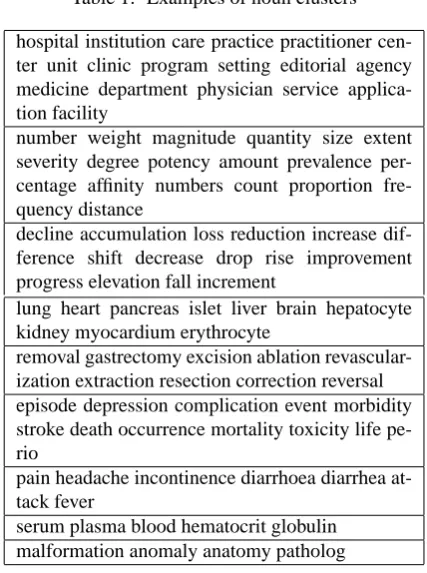
Using Markov Clustering (van Dongen, 2000), we divided the noun-noun graph into 120 (non-overlapping) dense re-gions representing groups of semantically similar words, some of which are listed in Table 1.
Our assumption is that within a cluster, each noun assumes only one sense, namely its medical sense. In order to find this medical sense, our strategy was to repeat the LCA-based algorithm described in earlier, for each other cluster member of the noun whose sense we were trying to identify. For a first comparison between this adjective-noun based method and the noun coordination based method described earlier, we compared the senses given by this process with those given by the earlier method on words that were al-ready in the 126 trial set. The (rather sparse) results of this evaluation are presented in Table 2. Of the pairs tested, 35 gave the correct medical sense, 22 gave an incorrect sense, and 95 gave no LCA at all. Even though there are more correct labels than incorrect ones, this is certainly discour-aging as far as recall goes, especially considering that the
Table 1: Examples of noun clusters
hospital institution care practice practitioner cen-ter unit clinic program setting editorial agency medicine department physician service applica-tion facility
number weight magnitude quantity size extent severity degree potency amount prevalence per-centage affinity numbers count proportion fre-quency distance
decline accumulation loss reduction increase dif-ference shift decrease drop rise improvement progress elevation fall increment
lung heart pancreas islet liver brain hepatocyte kidney myocardium erythrocyte
removal gastrectomy excision ablation revascular-ization extraction resection correction reversal episode depression complication event morbidity stroke death occurrence mortality toxicity life pe-rio
pain headache incontinence diarrhoea diarrhea at-tack fever
serum plasma blood hematocrit globulin malformation anomaly anatomy patholog
Table 2: Nouns occurring in the adjective-noun clusters and in the 126 sample terms from manual evaluation
Word Correct Incorrect No LCA
female 15 0 18
treatment 6 6 19
cell 4 2 7
plasma 1 0 0
antagonist 8 6 9
pressure 0 3 3
stage 0 1 2
head 1 2 24
risk 0 0 2
stroke 0 2 9
contraction 0 0 2
noun clusters already contained comparatively few nouns (662).
It was therefore decided not to pursue this method before reconsidering the approach in general. This is partly be-cause at least two observations were made during the work that question the relevance of the results.
2000). However, it is not negligible, and so far our experi-ments have not reflected this.
Secondly, some of the clusters seem to be semantically co-herent, but not really taxonomic enough to correspond well with the WordNet hierarchy. For example, consider the cluster
episode depression complication event morbidity stroke death occurrence mortality toxicity life pe-riod
Most of the terms are (arguably) about some medical event, some kind medical event, or a condition that a patient may or may not experience (some of the terms clearly corre-spond to what genetic epidemiologists would call a
phe-notype (Haines and Pericak-Vance, 1993, p. 53)).
How-ever, this intuitive cluster is certainly too fuzzy or contex-tual to correspond to any particular branch of the Word-Net noun hierarchy. The process of combining two syntag-matic adjective-noun relationships in the hope of obtaining a paradigmatic relationship, because our evaluation is based upon paradigmatic relationships, may be overlooking the more subtle opportunities of the situation, in the hope of finding something that we have more experience in evalu-ating.
4.1. Adjective clusters
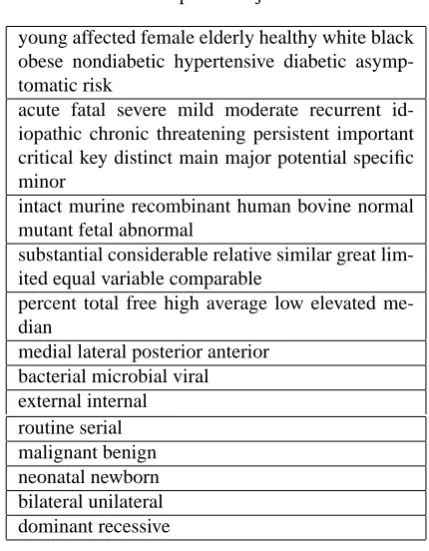
Some of the adjective clusters obtained using our method were also of interest, and a selection is presented in Table 3. Some of the larger clusters appear to be diverse groups of adjectives that can be used to modify people or diseases. However, some of the smaller groups are quite specific, and refer to fairly tight clusters of similar medical concepts, for example, the cluster
medial lateral posterior anterior
of terms that that describe anatomical positions. Many of the clusters comprising just 2 members are in fact antonyms, and would perhaps stand up well to a compari-son with the antonym organization of modifiers in WordNet (Miller, 1998b).
5.
Further Work
There are clearly many directions in which this work could be taken, some of which we intend to pursue. These areas include the following.
Enhanced preprocessing
Many medical terms are not single words, but complex nounphrases. In these cases, it is sometimes (though not always) possible to infer something about the semantics of a term from its constituents. This hypothesis was tested in some detail by Baldwin et al. (2003), using a distribu-tional technique (latent semantic analysis) to try to deter-mine when a complex term could be regarded as a hyponym of its syntactic head. In the medical domain, this hypoth-esis may be more regularly valid, since non-compositional idioms are presumably rarer in scientific writing. (Alterna-tively, this hypothesis could be a red herring.)
At the very least, it would be worthwhile to add some noun-phrase chunking operation to our preprocessing step, and to
Table 3: Examples of adjective clusters
young affected female elderly healthy white black obese nondiabetic hypertensive diabetic asymp-tomatic risk
acute fatal severe mild moderate recurrent id-iopathic chronic threatening persistent important critical key distinct main major potential specific minor
intact murine recombinant human bovine normal mutant fetal abnormal
substantial considerable relative similar great lim-ited equal variable comparable
percent total free high average low elevated me-dian
medial lateral posterior anterior bacterial microbial viral external internal routine serial malignant benign neonatal newborn bilateral unilateral dominant recessive
repeat our experiments using nounphrases and similar ex-tracted complex terms as well as just words.
Alternative extraction patterns
As well as noun coordinations and adjective-noun patterns, verbal patterns should be considered. The result will be a complex graph structure with (at least) nouns, verbs and adjectives as nodes, and labelled links. Such a semantic model will complement more distributional and probabilis-tic techniques such as latent semanprobabilis-tic analysis and n-gram modelling. In the long term, we hope to provide an em-pirical semantic complement to purely statistical language models.
Adaptation to other domains and languages
While our work has focussed on the English language and the medical domain, we have deliberately operated with the goal of keeping our linguistic assumptions compar-atively simple. For any language with suitable part-of-speech tagged corpus material, it is not difficult to define and use basic lexicosyntactic patterns. Once relationships have been extracted and built into a mathematical model such as a graph, the subsequent combinatoric analysis is language-independent.
This is not to say that our methods will work automatically in other domains and languages, but it does imply that it will comparatively easy to test them in other situations.
Distributed publication
potential for deployment to small devices, in which case, pruning an ontology may be seen as not only semantically useful, but practically necessary.
A distributed architecture for publishing subsets of corpora and lexical resources is described by (Balasubramanya et al., 2006), with these specific goals in mind. In this model, entries from resources such as WordNet will be definitively referred to, but researchers will be able to create standoff annotation to the effect that (for example) a particular sense is relevant to the medical domain. Then, instead of mak-ing a static choice of which version of WordNet is prefer-able, researchers and deployed systems can make a dy-namic choice of which publishers they trust to create good resources in particular domains, and subscribe to the data created by these publishers as it becomes available.
6.
Conclusions
By comparing the senses given for a word in a general lex-ical ontology with the usages of that word in a domain-specific corpus, it is possible to adapt general lexical re-sources to a specific domain with high accuracy in some cases, especially using patterns in text that directly reflect paradigmatic similarities.
This can be accomplished using comparatively simple tech-niques. While it is necessary to improve and extend these techniques to guarantee superior performance, the simplic-ity of our assumptions gives us reason to hope that our sys-tem can be adapted to other languages and domains at little extra cost.
This research is still in its early stages, and pursuing it prop-erly will involve close interactions with other syntactic and semantic work in understanding the nature of relationships beyond taxonomies.
7.
References
M. Balasubramanya, M. Higgins, P. Lucas, J. Senn, and D. Wid-dows. 2006. Collaborative annotation that lasts forever: Us-ing peer-to-peer technology for disseminatUs-ing corpora and lan-guage resources. Genoa, Italy, May 24-26, May.
Timothy Baldwin, Colin Bannard, Takaaki Tanaka, and Dominic Widdows. 2003. An empirical model of multiword expression decomposability. In Proceedings of the ACL-2003 Workshop
on Multiword Expressions: Analysis, Acquisition and Treat-ment, Sapporo, Japan.
Carol A. Bean and Rebecca Green, editors. 2001. Relationships
in the Organization of Knowledge. Kluwer.
Paul Buitelaar and Bogdan Sacaleanu. 2001. Ranking and select-ing synsets by domain relevance. In Proceedselect-ings of WordNet
and Other Lexical Resources, NAACL 2001 Workshop,
Pitts-burgh, PA, June.
Scott Cederberg and Dominic Widdows. 2003. Using LSA and noun coordination information to improve the precision and re-call of automatic hyponymy extraction. In Conference on
Nat-ural Language Learning (CoNNL), Edmonton, Canada.
Beate Dorow. 2006. A graph model for words and their
mean-ings. Ph.D. thesis, IMS, University of Stuttgart.
Christiane Fellbaum, editor. 1998. WordNet: An Electronic
Lexi-cal Database. MIT Press, Cambridge MA.
Jonathan L. Haines and Margaret A. Pericak-Vance, editors. 1993. Approaches to Gene Mapping in Complex Human
Dis-eases. Wiley-Liss.
Marti A. Hearst. 1992. Automatic acquisition of hyponyms from large text corpora. In COLING, Nantes, France.
William Hersh, Chris Buckley, T. J. Leone, and David Hickam. 1994. Ohsumed: An interactive retrieval evaluation and new large test collection for research. In Proceedings of the 17th
Annual ACM SIGIR Conference, pages 192–201.
Rodney Huddleston and Geoffrey K. Pullum. 2002. The
Cam-bridge Grammar of the English Language. CamCam-bridge
Univer-sity Press, Cambridge, UK.
A. Kilgarriff and J. Rosenzweig. 2000. Framework and results for english senseval. Computers and the Humanities, 34(1-2):15– 48, April.
Dekang Lin. 1998. Automatic retrieval and clustering of similar words. In COLING-ACL, Montreal, August.
George A. Miller. 1998a. Nouns in wordnet. In Fellbaum (Fell-baum, 1998), chapter 1, pages 23–46.
Katherine J. Miller. 1998b. Modifiers in wordnet. In Fellbaum (Fellbaum, 1998), chapter 2, pages 47–68.
Philip Resnik. 1999. Semantic similarity in a taxonomy: An information-based measure and its application to problems of ambiguity in natural language. Journal of artificial intelligence
research, 11:93–130.
John F. Sowa. 2000. Knowledge Representation: Logical,
Philo-sophical, and Computational Foundations. Brooks Cole
Pub-lishing, Pacific Grove, CA.
A. Toumouh, A. Lehireche, D. Widdows, and M. Malki. 2006. Adapting wordnet to the medical domain using lexicosyntac-tic patterns in the ohsumed corpus. In Proceedings of the 4th
ACS/IEEE International Conference on Computer Systems and Applications (AICCSA-06), Sharjah, UAE, March.
Stijn van Dongen. 2000. Graph Clustering by Flow Simulation. Ph.D. thesis, University of Utrecht, May.
Piek Vossen. 1998. Introduction to eurowordnet. Computers and
the Humanities, 32(2-3):73–89.
Dominic Widdows and Beate Dorow. 2002. A graph model for unsupervised lexical acquisition. In 19th International
Confer-ence on Computational Linguistics, pages 1093–1099, Taipei,
Taiwan, August.
Dominic Widdows, Diana Steffen, Scott Cederberg, Chiu-Ki Chan, Paul Buitelaar, and Bogdan Sacaleanu. 2003. Meth-ods for word-sense disambiguation. Technical report, MUCH-MORE project report.