Computational Linguistics and Chinese Language Processing
Vol. 8, No. 2 , August 2003, pp. 1-28 The Association for Computational Linguistics and Chinese Language Processing
A Class-based Language Model Approach to
Chinese Named Entity Identification
1Jian Sun
*, Ming Zhou
+, Jianfeng Gao
+Abstract
This paper presents a method of Chinese named entity (NE) identification using a class-based language model (LM). Our NE identification concentrates on three types of NEs, namely, personal names (PERs), location names (LOCs) and organization names (ORGs). Each type of NE is defined as a class. Our language model consists of two sub-models: (1) a set of entity models, each of which estimates the generative probability of a Chinese character string given an NE class; and (2) a contextual model, which estimates the generative probability of a class sequence. The class-based LM thus provides a statistical framework for incorporating Chinese word segmentation and NE identification in a unified way. This paper also describes methods for identifying nested NEs and NE abbreviations. Evaluation based on a test data with broad coverage shows that the proposed model achieves the performance of state-of-the-art Chinese NE identification systems. Keywords: Named entity identification, class-based language model, contextual model, entity model
1. Introduction
Named Entity (NE) identification is the problem of detecting entity names in documents and then classifying them into corresponding categories. This is an important step in many natural language processing applications, such as information extraction (IE), question answering (QA), and machine translation (MT). A lot of researches have been carried out on English NE identification. As a result, some systems have been widely applied in practice. On the other hand, Chinese NE identification is a different task because in Chinese, there is no space to mark the boundaries of words and no clear definition of words. In addition, Chinese NE
1
This work was done while the author was visiting Microsoft Research Asia. * Beijing University of Posts&Telecommunications.
Currently is an assistant researcher in Institute of Computing Technology, Chinese Academy of Sciences. Email: [email protected]
Jian Sun et al.
identification is intertwined with word segmentation. Traditional approaches to Chinese NE identification usually employ two separate steps, namely, word segmentation and NE identification. As a result, errors in word segmentation will lead to errors in NE identification. Moreover, the identification of NE abbreviations and nested NEs has not yet been investigated thoroughly in previous works. For example, nested locations in organization names have not been discussed at the Message Understanding Conference (MUC).
In this paper, we present a method of Chinese NE identification using a class-based LM, in which the definitions of classes are extended in comparison with our previous work [Sun, Gao et al., 2002]. The model consists of two sub-models: (1) a set of entity models, each of which estimates the generative probability of a Chinese character string given an NE class; and (2) a contextual model which estimates the generative probability of a class sequence. Our model thus provides a statistical framework for incorporating Chinese word segmentation and NE identification in a unified way. In the paper, we shall also describe our methods for identifying nested NEs and NE abbreviations.
The rest of this paper is organized as follows: Section 2 briefly discusses related work. Section 3 presents in detail the class-based LM for Chinese NE identification. Section 4 discusses our methods of identifying NE abbreviations. Section 5 reports experimental results. Section 6 presents conclusions and future work.
2. Related Work
Traditionally, the approaches to NE identification have been rule-based. They attempt to perform matching against a sequence of words in much the same way that a general regular expression matcher does. Some of these systems are, FACILE [Black et al., 1998], IsoQuest's NetOwl [Krupha and Hausman, 1998], the LTG system [Mikheev et al., 1998], the NTU system [Chen et al., 1998], LaSIE [Humphreys et al., 1998], the Oki system [Fukumoto et al., 1998], and the Proteus system [Grishman, 1995]. However, the rule-based approaches are neither robust nor portable.
A Class-based Language Model Approach to Chinese Named Entity Identification
been applied to practical applications.
When it comes to the Chinese language, however, NE identification systems still cannot achieve satisfactory performance. Some representative systems include those developed in [Sun et al., 1994; Chen and Lee, 1994; Chen et al., 1998; Yu et al., 1998; Zhang, 2001; Sun et al., 2002].
We will mainly introduce two systems, namely, the rule-based NTU system for Chinese [Chen et al., 1998] and the machine learning based BBN system [Bikel et al., 1999], because these are representative of the two different approaches.
Generally speaking, the NTU system employs the rule-based method. It utilizes different types of information and models, including character conditions, statistic information, titles, punctuation marks, organization and location keywords, speech-act and locative verbs, cache model and n-gram model. Different kinds of NEs employ different rules. For example, one rule for identifying organization names is as follows:
OrganizationName CountryName OrganizationNameKeyword e.g. 国 馆
US Embassy
NEs are identified in the following steps: (1) segment text into a sequence of tokens; (2) identify named persons; (3) identify named organizations; (4) identify named locations; and (5) use an n-gram model to identity named organizations/locations.
The BBN model [Bikel et al., 1999], a variant of Hidden Markov Model (HMM), views NE identification as a classification problem and assigns to every word either one of the desired NE classes or the label NOT-A-NAME, meaning “none of the desired class”. The HMM has a bigram LM of each NE class and other text. Another characteristic is that every word is a two-element vector consisting of the word itself and the word-feature. Given the model, the generation of words and name-classes is performed in three steps: (1) select a name-class; (2) generate the first word inside that name-class; (3) generate all the subsequent words inside the current name-class.
There have been relatively fewer attempts to deal with NE abbreviations [Chen, 1996; Sproat et al., 2001]. These researches mainly investigated the recovery of acronyms and non-standard words.
In this paper, we present a method of Chinese NE identification using a class-based LM. We also describe our methods of identifying nested NEs and NE abbreviations.
3. Class-based LM Approach to NE Identification
Jian Sun et al.
words by estimating the conditional probability P(wn|w1…wn-1). A class-based LM extends the word-based LM by defining similar words as a class. It has been demonstrated to be a more effective way of dealing with the data-sparseness problem. In this study, the class-based LM is applied to integrate Chinese word segmentation and NE identification in a unified framework.
In this section, we first gives definitions of classes. Then, we describe the elements of the class-based LM, parameter estimation, and how we apply the model to NE identification.
Table 1. Definitions of Classes
Class Explanation/Intuition Examples
FN foreign names in transliteration ‘Clinton’ PER1 Chinese personal name consisting only
of a surname
总 ‘Premier Zhou’
PER2 Chinese personal name consisting of a surname and a one-character given name
‘Li Peng’
PER3 Chinese personal name consisting of a surname and a two-character given name
来 ‘Zhou Enlai’ PER
PABB Abbreviation of a personal name 来 ‘Enlai’
LOCW2 Whole name of a location ‘Beijing City’
LABB Abbreviation of a location name 关 ‘Sino-Japan relation’
ORG Organization name 邮电 学
‘Beijing University of Posts&Telecommunications’ PT A personal title in context (-1~1) of PER 总 ‘Premier Zhou’ PV Speech-act verb in context (-2~2) of PER 总
‘Premier Zhou points out’ LK Location keyword in a location name
OK Organization keyword in an organization name
邮电 学
DT Data and time expression 2002 10
NU Numerical expression 亿, 5%
BOS Beginning of a sentence EOS End of a sentence
2
A Class-based Language Model Approach to Chinese Named Entity Identification
NLPWin3. Smoothing the MLE is essential to avoid zero probability for events that were not observed in the training data. We apply the standard techniques, in which more specific models are smoothed with progressively less specific models. The details of the back-off smoothing method we use are described in [Gao et al., 2001].
In what follows, we will describe our model estimation approach. We will assume that a
sample training data set has one sentence: “ 来 总 们 总 ” The
corresponding annotated training data4 are as follows:
3.4.1 Contextual Model Estimation
We extract training data for the contextual model by replacing the names in the above example with corresponding class tags, i.e., PER PT 们 总 . The contextual model parameters are computed by using MLE together with back-off smoothing.
3.4.2 Entity Model Estimation
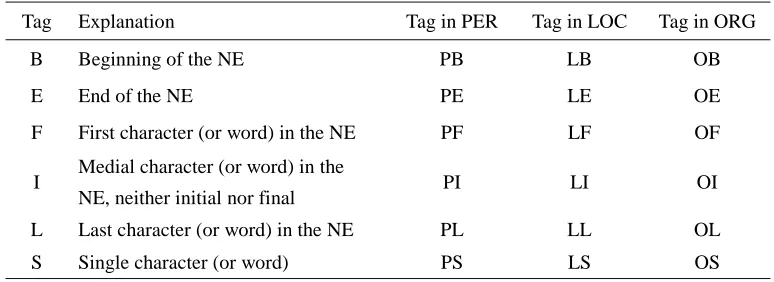
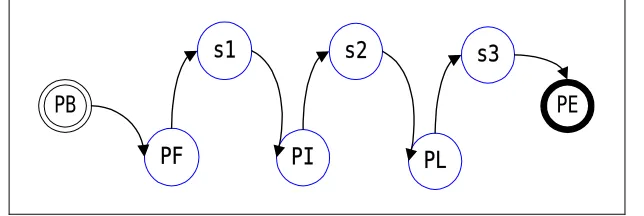
We can also obtain the training data of each entity model. For example, the PER3 list we obtained from the above example has one instance, 来 . The corresponding training data for PER3, where position tags are introduced, are as follows:
PB PF PI PL 来 PE .
The model parameters of PER3 are computed using MLE and back-off smoothing. We can also estimate other entity models in a similar way.
3.5 Decoder
The NE identification procedure is as follows: (1) identify PERs and LOCs; (2) identify ORGs based on the output of identifying PERs and LOCs. Thus, the PERs and LOCs nested in ORGs can be identified. Since the steps involved in identifying PERs and LOCs, and those involved in identifying ORGs are similar, we will only describe the former in the following.
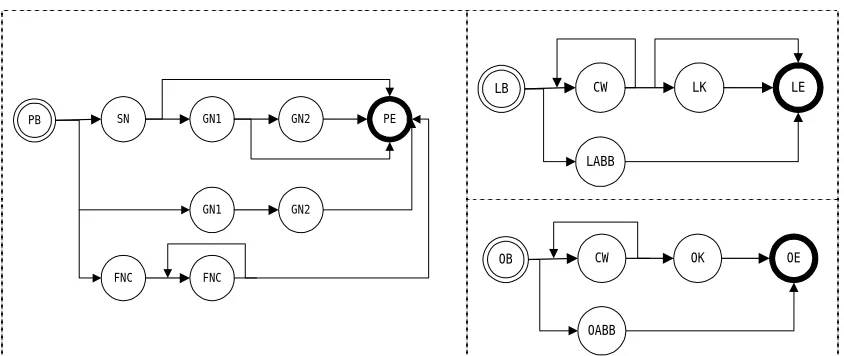
Generally speaking, the decoding process consists of three steps: lexical word candidate generation, NE candidate generation, and Viterbi search. A few heuristics and NE grammars, shown in Figure 2, are used to reduce the search space when NE candidates are generated.
3
The NLPWin system is a natural language processing system developed by Microsoft Research.
4
The PV and PT are not tagged in the training data parsed by NLPWin. They are then labeled using rule-based methods.
Jian Sun et al.
LB CW LK LE
LABB
PB SN GN1 GN2 PE
GN1 GN2
FNC FNC
OB CW OK OE
OABB
Figure 2. The grammar of PER, LOC and ORG candidates.
SN: Chinese surname; GN1: first character of a Chinese given name; GN2: second character of a Chinese given name; FNC: character of a foreign name; CW: Chinese word; LK: location keyword; LABB: abbreviation of a location name; OK: organization keyword; OABB: abbreviation of an organization name.
Given a sequence of Chinese characters, the decoding process is as follows: Step 1:
Lexical word candidate generation. All possible word segmentations are generated according to a Chinese lexicon containing 120,050 entries. The lexicon, in which each entry does not contain the NE tags even if it is a PER, LOC or ORG, is only used for segmentation.
Step 2:
A Class-based Language Model Approach to Chinese Named Entity Identification
Since there are no training data for the ORG abbreviation model, it is impossible to estimate the model parameters. We then utilize linguistic knowledge of abbreviation generation and construct a score function for the ORG abbreviation candidates. The score function is defined such that the resulting scores of the ORG abbreviation candidates are comparable to other NE candidates whose parameters (probabilities) are assigned using the probabilistic models described in Section 3.3.
The following is an example used to explain how a score is assigned. Suppose that
邮电 学 ‘Beijing University of Posts & Telecommunications’ has been identified as an ORG in the previous part in the text, and that one of the ORG abbreviation candidates is 邮. The generative probability of 邮电 学 (P( 邮电 学|ORG)) in the ORG model and that of 邮 P( 邮|Contextual Model) in the contextual model can be computed. We calculate the score of 邮 in the organization abbreviation model (denoted as Score( 邮 |ORG abbr) ) as
)) Model contextual |
( P ) ( ) ORG | (
P + − ×
× α
α 1
,
where
α
is set to be 0.5. In addition, according to intuition, the score of 邮 in the organization abbreviation model is larger than the probability of 邮 in the contextual model given that 邮电 学 has been identified as an ORG, i.e.,Model) Contextual |
P( abbr) ORG |
Score( ≥
.
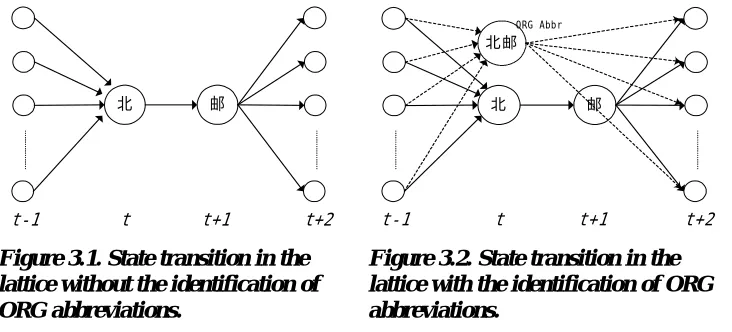
Accordingly, a maximum function is used. Figures 3.1 and 3.2 show the state transition in the lattice of the input sequence (e.g., 邮).
To sum up, given an identified organization name A = w1w2…wN, the score of a candidate
t-1 t t+1 t+2 t-1 t t+1 t+2
ORG Abbr
Figure 3.1. State transition in the lattice without the identification of ORG abbreviations.
A Class-based Language Model Approach to Chinese Named Entity Identification
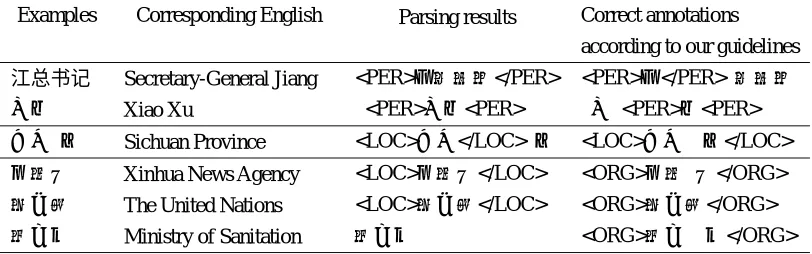
Table 4. NLPWin parsing results and correct annotations according to our guidelines.
Examples Corresponding English Parsing results Correct annotations according to our guidelines
Secretary-General Jiang
Xiao Xu
<PER> 总书记</PER>
<PER> <PER>
<PER> </PER> 总书记
<PER> <PER>
Sichuan Province <LOC> </LOC> <LOC> </LOC>
华
联 国
卫
Xinhua News Agency The United Nations
Ministry of Sanitation
<LOC> 华 </LOC> <LOC>联 国</LOC>
卫
<ORG> 华 </ORG> <ORG>联 国</ORG>
<ORG>卫 </ORG>
The statistics of the training data are shown in Table 5.
Table 5. Statistics of the Training Data.
Number of Word Tokens Entity
Year 1997 Year 1998
PER1 2,459 1,863
PER2 48,404 46,141
PER3 126,384 115,057
Person
FN 81,885 82,474
Locations (whole names) 376,126 354,317
Abbreviations of Locations 21,304 17,412
Organizations 122,288 125,711
Personal Titles 67,537 59,879
Speech-act Verbs 87,602 83,930
Location Keywords 49,767 53,469
Organization Keywords 115,447 117,423
5.2.2 Test Data
We developed a large open test data based on our guidelines8. As shown in Table 6, the data set, which was balanced in terms of domain, style and time, contained approximately half a million Chinese characters. The test set contained 11,844 sentences, 49.84% of which contain at least one NE token.
8
Jian Sun et al.
Table 6. Statistics9 of the Test Data.
Number of NE Tokens ID Domain
PER LOC ORG
Data Size
(Byte)
1 Army 65 203 30 19k
2 Computer 62 160 134 59k
3 Culture 549 672 81 138k
4 Economy 154 824 354 108k
5 Entertainment 665 617 143 104k
6 Literature 458 715 131 96k
7 Nation 450 1195 251 101k
8 People 1134 913 400 116k
9 Politics 510 1147 214 122k
10 Science 148 206 81 60k
11 Sports 733 1194 623 114k
Total 4928 7846 2442 1037k
Note that the open-test data set was much larger than the MET test data set (the numbers of PERs, LOCs, and ORGs were 174, 750, and 377, respectively). The numbers of abbreviations of PERs, LOCs, and ORGs in the open-test data set were 367, 729, and 475, respectively.
5.3 Baseline NLPWin Performance
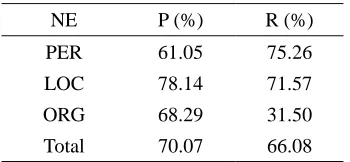
We conducted a baseline experiment, which consisted of two steps: parsing the test data using NLPWin; correcting the errors according to the rules. The performance achieved is shown in Table 7.
Table 7. Baseline NLPWin Performance.
NE P (%) R (%)
PER 61.05 75.26
LOC 78.14 71.57
ORG 68.29 31.50
Total 70.07 66.08
9
A Class-based Language Model Approach to Chinese Named Entity Identification
5.4 Experimental Results
In order to investigate the contribution of the unified framework, heuristic information and the identification of NE abbreviations, the following experiments were conducted using our NE identification system:
(1) Experiments 1, 2 and 3 examined the contribution of the heuristics and unified framework.
(2) Experiments 4, 5 and 6 tested the performance of the system using our method of NE abbreviations identification.
(3) Experiment 7 compared the performance of identifying whole NEs and that of identifying NE abbreviations.
5.4.1 Experiments 1, 2 and 3: The contribution of the heuristics and unified framework
Experiment 1 was performed to examine the performance of a basic class-based model, in which no heuristic information was employed in the decoder in the unified framework. Experiment 2 examined the performance of a traditional method, which consisted of two separate steps: segmenting the sentence and recognizing NEs. In the segmentation step, we searched for the word with the maximal length in the lexicon to split the input character string10. Heuristic information was employed in this experiment. Experiment 3 investigated the performance of the unified framework, where the unified framework and heuristic information were adopted.
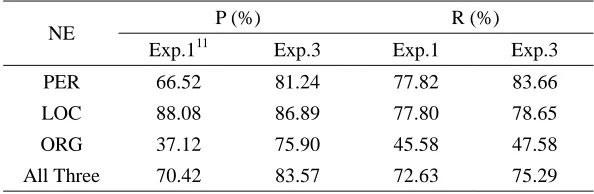
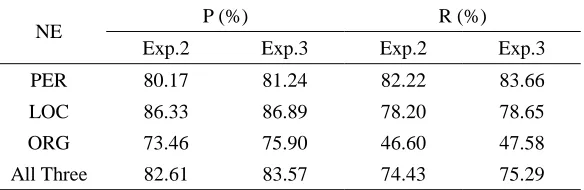
A comparison of the results of Experiment 1 and Experiment 3, which aims to show the contribution of heuristic information, is shown in Table 8. A comparison of the results of Experiment 2 and Experiment 3, which aims to show the contribution of the unified method, is shown in Table 9.
Table 8. Results of Experiment 1 and Experiment 3
P (%) R (%)
NE
Exp.111 Exp.3 Exp.1 Exp.3 PER 66.52 81.24 77.82 83.66 LOC 88.08 86.89 77.80 78.65 ORG 37.12 75.90 45.58 47.58
All Three 70.42 83.57 72.63 75.29
10
Every Chinese character in the input string, which can be seen as a single character word, is also added into the segmentation lattice. We save the minimal length segmentation in the lattice so that the character-based model (for PER) can be applied.
11
Jian Sun et al.
From Table 8, we observed that after the introduction of heuristic information, the precision of PER increased from 66.52% to 81.24%, that of ORG from 37.12% to 75.90%. We also noticed that the recall of PER from 77.82% to 83.66%, that of ORG from 45.58% to 47.58%. Therefore, the heuristic information was an important knowledge resource for recognizing NEs.
From Table 9, we find that the precision and recall of PER, LOC and ORG all improved as a result of the combining word segmentation with NE identification. For instance, the precision of PER increased from 80.17% to 81.24%, and the recall from 82.22% to 83.66%. Therefore, we can conclude that the unified framework for NE identification was a more effective method.
5.4.2 Experiments 4, 5 and 6: Performance achieved when modeling abbreviations of personal, location and organization names
In order to examine the performance of our methods of identifying NE abbreviations, Experiments 4, 5 and 6 were conducted. Experiment 4 examined the effectiveness of modeling the abbreviations of personal names. Experiment 5 incorporated modeling of the abbreviations of location names based on Experiment 4, and Experiment 6 integrated modeling of the abbreviations of organization names based on Experiment 5. The results are shown in Table 10.
Table 10. Results of Experiments 3, 4, 5 and 6.
P (%) R (%)
NE
Exp.3 Exp.4 Exp.5 Exp.6 Exp.3 Exp.4 Exp.5 Exp.6
PER 81.24 79.64 79.77 79.78 83.66 89.31 89.31 89.29
LOC 86.89 87.04 85.76 86.02 78.65 78.61 84.91 84.87
ORG 75.90 75.97 75.95 76.79 47.58 49.50 47.71 59.75
All
Three
83.57 82.95 82.52 82.59 75.29 77.08 80.36 82.27 Table 9. Results of Experiment 2 and Experiment 3
P (%) R (%)
NE
Exp.2 Exp.3 Exp.2 Exp.3
PER 80.17 81.24 82.22 83.66 LOC 86.33 86.89 78.20 78.65
A Class-based Language Model Approach to Chinese Named Entity Identification
It can be seen that the recall of PER, LOC and ORG showed distinct improvement. For example, the recalls increased from 83.66%, 78.65%, 47.68% to 89.31%, 84.91%, 59.75%, respectively. However, we also find that the precision of PER and LOC decreased a little (PER: from 81.24% to 79.78%; LOC: from 86.89% to 86.02%). The reason was that the precision of identifying NE abbreviations was lower than that of identifying whole NE names in general. It is difficult to decide whether a Chinese character is an NE, a single Chinese character, or a part of an ordinary word. For example, the Chinese character “ ” can be an abbreviation of LOC ( 国 ‘China’), a single Chinese character, or a part of a word (e.g.,
间 ‘in the middle of’). Although the precisions decreased a little, on the whole, we can conclude that the performance of NE identification improved after the models of NE abbreviations were constructed.
5.4.3 Experiment 7: Comparing the performance of identifying whole NEs and NE abbreviations
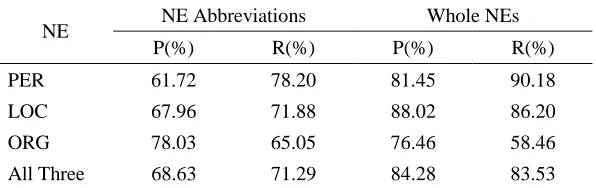
In order to compare the performance of identifying whole NE names with that of identifying NE abbreviations in more detail, we show results in Table 11. We can observe that the performance (precision and recall) of identifying NE abbreviations was about 10% lower than that of identifying whole NE names, in general.
Table 11. Results of identifying whole NEs and NE abbreviations.
NE Abbreviations Whole NEs NE
P(%) R(%) P(%) R(%)
PER 61.72 78.20 81.45 90.18
LOC 67.96 71.88 88.02 86.20
ORG 78.03 65.05 76.46 58.46
All Three 68.63 71.29 84.28 83.53
5.4.4 Summary of Experiments
Jian Sun et al.
Figure 4. Precision in different settings. Figure 5. Recall in different settings.
1. Results of NLPWin parsing. 2. Results of the baseline class-based model. 3. Performance of the segmentation-identification separate method.
4. Performance of integrating heuristic information and adopting the unified framework. 5. Performance of modeling for the abbreviations of personal names.
6. Performance of modeling for the abbreviations of location names. 7. Performance of modeling for the abbreviations of organization names
From these two figures, we can see that: (1) the results of the baseline class-based LM are better than those of NLPWin; (2) the distinct improvement was achieved by employing heuristic information; (3) the precision and recall rates improved when we adopted the unified framework; (4) modeling for NE abbreviations distinctly improved the recall of all NEs (as shown in Figure 5) with only a trivial decrease in precision.
5.5 Error Analysis
A Class-based Language Model Approach to Chinese Named Entity Identification
Table 12. Distribution of two kinds of errors.
Boundary Class Tag
Correct
Error
Correct
Error
E r r o r 2 E r r o r 1
Figure 6. Two kinds of errors.
NE Error 1 (%) Error 2 (%)
PER 87.71 12.29
LOC 96.86 3.14
ORG 97.73 2.27
All Three 93.14 6.86
From Table 12, we observe that boundary errors accounted for a large percentage of these two kinds of errors in Chinese NE identification. The errors of three kinds of NEs will be further shown in Sections 5.5.1, 5.5.2, and 5.5.3. For some errors, the solutions are given. We also indicate some cases that could not be perfectly handled in our method.
5.5.1 PER Errors
The major PER12 errors are shown in Table 13:
We will try to deal with some of above errors in our future work. Case (b) can be handled
12
PER LOC ORG
Table 13. PER Errors
Cases Identified results Standard Transliteration/Translation
a. Personal names that
contain content word
厉 为 厉 为 Li Youwei
Gao Feng
b. Location names that
have nested personal name
Ho Chi Minh City
c. Japanese names Tengjing
Meizi
d. Aliases of personal
names
东东 娇娇
东东 娇娇
Dongdong
Jiaojiao
e. Transliterated personal
names and transliterated location names that cannot be distinguished
贾 贾 Ajax
A Class-based Language Model Approach to Chinese Named Entity Identification
Case (a) can be partly handled by refining the model of organization names. However, our system may fail to handle an instance like “ 华 门 ” because it does not have enough information to detect the right boundary of the organization name. In addition, our class-based LM cannot successfully deal with Case (b) at present.
In addition, although the language model method was adopted to identify the abbreviations of organization names, there were still some abbreviations of organization names that were not identified. One reason is that some abbreviations are not covered in the above patterns. The other reason is that the score function in Equation 9 is just an empirical formula and needs to be improved.
5.6 Evaluation with MET2 Data
We also evaluated our system (nested NEs were not numbered in this case) using the MET2 test data and compared the performance achieved with that of two public systems13 (the NTU system and KRDL system). As shown in Table 16, our system outperformed the NTU system. Our system was also better than the KRDL system for PERs, but the performance for LOCs and ORGs was worse than that of the KRDL system. The possible reasons are: (1) Our NE definitions are slightly different from those of MET2. (2) The model is estimated using a general domain corpus, which is quite different from the domain of MET2 data. (3) An NE dictionary is not utilized in our system.
Table 16. Results using MET2 Data.
Our System NTU Results
Kent Ridge Digital Labs Results
(KRDL) NE
P (%) R (%) P (%) R (%) P (%) R (%)
PER 77.51 93.10 74 91 66 92
LOC 86.52 87.20 69 78 89 91
ORG 88.75 77.25 85 78 89 88
6. Conclusions & Future work
We have presented a method of Chinese NE identification using a class-based language model, which consists of two sub-models: a set of entity models and a contextual model. Our method provides a unified framework, in which it is easy to incorporate Chinese word segmentation
13
Available at
Jian Sun et al.
and NE identification. As has been demonstrated, our unified method performs better than traditional methods. We have also presented our method of identifying NE abbreviations. The language model method has several advantages over rule-based ones. First, it can integrate the identification of NE abbreviations into the class-based LM. Secondly, it reduces the labor of developing rules for NE abbreviations. In addition, we have also employed a two-level ORG model so that the nested entities in organization names can be identified.
The achieved precision rates of PER, LOC, ORG on the test data were 79.78%, 86.02%, and 76.79%, respectively, and the achieved recall rates were 89.29%, 84.87%, and 59.75%, respectively.
There are several possible directions of future research. First, since we use a parser to annotate the training set, parsing errors will be an obstacle to further improvement. Therefore, we need to find an effective way to correct the mistakes and perform necessary automatic correction. Secondly, a more delicate model of ORG will be investigated to characterize the features of all kinds of organizations. Thirdly, the current method only utilizes the features in the currently processed sentence, not the global information in the text. For example, suppose that the same NE (e.g., 来) occurs twice in different sentences in a document. It is possible that the NE will be tagged PER in one sentence but not recognized in the other. This raises a question as to how to construct a model of global information. Furthermore, the model of organization name abbreviations also needs to be improved.
Acknowledgements
We would like to thank Chang-ning Huang, Andi Wu, Hang Li and other colleagues at Microsoft Research for their help. We also thank Lei Zhang for his help. In addition, we thank the three anonymous reviewers for their useful comments.
References
Aberdeen J., Day D., Hirschman L., Robinson P. and Vilain M., “MITRE: Description of the Alembic System Used for MUC-6”, Proceedings of the Sixth Message Understanding Conference, pp. 141-155, 1995.
Black A., Taylor P. and Caley R., The Festival Speech synthesis system.
http://www.cstr.ed.ac.uk/projects/festival/ , 1998.
Black W.J., Rinaldi F. and Mowatt D., “Facile: Description of the NE System Used For MUC-7”, Proceedings of 7th Message Understanding Conference, 1998.
A Class-based Language Model Approach to Chinese Named Entity Identification
Borthwick. A., “A Maximum Entropy Approach to Named Entity Recognition”, PhD Dissertation, 1999.
Bikel D., Schwarta R. and Weischedel R., “An algorithm that learns what’s in a name”,
Machine Learning Journal Special Issue on Natural Language Learning, 34, pp. 211-231, 1999.
Brown P. F., DellaPietra V. J., deSouza P. V., Lai J. C., and Mercer R. L., “Class-based n-gram models of natural language”, Computational Linguistics, 18(4): 467- 479, 1992.
Brill E., “Transform-based Error-Driven Learning and Natural Language Processing: A Case Study in Part-of-speech Tagging”, Computational Linguistics, 21(4): 543-565, 1995.
Carreras X., Màrquez L. and Padró L., “Named Entity Extraction using AdaBoost”, The 6th Conference on Natural Language Learning, 2002.
Chang J.S., Chen S. D., Zheng Y., Liu X. Z., and Ke S. J., “Large-corpus-based methods for Chinese personal name recognition”, Journal of Chinese Information Processing, 6(3): 7–15, 1992.
Chen H.H., Ding Y.W., Tsai S.C. and Bian G.W., “Description of the NTU System Used for MET2”, Proceedings of 7th Message Understanding Conference, 1998.
Chen H.H., Lee J.C., “The Identification of Organization Names in Chinese Texts”,
Communication of Chinese and Oriental Languages Information Processing Society,
4(2): pp. 131-142, 1994 (in Chinese).
Chen, S. F., and Goodman, J., “An empirical study of smoothing techniques for language modeling”. Computer Speech and Language, 13: 359-394, October 1999.
Chen, Si-Qing., “The automatic identification and recovery of Chinese acronyms”, Studies in the Linguistics Sciences, 26(1/2): 61–82. 1996.
Chinchor. N., “MUC-7 Named Entity Task Definition Version 3.5”. Available by from
ftp.muc.saic.com/pub/MUC/MUC7-guidelines, 1997.
Collins M., Singer Y., “Unsupervised models for named entity classification”, Proceedings of the Joint SIGDAT Conference on Empirical Methods in Natural Language Processing and Very Large Corpora, 1999.
Collins M., “Ranking Algorithms for Named-Entity Extraction: Boosting and the Voted Perceptron”, Proceedings of the 40th Annual Meeting of the ACL, Philadelphia, pp. 489-496, July 2002.
Florian R., “Named Entity Recognition as a House of Cards: Classifier Stacking”, The 6th Conference on Natural Language Learning, 2002.
Fukumoto J., Shimohata M., Masui F. and Sasaki M., “Oki Electric Industry: Description of the Oki System as Used for MET-2”, Proceedings of 7th Message Understanding Conference, 1998.
Jian Sun et al.
Gotoh Y., Renals S., “Information extraction from broadcast news”, Philosophical Transactions of the Royal Society of London, series A: Mathematical, Physical and Engineering Sciences, 2000.
Grishman R., “The NYU System for MUC-6 or Where's the Syntax?”, Proceedings of the MUC-6 workshop, Washington. November 1995.
Humphreys K., Gaizauskas R., et al., Univ. of Sheffield: “Description of the LaSIE-II System as Used for MUC-7”, Proceedings of 7th Message Understanding Conference, 1998.
Jansche M., “Named Entity Extraction with Conditional Markov Models and Classifiers”, The 6th Conference on Natural Language Learning, 2002.
Krupka G. R., Hausman K.. “IsoQuest Inc.: Description of the NetOwlTM Extractor System as Used for MUC-7”, Proceedings of 7th Message Understanding Conference, 1998.
Kuhn R., Mori. R.D. “A Cache-Based Natural Language Model for Speech Recognition”,
IEEE Transaction on Pattern Analysis and Machine Intelligence, Vol.12. No. 6. pp 570-583, 1990.
McDonald D., “Internal and External Evidence in the Identification and Semantic Categorization of Proper Names”, Corpus Processing for Lexical Acquisition. pp. 21-39. MIT Press. Cambridge, MA. 1996.
McNamee P. and Mayfield J., “Entity Extraction without Language-specific Resources”, The 6th Conference on Natural Language Learning, 2002.
Mikheev A., Grover C. and Moens M., “Description of the LTG System Used for MUC-7”,
Proceedings of 7th Message Understanding Conference, 1998.
Miller S., Crystal M., et al., “BBN: Description of the SIFT System as Used for MUC-7”,
Proceedings of 7th Message Understanding Conference, 1998.
Palmer D., Day D.S., “A Statistical Profile of the Named Entity Task”, Proceedings of the Fifth Conference on Applied Natural Language Processing, Washington, D.C., March 31- April 3, 1997.
Sang E.T.K., “Memory-Based Named Entity Recognition”, The 6th Conference on Natural Language Learning. 2002.
Sekine S., Grishman R. and Shinou H., “A decision tree method for finding and classifying names in Japanese texts”, Proceedings of the Sixth Workshop on Very Large Corpora, Montreal, Canada, 1998.
Sproat R., Black A., Chen S., et al., “Normalization of non-standard words”, Computer Speech and Language, 15(3): 287-333, 2001.
Sproat R., Chilin Shih. “Corpus-Based Methods in Chinese Morphology and Phonology”, 2001 LSA Institute, Santa Barbara.
A Class-based Language Model Approach to Chinese Named Entity Identification
Sun M.S., Huang C.N., Gao H.Y., Fang J., “Identifying Chinese Names in Unrestricted Texts”,
Communications of COLIPS, Vol 4, No. 2, pp. 113-122, 1994 (in Chinese)
Takeuchi K., Collier N., “Use of Support Vector Machines in Extended Named Entity Recognition”, The 6th Conference on Natural Language Learning, 2002.
Toole J., “A Hybrid Approach to the Identification and Expansion of Abbreviations”,
RIAO'2000 Proceedings, 2000
Tsukamoto K., Mitsuishi Y., Sassano M., “Learning with Multiple Stacking for Named Entity Recognition”, The 6th Conference on Natural Language Learning. 2002.
Viterbi A. J., “Error Bounds for Convolutional Codes and an Asymptotically Optimum Decoding Algorithm”, IEEE Transactions on Information Theory, IT(13). pp. 260-269, April 1967.
Wu D.K., Ngai G., et al., “Boosting for Named Entity Recognition”, The 6th Conference on Natural Language Learning, 2002.
Yu S.H., Bai S.H. and Wu P., “Description of the Kent Ridge Digital Labs System Used for MUC-7”, Proceedings of 7th Message Understanding Conference, 1998.
Zhang L., “Study on Chinese Proofreading Oriented Language Modeling”, PhD Dissertation, 2001.
Zhou G. Su J., “Named Entity Recognition using an HMM-based Chunk Tagger”,