International Journal of Scientific Research in Computer Science, Engineering and Information Technology © 2017 IJSRCSEIT | Volume 2 | Issue 3 | ISSN : 2456-3307
An Efficient Agglomerative Algorithm Based On Modularity
Optimization to Find Homogeneous Regions in Image
Vikalp Mishra
Department of Computer Science, Naraina Group of Institutions, Kanpur, Uttar Pradesh, India
ABSTRACT
To address the problem of segmenting an image into sizeable homogeneous regions, this paper proposes an efficient agglomerative algorithm based on modularity optimization. Given an over-segmented image that consists of many small regions, our algorithm automatically merges those neighboring regions that produce the largest increase in modularity index. When the modularity of the segmented image is maximized, the algorithm stops merging and produces the final segmented image. To preserve the repetitive patterns in a homogeneous region, we propose a feature based on the histogram of states of image gradients, and use it together with the color feature to characterize the similarity of two regions. By constructing the similarity matrix in an adaptive manner, the over-segmentation problem can be effectively avoided. Our algorithm is tested on the publicly available Berkeley Segmentation Data Set as well as the Semantic Segmentation Data Set and compared with other popular algorithms. Experimental results have demonstrated that our algorithm produces sizable segmentation, preserves repetitive patterns with appealing time complexity, and achieves object-level segmentation to some extent.
Keywords: Homogeneous Regions, Modularity Optimization, Data Set, Object-Level Segmentation, Image
Segmentation, Community Aggregation, SSDS, HoS, VOI, BSDS500
I.
INTRODUCTION
The concepts of Modularity and Community Detection become very popular in the field of network science during the past decade. Due to its application in large scale networks, recently, researches try to explore the possibilities of applying these concepts to image segmentation, where millions of pixels are included. In this section, we first review these two concepts, and then discuss two recent approaches based on modularity optimization in details.
A. Modularity and Community Detection
Modularity was first defined by M.E.J. Newman in [25] for the analysis of weighted networks. For a weighted network G with the weighted adjacency matrix A, the modularity Q is defined by:
where Aij represents the weight between node i and
node j;
m = ∑ represents the total weights of the
network; = ∑ Aij is the weighted degree of the
node (i; ci) is the community label to which node i
belongs; δ(ci; cj) is 1 if node i and node j are in the
same community, otherwise it‟s 0. Intuitively, modularity means to evaluate the difference between the actual probability of the connectivity of two nodes in the same community and the estimated probability under the assumption that the two nodes are connected randomly.
Community Detection becomes a hot topic in network science during the past few years, for example, social networks. A community is a group of nodes from the network, where nodes in the same community are densely connected with each other, and nodes in different communities are sparsely connected.
the network. For example, a community in the social network may represent a group of friends sharing the same hobbies; a community in the citation network may reveal the related work in a certain research area. To uncover the interconnection of the nodes in a network, Community Detection algorithms aim to find a partition of the network such that every partition can well represent certain community property.
Since the first proposal of modularity, it has been widely used to evaluate the performance of community detection algorithms and also works as an optimization index for community detection. For example, Louvain method [29] is based on modularity increase to detect the communities. The modularity increase caused by merging community j into community i can be computed by Equation (4):
Where ∑ the total weights of the edges inside
community i; ∑ is the total weights of the edges
incident to nodes in community i; kj,in is the sum of the
weights from community j to community i; other notations are the same as defined in Equation (3). As is shown in Figure 1, the basic idea of Lo
uvain method is to iteratively repeat the process of Modularity Optimization in Phase 1 and Community Aggregation in Phase 2 below:
Phase 1: Modularity Optimization
At the beginning of this phase, the network is composed of several communities (each community is a single node initially, after several iterations, each community is a group of nodes), for each community i and its connected nodes { }, compute
the potential modularity increase ΔQij if we merge
community j (j Ni) into community i, according to
Equation (4). Find the maximum modularity increase caused by merging community j* and community i and merge these two communities. Repeat this process until no modularity increase for all the communities in the network;
Phase 2: Community Aggregation
To reconstruct the network, merge the communities sharing the same label and relabel them; treat the communities with the same label as a single node in the network and recomputed the weighted adjacency matrix by summing over all the weights connecting two communities. The above processes are repeated until there is no modularity increase caused by merging any two communities.
B. Related Approaches for Image Segmentation
Recently, modularity optimization has been applied in image segmentation. [26] explores the possibility of directly applying modularity maximization to image segmentation, where a top-down spectral method with an iterative rounding scheme is proposed for fast computation. Such a scheme can reduce the computational cost to some extent, compared with the practically used exchange heuristic [30]. However, it can only deal with images of relatively small size on normal PCs, due to the involved manipulation of a dense modularity matrix. Besides, direct application of modularity maximization to image segmentation is known to result in serious over segmentation. To address the over-segmentation problems, [27] proposes to use a weighted modularity, where the modularity computation only occurs locally within a pre-defined distance. Moreover, an approximation of the Louvain method, the so called basic iteration, is used for faster computation.
Both of these two methods focus on how to apply modularity optimization to segmentation, and ignore the differences between community detection and image segmentation.
II.
METHODS AND MATERIAL
Motivated by the limitations exposed in the existing work, our approach takes the following three aspects into consideration: 1) time complexity; 2) regularity preservation; 3) the prevention of over-segmentation. Inspired by the application of community detection algorithms in large scale networks, we attempt to view an image from the perspective of a network.
For a network, modularity [25] is a crucial quantity, which is used to evaluate the performance of various community detection algorithms. In more detail, the larger the modularity of a network is, the more accurate the detected communities are. Considering the efficient calculation of modularity in the community detection algorithm, similarly, we regard image segmentation problem as a community detection problem, and the optimal segmentation is achieved when the modularity of the image is maximized.
Although modularity has been applied to image segmentation by some researchers recently, e.g., [26], [27], it still faces similar problems as other segmentation algorithms mentioned above, due to the ignorance of the inherent properties of images (see Section II-B for more details). Different from the existing algorithms based on modularity, we identify the differences between community detection and image segmentation, start from „superpixels‟, and propose a new texture feature from low level cues to capture the regularities for the visually coherent object and encode it into the similarity matrix; moreover, the similarity among regions of pixels is constructed in an adaptive manner so as to avoid over-segmentation. Compared with other existing segmentation algorithms, our proposed algorithm can automatically detect the number of regions/segments in an image, produces sizable regions with coherent regularities preserved, and achieves better semantic level segmentation to some extent. The contributions of this thesis are the following:
An efficient agglomerative segmentation algorithm incorporating the advantage of community detection and the inherent properties of images is developed. The algorithm enjoys low time complexity as well as comparable performance;
A new texture feature, namely, Histogram of States (HoS) is proposed to capture the
regularities in the image. The HoS feature, together with the color feature, encodes better similarity measure from the semantic level, and is more likely to preserve regularities in the object;
An adaptive similarity matrix construction is proposed to avoid over-segmentation. In each iteration, the similarity between two regions of pixels is recalculated to reevaluate the color and texture similarity. In this way, it can effectively avoid breaking visually coherent regions, which share some regularity or have smooth changes in color or texture caused by shadow or perspectives. Whole processing of the thesis will be as follows:
Original Image Superpixels Image Segmented Image
Figure 1: Whole Proposed Process
III.
RESULTS AND DISCUSSION
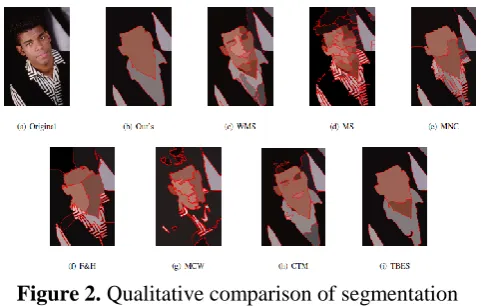
Figure 2 shows the Qualitative comparison of segmentation results by some popular methods:
Figure 2. Qualitative comparison of segmentation results by some popular methods.
Table 1 shows the quantitative comparison of different algorithms on SSDS:
TABLE 1
IV. CONCLUSION
In this paper, we have proposed an efficient image segmentation algorithm taking advantages of the scalability of modularity optimization and the inherent properties of images. Adopting the bottom-up framework, the proposed algorithm automatically detects the number of segments in the image, and by employing the color feature as well as the proposed Histogram of States (HoS) texture feature, it adaptively constructs the similarity matrix among different regions, optimizes the modularity and aggregates the neighboring regions iteratively. The optimal segmentation is achieved when no modularity increase occurs by aggregating any neighboring regions. Results of extensive experiments have validated that the proposed algorithm gives impressive qualitative segmentation results; besides, it is reported that the new algorithm achieves the best performance among all the experimented popular methods in terms of VOI and Precision on BSDS500. Since the algorithm aims to avoid over-segmentation, it produces low Recall value. In addition, it is demonstrated that the new algorithm can preserve regularities in the object and achieve the best performance from the semantic level on SSDS.
V. REFERENCES
[1] M. Dabbaghha, M. Dashtbayazi, S. Marjani, M. Sabaghi, “Increased Accuracy in Image Segmentation Considering the Modular Method Based on Texture Characteristics and Super Pixel,” Journal of Electrical and Electronic Engineering 2016; 4(3): 63-67.(Base paper) [2] J. Shi and J. Malik, “Normalized cuts and image
segmentation,” IEEE Transactions on Pattern Analysis and Machine Intelligence, vol. 22, no. 8, pp. 888–905, 2000.
[3] D. Comaniciu and P. Meer, “Mean shift: A robust approach toward feature space analysis,”
IEEE Transactions on Pattern Analysis and Machine Intelligence, vol. 32, no. 7, pp. 1271– 1283, 2010.
[4] P. Felzenszwalb and D. Huttenlocher, “Efficient graph-based image segmentation,” International Journal of Computer Vision, vol. 59, no. 2, pp. 167–181, 2004.
[5] P. Arbel´aez, M. Maire, C. Fowlkes, and J. Malik, “From contours to regions: An empirical evaluation,” in IEEE Conference on Computer Vision and Pattern Recognition, CVPR. IEEE, 2009, pp. 2294–2301.
[6] S. Rao, H. Mobahi, A. Yang, S. Sastry, and Y. Ma, “Natural image segmentation with adaptive texture and boundary encoding,” Asian Conference on Computer Vision, ACCV., pp. 135–146, 2010.
[7] P. Arbelaez, M. Maire, C. Fowlkes, and J. Malik, “Contour detection and hierarchical image segmentation,” IEEE Transactions on Pattern Analysis and Machine Intelligence, vol. 33, no. 5, pp. 898–916, 2011.
[8] H. Zhu, J. Zheng, J. Cai, and N. M. Thalmann, “Object-level image segmentation using low level cues,” IEEE Transactions on Image Processing, 2013.
[9] M. Wertheimer, “Laws of organization in perceptual forms,” A Source Book of Gestalt Psychology, pp. 71–88, 1938.
[10] D. D. Hoffman and M. Singh, “Salience of visual parts,” Cognition, vol. 63, no. 1, pp. 29–78, 1997. [11] T. Cour, F. Benezit, and J. Shi, “Spectral segmentation with multiscale graph decomposition,” in IEEE Conference on Computer Vision and Pattern Recognition, CVPR., vol. 2. IEEE, 2005, pp. 1124–1131. [12] L. Grady and E. L. Schwartz, “Isoperimetric
graph partitioning for image segmentation,” IEEE Transactions on Pattern Analysis and Machine Intelligence, vol. 28, no. 3, pp. 469– 475, 2006.
[13] J. Wang, Y. Jia, X.-S. Hua, C. Zhang, and L. Quan, “Normalized tree partitioning for image segmentation,” in IEEE Conference on Computer Vision and Pattern Recognition, 2008. CVPR 2008. IEEE, 2008, pp. 1–8.
Pattern Analysis and Machine Intelligence, vol. 33, no. 7, pp. 1384– 1399, 2011.
[15] L. Vincent and P. Soille, “Watersheds in digital spaces: an efficient algorithm based on immersion simulations,” IEEE transactions on Pattern Analysis and Machine Intelligence, vol. 13, no. 6, pp. 583–598, 1991.
[16] V. Grau, A. Mewes, M. Alcaniz, R. Kikinis, and S. K. Warfield, “Improved watershed transform for medical image segmentation using prior information,” IEEE Transactions on Medical Imaging, vol. 23, no. 4, pp. 447–458, 2004. [17] X.-C. Tai, E. Hodneland, J. Weickert, N. V.
Bukoreshtliev, A. Lundervold, and H.-H. Gerdes, “Level set methods for watershed image segmentation,” in Scale Space and Variational Methods in Computer Vision. Springer, 2007, pp. 178–190.
[18] V. Osma-Ruiz, J. I. Godino-Llorente, N. S´aenz-Lech´on, and P. G´omez-Vilda, “An improved watershed algorithm based on efficient computation of shortest paths,” Pattern Recognition, vol. 40, no. 3, pp. 1078–1090, 2007. [19] A. Yang, J. Wright, Y. Ma, and S. Sastry, “Unsupervised segmentation of natural images via lossy data compression,” Computer Vision and Image Understanding, vol. 110, no. 2, pp. 212–225, 2008.
[20] M. Kass, A. Witkin, and D. Terzopoulos, “Snakes: Active contour models,” International Journal of Computer Vision, vol. 1, no. 4, pp. 321–331, 1988.
[21] C. Xu and J. L. Prince, “Snakes, shapes, and gradient vector flow,” IEEE Transactions on Image Processing, vol. 7, no. 3, pp. 359–369, 1998.
[22] “Generalized gradient vector flow external forces for active contours,” Signal processing, vol. 71, no. 2, pp. 131–139, 1998.
[23] T. F. Chan and L. A. Vese, “Active contours without edges,” IEEE Transactions on Image Processing, vol. 10, no. 2, pp. 266–277, 2001. [24] B. Li and S. T. Acton, “Active contour external
force using vector field convolution for image segmentation,” IEEE Transactions on Image Processing, vol. 16, no. 8, pp. 2096–2106, 2007. [25] M. Newman, “Analysis of weighted networks,”
Physical Review E, vol. 70, no. 5, p. 056131, 2004.
[26] W. Li, “Modularity segmentation,” in Neural Information Processing Springer, 2013, pp. 100– 107.
[27] A. Browet, P.-A. Absil, and P. Van Dooren, “Community detection for hierarchical image segmentation,” in Combinatorial Image Analysis. Springer, 2011, pp. 358–371.
[28] H. Li, J. Cai, T. N. A. Nguyen, and J. Zheng, “A benchmark for semantic image segmentation,” in IEEE International Conference on Multimedia & Expo, ICME., 2013.