International Journal of Scientific Research in Computer Science, Engineering and Information Technology © 2017 IJSRCSEIT | Volume 2 | Issue 4 | ISSN : 2456-3307
Design of Finite Impulse Response Filter Using Genetic
Algorithm
Ela Mehra
*, Dr. Sulochana Wadhwani
Electrical Engineering Department, R.G.P.V. University, M.I.T.S., Gwalior, Madhya Pradesh, India
ABSTRACT
Genetic Algorithms (GAs) are used to solve many optimization problems in science and engineering such as pattern recognition, robotics, biology, medicine, and many other applications. The aim of this paper is to describe a method of designing Finite Impulse Response (FIR) filter using Genetic Algorithm (GA). Digital filters are an essential part of DSP. The purpose of the filters is to allow some frequencies to pass unaltered, while completely blocking others. The digital filters are mainly used for two purposes: separation of signals that have been combined, and restoration of signals that have been distorted in some way. In this present work, FIR filter is designed using Genetic Algorithm (GM) and its comparison is done with Kaiser window function parameters. Out of the two techniques, GA offers a quick, simple and automatic method of designing low pass FIR filters that are very close to optimum in terms of magnitude response, frequency response and in terms of phase variation. With the help of GA, the numbers of operations in design process are reduced and coefficient calculation is easily realized.
Keywords : Genetic Algorithm Optimization, Finite Impulse Response Filter Design, Signal Processing.
I.
INTRODUCTION
The heuristic programming methods were successful for many applications. GAs, one of the methods of the evolutionary calculation are based on principle protection of the best. (conversation of optimum). GAs generate the initial population producing values from large search space. GAs arrive the result from different search points by doing operation over this population . In this work, the design of FIR digital filter was realized by using window functions that their parameter values were calculated by helping of GA. The conventional approach to filter design is to select one of the standard polynomial transfer functions that satisfies the response specifications, followed by the implementation of the transfer function in one of the standard circuit structures. In many cases this approach is inadequate and an optimization is required Genetic algorithm optimization methods have emerged as a powerful approach to solving the more difficult optimization problems. Genetic Algorithms (GAs) represent a learning or adaptation method that is analogous to biological evolution according to
Darwin’s theory of evolution (Darwin 1859) and can be described as a kind of simulated evolution. GAs are often used to solve complex optimization problems that are either very difficult or completely impractical to solve using other methods.
II.
FILTER DESING AND PROCESSING
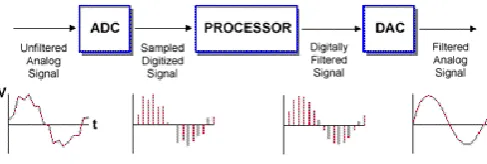
Filtering is a process by which the frequency spectrum of a signal can be modified, reshaped or manipulated to achieve some desired objectives.
Figure 1. Digital Signal Processing filters are implemented using a finite number "n" delay taps on a delay line and "n" computation coefficients to compute the algorithm (filter) function.
The number of taps (delays) and values of the computation coefficients (h0,h1,…...hn) are selected to
"weight" the data being shifted down the delay line to create the desired amplitude response of the filter. In this configuration, there are no feedback paths to cause instability. The calculation of coefficients is not constrained to particular values and can be used to implement filter functions that do not have a linear system equivalent.
This can be stated mathematically as:
( ) ∑ ( ) (
) ( )
Where
y(n) = Response of Linear Time Invariant (LTI) system. x(k) = Input signal
h(k) = Unit sample response N = No. of signal samples
FIR filters are simple to design and they are guaranteed to be bounded input-bounded output (BIBO) stable. By designing the filter taps to be symmetrical about the center tap position, an FIR filter can be guaranteed to have linear phase response. This is a desirable property for many applications such as music and video as an infinite recursive series. These implementations are referred to as Infinite Impulse Response (IIR) filters. IIR filters can be mathematically represented as:
( ) ∑ ( ) feed-back taps in the IIR filter and N is the number of feed-forward taps. IIR Filters are useful for high-speed designs because they typically require a lower number of multiply compared to FIR filters. IIR filters have lower side lobes in stop band as compared to FIR filters. Unfortunately, IIR filters do not have linear phase and they can be unstable if not designed properly. IIR filters are very sensitive to filter coefficient quantization errors that occur due to use of a finite number of bits to represent the filter coefficients. That is, the IIR filter is implemented as a series of lower-order IIR filters as opposed to one high-lower-order.
V.
ADVANTAGES OF FIR FILTER OVER IIR
FILTER
FIR filters have the following advantages over the IIR filters.
1. FIR filters are linear phase filters, which is useful in speech processing.
VI.
PROBLEM FORMULATION
A digital FIR filter is characterized by,
( ) ∑ ( ) FIR filter with h(n) as even symmetric and the order is even. The length of h(n) is N+1 and the number of coefficients is also (N+1). Because the coefficients h(n) are symmetrical, the dimension of the problem is halved. The (N+1)/2 coefficients are then flipped and concatenated to find the required (N+1) number of coefficients. The optimization algorithm attains the least error between the desired frequency response and the actual frequency response to determine the optimal h(n) values after a certain maximum number of iterations. The optimal h(n) values, after concatenation, finally represent the filter with better frequency response. Various filter parameters which are responsible for the optimal filter design are stop band and pass band normalized edge frequencies ( , ), pass band and stop band ripples ( and ), stop band attenuation and transition width. In this paper, PSO is applied in order to obtain the desired filter response as close as possible to the ideal response, where,
N, are individually specified. The particle vectors are distributed in a D dimensional search space, where D = N+1 for the case of Nth order FIR filter. The been used in different literatures.
( ) ( )[ ( ) approximate errors in different frequency bands. For ideal LP filter, ( )
( )
{
( )
where ωc is the cut-off frequency. The major drawback
of PM algorithm is that the ratio of δp / δs is fixed. To
improve the flexibility in the error function to be minimized, so that the desired level of δp and δs may be
specified, the error function given in (5) has been considered as fitness function in many literatures. The error fitness to be minimized using the evolutionary
and stop band normalized cut-off frequencies, respectively. Since the coefficients of the linear phase positive symmetric even order filter are matched, the dimension of the problem is halved. This greatly reduces the computational burdens of the algorithms.
VII.
GENETIC ALGORITHM
prevent the GA from being trapped at inferior local minima. The genetic algorithm loops over an iteration process to make the population evolve.
Figure 2. Genetic Algorithm Process
Each iteration consists of the following steps:
a) Initialization
The algorithm begins by creating a random initial population. For example, the initial population consists 20 individuals, which is the default value of population size in the population option.
b) Evaluation
At the beginning of each generation of the algorithm, the fitness of each particle must be calculated.
c) Selection
The algorithm selects individuals for reproduction. This selection is done randomly with probability depending on the relative fitness of the individual as a parent.
d) Mating
Mating is the creation of one or more offspring from the parents selected in the pairing process. The genetic makeup of the population is limited by the current population.
e) Mutation
By applying random changes to a single individual in the current generation to create a child.
f) Replacement
During the last step, individuals from the old population are killed and replaced by the new ones.
Figure 3. Flow Chart of GA
VIII.
EXPERIMENTS AND RESULTS
The method applied through MATLAB is to design a low pass FIR filter with ideal magnitude response, zero phase and small phase variation.
Consider that a low pass FIR filter is to be designed with the initial conditions described in Table 1.
TABLE 1.
VARIOUS PSO PARAMETERS
Parameters GA
Population Size 100 Iteration Cycle 1000 Crossover Percentage 0.7 Mutation Percentage 0.3 Mutation Rate 0.1
TABLE 2. OPTIMIZED COEFFICIENTS OF THE FIR LP FILTER OF ORDER 20
h(N) PSO
h(1)=h(21) -0.1097541 h(2)=h(20) -0.2929384 h(3)=h(19) -0.3929037 h(4)=h(18) -0.2927451 h(5)=h(17) -0.0633404 h(6)=h(16) 0.10732889 h(7)=h(15) 0.10727446 h(8)=h(14) 0.00697711 h(9)=h(13) -0.05346935 h(10)=h(12) -0.03274997
h(11) 0.006466789
Figure 4. Magnitude (dB) Plot for the Low Pass FIR Filter of Order 20
Figure 5. Magnitude (normalized) Plot for the Low Pass FIR Filter of Order 20
TABLE 3. STOP BAND PARAMETERS OF THE FIR LP FILTER OF ORDER 20
MIN. MAX. MEDIAN MODE MEAN STD.
DEV. 0.00226 1.019 0.1773 0.00226 0.4293 0.4395
IX.
CONCLUSION
This paper presents the FIR filter design using genetic algorithm. The simulation results obtained from genetic algorithm method. By using the genetic algorithm desired magnitude response is obtained and the best coefficients are found. Filter designed by the genetic algorithm produce better response in terms of minimum stop band ripple magnitude and maximum stop band attenuation.
X.
REFRENCES
[1] T.W. Parks, C.S. BURUS, Digital Filter Design, Wiley, Network, 1987.
[2] T.W. Parks, J.H. McClelan, "Chebyshev approximation for non-recursive digital filters with linear phase," IEEE Trans. CircuitsTheory CT-19, pp. 189–195, 1972.
[3] J.H. McClelan, T.W. Parks, L.R. Rabiner, "A computer program for designing optimum FIR linear phase digital filters," IEEE Trans.Audio Electroacoustic., AU-21, pp. 506–525, 1975. [4] L.R. Rabiner, "Approximate design relationships
for low pass FIR digital filters," IEEE Trans. Audio Electroacoustic, AU-21, pp. 456–460, 1973. [5] G. Liu and G. He, "Design of Digital FIR filters
Using Differential Evolution Algorithm Based on Reversed Gene", IEEE Congress on Evolutionary Computation, pp. 1-7, July 2010.
[6] N. Karaboga, "A new design method based on artifical bee colony algorithm for digital IIR filters", Journal of the Fraklin Institute, 346, (4), pp.328-347, 2009.
[7] N.E. Mastorakis and M.N.S. Swamy, "Design of Two Dimensional Recursive Filters Using Genetic Algorithms," IEEE Transaction on circuits and systems I-Fundamental Theory and Applications, 50, pp.634-639, 2003.
[8] N. Karaboga, "A new design method based on artifical bee colony algorithm for digital IIR filters", Journal of the Fraklin Institute, 346, (4), pp.328-347, 2009.