Developing NFC Technology to Enable the
Andriod Application to Student Card
Shimal Shukri1, Rıdvan Saraçoğlu2
M.Sc. Student, Department of Electrical and Electronics Engineering, Institute of Natural and Applied Science,
Yüzüncü Yıl University, Van, Turkey1
Associate Professor, Department of Electrical and Electronics Engineering, Institute of Natural and Applied Science,
Yüzüncü Yıl University, Van, Turkey2
ABSTRACT: Technology is a consequence of education, but in this modern technological period, time has come to education to get advantages from technology. A smartphone that includes the NFC chip (NFC Near Field Communication) enabled spread use of NFC cards for easy electronic identification. Smartphones are becoming rising more prevail and as such new possibilities for using the smartphones many abilities for public and private use are increasing. In this thesis, we offer the enforcement of the identification card in a smartphone. We have to Execution the NFC tag cards on students and evolved a mobile application to read the UID of students and authorize simulation of a student card with NFC chip. Thus, instead of plastic NFC card, which is nowadays in use at the University of Duhok, the student could use his smartphone or NFC card for authentication on lectures or tutorials, get the degree , books ,homework , resources and news ,…etc., or have access to certain premises of the Faculty.
KEYWORDS: NFC, NFC enabled android devices, NFC tag card, web application, Responsive web design.
I. INTRODUCTION
Technology Today the quick advancement and reception of information technologies (IT) is dynamical the approach of working together extensively. Smartphones and comparable mobile devices are pervasion and progress at a farfetched rapidity, and practically every new smartphone has advancements to frame life less demanding and more suitable. Oneamongst late developments to the smart devices is near Field Communication (NFC), which supply the capability to transmit data over a tiny separation. Applications contain NFC likes ticketing, access control and mobile payment. Furthermore, NFC can be utilised to bootstrap different sorts of connection, for example, as Bluetooth or Wi-Fi. For the reason that the NFC connection is very simple to arrange this might be utilised to swap parameters for an extra connection sort eventually making the last one less demanding to set up.
The Student card is an authentic document with which a student of the University or Higher education field it demonstrates the status of the understudy student. It is utilised to review the situation in the showing of examinations in pursuance of student classification, such as student vouchers and student discounts and rental books in university. The data and report are concerning of class and subject are an essential piece of students. The card systems of students have long depended just on the Plastic Card for identification, but this is changing with the emergence of secure and standards-based contactless smart card technology. By this way of old operation faced a lot of problems, they were face obstacle various hurdles surrounding it.
Which is more complex and time-consuming for the teacher calling names from the list students that are enrolled
into the course.
Students must go to the professor when he wants to know the degree and the professor should be called by names to give them the degree.
Receiving the resource!
Booking the Card from Library collage.
Forgettable or not attending to know information about the homework, notes and news related to the students.
Replaythe new cards needs long time when loses identification card.
It is very easy for copy any cards of plastic card for reason security.
Inattentiveness on changing the student schedule and forgetting what have today.
Using money of transmission inside the college and canteen.
These days practically every student smartphone with Android operating system, Windows or IOS. Most of it is already equipped with the NFC (Near Field Communication).During this work, we have a tendency to propose a web-based identification card system exploitation near Field Communication (NFC) technology. Newer student cards are equipped with chip NFC, which means that communication is brief vary already within the in the public domain. So it is simple to exchange the traditional card to smart cards without facing the problems.
The purpose of this thesis is to develop the NFC technologies to enable smartphone application for university, through the modifying the old-style identification card to smart card. The first process is to implementation the NFC tag card on student card. The student could utilise his smartphone or NFC card for validation on a lecture or instructional exercises, obtain a book in the library or have entry to specific premises and be getting all data of subject and information of college. We should develop android application for reading students cards. by using an NFC tag card that will be utilised for saving a unique ID for the student, using this ID will confirm the student to allow access an application on android so they can obtain their information from a database easily and more secure, that is stored in a server,, anddatabase on the server are going to be managed by administration of student, and the second program on android is changing the NFC tag card that allows emulation of a student card with NFC chip. While the third service is to develop a web application and outline a database to store the information of students on the Server. The objectives of this thesis under the following general headings It is collected.
Easily check all attendance of student without miss’s time.
Get the degree of all subject and each semester in mobile.
Get the free resources directly from the teacher of all subject.
Using the Smart card for booking the books in the library.
Control access to university by smart card or mobile phone.
Get information about the homework, notes and news related to the students when to touch the card to mobile.
Get the new cards on the fast speed when loses identification card.
Security of copying Cards.
Using the Smartphone instead the Student Card.
Using the Smartphone or Smart card to transmission inside the faculty
II. RELATEDWORK
In this section, the technology of NFC is used in the different system and with increasing the NFC chip in a smartphone is developed more and used in a lot of fields, the studies about the NFC technology from the past under the name of NFC system are compiled and presented.
The authors (SERKAN ÖZKAN 2012) worked in the development of NFC applications: use case for social networks, in this study, introduces Near Field Communication (NFC) technology, analyses its present condition and tries to form a use state for the application of NFC technology for social networking. The present study concentrates on Android platform, Android NFC backup, and how Android Application Programming Interfaces (APIs) can be used to improve an example NFC conscious social networking application.
morbidity through remedy administration. The system scope concentrates on exposure a drug allergy or drug interaction, alerting the nurse, the doctor, and also the druggist.
The authors (Rawad Kilani and Kenneth Jensen2015) Mobile Authentication with NFC-Enabled Smartphones, This project will discuss the ability to use smartphones as a platform for authentication and access control, using near field communication (NFC). To attain the required safety for authentication and access control purposes, cryptographic notion such as public keys, challenge-response and digital signatures are used.
III.NFCTECHNOLOGY
Near Field Communication (NFC) is a short-range radio communication technology that runs on the 13.56 MHz frequency with information transfers up to 242 Kbit/s. NFC depend on smart card criterion ISO 14443, which produce it appropriate with a great number of contactless smart cards. Also, it authorises for a simple and secure information interchange, and typically work within a ten-centimetrescope. NFC technology was announced in 2002 by Philips and Nokia .In 2004, NFC panel was determined in order to enhance collaboration and calibration by Nokia, Microsoft, Sony, and Philips.
NFC technology has been used in different mobile phones, like Google, Blackberry, Nokia, HTC, and LG. NFC-enabled smartphones have a built-in NFC reader within the smartphone’s shell. They also have a built-in NFC tag/smart tag with an antenna that helps convey information from one NFC-enabled smartphone to another or to outer NFC tags. So, the NFC-enabled smartphone will task as a contactless card and as a reader, which supplies it considerable potential. The existing contactless infrastructure is compatible with the technology used in NFC and the NFC devices offers three different modes.
1. Reader/writer mode allow enabling NFC devices to read and write data to NFC tags (e.g., in posters or advertisements). Duringthis mode, NFC devices can read NFC Forum-mandated tag kind, which does compliant with the NFC-A, NFC-B, and NFC-F specifications.
2. Peer-to-peer mode allows enabling NFC devices to interchange data and share data. Peer-to-peer mode complies
with ISO/IEC 18092 and may use the NFC Forum’s rational Link Control Protocol specifications to enable bidirectional data transfer.
3. Card emulation mode (which is the method that is the concentrate of this white paper) enables NFC devices to
function as contactless smart cards responding with the ISO/IEC 14443 standard and FeliCa allotment. Shoppers will behaviour package like purchasing, ticketing, and accessing transit with a tap of the device. NFC-enabled devices complete contactless transactions using the current contactless admission infrastructures.
IV.OVERVIEWOFTHESMARTCARDFORSTUDENTS
In our paper we have proposed the idea of student cards using NFC Technology. The application will containstudent details like unique ID and other information of students.
The current system changes the old style of card to the smart card by using NFC tags cards or smartphone cards. This card save the UID of student and develop the android application to read the UID card to gives the information related to the student by the administration and teacher such as (News , notification , degree , subject , resource , homework , etc…)in the fast time. Near Field Communication is a contactless communication using between two devices. The system consists of three applications to change the traditional card to smart card:
Android application for reading the NFC tags card or smartphone card then to display the information. (NFC reader UOD).
Android application that emulates a student card NFC (Smart card NFC UOD).
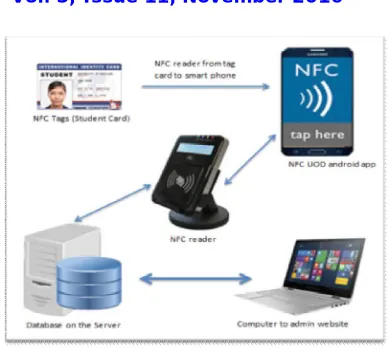
Figure 1: structure of NFC system used for students card
In figure 1.show the Correlation NFC card emulation applications, NFC reader and web applications in the database on the server.The integration of mobile applications and data transfer between them:
1. The first step is touch the smart card to NFC reader to check the UIDof student is recorded in the database of the server. If entered, the information will be transferred to the device and will show on the screen. Else it is not recorded in the database, Message will display on the screen will write please register the card in administration.
2. In the Second step is to change the NFC tags card to Emulation Card mean to use the smartphone instead the
card, it would check the UID of student card to database in server if the result is correct will transferee the UID to HCE of mobile device then will store the UID to mobile and store the IMEL mobile device on server. 3. In the third step website will control by admin to management the Smart card of NFC, and teacher will
management the information related to the student in University, admin of the website will also control the database of student for inserting or updating the Card.
V.VALIDATION
The Application has been implemented by using a Samsung Galaxy S6 smartphone with Android 5.1 platform.1GHz Hummingbird processor, and16GB of internal memory.We use this device because S6 was the Android Smartphone who supported NFC in both ways hardware with software and included integrate HCE. This version we are used to smartphone to install our Android NFC app that we created for this application and to read the unique ID of the NFC
tags by the NFC reader.This system has following 2 Main applications each applications has many functionalities:
A. ANDROID APPLICATION.
We have to develop two android applications, first for changing the plastic card to smart card while the second is to read the smart card to display the information related to the student. The application will be used to show how it could, for example, professors or students check the credibility of the card. The process of verifying the identity would be held as follows:
- Checking the NFC technology on the smartphone is supported and it is enabled.
does not exist the mobile have to connect to the internet to searching UID in database server and then transferring data of Student UID from the database server to inside the mobile device.
- The reader will display the student information on the smartphone device such as the news related to the university, subject of the student, schedule subject, homework and notes of a student of all subject and Degree of a student of all subject and all semester.
B. WEB SERVER APPLICATION.
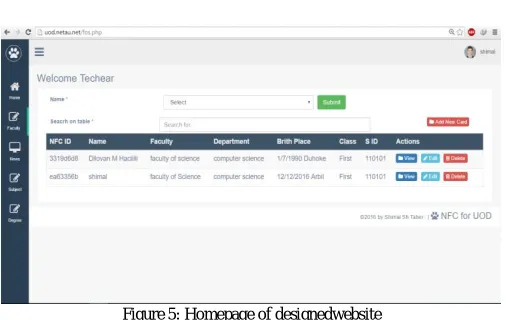
Web pages are the most significant part of Students card system. Most of the time admin will spend creating; modifying data at web pages the web page will act as the interface to access the test database of students to registration card of students in administration by admin. This website can update the information and update the data of student also the resources, note, homework and entering the degree of the student account .This website is supported Responsive web design (RWD).
VI.RESULTS
To confirm our design, we implemented this application in Java programming language(JAVA) on the visual android system, using SQLite for storage data on the smartphone device, using MySQL for register and update data on the server, and test our application on Samsung Galaxy 6.project will be senior about the student of the university . Using the NFC UOD application, the student has to touch or near the smart card to the phone, the application will read the card and display the login page by username and UID of the student to change the traditional card to smart card as shown in figure 2(a). After login the interface will change to show the details of a student as shown in figure 2(b), then can use the smartphone as a card. The Smart card will be run where near or touch the NFC reader without running the application.
(a) (b)
Figure 2:application interface of (a) login page (b) emulate card
(a) (b)
Figure 3: User Interface (a) student ID (b) menue panel
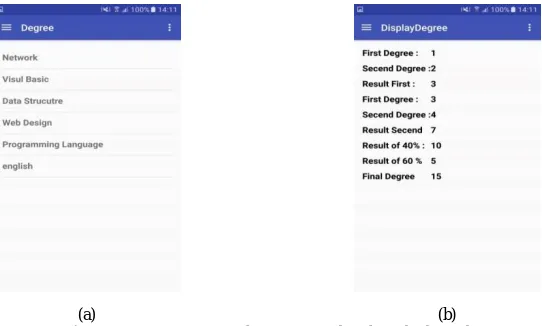
The application is extremely symmetric and user friendly, many services can be accessed easily such as News,subjects and degrees. If selected each item in the menu will display the information as shown in figure 4(a) selected the degree item to show the subject name ,then by selecting subject item will display the degree as show in figure 4(b).
(a) (b)
Figure 4: Degree menue (a) main degrees menu (b) selected subject degrees
Figure 5: Homepage of designedwebsite
VII.CONCLUSION
The paper proposes system of NFC to the enabled android application for student card. This application helps the students and teachers to improve information to the student by the NFC card and android application to receive information and get notification from the administration and teachers easily and fastest time .In addition, using the smartphone (emulation card ) instead of the card for all operation in education, the application bolsters could use his smartphone or NFC card for authentication on lectures or tutorials and knowledge such as ( degree, subject, resource, homework,etc...) without losing time. As well, using NFC technology between the NFC reader and smart devices and assure student information privacy and security.
VIII.FUTURESCOPE
The solution seems to us a very interesting and useful. There are also many opportunities for the upgrade. They could be emulated use student cards with NFC to payment like of transmission inside campus or outside, payment for foot in collage, insert function to Students attendance, and install the NFC device in all campus to get more advantage from this interesting technology. We may also try an alternative way of connection such as internal wireless network instead of the internet connection. We would also like to install smart poster in all place of campus and with inserting same function to make the system work in all service in education.
REFERENCES
[1] Asawari Dudwadkar, Akhil Gore, Tushar Nachnani and Harshil Sabhnani, “Near Field Communication in Mobile Phones”, International Journal of Engineering and Advanced Technology (IJEAT) ISSN: 2249 – 8958, VOL.3, Issue-1, Oct 2013.
[2] Kevin Curran, Amanda Millar and Conor Mc Garvey,“Near Field Communication”, International Journal of Electrical and Computer Engineering (IJECE), Vol.2, No.3, pp. 371-382, 2012.
[3] Pallavi R , Anish M, Akshay I, Sameera P K and Kokila.S, “Monitoring of School Kids Using Android Devices and Near Field Communication(NFC)” , International Journal of Innovative Research in Science Engineering and Technology, Vol. 5, 2016.
[4] Media Anugerah Ayu, Member, IACSIT and Barroon Ismaeel Ahmad, “TouchIn: An NFC Supported Attendance System in a University Environment”, International Journal of Information and Education Technology, Vol. 4, No. 5,2014.
[5] Mehmet N. Aydin and Busra Ozdenizci, “Design Science Perspective on NFC Research: Review and ResearchAgenda”, in Informatica 37, pp.203–218, 2013. [6] Haw Lee, Wei-Chih Hong, Chia-Hung Kao and Chen-Mou Cheng, “A User-friendly Authentication Solution using NFC Card Emulation on Android”, IEEE 7th
International Conference on Service-Oriented Computing and Applications, pp. 272-278, 2014.
[7] Sun-Kuk Noh, Dong-You Choi, HyeongGyun Kim,DaeKyu Kim, JaeHyun Seo, JongWon Kim and ByungRae Cha, “proposal of micropayment and credit card model using NFC technology in mobile environments ”, International Journal of Multimedia and Ubiquitous Engineering Vol. 8, No.3, 2013 .
[8] A. Lahtela, H. Marko and J. Virpi, "RFID and NFC in healthcare: Safety of hospitals medication care," in Pervasive Computing Technologies for Healthcare. PervasiveHealth. Second International Conference, Kuopio, 2008.
[9] Pankaj and Sharad, "Near Field Communication," SETLabs Briefings, vol. 10, no. 1, pp. 67-74, 2012.