Artificial Intelligence for the Prediction of
Safe Work Behavior in Construction Projects:
A Survey
Suraj Patil, Dr. Rahul Patil
PG Student Department of Civil Engineering,Dr. D. Y. Patil Institute and Technology Pimpri, Pune India
Professor, Department of Civil Engineering,Dr. D. Y. Patil Institute and Technology Pimpri, Pune India
ABSTRACT: A prototypical has stayed established employing an artificial neural network (ANN) to expect the benign work performance of personnel using 10 security environment concepts determined finished literature analysis. The typical utilizes protection climate concepts (determinants) as ideas and safe work performance as an productivity. A three-layer feed-forward back-propagation neural link was appropriate in building this model which has been trained, validated, and tested with sufficient data sets. The classical foresees the safe exertion behavior of workers reasonably well. In calculation, a sympathy scrutiny was carried out to homework the effect of each construct on the safe work comportment of employees. As a effect, security climate paradigms like controlling environment, work pressure, employees’ involvement, personal appreciation of risk, and supportive environment were significantly linked with the safe work conduct of employees. This classical has great latent in aiding independents and customers in promoting safe work performance and the efficient management of the protection of employees in construction projects.
KEYWORDS: Behavior; Neural system; Prediction; Protection climate; Hard work and people issues.
I. INTRODUCTION
Safety of construction workers is a major issue at construction sites all over the world. The cultivation of security culture is essential for any organization to prevent accident at a construction site. A positive safety culture can increase safety presentation in projects because it is directly correlated to safety performance. Safety climate is used as an display of safety presentation and insecure or safe work performance can be forecast by reviewing it. Prediction of protection climate may be accommodating in categorizing the faintness in safety temperature and curative measures may be taken prior to an accident occurrence. This will lead to manage safety issues effectively and unremitting progress strategies can be evolved at construction sites. Thus, the objective set for this study is to develop a model to guess well-being climate on innovative construction projects based on an artificial neural network (ANN) model. Artificial intelligence (AI) is intelligence exhibited by machines. In computer science, an ideal "intelligent" machine is a flexible rational agent that perceives its environment and takes actions that maximize its chance of success at some goal.
Artificial intelligence is a branch of computer science, involved in the research, design, and application of intelligent computer. Traditional methods for modeling and optimizing complex structure systems require huge amounts of computing resources, and artificial-intelligence-based solutions can often provide valuable alternatives for efficiently solving problems in the civil engineering.
(FAFR; incidents/1,000 employees/year) is estimated at 15.8 for Indian construction industries, as opposed to countries like the United States whose FAFR for construction industries is 0.23 (CIDC 2005). According to the Ministry of Labor and Employ-ment, government of India, 248 accidents were reported from 2003 to 2011 in the central sector construction projects. These accidents resulted in 335 fatalities and 147 injuries.
In the competitive nature of construction, industry and its heuristic problem-solving needs, among other reasons, have contributed to the development of some advanced decision-making tools. Research in artificial intelligence (AI), a branch of computer science, has provided more suitable tools to the construction industry. Since its initial development, the Artificial Intelligence has found large applicability in the field of engineering. In particular, the so-called soft computing methods have been shown to be very effective in the analysis and solution of construction engineering problems. However, the performance of these systems during the last decade is far from ideal. Neural networks research in AI has recently provided powerful systems that work as a supplement or a complement to such conventional expert systems. In this paper, neural networks are introduced as a promising management tool that can enhance current automation efforts in the construction industry, including its applications in construction engineering. Basic neural network architectures are described and its application in construction industry is discussed. Future possibilities of integrating neural networks and expert systems as a basis for developing efficient intelligent systems are described.
II. LITERATURE SURVEY
According Rafiq.M.Choudhry; Dongping.Fang, Sherif .Mohamed in (2007) presents a powerful reasonable model that has its foundations immovably dug in related scholastic and connected writing. This review uncovered a calculated model that perceives human, specialized, situational, and hierarchical components and also their communications. The model is moored in three essential calculated classifications, in particular wellbeing atmosphere, conduct based security, and wellbeing framework. The consequences of this review plainly demonstrate that the model fills in as the consistent reason for figuring out what and how to investigate and evaluate the diverse parts of development security culture. It offers the chance to embrace an objective setting worldview by seeking after different sub objectives. This gave them the conclusion that Employee recognitions, security practices, and ecological or situational elements could be gotten to through wellbeing atmosphere studies, peer perceptions, and frameworks reviews/examinations.
Keith.R.Molenaar; Jeong-Il.Park; Simon.Washington in (2009) presents the consequences of an auxiliary condition show SEM that portrays and evaluates the connections between corporate culture and wellbeing execution. The SEM and the idle factors depict to constitute an intense structure for characterizing, measuring, and enhancing corporate security culture. The SEM is assessed utilizing 196 individual survey reactions from three organizations with superior to anything normal security records. Examination of information from the 54 quantifiable attributes uncovered that 19 could be utilized to depict a last arrangement of five inert factors This gave them the outcome and conclusion that these five idle factors can be considered qualities of corporate wellbeing society and might be utilized as markers of security execution as measured through EMR. In light of the discoveries from the restricted specimen of three organizations, creator proposes a rundown of practices that organizations may consider to enhance corporate security culture and wellbeing execution.
close by giving an arrangement of proposals and systems to contractual workers for enhancing their wellbeing execution.
Rafiq. M. Choudhry; Dongping .Fang; Helen. Lingard in (2009) determine safety climate that would improve security culture and decidedly affect saw wellbeing execution on development ventures. A wellbeing atmosphere poll review was directed on the development destinations of a main development organization and its subcontractors. Around, 1,500 printed version surveys were conveyed and the reaction rate was amazing, bringing about 1,120 legitimate polls being gathered from 22 development ventures. From FA, two main segments were set up, administration responsibility, representative contribution and improper security methodology and work hones. These elements have been relapsed with the apparent wellbeing execution scores to set up the causal connection between security atmosphere and saw security execution. This at long last made them to arrive at the conclusion that the two-calculate arrangement clarified an aggregate of 43.9% of the change, with component 1 contributing 27.62% and element 2 contributing 16.28%. Amid the different relapse investigation, the two basic components were utilized as free factors in assessing the association with saw security execution. The review presumed that administration might be cautioned of potential security framework disappointments by measuring wellbeing atmosphere and can evaluate how security is working in development site conditions. The outcomes recommend that security atmosphere can be utilized as a compelling measure of surveying and enhancing site wellbeing for activities under construction.
Aviad.Shapira; F.Asce, BenyLyachin in (2009) presents the results of a study that identified the major factors affecting safety in tower-crane situations and assessed how much each element impacts progressing security on location. This review displayed a rundown of 21 variables with a progressing nearness that influences security in tower-crane conditions. The rundown was created and combined in light of the experience and aptitude of 19 senior security chiefs and gear administrators from the main ten development organizations, which among them possess and utilize about 300 tower cranes. With a view to evaluating hazard figures, the specialists additionally surveyed the impact of each of the elements, in this way making it conceivable to recognize components that apply a solid impact and those that apply a direct impact nearby security. General we get the opportunity to think about in this paper ,with the restricted assets accessible for wellbeing change and mishap counteractive action, more noteworthy consideration must be paid by all gatherings included e.g.construction firms, administrative and authorization specialists to those components assessed as exceptionally influencing site security because of tower-crane work. The review revealed in this paper constitutes the primary period of a more extensive research arrange for that expects to create quantitative files that unbiasedly and sensibly ponder wellbeing levels development locales because of the operation of tower cranes.
According to D. A. Patel and K. N. Jhaat. al. in (2014) they proposed A model has been developed employing an artificial neural network (ANN) to predict the safe work behavior of employees using 10 safety climate constructs determined through literature review. This paper developed a model based on an ANN to predict safe work behavior of employees, using 10 constructs of safety climate at construction projects which were determined through literature review. These qualitative constructs were transformed into construction indices. These construction indices were used as inputs and safe work behavior of workers was used as output in development of the model. The relationship between safety climate constructs and safe work behavior of employees is nonlinear and complex. So, a multilayered feed forward network with BP was used to train and validate the network. The closed form formula is used as a decision support system to calculate the safe work behavior of employees at construction projects. Managers can input information pertinent to the constructs of safety climate after getting feedback from employees of the project and this model can estimate the safe work behavior of employees on a 0–100% scale as a part of the safety performance evaluation of the project. The model has been validated and is reliable in predicting the safe work behavior of employees at construction sites.
using the artificial network to evaluate large deflection response of fixed immovable rectangular plates subjected to patch loading has been investigated.
Pedro Maria- Sanchez: The main goal of this research-work is to quantify in terms of money the cost of the risks involved in construction projects. For that reason, a list of Risk-Factors (RF) has been created in order to model the behaviour of the risks for the chosen construction project. This is made with the help of the Neural-Risk Assessment System (NRAS). The core parts of the system are represented by Artificial Neural Networks (ANN) and risk management.
D. A. Patel1 and K. N. Jha: In this research work a model has been developed employing an artificial neural network (ANN) to predict the safe work behavior of employees using 10 safety climate constructs determined through literature review. The model utilizes safety climate constructs (determinants) as inputs andsafe work behavior as an output.Two hundred twenty-two responses from several construction projects across India were collected through a questionnaire survey. A three-layer feed-forward back-propagation neural network (10-11-1) was appropriate in building this model whichhas been trained, validated, and tested with sufficient data sets. The model predicts the safe work behavior of employees reasonably well.In addition, a sensitivity analysis was carried out to study the impact of each construct on the safe work behavior of employees.
Farman A. Moayed and Richard L. Shell: In this paper limited studies have shown that they are capable of predicting outcomes more accurately than LR, but they have been tested either on continuous or on dichotomous variables or combinations of them. The objective of this research was to demonstrate that ANN models can perform better than LR models with data sets comprised of all ordinal variables, which has not been done so far. The data set used in this research was collected from construction workers using the Work Compatibility questionnaire. The data set contained only ordinal variables both as input (exposure) and as output (outcome) variables. LR models and ANN modelswere constructed using the same data set and the performance of all models was compared byusing the log-likelihood ratio.
The result of this study showed that ANN models performed significantly better than LR models with a data set of all ordinal variables as well as other types of variables such as dichotomous and continuous.
III. RESEARCH METHODOLOGY
3.1 Artificial Neural Network (ANN)
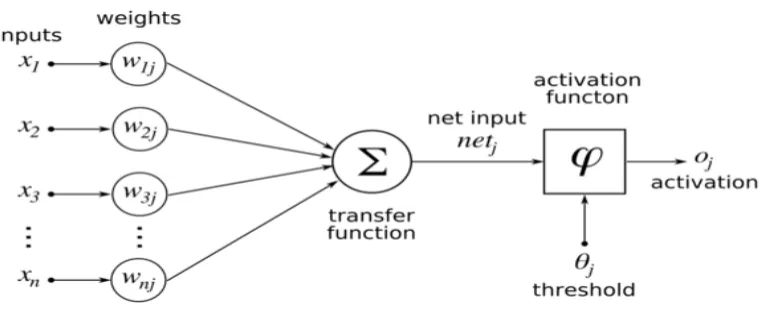
An Artificial Neural Network (ANN) is an information-processing system that has been established as overviews of calculated representations created on hominoid neural biology. An ANN is serene of nodes related by directed links. Each link has a numeric weight as shown in Figure 1.
Figure 1.Simple example of configuration of the developed neural network
ANN based models generate better prediction outcome than those obtained from regression models. Some existing surveys has been defined, it is not necessary that data should follow a specific statistical distribution.
Also, there is no requirement as such to training the inter relationship among inputs and outputs before developing an ANN based model. ANNs consume been castoff for cataloguing, collecting, vector quantification, control, decoration suggestion, estimate, occupation calculation, and optimization. Due to its useful features, ANN is a popular research tool even in construction management. The connection among safety environment and their constructs is nonlinear and complex. Nevertheless, ANNs have the capability to expect shelter environment of a construction project.
For this survey we have collected around 10 parameters data from each site. These are below (1) Commitment
(2) Communication
(3) Safety rules and procedures (4) Supportive environment (5) Supervisory environment (6) Workers’ involvement (7) Personal appreciation of risk
(8) Appraisal of physical work environment and work hazards (9)Work pressure
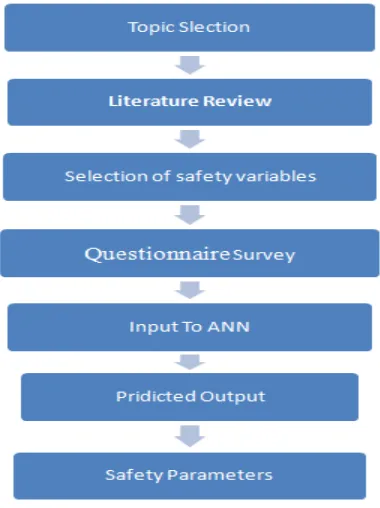
The below figure 2 show the how overall work will be execute the proposed approach
Figure 2: Methodology of flowchart
IV. CONCLUSIONS
This survey focused a robust model based on ANN to foresee and gauge the safety work on creation projects considering ten constructs of safety climate. By making use of the model, this research found that promise, managerial environment, people thankfulness of risk and competence had significant roles on safety climate. Contrary to the expectations, this study found that safety rules and procedures, appraisal of physical work and work hazard, and work pressure had negative influence on safety climate. The rest of constructs: communication, supportive environment and workers’ involvement were found unbiased in development of security climate. Therefore, the findings from this research desire project executives to focus on positive constructs of safety climate instead of all ten constructs. These positive constructs are more suitable to learning the protection climate in Indian construction industry. The main implication of this study is that practitioners can evaluate the protection environment of the particular project and compare with another projects or organizations easily. Researchers can use this model to quantify protection environment and study its impact on other factors like safety budget, safety outcomes etc.
REFERENCES
[1] Rafiq. M. Choudhry; Dongping. Fang, Sherif. Mohamed; “Developing a Model of Construction Safety Culture”, Journal of Management in engineering © ASCE, pp: 207- 212; October 2007.
[2] Keith. R. Molenaar; JeongIl. Park; Simon. Washington; “Framework for Measuring Corporate Safety Culture and its Impact on Construction Safety Performance”, Journal of Construction Engineering and Management, Vol. 135, No. 6, pp: 488–496; June 1, 2009.
[3]T. 11Subramani1; R. Lordson millar; “Safety Management Analysis in Construction Industry”; Journal of Engineering Research and Applications; Vol. 4; Issue 6(Version 5); pp.117-120 ;June 2014..
[4]Rafiq. M. Choudhry; Dongping .Fang; Helen. Lingard; “Measuring Safety Climate of a Construction Company”; Journal of Construction Engineering and Management; Vol.- 135, Issue- 9; pp : 890-899; September
1, 2009.
[5]Aviad.Shapira; F.Asce, BenyLyachin; “Identification And Analysis Of Factors Affecting Safety On Construction Sites With Tower Cranes”; Journal of Construction Engineering And Management; Vol.- 135; Issue 1; pp:24- 33;January 1;2009.