Minimizing the Interference and Delay Using
ITCD Guaranteed Routing for Mobile Adhoc
Network
Sareena Merin Thomas1 , Dr. S.Vijayalakshmi2
Research Scholar, Department of Computer Science, Sri Ramakrishna College of Arts and Science for Women,
Coimbatore, India
Associate Professor, Department of Computer Science, Sri Ramakrishna College of Arts and Science for Women,
Coimbatore, India
ABSTRACT:MANET is a self-configuring network of wireless links connecting mobile nodes. These nodes may be routers and/or hosts. One of the important and challenging problems in the design of ad hoc networks is the Development of an efficient routing protocol that can provide high-quality communications among mobile hosts. The development of Mobile Ad hoc Networks (MANETs), there is a growing requirement of quality of service (QoS) in terms of delay. In order to meet the delay requirement, it is important to consider topology control in delay constrained environment, which is contradictory to the objective of minimizing interference. In this research work focus on the delay-constrained topology control problem, and take into account delay and interference jointly. a cross-layer distributed algorithm called interference-based topology control algorithm for delay-constrained (ITCD) MANETs with considering both the interference constraint and the delay constraint, which is different from the previous work. The transmission delay, contention delay and the queuing delay are taken into account in the proposed algorithm. Moreover, the impact of node mobility on the interference-based topology control algorithm is investigated and the unstable links are removed from the topology. Our simulation done through NS2 simulator and these two mechanism result in a significant improvement of Throughput and packet delivery ratio. A MANET topology can depend on uncontrollable factors such as node mobility, weather, interference, noise as well as controllable factors such as transmission power, directional antennas and multi-channel communications. Achieving low interference using based on the ITCD recommendation of neighbour nodes .
KEYWORDS: MANET, ITCD, Route discovery, Data forwarding, and Route maintenance.
I. INTRODUCTION
lifetime-prediction algorithm, which explores the dynamic nature of mobile nodes the energy drain rate of nodes and the relative mobility estimation rate at which adjacent nodes move apart) in a route-discovery period that predicts the lifetime of routes discovered, and then, we select the longest lifetime route for persistent data forwarding when making a route decision.
II. RELATED WORK
[2]Has propose a cross-layer scheduling algorithm that achieves a throughput “ ε-close” to the optimal throughput in multihop wireless networks with a tradeoff of O([1/(ε)]) in average end-to-end delay guarantees. The algorithm guarantees finite buffer sizes and aims to solve a joint congestion control, routing, and scheduling problem in a multihop wireless network while satisfying per-flow average end-to-end delay constraints and minimum data rate requirements. This problem has been solved for both backlogged as well as arbitrary arrival rate systems. Moreover, we discuss the design of a class of low-complexity suboptimal algorithms, effects of delayed feedback on the optimal algorithm, and extensions of the proposed algorithm to different interference models with arbitrary link capacities.
[3]Proposed paper to develop a useful architecture that enables us to exploit the degree of freedom in choosing appropriate service discipline. Based on the new architecture, we propose three different approaches, each leading to an original algorithm. We study the performance of these algorithms in different scenarios to show both optimality characteristics and to demonstrate the favourable service discipline characteristics they possess. We provide extensive numerical results to compare the performance of all of these solutions to throughput-optimal back-pressure-type schedulers and to longest waiting-time-based schedulers that have provably optimal asymptotic performance characteristics. Our results reveal that the dynamic choice of service discipline of our proposed solutions yields substantial performance improvements compared to both of these types of traditional solutions under non asymptotic conditions.
[1] Proposed Ad hoc network consists of a set of identical nodes that move freely and independently and communicate among themselves via wireless links. The most interesting feature of this network is that they do not require any existing infrastructure of central administration and hence is very suitable for temporary communication links in an emergency situation. This flexibility, however, is achieved at a price of communication uncertainty induced due to frequent topology changes. In this article, we have tried to identify the system dynamics using the proven concepts of time series modeling. Here, we have analyzed variation of path length between a particular source destination pair nodes over a fixed area for different mobility patterns under different routing algorithm. We have considered four different mobility models—(i) Gauss-Markov mobility model, (ii) Manhattan Grid mobility model and (iii) Random Way Point mobility model and (iv) Reference Point Group mobility model. The routing protocols under which, we carried out our experiments are (i) Ad hoc On demand Distance Vector routing (AODV), (ii) Destination Sequenced Distance Vector routing (DSDV) and (iii) Dynamic Source Routing (DSR). The path length between two particular nodes behaves as a random variable for all mobility models for all routing algorithms. The pattern of path length for every combination of mobility model and for every routing protocol can be well modeled as an autoregressive model of order p i.e. AR(p). The order p is estimated and it is found that most of them are of order unity only. We also calculate the average path length for all mobility models and for all routing algorithms.
[4]Presented The topology control technique can prolong the network lifetime, but it can suffer the significant performance degradation due to the interferences of WLAN or Bluetooth devices. This paper proposes a novel topology control algorithm to reduce the interference effects. The basic idea of the proposed algorithm is to estimate the interference effects exactly and re-construct the robust network topology to the interference variations. From the experimental results, we can see that the proposed algorithm shows the good performance results in terms of the delivery ratio and the energy consumptions.
III . PROPOSED METHODOLOGY
corresponding RREQ packet to meet the requirement of the connection lifetime-prediction algorithm. Second, node agents need to update their predicted node lifetime during every period. Third the node-lifetime information in the RREP packet is updated when the RREP packet is returned from a destination node to the source node. Fourth The location information of the source and destination nodes is piggy-backed in the route request (RREQ) packet and then broadcasted. Upon receiving the RREQ, intermediate nodes will compare using a simple mathematical comparison based on the coordinates of source, destination and the current node that directs the packet towards the destination Once the decision to broadcast has been made Fifth the intermediate node will insert its location by replacing the source node coordinates and append its address and sequence number at the end of the RREQ packet. It will then broadcast the packet. Sixth The process will repeat at each intermediate node until it reaches the destination. The replacement of the source node location information with the intermediate node coordinates will make the packet more directed towards the destination since the comparison now is based on the previous node
TOPOLOGY MONITOR SOURCE ROUTING
The dynamic version of the XTC topology control algorithm. This simple and strictly local protocol removes unreliable and redundant links from the network. By means of physical experiments on an indoor mica2 testbed we study the beneficial effects of topology control on source routing, one of the most common routing schemes for ad hoc and sensor networks. the performance of source routing with and without topology control.If we refer to XTC throughout the rest of the paper we always refer to this extended version. The algorithm is implemented on the mica2 sensor node platform which facilitates rapid prototyping for wireless ad hoc networks. In order to examine the benefits of XTC we evaluate the performance of source routing as a generic sample application in wireless networks with and without XTC. The algorithm manages to identify stable connections and thus preserves source routing from taking unreliable links. To be more specific, XTC decreases the number of route failures and retransmission attempts and is therefore able to increase network throughput and to lower average packet delay. Moreover, the omission of fluctuating links (if not needed) by XTC only modestly increases average route lengths the beneficial effect of XTC on source routing a common application in wireless networks cluded environment using a small number of nodes. We then verified the obtained results in a real world scenario. Also in this environment XTC performed well reducing packet loss and delay and thus leading to improved network throughput
DELAY MODEL OF A PATH
The end-to-end delay contains transmission delay over intermediate links, contention delay caused by nodes’ contention for the shared channel and queuing delay induced at each intermediate node due to queuing policy/or severe channel conditions. The transmission delay is the time for successful transmission, which is defined as the period from the instant that a packet is transmitted for the first time to the instant that it is either successfully transmitted or dropped after a predefined number of retransmissions. The contention delay is the access delay. And each retransmission will cause new access delay. The contention delay is determined by the contention window (CW ) size of node and the contention window size reflects the contention level. The queuing delay at an intermediate node can be interpreted as the interval between the time a packet reaches the node and the time this packet is to be transmitted. For a path P : n1 ; n2 ; . . . ; ni ; . . . ; nN (N >=1), a packet is sent from node n1 to nN according to path P . L(i)(i+1) is the transmission delay of link between node i and node i + 1. Let Ci and Qi denote the contention delay and queuing delay at node i, respectively. The total delay DP contains the contention delay and the queuing delay at each node and the transmission delay of links on the path P DP = SUM (L(i)(i+1)+ Ci + Qi ). First, our algorithm focuses on reducing a
link breakage; If DTr > TMr , the link between s and r is unstable. Before the reception of the packet at node r, the link has been broken up. We call this unstable link as poor link. And when DTr 1⁄4 TMr , it is also considered as a poor link. To avoid frequent link breakages and reduce the impact of mobility on the interference-based topology control algorithm, the unstable poor links are moved from the topology
EXPERIMENTAL SETUP:
Our implementation is based on network simulator ns2.34. the mobility of nodes follows a random way-point model. The source–destination connection patterns are generated using cbrgen.tcl in NS-2. The initial energy is the 1000 joules and simulation time is set to 100 s In the simulation, we consider a total of 1000 nodes initially randomly distributed over a square network of size1000m×1000m. Every node moves at a speed Vand transmits at uniform power of coverage of radius under certain traffic load. Three different transmission ranges {150, 200, 250}are covered, all
within the coverage. Four different speeds {5, 10, 15, 20}/ are simulated, from lower mobility to higher mobility scenarios. Traffic, supplied from a CBR source with fixed packet size of 1000 Bytes, is randomly generated with uniformly distributed sources and destinations. Different number of traffic flows {5, 10, 15, 20}are simulated, covering low and moderate flow configuration.
Algorithm 1. ITCD
Path P : S; . . . ; i + 1; i; i - 1; . . . ; R; Ppre= Pmax ;
1: Forwarder i selects stable links which satisfy DTr<TMr ; 2: while (PsrPmax ) and (DTsrDmax ) do
3: {minimizing the power consumption while satisfying the interference constraint} 4: SINRr = Psr .sr 2 /((PrI+z 2 )dsr );
5: Psr= Psr.Er /SINRr ;
6: {adjusting Dmax with the balancing factor tb } 7: if (Ti <Dmax ) then
8: tb + = Dmax - Ti ; 9: Dmax + = tb ; 10: end if
11: {link( s; r) can not meet the requirement for delay, DTsr>Drs and increase the transmission range} 12: if (DTsr>Dmax ) or (Ti>Dmax ) then
13: Psr = min (Psr(1 +w); Ppre ); 14: Ppre = Psr ;
15: end if 16: end while
Our proposed interference-based topology control algorithm for delay-constrained mobile ad hoc networks is shown in Algorithm 1.The algorithm ITCD can converge to a stable operating point. Different types of parameter notations are used in the algorithm. TMr, Dmax, SINRr, Ti, dsr these are some of the parameters.in last , can came to conclusion that our algorithm ITCD is converging.
IV. RESULTS AND DISCUSSION Average End To End Delay
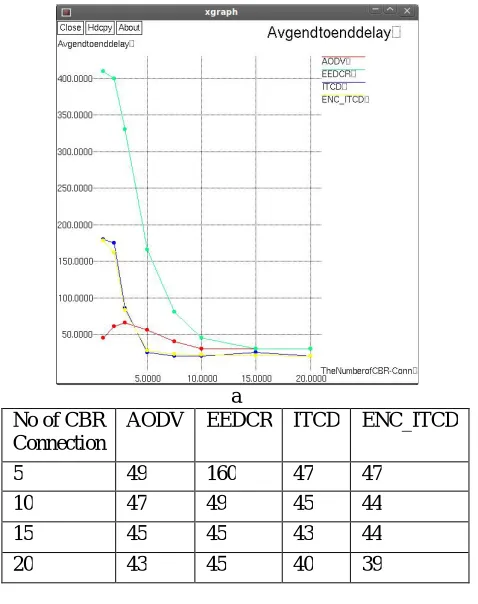
It is the Average end to end delay successfully received by destination and sent by source.
a No of CBR
Connection
AODV EEDCR ITCD ENC_ITCD
5 49 160 47 47
10 47 49 45 44
15 45 45 43 44
20 43 45 40 39
b
In figure a it shows the average end to end delay which is compared with existing AODV and EEDCR, Fig b shows the table format of the above diagram.
Control Overhead
It is the control overhead successfully received by destination and sent by source.
Control Overhead = No.Of Control Request Packet+ No.of Control Router Packet Total Control Packet Sent
No of CBR connection
AODV EEDCR ITCD ENC_ITCD
5 4.2 3.8 1.0 0.2
10 3.1 2.1 1.1 1.0
15 2.75 2.2 1.7 1.6
20 2.0 1.9 1.8 1.7
d
Figure c describes Control Overhed is compared with existing AODV and EEDCR, Figure d shows the values in tables from the above diagram.
Packet Delivery Ratio
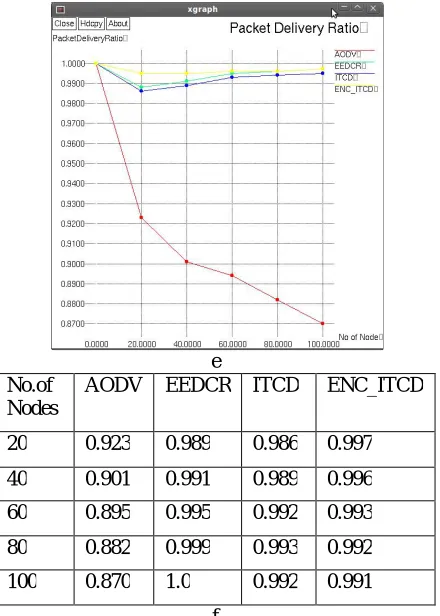
It is the ratio of total number of packets successfully received by the destination and send by source.
Packet Delivery Ratio= No.Of Packet Received No.Of Packet Sent
e No.of
Nodes
AODV EEDCR ITCD ENC_ITCD
20 0.923 0.989 0.986 0.997
40 0.901 0.991 0.989 0.996
60 0.895 0.995 0.992 0.993
80 0.882 0.999 0.993 0.992
100 0.870 1.0 0.992 0.991
f
Figure e shows Packet delivery ratio is compared with existing AODV and EEDCR, Figure f shows the existed and proposed in table format.
V . CONCLUSION
An interference-based topology control algorithm for delay-constrained mobile ad hoc networks. The objective of the topology control algorithm is to adjust the transmission power to minimize interference, which is contradictory to the requirement of delay constraint. When transmission power is increased to reduce the delay, which increases the number of neighbours covered by the transmission range and causes more interference from other active nodes in the network. For reducing delay and minimizing interference. First, the problem of minimizing the power consumption while satisfying the interference constraint is solved by iteration. Then, the transmit power is increased to meet the delay constraint. The proposed algorithm controls the topology to satisfy the interference constraint, and increases the transmit range to meet the delay requirement.
REFERENCES
1. J. Singh and P. Dutta, “The temporal effect of mobility on path length in MANET,” Int. J. Wireless Inf. Netw., vol. 19, no. 1, pp. 38– 48, 2012
2. D. Y. Xue and E. Ekici, “Delay-guaranteed cross-layer scheduling in multihop wireless networks,” IEEE/ACM Trans. Netw., vol. 21, no. 6, pp.
1696–1707, Dec. 2013.
3. R. G. Li and A. Eryilmaz, “Scheduling for end-to-end deadlineconstrained traffic with reliability requirements in multihop
networks,”IEEE/ACM Trans. Netw., vol. 20, no. 5, pp. 1649–1663, Oct. 2012.
4. J. Kim and Y. Kwon, “Interference-aware topology control for low rate wireless personal area networks,” IEEE Trans. Consum. Electron., vol.
55, no. 1, pp. 97–104, Feb. 2009.
5. Maleki M., Dantu K and Pedram M. ‘Lifetime Prediction Routing in mobile Ad hoc networks’, Proceedings on IEEE WCNC, pp.1185-1190,
2003.
6. Mirsha A. and Banerjee.S. ‘MRPC: Maximum Network Lifetime for Reliable Routing in Wireless Environments’ ,Proceedings on IEEE
WCNC , pp.138-147, 2002.
7. Qin L. and Kunz T. ‘Pro-active Route maintenance in DSR’, ACM SIGMOBILE Mobile Computing. Commn.Rev., Volume 6, Number. 3, pp.
79-89, 2002.
8. Rendong Bai and Mukesh Singhal. ‘DOA: AODV over AODV Routing for Mobile Ad Hoc Networks’, IEEE Transaction on Mobile
Computing, Volume 4, Number 10, pp 80-92,2006 .
9. Sarkar T.K, Kim.K,Medouri .A and Salazar , ‘A Survey Of Various Propagation Models for Mobile Communication’, IEEE Transaction On
Mobile Computing, Volume 45, Number 3 , pp. 51-81,2003.
10. Siva Ram Murthy C. and Manoj B.S ‘Ad Hoc Wireless Networks Architectures and Protocols’, Pearson Education Publishers, pp. 209-381,