Experimental Study to Develop MEPS
Aggregates from EPS Waste Based on Heat
Treatment Method
Shaik Hakeem Thousif Ahmed 1, Konapuram Prashanthi Kumari 2
Assistant Professor, Department of Civil Engineering, ACET, Hyderabad, India1
Assistant Professor, Department of Civil Engineering, GPREC, Kurnool City, India2
ABSTRACT: Expanded Polystyrene (EPS) is widely used as equipments production tools to absorb vibration during handling and transportation process. After this process, the EPS serves as disposal waste. Disposal is difficult as EPS is non-biodegradable and due to its light weight characteristics, it has the capacity to serve as aggregates in concrete by modifying it by Heat Treatment. The EPS waste was kept in a closed hot air oven at 1300 C for 15 minutes resulted in Modified EPS aggregates (MEPS).
KEYWORDS: LWC aggregates, ULWC aggregates, Artificial aggregates, MEPS aggregates, Artificial Sand.
I. INTRODUCTION
The civil construction is growing promptly, increased the demand of natural aggregates which is reducing the natural sources and on the other hand industrial by-products, soil wastes such as EPS , plastic, rubber, glass, iron, steel fibres, wood, brick-bats, thermal waste etc. are creating a huge loss to environment. For this reason, the Civil and Environmental Engineers have been challenged to covert the above waste materials to useful construction material. Hence, we require new artificial aggregates with equal natural aggregates properties. Modification to the above waste can result in new constructions material which can replace NA requirements. Hence, it is essential to advancing the new technologies which can result in new construction materials. This will create comfort to the environment pollution and facilitate the natural balance of life.
The use of lightweight aggregates in construction industry will increase in near future since it offers functional and economical advantages to the house building projects particularly. The voids and pores in these aggregates improve the thermal and acoustical insulating properties. Moreover, low density products reduce self weight, foundation size, and construction costs. There are different types of lightweight aggregates suitable for construction purposes. They vary in their composition, density, surface texture, porosity and water absorption capacity. Some LWAs occur naturally; others are manufactured from natural materials or from industrial by products. Because they are found only in some parts of the world, natural lightweight aggregates are not extensively used.
II. ORIGIN OF THE PROBLEM AND SCOPE OF RESEARCH WORK
Thermocol is a commercial name of Expanded polystyrene (EPS). In 1951 the researchers of a German company named BASF successfully restructured chemical bonding of polystyrene (a synthetic petroleum product) molecules and developed a substance named stretch polystyrene. This substance was named Thermocol, which nowadays is manufactured through a simple process. Thermoplastic granules are expanded through application of steam and air. Expanded granules become much larger in size but remain very light. Thermocol is a good resister of cold and heat but since it is a petroleum product it dissolves in any solvent of petroleum. The lightweight of this product is largely attributed to a relatively high proportion of semi-closed pores which can account for up to 90 % of the particle volume. The porous structure of loose expanded polystyrene granulates is composite and formed by the voids between individual grains and by the air-filled opening in the grain base. The expansion occurring in the ceramic body is caused by steam and gases, forming at different temperatures, which for various reasons are unable to escape from the body. In this experimental investigation, Thermocol waste was used as a specimen which are modified by Heat Treatment Method and the effects of polystyrene aggregate properties and level of temperature on the physical and micro-structural properties of EPS granules were examined.
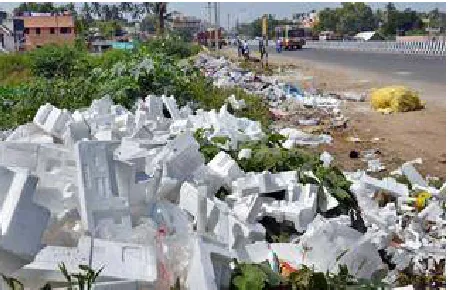
Figure 1: waste EPS dumped on a highway road side
Dumping of EPS waste which is non-biodegradable material not only creating disposal problems but also continues to pose a threat to road users. The situation turns worse when the waste materials are burnt by rag pickers and miscreants, causing thick smoke to spread, leaving the road users to suffer from throat irritation and breathing problems. Unmodified EPS waste consist to assemblage of EPS balls with various diameters ranging from 2 to 10 mm and with a density of only 10 to 50 kg/m3, Compressive Strength is 0.11 to 0.38 MPa with 0% water absorption. Hence, the above waste EPS is brought to the laboratory and most clean waste EPS is selected to recycling process. On the other hand, dirty waste EPS, with their low recycling rate have been dumped into landfill sites. The hand crushed waste EPS is converted to MEPS aggregate. Heat treatment is used to modify properties of materials in addition to hardening and softening. These processes modify the behavior of the EPS in a beneficial manner to maximize service life, e.g., strength properties, density, or some other desirable properties.
The main scope of this study is to use the thermally treated waste EPS as an aggregate in concrete for the structural, semi-structural and non-structural concrete applications. Waste EPS foams can be recycled in many ways once it comes to the end of its life. MEPS aggregates contains large percentage of air, so it is naturally a better material with respect to sound absorption, sound proofing and thermal insulation. Due to its low density it helps in reduction of dead load, increases the progressing of building, and lowers handling costs. The most important characteristic of light weight concrete is the relatively low thermal conductivity. Due to its low specific gravity, the concrete made with it is lighter than natural concrete. The choice of a recycling method is based on technical, environmental and economic considerations.
III. METHODLOGY TO MODIFY THE WASTE EPS
Figure: 4 Deformed Shapes of Plate Section & Cubic Specimens.
IV. RESULTS
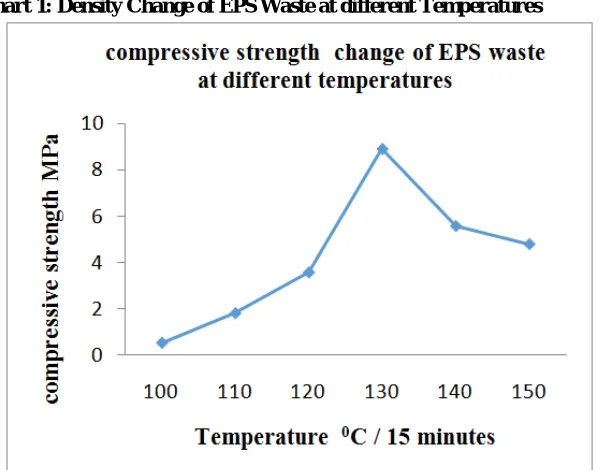
Chart 1: Density Change of EPS Waste at different Temperatures
Chart: 2 Compressive Strength Change of EPS Waste at different Temperatures
The maximum rise of the compressive strength and the density curve was observed at between 130 0C & 140
0
C temperatures at 15 minutes of time period. With this action, the Waste EPS properties changed completely. The melted matter filled inside the structure leaving air voids on the uppermost surfaces of MEPS aggregates. The rate of increase in density and the compressive strength may differ according to type of unmodified waste EPS used. The increase in temperature up to 130-140 0C result in increase in density and the compressive strength. Continuing to these temperatures may result constant or decrease in density, but the compressive strength fall was observed. Hence it was noticed that, the heat treatment at 130 0C for 15 minutes of time period gives the optimum results and the MEPS density was less than 300 kg/m3 and the compressive strength was up to 9 MPa.
V. CONCLUSIONS
The following conclusions were made from the study:
By using EPS waste for MEPS aggregate production not only solves the EPS disposal problems, but also helps to preserve natural resources. A new recycling technology to shrink waste EPS was developed by using Heat Treatment Method.
By keeping EPS waste in a closed hot air oven at 1300 C for 15 minutes resulted in Modified EPS aggregates (MEPS).
In Concrete construction, Self Weight represents a very large portion of the load on the Structure and use of MEPS aggregates in concrete can reduce the self weight up to 60% and are considerably advantages in reducing the cross-section dimensions of beams, columns & footing. This will have the double advantage of reduction in the cost of construction materials and also cost of waste disposal.
REFERENCES
1. Hantila, F., Maricaru, M., Popescu, C., Ifrim, C., Ganatsios, S., 2007. Performances of a waste recycling separator with permanent magnets. Journal of Materials Processing Technology 181, 246–248.
2. Kan, A., Demirboga, R., 2007. Effect of cement and EPS beads ratios on compressive strength and density of lightweight concrete. Indian Journal of Engineering & Materials Sciences 14, 158–162.
3. Neville, A.M., "Properties of concrete", long man group limited, fourth and final edition, 2000, p.831
4. Vivian, W.Y., Tam, C.M., 2006. Evaluations of existing waste recycling methods: a Hong Kong study. Building and Environment 41, 1649– 1660.
5. Yanhong, L., Yunge, F., Jianbiao, M., 2001. Thermal, physical and chemical stability of porous polystyrene-type beads with different degrees of crosslinking. Polymer Degradation and Stability 73, 163–167. .
BIOGRAPHIY