Additive Manufacturing Challenges the
Engineering Education
Esa Hietikko1
Principal Lecturer, Department of Mechanical Engineering, Savonia University of Applied Sciences, Kuopio, Finland1
ABSTRACT: Additive Manufacturing (AM) technology is considered revolutionary because of its freedom from geometrical limitations defined by the billets and tools. Engineers have a long tradition of designing products and parts with simple geometric shapes. The freedom of the shape places a new question: how should the shape be designed optimally in each case? Also, the process of AM manufacturing differs from traditional processes many ways. These require new kind of thinking from engineers and affects that way to the education needs as well. In engineering education the learning methods of PBL and Flipped Learning have been evidently providing increased productivity. These two teaching methods were tested in our research project with a mechanical engineering student group with promising results. It is still unsure how radically AM will change the engineering profession and education, but it is clear that at least minor changes in their curricula are needed.
KEYWORDS: Additive Manufacturing, Engineering Education, Project Based Learning, Flipped Learning.
I. INTRODUCTION
Engineering education is and has, for a while, been under an accelerating change process. The rapidly evolving technology and reduced teaching hours force educators to continually modify the content of engineering curricula and find new innovative teaching methods and tools. Many modern and innovative teaching and learning philosophies have been developed.
Additive Manufacturing (AM), also called 3D-printing or rapid prototyping is very popular discussion subject at the moment. The technology itself is not very new since it has been used about two decades. Earlier the technology has been used mainly for creating plastic prototypes. The present methods allow, however, the use of very wide material choices. Especially the use of metal has made it possible to realize that this technology can be used in everyday production and therefore it has a potential to replace widely the traditional manufacturing methods.[1]
ISSN(Online) : 2319-8753 ISSN (Print) : 2347-6710
I
nternational
J
ournal of
I
nnovative
R
esearch in
S
cience,
E
ngineering and
T
echnology
(An ISO 3297: 2007 Certified Organization)
Vol. 5, Issue 5, May 2016
II. THE POSSIBILITIES AND LIMITATIONS OF AM
In practice AM is not as overwhelming as you might think. The first thing to remember is that especially metallic AM parts are still very expensive. This is because of two things. First, the powder used in metal part production costs up to ten times more than the traditional metals. Second thing is the high prices of metal printers which will make the machine time expensive. The present metal printers are also quite slow, which will further increase the printing costs. When using very thin layers the printing of metal part may take several days.
One limitation of AM that involves most of the techniques used in it is printing above empty space in printing direction. It is either impossible or, at least, causes severe quality problems. These so-called negative surfaces need a generation of specific support structures that should be removed after printing. The metal parts are printed attached on a metallic base from which the parts must be removed after printing. All these post processing actions will increase the costs of AM.
The term DFMA (Design For Manufacturing and Assembly) is often seen in connection with traditional manufacturing methods. In it the examination is focused to the manufacturing phase of products. The life cycle costs of the part are then often forgotten. Even if the manufacturing of an AM part may be extremely expensive compared to the traditional part, its life cycle cost may still be smaller.
The well-known example of mass multiplication effect works here too. If, for example, the part of airplane can be manufactured so that the mass of it is smaller than earlier, the effect of one single part may still have irrelevant effect on the life cycle costs of the whole airplane. But if you think how this small improvement effects to all other parts in the airplane, the situation looks different. Because of the small mass reduction, a little bit smaller wing area, smaller engines, smaller fuel tanks and lighter landing gears are needed. The small portion of single part’s mass is multiplied which makes for example the savings of fuel costs during the life time of an airplane significant.
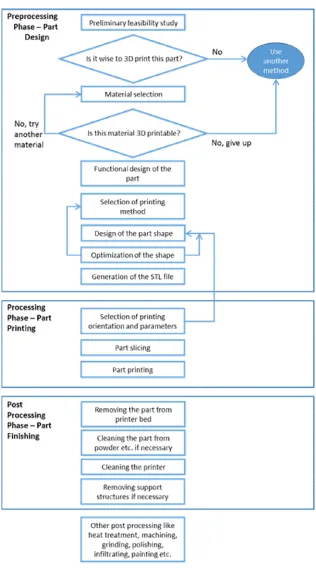
The process of AM manufacturing and design (Fig.1) differs from traditional processes many ways. The first question to think is: is this part really 3D-printable? There is no mean to print parts that have been designed to be produced by traditional manufacturing methods. Every printed parts must be designed or redesigned for 3D-printing.
Second thing to consider is the material. Does the part have any special demands for material and can such material be found among those that are possible to 3D-print?
ISSN(Online) : 2319-8753 ISSN (Print) : 2347-6710
I
nternational
J
ournal of
I
nnovative
R
esearch in
S
cience,
E
ngineering and
T
echnology
(An ISO 3297: 2007 Certified Organization)
Vol. 5, Issue 5, May 2016
III.NEW COMPETENCE DEMANDS FOR ENGINEERS
Engineers have a long tradition of designing products that will be manufactured from billets including simple geometric shapes (Fig. 2).
Fig. 2. Engineers are used to design simple geometric shapes.
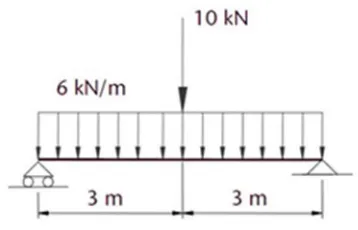
This has been one of the main reasons to the situation where the traditional theories, for example, of strength of materials are based on simple geometries (Fig. 3). Also the design software (CAD) is planned to produce parts with simple geometries.
Fig. 3. Traditional analysis is based on simple and idealized shapes.
Fig. 4. The free form part.
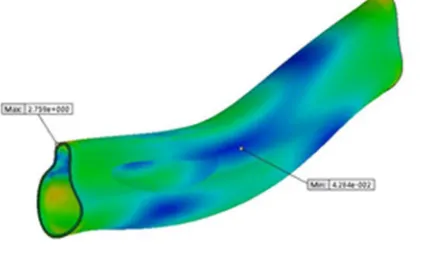
When the design freedom increases the problems are not reduced. In fact, when the limitations are decreased the design space (the amount of alternative solutions) grows. The problem is no longer attached to manufacturing possibilities but more how to select the most optimal solution among the several possible solutions. One way to do this is the use of simulation models. For example, the strength of freely shaped parts is impossible to analyse by traditional methods. Instead it is possible by using FEM-models. (Fig. 5). Also, for example, the optimization of material use (topology optimization) or fluid flow is possible by FEM-methods.
Fig. 5. FEM methods can be used to analyse free form parts.
ISSN(Online) : 2319-8753 ISSN (Print) : 2347-6710
I
nternational
J
ournal of
I
nnovative
R
esearch in
S
cience,
E
ngineering and
T
echnology
(An ISO 3297: 2007 Certified Organization)
Vol. 5, Issue 5, May 2016
Fig. 6. Topology optimization phases of an example part.
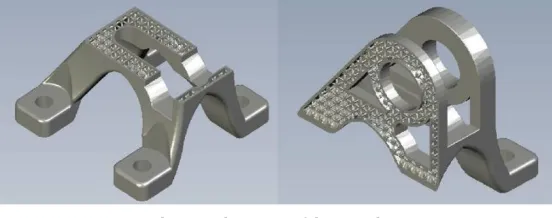
The internal structures can further decrease the part mass. There is software that can be used to find an optimal lattice structure inside the part. Fig. 7 shows an example of the internal shell type structure that could be used in the example part.
Fig. 7. The internal structure of the example part.
In fact, when designing parts for AM it is important to use the approach of functional design. The focus should be in the functions of the part that way that the customer needs could be best fulfilled. The costs estimation should not be focused on the manufacturing phase but instead on the life cycle costs of product. Often it is found that the manufacturing of AM part is much more expensive compared to the part manufactured by tradition-al methods but when looking at the life cycle costs the situation turns.
Also the arrangements in production will be different from traditional. Smaller batches or even single parts are printed. The printing operations are simpler, which means that no highly educated personnel will be needed and also a single person can operate several printers at the same time. The production will be lean and agile at the same time. [4]
The business logic will also go through a change process. The customer may not necessarily buy the physical part but instead only the 3D model of it and prints it home or in the nearest 3D-printing service available.
The quality and accuracy of printed parts can be compared to casted parts. In most cases at least the tolerance surfaces should be machined after printing. There are also so called hybrid printers that can both print and machine the produced parts.
IV.PROJECT BASED FLIPPED LEARNING
Flipped learning is a new way of teaching that embraces modern technology. Students need to familiarize the learning subject beforehand on the provided learning material (for example videos of lectures or articles) over the Internet. After that they will attend class in interaction with teachers and other students. The time in the classroom is spent on projects, exercises, and discussions. [5]
Project Based Learning (PBL) is a dynamic process that allows students to learn and understand content at highest level while taking an active part in their learning. PBL provides for deep inquiry, which leads to rich and powerful understanding. PBL has the ability to be a delivery method for the student centered classroom. In PBL, formative learning activities are experienced throughout the project. [6][7][8]
When examining the processes of PBL and Flipped Learning it will be clear that together those two may provide increased productivity in learning. Students will face questions that need interactivity with teachers and other students. The project work is front loaded by providing learning material at home that will be used to boost discussions and activities in the class period. This blending of two effective learning styles will break the classroom walls creating an authentic and constant learning experience. While examining the prior learning material, like videos, the students are able to pause, rewind, and replay the instruction. That is not possible during live lecture.
When designing AM parts the engineers will face different situation every time. The shapes of the parts are differing a lot of each other depending on the functional requirements, used materials and printing methods. Therefore there is now way to educate them to act the same way every time. Instead they must be educated to find new information and blend it with the present knowledge and apply those to the case in hand. The principles of PBL and Flipped Learning are assumed to suit well in these situations.
V. EXPERIENCES OF STUDENT PROJECTS
The two teaching methods mentioned above was tested in our project with a small mechanical engineering student group. None of the students had any experience or knowledge about additive manufacturing before the course. First they were given a short description of the subject and asked to find out more information. After that they were experienced to the 3D-printing by asking them to look for some examples of 3D-printable models in Internet and then print them. This way they had experiences about the challenges with 3D-printing.
ISSN(Online) : 2319-8753 ISSN (Print) : 2347-6710
I
nternational
J
ournal of
I
nnovative
R
esearch in
S
cience,
E
ngineering and
T
echnology
(An ISO 3297: 2007 Certified Organization)
Vol. 5, Issue 5, May 2016
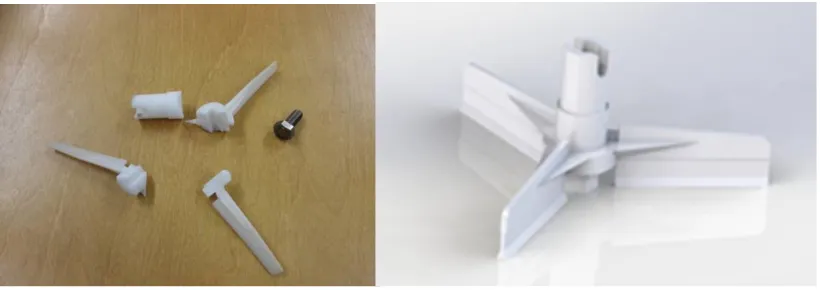
Fig. 9. The two printed versions of the spare part.
The other project was to design a hydraulic block. At the moment the block is made by drilling holes to a steel block. The new shape was designed in terms of fluid float and printability. The prototype of new shape was printed by using a powder bet plastic printer (Fig. 10).The students felt that the course was very instructional and they got good understanding about 3D-printing, its demands and possibilities.
Fig. 10. The old and new designs and a printed prototype of hydraulic block.
VI.CONCLUSION
Learning and teaching engineering are challenging tasks. The progress of technology is fast and curricula are under continuous development. The amount of learned material is also growing at the same that the governments are cutting teaching resources. The increasing needs of wide co-operation in work life demand also new kind of social and communication skills from graduating students.
The traditional lecture based teaching is an example of passive learning style, in which students listen and make notes without actually participating in the teaching process. The new learning methods, however, require the students to take more active and more responsible role. Working in the multidisciplinary projects also demands a broader view of the profession and ability to communicate and teamwork. Students must also be able to represent their own profession, be creative and integrate the knowledge of several courses to develop the solutions used to solve the problem of the project.
It is clear that AM will at least somehow change the engineering profession in near future. How radical this change is going to be, is still uncertain. However, because the changes in curriculum will be visible in the engineers work only after years of studies, there is a clear need to make some modifications at once. The important question is should we make radical changes or perhaps try to manage with minor changes and wait until it can be seen how the situation is developing?
In the implementation of AM teaching it would be important to give the students a practical view of AM. This means that they should be able to design and print some parts which gives them the possibility to see the result (the quality and design issues).
ACKNOWLEDGEMENT
This research has been supported by the European Structural Funds programme in a development project ALVO.
REFERENCES
[1] Mark Cotteleer, Mark Neier, Jeff Crane, Additive manufacturing:Four tactical paths, A Deloitte series on additive manufacturing, 2014 [2] Esa Hietikko, Design for Additive Manufacturing – DFAM, The International Journal Of Engineering And Science (IJES), Volume 3 Issue 12
December, 2014
[3] Antti Alonen, Esa Hietikko, Mikko Hoffren, Matti Kesonen, Arto Urpilainen: DeadMan-tutkimushankkeen loppuraportti – Kokemuksia metallikappaleiden ainetta lisäävästä valmistuksesta, Savonia-ammattikorkeakoulun julkaisusarja D4, 2015.
[4] Mina Aliakbari, Additive Manufacturing: State-of-the-Art, Capabilities, and Sample Applications with Cost Analysis Master of Science Thesis, Production Engineering and Management, Department of Industrial Production, KTH, 2012
[5] Mike Gorman, Project Based Learning and Flipped Classrooms: There Really is a Connection,Wordpress.com, 2015.
[6] Wael Mokhtar, Paul Duesing, Robert Hildebrand, Integration of Project-Based Learning (PBL) into Mechanical Engineering Programs, The International Journal of Learning, Volume 15, Issue 8, 2008.
[7] Rodrigo Pascual, RodrigoUribe, Experiential Learning Strategies in a Mechanical Engineering Senior Course, Universidad de Chile, 2006 [8] Kevin Delaney, John Kelleher, Real-World Process Designfor Mechanical Engineering Students: A Case Studyof PBL in DIT, International