ISSN(Online): 2319-8753 ISSN (Print): 2347-6710
I
nternational
J
ournal of
I
nnovative
R
esearch in
S
cience,
E
ngineering and
T
echnology
(An ISO 3297: 2007 Certified Organization)
Website: www.ijirset.com
Vol. 6, Issue 5, May 2017
Using Vikor Technique for Evaluating Customer
Satisfaction in Bank Using Entropy Weight
Dr Elsayed A Elsayed1, Dr A.K.Shaik Dawood2 , Dr R. Karthikeyan3
Department of Industrial Engineering, Zagazig University, Egypt1
Department of Industrial Engineering, King Khalid University, Abha, KSA2
Department of Management Studies, Karpagam University, Coimbatore, India3
ABSTRACT: There are many techniques of Multi-Criteria Decision Making MCDM methods that are able to rank alternatives in decision problems with conflicting criteria. This paper provides a comprehensive survey of Technique for Order Preference by Similarity to an Ideal Solution (TOPSIS) and its family for MCDM problems. Vlse Kriterijumska Optimizacija Kompromisno Resenje(VIKOR), and Distance to the ideal Alternative DIA methods, which has already become a quite popular multi-criteria decision-making MCDM tools. Two methods TOPSIS and VIKOR seem to be more appropriate for solving the retrofit selection problem because of their capability to deal with each kind of judgment criteria, the clarity of their results, and the reduced difficulty to deal with parameters and choices they involve. This paper provides a comparison analysis of the above-three methods. To avoid the limitation of TOPSIS, DIA calculates the Manhattan distance to select the best interface while ensuring no ranking abnormality problem and provide a good accuracy in identifying the alternative ranks.
KEYWORDS: Multi-attributes Decision Making, VIKOR, TOPSIS, SAW, Fuzzy AHP, decision-making, quantitative methods, weights of criteria, Pairwise Comparison, DIA.
I. INTRODUCTION
Making a decision implies that there are alternative choices to be considered, and in such a case we want not only to identify as many of these alternatives as possible but to choose the one that best fits with our goals, objectives, desires, values, and so on.
Three kinds of formal analysis can be employed to solve decision-making problems:
1. Descriptive analysis is concerned with the problems that decision makers (DM) actually solve. 2. Prescriptive analysis considers the methods that DM ought to use to improve their decisions. 3. Normative analysis focuses on the problems that DM should ideally address.
The main difficulty in MCDM problems lies in the fact that usually there is no objective or optimal solution for all the criteria. Thus, some trade-off must be done among the different points of view to determine an acceptable solution. Therefore, it is not easy problem at all, which explains the large amount of publications in the area in the last decades. Although MCDM problems have been studied in the operational research area for a long time, recently there is an increasing interest in including Artificial Intelligence techniques to the classical numerical methods.
ISSN(Online): 2319-8753 ISSN (Print): 2347-6710
I
nternational
J
ournal of
I
nnovative
R
esearch in
S
cience,
E
ngineering and
T
echnology
(An ISO 3297: 2007 Certified Organization)
Website: www.ijirset.com
Vol. 6, Issue 5, May 2017
transportation modes, the countries are comparatively studied. The proposed measure, elasticity, for each pair of variables indicates the extent to which the two variables have been changing consistently. Having developed the elasticity of the social, environmental and economic variables with respect to those of modal transportation, composite modal sustainability indices were suggested. The composite indices were then integrated into a unique SD index utilizing the Data Envelopment Analysis (DEA), and Concordance Analysis (CA) techniques. For comparative appraisal, country ranking and grouping based on DEA scores, as well as CA results were developed. The sustainability appraisal showed interesting patterns within and between group similarities and differences. The study confirmed the significance of modal transportation balancing and sustainability challenges of the 21st century. The research focus is on its methodology. Thus, the data gathered from any other time period and geographical scope may be used for further analysis.
Mei-Tai Chu , et al. [2], Knowledge management can greatly facilitate an organization’s learning via strategic insight. Assessing the achievements of knowledge communities (KC) includes both a theoretical basis and practical aspect; however, a cautionary word is in order, because using improper measurements will increase complexity and reduce applicability. Our results showed that TOPSIS and simple average weight (SAW) had identical rankings overall, but TOPSIS had better distinguishing capability. TOPSIS and VIKOR had almost the same success setting priorities by weight. However, VIKOR produced different rankings than those from TOPSIS and SAW, and VIKOR also made it easy to choose appropriate strategies. Both the TOPSIS and VIKOR methods are suitable for assessing similar problems, provide excellent results close to reality, and grant superior analysis.
N. Caterino, et al. [3], defined that the selection of a strategy to seismically upgrade an existing building is a difficult problem. In fact, several different technologies are available to this aim nowadays. Furthermore, many generally conflicting options have to be considered to assess the performance of each alternative. This article uses two methods TOPSIS and VIKOR among those considered, seem to be more appropriate for solving the retrofit selection problem because of their capability to deal with each kind of judgment criteria, the clarity of their results, and the reduced difficulty to deal with parameters and choices they involve.
Vijay M. A., Prasenjit C., and Shankar C. [4], illustrates the selection of an industrial robot for a specific engineering application is one of the most challenging problems in real time manufacturing environment. This has become more and more complicated due to increasing complexity, advanced features and facilities that are continuously being incorporated into the robots by different manufacturers. The decision maker needs to select the most suitable industrial robot in order to achieve the desired output with minimum cost and specific application ability. This paper mainly focuses on solving the robot selection problem using VIKOR (Vlse Kriterijumska Optimizacija Kompromisno Resenje) method, which has already become a quite popular multi-criteria decision-making (MCDM) tool. One real time example is cited in order to demonstrate and validate the effectiveness and applicability of VIKOR method.
Nihan C. D., and G.Nilay Y. [5], In this paper a decision making problem is considered and fuzzy analytic network process (ANP) and extended fuzzy VIKOR methodologies have been proposed to deal with the cruise port place selection problem in Istanbul. They proposed a model for selection of the most suitable place by using analytical network process and VIKOR method under fuzzy environment due to linguistic terms and compares the fuzzy analytic network process and VIKOR method results.
ISSN(Online): 2319-8753 ISSN (Print): 2347-6710
I
nternational
J
ournal of
I
nnovative
R
esearch in
S
cience,
E
ngineering and
T
echnology
(An ISO 3297: 2007 Certified Organization)
Website: www.ijirset.com
Vol. 6, Issue 5, May 2017
resources have stood first to third in priority and in ranking of this town branches, in addition to considering all financial challenges and indices related to Farhang, Enghelab and Khadamate Darmani in Sari have stood first to third.
Dr.A.K.Shaik Dawood et al.[7] Multi-Criteria decision making (MCDM) techniques are appropriate tools to prioritize under sophisticated environment, and are able to rank alternatives in decision problems with conflicting criteria. Banks represent entities of the financial market and the overall system for financing of the economy. This paper was performed a ranking of the banks through the application of the TOPSIS method With Entropy Weight.
Dr Elsyed et al[8] The purpose of this paper is to apply a Fuzzy Analytical Hierarchy Process model FAHP for estimating students' importance indexes problem, where the measures of students' attitudes and responses are often uncertain or difficult to determine by using non-fuzzy model. This paper introduces fuzzy theory with AHP approach to the research of university services as customers in public firms and it has reached some valuable conclusions.
Ali Mohaghar , et al. [9], the objective of this paper is to present a new methodology for selecting of marketing strategy by integration of Linear Goal Programming model and Fuzzy VIKOR. LGP method is used to determine the fuzzy weights of criteria and Fuzzy VIKOR aims to rank strategies. They applied the integrated approach in real case to demonstrate the application of the proposed method.
III.PROBLEM DESCRIPTION
A problem of finding the bank at a known place solved by ranking the different Banks due to some effective criteria, The criteria considered as the different ways of evaluating, reflecting specific needs of the decision maker may be of both economical/social and technical types.
Table 1 List of Banks Name Bi
The National Commercial Bank (NCB)
B1
Bank Al-bilad
B2
Riyad Bank
B3
Arab National Bank (ANB)
B4
Bank Al-jazira
B5
The Saudi Investment Bank
B6
Al Rajhi Bank
B7
Al-inma Bank
B8
Saudi French Bank
B9
Saudi British Bank (SABB)
B10
Saudi Hollandi Bank
B11
Saudi American Bank (SAMBA)
ISSN(Online): 2319-8753 ISSN (Print): 2347-6710
I
nternational
J
ournal of
I
nnovative
R
esearch in
S
cience,
E
ngineering and
T
echnology
(An ISO 3297: 2007 Certified Organization)
Website: www.ijirset.com
Vol. 6, Issue 5, May 2017
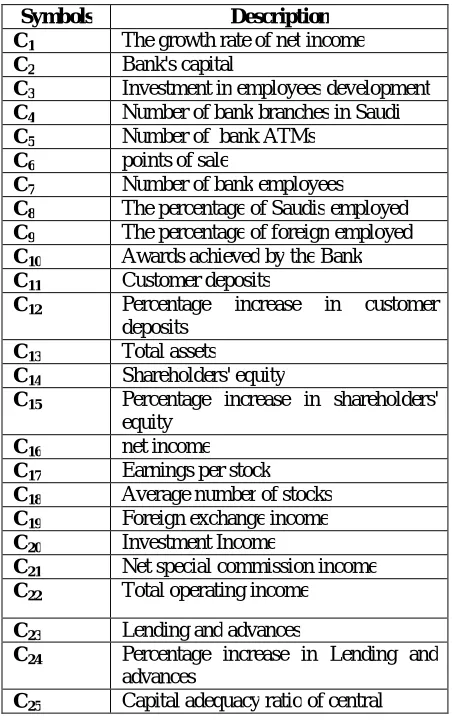
Table .2: list the Main Criteria Collected for the Different Banks.
IV. TOPSIS METHOD
As stated above, the TOPSIS (technique for order preference by similarity to ideal solution; according to the method, first all the values in the decision matrix. Table 3 illustrates the decision matrix contain the main effective criteria of the different Banks under study. The compromise solution can be regarded as choosing the solution with the shortest Euclidean distance from the ideal solution and the farthest Euclidean distance from the negative ideal solution. Next the positive ideal point (PIS) and the negative ideal point (NIS) are derived as:
= = { ( ), ( ), … . , ( ), … . , ( )}
= ( )| ∈ , | ∈ | = , … ,
= = { ( ), ( ), … . , ( ), … . , ( )}
= ( )| ∈ , | ∈ | = , … , , Symbols Description C1 The growth rate of net income
C2 Bank's capital
C3 Investment in employees development
C4 Number of bank branches in Saudi
C5 Number of bank ATMs
C6 points of sale
C7 Number of bank employees
C8 The percentage of Saudis employed
C9 The percentage of foreign employed
C10 Awards achieved by the Bank
C11 Customer deposits
C12 Percentage increase in customer
deposits
C13 Total assets
C14 Shareholders' equity
C15 Percentage increase in shareholders'
equity
C16 net income
C17 Earnings per stock
C18 Average number of stocks
C19 Foreign exchange income
C20 Investment Income
C21 Net special commission income
C22 Total operating income
C23 Lending and advances
C24 Percentage increase in Lending and
advances
ISSN(Online): 2319-8753 ISSN (Print): 2347-6710
I
nternational
J
ournal of
I
nnovative
R
esearch in
S
cience,
E
ngineering and
T
echnology
(An ISO 3297: 2007 Certified Organization)
Website: www.ijirset.com
Vol. 6, Issue 5, May 2017
Table 3. The Decision Matrix
C1 C2 C4 C5 C11 C13 C14 C16 C22 C23 B1 7 15 B 312 1,891 274 B 345,300 M 39,400 M 6,613 M 12,138 M 163 M
B2 72 3 B 88 728 23,742M 29,778 M 4,371 M
941,804
M 1,758 M 1,078 M
B3 10 15B 252 2,594 146,215M
190,181
M 31,963 M 3,466 M 6,865 M
117,471
M
B4 10 8 B 145 980 107,560M 136,639 M 17,804 M 2,371 M 4,784 M 86,329 M
B5 65 3B 54 350 40,675 M 50,957 M 5,012 M 501 M 1,600 M 29,897 M
B6 29 5 B 48 380 40,414 M 59,067 M 9,378 M 912 M 1,868 M 34,051 M
B7 7 15B 476 3,300 221,342M 267,382 M 36,468 M 78,470 M 14,328 M 2,212 M
B8 70 15B 87 650 32,214 M 54,014 M 16,664 M 733 M 1,826 M 819 B
B9 4 9 B 86 591 115,571M 157,777 M 22,686 M 3,015 M 5,011 M 103 M
B10 12 10 B 79 579 120,433M 156,652 M 20,065M 3,240 M 5,166 M 96,098 M
B11 21 3 B 45 261 53,913 M 68,505 M 8,305 M 1,253 M 2,219 M 453 M
B12 1 9 B 72 530 148,736M 199,224 M 31,636 M 4,333 M 6,694 M
104,800
T
Table 4 : Weighted Normalized Matrix and Two Artificial Extreme
C1 C2 C4 C5 C11 C13 C14 C16 C22 C23 B1 0.004301 0.065226 0.053228 0.042904 0.077044 0.079114 0.06902 2.39E-05 0.065852 9.65E-07
B2 0.042659 0.013045 0.015013 0.016517 0.006676 0.006823 0.007657 0.003398 0.009538 6.38E-06
B3 0.005892 0.065226 0.042992 0.058854 0.041113 0.043574 0.055992 1.25E-05 0.037244 0.000696
B4 0.005597 0.036962 0.024737 0.022235 0.030244 0.031306 0.031189 8.55E-06 0.025954 0.000511
B5 0.038298 0.013045 0.009213 0.007941 0.011437 0.011675 0.00878 1.81E-06 0.00868 0.000177
B6 0.017087 0.023916 0.008189 0.008622 0.011364 0.013533 0.016428 3.29E-06 0.010134 0.000202
B7 0.004042 0.065226 0.081207 0.074871 0.062237 0.061262 0.063884 0.000283 0.077733 1.31E-05
B8 0.041244 0.065226 0.014842 0.014747 0.009058 0.012375 0.029192 2.64E-06 0.009906 0.004849
B9 0.002357 0.039311 0.014672 0.013409 0.032496 0.036149 0.039741 1.09E-05 0.027186 6.1E-07
B10 0.007188 0.043484 0.013478 0.013137 0.033863 0.035891 0.035149 1.17E-05 0.028027 0.000569
B11 0.012373 0.014382 0.007677 0.005922 0.015159 0.015696 0.014548 4.52E-06 0.012039 2.68E-06
B12 0.000383 0.039136 0.012283 0.012025 0.041822 0.045645 0.055419 1.56E-05 0.036317 6.2E-07
A+ 0.042659 0.065226 0.081207 0.074871 0.077044 0.079114 0.007657 0.003398 0.077733 0.004849
A- 0.000383 0.013045 0.007677 0.005922 0.006676 0.006823 0.06902 1.81E-06 0.00868 6.1E-07
W 0.074773 0.156432 0.114422 0.112091 0.130316 0.135406 0.142507 0.00341 0.125679 0.004965 The separation values can be measured using the Euclidean distance, which is given as:
∗ = ∑ ( )− ( ) , = , … ,
= ∑ ( )− ( ) , = , … ,
ISSN(Online): 2319-8753 ISSN (Print): 2347-6710
I
nternational
J
ournal of
I
nnovative
R
esearch in
S
cience,
E
ngineering and
T
echnology
(An ISO 3297: 2007 Certified Organization)
Website: www.ijirset.com
Vol. 6, Issue 5, May 2017
V. VIKOR METHOD
It developed for MC optimization of complex system. It determines the compromise ranking list, the compromise solution, and weight stability intervals for performance stability of the compromise solution obtained with the initial or calculated weights. The compromise ranking algorithm VIKOR has the following steps: Compute the value of and
, = , , … .
Compute the values and = , , … , , by the relations
=∑ ∗− / ∗− ,
shown as in the average gap,
= ∗− / ∗− = , … , ,
shown as maximal
gap for improvement priority, where are the weights of criteria, expressing their relative importance.
2. Compute the value of
3. Sorting by the values S, R, and Q in decreasing order the results are three ranking lists. Compute the value , = , , … , , by the relation
= ( − ∗)/( − ∗) + ( − )( − ∗)/( − ∗),
= , , … , (Alternatives)
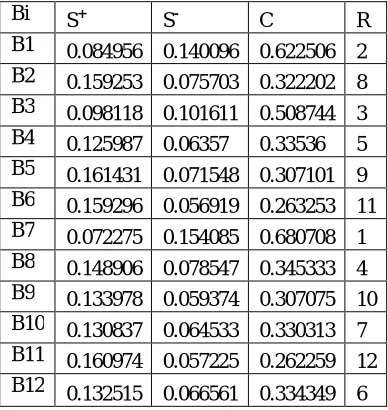
Table 5: The TOPSIS Parameters and Ranking
Where:
∗= or let ∗= be zero gap, i.e., achieve the aspired level,
= or let = be the worst level,
∗= or let ∗= be zero gap, i.e., achieve the aspired level,
= or let = be the worst level, Let = .
Therefore, we also can re-write = + ( − ) ,when ∗= , = , ∗= , = . is introduced as the
weight of the strategy of “the majority of criteria” (or “the maximum group utility”), here = 0.5.
1. Rank the alternatives, sorting by the values , , and , in decreasing order. The results are three ranking lists. 2. Propose as a compromise solution the alternative ( ′), which is ranked the best by the measure (minimum) if the following two conditions are satisfied:
Bi S+
S- C R
B1 0.084956 0.140096 0.622506 2 B2 0.159253 0.075703 0.322202 8 B3 0.098118 0.101611 0.508744 3 B4 0.125987 0.06357 0.33536 5 B5 0.161431 0.071548 0.307101 9
B6 0.159296 0.056919 0.263253 11 B7 0.072275 0.154085 0.680708 1 B8 0.148906 0.078547 0.345333 4
ISSN(Online): 2319-8753 ISSN (Print): 2347-6710
I
nternational
J
ournal of
I
nnovative
R
esearch in
S
cience,
E
ngineering and
T
echnology
(An ISO 3297: 2007 Certified Organization)
Website: www.ijirset.com
Vol. 6, Issue 5, May 2017
Table 6: The Different Values of Si
Si C1 C2 C3 C4 C5 C6 C7 C8 C9 C10
1 0.067843 0 0.043539 0.05197 0 0 0.142507 0.003388 0.021624 0.004965
2 0 0.156432 0.103006 0.094866 0.130316 0.135406 0 0 0.124118 0.004959
3 0.065029 0 0.059467 0.02604 0.066541 0.066569 0.112251 0.003399 0.073691 0.004254 4 0.06555 0.084734 0.087874 0.085571 0.08667 0.089546 0.054649 0.003403 0.094239 0.004443 5 0.007712 0.156432 0.112032 0.108808 0.121499 0.126317 0.002608 0.00341 0.125679 0.004785 6 0.045228 0.123842 0.113625 0.107701 0.121635 0.122836 0.02037 0.003409 0.123032 0.00476
7 0.068301 0 0 0 0.02742 0.033438 0.130579 0.003128 0 0.004953
8 0.002501 0 0.103272 0.097743 0.125905 0.125005 0.050011 0.003409 0.123447 0 9 0.071282 0.077692 0.103537 0.099919 0.082498 0.080475 0.07451 0.003401 0.091998 0.004965 10 0.062736 0.06518 0.105395 0.100361 0.079967 0.080958 0.063847 0.0034 0.090467 0.004383 11 0.053565 0.152424 0.114422 0.112091 0.114605 0.118786 0.016005 0.003407 0.119566 0.004963 12 0.074773 0.078216 0.107254 0.102169 0.065228 0.062688 0.110921 0.003396 0.07538 0.004965
Table 7 : Compute the Different Parameters of VIKOR
Bi SUM
( ) Rank( )
Compromise Solution B1 0.335835 0.142507 0.674697 1 2 B 2 0.749104 0.156432 0.943977 3 3 B 3 0.477242 0.112251 1.048382 6 5 B 4 0.656679 0.094239 1.358717 12 11 B 5 0.769281 0.156432 0.96259 4 4 B 6 0.786438 0.123842 1.240425 8 8 B 7 0.267819 0.130579 0.707849 2 1 B8 0.631292 0.125905 1.080725 7 7 B9 0.690277 0.103537 1.31496 11 12 B10 0.656695 0.105395 1.269041 10 9 B11 0.809834 0.152424 1.032227 5 6 B12 0.68499 0.110921 1.250721 9 10
The compromise solution between B1, and B7 where the (B7- (B1) not more than (1/11), then B7 is the best alternative successive by B1.
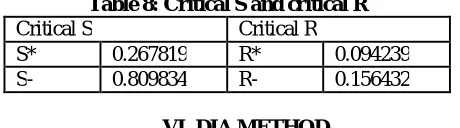
Table 8: Critical S and critical R
Critical S Critical R
S* 0.267819 R* 0.094239
S- 0.809834 R- 0.156432
VI. DIA METHOD
ISSN(Online): 2319-8753 ISSN (Print): 2347-6710
I
nternational
J
ournal of
I
nnovative
R
esearch in
S
cience,
E
ngineering and
T
echnology
(An ISO 3297: 2007 Certified Organization)
Website: www.ijirset.com
Vol. 6, Issue 5, May 2017
=∑ − , =∑ −
If we consider the ( , ) plane, the point (min , max ) is defined as the “positive ideal alternative” .
Table 9 : DIA Parameters and Ranking
Bi D+ D- Ri Rank
B1 0.179771 0.338485 0.062675 2 B2 0.392426 0.125829 0.363415 9 B3 0.258833 0.259422 0.174486 3 B4 0.352077 0.166178 0.306353 4 B5 0.406755 0.1115 0.383679 10 B6 0.421822 0.096433 0.404987 11 B7 0.135453 0.382802 0 1 B8 0.355383 0.162872 0.311028 5 B9 0.372593 0.145662 0.335367 8 B10 0.357944 0.160311 0.31465 6 B11 0.429737 0.088518 0.41618 12 B12 0.366236 0.152019 0.326376 7 Critical
D
0.135453 0.382802
Min max
The best alternative has the shortest distance to the PIA, which calculated as follow:
=
−
min(
)
+
−
max(
)
The alternative having the smallest value has the shortest distance to the PIA. The ranking order of the alternative due the shortest distance to the PIA. The final ranks by three different method illustrates in Table 10.
Table 10 : Rank the Bank by Three Methods
Bi Rank by (TOPSIS)
Rank by (VIKOR)
Compromise solution (VIKOR)
Rank (DIA)
B1 2 1 2 2
B2 8 3 9
B3 3 6 3
B4 5 12 4
B5 9 4 10
B6 11 8 11
B7 1 2 1 1
B8 4 7 5
B9 10 11 8
B10 7 10 6
B11 12 5 12
B12 6 9 7
VII. CONCLUSION
ISSN(Online): 2319-8753 ISSN (Print): 2347-6710
I
nternational
J
ournal of
I
nnovative
R
esearch in
S
cience,
E
ngineering and
T
echnology
(An ISO 3297: 2007 Certified Organization)
Website: www.ijirset.com
Vol. 6, Issue 5, May 2017
the extreme alternative, the best or the worst. When the information of criteria are nearly the parameters may be dense and ranking of alternative need more effective criteria and remove other criteria. In DIA algorithm, if the removed alternative includes one of negative ideal attributes, all distances D-j of the alternatives to negative ideal alternative will increase uniformly with the same distance. The distance to the PIA is unchanged. Therefore, the ranking order of alternatives is also unchanged The DIA algorithm is not subject to the ranking abnormality problem and outperforms TOPSIS algorithm. Table 11 illustrates the merits and demerits of the adopted methods in our study.
Table 11: The Merits and Demerits Of MADM Methods TOPSIS VIKOR DIA FAHP
Easy to calculate and understand
One parameter Relative closeness May be Ranking abnormality
Easy to calculate and understand
Three parameters (Compromise solution)
May be Ranking abnormality
1.Easy to calculate and understand
2. One parameter 3. little ranking abnormality
1. Highly complex methodology and requires more numerical
calculations
2. One criteria weights were computed.
REFERENCES
[1] A.A. Rassafi and M. Vaziri, “Assessment of Modal Transportation Sustainability: Application of Data Envelopment and Concordance Analyses”, Iranian Journal of Science & Technology, Transaction B, Engineering, Vol. 31, No. B2, pp. 179-193, The Islamic Republic of Iran, 2007.
[2] Mei-Tai Chu , et al., “Comparison among three analytical methods for knowledge communities group-decision analysis”, Expert Systems with Applications 33 (2007) 1011–1024
[3] Serkan Ball and Serdar Korukoğlu, “Operating System Selection Using Fuzzy AHP And TOPSIS Methods”, Department of Computer
Engineering, Ege University, 35000, Bornova, Izmir, Turkey, Mathematical and Computational Applications, Vol. 14, No. 2, pp. 119-130, 2009.
[4] N. Caterino, et al., “Comparative Analysis of Multi-Criteria Decision-Making Methods for Seismic Structural Retrofitting”, Computer- Aided Civil and Infrastructure Engineering 24, 432–445, 2009.
[5] Vijay M. A., Prasenjit C., and Shankar C., “Selection of Industrial Robots using Compromise Ranking Method”, International Conference on Industrial Engineering and Operations Management, Dhaka, Bangladesh, January 9 – 10, 2010.
[6] S.A. Nabavi Chashmi et al., “Evaluating & Ranking the Financial Performance of Bank after Privatization Using AHP FUZZY & TOPSIS Techniques”, Advances in Environmental Biology, 6(1): 502-508, ISSN 1995-0756, 2012.
[7] Dr Elsyed, Dr.A.K.Shaik Dawood. Dr Karthikeyan ”Evaluating Alternatives through the Application of Topsis Method with Entropy Weight, International Journal of Engineering Trends and Technology,Volume-46 Number-2 2017,PP 60-66
[8] Dr Elsyed, Dr.A.K.Shaik Dawood. Dr Karthikeyan ”Fuzzy Measurement of University Students Importance Indexes by Using Analytical
Hierarchy Process, International Refereed Journal of Engineering and Science (IRJES), Volume 6, Issue 1 (January 2017), PP.36-45.