A Comparative Study of Recommendation
Methods for Mobile OSN Users
Shyam Krishna K1, Dr. Vince Paul2
M.Tech Student, Department of Computer Science &Engineering, Sahrdaya College of Engineering & Technology,
Kodakara, Kerala, India1
Associate Professor, Department of Computer Science & Engineering, Sahrdaya College of Engineering &
Technology, Kodakara, Kerala, India2
ABSTRACT: Online Social Networks (OSNs) have grown a lot from the past and now it is becoming more and more popular in today’s life. The main problem facing by today’s networks is “information overloading”. A solution to this problem is a good recommendation system. It automatically suggests items to a user that he/she is having interest in it. To improve the accuracy and precision of recommendation systems, we have to incorporate information from social network. If so, the system will automatically monitors the social activities of users and ranks other users and recommends items/users to a target user based on this information. We provide a brief idea about the tasks of recommender system and how the concept of social interaction can be utilised to make recommendation. Here we make a comparative study of various recommendation systems which uses social data for normal users and mobile users. We also discuss about the traditional recommendation systems that do not uses social information also.
KEYWORDS: Recommendation systems, Social trust, Collaborative filtering. Online Social Networks.
I. INTRODUCTION
Online Social Networks (OSN) have become an important part of one’s life. They help to share interesting and important information with friends. The major cause for the popularity of OSNs is their ability to provide its users a platform to share information and ease of connection [1]. But the exponentially growing network introduces some challenges to its users termed as “information overloading”. It is a situation in which the users face difficulty to find out useful and appropriate information from the network [2]. Also the overwhelming contents broadcasted by through OSNs make the users difficult to review all the contents since they will not be having enough time to review the same [3].
But these traditional systems can’t make dynamic recommendations since the OSN and friend’s behaviour is changing day by day. It is seen that the friends are better and more qualified to make good and appropriate recommendations to the users rather than traditional recommendation systems [5]. So what we need is a new system which recommends items based on social data or the traditional methods incorporated with social network analysis. This introduces the concept of trust among users. Trust relationships defines how much we trust the contents posted by our friends. The trust values are computed based on the past interactions and they have to be propagated in the network [3].
Coming to the case of mobile OSN users, the above mentioned techniques can’t work perfectly because the mobile devices face some limitations such as small screen, poor input etc. [6]. Sparsity of data is one of the main challenge faced by our current recommendation system. The other challenge is cold start [2]. When the users are in mobile network environment, then their recommendation needs are greatly affected by the frequency of phone calls, messages and duration of the same [6]. It is a good practice to propagate trust among users. And users can become friends using this method. This method of propagating trust value about a user to another user can be termed as transitive trust. i.e. if user ‘A’ trusts user ‘B’ and ‘B’ trusts another user ‘C’, then A and C can trust each other [6].
This paper does a comparative study of various recommendation systems for the mobile based and non-mobile based OSN and the need of adhering social trust in such systems.
This paper is organized in such a way that the section II describes about related works. Section III discusses about the comparison of various models and in section IV a new model is proposed after comparing the various models and finishes with conclusion and references.
II. RELATEDWORK
In this section, we review several major approaches which used social data and non-social data and the systems for mobile based OSNs. Some of the works used link strength among users, some methods used behavioural trust and modelled some trust models, and some implemented social based recommendation systems.
(i.) Link strength
Kahanda et al. [7] made a model to estimate the link strengths based on the information which is transacted by the users. He used some pre-defined examples to train the model. Gilbert et al.[8] introduced a predictive model which mapped social media data to tie strengths. Their work distinguished the ties into strong and weak ties with an accuracy of 85%. Arnab et al. [1] validated the existence of dynamic degree of relationship among the Facebook users by using unsupervised machine learning techniques like divisive hierarchical clustering and statistical techniques like SSE. Arnab illustrated how the social media design elements like privacy controls, message routing and information prioritization in databases are improved by modelling the tie strengths.
The work [8] also measured the link strength based on interaction data, but it simply calculated the amount of interactions. It doesn’t considered the temporal aspect of link strengths and not analysed how the relationship strength is evolving.
(ii.)Trust relationship
Trust is an important concept for the case of communicating users and it determines the strength of communication [10]. Strong communities are formed by the users who “trust” each other. Trust also determines the flow and direction of flow in the social network. Trust is influenced by some factors like our own tendency to trust, our own relationships and past experiences about interaction in between the specific users or friends, news that have negative impact about other users etc. [10].
There are many works which deals with social trust. Adali et al. [10] measures dynamic trust based on behavioural trust. Adali developed an algorithmically quantifiable measures of trust. The main concept [10] was that trust depends on many patterns of behaviour and by measuring these patterns, behavioural trust can be measured.
Katz et al. [11] shows how trust values are derived from web based social networks can be used to prioritize defaults to generate recommendations about how much a user would trust an unknown user in the network. Katz in [11] just focused on inferring trust values between two unknown users.
Yu et al. [6]uses a trust relation of friendship to select the nearest neighbour. The model inferred that trust communication data of mobile users in a certain extent reflect the trust relationship between mobile users, in their daily conversation behaviour. [6] Considered that the trust of long talk time between users will be larger than that of short talk time between users, similar to the communication frequency. The model of [6] introduced two types of trust relationships – direct trust and indirect trust relationships. Direct trust is constituted by the number of calls made, duration of calls and frequency of short messages sent. Indirect trust relationship is calculated by considering the direct trust and transitive propagation of trust. If a user ‘A’ trusts ‘B’ and ‘B’ trusts ‘C’, then there can be a trust path from A to B. Indirect trust is calculated using the path length of directly trusted users.
Shen [3] in his work considers the same concept of trust transitivity as in [6]. They considered only directly connected users. Shen took the variation of trust values based on dates. Also trust value is computed at source-level.
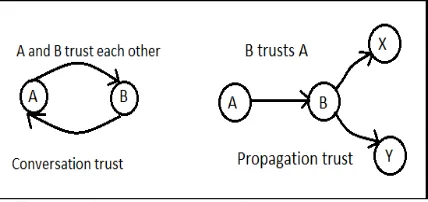
In [10], Adali define two types of behavioural trust – conversation trust and propagation trust. If two users trust each other, then they will propagate the information obtained from the trusted user to others. In propagation trust, the user will propagate the information which is propagated to the user by another user to whom the user trust to as shown in figure.
Figure 2.1 Conversation and propagation trust
(iii.)Recommendation systems
Guo et al. [2] merged social trust in CF. the main objective of [2] was to alleviate the data Sparsity and cold start issues. The quality of merged rating is measured by the confidence considering the number of ratings and the ratio of conflicts between positive and negative opinions. And this rating confidence is used to find out the user similarity. Predictions are made for a given item by considering the ratings of the similar users.
Hannon et al. [12] suggests CF approach to recommend Twitter users to follow other users. He introduced Twittomender [12] for recommending users on the real time web. The basis for recommendation is the social graph of the users. The Twittomender has been developed as a web service.
As early said, Adomavicius et al. [4] discusses about three major techniques used in recommendation system – content-based Recommendations, Collaborative recommendations and hybrid approaches. Hybrid approaches combines collaborative and content-based methods, which helps to overcome certain limitations of content and collaborative systems. Some of the trends in making hybrid systems are implementing both the systems separately and combining the predictions of both systems or to incorporate some content based characteristics in to a collaborative approach and vice versa and the last approach is to make a general unifying model that incorporates both content-based and collaborative characteristics.
Shen et al. [3] made a comparison of various RS’s. He incorporated the concept of social trust into user-based CF and compared its results with conventional user-based, item-based and Singular Value decomposition (SVD)-based CF approaches. Basic trust model and source-level trust models were used in [3]. Shen used auxiliary variables to capture the auxiliary causes of user behaviours which are independent of the trust towards a specific user.
(iv.)Recommendation methods for mobile networks
The traditional internet based recommendations can’t be used for recommendation in mobile networks. The main reason for this is the limitations faced by mobile devices. Small screen, poor input, poor processing capabilities and also weak wireless network bandwidth [6]. So for mobile recommendations, some specialized approaches are needed. In [6], the user preferences are collected during the time of registration phase into the social network. Then similarity of users and user’s attribute similarity is calculated. Then they are combined to get the final similarity. User’s scoring similarity is computed using the user-item scoring matrix. User’s trust in the network is calculated based on the call duration, call frequency and short message frequency. Two levels of trust namely direct trust and indirect trust is defined and implemented. Based on this trust value, recommendations are done.
III.COMPARISONOFVARIOUSMODELS
By comparing the various filtering and recommendation systems with new works, it is found that the trust incorporated methods are more efficient.
Adali et al. [10] in his work proposes measurable behavioural metrics for dynamic trust. The input to their social network model is a set of communication 3-tuples <sender, receiver, time>. The model [10] didn’t used communication content. The output obtained is a behavioural trust graph induced from those inputs. On analysis it is found that retweet in Twitter is a definite proportion indicating trust.
Guo et al. [2] to verify the effectiveness of Merge method, conducted experiments on three real-world data sets. To make a predictor, the Merge method needed to select a set of nearest neighbours and a similarity threshold. Guo varied the threshold from “0.0” to “0.9” with step “0.1”. He found that when similarity threshold increases, the Rating Coverage (RC) decreased dramatically. This decrease shows that less nearest neighbours are used to make predictions. Trust propagation is also verified in [2]. Their present work uses only explicit trust during the merging process.
Arnab et al. [1] illustrates about how tie strength can be incorporated to improve the social media design elements. The results of the work [1] can be used to make complex recommendation systems. Arnab classified tie strengths into two categories namely – strong and weak acquaintances. Again the tie strengths are classified as strong, strong acquaintances, weak acquaintances and weak ties. Arnab conducted his work on the Facebook Social Network and the result was based on 15 edge to edge features show that there are 4 different kinds of tie strengths visible in the network. Arnab also found the process to find out the optimum number of clusters.
Xiang et al. [9] developed an unsupervised model to estimate the relationship strength in between the users from interaction activities like communication, tagging, sharing etc. and user similarity. Xiang evaluated the approach on real-world Facebook data. He found that estimated link weight result in higher auto correlation and lead to improved classification accuracy.
Gilbert et al. [8] built a model on a dataset of 2000 social media ties and distinguished strong and weak ties with 85% accuracy. The model achieved a Mean Absolute Error (MAE) of 0.0994 on a continuous 0-1 scale where “0” represents weak and “1” represents strongest.
Yang et al. [13] did a survey of collaborative filtering based social recommender system. The prime objective of the work was to show the importance of social data to improve the accuracy and precision of the recommendation system. Yang classified social recommendation systems into two categories – Matrix factorization based Social Recommendation approaches and neighbourhood based social recommendation approaches.The work [13] concludes with an information that model based approaches perform well in both item-rating prediction and item-list recommendation tasks, while neighbourhood based approaches enjoy the advantage of easy implementation.
Shen et al. [3] makes a study of various RS’s like based, item-based, SVD-based and trust incorporated user-based CF. the model also used the concept of dynamic trust. To get the advantage of dynamic trust, Shen calculated trust about a user ‘v’ by user ‘u’ on a specific date ‘d’ as:
( , , ) = ( ) ( , ) ( , , ) + ( ) ( , ) ( , , ) + ( ) ( , ) ( , , )
+ ( ) ( , ) ( , )
Where C(u,v,d) indicate the number of comments posted by user u on user v’s entries before date ‘d’, L(u,v,d) represents the number of likes, S(u,v,d) represents the number of shares and N(u,v) represents the number of common friends between u and v. Here w1, w2, w3 and w4 represents the weight factors and a1, a2, a3 and a4 represents the auxiliary variables. Shen found that trust combined based CF performed well than traditional item-based, user-based and SVD user-based RS’s. User-user-based CF have higher precision than item-user-based and SVD-user-based CF.
The table below shows the advantages of some representative approaches.
Table 3.1 various models and their advantages.
Representative approaches Advantages
Behavioural trust Higher Correlation & prominence.
Merge trust High accuracy & coverage, better predictive performance.
Strength model Better classification based on tie strength. Social trust with CF Higher average precision and accuracy Recommendation method for mobile networks Higher precision & lower MAE
IV.PROPOSEDMODEL
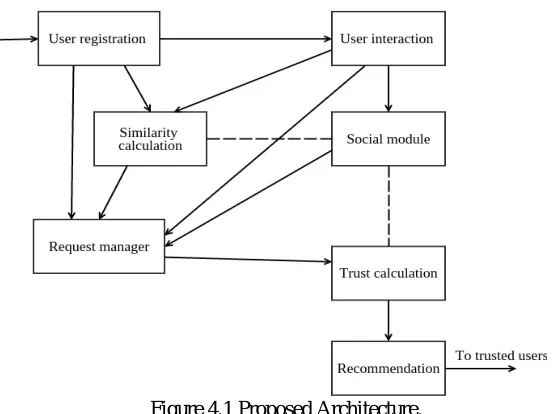
By combining the concepts from the existing models and by incorporating new methodologies, we can propose a new model. The model uses collaborative filtering approach and trust value calculated by specific criteria. Here the transitivity of trust can be limited by the number of social network friends connected. Semantics information can be incorporated to rate the users and this information can be mixed to get a final recommendation. The cost of this model can be limited by setting the maximum distance that should be taken care while calculating the trust values. The following diagram shows the expected modules and architecture of the proposed model.
Figure 4.1 Proposed Architecture.
when users make friend requests, the request manager module collects the required information from the user interaction, similarity and trust calculation modules. And the request manager coordinates these values and will be fed to the trust calculation module. The values given by the request manager is an estimated value from the previous interactions. Trust calculation module then does the actual trust calculation to get the basic trust value and is given to recommendation module. These recommendations are further provided to the trusted users.
V. CONCLUSION
This work makes a comparative study of recommendation systems. We saw that the recommendation systems can be classified in to content based, collaborative-filtering and hybrid approaches. But this work mainly deals with CF based approaches and trust incorporated methods. The existing recommender systems use trust value among the users of social network to establish relation among the users and to propagate information. Different concepts about trust calculation have seen. As the popularity of Online Social Networks are increasing in an exponential manner, better and efficient recommendation algorithms need to be developed and used. From the literature work, it is clear that trust-combined SVD-based CF have more stability and reliability. So a new model can be proposed and implemented which uses trust value and SVD-based CF to filter and recommend relevant information in OSN. Along with that this model can be used for recommending people and items. Since mobile devices have a lot of limitations, this work can overcome such limitations without incurring cost.
REFERENCES
[1] A. Kumar, T. Rao, and S. Nagpal, “Using Strong, Acquaintance and Weak Tie Strengths for Modeling Relationships in Facebook Network”, Proceedings of the 5th International Conference on Contemporary Computing, IC3, August 6-8, pp. 188-200, 2012
[2] G. Guo, J. Zhang, and D. Thalmann, “Merging trust in collaborative filtering to alleviate data sparsity and cold start”, Knowledge-Based Systems, 57, pp. 57-68, 2014.
[3] Xiao Shen, Haixia Long, and Cuihua Ma, “Incorporating Trust Relationships in Collaborative Filtering Recommender System”, Software Engineering, Artificial Intelligence, Networking and Parallel/Distributed Computing (SNPD), 16th IEEE/ACIS International Conference on. IEEE, 2015.
[4] G. Adomavicius and A. Tuzhilin, “Toward the next generation of Rss: A survey of the state- of-the-art and possible extensions”, IEEE Transactions on Knowledge and Data Engineering,Volume 17, Issue 6pp. 734-749, 2005.
[5] P. Bedi, H. Kaur, and S. Marwaha. “Trust based recommender system for semantic web”, In IJCAI’07: Proceedings of 20thInternational Joint Conferences on Artificial Intelligence, pages 2677–2682, 2007.
[6] Peng Yu, “Recommendation method for mobile network based on user characteristics and user trust relationship”, IEEE International Conference on Big Data Analysis (ICBDA), 2016.
[7] I. Kahanda and J. Neville, “Using transactional information to predict link strength in OSNs,” Proceedings of the 3rd International Conference on weblogs and social media, 2009.
[8] E. Gilbert and K. Karahalios, “Predicting tie strength with socialmedia,” Proceedings of the 27th International Conference on HumanFactors in Computing Systems, 2009.
[9] R. Xiang, J. Neville, and M. Rogati, “Modeling Relationship Strength in Online Social Network,” Proceedings of the 19th International Conference on World wide web, pp. 981-990, 2010
[10] S. Adali, R. Escriva, M.K. Goldberg, M. Hayvanovych, M. Magdon-Ismail, B.K. Szymanski, W.A. Wallace and G.T. Williams, “Measuring Behavioral Trust in Social Networks”, Proceedings of International Conference on Intelligence and Security Informatics, 2010.
[11] Y.Katz and J. Golbeck, “Social network-based trust in prioritized default logic,” Proceedings of the 21st International Conference on Artificial Intelligence, 2006.
[12] J. Hannon, M. Bennett, and B. Smyth, “Recommending Twitter Users toFollow Using Content and Collaborative Filtering Approaches,”Proceedings of the 4th ACM International Conference on RecommenderSystems, 2010.