DOI: 10.1534/genetics.107.086363
Variation and Evolution of Male Sex Combs in Drosophila: Nature of
Selection Response and Theories of Genetic Variation for Sexual Traits
Abha Ahuja and Rama S. Singh
1Department of Biology, McMaster University, Hamilton, Ontario L8S 4K1, Canada Manuscript received December 21, 2007
Accepted for publication February 18, 2008
ABSTRACT
We investigated the genetic architecture of variation in male sex comb bristle number, a rapidly evolving secondary sexual character of Drosophila. Twenty-four generations of divergent artificial selection for sex comb bristle number in a heterogeneous population of Drosophila melanogasterresulted in a significant response that was more pronounced in the direction of low bristle numbers. We observed a strong positive correlated response to selection in the corresponding female transverse bristle row. The correlated response in male abdominal and sternopleural bristle numbers, on the other hand, did not follow the same pattern as sex comb bristle number differences between selection lines. Relaxation-of-selection experiments along with mate choice and fecundity assays using the selection lines developed demonstrated the action of sta-bilizing selection on sex comb bristle number. Our results show (1) substantial genetic variation underlying sex comb bristle number variation; (2) a weak relationship between the sex comb and developmentally related, non-sex bristle systems; and (3) that sexual selection may be a driving force in sex comb evolution, indicating the potential of sex combs to diversify rapidly during population differentiation and speciation. We discuss the implications of these results for theories of genetic variation in display and nondisplay male sex traits.
M
ALE secondary sexual traits are one of the most rapidly diverging morphological characters of higher animals (Eberhard 1985). Their evolution is thought to be driven by sexual selection (Darwin1871) acting through female choice (Fisher1930; Andersson 1994), male–male competition (Parker 1970; Emlenet al. 2005), and/or sexual antagonism (Parker1979; Chapmanet al. 2003). Directional sexual selection acting on variation in male sex traits within populations, at different rates or in opposite directions across popula-tions, can result in rapid phenotypic divergence. This can contribute to the establishment of behavioral repro-ductive isolation (West-Eberhard1983; Civetta and Singh1998; Boughman2001). Such prezygotic barriers to mating may be more important in the early stages of species formation as compared to postzygotic isolating mechanisms such as hybrid sterility (Turelliet al. 2001; Kirkpatrickand Ravigne2002; Coyneand Orr2004). The male sex comb, an array of specialized bristles on the forelegs, is one such highly variable secondary sexual trait of themelanogasterandobscuraspecies groups of Drosophila (Kopp and True 2002; Schawaroch 2002). Behavioral studies performed in these groups have suggested that the sex combs are involved in grasp-ing the female’s abdomen or in spreadgrasp-ing her wgrasp-ings
during mating and that their role may even vary between species depending on morphology (Speith1952; Cook 1977; Coyne 1985). Markow et al. (1996) found that
Drosophila simulansmales captured from a natural popu-lation while mating had significantly fewer sex comb teeth than males found not mating. InDrosophila bipectinata, on the other hand, mating males in similar natural conditions had a significantly increased number of sex comb teeth (Polak et al. 2004). Evidence that the number of sex comb teeth affects mating success in opposite directions in different species suggests that the high intra- and interspecific variation seen in sex comb bristle number (Coyne 1985; Kopp et al. 2003; Tatsutaand Takano-Shimizu2006) may be driven by sexual selection.
Previous studies have investigated sex comb bristle number variation within and between species of the
melanogastercomplex using quantitative trait loci (QTL) mapping and gene expression analyses (Coyne 1985; True et al. 1997; Macdonald and Goldstein 1999; Nuzhdin and Reiwitch 2000; Kopp et al. 2003; T at-suta and Takano-Shimizu 2006; Graze et al. 2007). Despite a large amount of work in this field, there remains a gap in our basic understanding of sex comb bristle number inheritance and evolution. In this study we have used artificial selection in combination with relaxation-of-selection tests, investigation of genetic correlations with other bristle traits, and measurement of various fitness components in the lines developed. 1Corresponding author:Department of Biology, McMaster University,
1280 Main St. West, Hamilton, ON L8S 4K1, Canada. E-mail: [email protected]
Together, these experiments provide insights into the evolutionary potential of sex comb bristle number to respond to selection and the mechanisms responsible for maintenance of variation in this trait.
MATERIALS AND METHODS
All experiments were carried out at room temperature (22°–25°) with flies reared on standard cornmeal–molasses– agar medium.
Derivation of base population:Thirty-two different lines of D. melanogaster were obtained and reared under uniform laboratory conditions for three to four generations (supple-mental Table 1). Adult males were anesthetized on ice, and sex comb bristle number on both forelegs was counted in 30 males from each population under a light microscope. We used the mean of the left and right foreleg measurement as the sex comb bristle number score in all analyses. The absolute value of the numerical difference between the left and right foreleg measurement was used to calculate fluctuating asymmetry (FA) (Palmerand Strobeck2003). To test for a relationship between degree of fluctuating asymmetry and size of the sex comb, Spearman rank correlation coefficients between FA and mean bristle number were calculated.
To obtain a genetically variable population, the six most extreme populations according to their mean sex comb bristle number (three with the highest population mean and three with the lowest, indicated in supplemental Table 1) were crossed (supplemental Figure 1). Approximately 40 male and 40 female offspring from each population cross were pooled and allowed to interbreed for four generations to establish the base population from which we derived our replicate selection and control lines.
Artificial selection protocol: The selection experiment consisted of two replicates (designated 1 and 2) that each included one line selected for high sex comb bristle number (high), one line selected for low bristle number (low), and one unselected control line (control). Two hundred males from the base population were scored for sex comb bristle number and the highest-scoring males, 10 for each replicate, were chosen as parents for the high lines. Similarly, the lowest-scoring males, 10 for each replicate, were used as parents for the low lines while the 10 males for each of the control lines were chosen at random. Males for each line were mated with 10 randomly chosen females (supplemental Figure 2).
Because of the low number of progeny obtained in generation 1, we scored varying numbers of males: 56 high 1, 54 high 2, 30 control 1, 30 control 2, 74 low 1, and 46 low 2 males. The 10 most extreme males from within each line were chosen as parents for the second generation. We revised the protocol and increased the number of randomly chosen females to 20. In each subsequent generation, 100 males from each line were scored and the most extreme 10 were selected. Control males and control females were chosen at random. Selection was continued in this manner for each of these lines for a total of 24 generations.
Realized heritability of male sex comb bristle number for each line was estimated by linear regression of cumulative selection response (mean sex comb bristle number for each generation added for each round of selection) on the cumu-lative selection differential (absolute value of parental mean minus generation mean, added to each other for each round of selection) (Falconer and Mackay1996; Edwardset al. 2006). The first two generations of selection data were ex-cluded because the method of selection was different. For each replicate, the coefficients of genetic (CVG) and
environ-mental (CVE) variation were calculated as CVG¼100
ffiffiffiffiffiffi
VG p
=x and CVE¼100
ffiffiffiffiffiffi
VE p
=x (Houle 1992).V
G for each replicate was estimated ash2V
P, whereVPwas the average phenotypic variance of the respective control line, and h2 was calcu-lated from divergence between the high and low lines of that replicate.VEwas estimated asVPVG. The mean (x) was the mean sex comb bristle number of the respective control line.
Relaxed selection protocol:Each of the four selection lines was divided into two sublines at generation 14. In the first subline, artificial selection was continued as described above. The second subline was maintained for 10 generations without further selection for sex comb bristle number. Sex comb bristle number was scored in 50 males in these relaxed sublines every alternate generation until the 10th generation after relaxation when 100 males were scored.
Correlated responses to selection: At generation 24, we scored bristle number in the most distaltransversebristlerow (TBR), the segment that corresponds to the male sex comb (Tokunaga1962; Heldet al. 2004), of both forelegs of 30 females from each line. We also scored bristle number in the fourth abdominal segment of 100 males and in the left and right sternopleural plates of 30 males from each line at generation 24. The fifth abdominal segment is more com-monly used as a measure of abdominal bristle number. The sternopleural and TBR score used was the mean of the left- and right-side measurement.
Within-line fitness assays:We tested for the effect of sexual selection on sex comb bristle number by assessing differences in mating success associated with bristle number differences within the high 2, control 2, and low 2 lines. At generation 20, virgin males and females from each line were collected within 4 hr post-eclosion using CO2anesthesia and housed separately for 4–5 days prior to mating assays. On the basis of their sex comb bristle number, males from within each line were divided into two classes, high scoring (h) and low scoring (l), and paired in such a way as to maximize differences in sex comb bristle number. One male from each pair was marked with a notch at the base of either the right or the left wing with forceps to allow for identification. We ensured that paired treatments within a set were reciprocally marked for half the treatments. Of the 90 matings scored, 42 successful males had clipped wings and 48 had nonclipped males. These differences are not statistically significant (x2¼0.4, d.f.¼1,P¼0.52), confirming that notching had no significant effect on mating success. Each male pair was introduced into a vial with a female from the same line without anesthesia. We recorded male courtship behaviors, including time spent in wing vibrations (in seconds) and the number of attempted copulations. Trials were terminated if a successful copulation did not occur within 15 min. A trial was retained for statistical analysis only if both males courted the females. If one male was not active or did not get a chance to court the female because copulation occurred too soon, the trial was discarded. Thirty successful trials were recorded for each line.
RESULTS
Genetic variation in sex comb bristle number:The mean sex comb bristle numbers for each of the 32 dif-ferent populations examined are presented in supple-mental Table 1. We detected significant differences in mean bristle number among these populations (F31,928¼ 22.859,P,0.001), indicating high intraspecific variation for sex comb bristle number among these lines of
D. melanogaster.
Response to artificial selection for sex comb bristle number: Sex comb bristle number inD. melanogaster re-sponded to divergent artificial selection, exhibiting signif-icant differences in mean bristle number between lines after 24 generations of selection (replicate 1: F2,297 ¼ 4986.3, P , 0.001) (replicate 2: F2,297 ¼3145.15, P , 0.001; Figures 1 and 2). The phenotypic response was greater in the direction of decreased sex comb bristle number as seen in the estimates of heritability: h2 ¼ 0.1160.01 (P,0.01) andh2¼0.0760.02 (P,0.001) for high 1 and high 2 lines, respectively, while low 1 and low 2 line heritability estimates wereh2¼0.21 60.02 (P , 0.001) and h2 ¼ 0.16 6 0.02 (P , 0.001),
respectively. Estimates of heritability derived from di-vergence between high and low lines were also signifi-cant (replicate 1:h2¼0.1560.01,P,0.001) (replicate 2:h2¼0.0960.01,P,0.001). We note an increase in bristle number in control 1 males (Figure 1) and this is likely due to random genetic drift since the effective sample size is small and both males and females were chosen at random for the control lines.
Stabilizing selection for sex comb bristle number:
We compared mean sex comb bristle number of the relaxed sublines after 10 generations of relaxation with those of the paired source population before relaxation, at generation 14. Mean sex comb bristle number did not change significantly in both high 1 relaxed subline (t¼ 1.41,P¼0.96) and low 1 relaxed subline (t¼1.96,P¼ 0.312) after 10 generations of relaxation (Figure 1). Mean sex comb bristle number in the high 2 relaxed subline regressed toward control levels (t ¼9.67, P , 0.001) while mean bristle number in low 2 relaxed subline showed an increase in the direction of the controls (t ¼7.61, P , 0.001) (Figure 1). This dem-onstrates the action of net stabilizing selection acting to maintain intermediate bristle numbers in these lines.
Correlated responses to selection: Significant differ-ences in female distal TBR bristle numbers were seen in both replicate 1 (F2,87¼251.3,P,0.001) and replicate 2 (F2,87¼220.14,P,0.001; Figures 2 and 3A). These differences followed the same pattern as sex comb bristle number differences between selection lines; both high lines exhibited significantly higher TBR bristle numbers than their respective control lines, which had significantly more bristles than their respective low lines Figure 1.—Response to artificial selection for male sex
comb bristle number inD. melanogaster. Mean sex comb bristle numbers in high (square), low (circle), and control (triangle) lines over 24 generations in (A) replicate 1 and (B) replicate 2. Solid lines with solid symbols indicate artificial selection lines and dashed lines with open symbols indicate relaxed sublines. Error bars represent standard deviation.
[Tukey’s honestly significantly different (HSD) test,P, 0.01 for all comparisons]. In contrast, the differences in abdominal bristle number (replicate 1:F2,297¼30.33,P , 0.001 and replicate 2: F2,297 ¼ 48.17, P , 0.001) (Figure 3B) and sternopleural bristle number (replicate 1:F2,87¼14.7,P,0.001 and replicate 2:F2,87¼28.8,P, 0.001) (Figure 3C) were not entirely consistent with the pattern of changes in sex comb bristle number. Mean abdominal bristle numbers of males from low 1 and low 2 lines were significantlyhigherthan those of males from control 1 and control 2 lines, respectively (Tukey’s HSD test,P,0.001). Sternopleural bristle numbers did not change significantly from the respective control lines in high 1 (Tukey’s HSD test,P¼0.12) and low 2 (Tukey’s HSD test,P¼0.52) lines in response to selection for sex comb bristle number. All other comparisons of
abdom-inal and sternopleural bristle numbers within replicates were statistically significant atP , 0.01 (Tukey’s HSD test). These results show a strong positively correlated response to selection for sex comb bristle number in the homologous female TBRs but a weaker, inconsistent response in the abdominal and sternopleural bristles.
Sexual selection against extremely low sex comb
bristle numbers: Females from high 2, low 2, and
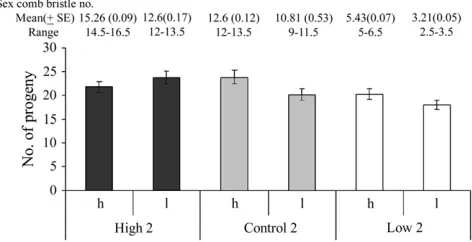
control 2 lines were given a choice between males that differed in sex comb bristle number from within their line to assess differences in mating success associated with differences in sex comb bristle number. Means of sex comb bristle numbers, time spent in wing vibration, and numbers of attempted copulations of successfulvs. unsuccessful males within each line were compared using a Wilcoxon paired sample test (Table 1). The only comparison that showed a significant difference was mean sex comb bristle numbers of low 2 males: success-ful males from the low 2 line had more sex comb teeth than unsuccessful males (x2¼19.2, d.f.¼1,P,0.01) (Table 1, Figure 4). More l males were successful as compared to the h males in the high 2 (x2¼1.2, d.f.¼1,
P¼0.27) and control 2 lines (x2¼0.13, d.f.¼1,P¼ 0.71) (Figure 4), but these differences were not significant.
The number of progeny sired by males with different sex comb bristle numbers within high 2, low 2, and control 2 lines was assessed to uncover fecundity differ-ences between these males (Figure 5). We detected a significant effect of line in assaying differences in fecun-dity (F2,175¼4.82,P¼0.009) and found that low 2 males had significantly lower fertility than high 2 (Tukey’s HSD test;P , 0.01) males. Within a line, however, multiple
t-tests showed no significant difference in the number of progeny sired by high-scoring and low-scoring males within high 2 (t¼1.69,P¼0.09), low 2 (t¼1.98,P¼ 0.05), or control 2 (t¼1.89,P¼0.07)
DISCUSSION
Genetic architecture of sex comb bristle number variation inD. melanogaster:The large differences in sex comb bristle number between the geographically wide-spread populations ofD. melanogasterused in our study, coupled with the rapid, robust phenotypic response to artificial selection, show that there is substantial additive genetic variance underlying this trait. The magnitude of the realized heritability, however, is relatively low (0.1) when compared to other morphological traits such as abdominal bristle number (h2 0.5; Clayton et al. 1957) and body size (h2 0.4; Robertson 1957) in Drosophila. The genetic and environmental coeffi-cients of variation, respectively, were 3.36 and 7.99 for replicate 1 and 2.96 and 7.87 for replicate 2. These values show that the low heritability of male sex comb bristle number is due to a higher proportion of Figure3.—Correlated responses to divergent selection for
environmental variance, rather than to a lack of genetic variation, which is a typical feature of many secondary sexual traits (Alataloet al. 1988; Pomiankowski and Moller1995).
The response to selection was highly asymmetrical with both low lines showing a greater per-generation decrease in sex comb bristle number as compared to the increase in bristle number in the high lines. Such a response could have resulted from the action of selec-tion (natural and/or sexual) operating along with the artificial selection applied. The regression of bristle numbers toward intermediate levels in both high 2 and low 2 on relaxation of selection shows that sex comb bristle number is under net stabilizing selection in these lines. The lack of a significant response to relaxation in replicate 1 may be due to lower levels of genetic vari-ation (Figure 1).
We measured correlated responses to selection for sex comb bristle number in other developmentally related mechanosensory bristle systems to assess the extent of genetic linkage between them. The last TBR of the fe-male is homologous to the fe-male sex comb (Tokunaga 1962; Heldet al. 2004), and here we observed a strong indirect response to selection. Changes in male abdom-inal and sternopleural bristle numbers, on the other
hand, were not entirely consistent with the pattern of differences seen in sex comb bristle number after 24 generations of selection. It appears that selection may have altered the frequency of a few loci affecting bristle number in general, but that there remain major loci affecting the sex comb system specifically that are not shared with other mechanosensory bristle systems. This weak relationship suggests reduced developmental con-straint on the sex combs to evolve in concert with other, non-sex, bristle systems. The sex combs appear to be a sexual modification evolving relatively independently of related bristle systems, which could enable them to evolve rapidly, and potentially with exaggeration.
Males from the low 2 line appear to be unfit in com-parison to males from both high 2 and control 2 lines. Low 2 males had lower fecundity than males from control 2 and high 2, and within the low 2 line, males with ex-tremely low bristle numbers had reduced mating success. This could be due to the accumulation of deleterious alleles during the selection process. Sexual selection against small combs could also be responsible, maintain-ing higher frequencies of alleles for greater bristle numbers in the base population, which would explain the greater response in the downward direction when artificial selection was applied. Another interesting
obser-Figure4.—Numbers of high-scoring (h) and low-scoring (l) males that were successful in mating trials conducted within each selection line. Mean (6SE) and range of sex comb bristle numbers of all (30) males from each class are indicated above bars.
TABLE 1
Sex comb bristle number, time spent in wing vibration, and attempted copulations of successful and unsuccessful males
Bristle no. of sex combs Time in wing vibration (sec) No. of attempted copulations
Line Successful Unsuccessful P Successful Unsuccessful P Successful Unsuccessful P
High 2 14.15 (1.6) 14.78 (1.38) t¼176, P¼0.24
25 (14.74) 20.76 (14.4) t¼186.5, P¼0.36
2.8 (2.3) 2.8 (1.56) t¼214, P¼0.87 Control 2 12.13 (1.3) 12.26 (1.62) t¼231.5,
P¼0.98
14.8 (12.8) 9.46 (8.6) t¼157.5, P¼0.13
1.6 (1.52) 1.46 (1.57) t¼202, P¼0.75 Low 2 5.21 (0.71) 3.53 (0.73) t¼50,
P¼0**
14.8 (9.15) 19.06 (12.61) t¼141, P¼0.06
2.63 (2.15) 2.93 (1.92) t¼173, P¼0.35
Data are from mating trials between high-scoring (h) and low-scoring (l) males from within high 2, control 2, and low 2 lines with mean (6SD) given. Comparisons between successful and unsuccessful males were performed using a Wilcoxon paired sam-ple test. **P,0.01.
vation is that, although not significant, successful males from within the control 2 and high 2 lines had fewer sex comb teeth than unsuccessful males (Table 1, Figure 4). This is similar to the trend seen in natural populations of
D. simulans, where mating males had significantly fewer sex comb teeth (Markowet al. 1996). Sexual selection appears to be an important driving force in sex comb evolution and it would be worthwhile to further in-vestigate this in themelanogaster subgroup to help un-derstand its potential role in species divergence.
Theories of genetic variation for male sexual traits:
Sexual selection acting on male sex traits is expected to lead to rapid fixation of favorable alleles and depletion of heritable genetic variation in such traits (Borgia 1979; Taylor and Williams1982). However, in con-trast to this expectation, it has been shown that additive genetic variation not only is maintained, but is actually higher in male sex traits as compared to non-sex traits (Pomiankowskiand Moller1995). Different hypoth-eses have been proposed to explain this persistence of genetic variance in male traits but few studies have attempted to empirically test these hypotheses. We find high levels of genetic variation underlying sex comb bristle number, allowing us to assess if, and how, current theories of genetic variation for sexual traits apply to this trait.
Pomiankowski and Moller (1995) have proposed that fitness increases exponentially as a sexually selected trait becomes exaggerated, which favors an increase in phenotypic variance through the evolution of modifiers that can increase the number of genes and their effect on the trait. According to this hypothesis, the high addi-tive genetic variance in male sex traits is a consequence of continual directional selection while traits subject to stabilizing selection should have reduced levels of genetic variation due to modifiers that restrict the number of loci and their effects. However, this expla-nation fails to consider that the exaggeration of a sexual trait does not continue indefinitely and that, after initial spread, most sexually selected traits are expected to be under stabilizing selection (Kirkpatrickand Ryan1991; Andersson 1994). Indeed, sex comb bristle number shows only a limited increase in the high lines in spite of the strong artificial selection applied and appears to be under stabilizing selection in the base population.
Alternatively, the ‘‘genic capture’’ hypothesis (Rowe and Houle1996) proposes that the expression of male sex traits is costly and condition dependent and thus involves a large number of genes in the genome, which provides an inexhaustible source of variation in such traits. For this explanation to apply, the secondary sexual trait must be condition dependent, but our results fail to find evidence to support this in the sex comb: A negative phenotypic correlation between size and degree of FA is expected for costly, condition-dependent secondary sexual traits, since males of high condition should be able to simultaneously maximize
size and minimize FA of sexual traits (Manning and Hartley 1991; Moller and Pomiankowski 1993; Tomkins and Simmons 2003). We did not detect a significant negative correlation in any of the 32 lines that we tested (supplemental Table 1). In a previous study, Polaket al. (2004) found apositiverelationship between sex comb bristle number and FA in lab-reared populations ofD. bipectinata.
Male secondary sexual traits can be classified into two types: (1) costly display traits subject to female choice and (2) traits not used for display but to coerce or drive females to mate with or without females having any control (Singhand Kulathinal2005). The absence of a negative relationship between FA and size suggests that the trait may not be a typical costly, condition-dependent display trait (Moller and Cuervo 2003). Instead, it has been proposed that the combs help to grasp the female (Speith1952), suggesting that males use them to control females during copulation. Singh and Kulathinal (2005) recently proposed the ‘‘male sex drive’’ hypothesis, which offers a more general explanation for maintenance of variation in different types of male traits. Complementary to female choice, it is the concept that males are the sex that develops new strategies (morphological, physiological, and behav-ioral) to mate and pass on offspring. This male drive to secure mates and reproduce leads to the recapture of any mutations affecting any male trait involved in sex-and reproduction-related functions. This selection-driven continuous input of new mutations would compensate for loss of genetic variation.
From our findings of significant heritable genetic var-iation, a weak relationship with other non-sex bristle systems, and evidence of intraspecific sexual selection in
D. melanogaster, we can conclude that the sex comb has the potential to diversify rapidly. The results presented here raise the possibility that sex comb bristles may not be a typical display trait and force us to think about the maintenance of genetic variation in displayvs. nondis-play traits. Our study lays the foundation for further work, providing experimental material to further analyze the genetic architecture, functional significance, and evolutionary dynamics of the sex comb in Drosophila.
We thank Marisa Melas and Maria Abou Chakra for foreleg images and Artyom Kopp and Joel Atallah for helpful suggestions and protocols. We are thankful to Wilfried Haerty, Ben Evans, Jonathon Stone, Carlo Artieri, Richard Morton, the associate editor, and three anonymous reviewers for their valuable comments on the manuscript. This work was supported by a Natural Sciences and Engineering Research Council of Canada grant to R.S.S.
LITERATURE CITED
Alatalo, R. V., J. Hoglundand A. Lunnberg, 1988 Patterns of
var-iation in tail ornament size in birds. Biol. J. Linn. Soc. Lond.34:
363–374.
Andersson, M., 1994 Sexual Selection. Princeton University Press,
Borgia, G., 1979 Sexual selection and the evolution of mating
sys-tems, pp. 19–80 inSexual Selection and Reproductive Competition, edited by M. S. Blumand N. A. Blum. Academic Press, New York.
Boughman, J. W., 2001 Divergent sexual selection enhances
repro-ductive isolation in sticklebacks. Nature411:944–948. Chapman, T., G. Arnqvist, J. Banghamand L. Rowe, 2003 Sexual
conflict. Trends Ecol. Evol.18:41–47.
Civetta, A., and R. S. Singh, 1998 Sex related genes, directional
sexual selection and speciation. Mol. Biol. Evol.15:901–909. Clayton, G. A., J. A. Morrisand A. Robertson, 1957 An
experi-mental check on quantitative genetical theory. I. Short term re-sponses to selection. J. Genet.55:131–151.
Cook, R. M., 1977 Behavioral role of the sex combs inDrosophila mel-anogasterandDrosophila simulans. Behav. Genet.7:349–357. Coyne, J. A., 1985 Genetic studies of three sibling species of
Dro-sophila with relationship to theories of speciation. Genet. Res.
46:169–192.
Coyne, J. A., and H. A. Orr, 2004 Speciation. Sinauer Associates,
Sunderland, MA.
Darwin, C., 1871 The Descent of Man, and Selection in Relation to Sex.
John Murray, London.
Eberhard, W. G., 1985 Sexual Selection and Animal Genitalia. Harvard
University Press, Cambridge, MA.
Edwards, A. C., S. M. Rollmann, T. J. Morganand T. F. C. Mackay,
2006 Quantitative genomics of aggressive behavior inDrosophila melanogaster. PLoS Genet.2:e154.
Emlen, D. J., J. Marangelo, B. Ball and C. W. Cunnigham,
2005 Diversity in the weapons of sexual selection: horn evolu-tion in the beetle genus Onthophagus (Coleoptera: Scarabaei-dae). Evolution59:1060–1084.
Falconer, D. S., and T. F. C. Mackay, 1996 Introduction to Quantita-tive Genetics. Longman, New York.
Fisher, R. A., 1930 The Genetical Theory of Natural Selection.
Claren-don, Oxford.
Graze, R. M., O. Barmina, D. Tufts, E. Naderi, K. L. Harmonet al.,
2007 New candidate genes for sex comb divergence between Dro-sophila mauritianaandDrosophila simulans. Genetics176:2561–2576. Held, L. I., M. J. Grimsonand Z. Du, 2004 Proving an old
predic-tion: the sex comb rotates at 16 to 24 hours after pupariation. Dros. Inf. Serv.87:76–78.
Houle, D., 1992 Comparing the evolvability and variability of
quan-titative traits. Genetics130:195–204.
Kirkpatrick, M., and V. Ravigne, 2002 Speciation by natural and
sexual selection: models and experiments. Am. Nat.159:22–35. Kirkpatrick, M., and M. J. Ryan, 1991 The evolution of mating
preferences and the paradox of the lek. Nature350:33–38. Kopp, A., and J. R. True, 2002 Evolution of male sexual characters in
the OrientalDrosophila melanogasterspecies group. Evol. Dev.4:
278–291.
Kopp, A., R. M. Graze, S. Xu, S. B. Carrolland S. V. Nuzhdin,
2003 Quantitative trait loci responsible for variation in sexually dimorphic traits inDrosophila melanogaster. Genetics163:771–787. Macdonald, S. J., and D. B. Goldstein, 1999 A quantitative genetic
analysis of male sexual traits distinguishing the sibling speciesD. simulansandD. sechellia. Genetics153:1683–1699.
Manning, J. T., and M. A. Hartley, 1991 Symmetry and
ornamen-tation are correlated in the peacock’s train. Anim. Behav.42:
1020–1021.
Markow, T. A., D. Bustozand S. Pitnick, 1996 Sexual selection
and a secondary sexual character in two Drosophila species. Anim. Behav.52:759–766.
Moller, A. P., and J. J. Cuervo, 2003 Asymmetry, size, and sexual
selection: factors affecting heterogeneity in relationships be-tween asymmetry and sexual selection, pp. 262–275 in Develop-mental Instability: Causes and Consequences, edited by M. Polak.
Oxford University Press, New York.
Moller, A. P., and A. Pomiankowski, 1993 Fluctuating asymmetry
and sexual selection. Genetica89:267–279.
Nuzhdin, S. V., and S. G. Reiwitch, 2000 Are the same genes
re-sponsible for intra- and interspecific variability for sex comb tooth number in Drosophila? Heredity84:97–102.
Palmer, R. A., and C. Strobeck, 2003 Fluctuating asymmetry analyses
revisited, pp. 279–319 inDevelopmental Instability: Causes and Conse-quences, edited by M. Polak. Oxford University Press, New York.
Parker, G. A., 1970 Sperm competition and its evolutionary
conse-quences in the insects. Biol. Rev.45:525–567.
Parker, G. A., 1979 Sexual selection and sexual conflict, pp. 123–
166 inSexual Selection and Reproductive Competition in Insects, edited by M. S. Blumand N. A. Blum. Academic Press, London.
Polak, M., W. T. Starmerand L. L. Wolf, 2004 Sexual selection for
size and symmetry in a diversifying secondary sexual character in
Drosophila bipectinata.58:597–607.
Pomiankowski, A., and A. P. Moller, 1995 A resolution of the lek
paradox. Proc. R. Soc. Lond. B Biol. Sci.260:21–29.
Robertson, F. W., 1957 Studies in quantitative inheritance. XI.
Ge-netic and environmental correlation between body size and egg production inDrosophila melanogaster. J. Genet.55:428–443. Rowe, L., and D. Houle, 1996 The lek paradox and the capture of
genetic variance by condition-dependent traits. Proc. R. Soc. Lond. B Biol. Sci.263:1415–1421.
Schawaroch, V., 2002 Phylogeny of a paradigm lineage: the Dro-sophila melanogasterspecies group. Biol. J. Linn. Soc. Lond.76:
21–37.
Singh, R. S., and R. J. Kulathinal, 2005 Male sex drive and the
masculinization of the genome. BioEssays27:518–525. Speith, H. T., 1952 Mating behavior within the genus Drosophila
(Diptera). Bull. Am. Mus. Nat. Hist.99:395–474.
Tatsuta, H., and T. Takano-Shimizu, 2006 Genetic architecture of
variation in sex-comb tooth number in Drosophila simulans. Genet. Res.87:93–107.
Taylor, P. D., and G. C. Williams, 1982 The lek paradox is not
re-solved. Theor. Popul. Biol.22:392–409.
Tokunaga, C., 1962 Cell lineage and differentiation on the male
foreleg ofDrosophila melanogaster. Dev. Biol.4:489–516. Tomkins, J. L., and L. W. Simmons, 2003 Fluctuating asymmetry and
sexual selection: paradigm shifts, publication bias, and observer expectation, pp. 231–261 inDevelopmental Instability: Causes and Consequences, edited by M. Polak. Oxford University Press, New
York.
True, J. R., J. Liu, L. F. Stam, Z. B. Zeng and C. C. Laurie,
1997 Quantitative genetic analysis of divergence in male sec-ondary sexual traits betweenDrosophila simulansandDrosophila mauritiana. Evolution51:81–832.
Turelli, M., N. H. Bartonand J. A. Coyne, 2001 Theory and
spe-ciation. Trends Ecol. Evol.16:330–343.
West-Eberhard, M. J., 1983 Sexual selection, social competition,
and speciation. Q. Rev. Biol.58:155–183.