ISSN(Online): 2319-8753 ISSN (Print): 2347-6710
I
nternational
J
ournal of
I
nnovative
R
esearch in
S
cience,
E
ngineering and
T
echnology
(A High Impact Factor, Monthly, Peer Reviewed Journal)
Visit: www.ijirset.com
Vol. 7, Issue 3, March 2018
A Survey on Seismic Analysis and Design of
Vertically Irregular R.C. Building Frames
Shridhar Chandrakant Dubule, Darshana Ainchwar
M.Tech Student. (Civil-Structural), G.H.Raisoni College of Engineering and Management, Pune, Maharashtra, India
Assistant Professor, G.H.Raisoni College of Engineering and Management, Pune, Maharashtra, India
ABSTRACT: Earthquake occurred in multi-storeyed building shows that if the structures are not well designed and constructed with an adequate strength it leads to the complete collapse of the structures. To ensure safety against seismic forces of multi-storied building, there is need to study of seismic analysis to design earthquake resistance structures.Response spectrum analysis method used in structural seismic analysis. We considered the residential building of G+ 13 storied structure for the seismic analysis and it is located in zone III. The total structure is analysed by computer by using STAAD.Pro V8i software. The study is concerned with the effects of various vertical irregularities on the seismic response of a structure. The objective of the project is to carry out Response spectrum analysis (RSA) of vertically irregular RC building frames and to carry out the ductility based design using IS 13920 corresponding to Response spectrum analysis (RSA). Comparison of the results of analysis of irregular structures with regular structure is done. Three types of irregularities namely mass irregularity, stiffness irregularity and stiffness &mass irregularity were considered. According to our observation, the storey shear force was found to be maximum for the first storey and it decreases to minimum in the top storey in all cases. The mass irregular structures were observed to experience larger base shear than similar regular structures. The stiffness irregular structure experienced lesser base shear and has larger inter-storey drifts.
KEYWORDS: Response spectrum analysis, Time history Analysis, vertical geometry irregularity
I. INTRODUCTION
During an earthquake, failure of structure starts at points of weakness. This weakness arises due to discontinuity in mass, stiffness and geometry of
structure. The structures havingthis discontinuity are termed as Irregular structures. Vertical irregularities are one of the major reasons of failures of structures during earthquakes. Height-wise changes in stiffness and mass render the dynamic characteristics of these buildings different from the ‘regular’ building. IS 1893 definition of Vertically Irregular structures: The irregularity in the building structures may be due to irregular distributions in their mass, strength and stiffness along the height of building.
There are two types of irregularities-
1. Plan Irregularities 2. Vertical Irregularities.
Vertical Irregularities are mainly of five types-
ISSN(Online): 2319-8753 ISSN (Print): 2347-6710
I
nternational
J
ournal of
I
nnovative
R
esearch in
S
cience,
E
ngineering and
T
echnology
(A High Impact Factor, Monthly, Peer Reviewed Journal)
Visit: www.ijirset.com
Vol. 7, Issue 3, March 2018
b) Stiffness Irregularity — Extreme Soft Storey-An extreme soft storey is one in which the lateral stiffness is less than 60 percent of that in the storey above or less than 70 percent of the average stiffness of the three storeys above. 2) Mass Irregularity-Mass irregularity shall be considered to exist where the seismic weight of any storey is more than 200 percent of that of its adjacent storeys. In case of roofs irregularity need not be considered.
3) Vertical Geometric Irregularity- A structure is considered to be Vertical geometric irregular when the horizontal dimension of the lateral force resisting system in any storey is more than 150 percent of that in its adjacent storey. 4) In-Plane Discontinuity in Vertical Elements Resisting
Lateral Force-An in-plane offset of the lateral force resisting elements greater than the length of those elements. 5) Discontinuity in Capacity — Weak Storey-A weak storey is one in which the storey lateral strength is less than 80 percent of that in the storey above.
As per IS 1893, Part 1 Linear static analysis of structures can be used for regular structures of limited height as in this process lateral forces are calculated as per code based fundamental time period of the structure. Linear dynamic analysis are an improvement over linear static analysis, as this analysis produces the effect of the higher modes of vibration and the actual distribution of forces in the elastic range in a better way.
Buildings are designed as per Design Based Earthquake (DBE), but the actual forces acting on the structure is far more than that of DBE. So, in higher seismic zones Ductility based design approach is preferred as ductility of the structure narrows the gap. The primary objective in designing earthquake resistant structures is to ensure that the building has enough ductility to withstand the earthquake forces, which it will be subjected to during an earthquake.
The term earthquake can be used to describe any kind of seismic event which may be either natural or initiated by humans, which generates seismic waves. Earthquakes are caused commonly by rupture of geological faults; but they can also be triggered by other events like volcanic activity, mine blasts, landslides and nuclear tests. An abrupt release of energy in the Earth's crust which creates seismic waves results in what is called an earthquake, which is also known as a tremor, a quake or a temblor). The frequency, type and magnitude of earthquakes experienced over a period of time define the seismicity (seismic activity) of that area. The observations from a seismometer are used to measure earthquake. Earthquakes greater than approximately 5 are mostly reported on the scale of moment magnitude. Those smaller than magnitude 5, which are more in number, as reported by the national seismological observatories are mostly measured on the local magnitude scale, which is also known as the Richter scale.
1.1 CAUSES OF EARTHQUAKE
There are various causes of Earthquakes. They are as follows, 1) Natural causes
2) Artificial causes
1) Natural causes:-
i) Collapse earthquakes:-
a) These are caused by landslips & landslides in mountains and valleys slopes.
b) These are also caused due to subsidence & collapse of roots of underground caves & caverns in crust (limestone) regions.
ii) Volcanic earthquakes:-
a) These are occurred in areas where volcanoes are active. b) They are of shallow origin and restricted to small areas.
iii) Tectonic earthquakes:-
a) These are most common, powerful and highly destructive.
b) The origin or causes of these earthquakes are explained by three theories
Elastic rebound theory
ISSN(Online): 2319-8753 ISSN (Print): 2347-6710
I
nternational
J
ournal of
I
nnovative
R
esearch in
S
cience,
E
ngineering and
T
echnology
(A High Impact Factor, Monthly, Peer Reviewed Journal)
Visit: www.ijirset.com
Vol. 7, Issue 3, March 2018
2) Artificial earthquakes:-
i. Large scale blasting in quarries.
ii. Collapse of underground mines without support or backfilling. iii. Withdrawal of large quantities of liquids from below source. iv. Underground test explosion at atomic and nuclear devices.
v. Due to heavy load of water stored in reservoir.
1.2 TYPES OF IRREGULARITIES
There are two types of irregularities- 1. Plan Irregularities
2. Vertical Irregularities
Vertical Irregularities are mainly of five types-
i) Stiffness Irregularity —
a) Soft Storey-A soft storey is one in which the lateral stiffness is less than 70% of the storey above or less than 80% of the average lateral stiffness of the three storeys above.
b) Extreme Soft Storey-An extreme soft storey is one in which the lateral stiffness is less than 60 % of that in the storey above or less than 70 % of the average stiffness of the three storeys above.
Fig 01 Type of Irregularities
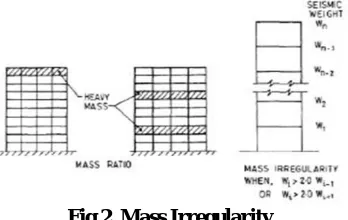
ii) Mass Irregularity:- Mass irregularity shall be considered to exist where the seismic weight of any storey is more than 200 % of that of its adjacent storeys. In case of roofs irregularity need not be considered.
Fig 2 Mass Irregularity
ISSN(Online): 2319-8753 ISSN (Print): 2347-6710
I
nternational
J
ournal of
I
nnovative
R
esearch in
S
cience,
E
ngineering and
T
echnology
(A High Impact Factor, Monthly, Peer Reviewed Journal)
Visit: www.ijirset.com
Vol. 7, Issue 3, March 2018
Fig 03 Vertical Geometric Irregularity
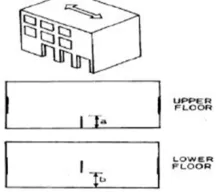
iv) In-Plane Discontinuity in Vertical Elements Resisting Lateral Force:-An in-plane offset of the lateral force resisting elements greater than the length of those elements.
Fig 04 In-Plane Discontinuity in Vertical Elements Resisting Lateral Force
v) Discontinuity in Capacity:- Weak Storey-A weak storey is one in which the storey lateral strength is less than 80 % of that in the storey above.
As per IS 1893-2002 Part 1 Linear static analysis of structures can be used for regular structures of limited height as in this process lateral forces are calculated as per code based fundamental time period of the structure. Linear dynamic analysis are an improvement over linear static analysis, as this analysis produces the effect of the higher modes of vibration and the actual distribution of forces in the elastic range in a better way. Buildings are designed as per Design based earthquake, but the actual forces acting on the structure is far more than that of DBE. So, in higher seismic zones Ductility based design approach is preferred as ductility of the structure narrows the gap. The primary objective in designing earthquake resistant structures is to ensure that the building has enough ductility to withstand the earthquake forces, which it will be subjected to during an earthquake.
1.3 OBJECTIVES OF THE STUDY
As a part of civil engineering work or as being a civil engineer it’s our duty to design such a structure which will sustain in severe earthquakes in various earthquake prone zones and which will lead to reduce the harm of catastrophic as well as economic losses.
In metro cities like Pune, Mumbai or developing cities like Kolhapur and Sangli there is scarcity of land for separate parking area. To overcome this situation buildings are being designed with various parking floors in the same building as well as in luxurious buildings there are facilities like swimming pool and gym etc. are provided.
ISSN(Online): 2319-8753 ISSN (Print): 2347-6710
I
nternational
J
ournal of
I
nnovative
R
esearch in
S
cience,
E
ngineering and
T
echnology
(A High Impact Factor, Monthly, Peer Reviewed Journal)
Visit: www.ijirset.com
Vol. 7, Issue 3, March 2018
1. To calculate the Base Shear by the use of STAAD.pro v8i
2. To study vertical irregularities in structures namely mass, stiffness irregularities. 3. To carry out ductility based earthquake resistant design as per IS 13920. 4. Dynamic analysis of the building using response spectrum method.
5. To analyse the building as per code IS 1893-2002 part I criteria for earthquake resistant structure.
II. LITERATURE REVIEW
Shvin g. Soniet al. (2015) carried out the performance evaluation of RC (Reinforced Concrete) buildings with irregularity. Structural irregularities are important factors which decrease the seismic performance of the structures. The study as a whole makes an effort to evaluate the effect of vertical irregularity on RC buildings, in terms of dynamic characteristics and the influencing parameters which can regulate the effect on Story Displacement, Drifts of adjacent stories, Excessive Torsion, Base Shear, etc and conclude that that irregularities in buildings are harmful for the structures and it is important to have simpler and regular shapes of frames as well as uniform load distribution of load around the building.
A. E. Hassaballaet al. (2013) carried out Seismic analysis of a multi-story RC frame in Khartoum city was analyzed under moderate earthquake loads as an application of seismic hazardand in accordance with the seismic provisions proposed for Sudan to investigate the performance of existing buildings if exposed to seismic loads. The frame was analyzed using the response spectrum method to calculate the seismic displacements and stresses. The results obtained, clearly, show that the nodal displacements caused drifts in excess of approximately 2 to 3 times the allowable drifts. The horizontal motion has a greater effect on the axial compression loads of the exterior columns compared to the interior columns and the compressive stresses in ground floor columns were about 1.2 to 2 times the tensile stresses.
HimanshuBansalet al. (2012)carried out Response spectrum analysis (RSA) and Time history Analysis (THA) of vertically irregular RC building frames and to carry out the ductility based design using IS 13920 corresponding to Equivalent static analysis and Time history analysis. Three types of irregularities namely mass irregularity, stiffness irregularity and vertical geometry irregularity were considered. According to observation, the storey shear force was found to be maximum for the first storey and it decreases to minimum in the top storey in all cases. The mass irregular structures were observed to experience larger base shear than similar regular structures. The stiffness irregular structure experienced lesser base shear and has larger inter-storey drifts. Lower stiffness results in higher displacements of upper stories. In case of a mass irregular structure, time history analysis gives slightly higher displacement for upper stories than that in regular structures whereas as we move down lower stories show higher displacements as compared to that in regular structures. When time history analysis was done for regular as well as stiffness irregular structure, it was found that displacements of upper stories did not vary much from each other but as we moved down to lower stories the absolute displacement in case of soft storey were higher compared to respective stories in regular structure.
Poonam et al. (2012) carried out the Results of the numerical analysis showed that any storey, especially the first storey, must not be softer/weaker than the storeys above or below. Irregularity in mass distribution also contributes to the increased response of the buildings. The irregularities, if required to be provided, need to be provided by appropriate and extensive analysis and design processes.
Sarkar et al. (2010) proposed a new method of quantifying irregularity in vertically irregular building frames, accounting for dynamic characteristics (mass and stiffness). The salient conclusions were as follows:
(1)A measure of vertical irregularity, suitable for stepped buildings, called ‗regularity index‘, is proposed, accounting
for the changes in mass and stiffness along the height of the building.
ISSN(Online): 2319-8753 ISSN (Print): 2347-6710
I
nternational
J
ournal of
I
nnovative
R
esearch in
S
cience,
E
ngineering and
T
echnology
(A High Impact Factor, Monthly, Peer Reviewed Journal)
Visit: www.ijirset.com
Vol. 7, Issue 3, March 2018
Athanassiadouet al. (2008) carried out the effect of the ductility class on the cost of buildings is negligible, while performance of all irregular frames subjected to earthquake appears to be equally satisfactory, not inferior to that of the regular ones, even for twice the design earthquake forces. DCM frames were found to be stronger and less ductile than the corresponding DCH ones. The over strength of the irregular frames was found to be similar to that of the regular ones, while DCH frames were found to dispose higher over strength than DCM ones. Pushover analysis seemed to underestimate the response quantities in the upper floors of the irregular frames.
Karavasillis et al. (2008) studied the inelastic seismic response of plane steel moment-resisting frames with vertical mass irregularity. The analysis of the created response databank showed that the number of storeys, ratio of strength of beam and column and the location of the heavier mass influence the height-wise distribution and amplitude of inelastic deformation demands, while the response does not seem to be affected by the mass ratio.
Lee and Koet al. (2007) subjected three 1:12 scale 17-story RC wall building models having different types of irregularity at the bottom two stories to the same series of simulated earthquake excitations to observe their seismic response characteristics. The first model had a symmetrical moment-resisting frame (Model 1), the second had an infilled shear wall in the central frame (Model 2), and the third had an infilled shear wall in only one of the exterior frames (Model 3) at the bottom two stories. The total amounts of energy absorption by damage are similar regardless of the existence and location of the infilled shear wall. The largest energy absorption was due to overturning, followed by the shear deformation.
Valmundsson and Nau et al. (1997) evaluated the earthquake response of 5-, 10-, and 20story framed structures with non-uniform mass, stiffness, and strength distributions. The response calculated from TH analysis was compared with that predicted by the ELF procedure embodied in UBC. Based on this comparison, the aim was to evaluate the current requirements under which a structure can be considered regular and the ELF provisions applicable.
III. METHODOLOGY
A) METHOD OF RESEARCH:-
The analysis and design of given statement of problem is done by this software is NUMERICAL based which are used for analysis and design of structure for various situations. Hence for design and analysis of our problem we use numerical method.
B) METHOD OF DATA COLLECTION:-
1. The various International generals regarding EARTHQUAKE ENGINEERING published by different professors, engineers and developers from Internet.
2. Different bye laws governed by regional MUNCIPAL CARPORATION regarding building construction. 3. Codes stated by Indian Standard Bureau such as IS 1893-2002(PART 1),
IS 13920, IS 456-2000, IS 875.
C) METHOD OF DATA ANALYSIS:-
The method used for data analysis is RESPONSE SPECTRUM.
IV. CONCLUSION
From above results it is observed that,
1. The storey shear force is maximum for the first storey and it decreases to minimum in the top storey. 2. The stiffness irregular structure experiences lesser base shear than similar regular structures.
ISSN(Online): 2319-8753 ISSN (Print): 2347-6710
I
nternational
J
ournal of
I
nnovative
R
esearch in
S
cience,
E
ngineering and
T
echnology
(A High Impact Factor, Monthly, Peer Reviewed Journal)
Visit: www.ijirset.com
Vol. 7, Issue 3, March 2018
According to RSA results, the storey shear force was found to be maximum for the first storey and it decreased to aminimum in the top storey in all cases. It was found that mass irregular building frames experience larger base shear than similar regular building frames. The stiffness irregular building experienced lesser base shear and has larger inter storey drifts. In case of mass irregular structure, Time History Analysis yielded slightly higher displacements for upper stories than that in regular building, whereas as we move down, lower stories showed higher displacements as compared to that in regular structures. In regular and stiffness irregular building (soft storey), it was found that displacements of upper stories did not vary much from each other but as we moved down to lower stories the absolute displacement in case of soft storey were higher compared to respective stories in regular buildings.
REFERENCES
1) Ashvin g. Soni, prof. D. G. Agrawal, dr. A. M. Pande, 2015 ,Effect of Irregularities in Buildings and their Consequences , International journal of modern trends in engineering and research.
2) E. Hassaballa, Fathelrahman M. Adam., M. A. Ismaeil ,2013 ,Seismic Analysis of a Reinforced Concrete Building by Response Spectrum Method , IOSR Journal of Engineering (IOSRJEN).
3) HimanshuBansal, Gagandeep , 2012 , Seismic Analysis and Design of Vertically Irregular RC Building Frames , International Journal of Science and Research (IJSR)
4) Poonam, Anil kumar, and Ashok k. Gupta , 2012 , Study of Response of Structurally Irregular Building Frames to Seismic Excitations , International Journal of Civil, Structural ,Environmental and Infrastructure Engineering Research and Development (IJCSEIERD).
5) Sarkar P, Prasad A Meher, MenonDevdas, 2010, Vertical geometric irregularity in stepped building frames, Engineering Structures 32 (2010) 2175–2182 .
6) Athanassiadou C.J, 2008, Seismic performance of R/C plane frames irregular in elevation, Engineering Structures 30 (2008):1250–1261 . 7) Karavallis, Bazeos and Beskos, 2008, Estimation of seismic inelastic deformation demands in plane steel MRF with vertical mass irregularities,
Engineering Structures 30 (2008) 3265–3275 .
8) Lee Han Seon ,Dong Woo Kee, 2007, Seismic response characteristics of high-rise RC wall buildings having different irregularities in lower stories, Engineering Structures 29 (2007):3149–3167 .
9) Valmundsson and Nau, 1997, Seismic Response of Building Frames with Vertical Structural Irregularities, Journal of structural engineering, 123:30-41.