LIU, FENG. ELLIPTICAL COPULAE WITH DYNAMIC CONDITIONAL
COR-RELATION. (Under the direction of Professor Peter Bloomfield).
Knowledge of the joint distribution is crucial for risk measure estimation,
port-folio allocation, derivative pricing, to name but a few problems. The multivariate
normal function, the most commonly used joint distribution, is not sufficient if data
have features of fat-tailed margins and co-extreme movements, which are commonly
found in financial data. More flexible multivariate distributions are needed in order
to address these features. The copula, originated by Sklar (1959) and also called
the dependence function, can be combined with arbitrary marginal distributions to
form various joint distributions. “Conditional copulæ”, proposed by Patton (2002a),
are adopted by several researchers to introduce time-varying dependence beyond the
existing time-varying variance-covariance. All the research thus far is focused on
bi-variate series. How to extend the models to higher dimension is not obvious. In
the financial world, it is essential to develop models for high dimensional data that
do not suffer the “curse of dimension” problem, but are still rich enough to capture
the major data features, such as fat-tailed margins, volatility clustering, time-varying
correlation and tail dependence.
Motivated by Chen et al. (2004), we propose a model of “elliptical copulæ with
a straightforward way. Combining the good properties of copulæ and DCC models,
our model is especially attractive for high dimensional data. The general ideas of
our model are as follows: each individual series is modelled by its own appropriate
heteroskedasticity model, and standardized residuals are obtained after filtering out
the estimated dynamic variance; then the standardized residuals are monotonically
transformed to new ones as from the same univariate elliptical distribution; finally,
the transformed residuals are used to build the dependence model of elliptical copulæ
with time-varying correlation from the corresponding elliptical DCC models.
Our model is applied to two financial practices: VaR estimation and optimal
port-folio allocation. The impacts of fat-tailed margins, time-varying correlation and tail
dependence are investigated with two hypothetical portfolios. For VaR estimation,
these data features have substantial importance; while for portfolio allocation, the
by
FENG LIU
A dissertation submitted to the Graduate Faculty of North Carolina State University
in partial satisfaction of the requirements for the Degree of
Doctor of Philosophy
STATISTICS
Raleigh
2006
APPROVED BY:
Dr. John Monahan Dr. Denis Pelletier
Dr. Peter Bloomfield Dr. David Dickey
Biography
Feng Liu was born in Jiangxi, China to parents Rongrong Liu and Muqin Zhang in
May, 1979. She graduated with a B.S. of Statistics from the Department of
Mathe-matics, Beijing Normal University, in July, 2001. In August, 2001, she was enrolled
in the Department of Statistics at North Carolina State University and received her
Master of Statistics degree in May, 2003 and Master of Economics degree in May,
Acknowledgements
I am largely indebted to Prof. Peter Bloomfield, who has been such a great advisor
and mentor to me. His ingenious ideas and profound insight have constantly inspired
me and guided me through the past three years. And his remarkable knowledge of
statistics and finance has been a great source of enlightenment to me. I am especially
grateful for his enormous patience in dealing with all my questions.
My sincere gratitudes also go to other members of my committee. Prof. Denis
Pelletier’s valuable suggestions, such as parameter uncertainty and duration testing,
have made this work more complete; Prof. David Dickey and Prof. John Monahan
both have read my dissertation carefully and provided numerous useful comments
and feedback. I have also learned a lot from the interesting courses that they taught.
It is a pleasure to thank those people that helped me during my time as a graduate
student. Prof. William Swallow and Prof. David Flath have generously given me
the opportunity to acquire a master degree in Economics, which has facilitated me
in understanding my dissertation topic. During my studying in the Department of
Statistics, Terry Byron has been really helpful to smooth out computer-related issues;
while Adrian Blue and Janice Gaddy have assisted us in so many ways. There are
also other faculty members, staff members and fellow graduate students who have
made the past five years an enjoyable journey for me. I feel fortunate to be around
with all of them.
He is always there listening to me when I am frustrated, helping me out with his
programing skills and so many other things. I have felt his love at each and every
moment during the course of this study. I also owe my deepest gratitude to my
parents, who always love me, believe in me and support me no matter what. I hope
that I will make them proud by my doctorate fulfillment.
Finally, to my coming baby Ben. His company has given me so much joy and
encouragement and his naughty movements let me not feel lonely when I was sitting
in front of the computer alone. This dissertation is completed little by little with his
Contents
List of Figures viii
List of Tables ix
1 Introduction 1
2 Preliminary Review 13
2.1 Elliptical DCC Model . . . 13
2.1.1 Elliptical Distribution . . . 14
2.1.2 Elliptical DCC Model . . . 14
2.2 Definition and Properties of Copula . . . 17
2.2.1 Definition . . . 18
2.2.2 Sklar’s Theorem . . . 18
2.2.3 Copula Invariance . . . 19
2.2.4 Tail Dependence . . . 20
2.3 Elliptical Copulæ . . . 21
2.3.1 Normal Copula . . . 22
2.3.2 T Copula . . . 22
2.3.3 Why Elliptical Copulæ . . . 23
3 Elliptical Copulæ with Dynamic Conditional Correlation 26 3.1 The Motivation . . . 26
3.2 Elliptical Copulæ with Dynamic Conditional Correlation . . . 33
3.2.1 Marginal Distribution . . . 34
3.2.2 Residual Transformation . . . 36
3.2.3 Construction of the Dynamic Conditional Correlation . . . 38
3.2.4 Copula Estimation . . . 39
3.2.5 Asymptotic Properties of the Estimates . . . 40
3.2.6 Parameter Uncertainty . . . 42
3.3 VaR Estimation . . . 45
3.3.1 Simulation from the Normal and T Copulæ . . . 46
3.3.2 Estimation of VaR and ES . . . 48
3.4 Optimal Portfolio Allocation . . . 49
3.5 Future Topics . . . 51
4 Empirical Application - VaR Estimation 53 4.1 Data and Basic Properties . . . 54
4.2 Marginal Distribution . . . 57
4.3 Dependence Structure . . . 65
4.4 Estimation of VaR and ES . . . 70
4.5 Evaluation of the VaR models . . . 74
4.5.1 Backtesting Methods . . . 76
4.5.2 Loss Function . . . 80
4.6 Conclusions . . . 81
5 Empirical Application - Optimal Portfolio Allocation 84 5.1 Data and the Descriptive Statistics . . . 85
5.2 Utility Function and Its Expectation . . . 86
5.3 Optimal Allocation . . . 89
5.4 Strategy Performance Comparison . . . 91
5.5 Conclusions . . . 101
6 Conclusions 103
List of Figures
3.1 Simulations from the normal andt copulæ. . . 30
3.2 Relationship of tail dependence with DoF and correlation for the t copula. . . 31
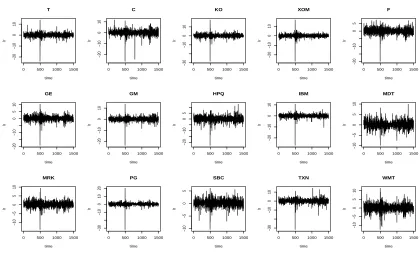
4.1 Graphs of the log returns (yj,t) for each stock. . . 56
4.2 Normal QQ-plots of the residuals j for each stock. . . 61
4.3 Standardized t QQ-plots of the residuals j for each stock. . . 61
4.4 ACFs of the errorsj for each stock. . . 62
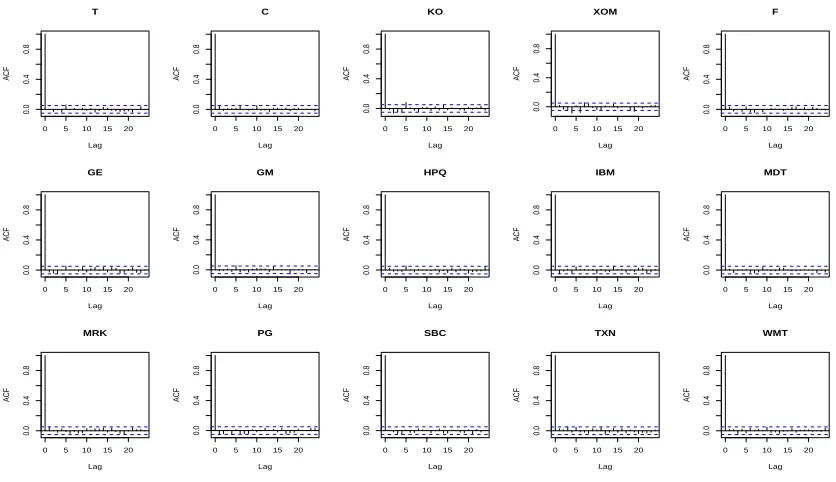
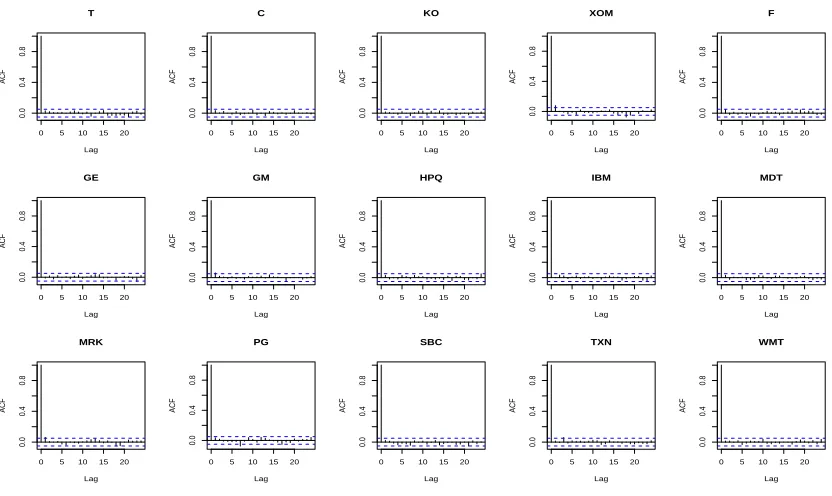
4.5 ACFs of the squared errors 2 j for each stock. . . 63
4.6 ACFs of the residuals ξj for each stock. . . 63
4.7 ACFs of the squared residuals ξ2 j for each stock. . . 64
4.8 1/DoF estimates (1/νˆ) of CTcopulan. . . 69
4.9 1/DoF estimates (1/νˆ) of CTcopulat. . . 69
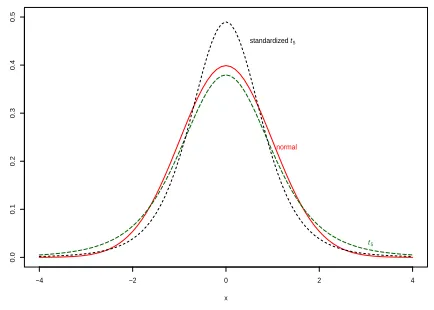
4.10 Graph of the standard normal, standardt5 and standardizedt5density functions. . . 72
4.11 VaRt p estimates for both positions and the corresponding real loss val-ues Lt. . . . 75
5.1 1/DoF estimates (1/νˆ) for the model of CTcopulan. . . 87
5.2 1/DoF estimates (1/νˆ) for the model of CTcopulat. . . 87
5.3 Average utility differences between the EW strategy and some other strategies for short-sale-constrained situation. . . 94
List of Tables
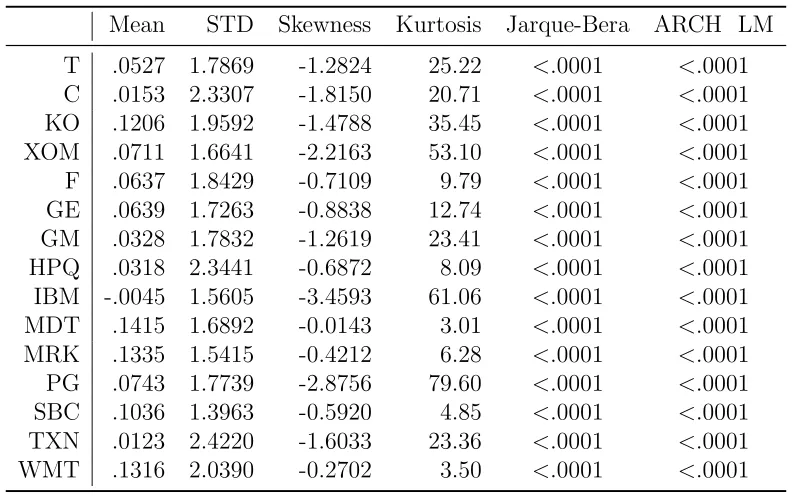
4.1 Summary statistics of the log returns for each stock. . . 57
4.2 2NLL, AIC and BIC of the marginal distributions with the normal or
standardized t residual assumption. . . 59
4.3 The DoF estimate (ˆν) and its corresponding STD of the standardized
t residual distribution for each stock. . . 64
4.4 2NLL, AIC and BIC of the 10 joint distributions for the stock portfolio. 67
4.5 VaR estimates for the stock portfolio. . . 71
4.6 ES estimates for the stock portfolio. . . 73
4.7 The number of violations (N) at different levels for both positions. . . 77
4.8 The backtesting results based on the methods of UC, Markov, CC and
Weibull. . . 79
4.9 The loss function values for some VaR estimation models. . . 82
5.1 Summary statistics of the log-returns for each currency. . . 86
5.2 Summary statistics of the percentage wealth change series for
short-sale-constrained situation. . . 92
5.3 Summary statistics of the percentage wealth change series for
uncon-strained situation. . . 93
5.4 Means of pairwise utility difference and p-values of Wilcoxon signed
rank sum test for short-sale-constrained situation. . . 97
5.5 (Continued) Means of pairwise utility difference and p-values of Wilcoxon
signed rank sum test for short-sale-constrained situation. . . 98
5.6 Means of pairwise utility difference and p-values of Wilcoxon signed
rank sum test for unconstrained situation. . . 99
5.7 (Continued) Means of pairwise utility difference and p-values of Wilcoxon
signed rank sum test for unconstrained situation. . . 100
Chapter 1
Introduction
This research is motivated by the increasing need for flexible multivariate
distri-butions, especially sound multivariate dependence models. A portfolio’s value-at-risk
(VaR) is determined by the risk behavior of each single asset in the portfolio and, at
the same time, the dependence structure among assets. To set the prices of some
fi-nancial derivatives, like multi-name options, the joint distribution of underlying assets
is needed. Portfolio managers need to obtain information about dependence among
components before making reasonable portfolio allocation decisions. More and more
researchers and practitioners pay attention to the role that dependence between
fi-nancial assets plays in risk management, portfolio allocation and derivative pricing,
to name but a few.
Following Markowitz (1952), the Pearson correlation1 coefficient has been widely
1
used as the measurement of the dependence among assets. But Cambanis et al. (1981)
identify that correlation is enough to describe dependence only for an elliptic
distri-bution. In order to make problems workable, people often assume the multivariate
normality as the data distribution. As such, the multivariate versions of generalized
autoregressive conditional heteroskedasticity (GARCH) models typically require the
joint residual distribution to be multivariate normal. The normality assumption has
been found to be inappropriate given skewness and leptokurtosis that commonly
ex-ist in financial data even after allowing for the conditional volatility effect (Nelson,
1991). Except for the requirement of univariate normality, the multivariate normal
distribution assumption also imposes tail independence. The co-extreme movement
patterns exhibited by financial assets and markets cannot be captured by correlation,
which, as we noted above, is sufficient to measure dependence only for the multivariate
elliptical distribution. Correlation, as a dependence measure, has some serious
short-comings: a) It is not invariant to monotone transformation; b) It does not incorporate
co-extreme movements in the data; c) Multivariate distributions with identical
cor-relation can have totally different dependence structures. These shortcomings make
correlation not a good measure of dependence outside the elliptical world, especially
when the dependence in the tail areas has non-negligible effects.
One difficulty of modelling multivariate financial series is the scarcity of available
multivariate distributions, which are usually extensions of the univariate distributions
same probabilistic structure for each asset in the portfolio is unrealistic given its
di-versification purpose. The copula, introduced by Sklar (1959), solves this problem by
constructing multivariate distributions from almost arbitrary univariate distributions
and a chosen dependence structure.
A copula is simply a multivariate distribution with uniform margins. It was first
used explicitly in the financial world in 1999 (Embrechts, et al, 1999; Li, 1999; Ceske
and Hern´andez, 1999). Copulæ enable us to separate the modelling of dependence
from that of margins, which is advantageous considering that, for a portfolio, the
distribution of a single asset may be well studied and different from other assets. As
a result, dependence among multiple series can be flexibly modelled with no influence
on the distribution of each individual series. With special interest to the studies of
risk and portfolio management, copulæ embed information about the entities’
co-movements in the tails of the joint distribution. In the last decade, copulæ have
been heavily studied in areas such as integrated risk management (Hull and White,
1998; Embrechts, et al., 2003; Fortin and Kuzmics, 2002), asset allocation (Patton,
2004; Xu, 2004; Liu, 2005), joint models of credit risk (Li, 2000; Frey, et al., 2001),
multivariate derivative pricing (Rosenberg, 1999; Cherubini and Luciano, 2002) and
contagion (Costinot, et al., 2000). For a complete introduction to copulæ, see the
books of Joe (1997) and Nelsen (1999).
For multiple series, the data may be sufficient to gain good knowledge about
of data for high dimension specifications. People have observed that the log returns of
a financial series cannot be treated as independently and identically distributed (i.i.d.)
numbers because of “volatility clustering”2. GARCH models flourish in recent decades
for their abilities to allow “volatility clustering” and predict future volatility of a time
series. Using copulæ to model the dependence of the joint standardized residuals3
from GARCH models is our approach to building the multivariate distribution for
the multiple series. Since volatility is believed to change along time, it is reasonable
to assume that dependence among financial series is also time-varying.
Even though the concept of copulæ is theoretically concise and powerful, the
re-search on copula specifications and on time dependence in copulæ is still in its infancy.
In recent years, several approaches appear to include the feature of time dependence
in copulæ. Patton (2002a, 2002b) first introduces a new concept, “conditional
cop-ulæ”, whose parameters vary with the conditioning information. In the study of
Patton (2002a), to allow time-varying dependence for the standardized residuals of
foreign currencies, an autoregressive moving-average (ARMA) type process with
lo-gistic transformation is assumed for dependence parameters. A similar approach is
used by van den Goorbergh (2004) to study the cross-country stock market
depen-dence, but with different specification for time-varying dependence. In his approach,
Kendall’s τ is modelled by an autoregressive (AR) model. Since there is a one-to-one
relationship between Kendall’s τ and copula parameters, the time-varying Kendall’s
2
Financial phenomenon in which large changes tend to be followed by large ones and small changes followed by small ones.
3
τ implies the dynamics of the copulæ. Rockinger and Jondeau (2001) introduce the time-varying dependence by forcing the Plackett’s copula parameter linearly
depend-ing on the previous joint large deviations. All these approaches of conditional copulæ
only focus on the bivariate cases. How to extend these models for higher dimensional
data is not obvious. But in reality, there are usually many assets in a single portfolio.
High dimensional dependence models are needed for empirical applications.
To take into consideration the high dimensional setup, we propose to model
de-pendence with conditional elliptical copulæ whose dynamic correlation is constructed
in the same way as elliptical dynamic conditional correlation (DCC) models. Our
method is motivated by Chen et al. (2004), who, in order to test the normal copula,
use a DCC model to build the time-varying correlation matrix in the normal
cop-ula. It works by transforming the margins into univariate normally distributed ones
and testing whether the joint distribution of the transformed series is multivariate
normal. Our approach for the high dimension dependence model is based on several
considerations as follows.
Firstly, there are two main copula families: Archimedean copulæ and elliptical
copulæ. Archimedean copulæ, in contrast to elliptical copulæ, have closed form
ex-pressions. They include different and more flexible dependence structures than
ellip-tical copulæ. But they were originally defined on the two-dimensional background.
Their higher dimension extensions need some technical conditions to insure that they
confined in practice to bivariate problems. Unfortunately, portfolios typically have
more than two assets, which makes Archimedean copulæ not suitable as the
depen-dence models. Also the two popular copulæ from archimedean copula family, Gumbel
and Clayton copulæ, allow only positive dependence, which may be too restrictive for
some financial data.
As for elliptical copulæ, they are conveniently defined in any dimension. The
cor-relation part of the elliptical copulæ shows the positive or negative dependence. Extra
parameters, such as the degree-of-freedom (DoF) in the t copula, control the degrees
of tail dependence. The normal and t copulæ from this family are popularly used
by practitioners, with the normal copula having no tail dependence and the t copula
allowing different degrees of tail dependence. Assuming tail independence when there
is tail dependence would underestimate the potential financial risks, while assuming
tail dependence directly may lead to risk overestimation if there are no co-extreme
movements. Hence, neither of these two preassumptions is acceptable without
veri-fication. The t copula, which exhibits different degrees of tail dependence adjusted
by different DoF, has as a special case the normal copula when DoF is infinity. This
property makes thetcopula very attractive since it does not impose tail independence
or tail dependence. It lets the choice be made by the data themselves. Furthermore,
computational efficiency is another outstanding point of elliptical copulæ. Elliptical
copulæ do not suffer the problem of “curse of dimension4”. Simulations from elliptical
4
copulæ are similar as simulating the elliptical distributions. They are straightforward
and efficient. Because of the good properties and computational efficiency for high
dimensional data, elliptical copulæ are the dependence structures we use here.
Secondly, GARCH models have been well studied as heteroscedastic volatility
models and are popularly used in practice. But the ordinary multivariate GARCH
models typically suffer the ”curse of dimension” problem. To overcome this
prob-lem, Bollerslev (1990) proposes a Constant Conditional Correlation (CCC) model,
in which the covariance is decomposed into univariate variance and correlation. The
correlation in the CCC model is constant over time, which is not plausible for
multi-ple financial series. To retain the computational advantage of CCC model and relax
the constant correlation assumption, Engle (2002) introduces the DCC model with
GARCH-type dynamic correlation. A similar model is discussed in Tse and Tsui
(2002). To avoid the non-linearities side effect in DCC model, the Regime Switching
Dynamic Correlation (RSDC) model is presented by Pelletier (2004), where regime
switching correlation is used. These special multivariate GARCH models break the
curse of dimension and are suitable to use in high dimensional data. But all these
mod-els make the assumption that the residuals are normally, or elliptically distributed.
One-dimensional symmetric distributions may be reasonably true for univariate
resid-uals. But elliptical distributions are unlikely for the joint residuals, which requires
that the distribution for each residual series is the same.
transformed for statistical fitting purposes without changing the original copula. That
is, each series can be transformed as from a new distribution while the cumulative
distribution functions are kept unchanged. The dependence between the transformed
series is kept unchanged. We mentioned above that it is critical to assume elliptical
distributions for joint residuals in CCC, DCC and RSDC models. But if the
depen-dence structure of the joint residuals is an elliptical copula, the joint residuals can be
transformed as from the elliptical distribution. The distribution of each transformed
margin is the same univariate elliptical function, whose multivariate extension has
the elliptical copula as the dependence structure.
With these considerations, our approach of building the joint distribution is as
follows. First, each individual series is modelled by its own appropriate
heteroskedas-ticity model, such as a GARCH model, and standardized residuals are obtained after
filtering out the estimated dynamic variance. Then the standardized residuals are
monotonically transformed to new ones as from the same univariate elliptical
distri-bution. Finally, the transformed residuals are used to build the dependence model of
elliptical copulæ with correlation from the corresponding CCC, DCC or RSDC
mod-els. Because analytical computation is not our concern, the non-linearities side effect
in DCC model is not an issue in this thesis. Elliptical DCC model is the one that
we use to obtain correlation for the dependence model, although other correlation
models work in a similar way. Hence, our dependence model is an elliptical copula
In finance, modelling high dimensional data is a big challenge. Our proposed
de-pendence model by using elliptical copulæ with dynamic conditional correlation would
be a good starting point for large portfolios. In the literature, bivariate copulæ, taken
as representatives of multivariate dependence problems, are often investigated
with-out noticing the appearing new problems in higher dimension backgrounds, such as
the suitability of copula and “curse of dimension” problems. Practitioners generally
have numerous risk exposures and many assets in their portfolios. And bivariate
mod-els alone are not practically useful. Our approach is proposed from high dimension
perspective. Models based on our approach do not badly suffer from the dimension
curse problem.
As we mentioned above, the normal copula implies tail independence, while the
t copula allows different levels of tail dependence by adjusting the DoF. As studied
by Mashal and Zeevi (2002), the normal copula is an extreme case of the t copula
as DoF goes to infinity. The t copula is flexible without imposing tail dependence or
tail independence. But as a dependence structure, it has three obvious shortcomings.
The DoF in the t copula is not time-varying. Different time period might need
different DoF. Thet copula automatically assumes that each pair has the same DoF,
which restricts the model to have the same tail dependence for all pairs excluding the
correlation effects. Furthermore, the unconditional t copula is radially symmetric.
The asymmetric dependence can be introduced only by conditional correlation, which
t copula can still be a workable dependence structure. Subtly specifying dependence higher than second-moments, such as variance-covariance, requires a huge amount
of data and also introduces much more parameter uncertainty. A more complicated
dependence model may not outperform this simpler one. Based on the fact that we
have already taken into account the time-varying variance-covariance, which is a big
part of the dependence, there should be no serious problem to assume the constant
DoF for thetcopula over time. The restriction of the same DoF for all pairs does not
have a big effect if pair-wise tail dependence, excluding correlation effects, does not
differ too much. Furthermore, one can relax this assumption when the assumption of
the similar tail dependence is seriously doubted. The “groupedtcopula” proposed by
Daul et al. (2003) might be a good approach to this situation. As for symmetry, we
find that the asymmetric correlation is usually not significant for equity or currency
portfolios. Assuming that the asymmetric higher order dependence is insignificant
is not a bad starting point. Because of the facts of sparse data and the difficulty
to specify the higher moment dependence, we argue that the elliptical copulae are
enough, or at least good start points, for high dimensional dependence modelling in
the risk and portfolio management.
In this thesis, this dependence structure is used to investigate the importance of
fat-tailed margins and tail dependence in risk measurement and portfolio allocation
problems.
co-extreme movements. To illustrate the flexibility of our model and the importance
of those data features, a hypothetical stock portfolio and a currency portfolio are
considered as empirical applications in two areas: risk management and portfolio
management. The power and the flexibility of our model are obvious in the risk
management, such as value-at-risk (VaR) and expected shortfall (ES) calculations.
The traditional RiskMetrics exponentially weighted moving average method (EWMA)
substantially underestimates the risk when the desired confidence levels go beyond
the moderate one 0.95. Models with the features of fat-tailed margins, time-varying
correlation and co-extreme movements outperform those that ignore these features in
risk management. Our model works well in this risk management application. The
results for optimal portfolio allocation application are quite different from those in
risk management. For investors with no short-sale constraints, being aware of the
data feature of fat-tailed margins increases the model performance in portfolio
al-location problems. For short-sale-constrained investors, the effect is nonsignificant.
The features of co-extreme movements and time-varying correlation do not
substan-tially affect the portfolio results no matter if investors act with or without short-sale
constraints. Overall, tail dependence is not a significant feature as for portfolio
al-location problems from the expected utility point of view. In summary, our model
is powerful and convenient to incorporate important data features, such as fat-tailed
margins and co-extreme movements, for high dimensional modelling. For problems
produce better results. Otherwise, like the optimal portfolio allocation problem, the
advantage is not obvious.
The remainder of this thesis is organized as follows. Chapter 2 contains the
preliminaries, including an introduction to the concepts of elliptical DCC models and
some basic copula knowledge. In Chapter 3, we present our proposed model: elliptical
copulæ with dynamic conditional correlation. A stock portfolio is set up in Chapter
4 and its VaR and ES are estimated based on several models. Some backtesting
methods are used to evaluate the model performances. The application in optimal
portfolio allocation is investigated in Chapter 5 with a currency portfolio. Strategies
built on different models are compared. Conclusions are presented in Chapter 6. The
forms of the normal andt copulæ, their density functions, and the copula parameter
Chapter 2
Preliminary Review
This chapter gives a review of the preliminaries that are needed to develop our
model. Section 2.1 presents the elliptical DCC model. In Section 2.2, the definition
of copula is given and some copula properties are discussed. The well-known elliptical
copula family is introduced in Section 2.3.
2.1
Elliptical DCC Model
Pelagatti and Rondena (2004) propose the elliptical DCC model as the extension of
the ordinary DCC model (Engle, 2002). Elliptical DCC model relaxes the requirement
of the multivariate normal residual distribution. Instead, a more general multivariate
elliptical distribution is assumed for the joint residuals. The notations in this section
2.1.1
Elliptical Distribution
The random vector X = (X1, . . . , Xd)0 is said to have an elliptical distribution
with parameters the vector µ ∈ Rd and the d×d nonnegative definite symmetric
matrix Σ if its characteristic function can be expressed as
E[exp(it0X)] = exp(it0µ)·ψ(t0Σt),
for some function ψ : [0,∞) → R and t0 = (t
1, t2, . . . , td). The function ψ is called
the characteristic generator of X. Its density function, if it exists, has the following
form:
f(X) =cd|Σ|−1/2gd{(X−µ)0Σ−1(X−µ)},
for some function gd : R+ → R+ and normalizing constant cd. The function gd is
called density generator. We write X ∼ Ed(µ,Σ, gd). For the normal distribution,
gd(u) = exp(−u/2). For the t distribution with DoF ν, gd(u) = (1 + µν)−(d+ν)/2.
2.1.2
Elliptical DCC Model
Let rt be d-dimensional log-returns with mean zero1 and ξt be the corresponding
standardized residuals. The elliptical DCC model can be formulated as follows.
rt|Ft−1 ∼Ed(0,Σt, gd) (2.1)
Σt =DtRtDt (2.2)
1
Dt2 = diag{ω}+ diag{k} ◦rt−1rt0−1+ diag{λ} ◦D2t−1 (2.3)
ξt =Dt−1rt (2.4)
Qt =S◦(110−A−B) +A◦ξt−1ξt0−1+B◦Qt−1 (2.5)
Rt = diag{Qt}−1/2 Qt diag{Qt}−1/2 (2.6)
Ft−1 is the information set up to time t −1. Specifically, Ft−1 = σ(rt−1, rt−2, . . .).
ω = (ω1, . . . , ωd) and diag{ω} =
ω1 · · · 0 ... ... ...
0 · · · ωd
. The same notation holds for
diag{k} and diag{λ}. The symbol ◦ is for the Hadamard product2. The joint
dis-tribution of log returns rt is an elliptical one with variance-covariance Σt and
den-sity generator function gd. Equation 2.3 shows that each series follows a univariate
GARCH model. Any univariate GARCH model can be fit into this setup even though
only standard univariate GARCH model is illustrated here. Standardized residuals ξt
are obtained in equation 2.4. Equations 2.5 and 2.6 provide the dynamic process of
the conditional correlationRtfor standardized residualsξt. With univariate variances
D2
t and conditional correlation Rt, the variance-covariance Σt is obtained using the
expression from equation 2.2. Ding and Engle (2001) show that the positive definite
Qt only requires positive definite S and positive semi-definite A, B and 110−A−B.
To make the model suitable for high dimensional data,A is often taken asα·110 and
B as β·110. α and β are positive scalars. S is the unconditional correlation, which
2
is usually estimated with the sample correlation.
The log-likelihood function of the elliptical DCC model is deduced from equations
2.1 - 2.6 as
`= T X
t=1
logcd−
1
2log|Σt|+ loggd(rtΣ
−1 t rt0)
. (2.7)
When the dimension d is high, the estimation of the margins and the dynamic
con-ditional correlation is separated into two steps for the computational consideration.
The models for margins are estimated first and the univariate standard deviation
esti-mates ˆDt are obtained. With the corresponding standardized residuals, the dynamic
conditional correlation Rt is fitted in the second step. With the estimates ˆDt from
the first step, the log likelihood function in equation 2.7 is rewritten as
`c= T X
t=1
logcd−
1
2log|Rt| −log|Dˆt|+ loggd( ˆξtR
−1 t ξˆt0)
,
with only conditional correlation parameters αand β unknown. The estimates ˆαand
ˆ
β are obtained by maximizing `c. By the results of Newey and McFadden (1994),
Pelagatti and Rondena (2004) demonstrate that the estimators are consistent and
asymptotically normal. There are various DCC models available in the literature
with different univariate GARCH models and different specification of the correlation
evolution (Hafner and Franses, 2003; Cappiello et al, 2003). Which model to use
usually depends on the data properties.
In an elliptical DCC model, the conditional correlation estimation is separated
from univariate GARCH model estimation. The number of correlation parameters
model has great computational advantages over other multivariate GARCH models
and is especially attractive for applications with a large number of assets. With similar
computation consideration, CCC and RSDC models are also available for practical
uses. We do not introduce them in the interests of parsimony. Interested readers can
refer to the works of Bollerslev (1990) and Pelletier (2004).
2.2
Definition and Properties of Copula
In this section, the definition of copula and a brief review of its theories are
presented. A copula is a multivariate distribution with uniform margins. It can be
combined with almost arbitrary univariate distributions to form a new multivariate
distribution. The study of copula originates with Sklar (1959) and has had various
applications in economics and finance. For insight about how to apply a copula in
finance, see the book of Cherubini, Luciano and Vecchiato (2004). The definition of
copula is introduced in Section 2.2.1 and some important copula features related to
our work are given from Section 2.2.2 to Section 2.2.4. The definition and results
here and in Section 2.3 are mostly taken from Nelsen (1999), Joe (1997), Embrechts
2.2.1
Definition
A functionC: [0,1]d →[0,1] is and-dimensional copula if it satisfies the following
properties:
1) For all ui ∈[0,1],C(1, . . . ,1, ui,1, . . . ,1) =ui. 2) For allu∈[0,1]d,C(u
1, . . . , ud) = 0 if at least one of the coordinates,ui, equals zero.
3)Cis grounded andd-increasing, i.e., theC-measure of every box whose vertices
lie in [0,1]d is non-negative.
Conditional copula is proposed by Patton (2002a) to introduce the time-varying
dependence. Its definition is similar to the above unconditional one except that
the conditional copula model is conditioned on some time related information set.
The copula parameters are functions of the conditioning information set. Hence,
the parameters change with time. The time-varying copula parameters imply the
time-varying dependence.
2.2.2
Sklar’s Theorem
The usefulness of copula in modelling dependence stems from a famous theorem of
Sklar (1959). Sklar’s theorem says that any continuous multivariate distribution can
be uniquely separated into two parts: the univariate margins and the multivariate
dependence structure. The latter is represented by a copula.
Given ad-dimensional conditional distribution functionF with continuous marginal
cumulative distributions F1, . . . ,Fd, and letF be the conditioning set, there exists a
unique d-dimensional conditional copula C : [0,1]d →[0,1] such that
F(x1, . . . , xd|F) =C(F1(x1|F), . . . , Fd(xd|F)|F).
Sometimes, we say that “(x1, . . . , xd) has copula C” or “C is embedded in the
distri-bution F(.)” to indicate this relationship.
The conditioning information set needs to be the same for all the marginal and
copula distributions. For example, if the copula conditions on the set that includes
all information of past values of X and Y, the marginal distributions also need to
condition on that information set. From the theoretical point of view, this restriction
does not cause extra problems. But in practice, the marginal distribution is usually
modelled by their own past values for the simplicity sake. Before using the Sklar’s
theorem, we need to test empirically that the information from other series does not
contribute significantly to the modelling of one series.
2.2.3
Copula Invariance
As we know, correlation is not invariant under strictly monotone transformations
outside the elliptical world. This makes correlation unattractive as a dependence
measure. On the contrary, the copula has the good property of invariance to monotone
C. If g1, . . . , gd : R → R are strictly increasing on the range of X1, . . . , Xd, then (g1(X1), . . . , gd(Xd)) also have C as their copula.
Using this invariance property, we can change the marginal distribution for
sta-tistical fitting purposes without changing the copula. Consider that X1 and X2 are
two series of random variables with continuous distribution functionsF1 andF2. For
modelling purposes, we want to map the original series to new series as from two
other distributionsF3 andF4. The two new series can be denoted as (F3)−1(F1(X1)
and (F4)−1(F2(X2). Suppose the copula obtained from the joint distribution of X1
and X2 is C. By the copula invariance property, the copula for the joint distribution
of (F3)−1(F1(X1) and (F4)−1(F2(X2) is still C.
2.2.4
Tail Dependence
Most dependence measures, such as Pearson correlation and rank correlation,
summarize the dependence over the entire support. Tail dependence is different from
others as a local dependence measure, which quantifies the dependence when one
variable goes to extreme. The tail dependence concept is important for issues that
focus on the tail areas such as risk management. If the copula of the joint distribution
is known, the value of the tail dependence can be calculated uniquely. One of the
reasons that copula is named “dependence function” is that all kinds of dependence
can be measured once the copula is known.
respec-tively. The upper tail dependence coefficient of X and Y is defined as
λU := lim
u↑1 P(Y > G
−1(u)
|X > F−1(u)).
Let C be the copula for the bivariate joint distribution of X and Y. The upper tail
dependence coefficient can also be expressed as
λU := lim
u↑1(1−2u+C(u, u))/(1−u).
In a similar way, the lower tail dependence coefficient is defined as
λL:= lim
u↓0P(Y < G
−1
(u)|X < F−1(u)).
It can also be measured as
λL:= lim
u↓0C(u, u)/u.
The upper and lower tail dependence coefficients are symmetric in X and Y.
2.3
Elliptical Copulæ
The well-known elliptical copula family is discussed in this section. This family
is popularly used in practice for economic and financial problems. Because of its
tractability and easy extension to high dimension, it is heavily discussed in this thesis
and is used later in our empirical applications.
The dependence function C is called an elliptical copula if it is embedded in
transformed into uniform ones and the new multivariate distribution is an elliptical
copula. Two most commonly used elliptical copulæ are introduced in Section 2.3.1
and Section 2.3.2. They are the normal (gaussian) copula and the t copula. And
finally a few reasons why we work on these two copulæ are given in Section 2.3.3.
2.3.1
Normal Copula
With dependence denoted by a copula, one is free to pick the margins to form
the joint distribution. The normal copula is the one that, when normal margins are
chosen, produces a multivariate normal distribution. We denote the normal copula
with correlation R as CN
R:
CRN(u1, . . . , ud) = ΦR(Φ−1(u1), . . . ,Φ−1(ud)),
where ΦR is the standard multivariate normal distribution function with correlation
matrix R and Φ−1 is the inverse of the standard univariate Gaussian cumulative
distribution function (CDF). The normal copula implies tail independence, that is,
λU =λL= 0, unless the pairwise correlation is 1.
2.3.2
T
Copula
The t copula is the dependence function implicit in the multivariate Student-t
distribution. Let CT
ν,R be the t copula with correlation R and DoFν.
whereTν,R is the multivariate student-t distribution function with correlation matrix
R and DoF ν. Tν is the univariate t CDF with DoF ν. The t copula can create a
distribution with the same dependence as from the multivariate t distribution and
arbitrary margins. Unlike the normal copula, thet copula allows different tail
depen-dence by using different DoF ν. Because of its symmetry, the upper and lower tail
dependence coefficients are same. Its tail dependence between entity i and entity j
is:
λUi,j =λLi,j = 2[1−Tν+1(
√
ν+ 1 s
1−Ri,j
1 +Ri,j
)].
It is worth noting that R in the normal and t copulæ is usually not the same
as the correlation between the original entities. R in the normal or t copula is the
correlation after the original entities are transformed to the normally distributed, ort
distributed ones. The detailed information about the forms of the normal copula and
its corresponding density can be found in Appendix A. And in Appendix B, details
are given for the t copula. Appendix C presents the method of copula parameter
estimation: maximum likelihood (ML) method.
2.3.3
Why Elliptical Copulæ
These are some remarks to clarify why we focus on elliptical copulæ instead of
other families. Multivariate normal distribution is a common distribution assumption
in financial world because of its simplicity. The normal copula has been proposed
computational simplicity. The famous J. P. Morgan’s RiskMetrics actually uses the
normal copula for Monte Carlo simulations. But using normal copula has the potential
risk of underestimating the risk exposure in some cases because of its property of
tail independence. At the same time, directly assuming tail dependence without
verification may cause the overestimation of the risk exposure. In contrast, the t
copula retains the parsimony and tractability of the normal copula while introducing
tail dependence by adding one parameter, DoF. As the DoF goes to infinity, the
t copula converges to the normal copula. The smaller DoF is, the greater the tail
dependence is. The flexibility between tail dependence and tail independence makes
thetcopula more appropriate for financial markets because people are not sure about
the degree of dependence. Even though the normal copula is an extreme case of the
t copula, the t copula may not always outperform the normal copula if parameter
uncertainty is taken into consideration. Hence, both copulæ are used in our empirical
applications in this thesis. Archimedean copula family is another one that is popularly
used in some research. Even though it introduces asymmetric dependence structure,
it currently works well only in two dimensional cases. Extending to higher dimension
needs technical verification and it is hard to interpret the parameters. Meanwhile,
the popular Gumbel and Clayton copulæ allow only positive dependence. They are
limited to one or two parameters, which makes them unable to generally capture the
important features of a high dimensional portfolio. Even though more complicated
and hard to interpret. Lack of sufficient parameters to capture data features may
also apply to elliptical copulæ. But with correlation structure, the problem may be
Chapter 3
Elliptical Copulæ with Dynamic
Conditional Correlation
In this chapter, we propose a dependence model for high dimensional financial data
and its applications in risk and portfolio managements are also discussed. Section
3.1 is the motivation for our approach. The dependence model is introduced step by
step in Section 3.2. How to apply this dependence model in risk measure calculation
and optimal portfolio allocation problems are presented in Section 3.3 and Section
3.4 respectively. Future topics are briefly discussed in Section 3.5.
3.1
The Motivation
A financial portfolio may involve not two, but a large number of securities. The
an overwhelming number of parameters but are yet rich enough to describe the major
data properties, such as fat tail, volatility clustering, time-varying correlation and
co-extreme movement, also referred as tail dependence.
DCC models with normal residual assumption are popular for their simplicity in
modelling high dimensional data whose correlation is dynamic. The number of the
correlation parameters to be estimated parametrically is independent of the number
of series, which makes DCC models attractive for high dimensional portfolios. But
the assumption of normal residuals is questionable. Substantial empirical evidence
is found that the financial returns typically have fat tails (Mandelbrot, 1963; Fama,
1965). Leptokurtosis still exists even after the returns are standardized by the
dy-namic variance estimated from GARCH models (Engle and Bollerslev, 1986; Nelson,
1990). The degrees of leptokurtosis are usually not the same for different series.
Hence, DCC models with normal residual assumption are not capable to fully
cap-ture the leptokurtosis feacap-ture in the data. Furthermore, people notice and are worried
about the co-extreme movements after the occurrences of several big financial crises1.
But DCC models ignore the co-extreme movement phenomenon in finance. For data
with features of leptokurtosis and tail dependence, DCC models with normal residual
assumption are not sufficient.
To have more flexible and powerful models for high dimensional data, we propose
a dependence model of elliptical copulæ with time-varying correlation constructed
1
like the correlation in the elliptical DCC models. We name this dependence model
as “elliptical copulæ with dynamic conditional correlation”. This dependence model
combined with certain dynamic fat-tailed margins can be used to capture the
impor-tant data features, such as, leptokurtosis, clustered volatility, time-varying correlation
and tail dependence. Our approach is motivated by Chen et al. (2004). In that article,
in order to test whether the normal copula is adequate as the dependence structure
implied in the data, the univariate residuals are normalized first and the correlation
part of the DCC model built on the normalized residuals is used as the time-varying
correlation matrix model of the normal copula. Under this setup, the original
de-pendence testing problem changes to the problem of testing whether the generating
process of the data is the DCC model with the multivariate normal as the residual
distribution.
The beauty of using copulæ is that the margins and dependence can be specified
separately. Univariate GARCH models flourish in recent decades for their ability
of modelling the “volatility clustering” phenomenon commonly found in the financial
time series. To account for the “leverage effect”2 existing in some financial series,
vari-ous extensions of the ordinary GARCH models have been proposed, such as EGARCH
by Nelson (1991), QGARCH by Sentana (1995), GJR-GARCH by Glosten,
Jagan-nathan and Runkle (1993). If not other specified, we address various GARCH models
all as GARCH models. The normal distribution is likely to be a bad assumption for
2
the GARCH model residuals. Alternatively, Student-tdistribution (Bollerslev, 1987),
generalized error distribution (GED) (Nelson, 1991; Kaiser, 1996), skew-t
distribu-tion (Hansen, 1994) and exponential generalized beta (EGB) family of distribudistribu-tions
(Wang, et al., 2001) have been studied and, usually, found to fit financial data
bet-ter. Unlike the normal distribution, Student-t distribution and GED can address
the leptokurtosis property. Furthermore, skew-t and EGB distributions incorporate
potential skewness, besides leptokurtosis, in the data. With copulæ, which marginal
distribution to use depends solely on the marginal data.
Copula is the dependence model, with no influence on the choice of marginal
distribution. Among many different kinds of copulæ, two copula families are popular
in financial applications. They are Archimedean copulæ and elliptical copulæ. When
the data dimension is larger than two, Archimedean copulæ are very complicated and
hard to use. For elliptical copulæ the high dimension is not an issue. Since our model
aims for high dimensional portfolios, elliptical copulæ are studied as the dependence
models.
The normal and t copulæ are two popular elliptical copulæ. The normal copula
is the dependence structure embedded in the multivariate normal distribution and
implies tail independence. For the t copula, it indicates different degrees of tail
de-pendence by different DoF. When DoF goes to infinity, the t copula coincides with
the normal copula and implies tail independence. Figure 3.1 shows the scatter points
o o o o o o o o o o o o o oo o o o o
oooo o o o o o o o o o o o o o o o o o o o o o o o o o oo o o o o o o o o o o o o o o o o o o oo o o o o o o o o o o o o o o o o o o o o o o o o o o o o o oo o o o o o oo o o o o o o o o o o o o o o o o o o o o o o o o o o o o o o o o o oo o o o o o o o o o o o o o o o o o o o o o oo o o o o o o o o o o o o o o o o o oo
o o o oo o o o o o oo o o o o o o o o o o o o o o o o o o o o o o oo o o o o o o oo o o oo o o o o o o o o o o o o o o o o o o o o o o o o o o o o o o o o o o oooo o o o o o o o oo o o o o o o o oo o o o
o oo o o o o o o o o o o o o oo oo o o o oo o o o o o o o o o o o o o o o o oo o o o o o o o o o o o o o o o o o o o o o o o o o o oo o o o o o o o oo o o o o o o o o o o o o o o o oo o
o
o o o o o ooo
o o oo o oo o o o o o o o ooo
o o oo o o o o o o o ooo o o o o o o o o o o o o o o o oo oo o o o o o o o o o o o o oo o o o o o o o o
o oo o o o o o o o o o o o o o o o o o o o o o o o o o o o o o o o oo o o o o o o o o o o o o o o o o o o o o o o o o o o o o o o o o o o o o o o o o o o o oo o o o o o o o o o o o o o o o o o o o o o o o o o o o o o o o o o o o o o o o o o o o o oo o o o o o o o o o o o o o o o o o o o o o o o o o o ooo oo o oo o o o oo oo ooo o
o o ooo o o o o o o o o o o o o o o o ooo o o oo o o o o o o o o o o o o o o o o o o o o o o o o o o o o oo o o o o o o o o o o o o o o o o o o o o o o o o o o o o o o o o o o oo o o o o o o o o oo o o o o o o o o o o o o o o o o o o o ooo
o o o o o o oo o o o o o o oo o o o o o o o o o o o o o o o o o o o o oo o o o o o
ooo oo o o oo o o o oo o o o o oo o o o o o o o o o o o o o o oo o o o o o o o o o o o o o o o o o o o o o oo o o o o o o o o o o o o o o o o o o o o o o o o o o o o oo o o o o o o o oo o o o o o o oo o o o o o oo o o o o o o o o o o o o o o o o o o o o ooo o
o o o oo oo
o o
o o o o oo
o o o o o o o oo o o o o o o o o o o o o o o oo o o o o o o o o o o o o o o o o o o o o o o o o o o o o o o oo o o o o
o o
o oo oo oo
o o o o o o o oo o o o o o o o oo o o o o o o o o o o o o o o o o o o o o o oo o o oo o oooo
o o o o o o o o o o o o o o o o o o o o o oo o o o oo o o o o o oo o o o o o o o o o o o o oo o o o o o o o o o o o o o o o o o o
o o o o o oo o o o o o o o o o o o o oo o o o o o o o o o o o o o o o o o o o o o o o o o oooooo
o o o o o o o o o o o o o o o o o o o o o o o o oo o o o o o o o o o o o o o o o o o o oo o o o o o o o o o o oo o o o o oo o o o o o o o o o o o o o o o o o o o o o o o o oo o o o o o o o o o o o o oo o o ooo o o o o o o o o o o o o o o o o o o o o o o o o o oo o o
ooo o o o o o o o o o o o o o o o o o o o o o o o o o o o o o o o o o oo o o o o o o o o o o o o o o o o o o o o o o o o o oo
o o o o o o oo o o oo o o o o o o o o o o o o o o o o o o o o o o o o o o oo
o o o o o o o o o o o o o o o o o o o o o o o o o o o o o
o o o o o o o o o o o o o o o o o o oo o o o o oo o o o o o o o o o o o o o o o o o o o o o o o o o o o o o o o o o o o o o o o o o o o o o o o o o o o o o o o o o oo o o o ooo o o o
ooo o
o o o o
oo o o o o o oo o o o oo o o o o o o o o o o o o o ooo
o o o o oo o o o o o o o o o o o o oooooooo
o o oo o o o o o o o o o o o o o o o o o o oo o o o o o o o o o o oo o oo o o o o oo o o o o o o o o o o o o o o o o o o o o o o o o o o o o o o o o o o o oo
o o o o o o o o o ooo o o o o o o o o o o o o o o o o o o o o oo o o o o o o o o o o o o o o o oo o o o o oo
o oo o oo o o o o ooo o o o o o o o o o oo o o o o oo o o o o o oo o oo o o o o o o o o o o o o o o o o o o o o o o o o o o o o o o o o o o
oooo o o o o o o o o o oo o o o o oooooo
o o o o o o o o o o oo o o o o o o o o o o o o oo o o o o o o o o o o o o o o o oo oo o o o o o o o o o o o o o o o o o o o o o o oo o o o o o o o o o o o o o o oo
o o o o o oo o o o o o o o o o o o o o o o o o o o o o o o o
ooo o o o o oo o o o o o o
−10 −5 0 5 10
−6 −4 −2 0 2 4 6 Normal Copula t4 t9 oo oo o o o o o o o o o ooo o o o
ooo o o o o o o o o o o o o o o o o o o o o o o o o
o oooo
o o o o o o o o o o o o o
o oo o oo o o o o o oo o o o o o o o o o o o o o o o o o o o oo
o ooo o o o o oo o o o o o oo o o o o o o o o o o o o o o o o o o o o o o o oo o o o o o o o oo o o o o o o o o o o o o o o o oo o o o o o o o o o o o o o o o o
o oo o
o o oo o o o o o oo o o o o o o o o o o o o o o o o o o o o o o o o o o o o o o o o o o oo oo o o o o o o o o o o o o o o oo o o o o o o o o o o o o o o o o oooo oo o o o o ooo o o o o o o o oo o o oo o
o o o o o oo o o o o o o
oooo o o o oo o o o o o
ooo o o o o o o o o oo o o oo o o o o o o o o o o o o o o o o o o o o o o oo o o o o o o o o o o o o o o o o o o o o o o o o o o o o o o o o o o o o o o o o o o o o o o o oo ooo o
o o o o o o o o o o o ooo
o o o o o o o o o o o o o oo o o o o o o o o o o o o o o o oo o o o o o o o o
oo o o o oo o o o o o o o o o o o o o o o o o o o o oo o o o o o o oo o o o o o o o o o o o o o o o o o o o o o o o o o o o o o o oo oo o o o o o o o o o o o o o o o oo o o o oo o o o o o o o o o o o o o oo
o o o o o o o ooo
o o o o o o o o o oo o o o o o o o o o o o o o o o o o o o o oo o o o ooo
o o o oo o o ooo o oooo
o o o o oo o o o o o o o o o o o o o o o oo o o ooo o o o o o o o ooo
o o o o
o o oo o
o o o o o o o o o o o oo o o o ooo o o o o o o oo o o o o o o o o o o o o o o o o o o oo o o o o o oo o o o oo o o o o o o o o o o o o o o o o o o oo
o o oo o o o o o o o o o o oo oo o o o o o o o o o o o ooo o o o o o o o o o o o o o o ooo o oo o o o oo o o o o oo o o o o o o o o o o o o o o oo o o o o o o o o o o o o o o o o o o o o o oo o o o o o o o o o o o o o o o ooo o
o o oo o
o o o
o ooo o o o o o o oo o o o o o o o o o o o o o o o o o o oo o o o o o o o o o o o o o o o ooo o o
o o o oo oooo
o o o o o o o o o o o o ooo
o o o o o o o o o o o o o oo o o o o o o o o o oo o o o o o o o o o o o o o o o o o o o oo o o o o o o ooo ooo ooo o o o o o o o o o o o o o o o o o o o o o o o o o o o o o o o o o o o o o o o o o o o o o o oo
o o o o o o o o o o o o o oo o o o o o o o o o o o o o o o o o o o o o o o o o o o o oo o o oo o o o o o o o o o o o o o o o o o o o o o o o oo o o o o o o o o o o o o o o o o o o o o o o o o o o o o o o o o o o o oooo
oo o o o o o o o o o o o o o o o o o o o o o o o o o o o o oo o o o o o o o o o oo o o o o o o o oo o o o o o o o o o o oo o o o o o o o o o o o o o o o o o o o o oo o o o o o o o o o o o o o o o o o o o o o o o o o o o o o o o o o o o o o o o o o o o o o oo o o o o o o o o o o o
o oo o o o o o o o o o o o o o o o o o o o o o o o o o o oo o o o o o oo o o o o o o o o o o o o oo o o o o o o o o o o ooo
o o o o o o oo o o o o o o o o o
oo o o o o o o o o o o o o o o o o o o oo o
o o o o o o o oo o o o o o o o o o o o o o o o o o o oo o o o o o o o o o o ooo o o o o o o o o o o o oo o o o o o o o o o o o oo o o o o o o o o o o o o o o o o o o o o o o o o o o o o o o o o o oo o o o o o o o o o oo o o o oo o o o o o o o o o o o o o o o o o o o o o o o o o o o o o o oooo
o o
o o
o oo o
o o o o oo o o o o o o o o o oooo
o o o o o o o o o oo o oo o
o o o o o o o o o o o o
o oo o o o oo o o o o o o o o ooo o o o o o o o o o o o o o o o o o o o o o o o o o o o o o o o o o o o o o o o o o o o o o o o o oooo oo o o o o o o o o o o o o o o o o o oo o o o o o o o o o o o o o o o o oo o o o o o o o o o o o o o oo o o o o oo o o o oo o o o oo oo o o o o o o o o o o o oo o oo o o o o o o o o o o o o o o o o o o o o o o o o o oo o o o o o o o o o o o o o o o o o o o o o o o o o o o o oo o o o o o o o o o o o o o o o o o o o o o o o o o o o o o o o o o o o o o o o o o o o oo o o o o o o o o o o o o o o o o o o o o o o o o oo o o oo o o o o oo o oo o
o o o o o o o oo o o o o o o o o o o o o o o o o o o o o o oo o o o o o o o o o o o o o o o o
−10 −5 0 5 10
−6 −4 −2 0 2 4 6
T Copula with DoF=2
t4 t9 o o o o o o o o oo o o o o o o o
o o oooo o o o o o o o o o o o o o o o o o o o o o o o o o oo o o o o o o o o o o o o o o o oo o oo o o o o o o o o o o o o o o o o o o o o o o o o o oo o o o oo o o o o oo o o o o o o o o o o o o o o o o o o o o o o o o o o o o o o o o o oo o o oo o o o o o o o o o o o o o o o o o oo o o o o o o o o o o o o o o o o o o o o o o o o o o o o o o o o o o o o o oo o o o oo o o o o o o o o ooo o o o o o o o oo o o o o o o o o o o o o o o o o o o o o o o o o o o o o o o o o o o o o o o o o o o o o o o o o oo o o o o o o o o o o o ooo o o o o o o o o o o o o o
oooo o o o o o o o o o o o o o o o o o o o o o oo o o o o o o o o o o o o o o o o o o o o o o oo o o oo o o o o o o o oo o o o o o o o o o oo o o o o o o o
o
o o o o o ooo o o oo o o o o o o o o o o ooo
o o oo o o o o o o o ooo o o o o o o o o o o o o o o o o o o o o oo o o o o o o o o o o o o o o o o o o o
o ooo o o o o o o o o o o o o o o o o o o o o o o o o o o o o o o oo o o o o o o o o o oo o o o o o o o o o o oooo
o o o o o o o o o o o o o o o o o o o o o o o o oo o o o o o o o o o o o oo o o o o o o o o o o o o o o o o o o o o o o o o o oo o o o o o o o o o o o o o o o o o o o o o o o o o o oo o oo o o o o o o oo oo ooo o
o o ooo o o o o o o o o o o o o o o o ooo o ooo o o o o o o o o o o o o o o o oooo
o ooo o o o o o o o o o o o o o o o o o o o oo oo o o o o o o o o o o o o o o o o o o oo o o o o o o o o oo
o o o o o o o o o o oo o o o o o o o o o o o o oo o o o o o o o o o o o o o o o o o o o o o o o o o ooo
o o o o o o o o o o o o o o oo o o oo o o o oo o o o o oo o o o o o o o o oooo
o o oo oo o o o o o o o o o o o o o o o o o o o oo o o o o o o o o o o o o o o o o o o o o oo o o o o o o o o o o o o o o o oo o o o o o o oo o o o o o o o o o o o o o o o o o o o o o o o o o o o oo o o
o o o ooo
o o o
o o oooo o o o o o o o oo o o o o o
o o o o o o o o o oo o o o o o o o o o oo o o o o o o o o o o o o o o o o o o ooo oo o o
o o
o oo oooooo
o o o o o oo o o o o o o o o o o o o o o o o o o o o o o o o o o o o o o o o o o oo o oooo
o o o o o o oo o o oo o o o o o o o o o oo o o o oo o o o o o oo o o o o o o o o oo o o oo o o o o o o o o o o o o o o o o o o o o o o o oo o o o o o o o o o o o o oo o o o o o o o o o o o o o o o o o o o o o o o o o o o o o oo o o o o o o o o o o o o o o o o o o o o o o o o oo o o o o o o o o o o o o o o o o o o o o o o o o o o o o o o oo o o o o o o o o o o o o o o o o o o o o o o o o o o o oo o o o o o o o o o o o o o o o o o o o o oo o o o o o o o o o o o o o o o o o o o o oo o o o oo oo
ooo o o o o o o o o o o o o o o o o o o o o o o o o o o o o o o o o o o o o o o o o o o oo o o o o o o o o o o o o o o o o o o o o o o o o o o o
o oo o o o o o o o o o o o o o o o o o o o o o o o o o ooo
o o o o o o o o o o o o o o o o o o o o o o o o o o o o o o o o o o o o o o o o oo o o o o o oo o o o o oo o o o o o o o o o o o o o o o o o o o o o o o o o o o o o o o o o o o o o oo o o o o o o o o o o o o o o o o o o oo o
o o o o o o o o
oo o o o o o o o o o o o o o o o o o o o o o o o o o o oo o o o o o o oo o o o o o o oo o o oo ooo o
o o o oo oo o
o o o o oo o o o o o o o o o o o o o o o o
o ooo o o o oo o o o o o oo o oo o oo o oo o o o o o o o o o o o o o o o o o o o o o o o o o o o o o o o o o o o oo
o o o o o ooooooo
o o o o o o o o o o o o o o o o o o o o oo o o o o o o o o o o o o o o o o o o o o o oo
o oo o oo o o o o ooo o
o o o o o o oo oo o o o o oo o o o o o o o o oo o o o o o o o o o o o o o o o o o o o o o o o o o o o o o o o o o o
oo oo o o o o o o o o o o o o o o o o o oo o o o o o o o o o o o o o o o o o o o o o o o o o o oo o o o o o o o o o o o o o o o oo oo o o o o o o o o o o o o o o o o o o o o o o oo o o oo o o o o o o o o o o ooo
o o o o oo o o o o o o o o o o o o o o o o o o o o o o o o
ooo o o
o o
oo o oo o
o o
−10 −5 0 5 10
−6 −4 −2 0 2 4 6
T Copula with DoF=8
t4 t9 o o o o o o o o oo o o o o o o o o o
oooo o o o o o o o o o o o o oo o o o o o o o o o
o o oo
o o o o o o o o o o o o o o o o o o o o o o o o o o o o o o o o o o o o o o o o o o o o o o o o o oo o o o o o oo oo o o
o o o o o o o o o o o o o o o o o o o o o o o o o o o o o oo o o oo o o o o o o o o o o o o o o o o o oo o o o o o o o o o o o o o o o o o o ooo o o o o o o o o oo o o o o o o o o o o o o o o oo o o o o o o o o o o o o o o o o oo oo o o o o o o o o o o o o o o o o o o o o o o o o o o o o o o o o o o oooo o o o o o o ooo o o o o o o o o o o o o o oo
o o o o o o oo o o o o oo oo o o o oo o o o o o o o o o o o o o o o o o o o o o o o o o o o o o o o o o o o o o o o o o o o o oo o o o ooo
o oo o o o o o o o o o o o o o o o o o o o o o o o o ooo
o o oo o oo o o o o o o o o o
o o o o o o o o o o o o o oo o o o o o o o o o o o o o o o oo oo o o o o o o o o o o o o o o o o o o o o o o
o oo o o o o o o o o o o o o o o o o o o o o o o o o o o o o o o o oo o o o o o o o o o o o o o o o o o o o o o o o o oo o o o o o o o o o o o o o oo o o oo o o o o o o o o o o o o o o o o o o o o o o o oo o o o o o o o o o o o o o o o o o o o oo o o o o o o o o o o o o o o o o o o o o o o o o o o ooo oo o o o o o o oo oo ooo o o o ooo o o o o o o o o o o o o o o o oo o o o
o o o o o ooooo
o o o o o o o o o o o o o o o o o o o o oo o o o o o o o o o o o o o o o o o o o o o o o o o o o o o o o o o o oo o o o o o o o o o o o o o o o o o o o o o o o o o o o o o ooo
o ooo o o o o o o o o o o o o o o o o oo o o o o o o o o o o o o o o o o o o o o o oo o oo o o oo o o o oo o o o o oo o o o o o o o o o o o o o o oo o o o o o o o o o o o o o o o o o o o o o oo o o o o o o o o o o o o o o o o o o o o o o o o o o oo oo o o o o o o o o o o o o o o o oo o o o o o oo o o o o o o o o o o o o o o o o o o o o o o o o o o o oo oo
o o
o o o o oo
o o o o oo o o o o o o o o o o o o o o o o o o o o o o o o o o o o o o o o o o o o o o o o o o o o o o o o o oo o o o o
o o
o oo oooooo
o o o o o o o o o o o o o o oo o o o o o o o o o o o o o o o o o o o o o oo o o oo o oooo
o o o o o o oo o o o o o o o o o o o o o oo o o o oo o o o o o o o o o o o o o o o o o o o oo o o oo o o o o o o o o o o o o o o
o oo o o oo o o o o o o o o o o o o o o o o o o o o o o o o o o o o o o o o o o o o o o o
ooo o oo o o o o o o o o o o o o o o o o o o o o o o o o oo o o o o o o o o o o o o o o o o o o oo o o o o o o o o o o oo o o o o o o o o o o o o o o o o o o o o o o o o o o o o o o oo o o o o o o o o o o o o oo o o o oo
o o o o o o o o o o o o o o o o o o o o oo o
o o
o o o o
ooo o o o o o o o o o o o o o o o oo o o o o o oo o o o o o o o o o oo o o o o o o o
o oo o o o o o o o o o o o o o o o oo
o o o o o o oo o o oo o o o o o
ooo o o o o o o o o o o o o o o o o o o oo
o o o o o o o o o o o o o o o o o o o o o o o o o o o o o
o o o o oo o o o o o o o o o o o o oo o o o o oo o o o o o o o o o o o o o o o o o o o o o o o o o o o o o o o o o o o o o o o o o o o o o o o o o o o o o o o o o o o o o o o o o o o o o o o o o o o o
oo o o o o o oo o o o o o o o o o o o o o o o o o o o o o o o o o o o o o o o oo o o o oooo
o o oo o
o o oo oo o o o o o o o o o o o o o o o o o o oo o o oo o o o o o o o o oo o o o o o oo o o o o o o o o o o o o o o o o o o o o o o o o o o o o o o o o o o o oo
o o o o o o o o o ooo o o o o o o o o o oo o o o o o o o o o oo o o o o o o o o o o o o o o o oo o o o o oo
o oo o oo o o o o ooo o
o oo o o o o o oo o o o o oo o o o o o o o o oo o o o o o o o o o o o o o o o o o o o o o o o o o o o o o o o o o o
oooo o o o o o o o o o oo o o o o o o ooo o o o o o o o o o o o oo o o o o o o o o o o o o o o o o o o o o o o o o o o o o o oo o o o o o o o o o o o o o o o o o o o o o o o o oo o o o o o o o o o o o o o o oo o
o o o o oo o o o o o o o o o o o o o o o o o o o o o o o o
ooo o o o o oo o oo o o o
−10 −5 0 5 10
−6 −4 −2 0 2 4 6
T Copula with DoF=30
t4 t9
Figure 3.1: Simulations from the normal and t copulæ.
copulæ are normal (left-top panel), t with DoF=2 (right-top panel), t with DoF=8
(left-bottom panel) andt with DoF=30 (right-bottom panel). The marginal
distribu-tions are set to be the t distribution with DoF=4 and thet distribution with DoF=9
respectively. For each joint distribution, 2000 simulation data are generated and a
linear correlation of 0.5 is implied. The four scatter plots are different, especially
in the tail areas. It is clear that the knowledge of marginal distributions and linear
correlation is not enough to determine a joint distribution. It also can be seen from
Figure 3.1 that the tcopulæ generate more co-extreme observations than the normal
copula. With other aspects of the distribution unchanged, the number of extreme
observations decreases as the DoF increases. The t copula with DoF=30 generates
0 5 10 15 20 25 30
0.0
0.2
0.4
0.6
0.8
ν λU
=
λL
ρ =0.9
ρ =0.5
ρ =0
ρ = −0.9 ρ = −0.5
Figure 3.2: Relationship of tail dependence with DoF and correlation for thetcopula.
demonstrates the relationship of tail dependence (λ) with DoF (ν) and correlation
(ρ) for 2-dimensional t copulæ. The value of tail dependence is a deceasing function
ofν and an increasing function ofρ. Theoretically, only when ν is infinity andρ6= 1,
the value of tail dependence is 0. But when DoF is large, such as 30 in this 2
dimen-sional case, the tail dependence almost dies out when the positive correlation is not
very strong. Assuming the normal copula when data actually are from the t copula
would incur danger of underestimating tail dependence, especially when DoF is not
very large.
Our dependence model is constructed in 3 steps. First, each individual series
is fit by its own appropriate univariate GARCH model. Standardized residuals are
obtained by filtering the estimated dynamic variance for each margin. Then each
series of the standardized residuals is monotonically transformed to a new series