An Innovative Approach for Skin Disease
Detection Using Image Processing and Data
Mining
[1]
Er.Shrinidhi Gindhi, [2]Ansari Nausheen, [3]Ansari Zoya, [4]Shaikh Ruhin
Assistant Professor, Dept. of I.T., MHHSCOE, Mumbai, India
Student, Dept. of I.T., MHHSCOE, Mumbai,India
Student, Dept. of I.T., MHHSCOE, Mumbai, India
Student, Dept. of I.T., MHHSCOE, Mumbai, India
ABSTRACT: Skin diseases are becoming a common phenomenon these days as different types of allergies are increasing rapidly. Most skin diseases tend to pass on from one person to another and therefore it is important to control it at initial stages to prevent it from spreading. In this paper, we study the problem of skin disease automated detection. We will be constructing a diagnosis system based on the techniques of image processing and data mining. We will be making use of Matlab software to perform the pre-processing and processing of the skin images which will be obtained from the given data set.
KEYWORDS: Image processing, Histogram, Vitiligo, Psoriasis
.
I. INTRODUCTION
In today’s world, people of different age groups are suffering from skin diseases such as eczema, scalp ringworm, skin fungal, skin cancer of different intensity, psoriasis etc. These diseases strike without warning and have been one among the major disease that has life risk for the past ten years.[1] If skin diseases are not treated at earlier stage, then it may lead to complications in the body including spreading of the infection from one individual to the other. The skin diseases can be prevented by investigating the infected region at an early stage. It is important to control it at initial stages to prevent it from spreading. Also damage done to the skin through skin diseases could damage the mental confidence and wellbeing of people. Therefore this has become a huge problem among people and it has become a crucial thing to treat these skin diseases properly at the initial stages itself to prevent serious damage[2].
Many of the skin diseases are very dangerous, particularly if not treated at an early stage. Skin diseases are becomingcommon because of the increasing pollution. Skin diseases tend to pass from one person to another [3]. Human habits tend to assume that some skin diseases are not serious problems. Sometimes, most of the people try to treat these infections of the skin using their own method. However, if these treatments are not suitable for that particular skin problem then it would make it worse. And also sometimes they may not be aware of the dangerousness of their skin diseases, for instance skin cancers. With advance of medical imaging technologies, the acquired data information is getting so rich toward beyond the human’s capability of visual recognition and efficient use for clinical assessment.
pre-processing and pre-processing of the skin images of the users. This pre-processing will be conducted on the different skin patterns and will be analyzed to obtain the results from which we can identify which skin disease the user is suffering
from. This data will help in early detection of the skin diseases and in providing their cure [5].Through this we will be finding a cost effective and feasible test method for the detection of skin disorders. The results obtained will be classified according to the given prototype and diagnosis accuracy assessment will be performed to provide users with efficient and fast results.
II. EXISTING SYSTEM
The problem of Skin disease detection has been proposed in the paper “Skin Diseases Detection Models using Image
Processing: A Survey” by Nisha Yadav,Virender KumarNarang,UtpalShrivatava,March,2016.In this paper the
diseases like ringworm, eczema, etc. were detected using technologies like image processing and Artificial Neural Network(AAN). In the paper “Cancer Detection Using Image Processing Techniques” by Mokhld S. AL-Tarawneh 20, January-June 2012 the problem of Lung cancer detection was studied where the disease was rectified using Image segmentation and feature extraction. The RGB and CIE Lab color space model for detecting the human skin was studied in “Detection and Identification of Human Skin Diseases Using CIE lab Values” paper by ] C.B. Tatepamulwar, V.P. Pawar, K.S. Deshpande , H. S. Fadewar , June 6,2016.
The problem of automatic Skin disease detection has been proposed in the paper “Expert System For Diagnosis Of Skin Disease” by A.A.L.C Amarathunga, E.P.W.C. Ellawala, G.N. Abeysekara and C.R.J. Amalraj,January 2015. This research paper presents a development of a skin diseases diagnosis system which allows user to identify diseases of the human skin and to provide advises or medical treatments in a very short time period. For this purpose, user will have to upload an image of skin disease into the system and answer questions based on their skin condition or symptoms. It will be used to detect diseases of the skin and offer a treatment recommendation.
In the paper “An innovative skin detection approach using color based image retrieval technique” by Shervan Fekri-Ershad, Mohammad Saberi2 and Farshad Tajeripour in June, 2012 the article, an approach based on colour based image retrieval technique has been presented to resolve issues. In this approach, firstly a set of features are defined by CBIR technique and histogram analysis, and then by tiling the image and using a train level, a good threshold for classifying the pixels would be achieve. The given approach in this article has the ability of detecting all kinds of skin because of using the train level. Also because of considering the relation of every pixel with its neighbours, it’s not sensitive to noise, illumination and changing the orientation of face or body.
Also in the paper “Automating skin diseases using image classification” by Damilola A. Okuboyejo, Oludayo O. Olugbara, and Solomon A. OdunaikeOctober,2013, the author has focused on designing and modelling a system that will collate past Pigmented Skin Lesion (PSL) image results, their analysis, corresponding observations and conclusions by medical experts using prototyping methodology. These wealth of information would be used as a library. A part of the system would use computational intelligence technique to analyse, process, and classify the image library data based on texture and possibly morphological features of the images.
These papers present an implementation of a skin diseases diagnosis system which helps user to detect human skin diseases and provides medical treatments timely.
III. PROPOSED SYSTEM
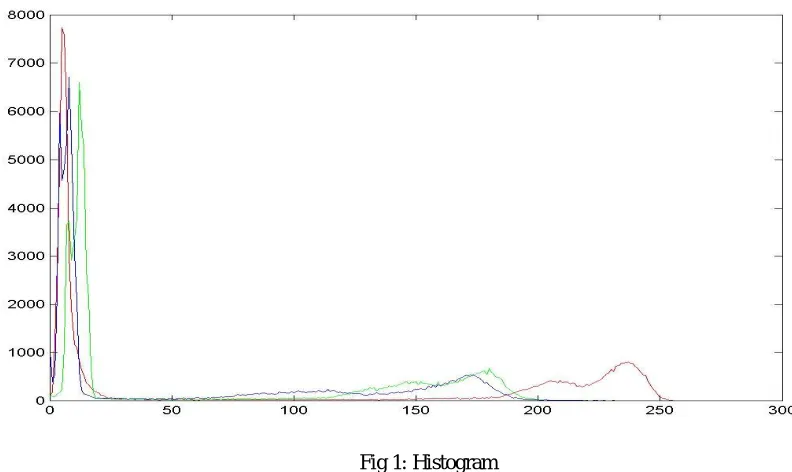
through data mining. The segmentation of image is done using a tolerance value. The tolerance value is calculated through histogram.
Fig 1: Histogram
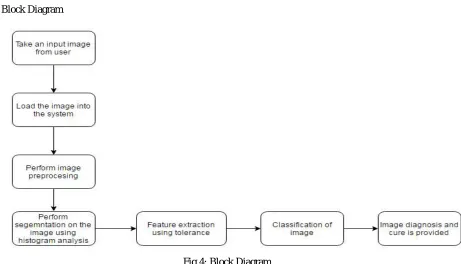
In this method we start with generating the histogram of the image and obtaining the tolerance value for the image. This value is calculated using the values obtained in the histogram. And using this tolerance value the unaffected part is highlighted. We take into consideration the mean value of the colors (RGB) and the background of the image is assumed to be black. Once the presence of disease is detected, classification of the disease is done. i.e., detection of disease according to the different tolerance values of the images.
Fig 3: Output image
Our proposed diagnosis system mainly consists of these components:
A. Image processing unit.
Image processing is the main part of the design process in our system as it is required to identify theregion of skin infected with the disease and in orderto do that the image processing part of this process should be carried out.
B. Data mining unit
The results obtained from the image processing unit will be examined and the disease will be identified and displayed by this unit.
The exact location of the affected area is traced.
Diseases are detected efficiently.
Users will benefit with the early detection of the skin diseases they have acquired.
The system is not costly and hence can be used by a large number of people.
IV. RESULTS AND CONCLUSION
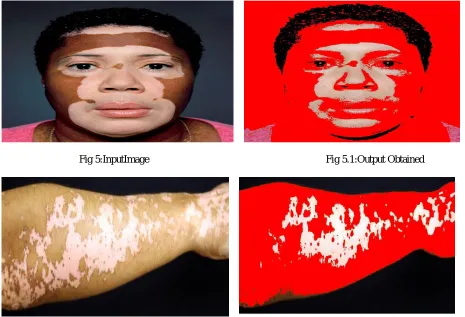
An automated skin disease detection system is proposed which will help the medical society for the early detection of the skin diseases. The diagnosis methodology uses Digital Image Processing in Matlab. The unique features of the enhanced images were segmented using histogram. Based on the results, the affected area is detected and the skin diseases are classified.
Vitiligo detection:
Fig 5:InputImage Fig 5.1:Output Obtained
Fig 7:InputImage Fig7.1: Output Obtained
I. FUTURE WORK
To integrate the diagnosis system as a mobile application so that it is easily accessible to multiple users.
To make the system more robust and secure so that user information is not tampered with.
To reduce the computational and time complexity.
To integrate the system as a web based application where more modules can be added for the users.
II. REFERENCES
[1] Dalia N. Abdul-wadood, Dr. Loay E. George, Dr. Nabeel A. Rasheed, ”Diagnosis of Skin Cancer Using Image Texture
Analysis” International Journal of Scientific & Engineering Research, Volume 5, Issue 6, June-2014
[2]Nidhal K. Al Abbadi, Nizar SaadiDahir, Muhsin A. AL-Dhalimi and Hind Restom,”Psoriasis Detection Using Skin Color and Texture Features” Journal of Computer Science 6 (6): 648-652, 2010 ISSN 1549-3636 © 2010 Science Publications.
[3] B.V.Dhandra, Shridevi Soma, Shweta Reddy and Gururaj Mukarambi.”Color Histogram Approach for Analysis of Psoriasis
Skin Disease” Proc. of Int. Conf. on Multimedia Processing, Communication& Info. Tech., MPCIT
[4]Shervan Fekri-Ershad1, Mohammad Saberi2 and FarshadTajeripour“An innovative skin detection approach using color based image retrieval technique”, The International Journal of Multimedia & Its Applications (IJMA) Vol.4, No.3, June 2012.
[5] Kakumanu, P., Makrogiannis, S., &Bourbakis, N., "A survey of skin-color modeling and detection methods", Pattern Recognition, Vol. 40, pp. 1106 – 1122, 2007.
[7] Damilola A. Okuboyejo, Oludayo O. Olugbara, and Solomon A. Odunaike“ Automating skin disease diagnosis using image classification”, Proceedings of the World Congress on Engineering and Computer Science 2013 Vol II WCECS 2013, 23-25 October, 2013, San Francisco, USA.
[8]WasanKadhimSaa'dTechnical collage – Najaf., “Method for detection and diagnosis of the area of skin disease based on color by wavelet transform and artificial neural network, Al-Qadisiya Journal For Engineering Sciences Vol. 2 No.4 Year 2009.
[9] K.M.M. Rao, V.D.P. Rao “MEDICAL IMAGE PROCESSING” 2009.
[10] Rohini Paul Joseph, C. Senthil Singh, M.Manikandan“Image Segmentation And Detection In Image Processing”IJRET: International Journal Of Research In Engineering And Technology Eissn: 2319-1163 | Pissn: 2321-7308.
[11] Mokhled S. AL-TARAWNEH “Cancer Detection Using Image Processing Techniques” Leonardo Electronic Journal Of Practices And Technologies ISSN 1583-1078Issue 20, January-June 2012 P. 147-158.
[12] C.B. Tatepamulwar, V.P. Pawar, K.S. Deshpande , H. S. Fadewar “Detection and Identification of Human Skin Diseases Using CIE lab Values” Volume 5, Issue ISSN: 2277 128X International Journal of Advanced Research in Computer Science and Software Engineering, 6, June 2015.
[13] Fernando Roberti de Siqueira, William Robson Schwartz and HelioPedrini, ”Adaptive Detection of Human Skin in Color Images” 2010