Internet of Things Network Durability
Enhancement for OLSR Protocol using
Advanced Energy Efficient Techniques
Veena H. S, Advaith. K. P
Associate Professor, Department of ECE, BIT, Bangalore, India
M.Tech VLSI and ES, Department of ECE, BIT, Bangalore, India
ABSTRACT: Mobile Adhoc Networks (MANETs) are networks of mobile nodes which have limited resources in terms of processing power, memory and battery life. This paper proposed a Clustering approach based routing protocol for MANETs. The proposed algorithm is a clustering algorithm together with OLSR Routing protocol, which defined by throughput of protocol. The performance of the proposed algorithm OLSR routing protocol and outperform the routing protocol in term of Energy, throughput and PDR (Packet Delivery Ratio), thus provides a best standard for the algorithm’s success.
KEYWORDS: MANETs, OLSR, Energy, Throughput, Packet Delivery Ratio.
I. INTRODUCTION
Accurately hundreds of routing protocols are proposed for mobile-ad hoc network. Due to wide range of achievable scenario, there is no procedure that always gets a best performance for every case. Thus, some adaptive routing protocols are proposed for MANETs.
Mobile Adhoc Networks (MANETs) were infrastructure less network in which nodes are co-operatively advance data to nodes which can be past their range. The topology of network keeps altering as mobile nodes liberally join else leave network without any condition. The MANETs utilizes a TCP/IP stack and underlying layers follow an IEEE 802.11 standard. The dissimilarity is largely in network layer where routing protocols can be MANETs specific. Thus, nodes can be act as end strategy and routers also. The threats to MANETs at various layers can be same as that of any infrastructure wireless network, apart from network layer; the routing protocols more susceptible to attack because of cooperative nature of nodes and lack of communications for route.
A wireless sensor network (WSN) is a wireless network that consists of distributed sensor nodes that monitor specific physical or environmental events or phenomena, such as temperature, sound, vibration, pressure, or motion, at different locations. The first development of WSN was first motivated by military purposes in order to do battlefield surveillance. Nowadays, new technologies have reduced the size, cost and power of these sensor nodes besides the development of wireless interfaces making the WSN one of the hottest topics of wireless communication. Sensor nodes, as mention earlier, are low-cost and low-power devices used to accumulate the desired data and forward it to the base station. The nodes are equipped with a sensing unit, a radio transceiver or other wireless communications device, a small microcontroller, and an energy source, usually a battery, some sensor nodes have an additional memory component.
II. LITERATURESURVEY
Mayank Dixit et.al [01] presented a concept of VANET: Architectures, Routing Protocols, Research Issues and its Applications. They provides a survey about VANET basic architecture, its characteristics, research challenges, routing protocols classifications and names of related algorithms, various bio-inspired approaches. These approaches getting used now a day in various scenarios of VANET, appliance and simulating tools for VANETs.
Raj Kamal Kapur et.al [02] analyzes a routing procedure, with them vulnerabilities and different types of attacks are launched by developing a same, to disrupt routing procedure or launch DoS attacks. They reviewed a possible countermeasure against those attacks and listed out compensation and limitations of countermeasures, also summarized. This can be observed that although active research carried out in this area, proposed solution is not complete. Few solutions are involving specialized hardware such as GPS else directional antennas and might be requiring major modification of previous protocol. The research is not only to increase the effectiveness of security system but also on minimizing a cost to create them appropriate for MANETs.
Ruchi Mehra et.al [03] proposes a clustering method based on routing protocol for VANETs. This is a distributed a clustering method together by OLSR Routing protocol, is possesses excellent information dissemination rate. This dissemination can be defined by throughput of the protocol. Additionally, proposed method is performing excellent in End to End delay and exhibit a sensible overhead. The proposed system can be achieved by using a new clustering method based protocol known OLSR-C (OC). The act of proposed method is validated beside AODV, DYMO and OLSR routing protocol and better a routing protocol in throughput, End to End delay and PDR, thus offers a good benchmark for technique success.
Amjad El Khatib et.al [04] proposes a problem of detecting misbehaving vehicles in Vehicular Ad Hoc Network using, Quality of Service-Optimized Link State Routing protocol. This QoS-OLSR is clustering protocol is able to improve stability of network while maintain QoS necessities. The majority of previous detection methods are non-cooperative in sense that those are based on unilateral judgments, which can be untrustworthy. To overcome these problems, they propose a cooperative technique using ANN, which can be able to aggregate the judgments and stop the unilateral decision, and benefit from exist detection knowledge by continuous learning. The simulation result shows that proposed model can be improves a detection probability and reduces a false alarm rate.
Elmano Ramalho Cavalcanti et.al [05] proposes a mobility-aware adaptive OLSR routing protocol, is based on a new technique for MPR collection. The actual MPR method is only on number of reachable neighbors for significant a MPR set, not taking into account how nodes moving. The proposed solution adding a spatial mobility metric is improved also Smoothed Degree of Spatial Dependence (ISDSD), thus the neighbors have both high reach ability but also a elevated spatial movement correlation can be selected. Proposed resultatnt, is selected MPR set tends to stay unchanged for longer time, resulting in greater stability of routes, can makes a protocol more efficient.
Ryoichiro Obukata et.al [06] presents implementation and design of a testbed for AMI using Raspberry Pi mount on Raspbian OS. They analyze a performance of Optimized Link State Routing and Wired Equivalent Privacy protocol in an indoor situation. For evaluation they considered delay, throughput and jitter metrics. The results show that nodes in testbed were communicating easily.
III. METHODOLOGY
The implementation phase involves the actual materialization of the ideas, which are expressed in the analysis document and developed in the design phase. Implementation should be perfect mapping of the design document in a suitable programming language in order to achieve the necessary final product. Often the product is ruined due to incorrect programming language chosen for implementation or unsuitable method of programming. It is better for the coding phase to be directly linked to the design phase in the sense if the design is in terms of object oriented terms then implementation should be preferably carried out in a object oriented way.
Network contains description of functionality of the scripts used in building topology. This module involves building Wireless Network topology, topology consisting of mobile nodes, each node working with multiple channels.
The energy model only maintains the total energy and does not maintain radio states. It is generic enough for future simulations such as the CPU power consumption. Please note that the old energy model indeed maintains some radio states, and have some methods to manipulate them, and they are only used by the adaptive fidelity module. This
approach may cause inconsistency withwireless-phy. To keep adaptive fidelity work, we did not remove it from the
energy model, but it is obsolete, and should not be used further. Now all access to the energy model should go
throughwireless-phy.
3.1 Optimal Link State Routing Protocol
A proactive approach to MANET routing seeks to maintain a constantly updated topology understanding. The whole network should, in theory, be known to all nodes. This results in a constant overhead of routing traffic, but no initial delay in communication.
The Optimized Link State routing (OLSR) is described in RFC3626. It is a table-driven pro-active protocol. As the name suggests, it uses the link-state scheme in an optimized manner to diffuse topology information. In a classic link-state algorithm, link-state information is flooded throughout the network. OLSR uses this approach as well, but since the protocol runs in wireless multi-hop scenarios the message flooding in OLSR is optimized to preserve bandwidth. The optimization is based on a technique called Multipoint Relaying.
Being a table-driven protocol, OLSR operation mainly consists of updating and maintaining information in a variety of tables. The data in these tables is based on received control traffic, and control traffic is generated based on information retrieved from these tables. The route calculation itself is also driven by the tables.
OLSR is proactive in nature, having routes immediately available in each node for all destinations in the network. OLSR is an optimization of pure link state routing protocol like Open Shortest Path First (OSPF). This optimization is related to concept of multipoint relay (MPR).A multipoint relay reduces the size of control messages. The use of MPRs also minimizes flooding of control traffic. Multipoint relays forward control messages, providing advantage of reduction in number of retransmissions of broadcast control messages. OLSR provides two main functionalities: Neighbour Discovery and Topology Dissemination. With the help of these two functionalities, each node computes routes to all known destinations.
The two most important message types in OLSR are the HELLO and the TC (Topology Control) messages such as Hello Messages and TC Messages.
In HELLO Messages, Every node broadcasts HELLO messages periodically, to support link sensing, detection of neighbours and signalling of MPR selection. There commended emission interval for HELLO messages is 2seconds, and the holding time for neighbour information is 6seconds. Thus a neighbour is considered lost 6 seconds after the last HELLO message received from the neighbour.
Figure 1: Block Diagram of OLSR
Figure 1 depicts the block diagram of OLSR. In this diagram have a major input, local node and generation block.
1. Neighbour node:A node X is a neighbor node of node Y if node Y can hear node X(i.e., a link exists between an OLSR interface on node X and anOLSR interface on Y).
2. 2-hop neighbour: A node heard by a neighbor. A 2-hop neighbor which is not the node itself or a neighbor of the node and in addition is a neighbor of a neighbor, with willingness different from WILL_NEVER, of the node.
3. Multipoint relay (MPR): A node which is selected by its 1-hop neighbor, node X, to"re-transmit" all the broadcast messages that it receives fromX, provided that the message is not a duplicate, and that thetime to live field of the message is greater than one.
4. Link:A link is a pair of OLSR interfaces (from two different nodes)susceptible to hear one another (i.e., one may be able toreceive traffic from the other). A node is said to have a linkto another node when one of its interface has a link to one ofthe interfaces of the other node.
5. Symmetric link:A verified bi-directional link between two OLSR interfaces.
6. Asymmetric link:A link between two OLSR interfaces, verified in only onedirection.
In the above the diagram shows the energy consumption of the node, where the residual energy can be calculated based on the communication cost, to increase the lifetime and to prolong the network lifetime.
Figure 3: Flow Chart for Basic Topology Module
Figure 3 depict the basic topology module flow chart. Initially we need to set up the network topology and identifies the neighbors by using Euclidian distance. Energy module is helping us to calculate the energy. Specifies the source, destination, data, and simulation start time then stop the program.
IV. RESULTS
The language used for the proposed implementation of project must be platform independent, simple and powerful, object oriented, robust, interactive, easy to learn, dynamic and extensible. The C++ object model helps speed development in two ways. First through abstraction or information hiding, C++ allows us to divide and conquer complex applications like communications protocols. Information hiding is one of the most powerful tools we have for dealing with complexity. The C++ object model allows a developer to explicitly define what information is to be hidden through the use of private data. The C++ object model is far superior to C’s module concept which is only enforced by programming conventions and not enforced by the language rules. C modules only work well if everyone follows the rules. C++ classes can be used to closely model the concepts defined in a communications protocol’s specification.
Network Simulator 2 (NS2) is an Object-oriented, discrete event-driven network simulator. It is written in C++ and OTcl. There are visualization tools like NAM or Graph that can be used to display visualization results.
This module consists of following steps: Algorithm: Proposed System Steps
Step 1 : Begin
Step 2 : Setting up Wireless Network Topology includes environmental settings, node configuration, and topology creation.
Step 3 : In setting the energy module, Each and every node in the network topology will be assigned with certain energy levels.
Step 4 : In order to identify the neighbors for a particular node Euclidian distance concept is used.
Step 5 : Specifying the source, destination and data from which node the data has to be sent and which node must receive the data will be specified. Also how much amount of data has to be sent along with the time interval of sending the data can specified.
Step 6 : In NS 2 the entire transaction takes place within fraction of seconds. The transaction can be viewed through the NAM window at any time. For this the simulation start time and end time will be specified.
Step 7 : Stop
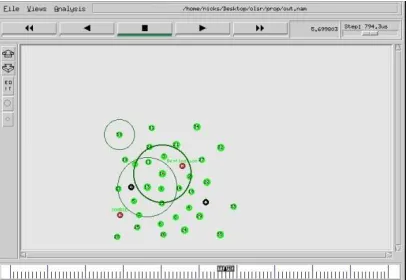
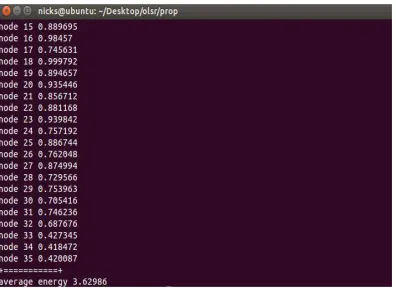
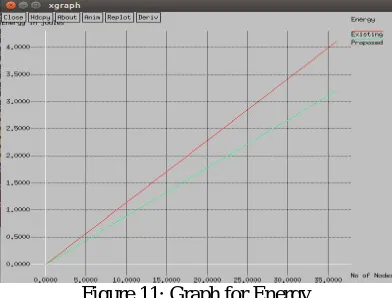
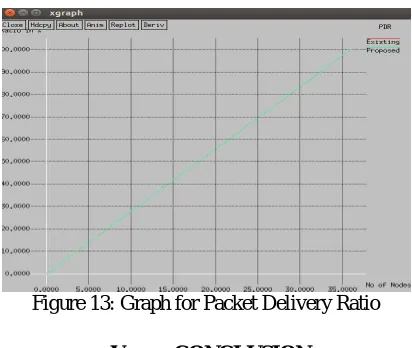
Figure 4 depicts the connection establishment. Initially cluster nodes are formed, and then it will get grouping based on cluster head. Figure 5 depicts the establishment for different sensor node. Figure 4, 7, 8 and 8 depicts initial energy evaluation, parameter, final energy and final parameter respectively. Figure 10, 11 and 12 depicts a performance graph of energy, throughput and packet delivery ratio.
Figure 5: Connection Establishment
Figure 7: Initial Energy Evaluation
Figure 8: Evaluation of Parameters
Figure 10: Evaluation of final parameters
Figure 11: Graph for Energy
Figure 13: Graph for Packet Delivery Ratio
V. CONCLUSION
MANETs are fast emerging as alternate network architecture to infrastructure networks. It is finding many applications and the constraints of processing of parameter. Energy, throughput and packet delivery ratio are performed and gives a better performance than exist. In this paper we analysis the OLSR routing protocol.
REFERENCES
[1] Dixit, M., Kumar, R., & Sagar, A. K, “VANET: Architectures, research issues, routing protocols, and its applications”, In Computing, Communication and Automation, IEEE, pp. 555-561, 2016
[2] Kapur, R. K., & Khatri, S. K, “Analysis of attacks on routing protocols in MANETs”, In Computer Engineering and Applications (ICACEA), IEEE, pp. 791-798, 2015
[3] Mehra, R., Bali, R. S., & Kaur, P, “Efficient clustering based OLSR routing protocol for VANET”, In Colossal Data Analysis and Networking (CDAN), IEEE, pp. 1-7, 2016
[4] El Khatib, A., Mourad, A., Otrok, H., Wahab, O. A., & Bentahar, J, “A Cooperative Detection Model Based on Artificial Neural Network for VANET QoS-OLSR Protocol”, Ubiquitous Wireless Broadband (ICUWB), IEEE, pp. 1-5, 2015
[5] Cavalcanti, E. R., & Spohn, M. A, “Enhancing OLSR protocol performance through improved detection of Spatial Dependence”, In Computers and Communication (ISCC), IEEE, (pp. 1-6, 2014
[6] Obukata, R., Oda, T., & Barolli, L, “Design of an ambient intelligence testbed for improving quality of life”, In Advanced Information Networking and Applications Workshops (WAINA), IEEE, pp. 714-719, 2016
[7] F. De Rango and M. Fotino, “Energy Efficient OLSR Performance Evaluation Under Energy Aware Metrics,” in Proceedings of the 12th International Conference on Symposium on Performance Evaluation of Computer & Telecommunication Systems, ser. SPECTS’09. Piscataway, NJ, USA: IEEE Press, pp. 193–198, 2009
[8] Benslimane, A., El Khoury, R., El Azouzi, R., & Pierre, S., “Energy Power-Aware Routing in OLSR Protocol”, Proc. First Int. Mobile Comp. and Wireless Communication, IEEE, pp. 14-19, 2006
[9] T. Clausen, P. Jacquet, “Optimized Link State Routing Protocol (OLSR)”, RFC 3626, Oct. 2003.
[10] R. N. Enam; “Energy efficient differential data aggregation in a dynamic cluster based WSN”, Collaboration Technologies and Systems (CTS), 2013 International Conference on (2013).
[11] J. Kim; “Energy-Efficient Dynamic Packet Downloading for Medical IoT Platforms”, IEEE Transactions on Industrial Informatics, Vol. 11, No. 6, 2015.