Image Re Rank In User Clicks And Future
Search
Sudhishna K.S
1, Mr.S.Senthil Prabhu
2P.G. Student, Department of Computer Science and Engineering, Easa College of Engineering and Technology,
Coimbatore, India1
Assistant Professor, Department of Computer Science and Engineering, Easa College of Engineering and Technology,
Coimbatore, India2
ABSTRACT: In Today’s world searching of images on internet are very popular, but most of the times searching
result not exact match with the searching key. Improve the results of web-based image search as an effective way by Image re-ranking, this is adopted by commercial search engines such as Google and Bing. Given a query keyword, pools of images are first retrieved based on textual information. When the user selects a query image from the pools of images, then the re-ranking of remaining images are based on their visual similarities with the user selected query image. A big challenge is that the similarities of images visual features do not well correlate with semantic meanings of images which interpret users search intention. Recently people proposed to matching images from semantic space which used reference classes or attributes closely related to the semantic meanings of images. Semantic signatures of images are improved both the efficiency and accuracy of image re-ranking. In this paper different methods for web image re-ranking and propose new re-ranking technique with removing of duplicate images are discussed. Index Terms - Image search, image re-ranking, cluster of images, semantic space.
KEYWORDS: Image Re-ranking, Click based search, Topic Diversity, Maximise search relevancy, Security.
I.INTRODUCTION
Searching for relevant images from large scale community databases given a query term is an important task. The image ranking approach represents an image collection as a graph that is built using multimodal similarity measures based on visual features and user tags. To improve the performance of this image search image re-ranking technology is used. Search re-ranking is regarded as a common way to boost retrieval precision. The problem nevertheless is not trivial especially when there are multiple features or modalities to be considered for search, which often happens in image and video retrieval. Different re-ranking algorithms are available in computer world which gives different precisions. Formally; the definition of the ranking problem with a query image is as follows. The re-ranking process is used to improve the search accuracy by reordering the images based on the multimodal information extracted from the initial text-based search results, the auxiliary knowledge and the example image. The auxiliary knowledge can be the extracted visual features from each image or the multimodal similarities between them.
II.LITERATURE SURVEY
1. Image Location Inference By Multi-Saliency Enhancement
useful for location based services recommendation, user preferred POIs recommendation, and user travel footprint mining and management.
2 Boost Search Relevance For Tag-Based Social Image Retrieval
Social media sharing web sites like Flickr allow users to annotate images with free tags, which greatly facilitate social image search and browsing. However, currently tag-based image search on Flickr does not provide the option of relevance-based ranking, i.e., the search results cannot be ranked according to their relevance levels with respect to the query tag, and this has limited the effectiveness of tagbased search. In this paper, i propose a relevance-based ranking scheme for social image search, aiming to automatically rank images according to their relevance to the query tag. It integrates both the visual consistency between images and the semantic correlation between tags in a unified optimization framework. I propose an iterative method to solve the optimization problem, and the relevancebased ranking can thus be accomplished. Experimental results on real Flickr image collection demonstrate the effectiveness of the proposed approach.
III.EXISTING SYSTEM
In the research literature, many technique are used for re-ranking image. A novel re-ranking approach, named spectral clustering re-ranking with clickbased similarity and typicality. Jie Liu et al first, to learn proper similarity measurement, suggest click-based multi-feature resemblance learning algorithm, which conducts metric learning based on click-based triplets selection, and integrates multiple features into a joined similarity space via multiple kernel learning. Then, based on the learnt click-based image correspondence measure, conduct spectral clustering to group visually and semantically similar images into same clusters, and get the final re-rank list by scheming click-based clusters typicality and within clusters click-based image typicality in descending order. Jiebo Luo et al a multimodal hyper graph learning-based sparse coding method for image click prediction, and concern the obtained click data to the re ranking of images. Adopt a hyper graph to build a group of manifolds, which explore the complementarily of unlike features through a group of weights. Distinct a graph that has an edge between two vertices, a hyper edge in a hyper-graph connects a set of vertices, and helps protect the local smoothness of the constructed sparse codes.
A novel method named multimodal hyper graph learning-based small coding for click prediction, and concern the predicted clicks to re-rank web images. Meng Wang et al a multimodal graph-based learning approach that can adaptively integrate multiple modalities.
IV. PROPOSED METHODOLOGY
To improve the search performance new direction has emerged named as image search Reranking which applies visual information to reorder the text based search results . This Kind of approach first take out image's visual features from the initial search results and then build the ranking function and finally reorders the images with the ranking function. Re-ranking of images is done by including, Visual aspects, Visual similarity of the images, to maximize relevancy of image results & to achieve diversity of image results. In image search re-ranking goal is to refine the text based search effect which requires mining image visual content. That is taking into account the image visual contents while re-ranking. To confine the user's goal with minimum human interaction, propose significant image search method to search related images by requiring that the user gives only one click on the initially searched images.
Multimodal Hypergraph Learning-Based Sparse Coding
Given an image x {x ∈ Rd} , and web image bases with associated clicks as A = [a1, a2, . . . , as, ] A ∈ Rd×s , sparse coding can build a linear reconstruction of a given image x by using the bases in A: x =c1a1 + c2a2 +· · ·+csas = Ac. Multimodal Feature Combinations In real applications, images are described by multimodal features. Given a dataset with multiple features:
which each representation
X(i) is a feature matrix from view i .[2]
Multimodal Graph-Based Learning Algorithm
where n is the number of samples, dk is the dimensionality of the k-th modality, K is the number of modalities, and T , T1 and T2 are the iteration period of discontinuous optimization, the gradient descent process in Algorithm and the coordinate descent method for updating α, respectively[3].
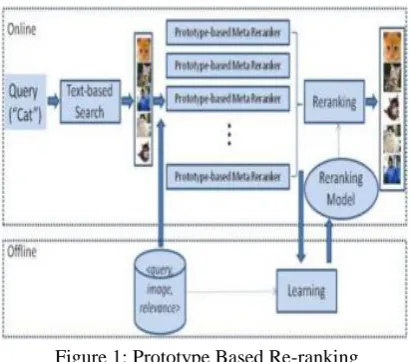
Figure 1: Prototype Based Re-ranking
Analysis And Discussion
Self-re-ranking focuses on distinguish recurrent model in the preliminary search results without any external knowledge, and then uses the recurrent patterns to perform re-ranking. This prepare reranking as a random walk problem along the context graph, where video stories are represented as nodes and the edges between them are weighted by multimodal contextual similarities . Bring forward the predictable idea of pseudo-relevance feedback (PRF) that the top-ranked (bottom-ranked) documents are chosen as pseudo-positives (pseudonegatives) for an supported vector machine (SVM) classifier . Multiple graphs into a regularization and optimization framework to explore the complementary nature of multiple visual modalities. Compared with self-re-ranking, example-based reranking mainly relies on query examples provided by users[1]. Multimodal feature fusion are classified into two categories, namely early fusion and late fusion. It has been shown that if an SVM classifier is used, late fusion tends to result in better performance[2]. An SVM model is learned based on samples to rerank search outcome. The robustness of this approach by a bagging strategy enhanced. They collect multiple pseudo irrelevant sample sets and then create different ranking lists consequently. These ranking lists are combined to generate final results. A most favorable set of document pairs via an information theory opinion and a ranking list is directly recovered from this pair set is identified. These methods can effectively improve search performance if good visual examples are provided[3].
V.EXPERIMENTAL RESULTS
System implementation
Implementation is the final and important phase, the most critical stage in achieving a successful new system and in giving the users confidence. That the new system will work be effective. The system can be implemented only after through testing is done and if it found to working according to the specification. This method also offers the greatest security since the old system can take over if the errors are found or inability to handle certain type of transactions while using the new system.
Algorithm:
1. Take input as a text query.
2. From original text based result take out all possible output .
3. Using significant image search images are sorted as Significant, trivial and fair.
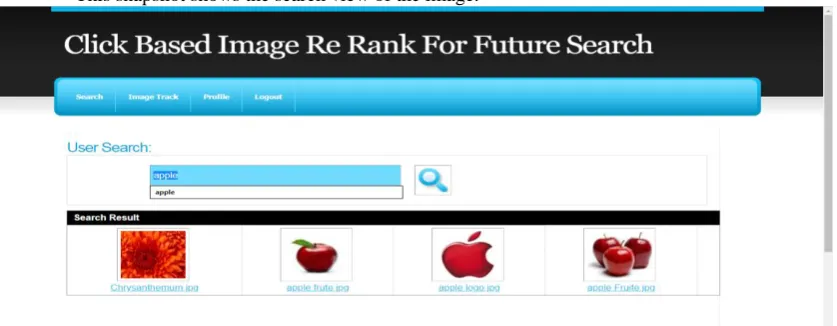
4. Images are reordered at top significant image will display and then other related image will shown. Image search re-ranking with the proposed algorithm, considering example, take the query "apple" when submit it to a web image search engine, preliminary text-based search result is returned to the user.
Search Image View:
This snapshot shows the search view of the image.
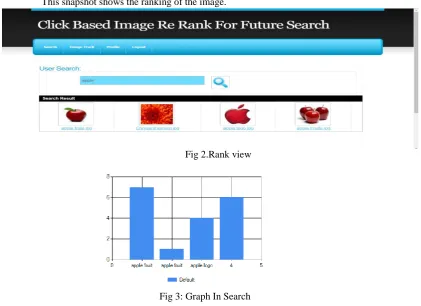
Rank View:
This snapshot shows the ranking of the image.
Fig 2.Rank view
Fig 3: Graph In Search
The result is not adequate since of some noisy or unwanted images are also returned as top results. To improve the retrieval concert, significant image search method is used. Original low-level features are first extracted to represent their visual contents. At last, the images are reordered as the most important image are shown at the top and after that related image come will display.
VI.CONCLUSION AND FUTURE WORK
This paper presents a survey on various Reranking algorithms that were proposed by earlier researches for the better development in the field of Image Processing. Various algorithms and methods discussed above will help in developing efficient and effective re-ranking for image processing. In the future scope, a comparative study of various algorithms will be presented for circular re-ranking. Circular re-ranking provides information exchange and reinforcement for visual search re-ranking for images. Particularly, the placement of modalities in the circular framework which could lead to the highest possible retrieval gain in theory for search re-ranking.
REFERENCES
[1] The concept of image inpainting was first introduced by Bertamio et al. [2] Exemplar Based method proposed by Criminisi et al.
[3] X-Y. Wei, Y-G. Jiang and C.W. Ngo, “Concept Driven Multi-modality fusion for video search,” IEEE Trans. Circuits syst. Vide Technol., vol.21, no.1, pp. 62-73, Jan. 2011
[6] P.K. Atrey, A. Hossain, A.E. Saddik and M.S. Kankahalli, “Multimodal Fusion for Multimedia Analysis: A Survey,” Springer Multimedia Syst., vol. 16 No.6, pp. 345-379,200.
[7] F. Richter, S.Romberg, E. Horster and R. Lienhart, “Muti-modal Ranking for Image Search on community Database,” ACM SIGMM Int. Workshop Multimedia Inf. Retr., 2010 pp.63-72
[8] H.K. Tan and C.W. Ngo, “Fusing Heterogenous Modalities for Video and image Re-ranking,” ACM Int.Conf. Multimedia Ret., 2011 pp, 15, TRECVID
[9] Y. Liu, T. Mei and X.-S. Hua, “Crowd Reranking Exploring Multiple Search Engines for Visual Search Reranking,” in Proc. ACM Special Interested Group Inf. Retr. 2009, pp.500-507
[10] M. Wang, L. Yang and X.S.Hua, “MSRA-MM: Bridging Rengtonsearch and Tech. industrial societies for Multimedia information retrieval, “Microsoft Washington, DC, Rep. MSR-TR-2009-30, 2009
[11] Y.S. Jing and S. Baluja, “Visual rank: Applying page rank to large-scale image search,” Trans. Pattern Anal. Mach. Intel., vol.30 no. 11. pp. 1877-1890 Nov.2008