Authorized Deduplication Technique for
Encrypted Data with DARE Scheme in a Twin
Cloud Environment
Neha S.Chavan 1, Nilesh wani 2
P.G. Student, Department of Computer Engineering, Godavari college of Engineering, Jalgaon, India1 Associate Professor, Department of Computer Engineering, Godavari college of Engineering, Jalgaon, India2
ABSTRACT: Data reduction has become increasingly important in storage systems due to the explosive growth of digital data in the world that has use hered in the big data era. One of the main challenges facing large-scale data reduction is how to maximally detect and eliminate redundancy at very low overheads. In this paper, we present DARE, a low-overhead deduplication-aware resemblance detection and elimination scheme in a Twin Cloud environment that effectively exploits existing duplicate-adjacency information for highly efficient resemblance detection in data deduplication based backup/archiving storage systems as well as supports authorized deduplication technique for encrypted data. The main idea behind DARE is to employ a scheme, call Duplicate-Adjacency based Resemblance Detection (DupAdj), by considering any two data chunks to be similar (i.e., candidates for delta compression) if their respective adjacent data chunks are duplicate in a deduplication system, and then further enhance the resemblance detection efficiency by an improved super-feature approach. In existing system DARE Deduplication technique is used only in-house computer, in our proposed system you can use DARE Deduplication technique in cloud storage also and you can perform DARE Deduplication technique on encrypted data. Our experimental results based on real-world and synthetic backup datasets show that DARE only consumes about 1/4 and 1/2 respectively of the computation and indexing overheads required by the traditional super-feature approaches while detecting 2-10 percent more redundancy and achieving a higher throughput, by exploiting existing duplicate-adjacency information for resemblance detection and finding the “sweet spot” for the super-feature approach.
KEYWORDS: Data deduplication, delta compression, storage system, index structure, performance evaluation
I.INTRODUCTION
Now a days the cloud computing has widely attracted more and more attention. In the data storage to reduce the data copies we go for deduplication techniques.
The technique referred to as deduplication that is employed to reduces information by removing the duplicate copies of identical data and it's wide utilized in cloud storage to avoid wasting bandwidth and minimize the space for storing[1]. In cloud computing usually the users outsource their data to external cloud servers which may be the public cloud thus not secure and that data may contain some privacy information, such as personal photos, emails, etc. If there is no means for efficient protection, then it leads to severe confidentiality and privacy violations. Therefore it is very essential to encrypt the private data before storing them to the cloud. This issue in mobile cloud computing motivates to protect the confidentiality of sensitive data. One of the technique
When deduplication found, Proof of ownership protocol is employed to convey the proof that the user conjointly owns a similar file. This protocol is employed to supply a licensed access. when authentication, server give a pointer to owner for accessing same file while not having to upload same file. once user need to transfer file he merely download the file from cloud that is in encrypted kind and decipher this file mistreatment convergent key[3]. we have a tendency to also present a Deduplication-Aware likeness detection and Elimination (DARE) scheme for information compression that removes redundancy at most level with minimum overhead[1].
From our observation of duplicate and similar data of backup streams stored in a very cloud storage, we discover that the non-duplicate blocks that are adjacent to duplicate ones might be thought-about sensible delta compression candidates in information deduplication systems. Hence we propose the technique of Duplicate- Adjacency based Resemblance Detection, or DupAdj for short. Exploiting this existing deduplication information (i.e., duplicate-adjacency) not only avoids the high overhead of super-feature computation but also reduces the size of index entries for resemblance detection.
II. RELATED WORK
I. Authorized data de-duplication
Even if there are a lot of advantages of data de-duplication technique, this will not supports privacy and security of data in cloud storage. So there may be the possibility that users private data are susceptible to both the insider and outsider attacks. The traditional deduplication was unable to provide data confidentiality when applied on encrypted data. The traditional encryption requires different users to encrypt data with their own keys. Thus different cipher texts will generate from duplicate copies of different users and this makes de-duplication on encrypted data impossible. The convergent encryption is one in all the algorithmic program that is projected to encrypt information for confidentiality whereas creating de-duplication possible [6]. This system uses symmetric encryption, and therefore the secret's obtained by computing the cryptographic hash value of the content of the message. Once completion of key generation and encoding, users retain the keys to private cloud and then send the cipher text to the cloud. Since the encryption operation is deterministic and comes from the data content, identical information files generate an equivalent convergent key and thence an equivalent cipher text. A secure proof of ownership protocol is additionally needed to produce the proof that the user indeed owns. this can be all to stop unauthorized access. If the file duplicates are found, only the pointer to that file is stored in public cloud. After the proof submission by owner, who are having the subsequent files, doesn’t need to upload the same file[4]. The corresponding data users can download the encrypted files and also decrypt them by using their convergent keys. Therefore in cloud storage, convergent encryption allows the cloud to perform de-duplication on encrypted data and the proof of ownership prevents the unauthorized user to access the file and in this way, providing confidentiality along with authorization. The previous de-duplication systems cannot supports Differential authorized de-duplication check. With the authorized de-duplication system, each user issued a set of the privileges during system initialization[6]. The controlling task to deciding which type of user is allowed to perform the duplicate check and access the files is performed at the time of uploading each file to the cloud and is also bounded by the set of privileges. The user have to submit the file and their own privileges as inputs before sending the user duplication check request for the same file. If copy of the file exist and users privileges matched with the privileges stored in cloud, then and only then the user will get the pointer for the same file[7]. The detailed system architecture is shown in figure 1.
II. Resemblance Detection Based Data Reduction
features of the information stream (e.g., Rabin Fingerprints) and group features into super-features to capture the likeness of knowledge then delta compress the information. of these approaches for likeness detection needs high overheads of computation and categorisation. Shilane et al. projected a stream-informed delta compression (SIDC) approach utilized in a WAN surroundings for reducing similar information transmission and so fast information replication [9]. This approach is super-feature primarily based and enhances the block-level deduplication by solely police work resemblance among non-duplicate blocks within the cache that preserves the backup stream locality. It avoids the indexing. whereas the combined detection of duplicate and alikeness guarantees to attain a superior information reduction performance.
III. The concept of duplicate adjacency
The changed blocks could also be terribly like their previous versions in a very backup system whereas unmodified blocks can stay duplicates and are simply identified by the deduplication method. For those non-duplicate blocks that are location-adjacent to known duplicate knowledge blocks in a very deduplication system, it's intuitive and quite attainable that solely a couple of bytes of them are changed from the last backup, making them potentially excellent delta compression candidates.
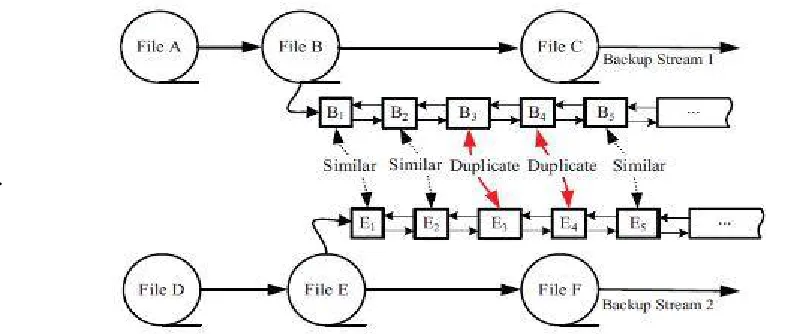
Fig. 2 shows the situation of duplicate data blocks and their immediate non-duplicate neighbors. As mentioned above, our intuition is that the latter are highly likely to be similar and thus good delta compression candidates. Specifically, since blocks ’B3’ and ’B4’ are duplicates of chunks ’E3’ and ’E4’ in Fig. 2 respectively, their immediate neighbors, the block pairs ’B1’ and ’E1’, ’B2’ and ’E2’, and ’B5’ and ’E5’, are then considered good delta compression candidates, which is consistent with the aforementioned backup-stream locality
.
Fig. A conceptual illustration of the duplicate adjacency. The non-duplicate chunks adjacent to duplicate ones are considered good delta compression candidates as they are potentially similar.
III. SYSTEM ARCHITECTURE
Architecture of An Effective Data Reduction in a Twin Cloud Environment Using an Authorized De-dup. Technique with DARE Scheme
Our proposed system is divided into three parts:
1) The authentication scheme for data users is used in a private cloud server to prevent system from attackers. 2) Convergent encryption is used to encrypt the data and perform duplicate check.
3) DARE approach is employed to maximally find and eliminate redundancy at minimum overheads.
Secure Duplication with DARE scheme in a hybrid cloud environment:
The main issues within the cloud computing is de-duplication with differential privileges. the main aim of this paper is to resolve this drawback. For this we tend to go along with completely different variety of design, that has public cloud and private cloud i.e., Hybrid Cloud Architecture also called as twin cloud architecture. The private cloud performs the main role in hybrid cloud environment, that is involved as the substitution to allow data owners to perform de-duplication check securely with differentials privileges[6]. We implement the authorization by using OTP generation technique, where without permission of file owner, no one can access the file from private cloud. Here, the key is managed by private cloud and only the data which is in encrypted from stored on public cloud. Under the hybrid cloud design we have a tendency to propose differential duplication check separated by a brand new de-duplication system. A user solely with corresponding privilege on files has been allowed to perform de-duplication. we conjointly present DARE, a deduplication aware, minimum overhead resemblance detection and elimination technique for delta compression additionally of deduplication on cloud storage system.
DARE uses a likeness detection approach, DupAdj, that uses the duplicate-adjacency info for efficient resemblance detection in existing deduplication systems, and employs an improved super-feature approach to additional detecting likeness once the duplicate-adjacency info is lacking or limited. So, our contribution achieves root level deduplication and also implements an OTP validation scheme to avoid unauthorized access by using hybrid cloud environment where private cloud is responsible to manage the convergent key and public cloud holds the file in encrypted format.
System Modules
There are three entities define in our system :
1) Users 2) Private cloud
3) S-CSP in public cloud
1. Data Users: A user is associate entity that wishes to source information storage to the S-CSP and access the information later. User generate the key and store that key in private cloud. every file is protected by convergent encryption key and might access by solely licensed person. In our system user should have to be compelled to register in private cloud for storing token with several file that are store on public cloud..
2. Private Cloud: In general for providing more security instead of public cloud user can use the private cloud. User store the generated key in private cloud. At the time of file downloading, system first asks the key to download the file. User cannot store the secrete key internally. For providing proper protection to key we use private cloud. For providing correct protection to key we tend to use private cloud. private cloud solely store the convergent key with its individual file. once user wish to access the key he 1st check authority of user then solely give the key
Public Cloud: Public cloud entity is employed for the storage purpose. User upload the files in public cloud. Public cloud is similar as S-CSP. When the user want to download the files from public cloud, it will be ask the key which is generated or stored in private cloud. Only authorized user can access the file. In public cloud all files are stored in encrypted format.
IV. PROPOSED ALGORITHM
I. Convergent Encryption Technique
Four primitive functions which defines the convergent encryp-tion scheme are as follows
1) KeyGenCE(M) - > K maps a data copy M to a convergent key K, so it is the key generation algorithm;[6] 2) EncCE(K, M) - > C takes both the convergent key K and the data copy M as inputs and then outputs a ciphertext
C, so it is the symmetric encryption algorithm.[6]
3) DecCE(K, C) - > M takes both the ciphertextC and the convergent key K as inputs and then outputs the original data copy M, so called as the decryption algorithm; [6]and
4) TagGen(M) - >T (M) maps the original data copy M and outputs a tag T (M), so T (M) is the tag generation algorithm.[6]
II. Proof of Ownership 5)
The main purpose of proof of ownership (POW) protocol is to enable users to prove their ownership of data copies to the storage server. It is a protocol which is denoted by POW. The verifier derives a short value ϕ (M)
from a data copy M. To prove the ownership of the data copy M, the prover needs to send ϕ to the verifier such that ϕ’=ϕ (M).[6]
PSEUDO CODE
Step1: Calculate the two convergent key values 6) Step2: Compare the two keys and files get accessed. 7)
Step3: Apply de-duplication to eradicate the duplicate values.
Step4: If any other than the duplicates it will be checked once again and make the data unique. 8)
Step5: That data will be unique and also more confidential the authorized can access and data is stored.
III. File Encryption
Data owner runs this algorithm. It encrypt the entire document and generates ciphertexts. For each document, this algorithm will create a delta a for its searchable encryption key ka. This algorithm outputs data ciphertext and keyword ciphertexts Ca on input of the owners public key pk and the file index i,
IV. Encrypted Data Upload
The data holder encrypts its data using a randomly selected symmetric key DEK in order to ensure the security and privacy of data, and stores the encrypted data at CSP along with the token used for data duplication check only and only if data duplication check is negative. The data holder first encrypts DEK with pk AP and then passes the encrypted key to CSP.
V. Data Deduplication
Data duplication happens once information owner tries to store identical data that has been hold on already at the general public cloud storage. this can be checked by scrutiny the tags. If the comparison is positive, CSP contacts AP for deduplication by providing the token and also the knowledge key. The AP challenges knowledge possession, checks the eligibility of the information holder, so problems a re-encryption key which will convert the encrypted DEK to a type which will solely be decrypted by the eligible knowledge holder.
VI. Delta Compression
MATHEMATICAL MODEL
Input: Input given to the system is: -Encrypted File inany format.
Output: Whenever user wants to upload the file on cloudor store the file on secondary storage then we check or test the duplication and Resemblance Detection and Elimination or not.
Process:
Step 1: Data owner Select File
Step 2: Encrypt File (For encryption we user AES or RSA). Step 3: Upload file on cloud or store the file on secondary storage.
Step 4: CSP or Controller check the duplicate file available on cloud or secondary storage. Step 5: If found then remove the duplication and maintain index.
Step 6: On non duplicate data CSP again check resemblance detection of similar chunk.
Step 7: If resemblance found then reduce it create delta store. Step 8: Again on non similar data check resemblance detection.
Step 9: If resemblance found then reduce it store similar data in delta store. Step 10: Finally non similar data stored into secondary storage or Cloud storage.
Mathematical model contains five tuples –
S= {s, e, X, Y, ϕ }
where the following conditions are satisfied-
s = Start of the program
1) Log in with webpage.
Load Text Files on cloud e = End of the program.
Retrieve the file from cloud storage system.
X = Input of the program.
Input should be any text file.
Y = Output of the program.
Φ = Success and failure conditions.
File will be first fragmented then it is encoded and the fragments are allocated. Finally when we request for text file downloading we get text file as output.
X, Y ϵ U
Let U be the Set of System.
U = { Client, F, S, T, M, D, R, DC }
Where,
Client, F, S, T, M, D,R,DC are the elements of the set.
Client = Data Owner, User
F = Fragmentation
S= Fragments encoded using Secret Sharing Scheme
M = Message Authentication Code for generating hash values.
D = Check for duplicate file or block
R = Detects resemblance by exploiting existing duplicate-adjacency information of a deduplication system.
DC = Delta compression module takes each of the resembling chunks detected in R, and reads its base-chunk, then delta encodes their differences.
Success Condition: Successfully work keys aggregation,trapdoor generation, file splitting and stored into multi cloud. User gets result very fast according to their needs.
Failure Condition :
1) Huge database can lead to more time consumption to get the information 2) Hardware failure.
3) Software failure.
Space Complexity: The space complexity depends onPresentation and visualization of discovered patterns. More the storage of data more is the space complexity.
Time Complexity: Check No. of patterns available inthe database = n. If (n>1) then retrieving of information can be time consuming.
Above mathematical model is NP Complete.
V. SYSTEM IMPLEMENTATION
We implement system with data deduplication,in which we model three entities as separate programs. To model the data users a Client program is used to carry out the file uploading/downloading process. A Private Server program is used to model the private cloud which manages the private keys and handles the file token computation. A Storage Server program is used to model the S-CSP which stores and deduplicates files. Followings are function calls used in system:
FileTag(File) - It generates SHA-1 hash of the File as File Tag;
DupCheckReq(Tag) - It requests the Storage Server for Duplicate Check of the file.
FileEncrypt(File) - It uses 256-bit AES algorithm to encrypts the File with Convergent Encryption in cipher block chaining (CBC) mode, where the convergent key is from SHA-256 Hashing of the file;
FileUploadReq(FileID, File, Token) – It uploads the File Data to the Storage Server only if the file is Unique and updates the File Token stored.
FileStore(FileID, File, Token) - It stores the File on Disk and updates the Mapping.
GenOTP(RandomFun) – It generates OTP which is send by owner of file to the other authorized user of same file
VI. EXPERIMENTAL RESULTS
We evaluate DARE in the key metrics of data reduction, data-reduction throughput and similarity degree.
Data reduction here is defined as the percentage of redundancy removed by deduplication and resemblance detection. Data-reduction throughput is measured by the rate at which datasets are processed, including deduplicating, detecting resemblance, and delta compressing. The similarity degree of resemblance-detected chunks is measured by the ratio of (compressed size) / (original size).
store only 50% data on cloud storage which is not duplicate. Above result table and graph shows the Performance Mesurment and Comparitive analysis between Proposed and Existing System.
Following graph illustrates the percentage of found similer block in Existing System & Proposed System
100
80
60 Existing System
40
20
0
File A File B File C File D
Fig. Performance Mesurment and Comparitive analysis
Result table:
Percentage of found similer blocks in Existing System & Proposed System.
File\Method Proposed System Existing System File A 60 40
File B 70 45
File C 75 50
File D 80 50
Fig:Throughputs of resemblance detection enhanced data reduction approaches (i.e., deduplication + delta compression) on sample backup dataset
Fig: Home screen of the deduplication system
User or owner selects the file to be uploaded on the cloud. After selecting the file for uploading, the system checks for deduplication. There are four possibilities-
User can send request to file owner for downloading their files
Fig: User get the OTP and download the file Successfully
VII. CONCLUSION
In this paper to support stronger security, we present an advanced authorized deduplication scheme by encrypting the Text file with convergent keys in a twin cloud environment. In this way, the users without taking owner’s permission cannot access the files of other users. Furthermore, any unauthorized users cannot decrypt the cipher text even collude with the S-CSP. In this manner we achieves the authorization. Also we implement DARE scheme which is very effective in determining and eliminating redundancies at maximum level and with very low overheads. The system effectively manages the storage space in a secure and authorized manner. And the system enables to maximally detect and eliminate redundancy at very low overheads supporting the secure data storage on public cloud
ACKNOWLEDGEMENT
We express our deepest gratitude to the college authorities for technical guidance and infrastructure. Lastly we wish to thank the researchers and reviewers for their contributions because of which we could complete this work.
REFERENCES
[1] Wen Xia, Member, IEEE, Hong Jiang, Fellow, IEEE, Dan Feng, Member, IEEE, and Lei Tian, Senior Member, IEEE, DARE: A Deduplication-Aware Resemblance Detection and Elimination Scheme for Data Reduc-tion with Low Overheads, IEEE TRANSACTIONS ON COMPUTERS, VOL. 65, NO. 6, JUNE 2016.
[2] Zheng Yan, Senior Member, IEEE, Wenxiu Ding, Xixun Yu, Haiqi Zhu, and Robert H. Deng, Fellow, IEEE, Deduplication on Encrypted Big Data in Cloud, IEEE TRANSACTIONS ON BIG DATA, VOL. 2, NO. 2, APRIL-JUNE 2016.
[3] Jin Li, Yan Kit Li, Xiaofeng Chen, Patrick P. C. Lee, Wenjing Lou, A Hybrid Cloud Approach for Secure Authorized De-duplication IEEE Transactions on Parallel and Distributed Systems: Volume:26. No. 5, MAY 2015.
[4] J. Li, X. Chen, M. Li, J. Li, P. Lee, andW. Lou. Secure deduplication with efficient and reliable convergent key management. In IEEE Transactions on Parallel and Distributed Systems, 2013.
[5] A. Venish and K. Siva Sankar, Study of Chunking Algorithm in Data Deduplication Proceeding of the International Conference on Soft Computing System, ICSCS , Volume 2.
[6] JadapalliNandini, Rami reddyNavateja Reddy Implementation De-duplication System with Authorized Users International Research Journal of Engineering and Technology (IRJET), volume-2, Issue 3, June -15.
[7] Backialakshmi. N Manikandan. M Secured Authorized De-Duplication in Distributed System IJIRST International Jour-nal for Innovative Research in Science and Technology Volume 1 Issue 9 February 2015.
[8] Rajashree Shivshankar Walunj, 2, Deepali Anil Lande, 3, Nilam Shrikrushna Pansare, Secured Authorized Deduplication Based Hybrid Cloud, The International Journal Of Engineering And Science (IJES), Volume 3 , Issue 11.2014
[9] P. Shilane, M. Huang, G. Wallace, and W. Hsu, WAN optimized replication of backup datasets using stream-informed delta compression, in Proc. 10th USENIX Conf. File Storage Technol., Feb. 2012, pp. 4964.
[10] F. Douglis and A. Iyengar, “Application-specific delta-encoding via resemblance detection,” in Proc. USENIX Annu. Tech. Conf., General Track, Jun. 2003, pp. 113– 126.