University of Windsor University of Windsor
Scholarship at UWindsor
Scholarship at UWindsor
Electronic Theses and Dissertations Theses, Dissertations, and Major Papers
2016
Efficient Multiplication Architectures for Truncated Polynomial
Efficient Multiplication Architectures for Truncated Polynomial
Ring
Ring
Ruiqing Dong University of Windsor
Follow this and additional works at: https://scholar.uwindsor.ca/etd
Recommended Citation Recommended Citation
Dong, Ruiqing, "Efficient Multiplication Architectures for Truncated Polynomial Ring" (2016). Electronic Theses and Dissertations. 5814.
https://scholar.uwindsor.ca/etd/5814
This online database contains the full-text of PhD dissertations and Masters’ theses of University of Windsor students from 1954 forward. These documents are made available for personal study and research purposes only, in accordance with the Canadian Copyright Act and the Creative Commons license—CC BY-NC-ND (Attribution, Non-Commercial, No Derivative Works). Under this license, works must always be attributed to the copyright holder (original author), cannot be used for any commercial purposes, and may not be altered. Any other use would require the permission of the copyright holder. Students may inquire about withdrawing their dissertation and/or thesis from this database. For additional inquiries, please contact the repository administrator via email
Efficient Multiplication Architectures for Truncated
Polynomial Ring
by
Ruiqing Dong
A Thesis
Submitted to the Faculty of Graduate Studies
through Electrical and Computer Engineering
in Partial Fulfilment of the Requirements for
the Degree of Master of Applied Science
at the University of Windsor
Windsor, Ontario, Canada
2016
c
Efficient Multiplication Architectures for Truncated Polynomial Ring
by
Ruiqing Dong
APPROVED BY:
Dr. L. Rueda
School of Computer Science
Dr. C. Chen
Department of Electrical and Computer Engineering
Dr. H. Wu, Advisor
Department of Electrical and Computer Engineering
DECLARATION OF ORIGINALITY
I hereby certify that I am the sole author of this thesis and that no part of this
thesis has been published or submitted for publication.
I certify that, to the best of my knowledge, my thesis does not infringe upon
anyones copyright nor violate any proprietary rights and that any ideas, techniques,
quotations, or any other material from the work of other people included in my
thesis, published or otherwise, are fully acknowledged in accordance with the standard
referencing practices. Furthermore, to the extent that I have included copyrighted
material that surpasses the bounds of fair dealing within the meaning of the Canada
Copyright Act, I certify that I have obtained a written permission from the copyright
owner(s) to include such material(s) in my thesis and have included copies of such
copyright clearances to my appendix.
I declare that this is a true copy of my thesis, including any final revisions, as
approved by my thesis committee and the Graduate Studies office, and that this thesis
ABSTRACT
In this thesis, four efficient multiplication architectures, named as Multipliers I, II,
III, and IV, respectively, for truncated polynomial ring are proposed. Their FPGA
implementation results are presented. All of the four proposed multipliers can be
used for implementation of NTRUEncrypt public key system.
All new multiplication architectures are based on certain extensions to Linear
Feedback Shift Register (LFSR). Multiplier I uses x2-net structure for LFSR, which
scans two consecutive coefficients in the control input polynomial r(x) during one
clock cycle. In Multiplier II, three consecutive zeros in the control input
polyno-mial r(x) can be processed during one clock cycle. Multiplier III takes advantage of
consecutive zeros in the control input polynomial r(x). Multiplier IV is resistant to
certain side-channel attacks through controlling the operations for each clock cycle.
An FPGA complexity comparison among the proposed multipliers and the existing
similar works is made, including number of adaptive logic modules (ALMs), number
of registers, number of cycles, maximum operating frequency (FMax) and latency.
The FPGA comparison results are given as follows. Multiplier I has smaller latency
than any existing works when the first set of parameters from every security level is
used (ees401ep1,ees449ep1, ees677ep1, ees1087ep2).
Multiplier II is the second best in speed compared to existing works, but has
better area-latency product compared to the fastest existing work for the first set of
parameters at security level 112-bit, 128-bit and 192-bit.
As an enhanced version of Multiplier II, Multiplier III is faster than any existing
works in comparison for all IEEE recommended parameter sets.
Multiplier IV, designed to be resistant to side channel attacks, also has high speed
property that it outperforms all the existing works in terms of latency for all three
DEDICATION
To my loving parents:
Father: Shouqiang Dong
ACKNOWLEDGEMENTS
I would like to express my sincere gratitude and appreciation to everyone who
helped me make this thesis possible. First of all, I am deeply indebted to my
supervi-sor Dr. Huapeng Wu, who gave me a big help during my study for the master degree.
He guided me throughout the writing of this thesis. His broad knowledge and logical
thinking have been of great value. Without his detailed and constructive comments
on my research, none of this thesis would be possible. In addition, I would like to show
my gratitude to my committee members, Dr. Chunhong Chen and Dr. Luis Rueda,
for their attendance and advice in my seminar and defense. Additionally, I would like
to appreciate my loving parents. Without their support and encouragement, it is
im-possible for me to achieve such accomplishment. I also feel grateful to my colleagues
and friends, Bingxin Liu, Siyu Zhang, Yaqiong Xu, Huifeng Dong and Yu Shen for
their support and help to my research and thesis. Finally, I wish to extend my
grat-itude to everyone at UWindsor’s Faculty of Electrical and Computer Engineering for
their efforts during my study in the M.A.Sc. Program. Moreover, I gratefully thank
for the financial support from University of Windsor and my supervisor Dr. Huapeng
Wu.
TABLE OF CONTENTS
DECLARATION OF ORIGINALITY iii
ABSTRACT iv
DEDICATION v
ACKNOWLEDGEMENTS vi
LIST OF TABLES x
LIST OF FIGURES xii
LIST OF ALGORITHM xiii
LIST OF ACRONYMS xiv
1 INTRODUCTION 1
1.1 Motivation . . . 1
1.2 Main Contributions . . . 4
1.3 Thesis Organization . . . 5
2 MATHEMATICAL PRIMITIVES 6 2.1 Truncated Polynomial Ring . . . 6
2.1.1 Addition . . . 6
2.1.2 Multiplication . . . 7
2.2 NTRUEncrypt Cryptosystem . . . 8
2.2.1 Parameter Selection . . . 8
2.2.3 Encryption . . . 11
2.2.4 Decryption . . . 11
3 AN OVERVIEW OF EXISTING WORKS 12 4 NTRU BASED HOMOMORPHIC ENCRYPTION AND ITS AP-PLICATIONS IN CLOUD COMPUTING 15 4.1 Cloud Computing . . . 15
4.1.1 Development of Cloud Computing . . . 15
4.1.2 Security Issues in Different Service Models . . . 16
4.1.3 Security Challenges in Cloud Computing . . . 17
4.1.4 Several Current Solutions . . . 18
4.2 Homomorphic Encryption . . . 19
4.2.1 Development of Homomorphic Encryption . . . 20
4.2.2 Two Types of Homomorphic Encryption . . . 21
4.3 The LTV Homomorphic Encryption Scheme . . . 23
4.3.1 Somewhat Homomorphic Encryption Scheme . . . 23
4.3.2 Fully Homomorphic Encryption Scheme . . . 27
5 THREE PROPOSED MULTIPLIERS FOR NTRUENCRYPT 31 5.1 Proposed Multiplier I . . . 31
5.1.1 Linear Feedback Shift Register . . . 31
5.1.2 Truncated Polynomial Ring Multiplier . . . 32
5.1.3 Proposed x2-net Architecture . . . . 33
5.1.4 Proposed Arithmetic Unit . . . 35
5.1.5 Proposed Multiplier I for Encryption . . . 37
5.1.6 Implementation of Multiplier I . . . 39
5.2 Proposed Multiplier II . . . 43
5.2.2 Proposed Arithmetic Unit . . . 46
5.2.3 Proposed Multiplier II for Encryption . . . 48
5.2.4 Implementation of Multiplier II . . . 49
5.3 Proposed Multiplier III . . . 52
5.3.1 General Idea . . . 52
5.3.2 Proposed Arithmetic Unit . . . 54
5.3.3 Proposed Multiplier III for Encryption . . . 56
5.3.4 Implementation of Multiplier III . . . 58
6 PROPOSED MULTIPLIER IV FOR NTRUENCRYPT 62 6.1 Side Channel Attacks . . . 62
6.2 General Idea . . . 63
6.3 Proposed Arithmetic Unit . . . 65
6.4 Proposed Multiplier IV for Encryption . . . 67
6.5 Implementation of Multiplier IV . . . 68
7 CONCLUSIONS AND FUTURE WORKS 71 7.1 Conclusions . . . 71
7.2 Possible Future Works . . . 72
REFERENCES 73
APPENDIX A 77
LIST OF TABLES
2.1 Recommended Parameters for NTRUEncrypt [1] . . . 10
4.1 Some Parameter Sets for the LTV Homomorphic Encryption [2] . . . 24
5.1 Operations Supported with the Arithmetic Unit . . . 36
5.2 Simulation Results for Different Parameter Sets . . . 40
5.3 Security Level 112 . . . 41
5.4 Security Level 128 . . . 42
5.5 Security Level 192 . . . 42
5.6 Security Level 256 . . . 43
5.7 Number of ‘0, 0, 0’ Pairs in Different Parameter Sets . . . 45
5.8 Average Number of Cycles for Different Parameter Sets . . . 45
5.9 Operations Supported with the Arithmetic Unit . . . 46
5.10 Simulation Results for Different Parameter Sets . . . 50
5.11 Security Level 112 . . . 50
5.12 Security Level 128 . . . 51
5.13 Security Level 192 . . . 51
5.14 Security Level 256 . . . 52
5.15 Average Number of Cycles for Different Parameter Sets . . . 54
5.16 Operations Supported with the Arithmetic Unit . . . 55
5.17 Simulation Results for Different Parameter Sets . . . 59
5.18 Security Level 112 . . . 59
5.19 Security Level 128 . . . 60
5.20 Security Level 192 . . . 60
5.21 Security Level 256 . . . 61
6.1 Average Number of Cycles for Different Parameter Sets . . . 64
6.2 Operations Supported with the Arithmetic Unit . . . 65
6.4 Security Level 112 . . . 69
6.5 Security Level 128 . . . 70
6.6 Security Level 192 . . . 70
A.1 FPGA Results for ees401ep1, Security Level 112-bit . . . 77
A.2 FPGA Results for ees541ep1, Security Level 112-bit . . . 77
A.3 FPGA Results for ees659ep1, Security Level 112-bit . . . 77
A.4 FPGA Results for ees449ep1, Security Level 128-bit . . . 78
A.5 FPGA Results for ees613ep1, Security Level 128-bit . . . 78
A.6 FPGA Results for ees761ep1, Security Level 128-bit . . . 78
A.7 FPGA Results for ees677ep1, Security Level 192-bit . . . 79
A.8 FPGA Results for ees887ep1, Security Level 192-bit . . . 79
A.9 FPGA Results for ees1087ep1, Security Level 192-bit . . . 79
A.10 FPGA Results for ees1087ep2, Security Level 256-bit . . . 80
A.11 FPGA Results for ees1171ep1, Security Level 256-bit . . . 80
LIST OF FIGURES
5.1 Linear Feedback Shift Register . . . 32
5.2 Truncated Polynomial Ring Multiplier . . . 33
5.3 x-net Architecture . . . 34
5.4 x2-net Architecture . . . . 35
5.5 Proposed Arithmetic Unit . . . 35
5.6 Proposed Arithmetic Unit Architecture . . . 37
5.7 Multiplier I Based NTRUEncrypt . . . 39
5.8 Proposed Arithmetic Unit . . . 46
5.9 Proposed Arithmetic Unit Architecture . . . 47
5.10 Multiplier II Based NTRUEncrypt . . . 49
5.11 Proposed Arithmetic Unit . . . 54
5.12 Proposed Arithmetic Unit Architecture . . . 56
5.13 Multiplier III Based NTRUEncrypt . . . 57
6.1 Proposed Arithmetic Unit . . . 65
6.2 Proposed Arithmetic Unit Architecture . . . 66
LIST OF ALGORITHMS
2.1 Parameter Generation Function for NTRUEncrypt [3] . . . 9
5.1 Multiplication in Truncated Polynomial Ring . . . 32
5.2 Proposed Arithmetic Unit . . . 36
5.3 Encryption in NTRUEncrypt . . . 38
5.4 Proposed Arithmetic Unit . . . 47
5.5 Encryption in NTRUEncrypt . . . 48
5.6 Proposed Arithmetic Unit . . . 55
5.7 Encryption in NTRUEncrypt . . . 57
6.1 Proposed Arithmetic Unit . . . 66
LIST OF ACRONYMS
ALM Adaptive logic module
CCSSG Cloud Computing Standard Study Group
CRT Chinese Remainder Theorem
CSA Cloud Security Alliance
ECC Elliptic Curve Cryptosystem
FMax Maximum operating frequency
IaaS Infrastructure as a Service
IT Information Technology
LFSR Linear Feedback Shift Register
LUT Look-up table
LWE Learning with errors
NIST National Institute of Standards and Technology
NTRU Nth Degree Truncated Polynomial Ring Unit
PaaS Platform as a Service
1
INTRODUCTION
1.1
Motivation
The Internet technology has an enormous impact on many aspects of our daily life.
One of the biggest advantages of the Internet is its easy access to information and
services. Rather than searching in libraries, users can get access to vast amounts of
information from their personal computers. In addition, the Internet offers
differ-ent kinds of services, sometimes for free. Such advantages make our life easier and
cheaper.
Since the Internet is accessible to all users, including the hackers, security breach
becomes a practical issue. Cyber security is a technology suite that provides
protec-tion for data from theft or damage as well as from disrupprotec-tion or unauthorized access
over cyber space including the Internet. Among a variety of technologies to provide
cyber security, cryptography is probably the most important and effective one.
Cryptography, as the core technology for cyber security, can provide many
es-sential and unique security services, such like confidentiality, authentication, data
integrity and non-repudiation. For example, confidentiality is a security service that
can prevent third parties from obtaining users’ private information during
communi-cation.
The modern cryptographic technology can be divided into two parts:
symmetric-key cryptography and public-symmetric-key cryptography. A symmetrical-key cryptosystem
requires the same shared keys for both encryption and decryption. Since the shared
keys should be kept only by involved parties and not accessible to third parties, such
system requires a secure communication channel for the key exchange between senders
and receivers. This strict requirement becomes the main issue for symmetrical-key
cryptography.
cryptosys-tem. Stream ciphers take plaintext input in the form of a stream of bits or digits and
have simple encryption and decryption operations. In addition, key size in stream
ciphers is very large and considered much larger than that in block ciphers. In block
ciphers, plaintext is encrypted in a multiple of blocks while the encryption/decryption
operations are more complicated. Examples for popular symmetric-key cryptosystems
can be Trivium for stream cipher and AES for block cipher.
Public-key cryptography, also called asymmetric-key cryptography, is a class of
cryptographic algorithms that use two different keys for encryption and decryption
respectively. A public-key cryptosystem has two keys: a public key and a private key.
The public key can be known to anyone including those who would like to send
confi-dential messages to the cryptosystem owner (the receiver) and the private key is only
known to the receiver. Public-key cryptography is proposed to address two main
is-sues: key distribution, which is used to exchange keys without having to trust a third
party, and digital signature, which is used to verify the intactness of a message from
a claimed sender. There are several public-key cryptosystems which are frequently
used currently, such as RSA and Elliptic Curve Cryptosystem (ECC). Compared with
symmetric-key cryptosystems, public-key cryptosystems usually have higher
compu-tational complexity while provide unique security services in key management and
digital signature, which makes them indispensable in cyber security.
However, with the emerging of quantum computing technology, some existing
public-key cryptosystems, such as RSA and ECC, have been shown to be insecure
[4]. Quantum computers are totally different from traditional electronic computers in
that the former use quantum-mechanical phenomena to perform operations on data
and have super faster computational speed. As quantum computers are expected
to be practically available in the near future, it is necessary for us to study on the
cryptographic technologies that can remain secure in the age of quantum computing.
algorithms that are considered to be secure under the attacks launched from quantum
computers [5].
One of the most popularly researched areas of post-quantum cryptography is
lattice-based cryptography, which depends on the worst-case hardness of lattice
prob-lems. Nth Degree Truncated Polynomial Ring Unit (NTRU), as one of the
lattice-based systems, is probably the most practical and widely researched existing
post-quantum cryptosystem.
NTRU was first proposed by J. Hoffstein et al. in 1996 [6]. In 2009, NTRU
was regulated in IEEE P1363.1 standard [1]. NTRU consists of two algorithms:
NTRUEncrypt and NTRUSign. NTRUEncrypt is used for encryption and decryption
while NTRUSign is applied to digital signature. In addition, due to its high speed
and low memory use, NTRU can be used in variety of applications such as mobile
devices and smart cards. Its efficiency, as well as its resistance to quantum computer
based attacks, makes NTRU and its efficient implementations a hot research topic in
public-key cryptography.
Recently some new requirements for cloud computing are proposed in which the
most critical one is that users prefer to delegate computations to untrusted
com-puters. In specific, users would like to give untrusted computers only an encrypted
version of data to process the computations. Considering confidentiality of the data,
it is necessary for untrusted computers to perform the computations on encrypted
data without knowing any part of the plaintext. The computation with untrusted
computers yields results in encrypted form, which is then sent to the user for
decryp-tion. For the correctness of the whole computation, the decrypted result has to be
equivalent to the intended value performed on the original data. This property is
called homomorphism and such encryption schemes are referred to as homomorphic
encryption.
homomorphic encryption and fully homomorphic encryption. Partial homomorphic
encryption allows either addition or multiplication operation while fully
homomor-phic encryption supports arbitrary computations on ciphertext. Partial homomorhomomor-phic
encryption, such as RSA and ElGamal, took the lead in study of homomorphic
encryp-tion until 2009. In 2009, C. Gentry proposed the first fully homomorphic encrypencryp-tion
scheme which showed a new path for the research of homomorphic encryption [7]. D.
Stehl´e et al. proposed a revised NTRUEncrypt scheme which can provide higher level
of security in 2011 [8]. One year later, A. L´opez-Alt et al. found the fully
homomor-phic property in the revised NTRUEncrypt scheme and proposed a multi-key fully
homomorphic encryption scheme called the LTV homomorphic encryption scheme
[9]. The application of NTRU to cloud computing security makes it one of the most
interested research topics in cryptography.
1.2
Main Contributions
In this thesis, several efficient truncated polynomial ring multiplication architectures
are proposed. Their FPGA implementations are presented and compared with
exist-ing similar works. A summary of the proposed works is given below.
• Multiplier I, which is presented in Chapter 5 Section 1 (§5.1), is a high-speed
polynomial multiplier. The FPGA results show that latency of the proposed
work is only 63.52%, 60.62%, 61.20%, and 93.53%, compared to the fastest
among the existing similar works for IEEE recommended parameter setsees401ep1,
ees449ep1, ees677ep1, and ees1087ep2, respectively. Note that the
above-mentioned parameters sets are corresponding to different security levels, such
like 112-bit, 128-bit, 192-bit, and 256-bit.
• Multiplier II is presented in Chapter 5 Section 2 (§5.2). The architecture takes
polynomial r(x). It is the second best in speed compared to existing works,
but has better area-latency-product compared to the fastest existing work for
the first set of parameters ees401ep1, ees449ep1, ees677ep1, at security level
112-bit, 128-bit and 192-bit, respectively.
• Multiplier III is presented in Chapter 5 Section 3 (§5.3). The architecture
takes advantage of consecutive zeros in polynomial coefficients by re-coding the
polynomialr(x). Its FPGA results show that it is faster than any existing works
in comparison for all IEEE recommended parameter sets.
• A new efficient polynomial multiplier resistant to certain side channel attacks,
which we call it Multiplier IV, is presented in Chapter 6. It outperforms all
the existing works in terms of latency for all three parameter sets ees401ep1,
ees449ep1 and ees677ep1.
Note that a comprehensive list of comparisons of FPGA results of proposed
mul-tipliers with existing similar works is provided in Appendix A.
1.3
Thesis Organization
An organization of the rest of this thesis is as follows. Chapter 2 presents
mathemat-ical background of NTRUEncrypt system. A brief overview of existing works is given
in Chapter 3. Chapter 4 introduces a brief overview of cloud computing and
homo-morphic encryption, especially the LTV homohomo-morphic encryption scheme. Chapter
5 proposes three new truncated polynomial multiplier architectures and their FPGA
results. In addition, a comparison of the proposed works with several existing works
is given. Chapter 6 proposes a highly efficient multiplication architecture, which is
also resistant to certain side channel attacks. Its FPGA simulation results are
pre-sented and a complexity comparison is made in the same chapter. In Chapter 7, a
2
MATHEMATICAL PRIMITIVES
This chapter first introduces truncated polynomial ring, as the mathematical
back-ground of NTRUEncrypt system. Then an overview of NTRUEncrypt system is given,
which includes key generation, encryption, and decryption. The parameter selection
for NTRUEncrypt cryptosystem is also discussed.
2.1
Truncated Polynomial Ring
NTRUEncrypt system is defined over a special algebraic structure, the truncated
polynomial ring, which is denoted byR=Z[x]/(xN−1), whereN is a prime number.
In this notation, Z[x] denotes the set of polynomials of arbitrary degree with integer
coefficients and xN −1 is the modulo polynomial. It can be seen that the set of R
contains all the polynomials with integer coefficients of degree up to N−1.
Let f(x) be a polynomial belonging to R. Then it can be represented as
f(x) = fN−1xN−1+fN−2xN−2+...+f1x+f0, fi ∈Z for i = 0,1, ...,N−1 (1)
Arithmetic operations on R =Z[x]/(xN −1) includes addition and multiplication
which are discussed in the following two subsections.
2.1.1 Addition
Leta(x), b(x)∈R be given as
a(x) =aN−1xN−1+aN−2xN−2+...+a0 (2)
Then addition operation between a(x) and b(x) is given by
a(x) +b(x) = (aN−1+bN−1)xN−1+ (aN−2+bN−2)xN−2+...+ (a0+b0) (4)
2.1.2 Multiplication
Leta(x), b(x)∈R be given as
a(x) =aN−1xN−1+aN−2xN−2+...+a0 (5)
b(x) =bN−1xN−1+bN−2xN−2+...+b0 (6)
Let c(x) be the product polynomial of a(x) andb(x). Then
a(x)×b(x) =c(x) = cN−1xN−1+cN−2xN−2+...+c0 (7)
where
ck =
X
i,j=0,1,...,N−1
i+j=k modN
aibj, k = 0,1, ..., N −1 (8)
Besides the limitation on the degree of polynomials, NTRUEncrypt system
re-quires a certain restriction on polynomial coefficients. The operations in
NTRU-Encrypt system are performed in the truncated polynomial ring R modulo a fixed
number q, which indicates that all polynomial coefficients should be from integer set
{0,1,2, ..., q−1}.
Therefore, NTRUEncrypt cryptosystem works in the truncated polynomial ring
2.2
NTRUEncrypt Cryptosystem
NTRUEncrypt cryptosystem includes totally four parts: parameter selection, key
generation, encryption and decryption. Each part is discussed in this section in
detail.
2.2.1 Parameter Selection
Basically, the NTRUEncrypt is a parameterized cryptosystem where the truncated
polynomial ring R is determined by three integer parameters N, p and q. N is a
prime number which is used to determine the degree of the truncated polynomials
in R. p and q define two moduli where p << q. Additionally, p and q must be
relatively prime. Besides these three integer parameters, three more integers df, dg
and dr are selected to determine three corresponding polynomial sets Lf, Lg and Lr
for NTRUEncrypt system. All these three polynomial sets are denoted in the form
of L(d1, d2), which means that a polynomial in L(d1, d2) has d1 coefficients equal to
1,d2 coefficients equal to −1 and the rest coefficients equal to 0. In specific, we have
Lf =L(df, df −1), Lg =L(dg, dg), Lr=L(dr, dr)
In 2009, a parameter generation function for NTRUEncrypt system were
pro-posed in [3], which is shown in Algorithm 2.1. In this algorithm, security level,
which represents the security strength, is taken as the input and the output is the
parameter set of N and df. Note that there are two functions used in this
algo-rithm. One ishybridSecurityEstimate(n, df), which is used to estimate the minimal
security over all attack strategies on certain parameter set while the other one is
decryptionF ailureP rob(n, df), which is used to estimate the chance of a decryption
Algorithm 2.1 Parameter Generation Function for NTRUEncrypt [3] Input: Security Level, k
Output: Parameter Set (n, df)
1: i←1{The variable i is used to index the set of acceptable primes P}
2: i∗ ←0{This will become the first index which can achieve the required security}
3: repeat
4: n ← Pi
5: df ←[n/3]{We will try each df from [n/3] down to 1}
6: repeat
7: k1 ← hybridSecurityEstimate(n,df)
8: k2 ← log2(decryptionFailureProb(n,df))
9: if (k1 ≥k and k2 <−k)then
10: (i∗,d∗
f)←(i, df) {Record the first acceptable index i and the value of df}
11: end if
12: df ←df −1
13: until i∗ >0 or d
f <1
14: i←i+ 1
15: until i∗ >0 16: c∗ ←cost(P
i∗, d∗
f)
17: while an increase in N can potentially lower the cost do
18: n ← Pi
19: df ←d∗f {Note that whennincreases the cost must be worse for alldf ≥d∗f,and that the decryption failure probability is decreased both by an increase in n
and a decrease in df}
20: repeat
21: k1 ← hybridSecurityEstimate(n,df)
22: c←cost(n, df)
23: if (k1 ≥k and c < c∗) then
24: (c∗,i∗,d∗f)← (c, i, df) {Record the the improvement in cost and the corre-spondingi, df}
25: end if
26: df ←df −1
27: until df <0
28: i←i+ 1
29: end while
30: return (Pi∗,d∗
f)
A table of recommended parameters for NTRUEncrypt system can be generated
with Algorithm 2.1, which is given in Table 2.1. From the table, it can be seen that
there are totally four security levels for NTRUEncrypt system and in each security
for all the parameter sets. It is in the form of 2n to allow highly efficient computation
of the modular operation. Since the parameter p and the parameter q are coprime
and p has to be much smaller than q, p is selected as 3, which is the smallest odd
prime number. It is also worthy to note thatdf anddrare assigned to the same value.
The security level of NTRUEncrypt cryptosystem is determined by the parameters
N, df, dg and dr.
Table 2.1: Recommended Parameters for NTRUEncrypt [1]
Security
Level Parameter set n p q df dg dr
112
ees401ep1 401 3 2048 113 133 113
ees541ep1 541 3 2048 49 180 49
ees659ep1 659 3 2048 38 219 38
128
ees449ep1 449 3 2048 134 149 134
ees613ep1 613 3 2048 55 204 55
ees761ep1 761 3 2048 42 253 42
192
ees677ep1 677 3 2048 157 225 157
ees887ep1 887 3 2048 81 295 81
ees1087ep1 1087 3 2048 63 362 63
256
ees1087ep2 1087 3 2048 120 367 120
ees1171ep1 1171 3 2048 106 390 106
ees1499ep1 1499 3 2048 79 499 79
2.2.2 Key Generation
As a public-key cryptosystem, NTRUEncrypt system requires the generation of a
public key and a private key. The public key is known to the public and the private
key is only known by the receiver. The detailed key generation process is given as
follows.
Step 1: Randomly choose a polynomial f(x), which is invertible in Rq and Rp, from
the polynomial set Lf.
Step 3: Calculate fq(x) and fp(x) which are the inverse of polynomial f(x) mod q
and f(x) mod p.
Step 4: Compute h(x) = p·fq(x)×g(x) mod q.
After the above four steps, the public key h(x) and the corresponding private key
pair (f(x), fp(x)) can be obtained.
2.2.3 Encryption
In order to prepare a confidential messagem intended to be sent to the receiver, the
sender is supposed to follow the encryption steps which are listed below.
Step 1: Encode the messageminto a polynomialm(x) with coefficients from{−1,0,1}.
Step 2: Randomly choose a polynomials r(x) from the polynomial set Lr.
Step 3: Encrypt message by performing e(x) = h(x)×r(x) +m(x) mod q
After the above three steps, e(x) is the ciphertext to be sent to the receiver.
2.2.4 Decryption
After receiving the encrypted message e(x) from the sender, the receiver is supposed
to follow the decryption steps to obtain the original plaintext.
Step 1: Compute a(x) =f(x)×e(x) mod q.
Step 2: Shift coefficients of a(x) to the range h−q 2,
q
2
i
Step 3: Compute m(x) =fp(x)×a(x) mod p
3
AN OVERVIEW OF EXISTING WORKS
Since NTRU cryptosystem was invented in 1996 by J. Hoffstein et al., it has been a
popularly researched area in the past twenty years. Compared with other popular
public-key cryptosystems, such as RSA and ECC, NTRUEncrypt system has been
shown more efficient in speed and memory usage [6]. In the last ten years,
opti-mizations have been made on NTRU cryptosystem in order to improve either area
efficiency or speed efficiency [10] [11] [12]. Meanwhile, several architectures focus
on the reduction of power consumption [13] [14]. In this chapter, we will give an
overview of the existing works on hardware architectures for NTRU system and their
implementations.
The first hardware based implementation of NTRU system was reported in [10].
In this work, NTRU was implemented in software running on several different
con-strained devices including the Palm Computing Platform, Advanced RISC Machines
ARM7TDMI and the Research in Motion Pager. In addition, it was implemented
in FPGA, which belongs to hardware implementation. In this implementation, the
parameter set (N, p, q) = (251, X + 2,128) is used. The whole encryption process is
operated within the following steps. First of all, the operands h(x), r(x) and m(x)
are loaded serially. Then, the system begins to scan the bits of each coefficient ofr(x)
consecutively and adds h(x) to the intermediate results for each non-zero coefficient.
After this procedure is done or for those coefficients equal to zero, h(x) is shifted to
left by one coefficient. After all the coefficients of r(x) are scanned, the engine adds
the message polynomial m(x) to the previous results to obtain the final encryption
results. Without using full coefficient multiplication, this implementation utilizes
repeated coefficient addition, which improves the efficiency of the whole system.
C. M. O’Rourke proposed three software and hardware designs for NTRU
cryp-tosystem in his master thesis [11]. The first implementation is based on software,
convolution algorithm. Although the result is not as good as the expectation, it
indi-cates the probability of applying CRT to the computation of inverse polynomials. The
second implementation uses a scalable NTRU multiplier, which can be used in the
procedures including key generation, encryption and decryption. The core
technol-ogy of such multiplier is the parallelism in the polynomial multiplication. The most
significant contribution of this design is that it provides a variety of time-area
config-urations. Either time or area consumption can be focused on in practical, depending
on the certain applications. Additionally, the multiplier can support arbitrary key
length to meet the requirements of different security level. Finally, another
architec-ture is presented by exploiting the Montgomery multiplication algorithm. Three kinds
of popular public-key cryptosystems, RSA, ECC and NTRU, are implemented. The
results indicate that for the same security level, NTRU shows the best performance
among three.
A new design of NTRUEncrypt system with FPGA implementation was
pre-sented in 2009 [12]. Specifically, this architecture uses the statistical properties of
the distance between the non-zero elements in the polynomials in both encryption
and decryption. In the decryption, two different methods are used for mod p
opera-tion. One is using Mersenne primes algorithm and the other is using look-up tables
(LUTs). This architecture also takes advantage of large number of zero coefficients in
certain polynomial. In order to speed up the whole system, it utilizes an s-bit shifter
to skip the zero coefficients, wheresis much smaller than the parameterN. Through
modifying the value of s, this hardware implementation can offer different area-speed
trade-offs for the NTRUEncrypt system.
An efficient hardware architecture and FPGA implementation for NTRUEncrypt
was proposed in [15]. In this paper, a new breakthrough is made by using LFSR
struc-ture due to its compact circuitry and high speed. Firstly, a new truncated polynomial
optimize the system, a new modular arithmetic unit is introduced, which takes
advan-tage of the property of coefficients in polynomialr(x). As a result, the multiplication
operations can be replaced with only shifting and addition operationsn. Then, a new
LFSR based NTRUEncrypt system is proposed. The FPGA implementation results
indicate that such architecture offers modest area consumption and relatively high
speed. Compared with several existing works, it shows the best performance in term
of area-latency product.
B. Liu proposed another efficient multiplication architecture over truncated
poly-nomial ring for NTRUEncrypt system [16]. The proposed architecture is based on an
extended LFSR. The general idea of this architecture is that a considerable reduction
in the number of clock cycles can be achieved if two consecutive zero coefficients in
the polynomial r(x) can be processed during one clock cycle. In order to increase
the utilization of each clock cycle, a new modular arithmetic unit is designed, where
the redundant state of the input from r(x) is used. Then, an extended LFSR based
NTRUEncrypt structure can be obtained. Although the implementation results show
that this design utilizes slightly more area resource, compared with the LFSR based
architecture, it has a higher speed. Moreover, the product of area and latency of this
4
NTRU BASED HOMOMORPHIC
ENCRYP-TION AND ITS APPLICAENCRYP-TIONS IN CLOUD
COMPUTING
4.1
Cloud Computing
Currently cloud computing is a popularly researched field of Information Technology
(IT). According to the National Institute of Standards and Technology (NIST), cloud
computing is defined as a model for enabling convenient, on-demand network access to
a shared pool of configurable computing resources, such as networks, servers, storage,
applications, and services, which can be rapidly provisioned and released with minimal
management efforts or service provider interaction.
Compared with conventional computing models where end-user data and
com-puting power are located in users’ computer systems, cloud comcom-puting resources
are provided in massive, abstracted infrastructures managed by professional service
providers, which makes it simpler and more convenient for users to operate, store and
maintain their data.
4.1.1 Development of Cloud Computing
The first generation of cloud computing, which is called Cloud 1.0, originated from the
abstraction of TCP/IP layers, where network devices communicate with one another
by complying with TCP/IP protocol specifications without knowing exactly where
and who the other one is.
Cloud 2.0 came out from the abstraction of World Wide Web data, where
docu-ments can be published and retrieved by users from the web without knowing
before-hand exactly where they are located or who published them.
abstrac-tion of infrastructure complexities of servers, applicaabstrac-tions, data, and heterogeneous
platforms where infrastructure, servers or applications can be used without knowing
their exact location.
4.1.2 Security Issues in Different Service Models
Cloud computing utilizes three delivery models by which different types of services are
delivered to end users. The three delivery models are Software as a Service (SaaS),
Infrastructure as a Service (IaaS) and Platform as a Service (PaaS), which provide
software, infrastructure resources and application platforms to consumers respectively.
SaaS is a software deployment model where applications are remotely hosted by
service providers. It is available to customers on demand over the Internet. SaaS
offers numerous benefits to customers, such as operational efficiency and reduced
costs. These advantages make it as a dominant delivery model in some companies.
However, many enterprises still worry about its security levels and thus, hesitate to
put it into practice mainly due to the opacity of its data storage and security. In
SaaS, users have to rely on providers for proper security measures. Providers must
prevent multiple users from gathering others’ data. Therefore, it is difficult for users
to ensure that right security measures are in place and applications are available when
needed. A variety of security elements are supposed to be taken into consideration
before SaaS could be accepted more widely, such as data security, network security,
data locality, data integrity and data authentication.
Compared with SaaS, IaaS completely changes the way developers deploy their
applications. Instead of spending big efforts building their own data centers or
deploy-ing services, users can get access to an IaaS provider, such as Amazon Web Services,
to get access to a virtual server. Using the IaaS model, users no longer need to focus
on the maintenance and the management of infrastructure. On the other hand,
former is responsible for the hardware layers while the later are supposed to control
the software security.
PaaS is a layer above IaaS. It offers developers a service which provides a complete
software development lifecycle management to build their own applications. Such
service is based on software platforms. Hence, the security below the platform should
be considered seriously by providers. Vulnerabilities are supposed to appear in both
web applications and machine-to-machine service-oriented architecture applications.
4.1.3 Security Challenges in Cloud Computing
Although cloud computing brings us great benefits, there are a variety of security
problems in cloud computing that need to be addressed.
Some traditional security challenges are required to be reconsider by cloud providers.
Firstly, working environment is required to be changed to fit the environment of cloud
computing, especially in terms of authentication and authorization, since in cloud
computing, users are unable to access to the system hardware physically.
Addition-ally, availability of cloud services is a big issue since the disruption of cloud services
is much more serious than that of traditional service models. Last but not least, as
virtual machines may also contain vulnerabilities, security of virtual machines should
be concerned about as well.
On the other hand, many new security challenges are springing out with the
de-velopment of cloud computing. Since end-users of cloud computing are supposed to
store their data in cloud providers’ infrastructure, the most critical security challenge
is data privacy and confidentiality. Cloud users would like to know where their
infor-mation is stored and who is in charge of their inforinfor-mation. Meanwhile, they would
like to be guaranteed that their personnal information is unaccessible to others, even
to the cloud providers. Secondly, establishing a trusted security monitoring system
computing monitoring system requires three factors to be considered: rapid
identifi-cation, warning and protection of security attacks based on cloud computing, content
monitoring of cloud computing and identification and protection of cryptographic
crimes. In addition, cloud standards are required to be set up to achieve
interop-erability and stability. There are several groups working on cloud computing
spec-ifications, like IEEE Cloud Computing Standard Study Group (CCSSG) and Cloud
Security Alliance (CSA). Yet, no common standard has been set up and accepted
jointly.
4.1.4 Several Current Solutions
Regarding security requirements of cloud computing, data storage and sharing are
two main aspects which are concerned by cloud users, especially those companies
who require strict secure data processing in order to protect their business interests.
Several mechanisms and techniques have been proposed to solve these two
trouble-some security issues.
The key point of secure data storage is that data stored on the cloud should
be extremely private and no one can access to or control the data except the data
owners, even the providers have no rights to deal with the data. [17] suggests resource
isolation to ensure data security by isolating the processor caches in virtual machines
and isolating those virtual caches from the hypervisor cache. Another solution which
is stated to be widely used in UK business is to use in-house private clouds. A
private cloud is a software-defined data center that combines essential hardware and
other computing resources into a unified virtualized unit. A private cloud’s hardware
and networking abstraction layer, which is provided by software, enables companies
to scale and provide resources more dynamically. Compared with a public cloud, a
private cloud is hosted within a company’s firewall. A private cloud allows business to
and privacy.
Secure data sharing is another critical issue in cloud computing. Homomorphic
encryption and incremental encryption can be utilized to ensure the confidentiality
during the transmission of users’ data. Homomorphic encryption is a form of
encryp-tion that allows computaencryp-tions to be carried out on ciphertext, thus generating an
encrypted result which, when decrypted, matches the result of operations performed
on the plaintext. Such encryption makes it possible for multiple parties to
cooper-atively generate a piece of ciphertext without knowing the plaintext that others are
working on. The general idea of incremental encryption is that if we have already
computed the function on a document, and this document is modified, then we update
the function value based on the old value rather than re-computing it from scratch. In
data sharing, the encrypted data is re-encrypted without being decrypted first. The
re-encrypted data is accessible only to the authorized users. This kind of encryption
has a great advantage that in sharing process, the data is always in its encrypted
form, which means there is no single stage that the data is decrypted before it is
delivered to the authorized users.
4.2
Homomorphic Encryption
Basically, the goal of encryption is to ensure confidentiality of the data in the process
transmission and storage. However, some new requirements for cloud computing are
proposed in which the most critical one is that users prefer to delegate computations to
untrusted computers. Specifically, users would like to give untrusted computers only
an encrypted version of data to process the computations. Considering confidentiality
of the data, it is necessary for untrusted computers to perform the computations on
encrypted data without knowing any part of the plaintext. The computation with
untrusted computers yields results in encrypted form, which is then sent to the user
to be equivalent to the intended value performed on the original data. This property
is called homomorphism and such encryption schemes are referred to as homomorphic
encryption.
4.2.1 Development of Homomorphic Encryption
The notion of homomorphic encryption was first proposed by R. L. Rivest et al.
in 1978 [18]. They proposed the exponentiation function and the RSA function as
additive and multiplicative privacy homomorphism respectively, which made the first
generation of homomorphic encryption known to the world. However, the security
level of these functions was so low that they cannot even prevent the chosen plaintext
attack.
In 1982, S. Goldwasser et al. first proposed a homomorphic encryption scheme
satisfying semantic security [19]. After that, a number of homomorphic encryption
schemes were proposed, including ElGamal encryption scheme, Paillier encryption
scheme and so forth. All these encryption schemes support either additive
phism or multiplicative homomorphism. Therefore, they are called partial
homomor-phic encryption.
A new question rose in 1991 when J. Feigenbaum et al. proposed an important
idea that if there exists an encryption function E that is both additively and
multi-plicatively homomorphic [20]. Basically, such schemes are called fully homomorphic
encryption.
C. Gentry proposed the first fully homomorphic encryption scheme that enables
the computations of arbitrary functions on encrypted data and producing compact
ciphertexts in 2009 [7]. It showed a new path for study on fully homomorphic
4.2.2 Two Types of Homomorphic Encryption
The definition of homomorphic encryption is as follows: an encryption scheme is said
to be homomorphic if for any given encryption key k, the encryption function E
satisfies Ek(m1 4 m2) = Ek(m1) Ek(m2), where 4, denote either addition or
multiplication, and m1, m2 stand for two messages.
Partial Homomorphic Encryption
In the early age of homomorphic encryption, several public key encryption schemes
were shown to meet the homomorphic properties in terms of either addition or
mul-tiplication. Such encryption schemes are called partial homomorphic encryption.
At first, RSA was immediately shown to satisfy the multiplicative homomorphism.
In 1984, T. ElGamal proposed a new public-key cryptosystem, which was shown to
be multiplicatively homomorphic as well [21].
Another well-known homomorphic encryption is Goldwasser-Micali whose
homo-morphism is based on XOR operation [19]. Goldwasser-Micali is an encryption
al-gorithm based on the problem of quadratic residue. In addition, along with this
encryption scheme, S. Goldwasser et al. proposed a rigorous definition of semantic
security. According to their definition, a cryptosystem is semantically secure if the
knowledge and the length of the ciphertext do not reveal any additional information
on the message that can be feasibly extracted. Furthermore, S. Goldwasser et al.
showed the equivalence of semantic security and indistinguishability under chosen
plaintext attack, which is considered as a basic requirement for secure public key
cryptosystems.
One of the most effective additive homomorphic encryption is Paillier. It was
pro-posed by P. Paillier in 1999 [22]. This cryptosystem is based on decisional composite
residuosity assumption. Furthermore, Paillier is shown to be semantically secure. It
Partial homomorphic encryption is well-known for its high efficiency. Some
par-tial homomorphic encryption schemes are efficient enough for practical applications.
However, some restrictions still exist. The main problem is the limited circuits that
they support. Since partial homomorphic encryption schemes only support one type
of operation, basically either addition or multiplication, circuits’ evaluation is limited
in the range of single operation.
Fully Homomorphic Encryption
Partial homomorphic encryption took the lead in certain research field until 2009.
C. Gentry proposed the first fully homomorphic encryption scheme which can
eval-uate arbitrary additions and multiplications [7]. His fully homomorphic encryption
is based on three components: a somewhat homomorphic encryption scheme that
can evaluate a limited class of functions, a sufficiently powerful homomorphic
en-cryption scheme called bootstrappable enen-cryption scheme and finally, to connect the
dots, a specialized method to turn the somewhat homomorphic scheme into a
boot-strappable scheme. In his construction, he uses ideal lattices to construct somewhat
homomorphic encryption scheme. Therefore, this scheme is also called a lattice-based
cryptosystem. However, this scheme is considered as impractical in that ciphertext
size and computation time increase rapidly with the growth of security level.
On the other hand, Gentry’s work created a new path for the development of fully
homomorphic encryption. Several optimizations on Gentry’s work were proposed in
[23], [24], [25] and [26]. Meanwhile, some more efficient schemes were proposed, such
as [27], [28], [29] and [30], most of which are based on the hardness of the learning
with errors (LWE) problem [31].
Compared with partial homomorphic encryption, fully homomorphic encryption
is advantageous in the evaluation of circuits. A practical and efficient fully
unlimitedly. Nevertheless, until nowadays, fully homomorphic encryption is still far
away from practical applications due to its low computation speed and large
cipher-text size.
4.3
The LTV Homomorphic Encryption Scheme
A. L´opez-Alt et al. proposed a multikey fully homomorphic encryption scheme called
the LTV homomorphic encryption scheme in 2012, which is based on NTRU
public-key cryptosystem [9]. This scheme is capable of operating on inputs encrypted under
multiple, unrelated keys. A ciphertext resulting from a multikey evaluation can be
jointly decrypted using the secret keys of all the users involved in the computation.
A somewhat homomorphic encryption scheme based on NTRU is proposed at first.
Then such somewhat homomorphic encryption scheme is transformed to a fully
ho-momorphic encryption scheme. This scheme is expected to be a leading candidate
for a practical fully homomorphic encryption scheme.
For brevity, we focus on the single user case for the LTV scheme in the following
presentation.
4.3.1 Somewhat Homomorphic Encryption Scheme
In this section, the primitives of the somewhat homomorphic LTV encryption scheme
are introduced, including parameter selection, key generation, encryption and
decryp-tion. Besides, homomorphic properties of such scheme are discussed as well.
Parameter Selection
D. Cabarcas et al. proposed a method of parameter selection for NTRU based
ho-momorphic encryption, which can be applied to the LTV hoho-momorphic encryption
scheme in 2014 [2].
• An integer n.
• A prime number q.
• A degree-n polynomial ϕ(x) =xn+ 1.
• An error distribution χ, which is the truncated discrete Gaussian distribution
DZn,r for standard deviationr >0.
It is pointed out that the message space for the LTV homomorphic encryption
is M = {0,1} and all the operations are carried out in the ring Rq = Zq[x]/(ϕ(x)).
However, in order to prevent a wrap-around error, all the coefficients are required to
located in the range [−q/2, q/2].
Some specifications are required in parameter selection, which are listed as follows.
• Set n to be a power of two.
• Set q ∈ [dn6ln(n),2dn6ln(n)], such that q ≡ 1 mod 2n. For d = 25830,
correctness of the scheme can be guaranteed.
• Set r =p2n/π.
Some parameter sets are listed in Table 4.1.
Table 4.1: Some Parameter Sets for the LTV Homomorphic Encryption [2]
Security
Level n log2q r 38 1024 71.90 25.53 144 2048 77.28 36.11 138 4096 83.30 51.06
Key Generation
The key generation process is shown as follows.
Step 2: Compute f = 2f0 + 1∈Rq.
Step 3: Compute h= 2gf−1 ∈R
q.
After the above three steps, the public keyhand the corresponding private keyf can
be obtained.
Encryption
The encryption process is given as follows.
Step 1: Sample polynomials s and e fromχ.
Step 2: Compute c=hs+ 2e+m ∈Rq.
After the above two steps, polynomial cis generated as the ciphertext.
Decryption
The decryption process is proposed as follows.
Step 1: Compute µ=f c∈Rq.
Step 2: Compute m=µ mod 2.
After the completion of the two steps, m is output as the decrypted message.
Homomorphic Properties
Let c1 and c2 be two ciphertexts, which are the encryptions of messages m1 and m2
with the same secret key f.
Addition:
Define the sum of two ciphertexts as
Then, we can have
f ·cadd mod 2 =f·(c1+c2) mod 2
=f·c1+f ·c2 mod 2
=µ1+µ2 mod 2
=m1+m2 mod 2
=m1+m2
(10)
Hence, we can decrypt the sum of the two ciphertexts to recover the sum of the
two messages.
Multiplication:
Define the product of two ciphertext as
cmult =c1·c2 (11)
Then, we can have
f2·cmult mod 2 = f2·(c1·c2) mod 2
= (f ·c1)·(f ·c2) mod 2
=µ1·µ2 mod 2
=m1·m2 mod 2
=m1·m2
(12)
Hence, we can decrypt the product of the two ciphertexts to recover the product
Combination of Addition and Multiplication
As mentioned before, since
f = 2f0 + 1
We can have
f ≡1 mod 2
Thus,
fk·m mod 2 = m
Therefore, we can decrypt a combination of additions and multiplications through
multiplying the result ciphertext byfk, wheref is the secret key andk is the depth of
the longest chain of multiplications. This is one of the most significant improvements
from the NTRUEncrypt scheme to the LTV scheme, which makes the LTV scheme
somewhat homomorphic.
However, with the increasing of additions and multiplications, noise grows in result
ciphertexts. Specifically, noise grows linearly for addition and exponentially for
mul-tiplication. The noise makes the result ciphertext indecipherable ultimately, which is
a limitation for somewhat homomorphic encryption schemes.
4.3.2 Fully Homomorphic Encryption Scheme
In this section, we introduce how to convert the somewhat homomorphic LTV
en-cryption scheme to a fully homomorphic one. Two techniques, relinearization and
modulus reduction, are applied to the fully homomorphic LTV scheme.
Relinearization
As mentioned before, in order to decrypt a product of k ciphertexts, we are supposed
to multiply the product ciphertext by the secret keyk times. Thus, we have to keep
track of the depth of the circuit. It turns out to be difficult when the circuit is
Relinearization makes it possible for us to decrypt any combination of additions
and multiplications of the ciphertext by multiplying the result ciphertext by the secret
key only once. In order to achieve this, an evaluation key is used, which is introduced
in Key Generation in Section 4.3.2.
Modulus Reduction
Modulus reduction is a kind of noise management technique which provides an
expo-nential gain on the depth of the circuit that can be evaluated. It controls the noise by
scaling the ciphertext after each operation. Applying it repeatedly can significantly
improve the maximum depth of the circuit. It is discussed in Evaluation in Section
4.3.2 in detail.
Parameter Selection
The parameter selection for the fully homomorphic LTV scheme is the same as that
for the somewhat version, which is referred to Parameter Selection in Section 4.3.1.
Key Generation
The key generation process is shown as follows.
Step 1: Choose a decreasing sequence of moduli q0 > q1 > ... > qddec, where ddec is
the depth of the circuit to be evaluated.
Step 2: For every i∈ {0, ..., ddec}, sampleg(i) and u(i) from χ.
Step 3: Compute f(i) = 2u(i)+ 1 ∈R
qi.
Step 4: Compute h(i) = 2g(i)(f(i))−1 ∈R
qi.
Step 6: Compute γτ(i) = h(i)s(τi)+ 2eτ(i)+ 2τf(i−1) ∈ Rqi−1 and ζ
(i)
τ =h(i)sτ(i)+ 2e(τi)+ 2τ(f(i−1))2 ∈R
qi−1.
After the above six steps, the public key ish(0) ∈R
q0, the private key isf(ddec) ∈Rqddec and the evaluation key is nγτ(i), ζτ(i)
o
i∈[ddec],τ∈{0,...,blogqic}
.
Encryption
The encryption process is given as follows.
Step 1: Sample polynomials s and e fromχ.
Step 2: Compute c=h(0)s+ 2e+m ∈R
q0.
After the above two steps, polynomial cis generated as the ciphertext.
Decryption
Given a ciphertext c∈Rqddec, the decryption process is proposed as follows.
Step 1: Compute µ=f(ddec)c∈R qddec.
Step 2: Compute m=µ mod 2.
After the completion of the two steps, m is output as the decrypted message.
Evaluation
We show how to evaluate a t-input circuit C, where all inputs ci are encrypted with
the same public key/private key pair (pk, sk) having corresponding evaluation key
ek, which is also publicly available.
Addition:
Given two ciphertexts c1, c2 ∈Rqi
Step 2: For τ ∈ {0, ...,blogqic}, define ˜cτ asc=
blogqic
P
τ=0
2τ˜cτ.
Step 3: Define ˜c=
blogqic
P
τ=0
˜
cτγτ(i) ∈Rqi.
Step 4: Compute cadd =
qi+1
qi
·˜c
mod 2.
The output cadd is the encryption of the sum of the corresponding messages.
Multiplication:
Given two ciphertexts c1, c2 ∈Rqi
Step 1: Compute c=c1·c2.
Step 2: For τ ∈ {0, ...,blogqic}, define ˜cτ asc=
blogqic
P
τ=0
2τ˜cτ.
Step 3: Define ˜c=
blogqic
P
τ=0
˜
cτζτ(i+1) ∈Rqi.
Step 4: Compute cmult =
qi+1
qi
·˜c
mod 2.
5
THREE PROPOSED MULTIPLIERS FOR
NTRU-ENCRYPT
5.1
Proposed Multiplier I
In this section, a new truncated polynomial ring multiplication architecture is
pro-posed for NTRUEncrypt cryptosystem. Its FPGA simulation results are obtained.
Firstly, basic concepts about linear feedback shift register (LFSR) are briefly
intro-duced. Secondly, the existing similar works are reviewed in detail. Then, we propose
a new x2-net architecture to speed up the system. Next, an optimized design for
arithmetic unit in the x2-net architecture is presented. After that, a high speed
multiplier architecture is proposed, which is called Multiplier I. Finally, the FPGA
implementation results and a comparison of the proposed work with several existing
works are given.
5.1.1 Linear Feedback Shift Register
Basically, an LFSR is a shift register whose input bit is a linear function of its previous
state. The initial value of an LFSR is called a seed. Since the operation of the register
is deterministic, the stream of values produced by the register is determined by its
previous state. An LFSR can generate periodic sequence if it starts with a non-zero
state and the maximal-length of an LFSR is 2n −1, where n is the highest degree
of the characteristic polynomial. LFSR has a wide range of applications, including
generation of pseudo-random numbers, fast digital counters and cryptography.
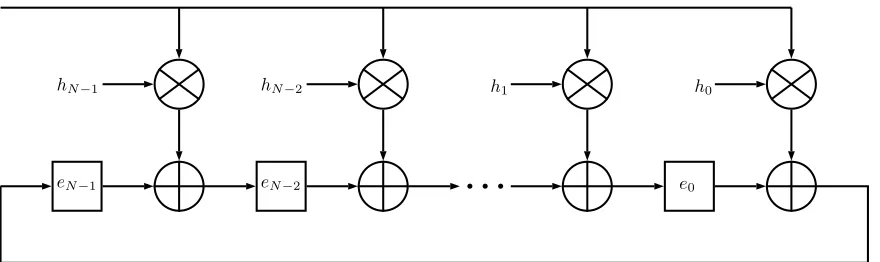
An LFSR structure is given in Fig.5.1. It is determined by a characteristic
poly-nomial f(x), which can be expressed as
In Fig.5.1, ⊕refers to an adder and ⊗refers to a multiplier. Besides,represents
a register. If we suppose that the registers are loaded with the coefficients of a
polynomiala(x) = (an−1, ..., a0), a shift-to-right operation equals to performa(x)×x
mod f(x), where x is the root of its characteristic polynomial f(x).
b
f1 f2 fn−1
b
b
a0 a1 an−1
Fig. 5.1: Linear Feedback Shift Register
5.1.2 Truncated Polynomial Ring Multiplier
A truncated polynomial ring multiplier was proposed in [15]. Some modification is
made to the LFSR structure to realize this function.
Assume that a register content ek(k = 0, ..., N −1) at clock cyclej is denoted by
e(kj). The detailed steps to implement truncated polynomial multiplication are given in Algorithm 5.1. In this algorithm, two inputs are polynomial h(x) and r(x), each
with N coefficients and the output is the result polynomial e(x) with N coefficients.
Algorithm 5.1 Multiplication in Truncated Polynomial Ring Input: h=hN−1, ..., h0, r=rN−1, ..., r0
Output: e=hr=eN−1, ..., e0
1: e(0) := 0
2: for j := 1 to N do
3: for i:= 0 toN −1 do
4: e(ij) :=ei(+1 modj−1) N +hi+1 modN ×rj−1 mod q
5: end for
6: end for
7: return e:=e(N)
An architecture for this multiplier is shown in Fig.5.2. In this multiplier, N
the form of 2n, modular q operation can be easily achieved by truncating the result
to n bits and all the operations including addition and multiplication are performed
without any carry. The registers e = (eN−1, ..., e0) are initially loaded with 0. The
coefficients of the polynomial h(x) are input to each multiplier in parallel while the
coefficients of the polynomialr(x) are input to all multipliers in a serial fashion. After
N clock cycles, the multiplication result ofh(x)×r(x) will be stored in the registers
e= (eN−1, ..., e0).
b b b
eN−1 eN−2 e0
hN−1 hN−2 h1 h0
rN−1, rN−2, ..., r1, r0
Fig. 5.2: Truncated Polynomial Ring Multiplier
5.1.3 Proposed x2-net Architecture
The core architecture in the truncated polynomial ring multiplier is called x-net
ar-chitecture, which is presented in Fig.5.3. In x-net architecture, a register content
ek(k= 0, ..., N −1) at clock cycle j is denoted by ek(j). (hN−1, ..., h0) are the
corre-sponding coefficients of the polynomial h(x) and ri stands for the ith coefficient of
the polynomial r(x), which acts as a control input at clock cycle i+ 1. We treat one
adder and one multiplier as an arithmetic unit and totally there are N arithmetic
hN−1 hN−2 h0
b
e(Nj−−1)1 e
(j−1)
N−2 e(1j−1) e(0j−1)
e(Nj)−1 e
(j)
N−2 e(1j) e (j) 0
e(Nj)−3
b b b b b
b b b
b b b
hN−3 h1
e(Nj−−1)3
ri
e(Nj)−4
b b b
Arithmetic Unit
Fig. 5.3: x-net Architecture
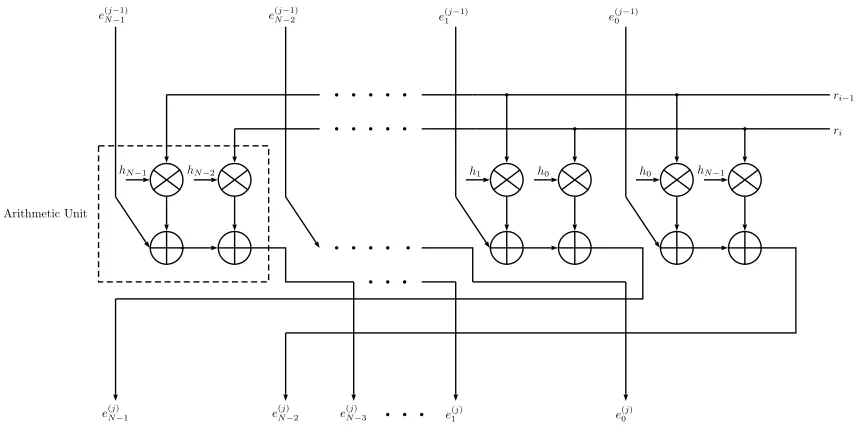
In order to optimize x-net architecture, we propose a new design called x2-net
architecture, which is given in Fig.5.4. In x2-net architecture, a register content
ek(k= 0, .., N−1) at clock cycle j is denoted by ek(j) and (hN−1, ..., h0) are the
cor-responding coefficients of the polynomialh(x). One difference is that this new design
keeps the inputri but also requires a new inputri−1, which is the (i−1)th coefficient
of the polynomialr(x). Moreover, the size of one arithmetic unit is doubled that two
adders and two multipliers are required. However, the total number of arithmetic
units remains N. In each arithmetic unit, totally five inputs are required, two more
than those in x-net architecture while the output is kept the same. Another
mod-ification is the shift-to-right operation. x-net architecture multiplies with x in one
shift-to-right operation while the x2-net architecture multiplies with x2 in one
shift-to-right operation. Two coefficients of the polynomial r(x) can be processed during
hN−1 hN−2 h1 h0 h0 hN−1
b
b
b
b
e(Nj−−1)1 e (j−1)
N−2 e (j−1)
1 e
(j−1) 0
e(j)
N−1 e (j)
N−2 e(1j) e (j) 0 e(j)
N−3
b b b b b
b b b b b
b b b b b
b b b
ri
ri−1
Arithmetic Unit
b b b
Fig. 5.4: x2-net Architecture
5.1.4 Proposed Arithmetic Unit
In the encryption, since the coefficients of the polynomial r(x) are selected from the
set {−1,0,1}, the multiplication h(x)×r(x) can be evaluated without any integer
multiplication. More specific, these multiplication operations can be replaced with
only addition and subtraction operations. Meanwhile, as mentioned before, since the
parameter q is in the form of 2n, modular q operation can be achieved by
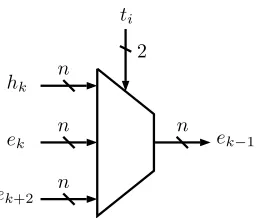
truncat-ing the result to n bits. An optimized design for the arithmetic unit in our x2-net architecture is proposed in Fig.5.5.
2 2
hk hk−1
n n n n n n n n ri
ri−1
4
ek−2
ek hk
hk−1
riri−1
ek ek−2
n
Fig. 5.5: Proposed Arithmetic Unit
![Table 2.1: Recommended Parameters for NTRUEncrypt [1]](https://thumb-us.123doks.com/thumbv2/123dok_us/1383169.1170988/25.612.156.490.242.455/table-recommended-parameters-for-ntruencrypt.webp)