Abstract
CREWS, HUGH BATES. Fast FSR Methods for Second-Order Linear Regression Models. (Under the direction of Leonard Stefanski and Dennis Boos.)
Many variable selection techniques have been developed that focus on first-order
linear regression models. In some applications, such as modeling response surfaces,
fitting second-order terms can improve predictive accuracy. However, the number of
spurious interactions can be large leading to poor results with many methods. We focus
on forward selection, describing algorithms that use the natural hierarchy existing in
second-order linear regression models to limit spurious interactions. We then develop
stopping rules by extending False Selection Rate methodology to these algorithms.
In addition, we describe alternative estimation methods for fitting regression
mod-els including the LASSO, CART, and MARS. We also propose a general method for
controlling multiple-group false selection rates, which we apply to second-order linear
regression models. By estimating a separate entry level for first-order and
second-order terms, we obtain equal contributions to the false selection rate from each group.
We compare the methods via Monte Carlo simulation and apply them to optimizing
Fast FSR Methods for Second-Order Linear Regression Models
by Hugh Crews
A dissertation submitted to the Graduate Faculty of North Carolina State University
in partial fulfillment of the requirements for the Degree of
Doctor of Philosophy
Statistics
Raleigh, North Carolina
April 28, 2008
APPROVED BY:
Dr. Leonard Stefanski (Co-chair) Dr. Dennis Boos (Co-chair)
Dedication
Biography
Hugh Crews was born on March 1, 1982 in Wilmington, NC. After graduating from
New Hanover High School in 2000, he began his undergraduate work at North Carolina
State University in statistics. In May 2003, Hugh completed his Bachelor of Science
degree in statistics. After completing this degree, he decided to continue his graduate
work at NCSU. Hugh completed his Master of Statistics degree in May 2005 and
began working toward a doctoral degree. After finishing coursework, he began his
research under the direction of Dr. Leonard Stefanski and Dr. Dennis Boos. As a
college student, Hugh had the opportunity to teach an introductory statistics course,
advise undergraduates majoring in statistics, work on an air pollution problem with
Acknowledgements
First, I would like to thank my advisors Dr. Leonard Stefanski and Dr. Dennis Boos for
their guidance and support throughout my graduate career. As professors, they inspired
me to learn statistics, but as advisors, they challenged me to grow as a statistician.
I am thankful for my committee members who have taken time to contribute to my
research. I would also like to thank Dr. Bill Swallow who advised me through my years
as an undergraduate and convinced me to pursue a doctoral degree. I would also like
to thank the faculty and staff in the statistics department for making our department
a great learning environment.
I would like to thank SAS for employing me many summers and supporting me as
an undergraduate SAS Scholar. I would also like to thank GlaxoSmithKline for their
generous award which I received in my first year of graduate school. I must also thank
the National Science Foundation for supporting research in statistics.
I must thank Ben Ogorek for mentoring me in my first few years as a graduate
student. Without his help, I would not have grasped many of the key concepts in
statistics. I would also like to thank Clay Barker for mentoring me in the last few
years. He answered my numerous questions promptly and offered encouragement. His
support these last few years has gotten me through many tough situations. I would
like to thank Staples, Jeff, West, Brett, Brent, Scotty, Steve, and Jonah for running
with me throughout the years. I am grateful for Steve, Emily, David, Michael, McKay,
Darryl, and Joe, all of whom I met in graduate school. Finally, I must thank Mike,
college.
I must thank Marty Sugerik for introducing me to the field of statistics during my
time in high school. He was the first teacher to show me that mathematics has many
interesting applications.
Most importantly, I must thank my family for their support and encouragement
throughout my life. No matter what I pursue, they always show interest and support.
I am thankful for my brother and sister who always spend time with me when I visit
Wilmington. My father has been a great inspiration to me. He has always trusted
me to do what was best for myself and is always available for help, wisdom, and
Table of Contents
List of Tables . . . x
List of Figures . . . xiv
1 Modeling Interactions in Regression Analysis . . . 1
1.1 Introduction . . . 1
1.2 Issues with Interactions in Regression . . . 2
1.3 Subset Selection Methods . . . 4
1.4 No Hierarchy . . . 6
1.5 Strong Hierarchy . . . 7
1.6 Weak Hierarchy . . . 9
2 Other Modeling Techniques . . . 11
2.1 Regression with Shrinkage . . . 11
2.1.1 Nonnegative Garrote . . . 12
2.1.2 Least Absolute Shrinkage and Selection Operator . . . 14
2.2 Recursive Partitioning . . . 14
2.2.1 Automatic Interaction Detection . . . 14
2.2.2 Classification and Regression Trees . . . 17
2.2.4 Other Techniques . . . 21
2.3 Multivariate Adaptive Regression Splines . . . 23
3 Fast False Selection Rate . . . 28
3.1 Introduction to Fast False Selection Rate . . . 28
3.1.1 Calculating Alpha Grid . . . 31
3.1.2 Choosing Alpha . . . 33
3.2 False Selection Rate for Interactions . . . 35
3.3 No Hierarchy with Fast FSR . . . 36
3.4 Hierarchy Methods with Fast FSR . . . 37
3.5 Fast FSR Summary . . . 37
4 Controlling Group False Selection Rates . . . 39
4.1 Forward Selection with Group Entry-Levels . . . 39
4.1.1 Example . . . 41
4.2 Adjustment Method 1 . . . 41
4.2.1 Summary of Algorithm for Adjustment Method 1 . . . 47
4.3 Adjustment Method 2 . . . 47
4.3.1 Summary of Algorithm for Adjustment Method 2 . . . 49
4.4 Weak Hierarchy with Adjustment Method 2 . . . 49
4.4.1 Summary of Algorithm for Weak Hierarchy with Adjustment Method 2 . . . 51
5 Comparison of Methods . . . 54
5.1 Power and Predictability . . . 54
5.2 Interpretability . . . 55
5.3 Simulation Design . . . 55
5.3.1 Methods and Stopping Rules . . . 56
5.3.2 Data Generation . . . 58
5.3.3 Measures of Interest . . . 60
5.4 Simulation Results . . . 62
5.4.1 Overall Performance by Method . . . 63
5.4.2 Overall Performance by Model . . . 71
5.4.3 Comparison of Other Factors . . . 72
5.4.4 Adjustment Methods . . . 74
6 Applications . . . 77
6.1 Response Surface Study . . . 77
6.1.1 Introduction . . . 77
6.1.2 Simulation Design . . . 79
6.1.3 Measures of Interest . . . 81
6.1.4 Simulation Results . . . 81
6.2 Real Data Examples . . . 85
6.2.1 Cutinase Study . . . 85
6.2.2 Lipase Study . . . 88
6.2.4 Pyrimidine Study . . . 95
6.2.5 Triazine Study . . . 96
7 Conclusions . . . 104
Appendix . . . 111
Appendix A Simulation Results . . . 112
A.1 Results for Chapter 5 Simulation Study . . . 112
A.2 Results for Chapter 6 Simulation Study . . . 112
Appendix B Response Surface Designs . . . 144
List of Tables
Table 3.1 Example of Forward Sequence . . . 32
Table 3.2 Example of Alpha Grid . . . 35
Table 4.1 Forward Selection Step 1 . . . 42
Table 4.2 Forward Selection Step 2 . . . 42
Table 4.3 Forward Selection Step 3 . . . 43
Table 4.4 Forward Selection Step 4 . . . 43
Table 5.1 Methods and Stopping Rules . . . 57
Table 5.2 Method Abbreviations . . . 57
Table 6.1 Optimal Levels for Small Composite Design with 10 Factors . . . 81
Table 6.2 Optimal Levels for Central Composite Design with 8 Factors . . 81
Table 6.3 Variables in Cutinase Study . . . 85
Table 6.4 Model Summaries for Cutinase Production . . . 87
Table 6.5 Optimal Levels and Maximum Cutinase Production . . . 87
Table 6.6 Variables in Lipase Study . . . 88
Table 6.7 Model Summaries for Lipase Production . . . 89
Table 6.8 Model Summaries for Specific Activity . . . 90
Table 6.9 Type III p-values for Rathi et al. Models . . . 92
Table 6.10 Optimal Levels for Maximum Lipase Production . . . 93
Table 6.11 Optimal Levels for Maximum Specific Activity . . . 93
Table 6.13 Model Summaries for Disease Progression . . . 95
Table 6.14 Variables in Pyrimidine Study . . . 97
Table 6.15 Variables in Pyrimidine Study Continued . . . 98
Table 6.16 Model Summaries for Pyrimidine Activity . . . 98
Table 6.17 Effects Selected for Pyrimidine Activity . . . 99
Table 6.18 Variables in Triazine Study . . . 100
Table 6.19 Variables in Triazine Study Continued . . . 101
Table 6.20 Variables in Triazine Study Continued . . . 102
Table 6.21 Model Summaries for Triazine Activity . . . 102
Table 6.22 Effects Selected for Triazine Activity . . . 103
Table A.1 Comparison of Methods: Normal Uncorrelated, Model 1, R2 = 0.25 . . . 113
Table A.2 Comparison of Methods: Normal Uncorrelated, Model 2, R2 = 0.25 . . . 114
Table A.3 Comparison of Methods: Normal Uncorrelated, Model 3, R2 = 0.25 . . . 115
Table A.4 Comparison of Methods: Normal Correlated, Model 1,R2 = 0.25 116 Table A.5 Comparison of Methods: Normal Correlated, Model 2,R2 = 0.25 117 Table A.6 Comparison of Methods: Normal Correlated, Model 3,R2 = 0.25 118 Table A.7 Comparison of Methods: Chi Square Uncorrelated, Model 1, R2 = 0.25 . . . 119
Table A.9 Comparison of Methods: Chi Square Uncorrelated, Model 3,
R2 = 0.25 . . . 121
Table A.10 Comparison of Methods: Chi Square Correlated, Model 1,
R2 = 0.25 . . . 122
Table A.11 Comparison of Methods: Chi Square Correlated, Model 2,
R2 = 0.25 . . . 123
Table A.12 Comparison of Methods: Chi Square Correlated, Model 3,
R2 = 0.25 . . . 124
Table A.13 Comparison of Methods: Normal Uncorrelated, Model 1,
R2 = 0.5 . . . 125
Table A.14 Comparison of Methods: Normal Uncorrelated, Model 2,
R2 = 0.5 . . . 126
Table A.15 Comparison of Methods: Normal Uncorrelated, Model 3,
R2 = 0.5 . . . 127
Table A.16 Comparison of Methods: Normal Correlated, Model 1,R2 = 0.5 128
Table A.17 Comparison of Methods: Normal Correlated, Model 2,R2 = 0.5 . 129 Table A.18 Comparison of Methods: Normal Correlated, Model 3,R2 = 0.5 . 130
Table A.19 Comparison of Methods: Chi Square Uncorrelated, Model 1,
R2 = 0.5 . . . 131
Table A.20 Comparison of Methods: Chi Square Uncorrelated, Model 2,
R2 = 0.5 . . . 132
Table A.21 Comparison of Methods: Chi Square Uncorrelated, Model 3,
Table A.22 Comparison of Methods: Chi Square Correlated, Model 1,
R2 = 0.5 . . . 134
Table A.23 Comparison of Methods: Chi Square Correlated, Model 2, R2 = 0.5 . . . 135
Table A.24 Comparison of Methods: Chi Square Correlated, Model 3, R2 = 0.5 . . . 136
Table A.25 Comparison of Methods for Model 1a . . . 140
Table A.26 Comparison of Methods for Model 1b . . . 141
Table A.27 Comparison of Methods for Model 2a . . . 142
Table A.28 Comparison of Methods for Model 2b . . . 143
Table B.1 Small Composite Design with 10 Factors (Runs 1-25) . . . 145
Table B.2 Small Composite Design with 10 Factors (Runs 26-50) . . . 146
Table B.3 Small Composite Design with 10 Factors (Runs 51-73) . . . 147
Table B.4 Orthogonal Central Composite Design with 8 Factors (Runs 1-25) . . . 148
Table B.5 Orthogonal Central Composite Design with 8 Factors (Runs 26-50) . . . 149
Table B.6 Orthogonal Central Composite Design with 8 Factors (Runs 51-75) . . . 150
List of Figures
Figure 3.1 Example of step function for model size by α. •indicates the closed lower bound for α corresponding to a specific model size.
◦indicates the open upper bound forα corresponding to specific model size. . . 33
Figure 3.2 Example plot of ˆγf ast(α) by α . . . 36
Figure 5.1 Correlation matrix for simulation study . . . 59
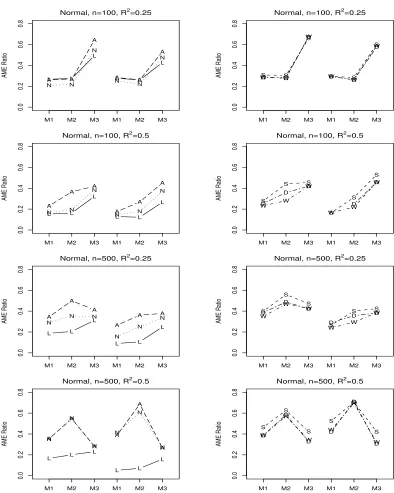
Figure 5.2 AME ratio (larger is better) using Normal predictors for LASSO
(L), FFSR-NH (N), FFSR-SH (S), FFSR-WH (W), FFSR-NHA2
(A), and FFSR-WHA2 (D). The first three values in each plot
are uncorrelated predictors and the last three values are
correlated predictors. . . 64
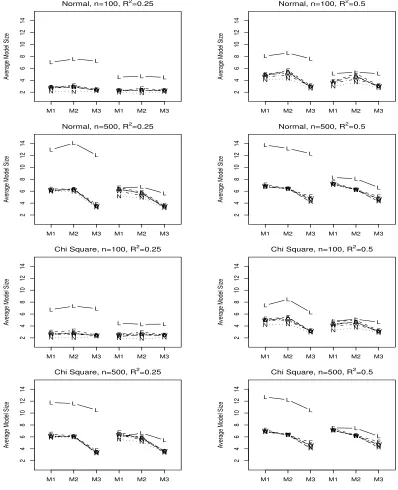
Figure 5.3 Average model size for LASSO (L), FFSR-NH (N), FFSR-SH
(S), FFSR-WH (W), FFSR-NHA2 (A), and FFSR-WHA2 (D).
The first three values in each plot are uncorrelated predictors and
the last three values are correlated predictors. . . 65
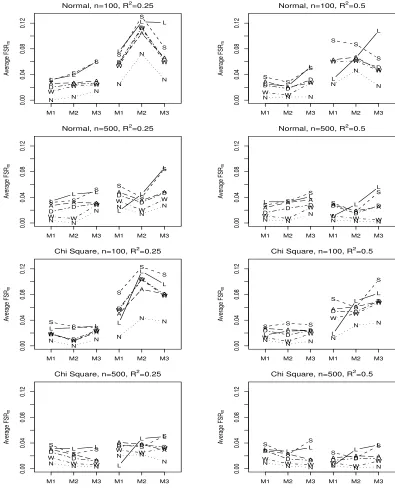
Figure 5.4 Average F SRm for LASSO (L), FFSR-NH (N), FFSR-SH (S),
FFSR-WH (W), FFSR-NHA2 (A), and FFSR-WHA2 (D). The
first three values in each plot are uncorrelated predictors and the
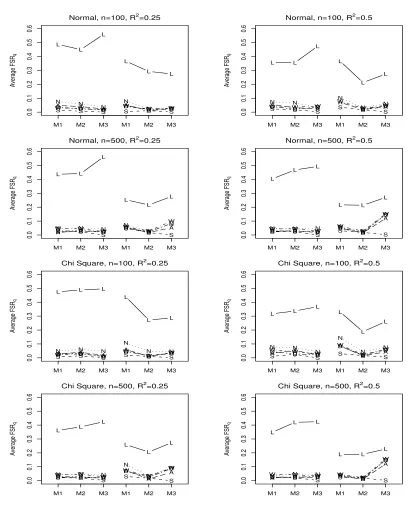
Figure 5.5 Average F SRq for LASSO (L), FFSR-NH (N), FFSR-SH (S),
FFSR-WH (W), FFSR-NHA2 (A), and FFSR-WHA2 (D). The
first three values in each plot are uncorrelated predictors and the
last three values are correlated predictors. . . 67
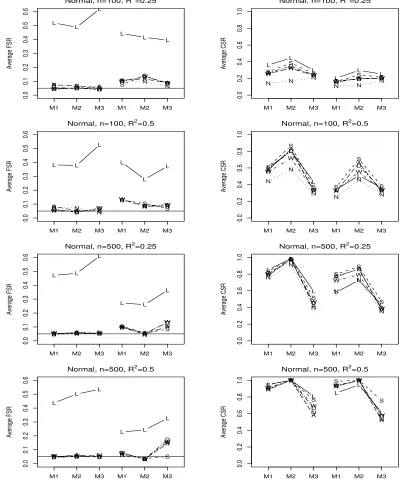
Figure 5.6 Average FSR (left) and CSR (right) using Normal predictors
for LASSO (L), FFSR-NH (N), FFSR-SH (S), FFSR-WH (W),
FFSR-NHA2 (A), and FFSR-WHA2 (D). The first three values
in each plot are uncorrelated predictors and the last three values
are correlated predictors. . . 68
Figure 5.7 Average CF for LASSO (L), NH (N), SH (S),
FFSR-WH (W), FFSR-NHA2 (A), and FFSR-FFSR-WHA2 (D). The first
three values in each plot are uncorrelated predictors and the last
three values are correlated predictors. . . 69
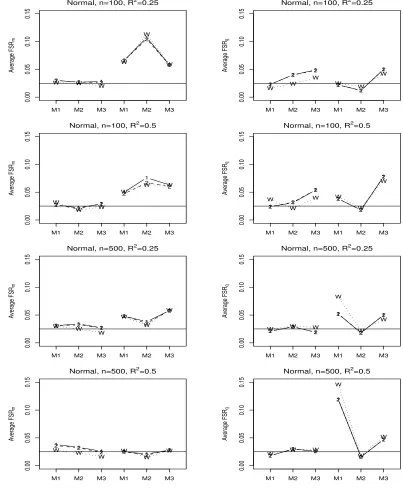
Figure 5.8 Comparison of average F SRm (left) andF SRq (right) using
Normal predictors for FFSR-NHA1 (1), FFSR-NHA2 (2), and
FFSR-WHA2 (W). The first three values in each plot are
uncorrelated predictors and the second three values are correlated
predictors. . . 76
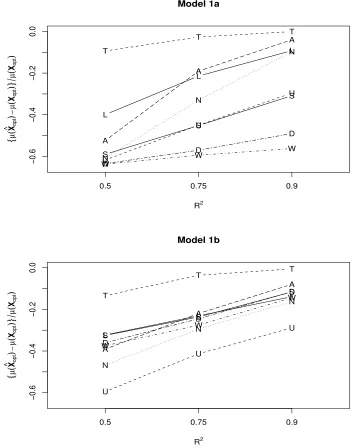
Figure 6.1 Scaled average difference in actual and optimal performance for
Model 1. True Model (T), Standard Approach (U), LASSO (L),
FFSR-NH (N), FFSR-SH (S), FFSR-WH (W), FFSR-NHA2 (A),
Figure 6.2 Scaled average difference in actual and optimal performance for
Model 2. True Model (T), Standard Approach (U), LASSO (L),
FFSR-NH (N), FFSR-SH (S), FFSR-WH (W), FFSR-NHA2 (A),
and FFSR-WHA2 (D). . . 84
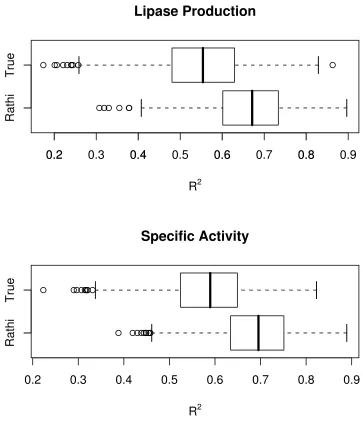
Figure 6.3 Boxplots of simulatedR2 values for lipase production and specific
activity . . . 91
Figure A.1 AME ratio (larger is better) using Chi Square predictors for
LASSO (L), FFSR-NH (N), FFSR-SH (S), FFSR-WH (W),
FFSR-NHA2 (A), and FFSR-WHA2 (D). The first three values
in each plot are uncorrelated predictors and the last three values
are correlated predictors. . . 137
Figure A.2 Average FSR (left) and CSR (right) using Chi Square predictors
for LASSO (L), FFSR-NH (N), FFSR-SH (S), FFSR-WH (W),
FFSR-NHA2 (A), and FFSR-WHA2 (D). The first three values
in each plot are uncorrelated predictors and the last three values
are correlated predictors. . . 138
Figure A.3 Comparison of averageF SRm (left) and F SRq (right) using Chi
Square predictors for FFSR-NHA1 (1), FFSR-NHA2 (2), and
FFSR-WHA2 (W). The first three values in each plot are
uncorrelated predictors and the last three values are correlated
Chapter 1
Modeling Interactions in Regression
Analysis
1.1
Introduction
Suppose that a researcher is interested in developing a statistical model in order to
explain the variation in a response, Y, for some population of interest. The researcher is able to collect data onY andppredictorsX1, . . . , Xp for a set ofnindividuals. There
are two main goals that could be of interest. The first is understanding the relationships
between the response variable and the predictors, and the second is predicting future
observations. Putting this in statistical terms, the model of interest is
Y =f(X1, . . . , Xp) + (1.1)
where is random error and f(·) is a real-valued function, often a linear function of the predictors. In terms of this model, the first goal is obtaining an easily interpretable
estimate of f(·) that can be used in explaining the science behind the variation in the response. The second goal is obtaining the best prediction for f(·) at fixed values of the predictor variables. Depending upon the study at hand, the researcher may focus
Chapter 1. Modeling Interactions in Regression Analysis
A great amount of recent research has been done in the area of variable and model
selection in this regression setting. However, the focus of this paper is less on variable
and model selection, in general, and more on how to approach model selection in the
presence of interactions. Thus, some background information is omitted, and it is
assumed that the reader has basic knowledge of model selection techniques. However,
a brief discussion of the problem and a summary of the model selection methods can
be found in George (2000). For a more in-depth reference, refer to Miller (2002).
Much of the past research has been on simply choosing the best subset of
vari-ables in fitting the linear model f(X1, . . . , Xp) = β0 +Ppj=1βjXj. However, in the
real world more complex relationships between the response and the predictors exist.
Thus the next logical step in the model fitting process is to include all pairwise
in-teractions and quadratic effects, expanding the model of interest to f(X1, . . . , Xp) =
β0 +Ppj=1βjXj+P p
j≤kβj,kXjXk. Of course the three-way interactions, four-way
in-teractions, etc., could be added increasing the complexity of the problem. However,
merely including the second-order effects greatly increases the space of response
sur-faces and provides sufficient flexibility for fitting a variety of models.
1.2
Issues with Interactions in Regression
Since linear models are the most widely used and best understood regression models,
it is of interest to discuss how these methods handle interactions. We first describe
certain problems encountered when fitting linear regression models when interactions
are present. These problems reveal the two most common strategies currently employed
Chapter 1. Modeling Interactions in Regression Analysis
variable, whereas the second is to follow the natural ordering or “hierarchy” of the
terms. An in-depth description of these approaches highlighting their advantages and
disadvantages appears in later sections.
Interactions are often much harder to detect than main effects in regression
mod-eling. Multicollinearity, measurement error, the numerous forms interactions can take,
and lack of power for detection are all problems that make interactions troublesome.
Jaccard et al. (1990) suggest centering predictors to reduce multicollinearity. They
also argue that standardizing the predictors makes causal inference troublesome. The
remainder of their suggestions for dealing with interactions are based on proper
plan-ning of experiments and using prior knowledge or scientific theory to aid in the model
selection process. However, it is often the case that the researcher is doing exploratory
analysis and has very little prior information on which variables affect the response
in a simple manner, let alone as a complex interaction. Thus, automatic methods of
variable selection such as stepwise regression, best subsets, shrinkage methods, etc.,
are appealing. They aid in identifying possible informative variables before conducting
more controlled and costly studies or experiments.
Another issue that arises when fitting interactions is that significance tests are
not invariant to linear transformations of the data. The problem occurs with the
significance tests for main effects when corresponding second-order effects are also in
the model. Uncentered main effects are often correlated with their second-order effects,
and since this correlation changes depending upon the measurement units, the Type
III significance tests for the main effects change as well. Therefore, it is possible for
two researchers with the same data in different units of measurement using the same
Chapter 1. Modeling Interactions in Regression Analysis
Griepentrog et al. (1982). As a result, many statisticians recommend keeping main
effects in the model if their interaction is significant regardless of whether the main
effect is significant. This strategy is known as “maintaining the hierarchy” and is
often associated with backward elimination of terms. Another solution to the linear
transformation problem is to first standardize the predictors. If all researchers start
by standardizing the set of predictors, then they will always choose the same model
when applying the same method on the same dataset regardless of their choice of
measurement units.
The idea of maintaining the hierarchy leads to the two most popular approaches
in the model building process when interactions are of interest. The first is enforcing
the hierarchy and the second is not enforcing the hierarchy. Enforcing the hierarchy
means that when including interaction and quadratic terms in the model, we require
their parent main effects to be included as well. The remainder of this chapter is
organized as follows. The next section provides a short discussion on some commonly
used searching algorithms: best subsets, forward selection, backward elimination, and
stepwise regression. Then the approaches of enforcing the hierarchy and no hierarchy
are discussed using forward selection, as well as some issues that arise with each.
Finally, a “weak hierarchy” approach is discussed.
1.3
Subset Selection Methods
Many different strategies have been developed for searching through the possible
mod-els. We review the most basic and commonly used algorithms. “Best subsets” refers to
Chapter 1. Modeling Interactions in Regression Analysis
such as Mallows’ Cp, Adjusted R2, Akaike’s Information Criterion (AIC), Bayesian
Information Criterion (BIC), etc. The number of possible models, 2p, increases
expo-nentially withp. Now consider including all the pairwise interactions and not enforcing the hierarchy. The number of total effects for a full quadratic is
pq = 2p+
p 2
, (1.2)
meaning that the number of subset models is 2pq. Even when enforcing the hierarchy,
the number of total subsets is large. Therefore, it should be obvious that unless p is very small, best subsets is impractical for searching models with interactions.
Forward selection starts with an intercept term and builds a model by adding terms
in a successive manner. At each step, the most informative variable is entered into the
model. The process continues entering variables until either all have been selected or
none meet the specified criterion for entry. Backward elimination starts with a full
model and removes uninformative variables one at a time. At each step a variable is
removed from the model until a stopping criterion is met or only an intercept term
remains. Backward elimination cannot be used when the number of possible terms
is greater than the sample size, which occurs more often when modeling interactions.
However, a solution to this problem is to use forward selection to build a large model
followed by backward elimination to “trim” it down. Another searching algorithm
combines forward selection with backward elimination at each step. This method,
called stepwise regression, is similar to forward selection in that in starts with an
intercept term and then builds a model. However, unlike forward selection, variables
Chapter 1. Modeling Interactions in Regression Analysis
most informative variable is entered or the most uninformative variable is removed
depending upon the criterion specified. The process proceeds one step at a time until
no variable meets the criterion for entry or removal. When including the pairwise
interactions, the number of total effects often outnumbers the sample size. For this
reason, forward selection and stepwise regression are obvious choices, since they can
be used when n < pq. The methods discussed and developed in this paper are applied
to forward selection, but they could be developed using backward elimination (when
n > pq) or stepwise regression.
1.4
No Hierarchy
Since it is often impossible to use best subsets or backward elimination, forward
selec-tion is commonly used. The simplest approach for fitting interacselec-tions using forward
selection is the no hierarchy approach where no restrictions are placed on the model.
Forward selection runs freely and can select any effect whether linear, quadratic, or
interaction regardless of the step in the model. That is, each term is a possible
candi-date for entry at the beginning of the forward selection process. Each term is treated
as a separate variable and selected according to the entry criterion.
There are three major problems with not enforcing the hierarchy. The first is
the tendency to choose larger and more complex models for a fixed α. As previously noted, each of the terms is treated as a separate variable, so that there arepq candidate
variables for entry on the first step. With so many more candidate variables at each
step, there is a higher expected number of selected variables than when only choosing
Chapter 1. Modeling Interactions in Regression Analysis
α entry-level =α0. Then for a model where none of the effects are truly important, the
probability for any single term to be entered is α0. When selecting from only p linear
terms, the expected model size is 1 +pα0, where 1 is added for the intercept. When
selecting from all linear, quadratic, and pairwise interaction terms at the beginning of
the selection process, the expected model size increases to 1 +pqα0. Also note that asp
grows, the pairwise interactions outnumber the linear terms, so there is a tendency to
choose them. Thus, not only are these models being overfitted, but they are often more
complex. A second problem with not maintaining the hierarchy is that the method
is not invariant to linear transformations of the predictors. However, henceforth we
suggest that the predictors be centered or standardized in order to avoid the lack of
invariance.
A third problem is that the quadratic or interaction effects and their corresponding
main effects are often highly correlated. This problem is greatly alleviated by centering
the predictors before creating the second-order terms. However, for highly skewed
pre-dictors, centering does not fully solve the problem. An alternative solution is sweeping
out the linear effects from each of the second-order effects and replace them with the
corresponding residuals. To sweep out the linear effects for quadratic terms, replace
X2
j with ˆ from the regression of Xj2 onto Xj. For interactions, replace XjXk with ˆ
from the regression of XjXk ontoXj and Xk.
1.5
Strong Hierarchy
A standard approach for finding informative interactions is to maintain the
Chapter 1. Modeling Interactions in Regression Analysis
then an interaction cannot be selected until both of its parent main effects are in the
model. Similarly, a quadratic term cannot be selected until its parent main effect is
in the model. Therefore, given the effects in the model, a candidate set of effects can
be formed. Only effects from this candidate set can be entered into the model. An
algorithm for forward selection with strong hierarchy is given below. Note that the
algorithm is limited to second-order terms.
1. Starting with an intercept term in the model, the candidate set includes all main
effects X1, . . . , Xp. Select the most informative effect from this set for model entry.
2. Suppose Xk is chosen in Step 1. Then the candidate set includes all remaining main
effects Xj, j 6=k and the quadratic effectXk2. Select the most informative effect from
this set for model entry.
3a. Suppose Xl is chosen at Step 2. Then the candidate set includes all remaining
main effects Xj, j 6=k and j =6 l, the quadratic terms Xk2 and Xl2, and the interaction
XkXl. Select the most informative effect from this set for model entry.
3b. Suppose Xk2 is chosen at Step 2. Then the candidate set includes all remaining
main effectsXj, j 6=k. Select the most informative effect from this set for model entry.
Proceed accordingly, adding new quadratic effects to the candidate set once their
par-ent main effect is selected and pairwise interactions once both parpar-ent main effects are
selected for the model.
Peixoto (1987) promotes using this practice of maintaining the hierarchy when
searching for the best model by forward, backward, or stepwise regression. He refers to
search-Chapter 1. Modeling Interactions in Regression Analysis
ing for such models. Stepwise regression would work just like the previous algorithm,
except at any given step a main effect cannot be removed unless there are no
second-order effects containing it currently in the model.
The advantage of the strong hierarchy is that it both enforces the hierarchy and
tends to choose smaller, less complex models since it does not select pairwise
interac-tions until both main effects have entered the model. The disadvantage of the strong
hierarchy is that there is no chance for important interaction terms to be included
unless both parent main effects are already in the model.
1.6
Weak Hierarchy
A less restrictive alternative to enforcing the hierarchy is to allow pairwise interactions
to enter the model once at least one of their parent main effects is included in the
model. Again, given the effects in the model, a candidate set of effects can be formed.
This method is employed in MARS (Friedman, 1991) and Penalized Logistic
Regres-sion (Park and Hastie, 2006). An algorithm for forward selection with weak hierarchy
is as follows. Note that the algorithm is limited to second-order terms.
1. Starting with an intercept term in the model, the candidate set includes all main
effects X1, . . . , Xp. Select the most informative effect from this set for model entry.
2. Suppose Xk is chosen in Step 1. Then the candidate set includes all remaining main
effects Xj, j 6= k, the quadratic effect Xk2, and all pairwise interactions of the form
XjXk, j 6=k. Select the most informative effect from this set for model entry.
Chapter 1. Modeling Interactions in Regression Analysis
main effects Xj, j 6= k and j =6 l, the quadratic effects Xk2 and Xl2, and all pairwise
interactions containing either Xk or Xl. Select the most informative effect from this
set for model entry.
3b. Suppose X2
k is chosen at Step 2. Then the candidate set includes all remaining
main effects Xj, j 6=k and all interactions of the form XjXk, j 6=k. Select the most
informative effect from this set for model entry.
3c. Suppose XlXk is chosen at Step 2. Then the candidate set includes all remaining
main effects Xj, j 6=k,the quadratic effect Xk2, and all interactions of the form XjXk,
j 6=k and j 6=l. Select the most informative effect from this set for model entry. Proceed accordingly, considering new quadratic effects once the parent main effect is
selected and pairwise interactions once either of the parent main effects is selected for
the model.
In terms of selecting interactions, the weak hierarchy approach provides a good
balance between enforcing the strong hierarchy and no hierarchy. The major weakness
of the strong hierarchy method is that it can miss important interactions, especially
in noisy models where both main effects are hard to detect. By making the selection
process less restrictive, the weak hierarchy suffers less in these cases. However, there is
no guarantee that all informative interactions will enter the candidate set early in the
selection process. The cost of making it easier for interactions to enter is that the weak
hierarchy still adds a large number of interactions to the candidate set. Therefore,
Chapter 2
Other Modeling Techniques
This chapter describes some alternative methods for estimating the regression function
f(X1, . . . , Xp). The first section is a short discussion of regression with shrinkage
focus-ing on the nonnegative garrote, the least absolute shrinkage and selection operator, and
some related methods followed by a discussion of recursive partitioning methods
lead-ing to Classification and Regression Trees. Finally, Multivariate Adaptive Regression
Splines that combines recursive partitioning with splines, is described.
2.1
Regression with Shrinkage
For some data sets, variable selection is not robust in the sense that small changes
in the data can result in very different models. Such instability can adversely affect
predictions. Therefore, alternative methods have been developed that are more stable.
Instead of estimating coefficients for a chosen subset of variables, these methods shrink
each variable’s coefficient. If some of the coefficients are shrunk to zero, then variable
selection is inherently conducted. In some sense, subset selection can be viewed as a
shrinkage method that selectively shrinks some coefficients to zero, while estimating
the others using ordinary least squares regression.
Chapter 2. Other Modeling Techniques
of squared beta coefficients when solving the normal equations. That is, it minimizes
n
X
i=1
(Yi−β0−
p
X
j=1
βjxij)2 (2.1)
subject to Ppj=1β2
j ≤ s where s ≥ 0. Although ridge regression improves prediction
accuracy, its models are more difficult to interpret than subset selection methods since
ridge regression models retain all pq variables.
It is important to choose the right amount of shrinkage. For some variables the
estimates change drastically for different values of s. In general, the coefficients are shrunk more for small values of s than large values. A standard way to estimate s is though cross validation or generalized cross validation.
2.1.1
Nonnegative Garrote
One limitation of ridge regression is that it does not perform variable selection, and
therefore its models are often difficult to interpret. The nonnegative garrote (Breiman,
1995) was proposed in order to combine variable selection and shrinkage. It minimizes
n
X
i=1
(Yi−β0 −
p
X
j=1
cjβˆjolsxij)2 (2.2)
subject tocj ≥0 andPpj=1cj ≤s. From (2.2) we see that the nonnegative garrote takes
the ordinary least squares estimates, ˆβols
j , and shrinks them using a different scaling
factor for each coefficient. Unlike ridge regression it shrinks some of the coefficients
to zero which leads to simpler models. The nonnegative garrote has predictive ability
Chapter 2. Other Modeling Techniques
In its original form, the nonnegative garrote enforces no hierarchy. Therefore, it
suffers from the same problems as forward selection with no hierarchy as described in
Chapter 1. However, adaptations of the nonnegative garrote have been developed to
handle interactions. Both the strong and weak hierarchy approaches have been applied
to the nonnegative garrote (Yuan et al., 2007b). With the strong and weak hierarchy
algorithms, main effects must be included in order for their interactions and quadratic
terms to be included in the model.
For the strong hierarchy, an additional constraint requires the scaling factor for a
quadratic term to be less than or equal to the scaling factor for its parent main effect.
Similarly, the scaling factor for an interaction must be less than or equal to both scaling
factors for its parent main effects. Let cj be the scaling factor for any main effect Xj
andcj,k be the scaling factor for a second-order termXjXk. Then the constraints imply
that cj,j ≤ cj for quadratic terms, and both cj,k ≤ cj and cj,k ≤ ck for interactions.
Any variable is included in the model if its scaling factor is nonzero. Therefore, with
the strong hierarchy imposed, any main effect cannot have scaling factor equal zero if
the scaling factor for any of its second-order terms is nonzero.
For the weak hierarchy, the constraint is changed so that for interactions the scaling
factor must be less than or equal to the sum of the scaling factors for its parent main
effects. That is, if XjXk is an interaction in the model, thencj,k ≤cj+ck. As a result,
any interaction in the model must have at least one of its parent main effects with a
Chapter 2. Other Modeling Techniques
2.1.2
Least Absolute Shrinkage and Selection Operator
The least absolute shrinkage and selection operator (LASSO) (Tibshirani, 1996) also
combines variable selection and shrinkage. The LASSO works by constraining the sum
of absolute beta coefficients when solving the normal equations. It imposes an L1
penalty on the least squares estimate, whereas ridge regression imposes an L2 penalty.
That is, the LASSO minimizes (2.1) subject to Ppj=1|βj| ≤ s for some s ≥ 0. Like
the nonnegative garrote, the LASSO can shrink some of the coefficients to zero. An
advantage of the LASSO is that it avoids the ordinary least squares estimates that can
be adversely affected by multicollinearity.
The LASSO is a special case of least angle regression (LARS) (Efron et al., 2004).
Under a simple modification, LARS can be used to obtain the LASSO solution. Like
the nonnegative garrote, constraints can be added in order to achieve strong or weak
hierarchy with LARS (Yuan et al., 2007a). Some other extensions of the LASSO include
SCAD (Fan and Li, 2001) and the Adaptive LASSO (Zou, 2006) which both modify
the penalization constraint.
2.2
Recursive Partitioning
2.2.1
Automatic Interaction Detection
Tree-based regression techniques trace their heritage to the method called Automatic
Interaction Detection (AID) (Morgan and Sonquist, 1963). The basic idea of the
method is very simple: partition or split the data set into groups of similar responses
Chapter 2. Other Modeling Techniques
real-value a creates the groups Xi ≤ a and Xi > a. These groups or nodes are also
called tL and tR respectively. For each predictor, there exists at most n−1 of these
binary splits that result in different groupings of the actual observations. The goal is to
choose these splits to best explain the variation in the response. The basic algorithm
is given below.
1. Start with a single group ts containing all observations. Define the unexplained
variation for a group t as
R(t) = X
Xi∈t
(Yi−Yt)2 (2.3)
For ts, R(ts) =Pin=1(Yi−Yts)
2 is the total sum of squares.
2. Split the data into two groups, tL and tR, that minimize the sum of squared errors.
That is, search all predictors for the binary split such that
∆R =R(t)−R(tL)−R(tR) (2.4)
is maximized.
3. Make sure that the reduction is greater than 1% of the total sum of squares. That
is, ∆R >0.01Pni=1(Yi−Yt)2. If not, then stop the splitting process.
4. Of the two groups,t1andt2, select the grouptwith the largest unexplained variation.
Search all possible nonoverlapping splits and choose the one that maximizes (2.4). Split
the group if the reduction, ∆R, is greater than 1% of the total sum of squares.
5. Continue searching and splitting groups until no group is more than 2% of the total
sum of squares.
Chapter 2. Other Modeling Techniques
in that group. That is,
b
Yt=n−t1
X
Xi∈t
Yi. (2.5)
Sonquist (1969) notes that AID is analogous to the sequential use of one-way
Anal-ysis of Variance (ANOVA) where the goal is to split the data into groups whose means
explain as much of the variation within the group as possible. He suggests the use of
AID to identify important interactions, but still recommends the use of scientific theory
to avoid interactions that make no sense. In response to this suggestion, Staelin (1970)
promotes the use of Tukey’s test for additivity to test for the presence of interactions.
Although AID was met with much enthusiasm, it was by no means flawless. Doyle
(1973) noted that:
1. By splitting the data, larger sample sizes are necessary to achieve high power
to detect effects.
2. Multicollinearity leads to spurious results.
3. Selection bias is created when building a model using a forward searching algorithm.
4. Selection bias is highly affected by noise such as measurement error in the
predic-tors.
5. Skewed predictors can lead to spurious results.
Like many others, he suggests the use of AID as an exploratory tool to help the
re-searcher specify the form of the model. Similar to forward, backward, and stepwise
regression techniques, AID also suffers from the problem that significance testing using
selec-Chapter 2. Other Modeling Techniques
tion or the amount of smoothing for splines, the 2% stopping rule for AID is arbitrary.
A later addition to the algorithm is limiting the minimum size of a final node, which
is an arbitrary choice as well. Based on these issues, much of the research for
extend-ing tree-based methods involves the process of “growextend-ing an honest tree.” The basic
elements of tree-based prediction include selecting the variables to use for splitting,
how to split, deciding when to stop growing the tree, and determining a method for
prediction once the tree is grown. For more history of AID and an updated version
called SEARCH refer to Morgan (2005).
2.2.2
Classification and Regression Trees
There have been numerous developments to resolve the issue of how to grow regression
trees. A popular method called Classification and Regression Trees (CART) (Breiman
et al., 1998) makes use of the original AID algorithm but approaches the problem by
growing overly large trees and then pruning them based on a cross-validation approach.
CART chooses binary splits of the data like AID, but CART proceeds until every final
node has a sample size of at most nmin. By choosing a small value for nmin, typically
nmin = 5, R(t) is often minimized. The largest tree grown using this stopping rule is
referred to as Tmax.
Despite having the “smallest” unexplained variation, Tmax is an overgrown tree
and needs to be pruned. In order to form subtrees, splits are deleted by remerging
the subgroups into a single group in a backward sequential fashion. Since nodes are
nonoverlapping, they cannot be removed alone or there will be holes in the prediction
Chapter 2. Other Modeling Techniques
choosing the final tree. This measure is defined as
Rλ(t) =R(T) +λ|Te| (2.6)
where λ is a complexity parameter and |Te| equals the number of final subgroups of the tree. Rλ(t) can be thought of as unexplained error plus a penalty for complexity.
Given a sequence of λ values, 0 = λ1 < λ2 < . . . , define Tk as the smallest subtree
that minimizes Rλ(T) for λk < λ < λk+1. Note that as λ increases, smaller trees are
favored.
In order to choose the best tree from the resulting sequence of subtrees, honest
estimates of R(Tk) are needed. This is done with V-fold cross validation. The process
works by randomly dividing the data into V subsamples, L1, . . . , LV, such that each
subsample has the same number of observations (or as close as possible). For v = 1, . . . , V, create the training sample that includes all observations not in Lv, and the
validation sample, Lv. The training sample is used to grow and prune the particular
tree, and the validation sample is used to estimate R(tk). After repeating this process
for all v, the average of each R(tk) is taken, resulting in the V-fold cross validation
estimate. This can also be defined as,
RCV(T
k) =n−1 V
X
v=1
X
(Xi,Yi)∈Lv
(Yi−Y
(v)
(Tk))2. (2.7)
whereY(v)(Tk) is the mean for the terminal node corresponding to observationi in the
Chapter 2. Other Modeling Techniques
of Tmax that minimizes RCV(Tk). Define this value as
RCV(T
k0) =minkR
CV(T
k). (2.8)
However,Tk0 may not have a significantly lower value forR
CV than smaller trees. Since
smaller trees are easier to interpret and therefore favored, the final tree chosen is the
simplest tree whose estimate from (2.7) is within one standard error ofRCV(T
k0). That
is, the actual selected tree is the smallest tree such that
RCV(Tk)≤RCV(Tk0) +SE(R
CV
(Tk0)) (2.9)
where SE(RCV(T
k0)) is the standard error of the estimate from (2.8).
Understanding the importance of the variables chosen in the splitting process is
an important issue. The measure of importance employed in CART is ∆R. That
is, the variables that reduce the sum of squared errors the most are deemed the most
important. CART uses the basic idea from AID, but implements an intelligent strategy
for choosing the right-sized tree for interpretation and prediction. Breiman et al. (1998)
emphasize that CART is one method for fitting regression models, but like any other
method requires “intelligent and sensible application.”
2.2.3
Chi Square Automatic Interaction Detection
Another method for growing regression trees called Chi Square Automatic Interaction
Detection or CHAID (Perreault and Barksdale, 1980) makes use of Bonferroni adjusted
Chapter 2. Other Modeling Techniques
to the 1% rule in the original AID algorithm. Unlike AID and CART, which only
permit binary splits, CHAID allows multiple splits of a single node. This provides
more practical and interpretable results, especially for nominal predictors which can
often be divided into more than just two distinct groups.
The CHAID algorithm works in the following way. The process begins by
deter-mining the number of splits that best describe each predictor. This is accomplished by
a process of merging levels of the predictor based on similar response patterns and then
splitting them if necessary. Note that if the predictor is continuous, then it must first
be partitioned into levels. That is, the researcher must choose ranges of the predictor
that make useful groups. The partitioning must be done in such a way that any value
of the predictor will fall into only one range. The grouping process starts by a pairwise
comparison of each level, merging those that are not significant based on a Chi-Square
test. After merging is done, the final group(s) can also be split. The advantage of this
additional process is that only predictors that are best described by more than one
group are then considered for actually splitting the dataset. Once the number of splits
is determined for each predictor, a Bonferroni-adjusted Chi-Square test is conducted
for each eligible predictor. The adjustment helps deal with the issue of selection bias
where predictors with more possible splits are favored. Assuming at least one of the
tests is significant, the predictor with the smallest p-value is then chosen. The dataset is then divided based on the splits of that predictor from the grouping process. After
splitting the dataset, the process is then repeated for each subgroup. Once all groups
are too small to be split or no predictors are significant from the Chi-Square tests, then
the process ends. Like AID, the predicted value for each final subgroup is the average of
Chapter 2. Other Modeling Techniques
diagram of the process, refer to Perreault and Barksdale (1980). Extended Automatic
Interaction Detection (XAID) (Heymann, 1981) is an extension of the CHAID
algo-rithm to better handle continuous predictors. It employs two sample t-tests rather than Chi-Square tests in the merging process.
Using Chi-Square testing in a forward, semi-hierarchical manner is reminiscent of
forward hierarchical regression presented in Chapter 1. One of the issues akin to such
searching procedures is the problem of inference using the final model. However, a
com-putational algorithm that calculates bootstrap standard errors for the predictions and
their corresponding confidence intervals has been developed (van Diepen and Franses,
2006).
Computer applications for CHAID and XAID are provided via a program called
Formal Inference-based Recursive Modeling (FIRM) (Hawkins, 1999). The
documen-tation for the two algorithms, called CATFIRM and CONFIRM respectively, describes
the main issues of recursive partitioning and the differences between FIRM and CART.
2.2.4
Other Techniques
Regression trees can be divided into two main groups: trees that use binary splits and
trees that use multilevel splits. AID and CART are in the former group whereas CHAID
and XAID are in the latter. There is a long list of similar methods that advance these
two basic approaches. QUEST (Loh and Shih, 1997) is a multistage inference-based
algorithm for fitting binary trees. By using multiple stages of testing in the variable
selection process, selection bias is reduced. GUIDE (Loh, 2002) uses Chi-Square tests
Chapter 2. Other Modeling Techniques
bias. Another important aspect of GUIDE is the inclusion of a Chi-Square test for
detecting pairwise interactions. CRUISE (Kim and Loh, 2001) uses multilevel splits,
linear combination splits, and GUIDE’s interaction test to produce less complex trees
with low selection bias. Finally, LOTUS (Chan and Loh, 2004) is an algorithm for
fitting logistic regression trees. Many more partitioning or tree-based algorithms exist,
most of which deal with the issue of selection bias.
So far, the trees grown use the mean of each terminal node as the prediction for
that group. However, other methods exist that make use of other estimators. Treed
regression (Alexander and Grimshaw, 1996) grows less complex binary trees than the
previously discussed methods. Instead of using the mean for prediction, the best simple
linear regression of the group using one predictor is alternatively fit, and predictions
are made using it. The goal of treed regression is to create less complex, more easily
interpreted tree models.
A resampling method for increasing the accuracy of regression trees was developed
by Brieman (1996). The method, called bagging, takes bootstrap samples from the
original sample, and then grows regression trees using them. Finally it takes the average
of the bootstrap predictors as the final predictor. Random Forests (Brieman, 2001)
generalizes the idea of growing a large number of trees through resampling techniques.
Brieman (2001) proves, via the Strong Law of Large Numbers, that as the number of
trees grown increases, the final estimate converges to the right-sized tree and thus does
not overfit. Although resampling methods can improve accuracy of predictions, they
complicate the model interpretation.
A shrinkage method for growing regression trees is discussed in (LeBlanc and
Chapter 2. Other Modeling Techniques
the LASSO in order to both prune branches of the tree and shrink the node estimates.
2.3
Multivariate Adaptive Regression Splines
As previously discussed, much of the need for automatic model selection techniques is
for researchers who are unable or unwilling to specify the form of the regression model.
Although recursive partitioning methods prove useful in detecting complex
interac-tions, they do not produce continuous models and have trouble handling simple linear,
additive, or interaction models of lower order. In fact, they cannot produce an additive
model with more than one main effect. Unlike partitioning methods, splines produce
continuous function estimates. Splines are a powerful nonparametric regression
tech-nique used to estimate smooth functions without specifying the form of the model.
However, they suffer from the need for high-dimensional basis functions to estimate
even simple functions. Multivariate Adaptive Regression Splines (MARS) was
devel-oped by Friedman (1991) in order to combine the adaptability of partitioning with the
smoothness of splines. In this section, an overview of MARS and some enhancements
to it are presented. For a review of spline estimation, refer to Eubank (1999).
The first step in understanding MARS is to see its relationship to the recursive
partitioning methods previously discussed. The partitioning methods were simply
de-scribed as splitting the data into subregions and then making predictions locally for
each terminal node. This lead to the tree-based view referred to as regression trees.
However, the partitioning methods can also be written as the sum of products of
in-dicator functions and regression coefficients. The inin-dicator functions identify the path
Chapter 2. Other Modeling Techniques
functions, the partitioning methods can be viewed as stepwise regression procedures,
where the goal is to find a set of basis functions whose corresponding estimator best
describes the data. Suppose there are m= 1, . . . , M subregions. Then,
b
f(X) =
M
X
m=1
amBm(X) (2.10)
wheream is the corresponding estimator for themth subregion. Bm(x) is the mth basis
function defined by
Bm(X) =I[X∈Rm] (2.11)
with Rm representing the terminal region of interest. The right hand side of (2.11)
can be broken further into the product of the Km indicator functions which give the
direct path to the specific region of interest. In order to see this, suppose that Xj is
the predictor used in the splitting process, and τ is the splitting point or knot. Also define,
Sk,m=
1 if right path,
−1 if left path
(2.12)
Then,
Bm(X) = Km
Y
k=1
I{Sk,m(Xj(k,m)−τk,m)≥0} (2.13)
where Sk,m tells which path, left or right, to take to get to a particular node, and
(Xj −τk,m) tells the path that the observation takes. If these paths match, then the
indicator function evaluates to 1. Otherwise, it evaluates to 0. Thus, by taking the
product of these indicators, the resulting basis is itself an indicator as specified in
Chapter 2. Other Modeling Techniques
In order to generalize the procedure, MARS substitutes the qth order spline basis
function [Sk,m(Xj(k,m)−τk,m)]q+ for the indicator function I{Sk,m(Xj(k,m)−τk,m)≥0}
in (2.13). This leads to multivariate spline basis functions which take the form
Bq
m(X) = Km
Y
k=1
[Sk,m(xp(k,m)−τk,m)]q+. (2.14)
The advantage of using such basis functions is that if q > 0, they lead to continuous estimates of the regression surface. Taking q = 0 in equation (2.14) yields (2.13), i.e. the usual regression tree.
One of the major drawbacks of partitioning techniques is that simple functions
are not handled well. This is a direct consequence of limiting splitting to only
cur-rently terminal nodes. As the level of splitting increases, the degree of the interaction
increases, yielding models with higher order interactions. In order to overcome this
problem, MARS allows all basis functions, whether parent or daughter, to be
consid-ered throughout the selection process. For example, to fit a purely additive function,
the parent basis can be chosen multiple times using different variables. As a result,
MARS can handle linear, additive, and other simple functions as well as more complex
interactions and nonlinear models.
Except for q = 0, the product of two basis functions involving Xj does not yield a
spline basis of power q. In order to solve this problem, a final addition to the MARS procedure is that a basis cannot be split on the same variable more than once. Instead
the same basis and variable combination can be chosen multiple times to introduce
additional terms without increasing the level of splitting.
pro-Chapter 2. Other Modeling Techniques
ceeds in a forward stepwise fashion building a large set of basis functions to
approxi-mate the overall model. Like CART, MARS employs this forward step followed by a
backward deletion. However, instead of deleting whole splits, MARS is able to delete
specific basis functions if they are deemed unnecessary. This is due to the fact that the
parent basis is not deleted to create daughter bases. Instead, the parent is maintained
and considered again in the selection process. A consequence is that the basis functions
overlap and can be removed individually without leaving holes in the predictor space.
Once MARS chooses a set of basis functions the model, can be rewritten from the
form in (2.10) to a more interpretable form. Using an ANOVA-like decomposition, the
estimator can be broken up into a constant basis, plus basis functions involving only
one variable, plus basis functions involving two variables, and so forth. By rearranging
the terms in such a manner the estimator is defined as
b
f(X) =a0+
X
Km=1
fj(Xj) +
X
Km=2
fj,k(Xj, Xk) +
X
Km=3
fj,k,l(Xj, Xk, Xl) +. . . . (2.15)
Using (2.15), it is easy to see which variables interact and to what degree. This makes
for much easier interpretation than was present with regression trees.
Although there are many more specific details on the MARS procedure, such as its
cost complexity function, knot optimization, etc., they are excluded, and the reader
is referred to Friedman (1991). Some advancements to MARS include POLYMARS
(Kooperberg et al., 1997), which is a customized version used for fitting logistic
re-gression models. Another advancement makes use of linear discriminant analysis to
help prespecify linear combinations of the predictors to include in the model selection
Chapter 2. Other Modeling Techniques
Chapter 3
Fast False Selection Rate
With forward selection, the probability of any variable being included in the final model
can be broken into two parts: the probability of the variable being a candidate for entry
and the probability of the variable entering the model given it is a candidate for entry.
That is, for an variable Xj,
P(Xj in final model) = P(Xj in candidate set)P(Xj is selected |Xj in candidate set).
(3.1)
Equation (3.1) holds true for both informative and uninformative variables. In this
chapter, we shift our focus to controlling the entry of uninformative variables into the
final model.
3.1
Introduction to Fast False Selection Rate
Wu et al. (2007) developed methods for controlling the proportion of uninformative
variables in the final model using forward selection. This proportion is referred to as
the false selection rate (FSR). By adding phony variables into the variable selection
process, they keep track of the proportion in the final model for different levels of the
tuning parameter. This information is used to estimate the correct amount of tuning to
Chapter 3. Fast False Selection Rate
which require no phony variable generation.
The empirical false selection rate is defined as the proportion of total variables in
a fitted regression model that are uninformative. In general, a variable Xj is deemed
informative if in the true model βj 6= 0 and uninformative if βj = 0. For any dataset
with response vector, Y,and matrix of predictors, X, we calculate the empirical false
selection rate as
γ(Y,X) = U(Y,X)
1 +U(Y,X) +I(Y,X), (3.2) where U(Y,X) is the number of uninformative variables and I(Y,X) is the number of informative variables. In order to avoid division by 0 and account for the intercept
term, 1 is added to the number of total variables. By adding 1 to the denominator, the
empirical false selection rate can also be viewed as the proportion of total regression
degrees of freedom that are unnecessarily spent, or the proportion of estimated beta
coefficients that are truly zero. That is,
γ(Y,X) = false regression df
total regression df. (3.3)
Suppose we desire the empirical false selection rate to equal some value, say γ0.
Since we are unlikely to hit this target for every dataset, we would instead like to
achieve this level in the long run. Therefore, given γ0, a properly tuned model selection
process would satisfy γ =γ0, where
γ =E{γ(Y,X)}. (3.4)
or-Chapter 3. Fast False Selection Rate
der to do so, we use information from the particular dataset of interest to best estimate
(3.4) for different values of the tuning parameter. In this paper we focus on forward
selection with α-to-enter as the tuning parameter. Before providing more information on estimating γ, some definitions are necessary. For a specific data set denote:
Kt= total number of variables.
U(α) = number of uninformative variables given α. I(α) = number of informative variables given α. S(α) =U(α) +I(α).
From the definitions provided, we see that given any α, the expected false selection rate is
γ(α) = E
U(α) 1 +S(α)
. (3.5)
In order to estimate γ we can focus on each part of equation (3.5). First, we know there are S(α) variables in the model for any α. The difficult part is deciding what proportion are uninformative. We turn to the definition of expectation to estimate this
quantity. Assuming the uninformative variables are independent, the expected number
in the final model is equal to the probability of one entering times the number being
considered for entry. The probability of any uninformative variable, Xj, entering the
model is some unknown function of α, say θ(α). That is,
P(Xj is selected | Xj in candidate set) =θ(α).
Chapter 3. Fast False Selection Rate
we can estimate U(α) as Kt−S(α). This leads to the FSR estimate,
ˆ
γ(α) = {Kt−S(α)}θ(α)
1 +S(α) . (3.6)
When using an α entry-level, a variable is only selected if its corresponding p-value is less than α. If we assume that thep-values for uninformative variables follow indepen-dent Uniform(0,1) distributions, then the probability that any p-value is less than α is in fact α. Therefore, we set θ(α) =α leading to the Fast FSR estimate,
ˆ
γf ast(α) =
{Kt−S(α)}α
1 +S(α) . (3.7)
3.1.1
Calculating Alpha Grid
Now that we have a formula for estimating γ, our next goal is to determine a grid of possible choices for α. For any particular dataset, the model size, and therefore false selection rate, only changes at certain values of α. These values correspond to the p-values of the variable being included at a given step of the selection process. While obtaining the forward sequence, we can keep track of the p-values to enter at each step. In particular, the maximum p-value of the current and previous steps is of interest. This list of maximum p-values can be used as the possible estimates for α.
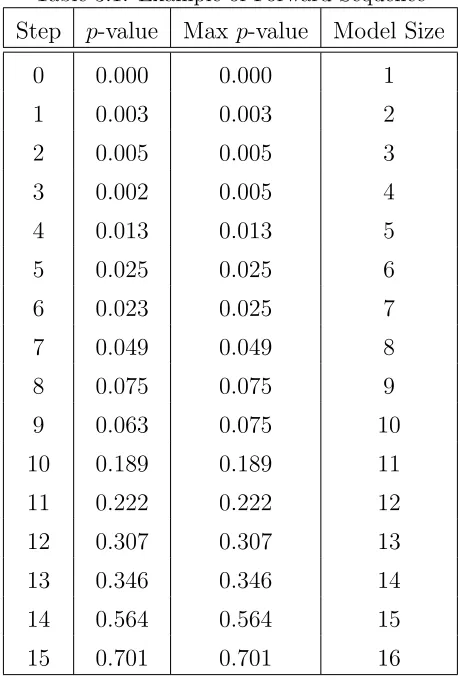
For example, suppose that Table 3.1 gives the 15 steps of a forward selection
Chapter 3. Fast False Selection Rate
Table 3.1: Example of Forward Sequence
Step p-value Max p-value Model Size
0 0.000 0.000 1
1 0.003 0.003 2
2 0.005 0.005 3
3 0.002 0.005 4
4 0.013 0.013 5
5 0.025 0.025 6
6 0.023 0.025 7
7 0.049 0.049 8
8 0.075 0.075 9
9 0.063 0.075 10
10 0.189 0.189 11
11 0.222 0.222 12
12 0.307 0.307 13
13 0.346 0.346 14
14 0.564 0.564 15
15 0.701 0.701 16
0.005. Once α gets to 0.005, the model size jumps from 2 to 4. An easy way to see the grid and resulting model sizes is by plotting 1 +S(α) by α. Figure 3.1 gives this plot for the example data in Table 3.1. From the plot we can see that in order to obtain
the model sizes, {1, 2, 4, 5, 7, 8, 10, 11, 12, 13, 14, 15, 16}, the minimum values of
Chapter 3. Fast False Selection Rate
0.0 0.1 0.2 0.3 0.4 0.5 0.6 0.7
5
10
15
α
Model Size
Figure 3.1: Example of step function for model size by α. • indicates the closed lower bound for α corresponding to a specific model size. ◦ indicates the open upper bound forα
corresponding to specific model size.
3.1.2
Choosing Alpha
Once we have our grid of choices for α, we can plug these values into (3.7). Rather than choosing the value which yields ˆγf ast(α) closest to γ0, we choose the largest α
such that ˆγf ast(α)≤γ0. The reasoning is that by choosing the largest model meeting
our false selection goal, a larger proportion of the informative variables are included.
When α = 0, no variables are entered into the model leading to ˆγf ast = 0. But also
when S(α) = Kt, ˆγf ast = 0 as well. These are the cases of fitting a null model and
a full model respectively. Of course we do not believe that the false selection rate of
Chapter 3. Fast False Selection Rate
process. Therefore, constraints must be added when choosingαto avoid fitting the full model every time. Since ˆγf ast starts and ends at 0 and is nonnegative, there must be a
maximum. Call theαentry-level corresponding to this maximumαmax. Beyond it, the
false selection rates tend to be underestimated with the extreme case being ˆγf ast = 0
for the full model. Therefore, the necessary constraint is to limit our choice of α to those which do not exceed this point. This leads to the estimate,
ˆ
α= sup
α≤αmax
{α : ˆγf ast(α)≤γ0}. (3.8)
Although the continuous interval [0,1] is used in (3.8), it is sufficient to search over
α from the discrete grid. Choosing α from the grid yields an expected false selection rate less than γ0, but results in the same model as choosing over the interval [0,1]. In
general, if αd is the value from the discrete grid that solves (3.8), then the solution
over [0,1] is
ˆ
α= γ0{1 +S(αd)} Kt−S(αd)
.
Using Kt = 15 for the data in Table 3.1, the grid and corresponding estimates of
false selection rate can be found in Table 3.2. Also, Figure 3.2 gives the corresponding
plot of ˆγf ast(α) by α. Notice that ˆγf ast peaks at 0.0859 when α = 0.189. Using the
discrete grid to solve (3.8), we get ˆα = 0.075, whereas solving (3.8) on [0,1] yields ˆ
Chapter 3. Fast False Selection Rate
Table 3.2: Example of Alpha Grid
α ˆγf ast(α) S(α)
0.000 0.0000 0 0.003 0.0210 1 0.005 0.0150 3 0.013 0.0286 4 0.025 0.0321 6 0.049 0.0490 7 0.075 0.0450 9
0.189 0.0859 10 0.222 0.0740 11 0.307 0.0708 12 0.346 0.0494 13 0.564 0.0376 14 0.701 0.0000 15
3.2
False Selection Rate for Interactions
When considering higher-order effects, the way we approach uninformative variables
changes somewhat. In Chapter 1, a discussion was given on how different units for
predictors can lead to different results when using a model selection process. It was
then suggested that the original predictors be standardized before creating the derived
variables. This would lead an experimenter to the same X matrix no matter what
units he used for measurement. Given that the original predictors are standardized,
we assume that the hierarchy is maintained. Therefore, if an interaction or quadratic
Chapter 3. Fast False Selection Rate
0.0 0.1 0.2 0.3 0.4 0.5 0.6 0.7
0.00
0.04
0.08
α
γ
^ fast
(
α
)
Figure 3.2: Example plot of ˆγf ast(α) byα
information, we now develop the Fast FSR formulas for the algorithms from Chapter
1.
3.3
No Hierarchy with Fast FSR
In the no hierarchy approach, the Fast FSR methodology works exactly as previously
described. Each effect is a candidate for entry at the beginning of the forward selection
process. Therefore, the probability of any effect being in the candidate set is 1, and