An Efficient Approach for Load Balancing
Using Dynamic AB Algorithm in Cloud
Computing
Pooja .B.Gothi1, Daxa .V.vekariya2
P.G Student, Department of Computer Engineering, Noble Group of Institutions, Junagadh, Gujarat, India
Associate Professor, Department of Computer Engineering, Noble group of Institutions, Junagadh, Gujarat, India
ABSTRACT: The aim of the research work is to develop a system for efficient load balancing in cloud computing by
ANT-BEE, which we combined here and called AB Algorithm. Cloud computing is the fast growing technology, which shares the resource consistency and economic of scale similar to a utility over a network. AB algorithm is to develop new self adaptive approach to combination of two natural inspired algorithm are ANT and BEE colony algorithm in cloud computing. There are some limitation of own Algorithm affected in load balancing task so, In ACO there exist limitations like slow convergence, tendency to stagnancy.[13] Bee colony algorithm obtains the solution only particular distance, because bee provides optimal solution based on small path. I wish to accomplish them, and combined both algorithm and get more feasible and optimization for self-adaptive algorithm.
KEYWORDS: load balancing, cloud computing, Ant colony algorithm, Bee’s life algorithm, Ant-Bee algorithm,
Pheromone value, fitness function.
I. INTRODUCTION
Cloud computing is moderately new and emerging technology. Cloud is a lake of heterogeneous resource. It is a engage of massive infrastructure and has no relevance with name cloud. [1] Cloud is mainly focusing on distributed environment which providing high user satisfaction as a service, storage resource, resource utilization, processing power. It is units in cloud environment are called as a virtual machine. Cloud has different meaning to different stakeholders. There are three main stakeholders of clouds are end-users, cloud providers and cloud developers. [1]
End-users: end users are use the services on demand basis and have to pay for the services availed depending upon
their usage. They have keep security as privacy based on secure manner- at reduced cost on demand basis-in an easy to use manner
Cloud providers: In providers cloud are divided into the public, private and hybrid environment. Mainly they work on
outsourcing, metering and cost efficiency for the service providers.
Cloud developers: developers are provided mediator interface between users and providers. Affecting matter for here
is adaptability, data management, reliability and visualization.
1. Recourse is simply available for on demanding.
2. Better recourse utilization in teams of loaded , overloaded or underloaded 3. Energy reduction in cloud resource.
4. Cost dipping in cloud implementation.
Cloud load balancing of VMs using ACO and BCO
Ant colony optimization is naturally follows their foraging behaviour of ant that encouraged them to find the optimal path for finding the food. Ants are randomly moving on path and put chemically introduced pheromone, it will start their journey randomly to initial selecting head node to any virtual machine. [13] High concentration pheromone shows vm’s criteria for load balancing action. Here probability of ant can disconnect the best optimal path for different pheromone proportion of a way’s their value. As a positively manner is helps ants to find vm on the base of pheromone value.
Bee colony optimization is naturally worked for three phase employee bee, worker bee and scout. In load balancing approach bee follows foraging behaviour of honey bee. [8, 14] It is work for distributed load of nodes so that information or load transferred easily on the destination with minimum load or makespan time and less no of failures of node in fitness function.
II. RELATED WORK
I reviewed many papers and done the following analysis for load balancing. There are static and dynamic load balancing have done in research paper which I have studied. Ant colony algorithm is used to get to the bottom of travelling sales man problem. Load balancing and pheromone of ACO’S is cannot move on or update information in resource relocated in node.[12, 16] Bee life algorithms are business for task forecast in cloud. In modified job forecast for task to used optimal solution. In bee algorithm used in load balancing we get optimal solution but it provide only in small path.[17] They can’t share load among the available resources it’s fail in produce load balance schedule.
Paper Advantage Drawbacks
Grid resource management by means of Ant colony optimization. Ieee paper- 2006
Established optical network for important requirement in load balancing
It is not scalable and can’t extended process to incorporate information about job requirement.
An Ant Colony Based Load Balancing Strategy in Cloud Computing.
Springer -2014
Give surety for QOS approach Requirement is fulfill here.
Fault tolerance and different function variation to calculate the pheromone value can be used for further research work.
Multiple Ant-bee Colony Optimization For Load Balancing In Packet-switched Networks.
(IJCNC) -2011
Give better result in unstable network.
It gives better effect but comes with more fault-tolerance.
Ant colony optimization for effective load balancing in cloud computing.
(IJETTCS)-2014
Provide dynamic and effective load balancing
Ant can move only one direction, it can’t rollback.
Interaction Artificial Bee colony based Load balance Method in cloud computing. Springer-2015
Beneficial for load balancing to minimize the no of failures.
III.PROPOSED ALGORITHM
Proposed load balancing method is based on the ant colony and bee colony concept. In our system ant colony use for the load balancing performance to system and find vm on based of their criteria but somewhere ant cant modify the same resulted pheromone value for vm so not find the optimal solution for it that’s why we use Bee’s fitness function for assuring to get optimal value on all vms.
Proposed method:
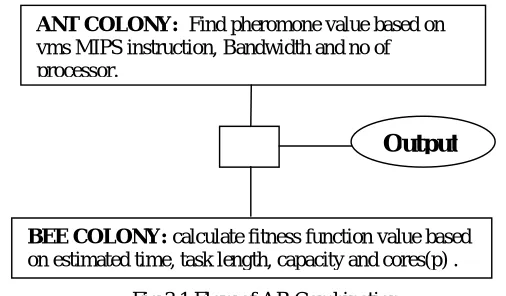
In our proposed method first of AB algorithm is to develop new approach to combine two dynamic two dynamic algorithm is Ant and Bee colony algorithm cloud computing is a collection of parallel and distributed system which have both cluster as well as grid .In this approach we exists effective load balancing for using (AB) algorithm for the resource allocation in load balancing. In this we can use the combination for ant’s evaporations. In our existing system has some limitation of ACO and ABC optimization. It work for not dynamically and one remaining one drawback is not updated the globally updating the pheromone value. So now we will improve them using by some new strategy used in both like called AB algorithm, to overcome these problem proposed system established a new dynamic approach for effective load balancing used by AB algorithm. Here fig shows the how the ACO and ABC are perform operation dynamic by both combination. It shows to dynamic approach combination of both the ACO and ABC algorithm how the ant and bee both are dynamically work in AB algorithm and also give the information for the load balancing and its dynamic approach is how flow in system to get better throughput.
Fig 3.1 Flow of AB Combination
Proposed Algorithm:
Step-1: Maintain an index table which contains vm id and its corresponding requests. Initially all VMs have current request 0.
Step-2: schedule new request to VM have current request 0.
Step-3: make corresponding change in the index table.
Step-4: if VMs are not available to allocate job, and create random no of ant with same pheromone vale and parameter place then randomly to traverse.
Step-5: store the current value of optimal solution and update pheromone value globally in the table.
ANT COLONY: Find pheromone value based on
vms MIPS instruction, Bandwidth and no of processor.
BEE COLONY: calculate fitness function value based
Step-6: if all ants complete their tour then compare every local pheromone update to output best possible solution.
Step-7: choose the optimal node(s), based on pheromone table and send on that node(s).
Step-8: calculate fitness function by their parameters.
Step-9: if fitness function is < threshold then migrate task to that node.
Step-10: otherwise find next optimal solution.
When any Ant task/work is to come to cloud service providers and they are allocated jobs on the base of FCFS (first come first serve) manner and it will be maintain in one initial index table to their collective current allocation on VM. Similarly process will continually ongoing due to vastness of providers when vms are available otherwise vms are going to exhaust. In this situation random ants are created and start their journey on path for finding the next underloaded vm’s. Artificial Ant is searching a node on path from the trailing pheromone intensity and initially it will assign as per equation-1.
τij (t=0) = f(MIPS J , BW J ,N)……….(1)
Where, τij (t=0) is the pheromone value in between two node i and j at turn t=0, MIPSJ (Million Instructions per Second) is the maximum capacity of each processor of VMJ. BWJ is related to the communication bandwidth ability of the VMJ. N is the no of processor.
Consequently any ant randomly select VM’S to finding underloaded vms, as the she will start her trip to reach source or head node to destination node from her current position. at each move we consider kth colony or ant traverse from node i to j, the probability for ant to reach next node is measures by probability and distance between source to destination, an ant at node i to choose a neighbour node j as its next stop at time t pkij(t) is given by Eq. 2.
( ) = [ ( )] [ / ( )]
∑ ∈ [ ( )] [ / ( )]
,
if j allowed k ………(2)The main aim/task of ants in the algorithm is to redistribute work load among the nodes. The ants traverse the cloud network, selecting nodes for their next step through the traditional formula given below, where the probability Pk of an ant, which is currently on node t selecting the nearest node s for traversal, is Where, p is possibility of ant heuristic information to random traverse on path and selecting the next neighbour node for biased their deposited pheromone value.dij is the attractiveness and repulsion of ant strategy between node i to j and show the distance between them. kth ant colony is depends on tabu list of ant by parameters and which get the control parameters and control the heuristic information , relative of the pheromone . Here distance is we take 1/ dij for corresponding the pheromone and i to j move on path. but there is one limitation random no of ant is create here and it find optimal node but it measures only the bandwidth , MIPS and no of processor that is why process complete but how much time it takes and not find the ant find the one best node at a time of one process but is it traverse to different way on different vm so it may have change so it have not find best optimal node , then we use bee colony to calculate the fitness function by measures vm estimated time , cores of vm, and it also measure the capacity , where ants pheromone update only local pheromone value in here my existing algorithm is update pheromone in terms of overloaded node to underloaded or underloaded to overloaded is update but bee find the each and every vms fitness value and then sum all pheromone and fitness value and find best node in process
Fitness (f) = est +
∗ ( )
……….(3)
Where, f= fitness value est= estimated start time , rl= total no of task length Capacity = MIPS * bandwidth of VM Cores (p) = no of processor
Flow chart of system
We create bee to calculating fitness function and put on path from overloaded node to underloaded node with different parameters, it must be kept on best underloaded node, so that it exceed the load on next underloaded node among all the neighbour nodes.
Process of Bee is equally distributed load on the all nodes and find imbalanced node, bee is find the optimal node on race condition and calculate vms capacity based on task priority for vms execution time so set threshold for selecting average virtual machine and find optimal node on distance based and move the sending bee on that node and update value on pheromone table. Then here for this purpose we define one variable to measure the perspective vale by THRESHOLD which works how much capacity of node to exchanging load in all system. They it will dependent on threshold and calculate the fitness value, and secondly choose underloaded node and load exchange on there.
Apply Bee-Colony algorithm with required capacity, task priority and time request.
Major purpose is minimizing with best task allocation.
Apply cloud constrain (Number of VMs their Processing Capabilities and Availability.
Calculates fitness value.
IV.SIMULATION RESULTS
The proposed algorithm is implemented using cloudSim simulator which runs on Net Beans IDE 7.2.1. In cloud environment different users, resources, scheduler implement by Cloudsim. Cloudsim is a well known simulation for cloud computing and designed to support various simulation tests across the IAAS, PAAS and SAAS. So AB algorithm used Cloudsim as a developing tool. Result was been analysed as per the pheromone table work same as routing table in cloud. VMs processing power range is 2000-8000 MIPS it has been resulted by through put as task waitining time is here minimize and task migration is same but migrate on different virtual machine.
V. CONCLUSION AND FUTURE WORK
In recent we have represented reviewed of existing Ant and Bee colony work different dynamic strategy in load balancing. After applying the mathematically equation in natural heuristics algorithm , the modified ACO and ABC optimization to finding common best suited nodes for shifting loads on overloaded to underloaded and as well as perform underloaded to overloaded nodes are balanced to fetch result and get output for effective load balancing. In future work I will show whole system in brief that provide good solution for effective load balancing using various different parameter in improved AB algorithm for better optimal solution. In this approach, here, In future work I will show whole system in brief that provide good solution for effective load balancing using various QOS parameter in improved AB algorithm for better optimal solution. And an AB algorithm approach is used for the independent loaded and overloaded solution for the individually for task scheduling.
2600 2800 3000 3200 3400
before after
waitingtime(s)
REFERENCES
[1] Mayanka Katyal, Atul Mishra, “A Comparative Study of Load Balancing Algorithms in Cloud Computing Environment ” , International Journal of Distributed and Cloud Computing Volume 1 Issue 2 December 2013 .
[2] Shagufta Khan, Niresh Sharma, “Ant Colony Optimization for Effective Load Balancing In Cloud Computing”, International Journal of Emerging Trends & Technology in Computer Science (IJETTCS) Volume 2, Issue 6, November – December 2013.
[3] Radha G. Dobale, R. P. Sonar, “Review of Load Balancing for Distributed Systems in Cloud”, International Journal of Advanced Research in Computer Science and Software Engineering 5(2), February - 2015.
[4] Rajkumar Somani, Jyotsana Ojha ,” A Hybrid Approach for VM Load Balancing in Cloud Using CloudSim ” , International Journal of Science, Engineering and Technology Research (IJSETR), Volume 3, Issue 6, June 2014.
[5] Kumar Nishant, Pratik Sharma, Vishal Krishna, Chhavi Gupta and Kuwar Pratap Singh,Nitin and Ravi Rastogi, “Load Balancing of Nodes in Cloud Using Ant Colony Optimization”, 14th International Conference on Modeling and Simulation 978-0-7695-4682-7/12 IEEE 2012.
[6] N. Sasikala and Dr. D. Ramesh,” Effective Load Balancing for Cloud Computing using Hybrid AB Algorithm”, International Journal of Innovative Research in Computer and Communication Engineering Vol. 2, Issue 4, April 2014
[7] Wei–neng Chen, Jun Zhang, IEEE member & Yang Yu,” Workflow scheduling in grids: An Ant colony optimization Approach”, 4244-1340-0/07/ 2007 IEEE.
[8] Ashish Soni, Gagan Vishwakarma, Yogendra Kumar Jain, “A Bee Colony based Multi-Objective Load Balancing Technique for Cloud Computing Environment”, International Journal of Computer Applications (0975 – 8887) Volume 114 – No. 4, March 2015.
[9] Gustavo Sousa Pavani, Helio Waldman Optical Networking Laboratory (OptiNet),” Grid Resource Management by means of Ant Colony Optimization”, 1-4244-0425-8/06/ 2006 IEEE.
[10] Deepika Nee Miku ,Preeti Gulia, “Improve Performance of Load Balancing using Artificial Bee Colony in Grid Computing ” , International Journal of Computer Applications (0975 – 8887) Volume 86 – No 14, January 2014 .
[11] R. Sagayam, Mrs. K. Akilandeswari , “Comparison of Ant Colony and Bee Colony Optimization for Spam Host Detection ” , International Journal of Engineering Research and Development Volume 4, Issue 8 November 2012 .
[12] Ekta Gupta , Vidya Deshpande,” A Technique Based on Ant Colony Optimization for Load Balancing in Cloud Data Center ” , 2014 IEEE [13] Santanu Dam, Gopa Mandal, Kousik Dasgupta, and Paramartha Dutta, “An Ant Colony Based Load Balancing Strategy in Cloud Computing”, M.K. Kundu et al. (eds.), Advanced Computing, Networking and Informatics - Volume 2, Smart Innovation, Systems and Technologies 28, Springer 2014.
[14] Fairouz Fakhfakh, Hatem Hadj Kacem, Ahmed Hadj Kacem, “Workflow Scheduling in Cloud Computing: A survey”, 2014 IEEE 18th International Enterprise Distributed Object Computing Conference Workshops and Demonstrations .2014 IEEE
[15] John A. Bullinaria and Khulood AlYahya, “Artificial Bee Colony Training of Neural Networks” , Nature Inspired Cooperative Strategies for Optimization (NICSO 2013), Studies in Computational Intelligence 512, Springer International Publishing Switzerland 2014.
[16] Mehdi Kashefikia, Nasser Nematbakhsh, Reza Askari Moghadam, “Multiple ANT-BEE COLONY optimization for load balancing in PACKET-SWITCHED networks”, International Journal of Computer Networks & Communications (IJCNC) Vol.3, No.5, Sep 2011.
[17] Jeng-Shyang Pan, Haibin Wang, Hongnan Zhao, and Linlin Tang, “Interaction Artificial Bee Colony Based Load Balance Method in Cloud Computing”, Springer International Publishing Switzerland 2015
[18] Mustafa Sonmez,” Discrete optimum design of truss structures using artificial bee colony algorithm”, 3 August, Springer- 2010
[19] David Martens, Manu De Backer, Raf Haesen, Jan Vanthienen, Monique Snoeck, and Bart Baesens,” Classification With Ant Colony Optimization”, Transaction on Evolutionarily Computation, IEEE VOL. 11, NO. 5, OCTOBER 2007.