ABSTRACT
GUMMULURI, SREEDEVI. Drug Research and Development Incentives Under a Changing Exclusivity Environment: An Event Study Approach. (Under the direction of Stephen E. Margolis and Charles R. Knoeber).
In this dissertation I explore the effect of marginal changes in the exclusivity
environment on research incentives of firms involved in the process of drug manufacturing,
and drug research and development. A model of copyright developed by Landes and Posner
(2003) explaining the effect of varying levels of copyright protection on research incentives,
is closely followed here and adopted in a patent and regulatory context. Exclusivity here is
taken to refer to the intellectual property environment and the regulations of the Food and
Drug Administration (FDA) pertaining to marketing exclusivity for approved drugs. Both
these aspects determine the period of time that drugs get marketed exclusively with limited
competition and the amount that markets enable them to appropriate in return for their
research activity. Intellectual property debates regarding the scope of patents and
determination of patentable subject matter would inadvertently affect research intensive of
firms such as pharmaceutical and biotechnology firms. Besides obtaining patents, drug
marketing also has to go through a long process of approval from the FDA governed by the
Federal Food Drug and Cosmetic Act (FFDCA). The Hatch-Waxman Act of 1984 brought
about some crucial amendments to the drug regulatory process by enabling easy entry to
generic drug manufacturers. Since the passage of the Hatch-Waxman Act, to the amendments
introduced to the Hatch-Waxman Act through the Medicare Prescription Drug Act (2003),
various court decisions have been instrumental in recognizing the weak links in the
Hatch-Waxman amendments to the FFDCA (1938). These cases were precursors to some of the
Medicare Prescription Drug Act of 2003. In the current study, the reaction of three sets of
firms- pharmaceuticals, biotechnology and generics drug manufacturers, are analyzed
following some precedent-setting cases that changed the exclusivity available to new drugs
entering the market. The event study methodology is used in evaluating their reaction to
these changes. The study further determines whether these firms are affected consistently and
significantly negatively or positively from these changes in exclusivity. As an extension to
this study, the research behavior of pharmaceutical and biotechnology firms are also
DRUG RESEARCH AND DEVELOPMENT INCENTIVES UNDER A CHANGING EXCLUSIVITY ENVIRONMENT: AN EVENT STUDY APPPROACH
by
SREEDEVI GUMMULURI
A dissertation submitted to the Graduate Faculty of North Carolina State University
In partial fulfillment of the Requirements for the degree of
Doctor of Philisophy
ECONOMICS
Raleigh, NC
2007
APPROVED BY:
__________________________________ __________________________________
Dr. Mark D. Walker Charles T. Joyner, J.D.
Technical Consultant
__________________________________ __________________________________
Dr. Alvin E. Headen Dr. Charles R. Knoeber
Co-Chair of Advisory Committee
__________________________________
Dr. Stephen E. Margolis
ii
BIOGRAPHY
Sreedevi Gummuluri was born in Bombay, India on the 28th of September 1979 to Dr.
Eswara Prasad Gummuluri and Srikantha Gummuluri. She obtained her Bachelor’s degree in
Commerce from S.I.E.S college of Arts, Science and Commerce, Bombay on April 1999.
While pursuing her Bachelor’s degree she developed an interest in economics and decided to
enroll into the Master’s of Arts program in Economics at Bombay University, Kalina. Upon
graduation with a Masters’ degree in Economics from Bombay University, she further
pursued her interest in the field by joining the PhD program in Economics at the North
iii
ACKNOWLEDGMENTS
I would like to thank my entire committee for all their valuable input and for their
patience from the idea formation to completion of the dissertation writing process. I am also
thankful to Dr. David Dickey and Dr. Dennis Pelletier for their guidance and advice in the
econometric estimations.
I would also like to thank my parents Dr. Eswara Prasad Gummuluri and Srikantha
Gummuluri, and my sisters- Satya and Radha, for their constant support and immense
patience. I am also thankful to my brother-in-law, Amod Kher for his help in data analysis
and computing, and for inspiring me to pursue this academic journey in the U.S. I would also
like to thank all my colleagues and professors from Bombay University, Kalina who were
iv
TABLE OF CONTENTS
LIST OF TABLES... vi
LIST OF FIGURES... viii
CHAPTER 1... 1
Introduction and Literature Review... 1
1.1 Background on patents... 7
1.2 Relevance of patents in drug research ... 11
1.3 Drug manufacturing industry background and regulation ... 14
1.3.1 Kefauver - Harris amendments -1962... 17
1.3.2 Hatch-Waxman Act - 1984 ... 20
1.3.3 Medicare Prescription Drug Act- 2003: Some relevant amendments to Hatch-Waxman Act 1984 ... 25
CHAPTER 2... 28
Analyzing the effect of changes in exclusivity using the event study method... 28
2.1 Introduction and Research Question... 28
2.2 Theoretical model ... 30
2.3 Event Study Methodology ... 47
2.4 Data ... 48
2.5 Results... 50
2.6 Conclusion ... 104
v
CHAPTER 3... 112
Analyzing the effect of changes in patent law and regulation on R&D expenditure.... 112
3.1 Introduction... 112
3.2 Estimation of effect on R&D from changes in patent and regulatory environment for biotechnology and pharmaceuticals firms... 115
3.3 Data ... 122
3.4 Results... 124
3.5 Conclusions... 133
3.6 Appendix B ... 135
CHAPTER 4... 136
Conclusions and final notes... 136
vi
LIST OF TABLES
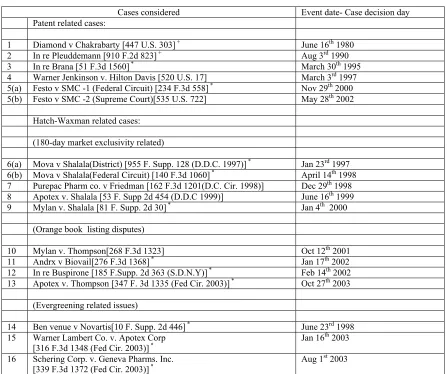
Table 2.1: List of events………...52
Table 2.2.1: In re Brana………... 53
Table 2.2.2: Festo (Federal Circuit)………. 57
Table 2.2.3(a): Mova v. Shalala (District level)……….. 63
Table 2.2.3(b): Mova v. Shalala (Federal Circuit)………... 65
Table 2.2.4: Mylan v. Shalala……….. 68
Table 2.2.5: Andrx v. Biovail……….. 72
Table 2.2.6: In re Buspirone……… 75
Table 2.2.7: Apotex v. Thompson………... 77
Table 2.2.8: Ben Venue v. Novartis……….83
Table 2.2.9: Warner Lambert Co. v. Apotex………... 85
Table 2.2.10: Schering v. Geneva……… 87
Table 2.3.1: Diamond v. Chakrabarty………. 90
Table 2.3.2: In re Pleuddemann………... 92
Table 2.3.3: Warner Jenkinson……… 94
Table 2.3.4: Festo – Supreme Court……… 96
Table 2.3.5: Purepac Pham co. v. Friedman……… 98
Table 2.3.6: Apotex v.Shalala………101
Table 2.3.7: Mylan v. Thompson………... 103
vii Table 3.1: Descriptive statistics and list of cases considered……… 123
Table 3.2(A): Effect of selected cases on R&D of Pharmaceutical firms- Parks method
estimates using case dummies………... 125
Table 3.2(B): Effect of selected cases on R&D of Biotechnology firms- Fixed effects
viii
LIST OF FIGURES
Figure 2.1: Market for drugs……… 39
Figure 2.2: Market for new inventions……… 39
Figure 2.3: Effect of an increase in exclusivity on the market for drugs………. 40
Figure 2.4: Market for new inventions illustrating reduction in number of new
inventions with an increase in exclusivity………. 40
Figure 3.1: Aggregate quarterly R&D expenses of 11 Pharmaceutical firms
considered in this study over 1989-2005………. 113
Figure 3.2: Aggregate quarterly R&D expenses of 14 Biotechnology firms considered
in this study over 1989-2005………114
Figure 3.3 (a): Diagrammatic illustrations of a positive relation between CAR and
R&D…………...………118
Figure 3.3 (b): Diagrammatic illustrations of a negative relation between CAR and
CHAPTER 1
Introduction and Literature Review
Intellectual property came into existence as a means of providing exclusive rights
to address the issue of appropriability. While easy imitation enables improved consumer
welfare, it simultaneously acts as a disincentive for research. Patent law tries to balance
these two conflicting objectives. Studies on different industries have demonstrated
differing relevance of patents in each of them (See Levin et al., 1987 and Cohen et al.,
1997). Cohen et al., (1997) use a questionnaire method to identify what a cross section of
firms in different industries perceived as important in appropriating the benefits of
research. Levin et al., (1987) use metrics such as lead time, secrecy, learning curve
advantages, sales and service advantages and patents. In these studies pharmaceutical
companies placed a higher importance on product and process patents in comparison with
other industries such as software and semiconductors that placed more importance on
lead time and learning curve advantages in appropriating benefits of new products and
processes. The authors argue that in comparison with other industries, drug
manufacturing companies can adopt clearer standards in assessing patent validity as
patents are given out on unique compounds or chemical molecules. This enables clearer
property creation and appropriation of research benefits. Grabowski and Vernon (1987)
using sensitivity analysis tried to evaluate how sensitive innovation rates were to different
rates of penetration by producers of imitative drugs into their market. Their finding was
that a penetration rate from 10 percent to 50 percent significantly reduces returns to
establish that modest restoration in patent life for new drugs can have the effect of
restoring reduced innovation and revenue
Drug development and marketing also faces considerable regulation in the United
States. A unique character of the drug manufacturing industry is that many of these
regulatory provisions can have the effect of controlling the marketing exclusivity of a
drug. Approval by the Food and Drug Administration (FDA) to market a drug in the U.S.
is just as important as obtaining a patent for drug companies to earn their revenues from
research activity. Ramanathan (1999) showed in his study that for a portfolio of
pharmaceutical firms, FDA approval of a drug mattered significantly in their value
creation. It would follow then that any changes in regulations that affect the functioning
of this approval process or ease the entry firms manufacturing imitation drugs may
consequently affect drug research.
The drug manufacturing industry is characterized by heavy expenditure in
research and development. DiMasi, Hansen and Grabowski (2003) have quoted this cost
to be about $802 million in the discovery and development of a new drug. In addition it
takes nearly 12 years for the investment period from initial drug synthesis to FDA
approval which in-turn causes a reduction in the effective patent life available to market
the drug. Drug research companies also tend to plow back their earnings into research.
The Pharmaceutical Research and Manufacturers of America, PHRMA, estimate the
domestic R&D expenditure as a percentage of domestic sales for this industry as 19.2
percent for 20051. After the expiry of the patent on a drug, the cost of imitating it tends to
1 Pharmaceutical Industry profile 2006 (Washington, DC: PhRMA, March 2006); Link:
be very low in this industry. Passage of the Hatch-Waxman Act2, further eased the
process of entry of firms producing imitation drugs. All these points make a case for
offering protection on drug marketing to provide an incentive for drug research.
In essence, exclusivity in the form of patents and regulatory conditions are of
consequence to drug companies in appropriating revenues from research. In this study the
term exclusivity is used to refer to both the patent and regulatory condition faced by drug
companies. While increasing exclusivity may impose social costs by delaying
introduction of cheap drugs, they may be beneficial in recuperating research costs and
encouraging research. Decreasing exclusivity on drugs on the other hand, may increase
social benefits by easing entry of generics and imitators but would be expensive in the
long run due to reduced availability of new and improved drugs. An economic issue
worth investigating following this discussion is to what extent changes in exclusivity at
the margin effect the research decisions of drug research and development companies.
This is the motivation of the current study. The approach adopted is to study marginal
changes in exclusivity provisions through legal changes and evaluating the effect of these
changes on the research behavior of firms involved in drug research and development.
This analysis is conducted using the event study methodology. In the current study, the
drug research firms are considered to comprise firms in the pharmaceutical industry as
well as biotechnology firms.
Various studies have investigated the relations that exist between patenting
activity and R&D undertaken by research intensive firms using patent count data.
Griliches (1981) conducts a time series cross-sectional analysis on large U.S. firms and
finds that a significant relationship exists between the market value of firms, their R&D
and number of patents. The market value of firms was computed here as the sum of
equity and debt. He also found a significant independent effect of patent count on the
market value of firms. Pakes (1985) analyzed stock market returns in noting that for large
manufacturing firms, fluctuations in their market values are related to successful patent
applications. She uses successful patent applications as a measure of the successful
research and development activity of the firm. In a later paper Griliches, Hall and Pakes
(1988) note that in the pharmaceutical industry there is evidence to suggest that patenting
activity explains changes in the firm’s market value measured in terms of stock market
rate of return. Austin (2000) analyzed the value of patents as intangible assets to
biotechnology firms applying the event study methodology based on the date of a patent
grant. He uses patent statistics as a means of improving the estimates of R&D
productivity change. In this study he finds significant changes in the market value of 20
biotechnology firms following a patent award especially in highly contested research
areas. He also studies extensively if any spillovers are generated by patent awards in the
form of economic benefits accruing to other firms in the industry not limited to
knowledge spillovers. According to his model, a new patent could raise costs by
narrowing research avenues or inducing infringement suits but at the same time a patent
discloses knowledge that might complement a rival’s research. Through empirical
analysis he finds that new patents induce significant reevaluations to a patentee and his
competitor’s market value. New patents generated net spillovers valued from $2 to $4
million per patent per rival, indicating how R&D productivity could be mutually
Various regulatory and statutory reforms aimed at the functioning of the drug
industry have also been instrumental in the development of this industry over the years.
Since the formation of the Food and Drug Administration (FDA) in 1938, various
important reforms have followed such as the 1962 amendments to the Food, Drugs and
Cosmetic Act, the Hatch-Waxman Act passed in 1984 and the Medicare Prescription
Drug Act (2003). Peltzman (1973), in his evaluation of the 1962 amendments to the
Food, Drugs and Cosmetic Act, noted that following these amendments there was a
marked increase in compliance costs faced by drug developing firms which led to a
reduction in drug innovation. Grabowski (1982) and Grabowski and Vernon (1983) came
to a similar conclusion in their analysis noting that increased pre-marketing testing that
followed this regulation was socially undesirable. The Hatch-Waxman Act passed in
1984 led to another important reform in the industry which enabled easy entry to generic
drug makers producing imitative drugs while allowing an extension on market exclusivity
to patent holding research firms. Studies on the effect of the Hatch-Waxman Act appear
in general to indicate no net gain or loss to drug research intensive firms. Grabowski and
Vernon (1986) compared revenues lost from generic entry to benefit accrued from patent
extension and conclude that the effect would be a close trade off. Proctor (1989) used the
event study methodology to show that the stock market expected the patent-term
restoration law to have a positive financial effect on research-based pharmaceuticals.
Joglekar and Paterson (1986) show that although generics take over a large market share
following these reforms, investment in R&D continues to be attractive. These studies
show that regulating firms involved in drug development end up effecting their research
Fewer studies have attempted the use of precedent-setting court decisions relating
to patenting and regulation of drugs, in analyzing the valuation and research incentives of
firms involved in drug research and development. In the current study, I concentrate more
specifically on the exclusivity environment since the passage of the Hatch-Waxman Act
(1984) to the introduction of amendments to this Act in 2003 through the Medicare
Prescription Drug Act. Precedent-setting court cases that are expected to affect
exclusivity during this time span are used in analyzing how marginal changes in the
exclusivity environment can impact market valuation of firms involved in extensive drug
research and development. These changes in the valuation of firms are expected to be
indicative of changes in research incentives to firms. In chapter 3 the study is extended by
analyzing how R&D expenditures of these firms are impacted following changes in their
valuation recognized as statistically significant. The event study method is adopted in
analyzing these changes in market valuation of firms, following these court events.
Event studies on statutory and regulatory changes usually face the issue of
pinning down the exact date when the news is received by the market. In the current
study, usage of precedent- setting cases in conducting event studies have the advantage of
a surprise element in the final hearing as courts tend to guard their decision till the actual
hearing takes place. An event study may therefore capture the relevant reaction of
research firms following decisions involving changes to exclusivity. Chapter 2 elaborates
on the event study methodology and presents the results of event studies performed on
selected sets of major firms involved in drug research and generic drug manufacturing
firms. Decision dates on selected precedent setting cases are used as the relevant event
this analysis cover some of the important decisions following the passage of the
Hatch-Waxman Act leading up to the statutes relevant to drug research that were incorporated
into the Medicare Prescription Drug Act (2003). Chapter 3 further extends the analysis by
evaluating the eventual impact on R&D of major drug research firms following the
change in the exclusivity environment.
The following sections in the current chapter present further background on
patents, their relevance in drug research, the drug development process faced by drug
research firms and regulations that are relevant to the cases selected and analyzed in this
study.
1.1 Background on patents
The United States Patent and Trademark Office (USPTO) has defined a patent for
an invention as the grant of a property right to an inventor. This right involves a right to
“exclude others from making, using, offering for sale, or selling” the invention in the
United States or “importing” the invention into the United States. There are three types of
patents:
1) Utility patents may be granted to anyone who invents or discovers any new and useful
process, machine, article of manufacture, or composition of matter, or any new and useful
improvement thereof;
2) Design patents may be granted to anyone who invents a new, original, and ornamental
3) Plant patents may be granted to anyone who invents or discovers and asexually
reproduces any distinct and new variety of plant.
To be protected by a utility patent, inventions are statutorily expected to fulfill
three essential requirements of utility, novelty and non-obviousness.
Patent rights are awarded by the government for a limited time period. The theory
behind formation of patent laws or other forms of intellectual property for that matter,
suggests that a free market with no exclusive rights will lead to too little production of
intellectual works relative to an efficient outcome due to the public goods nature of
knowledge. If exclusive rights are not provided to the inventor, then others can free ride
on the knowledge. This would lead to issues of appropriation from an invention as the
inventor is not able to completely recuperate the benefits from his or her invention. This
creates a disincentive to undertake research activities. Thus awarding patents to the
producers of knowledge should enable us to move closer to an efficient outcome. Another
argument that has developed however is that IP law could in some circumstances lead to
increased transaction costs that outweigh these gains. Restricting the free reuse of
knowledge imposes transaction costs. Further royalties elevate the price of using
intellectual property above zero, imposing social welfare losses. Intellectual property
debates usually address these trade-offs that exist between the “incentives” of and
“access” to an invention.
Dam (1994) points out that while intellectual property deals with the primary
problem of enabling a firm to recover its returns from investment in research, it also helps
in improving efficiency by overcoming some secondary problems that may be created in
enjoy an economic rent. The possibility of accruing an economic rent may cause firms to
engage in rent- seeking behavior which could end up being socially wasteful. Rent-
seeking generally implies engaging in an activity or incurring expenses with the intention
of extracting uncompensated value from others without a contribution to productivity. In
the present context, firms may incur various expenses during the patenting process with
the intention of obtaining rents. These costs include administrative costs, costs of using
the court system and costs incurred in enforcing rights all of which could be socially
wasteful. R&D expenses that are duplicative in nature in cases where firms are competing
over patents are again socially wasteful. The patent law limits rent-seeking behavior by
firstly, making everyone aware of the new patent and its scope so that R&D from other
firms can be redirected. Secondly, public disclosure enables firms to cut their own costs
or build upon the knowledge in furthering knowledge-enhancement. Thirdly, the
requirement of novelty and non-obviousness enables the elimination of discoveries with
low contributions.
Nelson and Merges (1990) argue that it is essential that the patent system
encourages early invention since larger numbers of inventions from increased R&D,
positively impact future productivity growth and well-being3. This makes it important for
researchers to apply as soon as possible to avoid delay or loss of patent to a competitor.
At the same time increased search costs also act as a hindrance to early invention and
reduce productivity. Patent law can again help reduce search costs and favor rules of
early invention. In US, the ‘first to invent’ rule is adopted whereby the first inventor who
conceives and reduces the technology or invention to practice is granted a patent rather
than the ‘first to file’ rule followed by many other countries, whereby the first to file a
patent application regardless of the date of actual invention is granted protection for that
invention. The ‘first to invent’ rule enables an inventor to economize on search costs. If
an invention is found to exist as part of prior art or is found with the patent registry then
resources would not be wasted in pursuit of patenting the same invention. This enables an
improvement in productivity. Also since the patent is not granted until the invention in
complete, inventors are encouraged to convert their ideas to practice as soon as possible.
There is also a “time bar” rule in place where by a patent will not be issued if applied for
one year after commercial use or publication describing the inventions. These provisions
encourage early application and knowledge disbursement.
To address the issue of monopoly profits arising from patent rights, the length and
breadth of a patent are also controlled by law. The length of a patent is restricted to 20
years from the date of filing. The breadth of a patent is determined by doctrines like the
doctrine of equivalents and the reverse doctrine of equivalents. The doctrine of
equivalents finds a device infringing if it performs substantially the same function in
substantially the same way to obtain the same result as provided in a patented device.
Application of this doctrine enables a patent to enjoy a broader scope. The reverse
doctrine of equivalents on the other hand, has a narrowing effect on the scope of a patent.
This is because a patent can be validly issued on a device if it performs a similar function
as another device but in a substantially different way. Besides these doctrines there also
exist patent misuse laws which form a branch of antitrust law and address concerns about
a monopoly arising from patents.
Kitch (1977) points out that a patent system functions as a prospect system
commercial value is sufficient for an inventor to apply for a patent. Following the logic of
a prospect system, pioneer inventions may be given broad patent rights since it may be
more efficient for a patent holder to invest in searching for commercial applicability of
his or her inventions in comparison with other entrepreneurs who may have to rebuild
whole new plants or reinvest in new projects to accomplish the same. The inventor could
in this case contract more efficiently with complementary information bearers.
Merges and Nelson (1990) were however of the view that rivalry in invention is
good since it encourages early invention. Landes and Posner (2003) point out that under
some circumstances “depropertizing” intellectual property rights may be an economically
sound policy. Rampant propertization of intellectual works could lead to a situation
wherein it becomes difficult to find a substitute to the patented work subsequently
conferring market power to the right holder. Creation of more patents may not necessarily
equate increased innovation. Rent seeking becomes an essential cost to address.
Following these arguments there would be a need to analyze the social cost justification
of these rights.
The issue of patent length and breadth has been analyzed by Gilbert and Shapiro
(1990) and Klemperer (1990). In a social context, narrow but long or broad but short
patents were found to be socially optimal.
1.2 Relevance of patents in drug research
Merges and Nelson (1990) point to the importance of distinguishing among
industries in studies of the impact of patent law on innovation, since technical advance
generic models are needed in characterizing inventive industries based on whether their
inventions are representative of (1) a discrete invention (2) “cumulative” technologies,
(3) chemical technologies (since chemicals technologies have their own characteristics),
and (4) science- based technologies (where technical advance occurs outside the
industry). These specifications are of particular importance when studying the patent
scope issues. Discrete invention is characterized by invention that doesn’t really point a
way towards subsequent technical advances. The inputs and outputs usually stand alone
and are not a part of integrated components or form a part of a bigger product. In
industries such as automobiles, aircraft, software and semiconductor devices, invention is
cumulative and builds on functions and features of existing technology. Unlike the case
of cumulative technologies, broad patents for discrete inventions do not block inventions
by other firms as much. In industries where innovation is cumulative- either sequential
(successive inventions building on previous ones) or complementary (where potential
innovators take different lines of research to enhance overall probability of innovation in
a given time), competition and imitation may promote innovation4. For industries such as
software or computers there is reason to believe that this holds true. Advances in the
chemical industries on the other hand, are believed to have components of both discrete
and cumulative inventions and some characteristics of their own as evident in the
pharmaceutical industries. Unlike industries such as electronics and information
technology, drug patents have received much support from the pharmaceutical industry
for revenue creation to cover expensive drug development procedures for new drugs.
Finally, science- based technologies include certain industries whose advance is driven
predominantly by scientific developments as in the case of biotechnology. The inventions
are very concentrated in certain areas and tend to be scientifically sophisticated.
Over-broad patents in this area as in the case of pharmaceuticals can also be a hindrance to
future advancement as per Merges and Nelson. They argue that once a scientific
technique has been established, further innovation and application becomes more
cumulative in nature. In such circumstances, allowing over-broad patents can end up
making development of improvements much harder.
In the case of the pharmaceutical industry, the importance of patents has been
demonstrated by many researchers. Edwin Mansfield in a 1988 study on 12 different
industries showed that 65 percent of drugs would not have been introduced and 60
percent wouldn’t have been developed had there been no patent protection5. Some other
such studies, already discussed above, are Levin et al., (1987), Cohen et al., (1997) and
Grabowski and Vernon (1987).
As Grabowski (2002) points out the importance of patents in the pharmaceutical
industry is because of the characteristics of its R&D process. It takes several millions of
dollars to discover, develop and gain regulatory approval for a new drug. Without patent
protection, imitators could free ride on the innovative drug and duplicate the compound
for a very small fraction of the costs that the innovative firm has to undertake. In that case
drug research firms cannot completely appropriate the benefits from their innovation.
Griliches and Cockburn (1994) note that revenue shares of a family of anti-infective
drugs which went off patent in 1987 were halved in two years, following the entry of
imitative drugs. Hughes, Moore and Snyder (2002) take a different approach by
analyzing the change in consumer welfare from eliminating patent protection and an
accelerated generic entry. The changes in consumer welfare are measured in the form of
trade-offs between reduced costs of easily accessible medicines and the loss of health
benefits from development of new drugs. They conclude that customers would lose
roughly $3 in health benefits from future innovation for every $1 gained due to easier
access to imitation drugs in the short term.
Similar results are also obtained in the biotechnology industry. Austin (1994)
showed that there were significant stock market reactions when broad patents were issued
in a data set consisting of 20 large biotechnology firms. The report also found that there
is a positive correlation between stock price, when a patent is filed and issued, and
research and development expenditure. In addition, he indicates that granting of an
important patent appears to raise the net value of the entire industry.
In essence, firms involved in the manufacture and research of innovative
pharmaceutical drugs or biological products are dependent on patents for appropriating
their revenues. Grabowski and Vernon (1994) also point out that disproportionately large
innovative contribution in the form of new drug introductions came from both new
biotechnology firms and largest multinational pharmaceutical firms over the 1984 to
1989 period. This innovation process is also very dependent on the regulatory
environment. The drug development process and the regulatory environment faced by the
drug developing companies are further discussed in the following section.
1.3 Drug manufacturing industry background and regulation
The drug manufacturing industry has been a culmination of scientific
advancement and regulatory changes over the past several decades6. Scientific
advancements include both basic academic research and applied research which involves
translating basic discoveries into commercial applications. Pharmaceutical chemicals first
gained relevance in the drug research process with the advancement in testing synthetic
organic chemicals in the process of creating medications. The world war eras especially
saw significant experimentation and focus on synthesizing new drugs. Over these eras,
many companies expanded in-house research and development projects while continuing
to involve in basic research with academicians. Over the years many pharmaceutical
companies have established themselves as essential drug research units and developed
capabilities to mobilize resources essential in conducting large scale experimentation and
testing of new drug compounds with the potential of curing ailments. Biotechnology
started emerging as a contributor in drug development and disease prevention when the
first recombinant DNA technologies were formulated in the seventies. It was around the
early eighties that Genentech exploited this technology and obtained approval for the first
biotechnology product, human insulin. Approval of man-made biological product
patenting was also enabled in 1980 following an important Supreme Court ruling
Diamond v. Chakrabarty7. Generic drug manufacturing also started gaining ground in the
eighties after the passage of the Hatch-Waxman Act in 1984 which essentially eased the
process of entry of these drugs. A generic drug is therapeutically equivalent (identical in
strength, concentration and dosage form) to a brand-name patented drug and is generally
made available when the patent on a brand-name drug expires. Generic drugs are usually
not sold under a brand name and are referred to by the chemical make up of a drug. These
drugs sell in markets that are subject to free entry and tend to be cheaper than brand-name
drugs because of various cost advantages that they face. Unlike brand-name drug
producers, generic drug manufacturers face lesser research and development costs, lesser
costs of fulfillment of safety and efficacy requirements8, and do not have to incur
expensive marketing costs in disbursing information about the new drug’s therapeutic
effects.
In this study all three of these sectors, innovative pharmaceutical drug
manufacturers, developers of biotechnological products, and generic drug manufacturers,
are considered to comprise the drug manufacturing industry as a whole. However, it is
only the pharmaceutical drug developers and developers of biotechnological products that
usually engage in research and development activity with the intent of developing
innovative drug products and patenting them. The Pharmaceutical Research and
Manufacturers of America’s (PhRMA) 2006 industry profile reports that the industry is
estimated to have spent $51.3 billion on R&D in 2005. Domestic R&D as a percentage of
domestic sales for this industry is estimated at 19.2 percent for 20059. A PhRMA 2006
reports also found that about 418 new biotechnology medicines are in development
dealing with over 100 diseases10.
New drug research and development is a lengthy process involving a lot of risky
investment by research firms. Not all research projects turn out fruitful. DiMasi (1995)
points out that less than one percent of the compounds examined in the pre-clinical period
make it to human testing and only 20 percent of the compounds entering clinical trials
survive the developmental process and gain FDA approval. Grabowski and Vernon
(2002) point out that returns on sales of drugs tend to be skewed with a few major drugs
8 The safely and efficacy requirements are further discussed below
9 Pharmaceutical Industry profile 2006 (Washington, DC: PhRMA, March 2006); Link:
http://www.phrma.org/files/2006%20Industry%20Profile.pdf
10 Pharmaceutical Research and Manufacturers of America report (Washington, DC: PhRMA, 2006); Link:
producing rates of returns modestly covering the cost of capital. As per the study, in the
nineties, 3 out of 10 marketed drugs ever produced revenues that matched or exceeded
R&D costs. Much of the R&D expenditure is also attributed to the drug regulatory
process faced by these firms. A 1998 Congressional Budget Office study indicates that an
additional year of patent protection can increase the present value of returns to a typical
pharmaceutical product by about $12 million, while a one-year acceleration of FDA
review would yield an increase of $22 million11. Grabowski and Vernon (1986) also
show a strong sensitivity of innovation levels to changes in regulatory clearance times.
One-year reduction in regulatory review-time causes approximately 30 percent increase
in industry revenues and R&D outlay. Some of the important regulatory amendments that
have affected drug research and manufacturing are discussed below.
1.3.1 Kefauver - Harris amendments -1962
Regulation of pharmaceuticals in the US dates back to the early 1900’s when the
Food and Drugs Act 1906 was passed, aimed at prohibiting adulteration and setting up
product labeling requirements to reveal ingredients used in a product. Institutionalization
of safety regulation in the U.S. occurred with the passage of the Food, Drugs and
Cosmetic Act of 1938. Following the passage of this Act, the Food and Drug
Administration (FDA) was provided with increased authority in supervision of marketing
new drugs including enabling it to request additional testing and authority to refuse
allowance of marketing drugs that don’t seem to conform to requirements. Clinically
11 U.S. Congressional Budget Office report (July 1998)
controlled trials for testing new drugs were increasingly promoted with the
pharmaceutical industry maintaining responsibility in testing and sponsoring such trials.
Public and government scrutiny of pharmaceuticals was more pronounced since
the 60’s. Following the thalidomide tragedy, the 1962- Kefauver Harris amendments
were introduced to the Food, Drugs and Cosmetic Act. The amendments provided
guidelines on approved methods of clinical testing and provided the FDA with increased
authority in approving and rejecting New Drug Applications (NDA). The main
requirements of the amendments were to incorporate efficacy testing along with the
safety tests in the new drug approval process.
The development of a drug goes through multiple phases before and after the drug
actually gets launched12. This begins usually with basic scientific research often
conducted by academic and medical institutions that are substantially funded by the NIH
and other federal agencies. The pharmaceutical companies have been instrumental in
conducting most applied research for converting basic research into commercial products
relevant to clinical therapy. Many chemical compounds based on basic research are
evaluated using laboratory and animal studies initially. These pre clinical tests have very
low success rates and can take anywhere between 2 to 5 years. Once a viable drug
emerges from this process of applied research it goes through a rigorous clinical research
process regulated by the U.S. Food and Drug Administration. The FDA rules require tests
that must demonstrate that the drug is both safe and efficacious. This involves 3 phases
of trials.
Phase 1-Initial safety tests- Phase one trials involve testing the drug on 20 to 100 healthy
volunteers primarily to determine safety by administering absorption, metabolism, and
toxicity. The probability of success at this stage is around 50-70%. This process takes
between 1-2 years.
Phase 2- Initial efficacy testing- This phase involves administering the drug on 100-300
patients with the disease primarily to determine the efficacy of the drug. Of the drugs that
pass phase 1 tests, the probability that they reach the next phase is around 50% taking
between 2 to 5 years.
Phase 3- Extensive Efficacy and Safety testing- After initial efficacy tests extensive tests
are undertaken on 300 to 3000 patients to provide a much larger sample to confirm
efficacy. The probability of getting past this stage is usually much higher, around 75%.
This stage takes around 2 to 3 years.
After this phase follows the post marketing surveillance in which doctors and
pharmacists are required to submit to the FDA any adverse events associated with taking
the drug. The FDA analyzes this data and sometimes withdraws a drug from the market
on the basis of information from this stage.
The effect of the 1962 amendment was increased clinical testing, regulatory
scrutiny of drugs and increased debate among the drug manufacturing community about
lags in drug introduction. The regulation did have a positive effect on reducing the risk of
endangering public health from ineffective, experimental drugs and drugs introduced
Grabowski and Vernon (1983) however noted that following these amendments there was
a marked increase in pre-marketing testing and compliance costs faced by drug
developing firms which led to a socially undesirable reduction in drug innovation.
1.3.2 Hatch-Waxman Act - 1984
Around the eighties rising pharmaceutical drug prices started developing as a
policy issue. In 1984 Drug Price Competition and Patent Term Restoration Act was
passed with the intent of addressing this issue. This Act is also called the Hatch-Waxman
Act13. The Hatch-Waxman Act aimed at increasing competition in drug manufacturing
by hastening the approval of generic drugs. It simultaneously made available a patent
term restoration provision on approved new drugs that lose out on the benefits of patent
protection due to the extended regulatory process. The Act was seen as an attempt at
reconciling the incentives from pharmaceutical research with quicker access to cheap
drugs. Passage of the Hatch-Waxman Act also briefly followed FDA’s first publication of
“Approved Drug Products with Therapeutic Equivalence Evaluations” also called the
“Orange Book” in 1980. The Orange Book lists products that have been fully reviewed
by the FDA for safety and efficacy and for which New Drug Applications (NDA) have
been approved. Pursuant to the Hatch-Waxman Act the book also lists approved generic
drug products along with information about patents on NDAs and periods of marketing
exclusivity. Some of the main provisions of this act include a statutory exemption for
patent infringement relating to regulatory marketing approval, patent term extension,
procedures for challenging the validity of pharmaceutical patents, and a reward for
challenging the validity, enforceability, or infringement of a patented and approved drug.
One of the main purposes of the Hatch-Waxman Act was easing generic entry.
This was done by allowing a new type of application for market approval of a generic
drug. This application was called the Abbreviated New Drug Application (ANDA). An
ANDA may be filed if the active ingredient of a generic drug is the bioequivalent (same
active substance and dosage form) of an approved drug. An ANDA allows a generic drug
manufacturer to rely upon the safety and efficacy testing of an approved NDA for its own
approval. This has the advantage of forgoing all the development and clinical testing
costs that an NDA had to go through in order to get approved. An approved ANDA gets
listed on the Orange book and can proceed to marketing the drug as soon as the patent on
the original drug expires.
The patent term restoration provision allows an extension to patents on drugs that
lost a portion of the term to clinical testing procedures. The Act however places certain
caps on the length of the term restoration. The patent term restored cannot exceed five
years. Further, the remaining patent term post restoration cannot exceed 14 years.
The provisions on procedures for challenging the validity of pharmaceutical
patents, and the rewards that ensue in case such a challenge is successful, were probably
instrumental in leading to most suits between patent- holding firms and generics. Under
the Hatch-Waxman Act, each holder of an approved NDA must list the relevant patents it
believes would be infringed if a generic were marketed before its expiration. The FDA
publishes this list in the “Orange Book”. The FDA oversees the listing of drugs on the
expertise to check on the propriety of the listings. A company filing an ANDA must
provide certification to the FDA about the specific patent associated with its generic drug.
The Act provides four possibilities under which an ANDA can seek approval:
1. the patent information on the drug has not been filed;
2. the patent has already expired;
3. a date on which the patent will be expiring; or
4. the patent is invalid or will not be infringed by the manufacture, use or sale of the
drug for which the ANDA is submitted.
These possibilities are referred to as the paragraph 1, 2, 3, and 4 certifications
respectively. ANDA certifications under paragraph 1 or 2 are approved almost
immediately after meeting all applicable regulatory and scientific requirements. An
ANDA certified under paragraph 3 is required to wait for approval until the patent on
listed drug expires even though all the pertinent regulatory and scientific requirements are
met.
If a paragraph 4 certification is made, the company filing the ANDA is required to
immediately notify the patent holding firm. The patent owner may then bring an
infringement suit within forty-five days of receiving such a notification. If the patent
owner files a timely infringement suit, then the FDA suspends approval of the ANDA
until:
1. the date of the court’s decision that the listed drug’s patent is either invalid or not
infringed; or
2. the date the listed drug’s patent expires, if the court finds the listed drug’s patent
3. subject to modification by the court, the date that is thirty months from the date of
the owner of the listed drug’s patent received notice of the filing of a paragraph 4
certification.
The Act also rewards a generic drug manufacturer for challenging the patent
associated with an approved pharmaceutical. It provides a 180-day exclusive marketing
period to the first generic drug applicant to file a paragraph 4 certification. The intention
of this provision is to reward the generic drug applicant for pointing out an incorrect
listing that delays entry and to encourage generic drug makers to find and challenge such
listings. This exclusivity period is triggered if one of two statutory conditions is met14,
1. a court decision finding the patent to be invalid, unenforceable, or not infringed
by the ANDA product; or
2. first commercial marketing of the ANDA product.
The first is sometimes referred to as the “court decision trigger” and the second is
referred to as the “commercial marketing trigger”.
After the passage of Hatch-Waxman Act however, various issues arose
concerning the provisions of the Act. One such issue was highlighted by the decision in
Mova v. Shalala15 regarding circumstances under which the 180-day exclusivity period
was available to the first generic drug applicant to file a paragraph four certification. The
FDA interpreted this provision to mean that the first generic drug applicant was required
to win the infringement suit in order to enjoy the exclusive marketing reward. The Court
however decided that first generic drug applicant to file a paragraph four certification,
was not required as per the plain language of the statute to “successfully defend” itself in
14 Section 505 (j) (5) (B) (iv)
order to be awarded the exclusivity period since such an interpretation would essentially
have the effect of removing the ‘first commercial marketing’ provision of the 180-day
exclusivity provision. It also stressed that the intention of the congress in making this
provision may have been to reward the first generic applicant whether or not they were
later sued which would not be the case under the FDA interpretation. Consequently,
circumstances arose where generic drug manufacturers rushed to file paragraph 4
certifications in order to gain the first-to-file status so as to gain rights over the 180-day
exclusivity provision. This enabled an increase in competition in the market prior to the
expiry of the patent. The provision in general also met with a lot of criticism for causing
sham paragraph four certifications by generic drug manufacturers intending to avail
themselves of this reward16.
Besides the “successful defense” provision of the FDA, the definition of a court
decision under the “court decision trigger” (whether the result of a declaratory judgment
action would be a valid decision, would this include a decision that is appealed etc) and
the level of the decision (District Court or at the Federal Circuit level) that is deemed
valid in claiming the 180-day exclusivity period were also issues of dispute.
Provisions of the Act also brought attention to improper Orange Book listings of
patent holding firms. As noted previously, the FDA asserts that it plays only a ministerial
role in over seeing the Orange Book listings and was ill- equipped in checking on the
propriety of the listed claims. The Act also does not provide generic drug producers with
sufficient channels to question a particular Orange Book listing or a procedure to delist a
wrong listing. As per the provisions of the Act, a generic drug producer seeking to
resolve the propriety of a listing could at the most make such a request to the FDA. The
FDA would in turn pass the request to the firm which filed the NDA and made the listing.
If the NDA holding firm states that the listing is proper the FDA simply accepts such a
statement and denies any firm submitting an ANDA from seeking approval on those
listings.
The thirty month stay provision of the Act was also a cause of concern in
circumstances where patent holding firms managed to make late listings on the Orange
Book and file patent infringement suits against firms filing ANDAs seeking approval of
their drugs. The FDA would then end up having to stall ANDA applications for at least
thirty months till the issue is resolved. Some of the case law emerging from such
circumstances is further discussed in Chapter two. Many of these cases were instrumental
in shaping up the policies that got eventually incorporated into the provisions of The
Medicare Prescription Drug Act (2003) that are relevant to the drug manufacturing
industry17.
1.3.3 Medicare Prescription Drug Act- 2003: Some relevant amendments to Hatch-Waxman Act 1984
The Medicare Prescription Drug Act (2003) introduced some relevant
amendments to the Hatch-Waxman provisions. Firstly, new patent listing rules came into
force. Permitted listings were to include patents on active ingredients, drug formulations
and uses of a drug. Listings on drug packaging, metabolites and intermediate forms of a
drug which were also leading to improper listing issues, were disallowed. Further, a
detailed signed attestation accompanying a patent submission towards Orange Book
listings were required and false statements could lead to criminal charges. This was done
with the intention of improving disclosure requirements on relevant patent listings and
controlling inappropriate listings. Secondly, only one 30-month stay was permitted for a
patent listing that has been challenged so as to curb misuse of this provision and delaying
entry of competitive drug producers. Thirdly, an ANDA applicant against whom a patent
infringement suit has been filed may assert a counter claim to delist or delete patent
information that has been wrongly submitted to the Orange Book hence providing an
avenue to generic drug producers to contest a listing. Fourthly, generic drug applicants
were also permitted to file a declaratory judgment action to obtain patent certainty if a
patent infringement suit is not filed by an NDA within forty five days of notification.
With respect to the 180-day exclusivity provision, the Medicare Act amendments
removed the “court decision trigger” altogether with the intension of encouraging early
marketing of FDA- approved generic products and curtail any abuse of the provision. The
new provisions focus on the “commercial marketing trigger” while imposing a time
constraint on the first generic drug applicant to utilize this exclusivity period. As per the
new provisions, the first company to file an ANDA must market its product within 75
days of final FDA approval or thirty months after submission of its ANDA, whichever is
earlier. The exclusivity period commences 75 days after a decision of a court from which
no appeal has been or will be taken. The generic applicant would not have to face the risk
of losing a portion of its exclusivity period if it decided to wait till the appellate court’s
decision. The court decision or order may be the result of any applicant that has received
tentative approval or in a declaratory judgment action brought by any company filing an
The Medicare Act also applies the 180-day exclusive marketing provision on a
product-by-product, as opposed to a patent-by-patent basis followed previously. The
exclusivity period is allowed to be shared among all the applicants who file a paragraph
four certification to any listed patent on the date the first paragraph-four certification is
filed for a particular product. After that date, an applicant that is the first to file a
paragraph-four certification to a different patent listed for the same product will not
receive any exclusivity. This was expected to clarify the application of the 180-day
exclusivity provision, curtail any frivolous lawsuits relating to that product and hasten
entry of other generic drug manufacturers.
In effect, the Medicare Prescription Drug Act (2003) appears to have brought
about some essential changes in the Hatch-Waxman Act provisions which may clear up
some of the ambiguities created with regard to the exclusivity environment faced by
drugs and help further ease up the process of generic drug entry to enhance competition
and reduction in drug prices in the U.S.18
18 See Derzko (2005) pg 165 for a comprehensive discussion on Medicare Prescription Drug Act’s Hatch-
CHAPTER 2
Analyzing the effect of changes in exclusivity using the event study method 2.1 Introduction and Research Question
Firms in research intensive lines of business argue about the importance of patents
in encouraging innovation, the pharmaceutical and biotechnology industries being no
exception. These industries are different from most other research intensive industries in
that they not only face pressures from patent terms running out before recuperation of
their research investment, but also face regulatory restrictions from the FDA in assuring
that the products are safe and effective in usage. The FDA regulatory requirements also
end up affecting the drug development times. Given these circumstances, it is not just the
acquisition of a patent which is of consequence to profit-motivated firms but also the
FDA’s approval to market the drug. Such approved drugs along with the claims that
related patents cover get listed on FDA’s Approved Drug Products with Therapeutic
Equivalence Evaluations or the “Orange Book”. While the FDA maintains that it does not
have the expertise to check on the propriety of patent claims being listed in the Orange
Book and that’s not a role it is expected to play, it does oversee the drug listing and its
therapeutic features. The Hatch-Waxman Act (1984), which followed briefly after the
first publication of Approved Drug Products by FDA in 1980, brought with it a whole
new set of legal battles over improper listing of drugs on the Orange Book and
“evergreening” patent claims in an attempt to extend protection. The Hatch-Waxman Act
was known for enabling easier entry for generics into the drug market by allowing them
to seek approval for their drugs without having to replicate the drug tests conducted by
composition to that of approved and listed drugs. Along with easy entry the Act also
allowed for an extension in patent term to innovative firms as a compromise. The Act
also had a provision for 180-day marketing exclusivity granted to the first generic to
contest the validity of a listed drug. Various loopholes in the statutes emerged over a
period of time leading to court battles. While the Medicare Prescription Drug Act
(2003)19 closes some of these loopholes, some precedent- setting cases have been
instrumental in shaping the policies that were eventually incorporated into this Act.
From the above discussion it would follow that both the patent and the regulatory
environments shape the market exclusivity that innovating firms face and the research
investment decisions these firms make20. In this study, the patent and the regulatory
environment are together referred to as the exclusivity environment faced by firms. The
question of interest here is how do marginal changes in exclusivity affect the returns and
incentives of drug manufacturing firms? In the case of research intensive firms, these
changes in returns are considered to be representative of their research incentives.
Marginal changes in exclusivity are taken to be reflected by changes in the patent and the
regulatory environment. A compilation of precedent-setting cases are expected to have
incited these marginal changes in exclusivity. Precedent-setting cases have the effect of
changing rules that uniformly affect claims on exclusivity enjoyed by innovative firms.
Cases which increase or expand this exclusivity might be viewed as encouraging by
research firms. On the other hand, cases reducing or contracting this exclusivity may be
viewed as discouraging to research.
19 Pub. L. No. 108-173, Title XI, 1101, 1102 (codified as amended at 21 U.S.C. 355(j) (2) and (5) (2004)). 20 Kannan Ramanathan in his study showed that FDA approval matters more than patent approval in value
In this chapter the method used to measure the effect of a change in exclusivity on
drug manufacturing firms is illustrated, events or the cases of consequence are recognized
and the effect of these events are evaluated. Measurement of the change in firm returns
following these cases is done using the event study methodology. Not many studies have
attempted to analyze the effect of patent cases using the event study methodology.
Lunney (2005) makes such an attempt and in general finds evidence supporting the
conception that there might be a causal relation between court decisions and observed
stock price reactions for drug company portfolios21. The result of that study is
encouraging for the current study which uses event studies to evaluate the effect of
selected cases of interest to drug companies and further analyzes these effects based on a
theoretical model in an attempt to determine the cause of an observed change.
2.2 Theoretical model
In order to analyze the effect of a change in exclusivity it can firstly be recognized
that innovative firms face tradeoffs between their returns to innovation and the
cost-of-innovating. Landes and Posner (2003)22 developed a model of copyright illustrating this
trade-off based on Salop and Scheffman’s (1987) model on how dominant firms choose
strategies that raise their own and their rival’s costs. Patents and regulatory exclusivity
can also be presented as following this relation. Changes in market exclusivity due to
amendments to patent law and regulation may have the effect of changing the returns
from the innovative activity of drug research and manufacturing firms while also
changing the costs faced by all drug manufacturing firms including generic drug makers.
21 Lunney (2005)
A change in patent law allowing a broader scope to patents would on one hand enhance
the returns appropriated by innovative drug producers, but on the other, would increase
their cost of innovating by decreasing the available patentable research domain. At the
same time, producers of competitive drugs would face higher costs of finding the means
to penetrate the market. Similarly, a regulation that allows a patent holding firm to list a
broad set of claims on the Orange Book or allows a late listing on a drug, would qualify a
drug for an extended exclusive marketing period and stall entry of generic drug
manufacturers. On one hand such a regulation would enhance the returns appropriated by
patent holding firms, while on the other, their costs incurred in the process of innovation
will increase as their expenses in finding new patentable claims along with the regulatory
listing expenses will increase. Producers of competitive drugs would again face higher
costs of finding means to penetrate the market.
Another possible circumstance is a regulation that eases the entry process of
generic drug makers by allowing them an easy means to contest a patent listing or
allowing quicker entry procedures such as, the allowance of filing for a paragraph-four
certification and enjoying of the 180-day exclusive marketing period before the listed
patents on a new drug expire. Such a regulation would possibly decrease returns of an
innovative drug producer while also decreasing their costs of innovating as they would
face lower costs of licensing and easily obtain substitutes to their research inputs. As the
entry process is simplified, generic drug makers would also face a decreased cost of
penetration as the available patentable research domain or the listable patent claims are
In what follows, I closely adopt Landes and Posner’s framework to analyze the
effect of changes in exclusivity in the form of patents or regulations that effect drug
innovation and drug marketing.
Some simplifying assumptions are made. A simple static framework with no
uncertainty in demand is assumed. A set of firms are involved in developing new
inventions with the intention of patenting them and converting them into finished
products that are demanded by consumers in the market for drugs. These firms are
referred to as the inventors. At the same time there exist firms that produce substitutes to
the inventor’s product. They do this by finding various means of working around the
claims of patent owners. In drug markets this is one of the characteristics of generic drug
manufacturing firms. They are involved in the business of manufacturing drugs that are
equivalent to the drugs manufactured by inventing firms who sell their drugs under a
brand name. Generic drugs are essentially copies of the branded drugs. Generic drugs can
be legally sold in case 1) the patent has expired, 2) the generic company certifies the
brand name company’s patents are either invalid, unenforceable, or will not be infringed,
3) the drugs never held patents or if the firms invent around the existing patents, or 4)
patent law is not in force as is the case in certain countries. In the U.S., passage of the
Hatch-Waxman Act in 1984 brought about regulatory changes that eased the process of
entry of generic drug makers into the drug production market. It also enabled early entry
of generic drugs as they can avoid the safety and efficacy tests that patenting firms have
to go through. It further included a paragraph-four certification clause which enables
entry before patent expiration if the patents listed on the Orange Book were contested as
firms are analogous to the copiers of copyrighted material considered in Landes and
Posner’s model.
The price of a drug is denoted by p, the market demand for a drug is represented
by q(p) , x and y denote the quantity produced by the inventor and the substitute drug
makers respectively so that, x + y = q. The marginal costs of production faced by the
inventors are constant and denoted by c.
Production and demand structures are assumed similar across innovating firms.
Cost of innovation is denoted by e. Cost of innovation here refers to the basic costs that
go into the process of research, innovation, patent application process and marketing.
This could include costs of setting up and running a research unit, licensing costs,
transaction costs etc. The level of exclusivity is denoted by z ≥ 0, so that z = 0 implies no
protection or exclusivity and z = 1 signifies complete exclusivity. The index z is assumed
to measure all the aspects of patent protection and exclusivity such as the current legal
and statutory provisions with regards to infringement and exclusivity, the FDA regulatory
environment, the elements and claims being protected, the duration of protection, and the
efficacy and cost of enforcement.
Firms producing substitutes are like fringe firms in a dominant firm model,
supplying substitutes to the point that their marginal cost equals price. Marginal cost of
firms producing substitute drugs is assumed to increase as the production of drugs
increases and as exclusivity provided to firms marketing the innovative drug increases.
This is an essential assumption because if the marginal costs of substitute drug producing
firms do not rise, then that would imply that inventions can be easily reproduced and