Efficient Method for 3D Reconstruction using
Underwater Videos
Sowmya S G, Dr. Sunanda Dixit,
Department of Information Science and Engineering, Dayananda Sagar Collage of Engineering, Bangalore, India
Associate Professor, Department of Information Science and Engineering, Dayananda Sagar Collage of Engineering
Bangalore, India
ABSTRACT: Range scanning methods for underwater images are gaining interest in exploring underwater. Different tools have come up for representing seafloors. These scan images or videos captured by underwater cameras or robots usually results in an unstructured cloud of points. These may also have few defects like noise and outliers present in this kind of extreme environment. These problems can be solved by approximating these 3D points. Hence in this paper we presented an efficient 3D reconstruction system. Proposed method enhances the input images using CLAHE and makes use of points obtained using SURF descriptor to work along with 3D triangulation. Final reconstruction is done using Delaunay method. It is used in many applications. This algorithm is evaluated on underwater video for reconstruct the 3D view of it.
KEYWORDS: CLAHE, SURF, 3D Reconstruction, Triangulation.
I. INTRODUCTION
In many areas of science and engineering for many decades the study of underwater species has become a hot topic. Study on this is done by researches for different purpose. It is applicable in different applications like marine biology, under water species recognition etc for understanding about invasive species, climate change and pollution. It is very important to provide all the information’s collected by the submersibles in an easily under stable way so that it makes easy for researches to work on it. Interpretation becomes bit confusing during vast amount gathering. For example in case of optical sensors present in most underwater vehicles.
Due to such reasons the captured image becomes noisier. Hence the robots may have to dive to very close range to the area being surveyed to obtain faithful image, which makes the information in a single image to be local. So to overcome this problem these individual images are gathered often together in some way to get the global view of the observed view. Hence the different 3D reconstruction of these images using different methods where proposed. These photo mosaics have been very useful in describing large underwater areas. Thus a better approximation for areas with 3D relief is needed.
II. RELATED WORK
Ricard Campos et.al [01] proposed a methodology for 3D reconstruction. Without assuming any specific sensor configuration, this method is robust to common problems in underwater captured images. This algorithm is evaluated on geology, archaeology and biology related datasets.
Enric Galceran et.al [02] presented an efficient method for 3D reconstruction for the inspection of complex structures present on the ocean floor with the help of underwater vehicle (AUV) by passing its sensors over all the points of the structure. This work is demonstrated in sea using the GIRONA 500 AUV.
ISSN(Online) : 2320-9801
ISSN (Print) : 2320-9798
I
nternational
J
ournal of
I
nnovative
R
esearch in
C
omputer
and
C
ommunication
E
ngineering
(An ISO 3297: 2007 Certified Organization)
Vol. 4, Issue 4, April 2016
III. PROPOSED SYSTEM
The methodology stated that the image histogram is portioned and transformation is applied to both the parts. The image further divided into different parts and some other methods are applied with more features on it. The proposed method is called as CLAHE and is compared with the traditional histogram feature output. In the proposed methodology for enhancing contrast of underwater image we made use of CLAHE method, SURF for extracting descriptor location, triangular method for 3D reconstruction and for the surface reconstruction Delaunay approach is used. Detailed explanation for the proposed method is given below
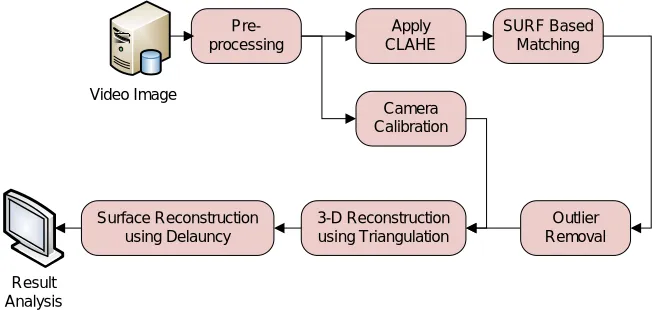
Pre-processing Apply CLAHE SURF Based Matching Outlier Removal 3-D Reconstruction using Triangulation Surface Reconstruction using Delauncy Result Analysis Camera Calibration Video Image
Figure 1: Proposed Architecture.
As shown in the Figure 1 the input image is passed to the pre-processing block. In the pre-processing block different pre-processing steps like input video frame generation, resizing and color conversion from RGB to gray is done. Once this conversions are done this image is passed camera calibration for calibrating the angles of the obtained images and SURF for extraction the feature descriptor and location value. The pre-processed image is passed to camera calibration block. Here different methods like finding the angle of the input image, rotating it to come to a proper form are done.
This image is then passed to outlier removal block to remove unnecessary objects in the image. The triangulation method is carried out for 3D reconstructing. During 3D construction we consider few set of frames and their SURF descriptor features. Whichever features matches we combine it together. Finally surface reconstruction of these matched points is done using Delaunay.
a) CLAHE
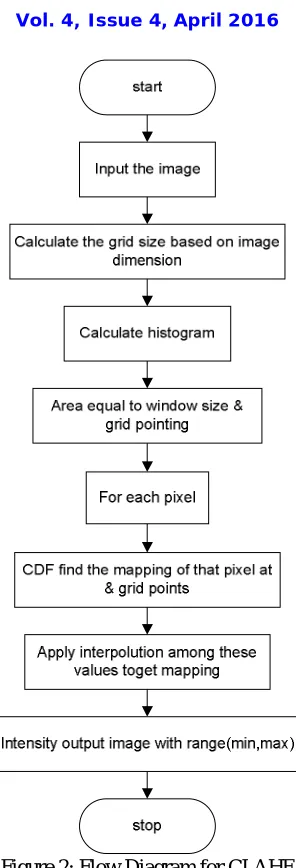
This approach is mainly used for limiting artifacts and enhances the image quality. In this approach the image is divided into different blocks based on the image dimension. Each of these blocks is contrast enhanced. Histogram of these regions is mapped with the specified histogram distribution. Artificially induced perimeters are removed by joining the neighboring blocks using bilinear interpolation
Figure 2: Flow Diagram for CLAHE .
b) Speed Up Robust Features (SURF)
In the computer vision filed one of the most popular feature detectors and descriptor is SURF. Using which rotation invariant and scale invariant interest points with descriptors are generated. This algorithm provides quick interest point matching and localization. It also provides structure localization within view variation. This detector is based on Hessian matrix to get good accuracy. The Hessian matrix H(σ) for a point (x, y) is defined as,
H(X,σ) = L (x, y,σ) L (x, y,σ)
L (x, y,σ) L (x, y,σ) (1)
During feature extraction prominent features are selected by searching pixel value which has intensity values with rapid changes in both horizontal and vertical directions. These pixels will have high harries corner detector scores and re referred as key points. Over a subspace of {x, y,σ}ϵR keypoints are searched. σ Denotes the Gaussian scale space at which keypoint exist [06]. SURF feature is used here to perform image frame matching of an input video [09].
ISSN(Online) : 2320-9801
ISSN (Print) : 2320-9798
I
nternational
J
ournal of
I
nnovative
R
esearch in
C
omputer
and
C
ommunication
E
ngineering
(An ISO 3297: 2007 Certified Organization)
Vol. 4, Issue 4, April 2016
comparing matched values distance and average distance obtained from the SURF descriptor. I.e. if the obtained distance values are more compared to the average distance then this matched points are considered as outlier [10]. The triangulation method is then applied to matched points for 3D reconstruction. These 3D coordinates are later processed with the help of Dealaunchy triangulation for surface reconstruction.
IV. EXPERIMENTAL RESULT
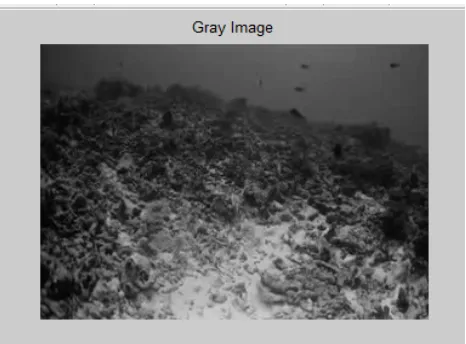
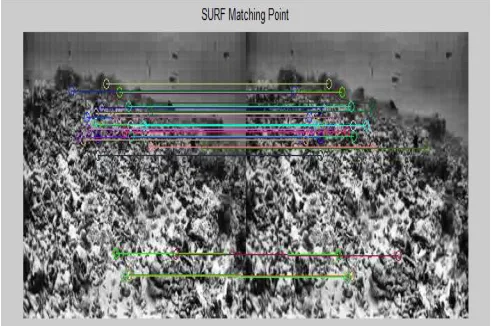
The results obtained at each stage are discussed briefly in this section. This algorithm is evaluated on underwater videos. Every time for 3D reconstruction the respective frames generated from the video sequence are taken. Figure 3 shows the inputvideo frame of our proposed system. Figure 4 shows the conversion of input image to a gray scale image as a result of preprocessing step. In figure 5 shows the histogram equalization of image. The results of SURF feature matching process are showed in Figure 6 and the 3D surface reconstructed images for the input video frame and matched SURF points are showed in figure 7.
Figure 3: Shows Video frame as input
Figure 5: Shows contrast-limited adaptive Histogram Equalization of Image.
ISSN(Online) : 2320-9801
ISSN (Print) : 2320-9798
I
nternational
J
ournal of
I
nnovative
R
esearch in
C
omputer
and
C
ommunication
E
ngineering
(An ISO 3297: 2007 Certified Organization)
Vol. 4, Issue 4, April 2016
V.CONCLUSION
In the proposed work underwater enhancement using CLAHE and 3D reconstruction of the video frames with the help of SURF feature detector and descriptor is done. CLAHE based image enhancement is done to get better matching of descriptors for efficient 3D reconstruction. Furthermore outlier removal and triangulation with the help Delaunay algorithm is also done for 3D surface reconstruction. These algorithms are evaluated on underwater videos. The proposed system could give accuracy when compared to the existing methods.
REFERENCES
[1] Ricard Campos, Rafael Garcia, Pierre Alliez and Mariette Yvinec, “A Surface Reconstruction Method for In-Detail Underwater 3D Optical Mapping”, HAL, 2014.
[2] Enric Galceran, Ricard Campos, Narcis, Palomeras, Marc Carreras and Pere Ridao, “Coverage Path Planning with Realtime Replanning for Inspection of 3D Underwater Structures”, IEEE, Pp. 6586 - 6591, 2014.
[3] Ravindra Pal Singh and Manish Dixit, “Histogram Equalization: A Strong Technique for Image Enhancement”, International Journal of Signal Processing, Image Processing and Pattern Recognition,Vol.8, Issue 8, pp.345-352, 2015.
[4] Ricardus Anggi Pramunendar, Guruh Fajar Shidik, Catur Supriyanto, Pulung Nurtantio Andono and Mochamad Hariadi, “Auto Level Color Correction for Underwater Image Matching Optimization”, IJCSNS International Journal of Computer Science and Network Security, Vol.13, Issue 1, 2013.
[5] Pujiono, Pulung N.A, I Ketut Eddy Purnama and Mochamad Hariadi, “Color Enhancement of Underwater Coral Reef Images Using Contrast Limited Adaptive Histogram Equalization (CLAHE) With Rayleigh Distribution”, The Proceedings of the 7th ICTS, Bali, 2013.
[6] G. N. Balaji, T. S. Subashini and N. Chidambaram, “Cardiac View Classification using Speed Up Robust Features”, Indian Journal of Science and Technology, Vol. 8, Issue S7, pp. 1-5, 2015.
[7] Pulung Nurtantio Andono, bRicardus Anggi Pramunendar, Catur Supriyanto, Guruh Fajar Shidik, I Ketut Eddy Purnama and Mochamad Hariadi, “Enhancement of 3d Surface Reconstruction of Underwater Coral Reef Base on Sift Image Matching Using Contrast Limited Adaptive Histogram Equalization And Outlier Removal”, KURSOR journal, Vol. 7, Issue 1, 2013.
[8] Kelly de Jesus, Karla de Jesus, Pedro Figueiredo, João Paulo Vilas-Boas,Ricardo Jorge Fernandes and Leandro JoséMachado, “Reconstruction Accuracy Assessment of Surface and Underwater 3D Motion Analysis: A New Approach”, Hindawi Publishing Corporation Computational and Mathematical Methods in Medicine, Vol. 2015, pp. 1- 8, 2015.
[9] Yanwei Pang, WeiLi , YuanYuan and JingPan, “Fully Affine Invariant Surf for Image Matching”, Elseveir, Vol. 85, pp. 6 – 8, 2012.