University of Windsor University of Windsor
Scholarship at UWindsor
Scholarship at UWindsor
Electronic Theses and Dissertations Theses, Dissertations, and Major Papers
4-30-2018
New Polyether Complexes of Germanium(II) and Tin(II): Synthesis,
New Polyether Complexes of Germanium(II) and Tin(II): Synthesis,
Structural Characterization and Reactivity
Structural Characterization and Reactivity
Alina Maria Secara
University of Windsor
Follow this and additional works at: https://scholar.uwindsor.ca/etd
Recommended Citation Recommended Citation
Secara, Alina Maria, "New Polyether Complexes of Germanium(II) and Tin(II): Synthesis, Structural Characterization and Reactivity" (2018). Electronic Theses and Dissertations. 7449.
https://scholar.uwindsor.ca/etd/7449
This online database contains the full-text of PhD dissertations and Masters’ theses of University of Windsor students from 1954 forward. These documents are made available for personal study and research purposes only, in accordance with the Canadian Copyright Act and the Creative Commons license—CC BY-NC-ND (Attribution, Non-Commercial, No Derivative Works). Under this license, works must always be attributed to the copyright holder (original author), cannot be used for any commercial purposes, and may not be altered. Any other use would require the permission of the copyright holder. Students may inquire about withdrawing their dissertation and/or thesis from this database. For additional inquiries, please contact the repository administrator via email
New Polyether Complexes of Germanium(II) and Tin(II):
Synthesis, Structural Characterization and Reactivity
By
Alina Maria Secara
A Thesis
Submitted to the Faculty of Graduate Studies through the Department of Chemistry and Biochemistry
in Partial Fulfillment of the Requirements for
the Degree of Master of Science at the University of Windsor
Windsor, Ontario, Canada
2018
New Polyether Complexes of Germanium(II) and Tin(II): Synthesis, Structural Characterization and Reactivity
by
Alina Maria Secara
APPROVED BY:
______________________________________________ J. Gagnon
Department of Earth and Environmental Sciences
______________________________________________ S. Loeb
Department of Chemistry and Biochemistry
______________________________________________ C. Macdonald, Advisor
Department of Chemistry and Biochemistry
iii
Declaration of Co-Authorship/Previous Publication
I. Co-Authorship
I hereby declare that this thesis incorporates material that is result of joint research, as follows:
Chapter 2 and 3 contain results included in the manuscript accepted for publication entitled “Synthesis and Structural Characterization of New Polyether Complexes of Germanium(II) and Tin(II)” (Alina M. Secara, Justin F. Binder, Ala’aeddeen Swidan and Charles L.B. Macdonald, Canadian Journal of Chemistry, 2018). I and Justin F. Binder prepared the manuscript. Justin F. Binder performed the X-ray crystallography experiments. I synthesized and further characterized all the complexes in this work. Ala’aeddeen Swidan performed the X-ray crystallography experiment for the water adduct (H2O·SnOTf(dibenzo[24]crown-8)][OTf]) presented in chapter 3 and the elemental
analysis. My supervisor, Dr. Charles L.B. Macdonald refined and solved the crystal structures and provided significant edits to the manuscript.
Chapter 4 contains the preliminary results of the investigation into reactivity of the new polyether complexes. I synthesized and characterized all the compounds in this work. Ala’aeddeen Swidan performed the elemental analysis for one of the compounds (C26H32F6Sn2O14S2) in this work. The results presented in this chapter are unpublished.
iv
obtained written permission from each of the co-author(s) to include the above material(s) in my thesis.
I certify that, with the above qualification, this thesis, and the research to which it refers, is the product of my own work.
II. Previous Publication
This thesis includes 1 original papers that have been previously published/submitted for publication in peer reviewed journals, as follows:
Thesis Chapter Publication title/full citation Publication status Chapter 2 “Synthesis and Structural Characterization of
New Polyether Complexes of Germanium(II) and Tin(II)”, Alina M. Secara, Justin F. Binder, Ala’aeddeen Swidan and Charles L.B. Macdonald,
Canadian Journal of Chemistry, 2018
Accepted
Chapter 3 “Synthesis and Structural Characterization of New Polyether Complexes of Germanium(II) and Tin(II)”, Alina M. Secara, Justin F. Binder, Ala’aeddeen Swidan and Charles L.B. Macdonald,
Canadian Journal of Chemistry, 2018
Accepted
v
III. General
I declare that, to the best of my knowledge, my thesis does not infringe upon anyone’s copyright nor violate any proprietary rights and that any ideas, techniques, quotations, or any other material from the work of other people included in my thesis, published or otherwise, are fully acknowledged in accordance with the standard referencing practices. Furthermore, to the extent that I have included copyrighted material that surpasses the bounds of fair dealing within the meaning of the Canada Copyright Act, I certify that I have obtained a written permission from the copyright owner(s) to include such material(s) in my thesis.
vi
Abstract
The chemistry involving group 14 cations and polyether ligands has been an area of great interest in the last decade. The Macdonald Group has long been interested in the synthesis, characterization and reactivity of polyether complexes containing group 13 and 14 elements in low oxidation state. Recently, our group has demonstrated that the properties of crown ethers and of the more flexible glyme ligands make them ideal for the stabilization of group 14 elements in the +2 oxidation state. Many of the resulting polyether complexes hold great potential for further reactivity in that they may act as Lewis acids to simple nucleophiles like water and ammonia while retaining a non-bonding electron pair.
A series of complexes of crown ethers and glymes with Ge(II) and Sn(II) bromide have been synthesized. Specifically, [GeBr([15]crown-5)][GeBr3],
[GeBr([18]crown-6)][GeBr3], [GeBr(triglyme)][GeBr3], [GeBr(tetraglyme)][GeBr3],
[SnBr([18]crown-6)][SnBr3], [Sn([15]crown-5)2][SnBr3]2, [SnBr(triglyme)][SnBr3] and
[SnBr(tetraglyme)][SnBr3] have been fully characterized including by single crystal X-ray
diffraction. [GeBr(triglyme)][GeBr3] and [GeBr(tetraglyme)][GeBr3] represent the first
examples of crystallographically confirmed glyme complexes of germanium. The synthesis of [GeBr(dibenzo[24]crown-8)][GeBr3] and [GeCl(dibenzo[24]crown-8)][GeCl3] are also
vii
Dedication
Dedicated to my loving husband Tudor and
viii
Acknowledgements
Since my graduation from university, my life has changed and become drastically different. Immigrating to Canada was one of the most significant events of my life; however, while my life in a new country progressed very quickly, one of my biggest dreams of continuing my education seemed to progressively fade as the years passed by. Because of this, I would like to express my sincere gratitude to Dr. Chuck Macdonald, my supervisor. I am very grateful to him for this special opportunity, as it has allowed me to reconnect and continue pursuing my aspirations, as well as obtaining my masters. Iwould like to thank Chuck especially for his patience, encouragement and guidance, and for all the advice he has given me – including the mini chemistry lessons when a question arose. Thank you very much for everything!
I would like to thank Dr. Steve Loeb and Dr. Joel Gagnon for agreeing to be on my examination committee and for taking the time to read my thesis.
ix
Extended thanks go to Dr. Matt Revington for his help and guidance with NMR spectroscopy and Dr. Janeen Auld for EA. Thank you to Marlene for always keeping us on track and to Beth for all the nice conversations we had. Thank you to Nedhal for her encouragement.
I would also like to thank the great professors that I have had, especially Dr. Steve Loeb, Dr. Jeremy Rawson and Dr. Tricia Charmichael for their awesome work. Especially, to Dr. Loeb for his patience and for listening to my first presentation, probably one of the longest presentations in his class.
x
Table of Contents
Declaration of Co-Authorship/Previous Publication ... iii
Abstract ... vi
Dedication ... vii
Acknowledgements ... viii
List of Tables ... xiv
List of Figures ...xv
List of Schemes ...xx
List of Abbreviations/Symbols ... xxi
List of Complexes ... xxiii
Chapter 1: Introduction to the Chemistry of Polyether Complexes of Heavier Main Group Elements in Low Oxidation State ...1
1.1 Introduction ...1
1.2 Crown ethers and related ligands ...2
1.2.1 Names and Structures ...2
1.2.2 A brief overview of history, properties and applications of crown ethers ...4
1.3 Oxidation state and related concepts ...9
1.3.1 Definitions and relationship of common terms ...9
1.3.2 Oxidation states of Group 13 and 14 Elements ...12
1.4 Group 14 Elements and the Chemistry of Ge(II) and Sn(II) Compounds ...14
xi
1.4.2 Metallylenes...15
1.4.3 Germylenes and Stannylenes ...17
1.5 Macrocyclic Polyether Ge and Sn Complexes ...22
1.5.1. Cationic crown ether and related complexes of germanium(II) ...24
1.5.2 Cationic crown ether and related complexes of tin(II) ...27
1.6 Thesis Overview...30
1.7 References ...31
Chapter 2: Synthesis and Structural Characterization of New Polyether Complexes of Germanium(II)...36
2.1 Introduction ...36
2.2 Results and Discussions ...37
2.2.1 Germanium(II) Crown Complexes ...37
2.2.2 Germanium(II) Bromide Glyme Complexes ...45
2.3 Conclusions ...48
2.4 Experimental...49
2.4.1 General procedures ...49
2.4.2 Specific Procedures ...50
2.4.3 X-ray crystallography ...54
2.5 References ...58
xii
3.1 Introduction ...60
3.2 Results and Discussions ...62
3.2.1 Tin (II) Bromide Crown Complexes ...62
3.2.2 Tin (II) Bromide Glyme Complexes ...67
3.2.3 Water Complex of Tin(II) Cation ...71
3.3 Conclusions ...75
3.4 Experimental...75
3.4.1 General procedures ...75
3.4.2 Specific procedures ...76
3.4.3 X-ray crystallography ...79
3.5 References ...83
Chapter 4: Conclusions and Future Work ...85
4.1 Conclusions ...85
4.2 Future work: Investigation into the Reactivity of the New Polyether Complexes 87 4.2.1 Reactivity with ammonia ...87
4.2.2 Deprotonation of the Water Complex ...89
4.2.3 Reactivity with water ...90
4.3 References ...94
Appendices ...95
xiii
Appendix II: Supplementary Information for Chapter 3 ...99
Appendix III: Supplementary Information for Chapter 4 ...101
References ...103
xiv
List of Tables
Table 2.1 Summary of crystallographic data and refinement details for
[NH4(benzo[18]crown-6)][GeBr3] and 2.1[GeBr3] ... 55 Table 2.2 Summary of crystallographic data and refinement details for 2.2[GeBr3] and [2.4(H2O)][GeCl3] ... 56 Table 2.3 Summary of crystallographic data and refinement details for 2.5[GeBr3] and 2.6[GeBr3] ... 57 Table 3.1 Summary of crystallographic data and refinement details for 3.1[SnBr3] and 3.2[SnBr3]2 ... 80 Table 3.2 Summary of crystallographic data and refinement details for 3.3[SnBr3] and 3.4[SnBr3] ... 81 Table 3.3 Summary of crystallographic data and refinement details for [3.5(H2O)][OTf]
xv
List of Figures
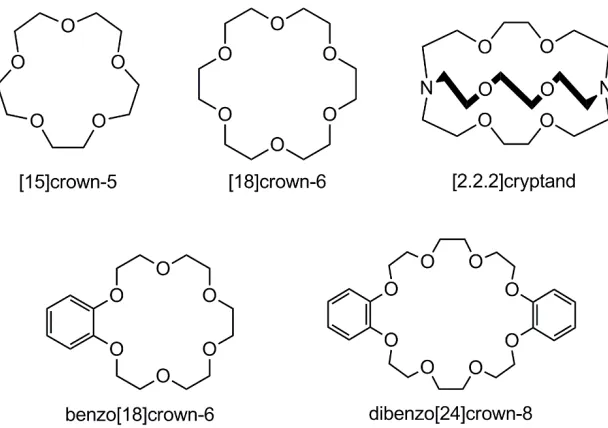
Figure 1.1 Examples of crown ethers and cryptand ... 3
Figure 1.2 Examples of glymes... 4
Figure 1.3 Products synthesized by Pedersen ... 5
Figure 1.4 Complexes of [18]crown-6 with H3O+ and NH4+ ... 7
Figure 1.5 Complexes of [18]crown-6 with K+ and Cs+ ... 7
Figure 1.6 Oxidation states of Group 14 elements (E) based on the alternative model .... 11
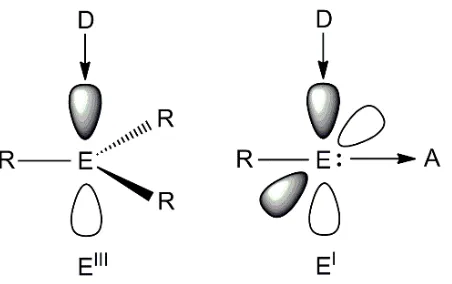
Figure 1.7 Group 13 elements (E) in the +3 and +1 oxidation states with electron donors (D) or acceptors (A) ... 13
Figure 1.8 Difference between the ground states of carbenes and metallylenes. ... 16
Figure 1.9 Ways of thermodynamic stabilization of metallylenes... 16
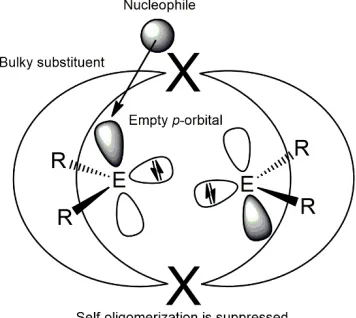
Figure 1.10 Kinetic stabilization of metallylenes using bulky substituents (E=Si, Ge, Sn, Pb) ... 17
Figure 1.11 Example of Lappert’s germylene complexes in monomeric and dimeric forms ... 18
Figure 1.12 (a) Structure of NHC-Ge(Mes)2 and (b) Structure of GeCl2(1,4-dioxane) .... 20
Figure 1.13 Lappert’s dialkylstannylene complexes in monomeric and dimeric forms ... 21
Figure 1.14 (a) Kira’s cyclic dialkylgermylene and (b) dialkylstannylene... 21
Figure 1.15 Examples of stable monomeric germylenes and stannylenes with bulky aryl groups (E= Ge, Sn; Mes = 2,4,6-trimethylphenyl ; R= iPr, cyclohexyl, 1-ethylpropyl) .... 22
xvi
Figure 1.17 Cationic crown ether, cryptand and glyme complexes of tin(II), (X=Cl, Br, I; OTf = CF3SO3-). ... 27 Figure 2.1 Examples of polyether complexes of germanium cations ... 37 Figure 2.2 Thermal ellipsoid plot (50% probability surface) of [NH4(benzo[18]crown-6)][GeBr3]. Hydrogen atoms (except those of ammonium) are
omitted for clarity. Selected bond lengths (Å): H1-O1, 2.10(9), H2-O3, 1.88(12); H3-O5, 2.20(10). ... 38 Figure 2.3 Thermal ellipsoid plot (50% probability surface) of 2.1[GeBr3]. Only one
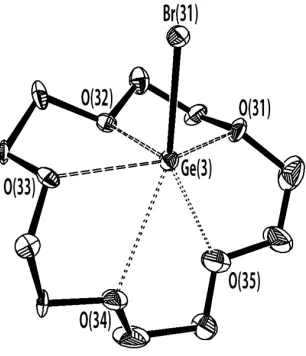
crystallographically unique cation is displayed for clarity. Hydrogen atoms and the anion are omitted for clarity. Dashed lines are used for Ge-O contacts shorter than 2.5 Å and dotted lines are used to indicate Ge-O contacts longer than 2.8 Å. Selected interatomic distances (Å) and angles (°): Ge3-Br31, 2.525(2); Ge3-Ge3-O31, 2.353(9); Ge3-O32, 2.135(9); Ge3-O33, 2.35(3); Ge3-O34, 2.857(10); Ge3-O35, 2.900(10); Br31-Ge3-O31, 89.2(7); Br31-Ge3-O32, 88.5(3); Br31-Ge3-O33, 95.1(2). ... 40 Figure 2.4 Thermal ellipsoid plot (50% probability surface) of 2.2[GeBr3]. Hydrogen
atoms and the anion are omitted for clarity. Dashed lines are used for Ge-O contacts shorter than 3 Å and dotted lines are used to indicate Ge-O contacts longer than 3 Å. Selected interatomic distances (Å) and angles (°): Ge2-Br21, 2.3993(5); Ge2-O21, 2.269(2); Ge2-O22, 2.413(3); Ge2-O23, 2.889(3); Ge2-O24, 3.300(3); Ge2-O25, 3.043(3); Ge2-O26, 2.556(3); Br21-Ge2-O21, 92.61(7); Br21-Ge2-O22, 88.13(7); Br21-Ge2-O23, 96.12(6); Br21-Ge2-O25, 88.70(5); Br21-Ge2-O26, 87.11(6). ... 41 Figure 2.5 Thermal ellipsoid plot (50% probability surface) of [2.4(H2O)][GeCl3].
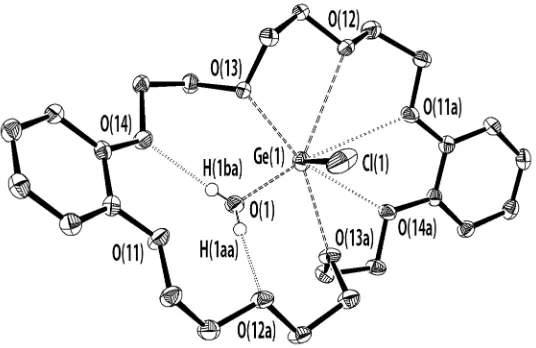
xvii
are used for Ge-O contacts shorter than 3 Å and dotted lines are used to indicate Ge-O contacts longer than 3 Å. Selected interatomic distances (Å) and angles (°): Ge1-Cl1, 2.2760(12); Ge1-O1, 2.029(4); Ge1-O11a, 3.5699(19); Ge1-O12, 2.9941(18); Ge1-O13, 2.2954(18); Ge1-O14a, 3.3609(19); H1aa-O12a, 1.95(7); H1ba-O14, 2.07(7); Cl1-Ge1-O1, 89.10(13). ... 43 Figure 2.6 FTIR spectrum of [(H2O)GeCl(dibenzo[24]crown-8)][GeCl3] ... 44 Figure 2.7 Thermal ellipsoid plot (50% probability surface) of 2.5[GeBr3]. Hydrogen
atoms and the anion are omitted for clarity. Dashed lines are used for Ge-O contacts shorter than 2.2 Å and dotted lines are used to indicate Ge-O contacts longer than 2.4 Å. Selected interatomic distances (Å) and angles (°): Ge1-Br11, 2.4155(9); Ge1-O11, 2.425(4); Ge1-O12, 2.122(3); Ge1-O13, 2.189(3); Ge1-O14, 2.656(4); Br11-Ge1-O11, 85.09(15); Br11-Ge1-O12, 94.65(11); Br11-Ge1-O13, 87.10(11); Br11-Ge1-O14, 87.96(10). ... 46 Figure 2.8 Thermal ellipsoid plot (50% probability surface) of 2.6[GeBr3]. Hydrogen
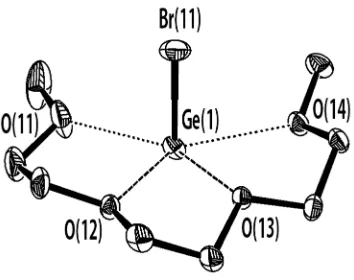
atoms and the anion are omitted for clarity. Dashed lines are used for Ge-O contacts shorter than 2.4 Å and dotted lines are used to indicate Ge-O contacts longer than 2.7 Å. Selected interatomic distances (Å) and angles (°): Ge1-Br11, 2.4003(7); Ge1-O11, 2.710(3); Ge1-O12, 2.389(3); Ge1-O13, 2.219(3); Ge1-O14, 2.364(3); Ge1-O15, 2.805(4); Br11-Ge1-O11, 90.80(9); Br11-Ge1-O12, 89.68(7); Br11-Ge1-O13, 92.79(11); Br11-Ge1-O14, 88.65(10); Br11-Ge1-O15, 88.49(8). ... 48 Figure 3.1 Examples of In(I) and Ge(II) crown ethers complexes (OTf=O3SCF3; X=Cl, Br) ... 60
Figure 3.3 Thermal ellipsoid plot (50% probability surface) of 3.1[SnBr3]. Hydrogen atoms
xviii
Sn1-Br1, 2.5979(11); Sn1-O11, 2.855(6); Sn1-O12, 2.745(6); Sn1-O13, 2.703(5); Sn1-O14, 2.764(6); Sn1-O15, 2.733(6); Sn1-O16, 2.740(6); Br1-Sn1-O11, 87.17(11) O12, 93.16(13); O13, 82.81(10); O14, 89.27(12); Br1-Sn1-O15, 87.16(13) Br1-Sn1-O16, 92.68(11).... 64 Figure 3.4 Thermal ellipsoid plot (50% probability surface) of 3.2[SnBr3]2. Hydrogen
atoms and anions are omitted for clarity. Selected interatomic distances (Å) and angles (°): Sn1-O11, 2.662(4); Sn1-O12, 2.648(4); Sn1-O13, 2.795(4); Sn1-O14, 2.740(4); Sn1-O15, 2.770(3). O1-Sn1-O2, 60.27(13); O2-Sn1-O3, 59.89(13); O3-Sn1-O4, 59.52(13); O4-Sn1-O5, 60.23(11); O5-Sn1-O1, 61.08(11).... 66 Figure 3.5 Thermal ellipsoid plot (50% probability surface) of 3.3[SnBr3]. Hydrogen atoms
and anions are omitted for clarity. Selected interatomic distances (Å) and angles (°): Sn1-Br11, 2.6751(7); Sn1-Br11a, 3.2552(7); Sn1-O11, 2.582(3); Sn1-O12, 2.472(3); Sn1-O13, 2.475(3); Sn1-O14, 2.585(3); Br1-Sn1-O11, 90.04(7); Br1-Sn1-O13, 84.43(7); Br1-Sn1-O14, 84.67(6). ... 69 Figure 3.6 Thermal ellipsoid plot (50% probability surface) of 3.4[SnBr3]. Hydrogen atoms
and anions are omitted for clarity. Selected interatomic distances (Å) and angles (°): Sn1-Br11, 2.6155(7); Sn1-O11, 2.666(4); Sn1-O12, 2.556(4); Sn1-O13, 2.453(4); Sn1-O14, 2.551(4); Sn1-O15, 2.715(4); Br1-Sn1-O11, 86.39(10); Br1-Sn1-O12, 85.95(8); Br1-Sn1-O13, 82.60(11); Br1-Sn1-O14, 90.41(10).... 70 Figure 3.7 Thermal ellipsoid plot (50% probability surface) of [3.5(H2O)][OTf]. Hydrogen
atoms (except those on H2O) are omitted for clarity. Dashed lines are used for Sn-O
xix
2.658(2); Sn-O22, 2.4199(16); Sn-O22a, 2.4339(15); Sn-O21a, 3.1680(17); Sn-O23a, 3.0775(17); Sn-O24a, 3.4006(17); S-O11, 1.4505(19); S-O12, 1.424(2); S-O13, 1.421(2); O23-H2, 1.84(4); O21-H1, 1.98(3) ... 73 Figure 3.8 FTIR spectrum of [3.5(H2O)][OTf] ... 74 Figure 4.1 FTIR spectrum of ammonia complex of Ge(OTf)2·(dibenzo[24]crown-8)..... 88 Figure 4.2 1H NMR spectrum of the reaction of [(H2O)GeCl(dibenzo[24]crown-8)][GeCl3]
with one equivalent of N-methylimidazole in CD3CN (C =crown ether; THF at 3.6 and
DCM at 5.44 ppm are also present) ... 90
Figure 4.3 1H NMR spectrum of the water adduct
[(H2O)GeCl(dibenzo[24]crown-8)][GeCl3] in CD3CN (H= H2 O; C =crown ether); THF:
xx
List of Schemes
Scheme 1.1 Synthesis of the dicationic complex of germanium (R= iPr NHC) ... 18
Scheme 1.2 Reactivity of germylenes and stannylenes (E = Ge, Sn) ... 19
Scheme 1.3 Synthesis and reactivity of In(I) complexes11 ... 23
Scheme 1.4 Synthesis of complex of Ge2+ with the [2.2.2]cryptand ... 24
Scheme 1.5 Syntheses of cationic crown ether complexes of Ge(II)11 ... 26
Scheme 2.1 Synthesis of 2.1[GeBr3] and 2.2[GeBr3]; a) [15]crown-5), b) [18]crown-6 .. 39
Scheme 2.2 Synthesis of 2.4[GeCl3] and isolation of [2.4(H2O)][GeCl3] ... 42
Scheme 2.3 Synthesis of 2.5[GeBr3] and 2.6[GeBr3]; a) triglyme, b) tetraglyme ... 45
Scheme 3.1 Synthesis of 3.1[SnBr3]... 62
Scheme 3.2 Synthesis of 3.2[SnBr3]2 ... 65
Scheme 3.3 Synthesis of 3.3[SnBr3] and 3.4[SnBr3]; a) triglyme, b) tetraglyme ... 67
xxi
List of Abbreviations/Symbols
[12]crown-4 1,4,7,10-tetraoxacyclododecane [15]crown-5 1,4,7,10,13-pentaoxacyclopentadecane [18]crown-6 1,4,7,10,13,16-hexaoxacyclooctadecane
Å Angstrom
Anal. Calc. Analytically Calculated
Benzo[18]crown-6 2,3,5,6,8,9,11,12,14,15-Decahydro-1,4,7,10,13,16-benzohexaoxacyclooctadecine
13C carbon-13
cm centimeter
CSD Cambridge Structural Database
δ Chemical Shift (NMR)
CD3CN acetonitrile-d3
DCM Dichloromethane
deg (or °) degrees
Dibenzo-24-crown-8
6,7,9,10,12,13,20,21,23,24,26,27-Dodecahydrodibenzo[b,n][1,4,7,10,13,16,19,22]octaoxacyclo tetracosine
E Element
Et2O diethyl ether
19F fluorine-19
FT-IR Fourier transform infrared spectroscopy
1H proton
g gram
Hz Hertz
iPr Iso-propyl
IUPAC International Union of Pure and Applied Chemistry
m Multiplet (NMR)
xxii
MeIm N-methylimidazole
mg milligram
mL milliliter
mm millimeter
mmol millimole
Mp Melting point
14N 14N nitrogen-14
NHC N-heterocyclic carbene
NMR Nuclear Magnetic Resonance
OTf Triflate, SO3CF3-, trifluoromethanesulfonate
p Pentet (NMR)
ppm parts per million
R organic substituent
Redox reduction-oxidation
s Singlet (NMR)
SC-XRD Single Crystal X-ray Diffraction
t Triplet (NMR)
THF Tetrahydrofuran
Triflate Trifluoromethanesulfonate
xxiii
List of Complexes
xxiv
Chapter 3
1
Chapter 1: Introduction to the Chemistry of Polyether
Complexes of Heavier Main Group Elements in Low Oxidation
State
1.1 Introduction
In this first chapter, the chemistry of polyether ligands including crown ethers, glymes and related ligands with main group elements – particularly with heavier group 13 and 14 elements, and the progress made over the past decades are explored. A review of important and related concepts such as valence and oxidation state and of the chemistry of group 14 elements, especially in lower oxidation states is also included in this chapter.
Ligands such as crown ethers and cryptands are a very interesting class of complexing ligands due to their remarkable binding ability. This special ability of these interesting ligands was initially exploited for binding metal ions – especially those from the s-block.1 In the p-block2, the first reported examples of crown ether complexes with metallic cations included aluminum,3 gallium,4 indium,4–7 thallium,8 tin,9 lead,2 and bismuth.2
2
The Macdonald Group, our research group, in collaboration with other groups, has demonstrated that the properties ofcrown ethers and of the more flexible glyme ligands make them ideal for the stabilization of low-valent group 13 and 14 elements.6,10,11
1.2 Crown ethers and related ligands
1.2.1 Names and Structures
Crown ethers are heterocycles containing repeating ethyleneoxy, (-CH2CH2O-)
3
Figure 1.1 Examples of crown ethers and cryptand
The cryptands were first synthesized by Lehn.15 He designed these ligands as a three-dimensional analogue to the crown ethers and named them “cryptands” from the Greek word “kruptos” which means “hidden” to express their special topological shape. The most common ligand of this series is cryptand[2.2.2], similar in size to the [18]crown-6. The numbers [2.2.2] indicate the number of oxygen atoms in each of the three bridges as shown in Figure 1.1. The presence of the third chain that converts the “two-dimensional” crown ethers into a three-dimensional ligand system is the major difference between crowns and cryptands. [18]crown-6 and cryptand[2.2.2] are representative of each group.
Acyclic crown ethers are called “podands”(open-chain crown type compounds)14
4
suggested by the numerical prefix. For example, the triglyme has 4 oxygen atoms and the tetraglyme has 5 oxygen atoms. These two common glymes are used in this thesis and their new complexes with cations of group 14 elements are characterized in the following chapters. The structures of these two types of glymes are given in Figure 1.2 below.
Figure 1.2 Examples of glymes
1.2.2 A brief overview of history, properties and applications of crown ethers
In 1913, Alfred Werner won the Nobel Prize for discovering that neutral ligands are able to ‘‘coordinate’’ with metal ions.16 In 1967, after half a century, Pedersen discovered
the crown ethers and examined their abilities to bind strongly with metal ions. Since then, the study of crown ethers and their related ligands has grown at an incredible pace.13,17
5
recognize three chemists, Pedersen,20 Cram,21and Lehn,22 for their remarkable work in host-guest and supramolecular chemistry.
When Pedersen wanted to synthesize a new complexing agent for divalent cations, he used catechol (1,2- dihydroxybenzene) as the key element.23 The strategy was to use one of the two hydroxyl groups to connect to a linker and attach to a second catechol. He obtained the desired product and also a neutral material, which appeared to interact with metal cations even though the compound was uncharged.24 The unexpected product was the dibenzo[18]crown-6 (Figure 1.3)13, one of the most common crown ethers now. The
formation of the crown ether, as the unexpected product of the synthesis reaction, was a consequence of the presence of an alkali metal-containing base (such as NaOH).13 Pedersen
earned the Nobel Prize for his remarkable discovery of crown ethers. This example of a cyclic polyether with special complexing abilities first recognized by Pedersen became the origin from which the field of supramolecular chemistry developed.
Figure 1.3 Products synthesized by Pedersen
6
oxygen ring, dibenzo[18]crown-6, is large enough to accommodate any unsolvated metal cation. It is noteworthy that the ammonium ion forms a complex with this crown ether13 andsince the ligand is neutral, the cation complex must be always associated with an anion.
There are more than 300 complexes of only dibenzo[18]crown-6 reported in the Cambridge Structural Database since Pedersen’s first discovery. A stunning amount of new structural types and new compounds were prepared and reported in the literature.25,26 Many hundreds of structures are now known and they differ in many ways, including conformations and metal-donor distances.
The most common compounds in the [3n]crown-n family (e.g. [12]crown-4, [15]crown-5, [18]crown-6, [21]crown-7 and [24]crown-8) are well known for complexing alkali metal cations, such as Li+, Na+, K+, and Cs+. [18]crown-6 is the superior binder in all of the cases. The strengths of binding for these compounds vary, according to the relationship between the size of the ring and cation or to the associated counter-anion, and depending on the solvent used in the complexation reaction, too. It is worth mentioning that the fusion of a benzene group to [18]crown-6 as in the cases of both benzo[18]crown-6 and dibenzo[18]crown-6 caused reduction of the binding strength.27
7
the crown ethers. All the binding constants peaks for [18]crown-6 when it binds with Na+, K+, NH4+, and Ca2+ show maximum values for this crown (compared with other common
crowns from [12]crown-4 to [24]crown-8 ). When [18]crown-6 binds the K+ ion (Figure 1.5), the size fit is good, the ethylene units are not conformationally compromised, and the six donor groups are focused on the cation with three oxygens above the plane and three below.27 It is also well known that [18]crown-6 has a high affinity for the hydronium ion H3O+and NH4+ , as they can fit inside the crown ether (Figure 1.4).
Figure 1.4 Complexes of [18]crown-6 with H3O+ and NH4+
When the crown ether is smaller than the target cation, a sandwich structure may form rather than a simple 1:1 complex. The cation is sandwiched between the two rings of the crown ether (Figure 1.5).28
8
An impressive number of coordination complexes with many types of metal ions has been reported since the discovery of crown ethers. Given the above examples of complexes of crown ethers with s-block elements, at this point, it is worth emphasising that for most of polyether complexes of p-block elements – particularly the elements at left-hand side (group 13 and 14), the cation is in a lower-than-usual oxidation state. An element in lower oxidation state is more electron rich and less electronegative than it is in the usual oxidation state, thus these elements, especially the heavier elements of groups 13 and 14 behave more like s-block metals, having lower ionization energies and electron afinities.29 Also, generally the estimations of the cavity sizes of common crown ethers used to bind p-block elementshave been based on the studies previously done with s-block metal ions.29
Since Pedersen’s fortuitous discovery of crown ethers, studies over the past decades have demonstrated that crown ethers can play interesting roles in many chemical and physical processes. As previously described, the special characteristics of crown ethers are their strong binding ability and high selectivity for metal ions. They have a very important role in ‘‘host–guest’’ chemistry; the crown ether plays the “host” molecule, which has the ability to encapsulate a “guest” molecule (e.g. a metal cation) via non-covalent interactions. Crown ethers have many useful applications based on their high selectivity for metal cations of different sizes. Their capability of enclosing NH4+ is of special importance
9
thesis is stabilization of low oxidation state germanium and tin by crown ethers and related glymes.
1.3 Oxidation state and related concepts
1.3.1 Definitions and relationship of common terms
It is worth clarifying the notions of valence, oxidation state and coordination number, terms often used in this thesis and describe their relationship. Each of these terms has individual meaning. Valence is defined as “the number of electrons that an atom uses in bonding”.30 Oxidation state sometimes referred to as oxidation number is “the charge
remaining on an atom when all ligands are removed heterolytically in their closed form, with the electrons being transferred to the more electronegative partner”.30 Coordination number is defined as “the number of atoms bonded to the atom of interest”.30 These are simple definitions of three related but fundamentally different concepts.
10
bonds. For example, the nitrogen in NH3 is trivalent, which indicates that there is a lone
pair of electrons on nitrogen that may be used to coordinate additional groups such as H+. Definitely, the valence concept provides useful information about the nature (structure, bonding and reactivity) of a molecule.30
Although, there are many situations when, by coincidence, the valence of an atom in a molecule is equal to its oxidation state, the two concepts are different.30 For example: C is tetravalent but has an oxidation state of 0 in Me4C, or N is pentavalent but has an
oxidation state of -3 in [NH4]+. There are different ways to assign the oxidation state of an
atom. In contrast to valence state, oxidation state of an atom in a molecule can be calculated from the molecular formula. Chemists use a set of axioms or guidelines for assigning the oxidation numbers31 (e.g.hydrogen is assigned an oxidation number of +1; oxygen is assigned an oxidation number of -2) to determine the oxidation state of an atom in a compound. These conventional rules are useful for balancing redox reactions.
11
Me2CCl2 and :CCl2 has an oxidation number of +2 these molecules have very distinct
chemical properties. While the carbene :CCl2 exists only as a reactive intermediate,
Me2CCl2 is known as a stable compound.30 According to the alternative model the carbon
has an oxidation state of +4 in Me2CCl2 and +2 oxidation state in :CCl2 which explain the
different chemistry of these two compounds.
Applying the alternative method to group 14 elements, the oxidation number of +4 is assigned to an atom with zero non-bonding electrons. The next oxidation numbers of +3, +2, +1, 0 are assigned to atoms with one, two, three and four accordingly, as illustrated in
Figure 1.6. This alternative approach relates more closely to the valence concept described above, than to the conventional method of assigning oxidation states which provides little insight into the nature of a molecule.
Figure 1.6 Oxidation states of Group 14 elements (E) based on the alternative model
The relationship between the valence and the coordination number is also worth mentioning. Defined as the number of atoms attached to the atom of interest, for neutral molecules of the hydride type, AHn as an example, n, the coordination number of an atom
12
(donor, such as H2O or NH3) to an atom A (acceptor) does not require any electrons from
A and as a consequence the valence of A remains unchanged upon coordination of the ligand.30 The coordination number of an atom is sometimes confused with its oxidation
state.
1.3.2 Oxidation states of Group 13 and 14 Elements
Chemists used the idea of an element existing in a particular oxidation state to explain the structural characteristics and chemical behavior of a molecule containing that element. By definition, an element in a lower oxidation state is more electron-rich than it would be in a higher oxidation state, and the presence of these additional electrons can affect considerably the chemistry of compounds containing these elements.33,34 The presence of an element with either an unusual formal oxidation state or valence state in a compound can suggest interesting structural or chemical features and both concepts should be considered. For the main group elements, the relative stability of lower oxidation and valence states within a given group tends to increase as the atomic number increases.33
For the majority of group 13 elements, the +3 oxidation state (EIII, E = B, Al, Ga,
In) is the most stable state. This explains the Lewis-acidic behavior of the electron deficient neutral molecules containing these elements. The compounds containing a group 13 element in the low +1 oxidation state (EI) can behave either as Lewis bases or Lewis acids
13
Figure 1.7 Group 13 elements (E) in the +3 and +1 oxidation states with electron donors (D) or acceptors (A)
The investigation of main group elements in unusually low oxidation states has been a very active area of research since the 1990s. As mentioned in the introduction, reported examples of crown ether complexes with cations of group 13 elements include aluminum, gallium, indium and thallium. Earlier members of our group have demonstrated that In(I) centres that are usually unstable can be stabilized using two different crown ethers.6 These indium complexes are presented in Section 1.5 of this chapter.
14
1.4 Group 14 Elements and the Chemistry of Ge(II) and Sn(II)
Compounds
1.4.1 Group 14 Elements
Group 14, sometimes called the Carbon Group (or the tetrels), consists of C, Si, Ge, Sn and Pb and thus includes elements with properties that range from non-metallic to metallic. Carbon, the lightest element, is a true non-metal, followed by silicon and germanium, the two metalloids. The heavier elements tin and lead are both metals. Germanium, tin and lead belong to the silicon subgroup and they are called the heavy elements of Group 14. Germanium and tin are the elements of focus in this thesis.
The electron configuration of group 14 elements is: [core]ns2np2, where n is the period number (or principal quantum number); due to the number of valence electrons these elements are known as “tetrels” (from the Greek word tetra, which means four).
15
1.4.2 Metallylenes
Metallylenes – the compounds of heavier group 14 elements in low oxidation state, are considered among the most studied analogues of carbenes.39,40,41 Generally, they are
represented as: R2M or ER2, (M or E = Si, Ge, Sn, Pb), where R can be, for example, simple
alkyl or aryl substituents or a group bound through a heteroatom (O, S, or N). Silylenes, germylenes, stannylenes and plumbylenes are divalent species with a +2 oxidation state.42
Arduengo and co-workers isolated and characterized the first stable N-heterocyclic carbene (NHC).43 N-heterocyclic carbenes are cyclic carbenes in which the divalent carbon atom is flanked by two nitrogen atoms; these two atoms donate electron density into the vacant p-orbital of carbon, thermodynamicaly stabilizing the system.44 Analogs of NHC with heavier group 14 elements such as Si,45 Ge,46 and Sn47 were synthesized and reported over the years.
At this point, comparing the ground states of metallylenes and carbenes is important for a better understanding of the chemistry regarding these compounds. While the carbenes can have a singlet or triplet ground state, their heavier analogs have a single state (since two valence electrons remain as a singlet pair in the ns orbital of the metallylene)48. In
16
Figure 1.8 Difference between the ground states of carbenes and metallylenes.
The high reactivity of metallylene is due to their empty p-orbitals and in order to stabilize and isolate the reactive metallylenes kinetic and/or thermodynamic (or electronic) stabilization is required. The electronic stabilization involves the transfer of electron density from a non-bonding electron or π donor ligands to the vacant p-orbital of E (Si, Ge, Sn, Pb). This type of stabilization can be accomplished in three different ways: π-donation from an intramolecular donor (1), σ-donation from an intermolecular (2) or intramolecular donor (3) as illustrated in Figure 1.9.42,48
Figure 1.9 Ways of thermodynamic stabilization of metallylenes
17
Figure 1.10 Kinetic stabilization of metallylenes using bulky substituents (E=Si, Ge, Sn, Pb)
1.4.3 Germylenes and Stannylenes
The chemistry of both germanium(II) and tin(II) is rich and diverse. A variety of substituents or ligands have been employed utilizing kinetic and thermodynamic stabilization resulting in new and unique structures. A brief review of some examples of the various ligands used and the resulting complexes is provided in the last part of this section.
In comparison to their analogues carbenes and silylenes,47germylenes are less
reactive, because of the larger energy gap between the s-orbitals and p-orbitals of germanium.49,50 Lappert et al. reported in 1974 the first stable acyclic diamidogermylene [(Me3Si)2N]2Ge.51 An example of one of Lappert’s germylene (Ge[CH(SiMe3)2]2), which
exists as a dimer in the solid state, is shown in Figure 1.11.52 Later, Jutzi et al. isolated the germylene [(Me3Si)3C][(Me3Si)2CH]Ge by replacing one of the CH(SiMe3)2 groups with
C(SiMe3)3, and characterized it crystallographically in 1991. This was the first monomer
18
Figure 1.11 Example of Lappert’s germylene complexes in monomeric and dimeric forms
Different types of germylene derivatives54 have been reported and reviewed periodically.55,56 In 2007, Baines and co-workers reported a dicationic complex of
germanium coordinated by three N-heterocyclic carbene ligands.57 In this case, the strong donor ability of NHCs enabled the synthesis of this new Ge(II) complex.This research group have also synthesized two carbene-dihalogermylene complexes B and C (halogens= Cl, I), exploredtheir reactivity with carbene A (iPr NHC)and prepared the diiodide salt D, which has three identical carbenes bonded to the germanium center (Scheme 1.1).57
Scheme 1.1 Synthesis of the dicationic complex of germanium (R= iPr NHC)
19
of ER2 intohaloalkanes to form R2ER’X , X = halogen)37,63–65 (c), and reduction (ER2 can
accept an electron into the empty p-orbital of E to give radical anions)66 (d). In the majority of the reactions involving germylenes and stannylenes, nucleophilic attack on the vacant p-orbital of Ge or Sn results in the formation of two new bonds at the new Ge(IV) or Sn(IV) centre. Germylenes and stannylenes can also form donor-acceptor complexes acting as donors or acceptors67,68 (Scheme 1.2).42,48,69
Scheme 1.2 Reactivity of germylenes and stannylenes (E = Ge, Sn)
20
(illustrated in Scheme 1.2, e) reduces the electron-deficiency of the system and moderates the reactivity of the metallylene. When E=Ge (germylene) the donor D = ether, imine, phosphine or carbene.
The perfect example of such donor-acceptor complexes is the NHC- dimesitylgermylene complex (NHC-Ge(Mes)2 where Mes = 2,4,6-trimethylphenyl)
synthesised and characterizated by Baines group and this was the first example of base stabilization of a highly reactive :GeR2 species by a carbene.67
Figure 1.12 (a) Structure of NHC-Ge(Mes)2 and (b) Structure of GeCl2(1,4-dioxane)
A very good example of an intermolecular stabilization of a germylene is GeCl2(1,4-dioxane), illustrated in Figure 1.12, a stable inorganic germanium(II) derivative
and a versatile reagent used for preparation of many germanium compounds.67 In fact, dihalogermylenes GeX2 were the first known and studied divalent germanium species.42
The structure of the well-known germanium dichloride complex consists of infinite chains of alternating GeCl2 and 1,4-dioxane molecules. The coordination number of the Ge(II) is
four (with two covalent bonds to two Cl and two weak bonds to two O from two dioxane molecules).70 GeCl2(1,4-dioxane) was first synthesized and structurally characterized in the
21
It is believed that stannylenes SnR2 belong to the first organotin compounds ever
prepared, more than 150 years ago. In those days short-lived intermediates of high reactivity were not known.71 The chemistry of stannylenes has been of much interest in the
last four decades. The first stable dialkylstannylene in solution was isolated by Lappert and co-workers in 1976, the same group that prepared the germylene analogues. As illustrated in Figure 1.13, this dialkylstannylene exists as a monomer–dimer equilibrium mixture with the dimer called “a distannene”; there are many examples of distannenes that exist in the crystalline state and dissociate to form stannylenes in solution.72–74
Figure 1.13 Lappert’s dialkylstannylene complexes in monomeric and dimeric forms
Kira et al. used a bidentate ligand to stabilize a dialkylgermylene (analogues to Lappert's original germylene) and to isolate the first stable dialkystannylene in its solid state (Figure 1.14).75,76
22
A variety of stable monomeric germylenes61,77–79 and stannylenes72,73,80,81 were isolated by substitution of various substituents with bulky aryl groups. Some of these examples are depicted in the figure below.
Figure 1.15 Examples of stable monomeric germylenes and stannylenes with bulky aryl groups (E= Ge, Sn; Mes = 2,4,6-trimethylphenyl ; R= iPr, cyclohexyl, 1-ethylpropyl)
1.5 Macrocyclic Polyether Ge and Sn Complexes
23
[18]crown-6, were synthesized, characterized and their reactivity investigated. The characterization methods indicate the formation of the two salts of indium(I): [In([15]crown-5)2][OTf], containing the sandwich-like cation, and
[In([18]crown-6)][OTf], (OTf = CF3SO3-), with unique structures and different reactivities
(Scheme 1.3).11
Scheme 1.3 Synthesis and reactivity of In(I) complexes11
24
Figure1.16 Macrocyclic Polyether Ge and Sn Complexes (M=Ge; X=Cl and M=Sn; X=Cl, OTf)
1.5.1. Cationic crown ether and related complexes of germanium(II)
The first example of a germanium dication stabilized by the [2.2.2]cryptand ligand, synthesized by Baines and co-workers (Scheme 1.4)80, highlighted the possibility of isolating reactive Ge2+ using electron-rich macrocyclic polyether molecules to stabilize the cation with numerous weak donor acceptor interactions.
25
The Macdonald group, in collaboration with the Baines group and in the same time with the Reid group, demonstrated that crown ethers are also appropriate ligands for the stabilization of reactive Ge(II) dications. Three differently sized crown ethers, [12]crown-4, [15]crown-5 and [18]crown-6 were used and their unique complexes with cationic Ge(II) have been structurally characterized.10 As with the indium complexes with
crown ethers, the germanium complexes exhibit different structures depending on the size of the crown ether cavity and the ionic radius of the cation and their relationship. As a consequence of this, the first structure exhibits two [12]crown-4 molecules sandwiching the germanium dication and two counteranions [GeCl3]- separated from Ge2+ (Scheme 1.5).
In this case, the Ge2+ ion is too large to fit into the cavity of the crown ether. This structure
is related to that of Ge(II) with the cryptand[2.2.2], illustrated earlier in Scheme 1.4, which contain an uncommon eight-coordinate germanium center (usual coordination numbers are two to four for Ge(II) species).10 The crystallographic analysis indicates that the structure
of [Ge([12]crown-4)2][OTf]2 , (OTf = CF3SO3-), the second complex of [12]crown-4 with
Ge2+, is similar to the first structure of [Ge([12]crown-4)
2][GeCl3]2 (both are illustrated in
26
Scheme 1.5 Syntheses of cationic crown ether complexes of Ge(II)11
The use of the larger crown ether [15]crown-5 resulted in the formation of two structures with different conformations. [Ge([15]crown-5)·OTf]+ exhibits the crown ether with a typical planar conformation and [GeCl([15]crown-5)]+ features a “folded” structure of the crown; in this unique conformation the plane defined by the central germanium and three of the oxygen atoms is almost perpendicular to the plane defined by Ge and the two remaining O atoms (Scheme 1.5).11
27
[Ge(OTf)2([18]crown-6)] shows a symmetrical Ge(OTf)2 fragment located within the
cavity of the crown (Scheme1.5).10
1.5.2 Cationic crown ether and related complexes of tin(II)
After the first crown ether complexes of tin(II) were studied in the group of Herber83,84, complexes of tin(II) halides with [18]crown-6 and [15]crown-5 were
structurally characterized by Nicholson and co-workers (Figure 1.16, E and F).9,82,85 In 2009, our researchgroup reported the synthesis and structural characterization of tin(II) complexes of [12]crown-4, [15]crown-5 and [18]crown-686 with the triflate ion (OTf -) and tin(II) glyme complexes11 with the same counterion, two years later. After all these crown ether complexes of tin(II) have been achieved, the Baines group reported the synthesis of the first tin(II) complexes with cryptand[2.2.2].82 These novel complexes were characterised and their structural characteristics compared to those obtained with the crown ethers.
28
Since Sn(II) is isoelectronic with In(I) and isovalent with Ge(II), the chemistry of tin(II) crown ether complexes was expected to be similar to the chemistry of germanium(II) and indium(I) analogues. In light of the different sizes of tin(II) and germanium(II) the structure of [18]crown-6 with Sn(OTf)2 (Figure 1.17, A) resembles the structure of
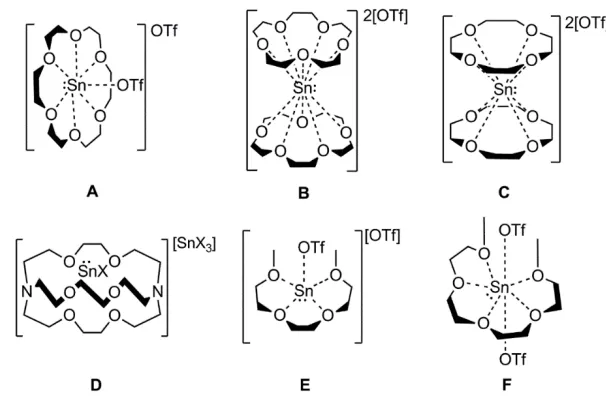
[Ge([15]crown-5)OTf] and is even more closely related to the complexes of [18]crown-6 and tin halides (Figure 1.15, F) reported by Nicholson.85 The smaller macrocycles, [15]crown-5 and [12]crown-4 produce 2:1 complexes. The [15]crown-5 macrocycle is too small to enclose the Sn(II) center adopting a centrosymmetric sandwich-like structure and have a stereochemically-inactive non-bonding pair of electrons (Figure 1.17, B).86 The complex of [12]crown-4 and tin(II) triflate ( Figure 1.17, C) was described as being a bent-sandwich-like structure.86 The bent arrangement of [Sn([12]crown-4)2]+2 fragment is
in contrast with the more conventional sandwich observed for the germanium(II) analogue [Ge([12]crown-4)2]+2 and have a stereochemically-active pair of non-bonding electrons.86
A series of cationic cryptand complexes of tin(II) halides, [Cryptand[2.2.2]SnX][SnX3] (X = Cl, Br, I) (Figure 1.17, D) and tin(II)
trifluoromethanesulfonate, [Cryptand[2.2.2]Sn][OTf] (Figure 1.16, D) were synthesized and characterised by the Baines group,82 after they reported the first cryptand-encapsulated germanium(II) dication.80 These new cryptand complexes were fully characterised and
29
electron density at tin is greater and also more spherically symmetric in the cryptand complex then in the analogous crown complex. Finally, the tin chemistry was compare with the analogous germanium chemistry. While Ge(II) formed a dicationic complex with the cryptand[2.2.2] (Figure 1.16, A), Sn(II) produced two cryptand complexes: a monocationic complex with the halides and a dicationic tin(II) cryptand complex with triflate as the counterion, also depicted in Figure 1.16. The difference between the size of tin and germanium could simply explain this contrast; the larger tin favors a higher coordination number and may require a larger cryptand to be completely encapsulated.80
To determine if the acyclic analogues of crown ethers, the more flexible glymes, are also suitable for the stabilization of tin(II), our research group investigated a series of complexes of tin(II) triflate and two glyme ligands. Tetraglyme and triglyme were the two glymes investigated using a variety of computational and experimental methods.11 The treatment of Sn(OTf)2 with the glymes resulted in the formation of the 1:1 complexes
Sn(OTf)2·triglyme and Sn(OTf)2·tetraglyme, (Figure 1.17, E, F). In both complexes the
30
1.6 Thesis Overview
Our research group has long been interested in the synthesis of compounds containing main group elements in lower than usual oxidation states. This thesis presents the synthesis and structural characterization of new polyether complexes of germanium and tin in +2 oxidation state. Indium(I) and germanium(II) halides and triflates complexes with various polyethers, reported by earlier members of our group,10,11 exhibit different structures depending on the relationship between the size of the crown ether cavity and the ionic radius of the cation and also on the substituents on the cation (In+ or Ge2+). A similar
chemistry was anticipated for Sn2+ given that Sn(II) is isoelectronic with In(I) and isovalent with Ge(II). As an extension to the previous work, the reactions between Ge(II) bromide and Sn(II) bromide with four differently sized crown ethers and two glymes are examined in detail. The complexation of Ge(II) and Sn(II) using larger crown ether ligands will also be explored. Chapter 2 presents the synthesis and structural characterization of Ge(II) bromide polyether complexes and the remarkable results of the reaction between GeCl2·dioxane and dibenzo[24]crown-8 are included in this chapter. Similarly, Chapter 3
describes the synthesis and structural characterization of Sn(II) bromide with crown ether and glyme complexes and presents the synthesis of a new complex of Sn(OTf)2 with
31
1.7 References
(1) T. P. Hanusa. Coordination Chemistry of the s, p, and f Metals; Elsevier, Amsterdam, 2003.
(2) R. D. Rogers, C. B. B. Comprehensive Supramolecular Chemistry, J. L Atwoo.; Pergamon: New York, 1996.
(3) Bott, S. G.; Alvanipour, A.; Morley, S. D.; Atwood, D. A.; Means, C. M.; Coleman, A. W.; Atwood, J. L. Angew. Chemie Int. Ed. English1987.
(4) Kloo, L. A.; Taylor, M. J. J. Chem. Soc. Dalt. Trans.1997, No. 15, 2693.
(5) Andrews, C. G.; Macdonald, C. L. B. Angew. Chemie Int. Ed.2005, 44 (45), 7453. (6) Cooper, B. F. T.; Macdonald, C. L. B. Journal of Organometallic Chemistry. 2008,
p 2468.
(7) B. F. T. Cooper, C. G. Andrews, C. L. B. M. J. Organomet. Chem.2007, No. 692, 2843.
(8) Mudring, A. V.; Rieger, F. Inorg. Chem.2005, 44 (18), 6240.
(9) Hough, E.; Nicholson, D. G.; Vasudevan, A. K. J. Chem. Soc. Dalt. Trans. 1989, No. 11, 2155.
(10) Rupar, P. A.; Bandyopadhyay, R.; Cooper, B. F. T.; Stinchcombe, M. R.; Ragogna, P. J.; Macdonald, C. L. B.; Baines, K. M. Angew. Chemie - Int. Ed. 2009, 48 (28), 5155.
(11) Macdonald, C. L. B.; Bandyopadhyay, R.; Cooper, B. F. T.; Friedl, W. W.; Rossini, A. J.; Schurko, R. W.; Eichhorn, S. H.; Herber, R. H. J. Am. Chem. Soc.2012, 134
(9), 4332.
(12) Gokel, G. W.; Leevy, W. M.; Weber, M. E. Chem. Rev.2004, 104 (5), 2723. (13) Pedersen, C. J. J. Am. Chem. Soc.1967, 89 (26), 7017.
(14) Vögtle, F. and Weber, E. Host Gest Complex Chemistry-Macrocycles; 1985. (15) Dietrich, B., Lehn, J. M., Sauvage, J. P. Tetrahedron Lett.1969, 10, 2885.
(16) Wang, Q.-Q.; Begum, R. A.; Day, V. W.; Bowman-James, K. Polyhedron2013, 52, 515.
(17) Pedersen, C. J. J. Am. Chem. Soc.1967, 89, 2495.
32
(19) Gokel, G. Crown Ethers & Cryptands; 1991; Vol. 3.
(20) Pedersen, C. J. Angew. Chemie Int. Ed. English1988, 27 (8), 1021. (21) Cram, D. J. Angew. Chemie Int. Ed. English1988, 27 (8), 1009. (22) Lehn, J.-M. Angew. Chemie Int. Ed. English1988, 27 (1), 89. (23) C. J. Pedersen. US Pat. 3 361 778, 1968.
(24) Frängsmyr, T.; Malmström, B. G. (Bo G. . Chemistry, 1981-1990; World Scientific,
1992.
(25) Gokel, G. W.; Korzeniowski, S. H. Macrocyclic Polyether Syntheses; Springer Berlin Heidelberg, 1982.
(26) Bradshaw, J. S.; Krakowiak, K. E.; Izatt, R. M. Aza-crown macrocycles; Wiley,
1993.
(27) Bradley D. Smith. Synthetic Receptors for Biomolecules; Smith, B., Ed.; Monographs in Supramolecular Chemistry; Royal Society of Chemistry: Cambridge, 2015.
(28) Mason, E.; Eick, H. A. Acta Crystallogr. Sect. B Struct. Crystallogr. Cryst. Chem. 1982, 38 (6), 1821.
(29) Swidan, A.; Macdonald, C. L. B. Chem. Soc. Rev.2016, 45 (14), 3883. (30) Parkin, G. J. Chem. Educ.2006, 83 (5), 791.
(31) McNaught A. D.; Wilkinson, A. IUPAC Gold Book; IUPAC, 1997.
(32) Ellis, B. D.; Macdonald, C. L. B. Coord. Chem. Rev.2007, 251 (7–8), 936. (33) C.L.B. Macdonald, B. D. E. John Wiley & Sons Ltd 2005,.
(34) Macdonald, C. L. B.; Ellis, B. D.; Swidan, A.; Macdonald, C. L. B.; Ellis, B. D.; Swidan, A. In Encyclopedia of Inorganic and Bioinorganic Chemistry; John Wiley & Sons, Ltd: Chichester, UK, 2012.
(35) Lee, V. Y.; Sekiguchi, A. Acc. Chem. Res.2007, 40 (6), 410. (36) Fischer, R. C.; Power, P. P. Chem. Rev.2010, 110 (7), 3877. (37) Power, P. P. Acc. Chem. Res.2011, 44 (8), 627.
(38) Sevov, S. C.; Goicoechea, J. M. Organometallics. American Chemical Society 2006, pp 5678–5692.
(39) Becerra, R.; Harrington, C. R.; Leigh, W. J.; Kefala, L. A.; Walsh, R.
33
(40) Huck, L. A.; Leigh, W. J. Organometallics2007, 26 (6), 1339.
(41) William J. Leigh; Cameron R. Harrington, A.; Vargas-Baca, I. J. Am. Chem. Soc. 2006, 128 (4), 1394.
(42) Barrau, J.; Rima, G. Coord. Chem. Rev.1998, 178–180, 593.
(43) Arduengo, A. J.; Harlow, R. L.; Kline, M. J. Am. Chem. Soc.1991, 113 (1), 361. (44) Bourissou, D.; Guerret, O.; Gabbaï, F. P.; Bertrand, G. Chem. Rev.2000, 100 (1),
39.
(45) Denk, M.; Lennon, R.; Hayashi, R.; West, R.; Belyakov, A. V.; Verne, H. P.; Haaland, A.; Wagner, M.; Metzler, N. J. Am. Chem. Soc.1994, 116 (6), 2691. (46) Herrmann, W. A.; Denk, M.; Behm, J.; Scherer, W.; Klingan, F.-R.; Bock, H.;
Solouki, B.; Wagner, M. Angew. Chemie Int. Ed. English1992, 31 (11), 1485. (47) Gans-Eichler, T.; Gudat, D.; Nieger, M. Angew. Chemie - Int. Ed. 2002, 41 (11),
1888.
(48) Mizuhata, Y.; Sasamori, T.; Tokitoh, N. Chem. Rev.2009, 109 (8), 3479.
(49) Jutzi, P.; Hoffmann, H. J.; Brauer, D. J.; Krüger, C. Angew. Chemie 1973, 85 (24), 1116.
(50) Stobart, S. R.; Churchill, M. R.; Hollander, F. J.; Youngs, W. J. J. Chem. Soc. Chem.
Commun.1979, 0 (20), 911.
(51) Harris, D. H.; Lappert, M. F. J. Chem. Soc., Chem. Commun.1974, 0 (21), 895. (52) Davidson, P. J.; Harris, D. H.; Lappert, M. F. J. Chem. Soc. Dalt. Trans. 1976, 21
(21), 2268.
(53) Jutzi, P.; Becker, A.; Stammler, H. G.; Neumann, B. Organometallics1991, 10 (6), 1647.
(54) Dias, H. V. R.; Wang, Z. J. Am. Chem. Soc.1997, 119 (20), 4650. (55) Weidenbruch, M. Eur. J. Inorg. Chem.1999, 1999 (3), 373. (56) Veith, M. Angew. Chemie Int. Ed. English1987, 26 (1), 1.
(57) Rupar, P. A.; Staroverov, V. N.; Ragogna, P. J.; Baines, K. M. J. Am. Chem. Soc. 2007, 129 (49), 15138.
(58) Su, M. Der; Chu, S. Y. J. Am. Chem. Soc.1999, 121 (49), 11478. (59) Schriewer, M.; Neumann, W. P. J. Am. Chem. Soc.1983, 105 (4), 897.
34
(61) Matsumoto, T.; Tokitoh, N.; Okazaki, R. J. Am. Chem. Soc.1999, 121 (38), 8811. (62) Okazaki, R.; Tokitoh, N. Acc. Chem. Res.2000, 33 (9), 625.
(63) Leigh, W. J.; Lollmahomed, F.; Harrington, C. R.; McDonald, J. M.
Organometallics2006, 25 (22), 5424.
(64) Leigh, W. J.; Harrington, C. R. J. Am. Chem. Soc.2005, 127 (14), 5084. (65) Köcher, J.; Lehnig, M.; Neumann, W. P. Organometallics1988, 7 (5), 1201. (66) Egorov, M. P.; Nefedov, O. M.; Lin, T. S.; Gaspar, P. P. Organometallics1995, 14
(3), 1539.
(67) Rupar, P. A.; Jennings, M. C.; Ragogna, P. J.; Baines, K. M. Organometallics2007,
26 (17), 4109.
(68) Schoeller, W. W.; Schneider, R. Chem. Ber.1997, 130 (7), 1013. (69) Satgé, J.; Massol, M.; Rivière, P. J. Organomet. Chem.1973, 56 (C), 1.
(70) Sutrisno, A.; Hanson, M. A.; Rupar, P. A.; Terskikh, V. V.; Baines, K. M.; Huang,
Y. Chem. Commun.2010, 46 (16), 2817.
(71) Neumann, W. P. Chem. Rev.1991, 91 (3), 311.
(72) Cotton, J. D.; Davidson, P. J.; Lappert, M. F. J. Chem. Soc. Dalt. Trans.1976, No. 21, 2275.
(73) Goldberg, D. E.; Harris, D. H.; Lappert, M. F.; Thomas, K. M. J. Chem. Soc. Chem.
Commun.1976, 227 (7), 261.
(74) Cotton, J. D.; Davidson, P. J.; Lappert, M. F.; Donaldson, J. D.; Silvet, J. J. Chem.
Soc., Dalt. Trans.1976, 0 (21), 2286.
(75) Kira, M.; Ishida, S.; Iwamoto, T.; Ichinohe, M.; Kabuto, C.; Ignatovich, L.; Sakurai,
H. Chemistry Letters. 1999, pp 263–264.
(76) Enholm, E. J.; Kinter, K. S. J. Am. Chem. Soc.1991, 113 (20), 7784. (77) Banaszak Holl, M. M.; Kampf, J. W. Organometallics1997, 16 (12), 2743.
(78) Jutzi, P.; Schmidt, H.; Neumann, B.; Stammler, H.-G. Organometallics 1996, 15
(13), 741.
(79) Tokitoh, N.; Matsumoto, T.; Manmaru, K.; Okazaki, R. J. Am. Chem. Soc. 1993,
115 (19), 8855.
35
(82) Avery, J. C.; Hanson, M. A.; Herber, R. H.; Bladek, K. J.; Rupar, P. A.; Nowik, I.; Huang, Y.; Baines, K. M. Inorg. Chem.2012, 51 (13), 7306.
(83) Herber, R. H.; Carrasquillo, G. Inorg. Chem.1981, 20 (11), 3693. (84) Herber, R. H.; Smelkinson, A. E. Inorg. Chem.1978, 17 (4), 1023.
(85) Drew, M. G. B.; Nicholson, D. G. J. Chem. Soc. Dalt. Trans.1986, No. 8, 1543. (86) Bandyopadhyay, R.; Cooper, B. F. T.; Rossini, A. J.; Schurko, R. W.; Macdonald,
C. L. B. J. Organomet. Chem.2010, 695 (7), 1012.
36
Chapter 2: Synthesis and Structural Characterization of New
Polyether Complexes of Germanium(II)
2.1 Introduction
Our research group has long been interested in the synthesis and characterization of polyether complexes containing group 14 elements in low oxidation state. As previously mentioned, the chemistry involving group 14 cations and polyethers ligands has been an area of great interest over the last decade.1 The complexation of lead(II) ions by macrocyclic polyethers in solution was well established by the early 1980s,2 and
accordingly, lead(II) and tin(II) were the first group 14 elements to form polyether complexes, which were structurally confirmed by single crystal X-ray diffraction.3,4 While it was generally thought that low valent germanium centers require stabilization by strongly bound covalent ligands, the isolation of cryptand[2.2.2]-encapsulated germanium(II) dication A (Figure 2.1) by the Baines group in 2008 caused this paradigm to shift5 and
paved the path for the isolation of many other polyether complexes of germanium(II) in the years that followed.6–9 Many of the resulting compounds hold great potential for further reactivity in that they may act as Lewis acids to simple nucleophiles like water and ammonia while retaining a non-bonding electron pair.10
37
and 14 elements,12,13 we sought to fill this gap by examining in detail the reactions between germanium(II) bromide with various cyclic and acyclic polyethers.
Figure 2.1 Examples of polyether complexes of germanium cations
2.2 Results and Discussions
2.2.1 Germanium(II) Crown Complexes
We began our investigations with the reactions of various crown ethers with commercially available GeBr2. While we obtained crystalline material from several of these
reactions, we found that these products were contaminated with significant amounts of ammonium. In several instances, single crystal X-ray diffraction experiments of these materials revealed crown ether ammonium complexes with GeBr3- anions (Figure 2.2
depicts [NH4(benzo[18]crown-6)][GeBr3] as an example). We discovered that the source
of the contamination was the commercially purchased GeBr2: when dissolved in MeCN-d3
and subjected to a 1H NMR experiment, the spectrum features a 1:1:1 triplet centered at 5.86 ppm, the multiplicity of which is due to coupling of the protons to the 14N isotope (I = 1, 99.63% abundant). Examination of the early literature suggests that this contamination is introduced as part of the purification process for commercially synthesized GeBr2 and
38
affinity for ammonium.14 While the addition of crown ethers almost certainly produced the desired reaction with GeBr2 (due to the presence of GeBr3- anions), the crown ethers’ large
binding affinity for ammonium15 likely resulted in the displacement of the GeBr+ cation,
whose fate remains unknown.
Figure 2.2 Thermal ellipsoid plot (50% probability surface) of
[NH4(benzo[18]crown-6)][GeBr3]. Hydrogen atoms (except those of ammonium) are
omitted for clarity. Selected bond lengths (Å): H1-O1, 2.10(9), H2-O3, 1.88(12); H3-O5, 2.20(10).
To solve the problem of ammonium contamination, we decided to synthesize GeBr2·dioxane from commercially purchased GeBr4, which is produced using a method
that does not involve ammonia.16 Treatment of two equivalents of GeBr2·dioxane with one
equivalent of [15]crown-5 and [18]crown-6 resulted in clean reactions to yield the salts [GeBr([15]crown-5)][GeBr3], 2.1[GeBr3] and [GeBr([18]crown-6)][GeBr3], 2.2[GeBr3]
39
were analytically pure. The 1H NMR signals for the crown ether protons in each complex (2.1[GeBr3] = 3.83 ppm and 2.2[GeBr3] = 3.81 ppm) are significantly deshielded from
those of the free crowns (ca. 3.5 ppm for both free crowns), which confirms formation of the complexes in solution. Recrystallization of the materials to give single crystals suitable for X-ray diffraction was done by adding an appropriate anti-solvent to a dissolved sample, cooling to -30 °C and storing over several days.
Scheme 2.1 Synthesis of 2.1[GeBr3] and 2.2[GeBr3]; a) [15]crown-5), b) [18]crown-6
The crystals of 2.1[GeBr3] are isomorphous to the chloride analogue reported by
our group,6 crystallizing in the orthorhombic space group Pca21 (Table 2.1) with four
![Figure 2.2[NH Thermal ellipsoid plot (50% probability surface) of 4(benzo[18]crown-6)][GeBr3]](https://thumb-us.123doks.com/thumbv2/123dok_us/1361485.1168976/63.612.212.454.192.416/figure-thermal-ellipsoid-probability-surface-benzo-crown-gebr.webp)

![Figure 2.6 FTIR spectrum of [(H2O)GeCl(dibenzo[24]crown-8)][GeCl3]](https://thumb-us.123doks.com/thumbv2/123dok_us/1361485.1168976/69.612.158.492.345.555/figure-ftir-spectrum-of-gecl-dibenzo-crown-gecl.webp)