Analysis of Optimized Link State Routing
Protocol Using UDP & TCP Traffics in
Wireless Ad Hoc Network
Ganesh Gupta1 , Dr. Khushboo Tripathi2
Assistant Professor, Dept. of Computer Science, Amity University Haryana, Gurugram, India12
ABSTRACT: The goal of this paper is to think about the execution of TCP/FTP and UDP/CBR movement in OLSR
directing convention in a remote impromptu system environment (i.e. MANET). A versatile specially appointed system (MANET) comprises of portable remote hubs. The correspondence between these versatile hubs is done with no incorporated control. The transmission of data in a MANET depends on the execution of the activity operator and information movement utilized as a part of a system. In this paper we will investigate the execution measurements of OLSR directing convention through expanding number of hubs in system. The study and recreations is being done utilizing NS-2 to break down results, which are assessed for execution measurements, for example, throughput, parcel conveyance proportion and normal end to end delay.
KEYWORDS: MANET, TCP/FTP, UDP/CBR, OLSR, NS-2.
I. INTRODUCTION
Mobile Ad-hoc network (MANET) is a collection of wireless mobile nodes forming a temporary network without any fixed infrastructure where all nodes are free to move arbitrarily and these nodes configure themselves. The entire collection of nodes is interconnected in various ways. There is more than one path from one node to another for routing. The MANET imposes several challenges for communication, out of which one of the important challenge is to provide secure and efficient routing of data in the network [1, 3]. Thus a great need to develop dynamic and efficient routing protocols, which can ensure efficient and secure routes for communication.
II. RELATED WORK
The Optimized Link State Routing Protocol (OLSR) is a proactive link state routing protocol for mobile ad hoc networks (MANETs), which use HELLO and Topology Control (TC) messages to discover and disseminate link state information throughout the network. The different types of messages are as follows:
a. HELLO MESSAGE
This involves transmitting the Link Set, the Neighbour Set and the MPR Set. In principle, a HELLO message serves three independent tasks:
i. Link sensing
ii. Neighbor detection
iii. MPR selection signaling
Three tasks are based on periodic information exchange.
b. TC MESSAGE GENERATION
Keeping in mind the end goal to assemble the topology data base, every hub, which has been chosen as MPR, telecasts Topology Control (TC) messages. TC messages are overflowed to all hubs in the system and exploit MPRs. MPRs empower a superior versatility in the circulation of topology data. OLSR minimizes the overhead from flooding of control movement by utilizing just chose hubs, called MPRs, to retransmit control messages.
c. MULTIPOINT RELAYS
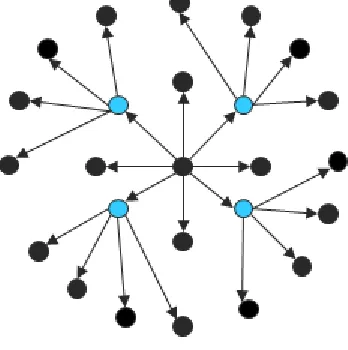
The idea of multipoint relays is to minimize the overhead of flooding messages in the network by reducing redundant retransmissions in the same region. Each node in the network selects a set of nodes in its symmetric 1-hop neighbourhood which may retransmit its messages. This set of selected neighbour nodes is called the "Multipoint Relay" (MPR) set of that node.
Figure 1: MPR election in OLSR protocol
.
Each node maintains information about the set of neighbours that have selected it as MPR. This set is called the "Multipoint Relay Selector set" (MPR selector set) of a node. A node obtains this information from periodic HELLO messages received from the neighbours.
Optimized link state routing protocol (OLSR) is a proactive and link state routing protocol designed especially for the mobile ad-hoc networks. Advantage of OLSR are only small subsets of links are declared and it provides various
1. Procedure: OLSR keeps up multipoint Relays (MPRs) which minimizes the flooding by doling out the connections
of neighbours inside its MPRs instead of all connections. Multicasting conduct of OLSR course revelation method can be joined with the portable IP administration by inserting the versatile IP specialist ad into OLSR flooding. A few augmentations of OLSR are accessible that relate to various system situations. Because of the proactive nature, OLSR works with the intermittent trade of messages like HELLO messages and Topology control messages just through its MPR.
2. Performance Analysis Objectives: OLSR Routing protocol performance in Mobile Ad Hoc Network
Objectives carried out for paper work are as follows:
i. To Design Network scenario for implementing existing OLSR Routing Protocol.
ii. To make certain modifications in OLSR Routing Protocol.
iii. To decide input/output parameters.
iv. To carry out Performance Analysis of Existing and modified routing protocol using TCP/FTP and UDP/CBR
traffic.
3. Management of Routing Table: The steering table for every last hub comprises of a rundown of every single accessible hub, their next jump to the destination, their metric and a grouping number created by the destination hub. With the assistance of the MANETs, directing table is utilized to send the information parcels. Directing table can be kept predictable with the powerfully changing topology of specially appointed system by occasionally overhauling the steering table with some\ little changes in the system. Consequently, portable hubs give their directing data by TV the steering table redesign bundle. The metric of the redesign bundle begins with the underlying estimation of one for one jump neighbours and goes on increased with every sending hub. The accepting hub upgrades their directing tables if the grouping number of the overhaul is more prominent than the present hub or equivalent to the present hub. Changes in the directing table are minimized by postponing the notice of courses until we locate the best course through OLSR.
III.SIMULATION ENVIRONMENT
A. SIMULATION MODELLING
Simulation helps in analysing the performance and behaviour of complex networks before implementing it in today’s real application. Several network simulators are available, whose output depicts as close as possible to real time implementation. In this work, we have used the discrete-event simulator NS2(version 2.35) and the performance analysis were conducted using AWK script. There are several models available in NS2 simulator, from which, we considered the following models:
a) Node Modelfor energy source, memory capacity, processing capabilities etc.
b) Node deployment Model for placement of nodes and its position as uniform model.
c) Node mobility modelfor dynamic network topologies as Random Waypoint Mobility model.
d) Radio Modelfor characteristics of radio used by node with a proper frequency, bandwidth, MAC layer
Functionality as IEEE802.11 MAC model.
e) Wireless Signal Propagation Modelfor SNIR at receiver as Two Ray Ground propagationmodel
f) Packet loss modelfor packets collision or dropped in Markov error model.
g) Traffic Modelfornodes sending traffic to destinations mostly CBR, UDP Model.
B. SIMULATION METHODS AND PARAMETERS:
The goal of our experiments is to examine and quantify the effects of various factors and their interactions on the
overall performance of ad hoc networks. Each run of the simulator accepts as input a scenario file that describes the
performance at a particular factor, we consider 10 random simulation runs to generate 10 random scenario patterns and the performance of the considered factor is the average of these 10 outputs. In all our experiments we considered five sample points of a particular factor and verified for three different protocols i.e. AODV, OLSR and DSDV [2,4,5,8]. Therefore 150 simulation runs were conducted to analyse each performance factor for these three protocols. Since our experiments is based on network layer characteristics so changes in routing strategy is only observed where as other characteristics like antenna gain, transmit power, ground propagation model and receiver sensitivity as physical layer characteristics, MAC 802.11 as wireless Ethernet for data link layer characteristics, UDP as transport layer characteristics and CBR as application layer characteristics remain fixed.
C. PERFORMANCE METRICS
The performance metrics helps to characterize the network that is substantially affected by the routing algorithm to achieve the required Quality of Service (QoS) [2,6,7]. In this work, the following metrics are considered.
i. End-to-End Delay (EED): It is the time taken for an entire message to completely arrive at the destination from the source. Evaluation of end-to-end delay mostly depends on the following components i.e. propagation time (PT), transmission time (TT), queuing time (QT) and processing delay (PD). Therefore, EED is evaluated as:
EED = PT + TT + QT + PD...(I)
ii. Throughput: It is the measure of how fast a node can actually sent the data through a network. So throughput is the average rate of successful message delivery over a communication channel.
iii. Control Overhead: It is ratio of the control information sent to the actual data received at each node.
iv. Packet Delivery Ratio (PDR): It is the ratio of the total data bits received to total data bits sent from source to destination.
IV.EXPERIMENTAL RESULTS AND OBSERVATIONS
The following tables show the observations taken for the various variations, and their effect on the three performance metrics for both TCP/FTP and UDP/CBR. The results are provided through graphs plotted as performance metrics vs. varying parameters.
a. OBSERVATION TABLE
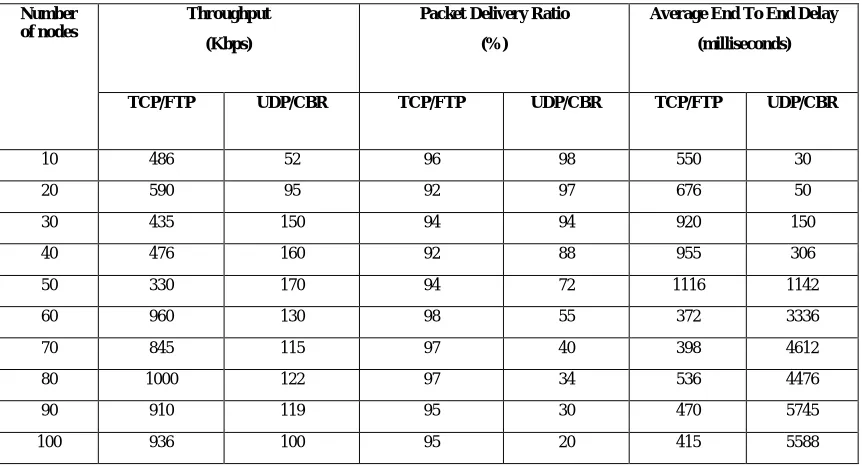
The observations obtained by implementing simulation model for the two traffic scenarios is provided in Table 1.1.The results are based on these observations.
B. THROUGHPUT VS. NUMBER OF NODES
C. PACKET DELIVERY RATIO VS. NUMBER OF NODES
Based on the observations of table 1.1 the response of packet delivery ratio in % against varying number of nodes is shown in Figure 1.2
Table 1.1 Observations for Varying Number of Nodes
Number of nodes
Throughput
(Kbps)
Packet Delivery Ratio
(%)
Average End To End Delay
(milliseconds)
TCP/FTP UDP/CBR TCP/FTP UDP/CBR TCP/FTP UDP/CBR
10 486 52 96 98 550 30
20 590 95 92 97 676 50
30 435 150 94 94 920 150
40 476 160 92 88 955 306
50 330 170 94 72 1116 1142
60 960 130 98 55 372 3336
70 845 115 97 40 398 4612
80 1000 122 97 34 536 4476
90 910 119 95 30 470 5745
100 936 100 95 20 415 5588
In this graph the PDR of UDP/CBR has greater maximum and minimum values than TCP/FTP, the TCP offers almost a constant trend, whereas, the UDP offers highly varying (rising and falling trends).
Fig.1.1 Graph of Throughput vs. Number of Nodes
Figure 1.2 Graph of Packet Delivery Ratio vs. Number of Nodes
D. AVERAGE END-TO-END DELAY VS. NUMBER OF NODES
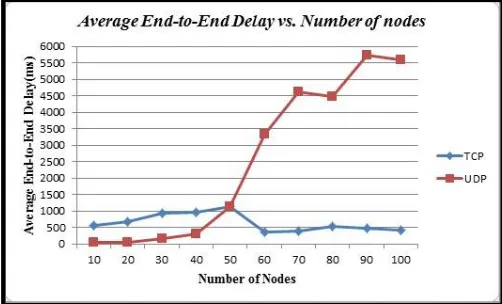
Based on the observations of table 1.1, the response of average end- to- end delay in ms against varying number of nodes is shown in Figure 1.3.
Figure 1.3 Graph of Average End – to – End Delay vs. Number of Nodes
In this graph the UDP/CBR offers lesser average end to end delay, than TCP/FTP, therefore better speed of transmission. Average end to end delay includes the total time of transmission i.e. propagation time, queuing time, route establishment time etc. A network with minimum average end-to-end delay offers better speed of communication.
V. CONCLUSION &FUTURE SCOPE
improvement of altered adaptation of the Optimized Link State Routing conventions, which ought to consider diverse parts of directing conventions, for example, rate of higher course foundation with less course breakage and the shortcoming of the conventions said ought to be extemporized for future expansions. OLSR can likewise be executed for multi-bounce steering in remote systems. The same work can be reached out for other proactive and receptive steering conventions with TCP and UDP traffics. One can likewise enhance OLSR convention and its execution by utilizing more parameters, for example, vitality parameters, lifetime of system, battery life time, security, QoS. This clarified work can likewise be explored and broke down for blurring and non blurring situations in remote specially appointed systems.
REFERENCES
1. T. Clausen and P. Jacquet,” Optimized Link State Routing Protocol (OLSR)” RFC 3626, 2003.
2. K. Tripathi, M. Pandey and S. Verma, “Comparison of Reactive Proactive Routing Protocols for Different Mobility Conditions in WSN” ICCCS’11, February 12th–14th, 2011,pp. 156-161, ACM.
3. Imrich Chlamtac, Marco Conti, Jennifer J-N Liu, “Mobile Ad Hoc Networking-Imperatives and Challenges”, Elsevier, pp. 13-64, 2003. 4. K. Tripathi and S. D. Dixit, “A Comparative Study of Channel Fading Effect on Ad Hoc Routing Protocols” International Journal of
Engineering Trends and Technology,Vol. 2, July to Aug Issue 2011, ISSN: 2231-5381, pp 18-23.
5. Danil S. Vasiliev, Daniil S. Meitis and Albert Abilov “Simulation-Based Comparison of AODV, OLSR and HWMP Protocols for Flying Ad Hoc Networks”, Springer, pp 245-252, 2014.
6. K. Tripathi and S. D. Dixit, “Effect of Channel Fading on the Performance of Wireless Ad Hoc Network Routing Protocols”, (ICCSLE 2011), 08th-10th December 2011, Zhengzhou, China, Applied Mechanics and Materials Vol. 197 (2012) pp 643-648, 2012.
7. V. Desai and N. Shekokar, “Performance Evaluation of OLSR Protocol in MANET under the Influence of Routing Attack”, Global Conference on Wireless Computing and Networking (GCWCN), IEEE ,pp. 138-143,2014.
8. A. Ouacha, N. Lakki and J. EI abbadi, A. Habbani and M.El Koutabi, “OLSR Protocol Enhancement Through Mobility Integration “, pp.17-22, IEEE, 2013.
9. Ganesh Gupta, Madnesh Gupta, A. K. Raghav“Energy Efficient Routing Protocol for MANET: A Survey”, IJETCAS ,Volume 1, Issue 11 , pp.30-37 , Dec.2014 –Feb.2015.
10. Young-Bae Ko and Nitin H. Vaidya, “Location-Aided Routing (LAR) in mobile ad-hoc networks in Wireless Networks,” Volume 6 , pp. 307 - 321 Issue 4 (July 2000).
11. S. Murthy, and J.J. GarciaLuna-Aveces, “An Efficient Routing Protocol for Wireless Networks,” AACM/Baltzer Journal on Mobile Networks and Applications, Special Issue on Routing in Mobile Communication Networks, Vol. 1, No. 2, pp 183-197, ACM, October 1996.
12. Yu Wang, Wen-Zhan Song, Weizhao Wang, Xiang-Yang Li and Teresa A. Dahlberg, “ LEARN: Localized Energy Aware Restricted Neighborhood Routing for Ad-hoc Networks,” in Third Annual IEEE Communications Society Conference on Sensor, Mesh and Ad-hoc Communications (IEEE SECON 2006).
BIOGRAPHY
Ganesh Gupta is a Assistant professor in the Computer Science Department, Amity School of Engineering and Technology, Amity University Haryana ,Gurugram. He received Master of Technology (M.Tech(I.T.)) degree in 2008 from Guru Gobind Singh Indra Prastha University, Delhi, India. His research interests are Computer Networks (wireless Networks), Ad-hoc wireless networks, Various Simulation Tools like NS-2 , Qualnet, GNS3 etc.
Dr. Khushboo Tripathi received her Masters and Ph.D. degree in Computer Science from University of Allahabad,