ABSTRACT
HOLMES, SHAWN YVETTE. Ethical Sensitivity Intervention in Science Teacher Education: Using Computer Simulations and Professional Codes of Ethics. (Under the direction of Leonard Annetta).
A simulation was created to emulate two Racial Ethical Sensitivity Test (REST) videos (Brabeck et al., 2000). The REST is a reliable assessment for ethical sensitivity to racial and gender intolerant behaviors in educational settings. Quantitative and qualitative analysis of the REST was performed using the Quick-REST survey and an interview protocol. The purpose of this study was to affect science educator ability to recognize instances of racial and gender intolerant behaviors by levering immersive qualities of simulations. The fictitious Hazelton High School virtual environment was created by the researcher and compared with the traditional REST. The study investigated whether
computer simulations can influence the ethical sensitivity of preservice and inservice science teachers to racial and gender intolerant behaviors in school settings.
analysis of the Quick-REST ascertained differences between comparison groups.
Cronbach’s alpha was calculated for internal consistency. The REST interview protocol was used to analyze recognition of intolerant behaviors in the in-simulation prompts. Post-simulation prompts were analyzed for emergent themes concerning effect of the Post-simulation on responses.
The preservice video group had a significantly higher mean rank score than other comparison groups. There were no significant differences across the remaining groups. Qualitative analyses of in-simulation prompts suggest both preservice and inservice
Ethical Sensitivity Intervention in Science Teacher Education: Using Computer Simulations and Professional Codes of Ethics
by
Shawn Yvette Holmes
A dissertation submitted to the Graduate Faculty of North Carolina State University
In partial fulfillment of the Requirements for the degree of
Doctoral of Philosophy
Science Education
Raleigh, North Carolina 2009
APPROVED BY:
_______________________________ ______________________________
Leonard A. Annetta Alan J. Reiman
Chair of Advisory Committee
________________________________ ______________________________
ii
DEDICATION
iii BIOGRAPHY
The journey has not been straight however the twists and turns have provided Shawn unparalleled experiences that have fed her desire to teach. Shawn Yvette is the youngest of three girls born to John and Frances Washington. She grew up in Philadelphia and her love for learning started before the first grade. Frances convinced the school principal to allow Shawn to start a year earlier than recommended. She enjoyed school and played the violin and read for after-school activities. School had always been a comfortable place for Shawn. At Germantown High School, Shawn was active in student government, the magnet
program, a member of the Historical and National Honor Societies, and was awarded the most outstanding science student (a four year distinction). She was a majorette and received varsity letters as a sprinter on the track team. Shawn was encouraged by her high school biology teacher and in the 10th grade enrolled in a college program and became certified as a Laboratory Animal Science Technician.
iv
other medically comprised patients in the Infectious Disease Clinic; there she became interested in treating the whole patient. For her expertise and dedication she received the Oral Medicine award for outstanding achievement. After graduating in 1990 she was accepted in the General Dentistry Residency Program at the Veterans Administration Hospital in Philadelphia. Upon finishing she returned to Temple University as an Assistant Clinical Professor in the Oral Medicine and Radiology departments where she gave clinical instruction to third and fourth year dental students. It was this experience coupled with being the supervising dentist at area dental hygiene programs that convinced Shawn she had intuitive skills in clinical teaching.
As well as being a general practitioner, Shawn treated nursing home patients and volunteered for a medical mission in Ghana and Liberia, West Africa, however it was working with students that drew her away from dentistry and back to school. She received a M.Ed. in multicultural education (2001) from Eastern University in St. David’s, PA and taught biology, AP biology, heath related occupations, earth, physical and life science in public schools in Philadelphia, and Orange and Long Beach, CA. Her teaching still had a clinical nature. She wanted to see and hear how her students were processing the
v
vi
ACKNOWLEDGMENTS
The ability to acknowledge those who have contributed guidance and support is often overlooked in day to day interactions. There are several individuals who without their guidance and support this project would not been as successful as the author deems it to be.
My committee chair and advisor, Dr. Len Annetta, was exactly what I needed for this project. His ability to lead by dropping seeds of guidance, supported yet mostly challenged me to gain confidence and competence in my research endeavors. His quiet style juxtaposed with my checklist approach to everything provided an alternative yet welcoming way to accomplish goals. Len has listened, showed respect for my research and teaching passions, and provided guidance by asking seemingly simple questions that deepened my knowledge about research protocols.
I have had some of the most inspiring conversations with Dr. Alan Reiman; my minor research committee chair. Alan has a depth of knowledge and insight for moral development, mentoring, and the clinical practice of teacher preparation that I drew from consistently. His approach to teacher preparation was a natural fit with my teaching
co-vii
teaching undergraduate science methods classes with Glenda and have watched Gail teach graduate education students; both provided teaching experiences that are of value to me. Specific technical support provided by Dr. Annetta, Oliver Gray, Adam Carriker, Kevin Herndon and James Niehaus were critical to complete this project. I am very appreciative of the late night help I received from each of you. Where my technical skills were sparse you deftly filled in the gaps and as a result I became better.
I would also like to thank my husband, Jeff, who helped me in immeasurable ways. He has been the supportive force that has allowed me to succeed.
viii
TABLE OF CONTENTS
LIST OF TABLES ... xi
LIST OF FIGURES ... xii
CHAPTER ONE: INTRODUCTION ... 1
REPRESENTATIVE STORY ... 1
PURPOSE OF THE STUDY ... 2
RESEARCH QUESTIONS ... 4
HYPOTHESES ... 4
SIGNIFICANCE OF THE STUDY ... 5
LIMITATIONS OF THE STUDY ... 6
DEFINITION OF TERMS ... 8
Teacher education program responsibilities. ... 9
Science teacher responsibilities ... 12
CHAPTER TWO: REVIEW OF LITERATURE ... 14
OVERVIEW ... 14
SELECTION CRITERIA ... 15
PRESENT CONCURRENT CONDITIONS ... 18
Teacher education responsibilities. ... 18
Science teacher responsibilities ... 18
Effects of changing student demographics. ... 19
Attitudes about multicultural teaching. ... 21
Cultural influences ... 22
SUPPORTING RESEARCH STUDIES ... 24
Multicultural teacher education programs. ... 24
A different approach. ... 25
Use of computer-based simulation ... 29
Effective learning environment. ... 30
Relevance for science education. ... 31
CHAPTER THREE: METHODOLOGY ... 33
OVERVIEW ... 33
RESEARCH DESIGN ... 33
SETTING OF THE STUDY AND PARTICIPANTS ... 34
VIDEO INSTRUMENTATION ... 36
DEVELOPMENT OF SIMULATION ... 39
Description of the Simulation ... 40
PROTOCOL AND INSTRUMENTATION ... 42
In-simulation prompts. ... 43
Professional codes for in-simulation prompts. ... 43
ix
Post-simulation prompts ... 45
PROCEDURAL DETAILS ... 46
DATA ANALYSIS ... 47
Analysis of Responses ... 47
Quick-REST scores. ... 47
Interview responses ... 50
CHAPTER FOUR: FINDINGS ... 55
OVERVIEW ... 55
Treatment Analysis ... 55
QUANTITATIVE ANALYSIS ... 56
Non-parametric Analysis ... 56
Internal Reliability ... 58
QUALITATIVE ANALYSIS ... 59
In-simulation Responses ... 59
Question one. ... 60
Question two. ... 62
Question three. ... 66
Question four. ... 67
Question five. ... 70
Post-simulation Responses ... 72
Question one. ... 73
Question two. ... 73
Question three. ... 74
CHAPTER FIVE: CONCLUSIONS AND IMPLICATIONS ... 77
OVERVIEW ... 77
SUMMARY OF FINDINGS ... 77
Quantitative summary ... 78
Qualitative summary ... 78
Simulation affect. ... 83
IMPLICATIONS AND FUTURE WORK ... 84
The Influence of Technology ... 84
Science Teacher Education Programs ... 87
Future Work ... 89
REFERENCES ... 92
APPENDIXES ... 101
Appendix A: IRB Consent Form ... 102
Appendix B: In-simulation Questions ... 104
x
Demographic Questions ... 109
Appendix D: Quick-REST Faculty Lounge ... 113
Appendix E: Post-simulation Questions ... 117
xi
LIST OF TABLES
Table 1: Ethical Principles Based on Professional Codes...………...44
Table 2: Ethical Issues Represented in the REST Linked to Behaviors.………..49
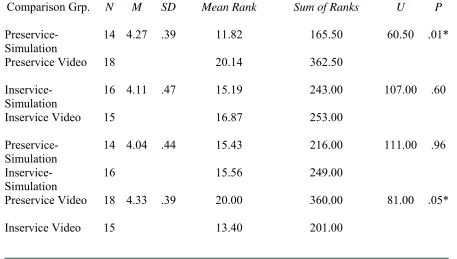
Table 3: Mann-Whitney U for Quick-REST Scores.………57
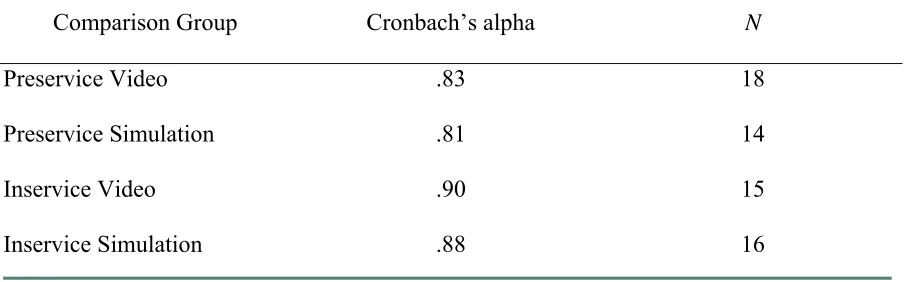
Table 4: Cronbach’s Alpha for Each Comparison Group...………58
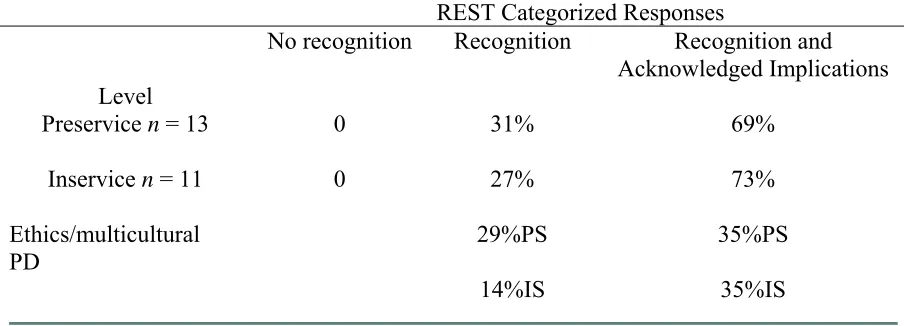
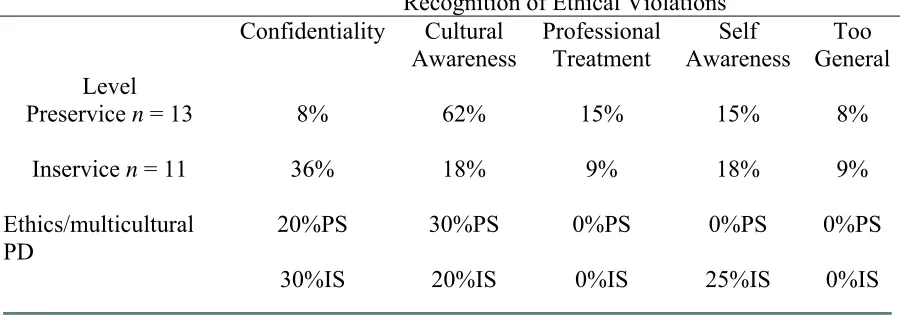
Table 5: Question One REST Categories and PD Percentages.………...60
Table 6: Question Two REST Categories and PD Percentages...………62
Table 7: Plans Presented by Participants to Help Student..………..64
Table 8: Question Three REST Categories and PD Percentages.…...…...………66
Table 9: Question Four REST Categories and PD Percentages.……….……….68
xii
LIST OF FIGURES METHODOLOGY
Figure 1: Procedural Sequence...46
FINDINGS
1
CHAPTER ONE: INTRODUCTION Representative Story
Miguel, a homeless 26 year old Puerto Rican father who lives in New York City with his wife and two children, eloquently and with clarity states his views of science, school science, his family and culture. He elaborates on how the school, his community and science were at odds. Miguel, born and raised in NY, is widely influenced by urban Puerto Rican culture. Through an ethnographic case study, Barton (2000) was able to open the door to Miguel’s interpretation of how the ‘culture of power’ (Delpit, 1988) effected his school and life decisions. The collision of the culture of school science and his misunderstood family culture left him unsupported to pursue science as a vocation. He left school in his junior year recalling that he was not respected, was not challenged, and pushed towards a vocational track instead of taking even basic science classes. Miguel remained focused following his enthusiastic feelings and passion for the natural world becoming a self-taught herpetologist. His story and other untold stories illustrate how the colliding factors of institutionalized racism, the rapidly diverging student/teacher racial differences, teacher accountability, and misunderstanding the importance of the confluence of a student’s culture, community culture and the culture of science can limit the acquisition of scientific literacy for students of color.
2
school culture. This awareness led him to believe the differences between his home experiences and his school experiences limited his academic success and achievement (Barton & Yang, 2000).
Purpose of the Study
This study will illuminate how teacher education programs struggle to fulfill mandated diversity standards, while teachers are held accountable for implementing methods to teach and engage all students from a population that is rapidly diverging from the teacher racial population. These dynamics, coupled with a history of institutionalized racism (i.e., our education system) operate on an inferiority paradigm (Tate, 1997) leaving students of color in greater jeopardy as they struggle to become scientifically literate for the global market of the 21st century.
A review of current teacher education program responsibilities is followed by a brief description of recommended teacher obligations set forth by professional teaching
3
influences in the classroom. Ignoring the cultural mismatch between the student’s culture and the culture of science has a limiting effect on the acquisition of scientific literacy.
The need for intervention in this arena is not new as several comprehensive multicultural teacher education programs exist and deliver results for affecting teacher beliefs and attitudes towards diversity (Bryan & Atwater, 2002; Downey & Cobbs, 2007; Fraser-Abder, 2005; Gay, 2002; Ladson-Billings, 2000; Villegas & Lucas, 2002). These studies show the importance and need for teacher education programs to develop curriculum which examines teacher’s beliefs about student characteristics, external influences, and responses to diversity. However the implementation of these strategies is based on changing teacher beliefs as a way to affect their actions. A more direct and concrete strategy which benefits students more quickly, instead of attempting to alter teacher personal beliefs, is possible through perspective-taking and recognition of behavior that is not in alignment with school-based professional code of ethics. This study attempts to influence perspective-taking and teacher’s responses to diversity based on professional ethics; an additive strategy to the existing multicultural teacher education curricular practices.
4
(Aikenhead, 1996) skills, and affecting the goals of science for all traditionally marginalized students (AAAS, 1989).
The aim of this study is to suggest a different approach for multicultural teacher education programs. By harnessing the perspective-taking power of computer-based simulations and emulating the traditional REST instrument, the goal of this study is to determine if computer-based simulations can be a useful tool for affecting preservice and inservice teacher’s ethical sensitivity to instances of intolerance towards culturally and linguistically diverse students as measured by the REST. Research questions solicit a comparison study of the traditional REST and the newly developed computer-based simulated REST.
Research Questions
To reach this end the following questions will be investigated by this study: 1) Can a computer simulated environment affect a preservice science teacher’s ethical sensitivity to instances of racial and gender intolerance when compared to the traditional REST-CD?
2) Can a computer simulated environment affect an inservice science teacher’s ethical sensitivity to instances of racial and gender intolerance when compared to the traditional REST-CD?
Hypotheses
5
Null hypothesis:Preservice teachers who do not complete the study using a computer-based simulation of the REST will not have an affect on their ethical sensitivity score.
2) Inservice teachers who complete the study using a computer-based simulation of the REST will have an affect on their ethical sensitivity score.
Null hypothesis:Inservice teachers who do not complete the study using a computer-based simulation of the REST will not have an affect on the ethical sensitivity score.
Significance of the Study
To link issues of racial and gender intolerance to existing professional education codes of ethics, open the discussion of racial intolerance in education programs, and prompt science teachers to act in ethically sensitive ways by recognizing intolerant behavior from the student perspective, a computer-based simulation was created using two REST scenarios to enhance perspective-taking and affect ethical sensitivity. In an attempt to affect REST scores a simulated-REST version was created using the software interface, Virtuoso, developed at North Carolina State University. Virtuoso was designed to use the proprietary Half-Life 2 game engine. Computer-based simulations are immersive, influence
6
simulated REST situates the teacher in a professional ethical dilemma in an attempt to influence perspective-taking aiming to influence recognition of racial and gender intolerant behavior. Thus, the significance of this study lies in the affective gain in science teacher ethical sensitivity with special attention paid to their ability to take the perspective of their students and identify instances of racial and gender intolerance. Ladson-Billings (1995) defines culturally relevant pedagogy from the student perspective. This strategy along with existing multicultural teacher education programs has the potential to increase the ethical sensitivity of science teachers, influence teachers to act in accordance with their
professional code of ethics, reduce the challenges of divergent student/teacher racial differences, and increase the acquisition of scientific literacy for students of color.
Limitations of the Study
This study aimed to influence science teacher recognition of intolerant behaviors in school settings, specifically racial and gender incidences. A sample of 63 preservice and inservice science teachers participated in the study. The sample was largely female (69% preservice and 77% inservice) and Caucasian (91% preservice and 87% inservice). One limitation of the study was the inability to secure a more diverse sample.
The technical expertise of the researcher was a limitation of the study as well as the usability of the Virtuoso software. The learning curve to achieve proficiency was steep. This study took place during the prerelease testing phase of Virtuoso. In other words, the
7
information sheet was given to each participant. The gaming proficiency of the participants was not determined. This can be a limitation because someone adept in a virtual
environment due to their experience with video games may perceive the simulation favorability. Whereas someone with less video game experience may find the experience frustrating.
Virtuoso only operated through an online software distribution platform and was downloaded to a set of laptops. Participation in the simulation portion of the study required access to the internet and use of the specific set of laptops. As a result the simulation group was not randomly assigned. Participants at testing locations where the internet was
inaccessible were automatically placed into the video comparison group. On one occasion a participant was at an internet accessible location however technical problems with Virtuoso or the software distribution platform dictated they view the video instead of participating in the simulation. A simulation operating without an online software distribution platform would have been more widely accessible and possibly increased sample size.
The immersive qualities added to the simulation to influence recognition of
intolerant behaviors were limited by the capabilities of Virtuoso. For example, it was very important to control participant line of vision during specific portions of the simulation. It would have been counterproductive to have a participant looking around or exploring another aspect of the virtual environment when a significant conversation between virtual characters was taking place. The ability to “freeze” player movements was not a
8
multiplayer capabilities might have influenced participant interaction however this function was in the development phase at the time of this project. The decision was made to maintain single player capabilities to better compare with the REST video assessment.
Lastly, a limitation and area of future work lies in the methods. The simulation group answered in-simulation questions however the video group did not answer
corresponding questions. The desire to have the traditional REST as the control dictated the choice to keep the procedures as in previous REST studies. A probable next step in this research area would be to investigate the video group with the same corresponding questions as the simulation group. This type of investigation should be looked upon with caution. It is not the questions themselves that are being investigated. It is the affect of the total immersive nature of the simulation that is revealed through responding to the questions that is being investigated. Additionally, a pre-assessment was not administered and is a probable area of future research. Post study questioning for the Hawthorne Effect (Adair, 1984), which causes increased production of a task due to participants being observed, may be necessary to determine participant view of the study. This was attempted in the post-simulation questions however more open prompts might solicit broader responses concerning the study.
Definition of Terms
Critical Race Theory: looking at race relations and discrimination through a pattern in
9
Culturally relevant pedagogy: pedagogy taught from the student perspective: student
experiences academic success; student develops/maintains cultural awareness; and student develops a critical consciousness to question the status quo.
Ethical sensitivity: empathizing and taking other’s perspectives, the first element of the Four
Component Model, developed by James Rest et al., (1999).
Perspective-taking: the ability to define a problem; consider the feelings of other’s
involved; brainstorm alternative ways to solve the dilemma; choose a course of action; and evaluate the probable outcome.
Scientific literacy: the ability to understand science concepts and processes to converse
about science issues in the popular press, determine validity of conclusions, evaluate scientific methods and information, pose and evaluate arguments for personal decision making, civic and cultural participation, and economic productivity.
Socioscientific issues: open-ended, ill-structured, controversial, debatable problems,
involving scientific content connected to societal issues and technology embedded with ethical and moral implications.
Teacher education program responsibilities. Standards that relate to preparation of candidates to teach students of diverse cultures. The Professional Standards for the
Accreditation of Schools, Colleges, and Departments of Education (NCATE, 2006, p. 29 - 31)Standard 4: Diversity recommends the teacher education program:
• Design, implement, and evaluate curriculum and experiences for candidates to
10
students learn. These experiences include working with diverse higher education and school faculty, diverse candidates, and diverse students in P-12 schools.
• Interaction and experiences in classroom and field settings with faculty, candidates,
and P-12 students who represent diverse ethnic, racial, gender, language, exceptionalities, and religious groups.
• The active participation of candidates from diverse cultural backgrounds and with
different experiences is solicited, and valued and accepted in class, field experiences and clinical practice.
• The experiences help candidates confront issues of diversity that affect teaching and
student learning and develop strategies for improving student learning and candidates’ effectiveness as teachers.
According to the Model Standard for Beginning Teacher Licensing, Assessment and
Development: A Resource for State Dialogue (INTASC, 1992, p. 18 - 19) Principle #3: • The teacher understands how students differ in their learning approaches to learning
and creates instructional opportunities that are adapted to diverse learners. • The teacher understands how students’ learning is influenced by individual
experiences, talents, and prior learning, as well as language, culture, family, and community values.
• Teacher respects students as individuals with differing personal and family
11
• Teacher seeks to understand students’ families, cultures, and communities, and uses
this information as a basis for connecting instruction to students’ experiences (e.g., drawing explicit connections between subject matter and community matters, making assignments that can be related to students’ experiences and cultures.) The North Carolina Professional Teaching Standards (2008) sets the following standards as the basis for teacher preparation, teacher evaluation, and professional development:
• Demonstrate a knowledge of diverse cultures
• Select materials and develop lessons that counteract stereotypes and incorporate
contributions
• Recognize the influences on a child’s development, personality, and performance
• Consider and incorporate different points of view
• Maintain high expectations for all students
• Improve communication and collaboration between the school and the home and
community.
The Standards for Science Preparation (NSTA, 2003, p. 24 - 25) Recommended Program Requirements Standard 7: Science and the Community:
[Science teachers] actively engage students in science-related studies or activities related to locally important issues. To show that they are prepared to relate science to the community, teachers of science must demonstrate that they:
• Identify ways that they relate science to the community, involve stakeholders
12
• Involving students successfully in activities that relate science to resources
and stakeholders in the community or to the resolution of issues important to the community.
Science teacher responsibilities. Standards related to teaching science to students of diverse cultures:
American Association for the Advancement of Science: Science for All Americans
(SFAA), an initiative of the American Association of the Advancement of Science (AAAS), focuses on adult scientific literacy. The report recommends what students should be able to do in science, mathematics, and technology by the end of high school. Inherent in the title, the SFAA “recommendations pertain to those who in the past have largely been bypassed in science and mathematics education: ethnic and language minorities and girls” (p. xv).
National Science Teachers Association:Principles of Professionalism for Science
Educators (NSTA, 2007, p. 1- 3) state science educators are central to educating, inspiring, and guiding students to be responsible scientifically literate citizens. Therefore science educators must uphold the highest ethical standards by understanding and demonstrating:
• The importance of promoting the growth of all students
o Show respect for each individual and value his or her identity and cultural
heritage.
o Help students reflect as learners and use skills of inquiry to become effective
13
o Keep science discussions focused on empirically based evidence collected
from the natural world, while showing respect for the various world view of students.
o Recognize the abilities and strengths, as well as their unique learning needs National Science Education Standards: These standards are guided by the following
principles (NSES, 1996, p. 19): • Science is for all students
• Learning science is an active process
• School science reflects the intellectual and cultural traditions that characterize the
practice of contemporary science
• Improving science education is a part of systemic education reform
14
CHAPTER TWO: REVIEW OF LITERATURE Overview
This literature review has two sections. The first section discusses how this area of research is impacted by several concurrent conditions: teacher education program
responsibilities; recommended teacher obligations set forth by professional teaching organizations; the rapidly diverging student/teacher racial demographics; and the racial inferiority paradigm noted by the CRT. A manifestation of the CRT may by evident in today’s attitudes about multicultural teaching resulting in increased “border
crossing”(Aikenhead, 1996) challenges for students of color. These colliding factors may result in limiting students of color acquisition of scientific literacy. The second section examines prior research pertinent to this study from several domains: multicultural teacher education programs; moral development theories; socioscientific issues as they related to the definition of scientific literacy; and computer-based stimulations as an effective learning environment.
Previous studies in teacher education that have investigated multicultural teacher education programs will be discussed. The focus of these studies has been teacher awareness and the relationship to teacher actions; suggesting long-term, comprehensive, holistic curriculums.
15
research in moral theories. Studies show educational interventions positively effect moral development and behavior in members of professional communities. Additionally, studies in perspective-taking research are also situated in the moral development theoretical frameworks. Studies in this area focus on stimulating perspective-taking in an effort to improve social reasoning. The rationale for emulating and creating a REST simulation are positioned in social cognitive research, specifically moral development.
The relevance to science education is the definition of scientific literacy. Scientific literacy entails the ability to examine moral reasoning, meaningful participation in a democratic society and possess critical thinking and decision-making skills related to socioscientific issues. Previous studies investigating moral reasoning and socioscientific issues in science classes are used to demonstrate this study’s importance in science education.
Lastly, prior research studies from military, fire fighter and business education fields provide the rationale for developing the REST computer-based simulation. Studies in this area utilize the effective learning environment, immersive power, and perspective-taking abilities of computer-based simulations. The newly developed REST stimulation emulating two scenarios will be used to influence the science teacher perspective-taking experience thereby affecting teacher ethical sensitivity to instances of racial and gender intolerance.
Selection Criteria
The research articles and books used in this review included a broad range of
16
addition, position statements and publications were read from national science education and teacher education professional organizations. Recommendations and position
statements from professional organizations were the foundation for this review. These documents are not assumed to be research-based however they present a locus for
definitional ideas. The selection of studies used in the initial review process were from four electronic databases; Academic Search Premier, ERIC, Google Scholar and PsycINFO. Journals such as Anthropology and Education Quarterly, International Journal of
Intercultural Relations, the Journal of Counseling and Development, the Journal of Dental Education,and the Journal of Moral Education, were included in this integrative review. Key words for the search included professionalism, teacher education, ethical sensitivity, moral education, perspective-taking, culturally responsive teaching, teacher attitudes towards diverse students, power and privilege, Critical Race Theory (CRT), scientific literacy, and socioscientific issues (SSI). The decision to use these was guided by the importance in presenting a cohesive vision of the dynamics involved in this review.
Readings of other moral theorists prominent between 1890 and 1980 were included to achieve a better idea of the evolution of moral development theories. In the area of culturally responsive teaching, attention was given to studies that recognized the need to modify teacher attitudes towards students who were culturally and linguistically different from themselves as a way of increasing student achievement. Bibliographies from
17
student perspectives and reasoning about morals and principles and elements of virtue, in the context of science instruction involving the personal, physical and social world of students, as a necessary component of scientific literacy were included in this review.
18
Present Concurrent Conditions
Teacher education responsibilities. The preamble and principle #3 of the Interstate New Teacher Assessment and Support Consortium (INTASC), the National Board for Professional Teaching Standards, and standard #4 of the National Council for Accreditation of Teacher Education (NCATE), places the responsibility of implementing diversity
programs and developing advocates for students in teacher education programs (INTASC, 1992; NCATE, 2006). The NCATE diversity standard recommends teacher education programs support teacher candidate learning by designing, implementing and evaluating “curriculum and experiences for candidates to acquire and apply the knowledge, skills, and disposition necessary to help all students learn,” (p. 10). The phrase “all students” is similar to NCATE’s definition of diversity.
Diversity and its role in teacher education programs is central to this study, therefore NCATEs definition of diversity will be utilized. Diversity is defined as “differences among groups of people and individuals based on ethnicity, race, socioeconomic status, gender, exceptionalities, language, religion, sexual orientation, and geographical area,” (p. 53). Teacher education programs should also provide teacher candidates working experiences with diverse individuals who are faculty members of higher education institutions, other candidates, and P-12 students.
Science teacher responsibilities. Through education programs teachers are
19
science in accordance with the American Association for the Advancement of Science (AAAS) and the National Science Education Standards (NSES). These professional organizations recommend school science aim for scientific literacy for all students. In addition the Standards “unequivocally advocate including those who traditionally have not received encouragement and opportunities to learn science,” (Bybee, 1995). As participants and members of these professional organizations, science teachers establish and revise standards of practice, model ethical behavior, and account for their actions (NSTA, 2006, Science Teacher Professionalism). Professional science teachers facilitate the development and construction of science concepts for learners by assuming the responsibility for
enabling each learner to reach their potential. This means empowering students to think and respond with their cultural, ethnic and linguistic differences, by focusing on learning in a personal context rather than an abstract context (NSTA, 2006). Science for All addresses students who are traditionally excluded from science and calls for teachers to teach science to engage all students (Gilbert & Yerrick, 2001). For students like Miguel who are more likely to be culturally and linguistically diverse from their teacher, this is shown by respecting the language and heritage of the student, maintaining high expectations and consistently using the student’s fund of knowledge as a resource (Barton & Osborne, 1998; Brisk, Barnhardt, Herrera, & Rochon, 2002; Moll, Amanti, Neff, & Gonzalez, 1992).
20
race and ethnicity during the same time frame were: African American 3.6%; Native American 9%; Asian 22%; and Latino/a 45.6%
(http://nces.ed.gov/programs/digest/d05/lt1.asp#3). According to the US Department of Education, the percentage of White teachers in K-12 public schools has remained stable, reporting 86% in 1979 and 84% in 2000 (http://nces.ed.gov/programs/digest/d02/dt101.asp). Similar teacher percentages are noted in high school grades 9-12 where limited access to advanced and honor classes by marginalized students may be a symptom of the growing student/teacher racial difference. For Miguel, he recognized what he found meaningful in his experiences of the natural world were not valued in middle school or high school. He remembers his teachers reinforcing the need to prepare for the job force not college or careers in science (Barton & Yang, 2000).
21
students, in essence hindering the acquisition of scientific literacy instead of advocating on behalf of the student (Rios, 1996; Villegas & Lucas, 2002). Such classroom environments risk perpetuating the notion that students must abandon their own sociocultural and experiential frames of reference and begin to function effectively in an abstract world (O'Loughlin, 1992). This suggests to the student a separation of oneself, from racial and ethnic identity as the only way to be successful. The NSTA specifically recommends teachers focus on personal context, relating content to student culture and ethnic heritage rather than teaching in an abstract context. NCATE specifically calls for teacher education programs to provide preservice teachers the necessary experiences to help all students learn.
Attitudes about multicultural teaching. Attitudes and perceptions predominant in multicultural education and the depiction of people of color in American jurisprudence have shared a common trait (Tate, 1997). The CRT relates law to the governing discourse on race and racism with a confrontational agenda. CRT identifies racism as endemic in US society and looks at the resulting limitations in education for students of color. It borrows from Marxism, poststructralism, feminism, pragmatism, liberalism and cultural nationalism to provide a coherent analysis of the experiences of students of color. CRT looks at the
contextual history of the law and argues how, for example, a fundamental document like the Constitution laid the legal foundation for the federal government to be legally empowered to maintain African American’s inferiority through the manifestation of slavery. The
22
has led to an assumed intellectual inferiority of African Americans, Native Americans and Latinos that has fueled an unequal education system for people of color.
Effects of the inferiority paradigm are evident in responses to multicultural teacher education programs. Advocates of multicultural teacher education are met with accusations that such policies go against national unity; multicultural policies are not supported by research; high standards of academic excellence will not be favored; academically
unprepared students of color will be allowed to enter teacher education programs; and using different approaches to teach students of color will lower the academic environment (Gay, 2005). Teacher education programs equivocate about where multicultural education should be placed in their institutions. This perpetuates confusion and misguides preservice and inservice teachers.
Cultural influences. Miguel’s story (Barton & Yang, 2000) is an ethnographic reference for the theoretical framework “border crossing.” Border crossing points out the probable obstacles for students who travel from their culture to the subculture of school science or science itself (Aikenhead, 1996). Aikenhead suggest teachers become “culture brokers” helping students resolve culture conflicts that exist between their everyday lives and the world of school science. Without this cultural navigation school science will be less accessible to students and fewer students will succeed and achieve scientific literacy
23
have the standards and expectations of the dominant culture or at least the understanding that these views are powerful.
Border crossing challenges are demonstrated in the following research study which examines the effects of student culture, science culture and school culture on the acquisition of scientific literacy. One of the goals of school science is to transfer some of the cultural practices of professional science to the classroom. An ethnographic study of an urban fifth grade science class by Hogan and Corey (2001) discussed the importance of analyzing student contextual resources, interactive customs and school-based cultural points of view. This study of 16 African American students, four Latino, and one Euro-American student investigated how the collective culture of science within a classroom was reframed by the student social culture thereby influencing scientific literacy. The researchers illuminated how the process of science was overlooked by the student agenda which was due to the established student cultural and social norms.
Depending on the task at hand, science conventions may not be in alignment with the student social culture. The differences between school culture and science culture must be taken into account (Hogan & Corey, 2001). School culture stresses individual
24
experiment because they wanted to be right. However, in science, predictions are not only valuable when right; knowledge is increased even if the prediction is incorrect.
Additionally, during a peer review to determine which student experiment would be nominated as the class experiment, the students focused solely on each others design weaknesses rather than design strengths. The goal was to demonstrate how scientists
collaborate when designing an experiment. Both examples in this study illustrate student use of personal preferences for competition and school-based norms for individual success. This study reveals the importance of thinking about the influence of student social culture within the culture of school science and scientific norms.
Supporting Research Studies
Multicultural teacher education programs. Multicultural teacher education programs provide teachers the skills and experiences to help students negotiate the cultural borders between their lives and the culture of science. However the focus of these programs has been teacher cognition and its interdependency with teacher actions (Rios, 1996) suggesting multicultural education curriculum that is holistic, comprehensive and long-term.
25
the assumption that when teachers (preservice and inservice) become acquainted with cultural differences by acquiring information first-hand about the lives of their students, the impact of these experiences are internalized and personal. Fifteen of the 20 present and future teacher participants felt they learned from the experience, gained insights and an awareness of themselves and others. Participants felt the experience would better help them to understand their students.
A different approach. The above study addresses the need for teacher education programs to develop multicultural curriculum by developing courses and implementing strategies which examines teacher beliefs about student characteristics, external influences, and responses to diversity. This study proposes a different approach for teacher education programs. Instead of indirectly affecting change in teacher responses to diversity based on the interdependency of their beliefs, this study aims to affect teacher responses to diversity based on recognizing instances of racial and gender intolerant behavior which are situated in school-based professional ethics; aimed toward professionalism. By using teacher
26
teacher multicultural education programs may prove to be very effective for teacher perspective-taking, more efficient culture border crossing skills, and quicker
acknowledgement of intolerant behaviors.
The theoretical framework draws from moral theories viewed through a social cognitive lens (Sprinthall, Sprinthall, & Oja, 1994). Extending the work of Piaget and Kohlberg in moral development, Rest, Narvaez, Bebeau, and Thoma (1999) changed how moral development was viewed and measured using a schema theory to explain moral judgment thus differing from previous theories which viewed moral development in stages. Rest (1983) developed the Four Component Model (FCM) which identifies at least four integrated abilities as needed conditions for effective moral functioning (Rest, Narvaez, Bebeau, & Thoma, 1999). Brabeck et al. (2000) further describes the FCM; (a) ethical sensitivity, empathizing and taking other’s perspectives; (b) moral judgment, integrating and weighing various moral considerations; (c) moral motivation, prioritizing moral values relative to other values; and (d) moral action, requiring moral character, ego strength, conviction and courage.
As of 1980 there were some empirical data suggesting there was a distinction between moral reasoning and ethical sensitivity however there were no instruments or methods to study ethical sensitivity. The Dental Ethical Sensitivity Test (DEST) was
27
directly related to obligations in the profession code of ethics (Bebeau, 1994). Dental students were placed in real-life situations by viewing videotapes to take on the perspective of the dental professional in the scenario and asked to respond to questions as if they were the professional. They were also asked why they responded the way they did, how they thought the patient would respond, and what they thought should be done in the situation. The semi-structured interview questions for the DEST were adapted by Bebeau and Rest from the Defining Issues Test (DIT). The DIT measures post-conventional moral thinking based on Rest’s FCM of moral development (Bebeau, 2002; Brabeck et al., 2000). The DEST indicated ethical sensitivity could be reliably assessed and improved with instruction (Bebeau, 1994). Research has shown that ethical sensitivity is distinct from moral reasoning and intentional education programs improve ethical sensitivity (Bebeau, 1994; Bebeau, Rest, & Narvaez, 1999; Reiman, 2009).
The research in ethical sensitivity primarily assumes it is something someone will do or is doing that can affect the welfare of someone else. Educators may ignorantly hold negative stereotypes that prevent them from treating persons different from them with respect and dignity. These attitudes can be displayed covertly through tone of voice, posture, and gestures and overtly through statements. Acts of intolerance can adversely affect the way students feel about themselves, peers, and their schools which may affect their adjustment to school and their academic success. Educators have a professional
28
Brabeck et al., (2000) the developers of the REST, “reason that if aspiring professionals understand that their professions expect and require certain kinds of ethically defensible behavior, they are more likely to adopt these behaviors,” (p.223). Teachers can be expected to learn their professional code of ethics, use them and take appropriate action. In other words, it is reasonable to expect teachers to behave tolerantly and promote such behaviors in their colleagues and students.
Brabeck et al., (2000) relates ethical sensitivity to educator recognition of racial and gender intolerant behaviors in school settings. Thus ethical sensitivity for educators
involves the ability to recognize ethical issues in a situation from (a) verbal and nonverbal behavior; (b) identifying the needs or wants of others in the situation; (c) predicting other’s reactions to help; and (d) responding with appropriate concern. The research in professional ethics, situated in the FCM, focuses on the professional’s ability to interpret factors directly stated as obligations in the professional code of ethics.
The REST is a reliable measure assessing educator ethical sensitivity to racial and gender intolerance in school situations (Brabeck et al., 2000) and extends the work of Rest and Bebeau. The latest derivation of the REST is the Quick-REST. Two changes were made from the REST to the Quick-REST. First, the semi-structured interview questions were replaced with 18 Likert-type survey questions following each scenario. The survey
29
Satiani, & Rogers-Sirin, 2003). Currently, these two of the five REST scenarios are used for evaluation purposes and the remaining three are used in teacher education and professional development workshops.
The scores of the Quick-REST assess the ability of participants to recognize ethical issues identified from school-based professional codes of ethics (S. R. Sirin, personal communication, September 18, 2008).
Use of computer-based simulation. A simulation “approximates a real world setting” and provides a complex virtual learning environment (Reigeluth & Schwartz, 1989; Winn, 2002). Stimulations can be utilized to enhance the teacher’s perspective-taking experience. Perspective-taking may provide the opportunity to consider others’ viewpoints and induce cognitive conflict. This type of growth and recognition of self does not happen in isolation rather it occurs through the cognitive development of social interactions and/or moral experiences challenging conflict between thought and behavior resulting in more
sophisticated, consistent and comprehensive perspective-taking behavior (Hall & Bishop, 2001; Selman, 1977).
30
believed individuals form ways of thinking through social experiences which help to
influence thinking about morality, justice, and fairness. It is a move from how to understand oneself to how one actually relates to others.
Effective learning environment. Cognitive growth that may occur by cycling through adaptation and assimilation noted as disequilibrium (Piaget, 1975) can provide a solid structure for designing simulation environments. Artificial intelligence and skills are built into virtual environments; to play the simulation a player must incorporate his/her prior knowledge (assimilation) with the yet unlearned skills of the virtual character(s) and possibly other players (accommodation). The merging of prior knowledge and the new knowledge may result in the player holding two opposing views, cognitive disequilibrium. Simulations supply a meaningful engaging learning environment by providing for the cycling of assimilation and accommodation which is cognitive disequilibrium and
resolution (Eck, 2006). Simulations succeed as teaching tools when they initiate cognitive disequilibrium and resolution while allowing the participant a risk free environment.
31
to those performing the task alone. Implications are given for greater effectiveness of virtual environments for studying social influence.
Studies in teacher education literature were not found that explore using computer-based simulations for influencing perspective-taking to affect the recognition of racial and gender intolerant behavior. However, prior studies in the military, fire fighting, and higher business education fields did use computer-based simulations to train specific skills as well as relate those skills to perspective-taking in sociocultural issues.
The military, fire fighters (Dugdale, Pallamin, & Pavard, 2006; Harmon, 2003; Macedonia, 2002), and higher business education fields (Bos, Shami, & Naab, 2006; Whitehouse, 2005) have reported success using simulations for training and educating adults. For fire fighters and military personnel simulations must provide an immersive environment because they rely heavily on their comrades, and their decisions depend on emotions and unconsciously performed gestures, body positioning, and head movements which have cultural and occupational implications. Virtual characters in the simulations are often constructed based on actions which occur during live training. The gestures exhibited by
virtual characters were realistic and only slight differences were noted in the interpretations
between humans and virtual characters (Dugdale et al., 2006).
32
society. Science education is the foundation for informed citizens to participate, discuss, and make decisions in a modern, democratic, technological society (Berkowitz & Simmons, 2003). In an earlier paper Sadler (2004) positions socioscientific issues as one component of scientific literacy then builds the case that students must be capable of considering and resolving scientific issues, be able to negotiate socioscientific issues, and produce informed decisions concerning those issues. To understand socioscientific issues, student
comprehension involves knowing the content of an issue, processing information regarding the issue, and attending to moral and ethical ramifications, to produce an informed decision. To meet this end Sadler (2004) recommends teachers provide students with, extended opportunities to actively reflect on multiple perspectives surrounding socioscientific issues, a robust understanding of scientific data, and encouragement to integrate scientific
knowledge into their decision-making process. Recommendations are also given for teacher training programs to help preservice teachers, effectively integrate socioscientific
33
CHAPTER THREE: METHODOLOGY Overview
The sections of this chapter answer the following research questions via a quasi-experimental design:
1) Can a computer simulated environment affect preservice science teacher’s ethical sensitivity to instances of racial and gender intolerance when compared to the traditional REST-CD?
2) Can a computer simulated environment affect inservice science teacher’s ethical sensitivity to instances of racial and gender intolerance when compared to the traditional REST-CD?
This methodology discusses the research design, setting, participants, the REST and the REST simulation. In addition, the rationale for using the REST, procedural details, and the development of the REST stimulation are summarized. A brief description of interview protocols and surveys are provided and plans for data analysis are included.
Research Design
This study utilized the posttest only control group design (Campbell & Stanley, 1963):
Group S: R → X → O Group V: R →→→ O
for a comparison between the REST-CD and the simulated-REST. The REST is an
34
group participated as the treatment group. In the above notation, R indicates random assignment to separate groups. X represents the exposure of the treatment group to an experimental variable or event, the effects of which were measured. O refers to the process of observation or measurement. Xs and Os in a given row were applied to the same persons in that group. Left-to-right dimension indicates temporal order and vertical dimension indicates actions were simultaneous. Parallel rows represent comparison groups equated by randomization. This research design focuses the research question on the treatment having an effect. The dependent variable is the measured affect of the participants’ ethical
sensitivity to instances of racial and gender intolerance in school settings. The independent variables are the simulated REST and the participants designated as preservice or inservice.
Setting of the Study and Participants
The study took place in the surrounding area of North Carolina State University (NCSU). Twenty-three secondary science education students volunteered from NCSU; consequently recruitment at nearby universities was necessary to reach a goal of 30
Winston-35
Salem, NC. Seven secondary science education students were recruited from Old Dominion University and two science education Master of Arts in Teaching students from University of Carolina at Chapel Hill. All preservice participants were tested at their school site. NCSU licensure-only participants were tested at their off-campus classroom location, a local high school. Contacts from the other universities either did not have secondary science education students or they did not respond to recruitment requests.
The secondary science teachers taught in the following counties of North Carolina: Durham County, Guilford County, Lee County, Orange County, and Wake County.
Subjects taught by these teachers were biology, chemistry, honors chemistry, earth science, marine ecology, outdoor science, physical science, advanced placement biology, and
advanced placement environmental science. Ten teachers were participants of a NSF funded project at NCSU. All inservice participants except four Wake County science teachers were tested at their school site. The four Wake County science teachers met on a Saturday
morning at NCSU Centennial Campus for testing.
Preservice (n = 32) and inservice teachers (n = 31) participated in this study. The preservice sample contained 22 females and 10 males whereas the inservice sample contained 24 females and 7 males. The self reported ethnic composition for preservice participants was: 91% Caucasian, 6% African American and 3% West Indian. Inservice participants self reported their ethnic composition as: 87% Caucasian, 10% African
36
reported taking classes or workshops for ethics, and/or multicultural issues as part of their professional training. All preservice and inservice participants reported the
underrepresented population in their classes to be between 2 – 80%. Over half of the participants reported 35% or more minority student population in their science classes.
Participants were assigned to one of two groups, “V” for REST and “S” for simulated-REST based on the internet access at their site. The simulated REST was operational on 15 laptops and operates through the internet. Network configurations at various high school testing sties in Durham County, Guilford County, Orange County, and Wake County did not allow internet access for these laptops. Additionally, the internet was not accessed at Old Dominion University and University of Carolina at Chapel Hill.
Consequently, site internet access became a factor in determining V or S group placement. There were 18 preservice in the video group and 14 in the simulation group. Fifteen inservice teachers were in the video group and 16 in the simulation group. The REST measurement and development of the simulated-REST are described in greater detail in the following section.
Video Instrumentation
The development of the REST was constructed around identifying acts of
intolerance that signify ethically insensitive conduct in US schools. These acts were tied to existing ethical codes developed by school-based professional organizations (Brabeck et al., 2000). Ethical principles were generated from the professions of teaching, school
37
working specifically with diverse populations and women. Six principles having
implications for working with populations of culturally and linguistically diverse students were identified and common to all reviewed school-based professional codes. They were: (a) professional competence, (b) integrity, (c) professional and scientific responsibility, (d) respect for others’ rights and dignity, (e) concern for others’ welfare, and (e) social
responsibility.
A digitized version of the video REST is the REST-CD. It is comprised of five scenarios in different educational settings embedded with violations of ethical principles depicted by acts of gender and racial intolerant behaviors representing 5 to 9 complex ethical issues. Using a wide range of behaviors portrayed by professional actors, the five scenarios contain 37 ethical violations. Assessment of ethical sensitivity was conducted by semi-structured interview questions. Scoring categories were: (a) no recognition of
38
The REST-CD was further developed into the Quick-REST consisting of the same five scenarios; however the open-ended interview was replaced with 18 Likert-type survey questions following each scenario (S. R. Sirin, personal communication, March 6, 2007). Of the five REST-CD scenarios two, the Faculty Lounge and Basketball Practice are currently used in the evaluation of teacher ethical sensitivity. The following is a brief synopsis of the two REST scenarios used to create the simulated-REST:
39
despite the fact that the student is on the honor role (Brabeck et al., 2000, p. 125 - 126).
Permission to emulate the Quick-REST for this study was obtained from the developers via email (S. R. Sirin, personal communication, March 2, 2007) as well as permission to incorporate the audio into the simulated REST (S. R. Sirin, personal communication, July 4, 2007).
Development of Simulation
The fictitious Hazelton High School was the virtual environment created for this study and was where the simulated REST scenarios took place. The simulated REST was created by the author with the technical assistance of computer science and science educators. The virtual environment was designed using a software application, Virtuoso,
developed at NCSU. Virtuoso uses the proprietary Half-Life 2™ game engine. Virtual
40
Several new features were incorporated into the simulation, some because of the functionality of the software and others for a more immersive quality. It is assumed to recognize behavior one must observe, listen and feel some sort of involvement, even if from the
sidelines. Immersive qualities were added to influence participant involvement: (a) virtual
characters turned to “look” at the participant during poignant moments of the scenario; (b) a
voice-over that described the scenes and instructed the participant to assume the role of the
education professional; (c) the participant could move through several rooms; (d) a virtual
school administrator guided the participant and added authority to the storyline; (e) the original
audio track from the REST video provided inflections and gave meaning to the actions of the
virtual characters; (f) a goal was incorporated into the plot; (g) movements of the participant
were frozen to direct attention; (h) participant line of sight was controlled and; (i) thought and
emotions were enticed through short answer questions presented by the virtual administrator. It
is important to note that it was not the goal to create a new REST instrument, however to begin
the process of evaluation and development of preservice and inservice science teacher ethical
sensitivity.
Description of the Simulation
The simulation begins in the locker area outside the science classroom at Hazelton High School. A virtual character, Mr. Delaney a school administrator, greets the participant and says, “So you think you can cut it at Hazelton High? Well, we have a couple of science teacher positions open. I can’t make any promises now; we’ll see how you do in the
41
the virtual environment. As participants investigate the science classroom they make their way into the science lab preparatory room; Mr. Delaney teleports into this room gives a description of the room and says, “The simulation will start when you click on the red button by the door. And oh by the way, I’ll check in on you during the simulation. I like to get reactions while you’re in the moment.”
When the participant finished investigating the science lab preparatory room they clicked the red button in the doorway and were teleported into Mr. Elliot’s office, the school counselor. Mr. Elliot introduced himself, gave a brief description of the scene, and
explained the role of the participant, “Assume you are me.” The Basketball Practice scenario from the REST began when the participant clicked the red button on Mr. Elliot’s desk. During this scenario the participant was teleported several times between the
42
the participant to complete the survey questions then continue to the next simulation. Upon completion of the Quick-REST Basketball Practice survey (Appendix C) the participant “walked” from the counselor’s office to the faculty lounge via several hallways and the science lab preparatory room.
The next simulation started when the participant clicked a black button in the science lab preparatory doorway and was teleported into the faculty lounge. A virtual teacher, Ms. Highland, walked in the faculty lounge, introduced herself, gave a brief description of the scene, and explained the role of the participant, “Assume you are me, the new teacher.” Ms. Highland walked out of the room and the Faculty Lounge scenario of the REST began. This scene contained similar immersive qualities described earlier and Mr. Delaney appeared three times to ask questions specific to this scene. At the conclusion the participant was instructed to complete the survey. Upon completion of the Quick-REST Faculty Lounge survey (Appendix D) the participant answered three post-simulation semi-structured interview questions (Appendix E) to garner information concerning the
immersive qualities of the simulation. All Quick-REST survey questions and post-simulation interview questions were accessed through www.surveymonkey.com. Participants also completed a demographic questionnaire within the Basketball Practice Quick-REST.
Protocol and Instrumentation
43
In-simulation prompts. Five questions (Appendix B) were specific for situations in each scenario and designed to gain insight to the participant’s ability to identify and note the complexity of racial and gender related violations. The scoring categories from the REST were used as prior themes (Miles & Huberman, 1994) for participant responses. Two questions were in the Basketball Practice scene and the remaining three in the Faculty Lounge scenario. Responses were used to support the quantitative data gathered from the Quick-REST. This semi-structured interview protocol has face-validity.
44 Table 1
Ethical Principles Based on Professional Codes
Ethical Principle Description
A. Professional Competence Conduct which brings credit to ones profession, including cultural competence
B. Integrity Self knowledge of professional values,
needs, limitations, and the effect of these on one’s work
C. Professional and Scientific Responsibility Ethical collaboration with other
professionals and holding each to ethical and professional standards
D. Respect for Others’ Rights and Dignity Treating others with respect, guarding confidentiality, awareness of individual, cultural and role differences
E. Concern for Other’s Welfare Welfare of student is paramount, knowing impact of adverse social, political, and environmental factors
45
Note. From“Increasing ethical sensitivity to racial and gender intolerance in schools: Development of the
racial ethical sensitivity test,” by M. M. Brabeck, L. A. Rogers, S. Sirin, J. Henderson, M. Benvenuto, and M.
Weaver, 2000, Ethics & Behavior,10(2), p. 129. Adapted with permission of the author.
Quick-REST survey. This was a two-part survey (Appendix C - D); the first part contained 18 Likert-type survey questions and a demographic questionnaire. These survey questions were a 1 – 5 scale, the categories were; “I strongly agree, I tend to agree, I’m not sure, I tend to agree, I strongly agree.” This section contained survey questions specific for identification of ethical violations and the complexities involved in the Basketball Practice scenario. Ten questions were reverse-coded. The second part contained 18 similarly constructed survey questions specific for identification of racial and gender intolerance in the Faculty Lounge scenario. Eight questions were reverse-coded. Responses from both parts of the Quick-REST create a score that reflects ethical sensitivity. The higher the score the more sensitive the participant is towards issues of racial intolerance in schools (S. R. Sirin, personal communication, September 18, 2008). The Quick-REST reliability and validity has been presented at an international peer-reviewed conference for moral
education. The researchers are currently working on publishing the results; “the alpha looks better than acceptable, approximately 0.80 and validity has been evidenced with the items from over 200 teachers” (S. R. Sirin, personal communication, March 6, 2007).
Post-simulation prompts. Post-simulation semi-structured interview questions (Appendix E) were three prompts focused on participant perception of the effect of the simulation on their responses. These responses were used in conjunction with the
46
Procedural Details
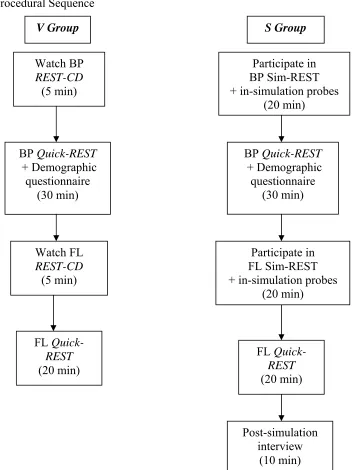
Figure 1 shows the sequence for a participant of group V and S through the Basketball Practice (BP), Faculty Lounge (FL), and simulated REST (Sim-REST). Procedural Sequence
Figure 1. Procedural sequence of study for a participant in groups V and S. Watch BP
REST-CD (5 min)
V Group
BP Quick-REST + Demographic questionnaire (30 min) Watch FL REST-CD (5 min)
FL Quick-REST (20 min)
S Group
Participate in BP Sim-REST + in-simulation probes
(20 min)
BP Quick-REST + Demographic questionnaire
(30 min)
Participate in FL Sim-REST + in-simulation probes
(20 min)
FL Quick-REST (20 min)
Post-simulation interview