Fuzzy Computing and Control: A System
Augmentation for Regulating Air Pressure in
Air Compressed Tank
Dr. Magan P. Ghatule
Sinhgad Academy of Engineering, Kondawa (Bk), Savitribai Phule Pune University, Pune, Maharashtra, India
ABSTRACT: In this paper, proportional–integral–derivative (PID) control which is the most frequently used controller for controlling the processes is used for controlling the pressure in the air tank to the required set value.Study and behavior of PID has been studied well and it is observed that the PID controller controls the pressure of air in the tank by controlling the values of Kp, Kd and Ki. It is observed that due to adjustment of such parameters the settling time of
the system is more.
However in some control systems a precise control is necessary for handling the uncertainties in the system within some stipulated time. However to remove the effect of these uncertainties appearing in the system and also to reduce the settling time of the system , a method of Fuzzy logic control is proposed. This paper also describes the comparison between the PID control and Fuzzy logic control for the particular system described in the paper.
KEYWORDS:: Fuzzy control, proportional integral derivative, PID control.
I. INTRODUCTION
The PID control algorithm is the most popular feedback controller used within the process industries. It has been successfully used for over 50 years. It is a robust algorithm that can provide excellent control performance despite the varied dynamic characteristics of process plant. Proportional + Integral (PI) controllers were developed because of the desirable property that systems with open loop transfer functions of type 1 or above have zero steady state error with respect to a step input.
Proportional action responds quickly to changes in error deviation. Integral action is slower but removes offsets between the plant’s output and the reference. Derivative action predicts system behavior and thus improves settling time and stability of the system. Here PID control is applied to hypersonic wind tunnel for regulating pressure inside the settling chamber. The proposed PID control method provides the settling chamber pressure to settle faster and reduces peak overshoot.
Hypersonic wind tunnel is a test facility to measure the aerodynamic forces on the space vehicle in high pressure flow regime. Wind tunnels are categorized as subsonic, supersonic and hypersonic, depending on the mach number.
Most of the systems in the universe are nonlinear. So, Fuzzy logic control approach is also discussed. We can see that using fuzzy logic controller, settling time is reduced and hence the system performance is improved by removing the nonlinearities in the system.
II. EXPERIMENTALSETUPANDRESULTSOFPIDCONTROLLER
The pressure in the air storage tank can be set to 14 bar to its full capacity. By changing the valve position, the pressure in the settling chamber is to be adjusted to a particular value as per our requirement. This value of pressure should be from 2 bar to 14 bar. The system is nonlinear, but not highly nonlinear. By performing experiment on a test air storage tank, the following readings for pressure and corresponding volume with respect to time are obtained.
Table-1: Experimental reading of Pressure -Volume value
Time (Min)
Pressure (P) PSI
Volume (m^3/min) T P V
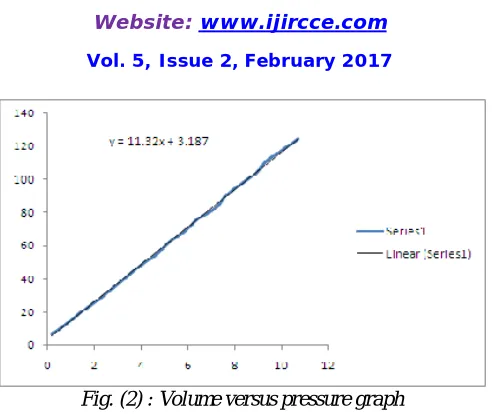
1 0.2 6.9 2 0.9 13.8 3 1.5 20.7 4 2.2 27.6 5 2.8 34.5 6 3.4 41.4 7 4 48.3 8 4.7 55.2 9 5.2 62.1 10 5.9 69 11 6.4 75.9 12 7.2 82.8 13 7.6 89.7 14 8.2 96.6 15 8.9 103.5 16 9.3 110.4 17 10 117.3 18 10.7 124.2
Fig. (2) : Volume versus pressure graph
From the graph, we can see that the system has small nonlinearity. By changing the values of the gains Kp,Ki and Kd in a PID controller, we can achieve the target value of pressure as can be seen in the MATLAB simulation.
Fig. (4): Scope of PID controller for pressure value set to 7 bar.
From the results in the scope, we can see that the pressure settles to the required value which is 7 here in less time in the 1st figure of scope. 2nd &3rd graphs show the values of error and derivative of error respectively. The 4th figure of the scope shown above gives the value of volume which is 82.4 m3/min .
III.NEEDTOUSEFUZZYLOGICFORCONTROLPURPOSE
Fuzzy Logic is a problem-solving control system methodology that lends itself to implementation in systems ranging from simple, small, embedded micro-controllers to large, networked, multi-channel PC or workstation-based data acquisition and control systems. It can be implemented in hardware, software, or a combination of both. It provides a simple way to arrive at a definite conclusion based upon vague, ambiguous, imprecise, noisy, or missing input information.
Fuzzy Logic offers several unique features that make it a particularly good choice for many control problems.
1. It is inherently robust since it does not require precise, noise-free inputs and can be programmed to fail safely if a feedback sensor quits or is destroyed. The output control is a smooth control function despite a wide range of input variations.
2. Since the Fuzzy Logic controller processes user-defined rules governing the target control system, it can be modified and tweaked easily to improve or drastically alter system performance. New sensors can easily be incorporated into the system simply by generating appropriate governing rules.
3. Fuzzy logic is not limited to a few feedback inputs and one or two control outputs, nor is it necessary to measure or compute rate-of-change parameters in order for it to be implemented. Any sensor data that provides some indication of a system's actions and reactions is sufficient. This allows the sensors to be inexpensive and imprecise thus keeping the overall system cost and complexity low.
IV. RESULTSOFFUZZYLOGICCONTROLLER
A program is written in MATLAB for Fuzzy controller. The output scope of the program is shown in above figure. The 2nd figure in the scope shows that the pressure settles to the required set value Which is equal to 2 bar in less time.
Thus by using a fuzzy controller technique, we can observe that the pressure settles to the set point value in less time. Thus settling time is reduced and system performance is improved by using a fuzzy logic controller. The 1st figure in the scope gives the value of the volume versus time.
Time ----
Fig.(5): Graphical representation of Fuzzy logic computational control.
V. CONCLUSION
In this paper, a PID controller is successfully designed and it is able to control the settling chamber pressure to the required set point. The system is brought to strict feedback form after applying some approximations. The performance of the proposed control law is evaluated through simulation.
The Simulated results shows that the settling chamber pressure with the designed controller has no peak overshoot and it settles within a few minutes. By using the Fuzzy logic control, we can see that the nonlinearities in the system can be removed or minimized and the settling chamber pressure settles to the set point value in less time as compared to that with PID controller.
Therefore, by using a Fuzzy Logic controller the settling time of the system is reduced and hence the system performance is improved. Further by using a combined controller like Neuro-Fuzzy, Fuzzy- Sliding mode control or type-2 Fuzzy logic, better control can be achieved if the system is complicated and highly nonlinear.
C
o
n
tr
o
l p
ar
am
et
er
REFERENCES
[1] Ki-Seok Kim and Youdan Kim, “Robust Backstepping Control for Slew Maneuver Using Nonlinear Tracking Function”, Proceedings of the IEEE Transactions on Control Systems Technology, VOL 11,NO.6, November 2003.
[2] Roger Skjetne and Thor I.Fossen, “On Integral Control in Backstepping:Analysis of Different Techniques”, Proceedings of American
Control Conference, Bosten, Massachusetts, july 2004
[3] Vargese Jacob and Binu.L.S, “High Pressure System Modelling of Hypersonic wind tunnel”, Proceedings of International Conference On
Modelling And Simulation, College Of Engineering, Trivandrum, India, Dec 2009
[4] Vargese Jacob and Binu.L.S, “Adaptive Fuzzy PI controller for Hypersonic Wind Tunnel Pressure Regulation”, Proceedings of 10th National
Conference On Technological Trends(NCTT 09), College Of Engineering, Trivandrum, India, Nov 2009
[5] Fu-Kuei Tsai and Jung-Shan Lin, “Backstepping Control Design of 360-Degree Inverted Pendulum Systems”, Proceedings of Automatic
Control Conference, National Chi Nan University, Taiwan, 2003
[6] Donald P. Echman, “Automatic Process Control”, Wiley Eastern Limited, New Delhi.
[7] Ola HarkegArd and S. Torkel Glad, “A Backstepping Design for Flight Path Angle Control”, Proceedings of the 39 IEEE Conference on
Decision and Control, Australia, December, 2000
[8] Jen Jacques E.Slotine, “Applied nonlinear control”, Massachusetts institute of technology, Weiping Li. Prentice-Hall.pub., 1991
[9] A Joseph, S Geetha, “Application of Backstepping for the Control of Launch Vehicle”, Proceedings of IE(I) JournalAS, Vol 88, November,