THOMSON, LISA PETTY. Exploring Student Perceptions of Ed.D. Program Benefits: A Q Method Examination. (Under the direction of Dr. James E. Bartlett)
Within the field of higher education, Colleges of Education, in conjunction with the Carnegie Project on the Education Doctorate (CPED), are working to distinguish the Doctor of Education (Ed.D.) as a distinct doctoral degree designed for scholar-practitioners. The purpose of this study was to identify the perceptions of current Ed.D. students and alumni in CPED-affiliated programs regarding their program benefits. Q methodology, a mixed method approach designed to examine individuals’ subjective opinions and perceptions in a
systematic way, was used to study the participants’ viewpoints. Participants received a
concourse of 61 statements to sort based on their opinions of their program’s benefits, using a +5 (most important benefit) to -5 (least important benefit) scale. In addition, participants completed a post-sort survey designed to collect demographic information and gather a more in-depth perception of each participant’s highest three statements (+5) and lowest three statements (-5). Data were analyzed through factor analysis to determine six distinct factor groups with opinions about Ed.D. program benefits.
The results of this study indicate that Ed.D. students hold varied opinions about the benefits of their programs. The six factors formed through the analysis illustrated that students chose their Ed.D. programs to gain research skills, for leadership development, for enhanced earnings and job prospects, to gain credentials and recognition, to become change agents, or for personal change. These six groups were all distinguished from each other in their opinions and represented a range of ages, races/ethnicities, job functions, and
very focused on career advancement and increased earnings, whereas older students were more interested in self-directed learning and personal growth. In addition, individuals seeking to gain practical research skills were less interested than their peers in personal growth and networking. Interestingly, while multiple groups illustrated an interest in change, the types of change individuals sought ranged from personal change to the ability to become a change agent within their workplaces and in the field.
by
Lisa Petty Thomson
A dissertation submitted to the Graduate Faculty of North Carolina State University
in partial fulfillment of the requirements for the degree of
Doctor of Education
Adult and Community College Education
Raleigh, North Carolina 2018
APPROVED BY:
_______________________________ _______________________________
James E. Bartlett Diane Chapman
Committee Chair
_______________________________ _______________________________
DEDICATION
BIOGRAPHY
Lisa Petty Thomson grew up Raleigh, North Carolina. Always interested in learning, she graduated from Appalachian State University with a B.S.B.A in Marketing and Economics, Bowling Green State University with an M.A. in College Student Personnel, and The University of North Carolina at Chapel Hill with an M.Ed. in School Counseling. Given her passion for higher education and working with students, her career has allowed her to work in a wide variety of student services functions at institutions including Fairleigh Dickinson University, the University of Virginia, the University of North Carolina at Charlotte, and Duke University. She currently works as an Associate Director in the Career Management Center at Duke University’s Fuqua School of Business.
While pursuing her doctoral studies, Lisa was selected for the Directorate Board for the Commission for Graduate and Professional Student Affairs within APCA – College Student Educators International. In addition she has been actively involved with the Academy of Human Resource Development, the National Association of Colleges and Employers, the Junior League of Raleigh, and 519 Church.
ACKNOWLEDGMENTS
I could not have successfully completed my Ed.D. without the help and support of countless individuals, and I am truly thankful to have such a strong support network in my life. I must first thank my husband, Tug, for encouraging me to pursue this degree, despite all of the hours I was away in class and completing assignments. To my children, Ferne and Quinn, thank you for always bringing a smile to my face and helping me keep my priorities in perspective. To my parents, Berry and Frankie, thank you for instilling in me a love of learning.
Also, thank you to the many friends who have helped me balance work and life during this program. To Jeremiah, thank you for convincing me to apply to this program – I look forward to soon becoming doctors together! To Robin and Brian, thank you for turning your house into a hotel for me for countless weekends – I only hope I can repay your
generosity one day. To Michelle, Robin, and Brooke – thank you for always checking in on me at just the right times, no matter the distance between us. To my dear classmates, Ben and Kirk, our Saturday breakfasts and sarcastic banter were highlights of this experience.
To my chair, Dr. James Bartlett, thank you for your guidance throughout this process. Thank you for introducing me to CPED and encouraging me to pursue this topic for my dissertation. To my committee members – Dr. Diane Chapman, Dr. Lance Fusarelli, and Dr. Dennis Wiese – thank you for your thoughtful responses to my research. It has been great to learn from such talented individuals.
TABLE OF CONTENTS
LIST OF TABLES ... ix
LIST OF FIGURES ... xi
CHAPTER ONE: INTRODUCTION ... 1
Background ... 1
Performance-Based Funding ... 2
Emphasizing Program Outcomes ... 2
Statement of Problem ... 4
Purpose Statement ... 6
Theoretical Framework ... 8
Human Capital Theory. ... 8
Super's Life-Span, Life-Space Theory. ... 10
Conceptual Framework ... 10
Research Questions ... 11
Significance of the Study ... 12
Limitations ... 13
Delimitations ... 14
Definition of Terms... 15
Summary ... 16
CHAPTER TWO: REVIEW OF LITERATURE ... 18
Introduction ... 18
Section One: Human Capital Theory and Super's Life-Span, Life-Space Theory ... 19
Human Capital Theory ... 19
Background ... 19
Links to Education. ... 21
Critiques of Human Capital Theory. ... 22
Human Capital Theory and Doctoral Education. ... 23
Super's Life-Span, Life-Space Theory ... 24
Background ... 25
Links to Education. ... 27
Section Two: Graduate School Choice and Doctoral Education ... 28
Mismatch of Perceived Student Outcomes ... 31
Section Three: Doctoral Degrees within Colleges of Education ... 32
Institutional Type ... 33
Distinguishing the Ed.D.. ... 34
Re-establishing the Ed.D. ... 35
Carnegie Project on the Education Doctorate (CPED).. ... 37
Section Four: Advancing the Research ... 39
Program Outcomes... 40
Summary ... 42
CHAPTER THREE: METHODS ... 43
Introduction ... 43
Research Design... 43
Q Methodology Background... 44
Q Methodology ... 46
Concourse development. ... 46
Q Sample. ... 47
P-set... 47
Q Sort. ... 49
Correlation, factor analysis, and factor scores. ... 51
Definitions of Q Methodology Terms... 55
Q Methodology and Ed.D. Students ... 55
P-Set ... 56
Instrumentation ... 57
Data Collection ... 59
Data Analysis and Interpretation ... 60
Summary ... 62
CHAPTER FOUR: FINDINGS ... 63
Introduction ... 63
P-Set Demographics... 65
Correlation Matrix and Factor Correlation Matrix ... 67
Factor Analysis and Rotation ... 69
Factor Loadings ... 71
Factor Arrays ... 74
Consensus Statements ... 78
Distinguishing Statements ... 78
Factor One: Chose Ed.D. for Research Skills. ... 79
Factor Two: Chose Ed.D. for Leadership Development... 83
Factor Three: Chose Ed.D. for Enhanced Earnings and Job Prospects ... 88
Factor Four: Chose Ed.D. for Credentials and Recognition ... 92
Factor Five: Chose Ed.D. to Become a Change Agent ... 97
Factor Six: Chose Ed.D. for Personal Change. ... 102
Summary ... 105
CHAPTER FIVE: DISCUSSION AND IMPLICATIONS ... 108
Conclusions ... 109
Finding one ... 109
Finding two. ... 110
Finding three ... 112
Finding four ... 116
Application to Theoretical Framework ... 117
Discussion ... 119
Limitations ... 120
Implications for Ed.D. Programs ... 121
Implications for admissions committees ... 121
Implications for course design/faculty ... 122
Implications for program administrators ... 123
Recommendations for Future Research ... 124
Recommendations for Future Q Studies ... 124
Summary ... 125
APPENDICES ... 146
Appendix A: Program Director Recruitment Email. ... 147
Appendix B: Participant Recruitment Email. ... 148
Appendix C: References used for Initial Concourse Creation ... 149
Appendix D: Initial Concourse ... 150
Appendix E: Final Concourse ... 154
Appendix F: Q Sort Instructions ... 156
Appendix G: Additional Q Sort Questions ... 157
Appendix H: Current Job Function/Role of P-Set ... 158
LIST OF TABLES
Table 1 Institutional Type, by Percentage ... 65
Table 2 Participant Gender, by Percentage ... 65
Table 3 Racial/Ethnic Background of Participants, by Percentage ... 66
Table 4 Reasons for Selecting Ed.D. Program, by Percentage ... 66
Table 5 Correlations between Factor z-scores ... 68
Table 6 Factor Solutions, Arranged by Factor ... 70
Table 7 Factor Characteristics... 70
Table 8 Flagged Factor Loadings... 72
Table 9 Six Factor Solution for Perceptions of Ed.D. Programs, based on p-value ... 73
Table 10 Factor Arrays for Six Study Factors ... 75
Table 11 Highest and Lowest Ranked Items for Factor One ... 79
Table 12 Factor Interpretation Crib Sheet for Factor One ... 80
Table 13 Distinguishing Statements, Factor One... 81
Table 14 Highest and Lowest Ranked Items for Factor Two ... 84
Table 15 Factor Interpretation Crib Sheet for Factor Two ... 85
Table 16 Distinguishing Statements, Factor Two ... 86
Table 17 Highest and Lowest Ranked Items for Factor Three ... 88
Table 18 Factor Interpretation Crib Sheet for Factor Three ... 90
Table 19 Distinguishing Statements, Factor Three ... 91
Table 20 Highest and Lowest Ranked Items for Factor Four ... 93
Table 21 Factor Interpretation Crib Sheet for Factor Four ... 94
Table 23 Highest and Loweest Ranked Items for Factor Five ... 98
Table 24 Factor Interpretation Crib Sheet for Factor Five... 99
Table 25 Distinguishing Statements, Factor Five ... 100
Table 26 Highest and Lowest Ranked Items for Factor Six ... 102
Table 27 Factor Interpretation Crib Sheet for Factor Six ... 103
Table 28 Distinguishing Statements, Factor Six ... 104
Table 29 Highest Ranked Statements, by Factor ... 111
Table 30 Lowest Ranked Statements, by Factor ... 112
LIST OF FIGURES
Figure 1 Conceptual framework ... 12
Figure 2 Sample Q Set... 48
Figure 3 Sample Ranking Sheet for Q Sort ... 50
Figure 4 Q-Sample Rankings, One Respondent ... 50
Figure 5 Sample Ranking Sheet in Q sortware ... 59
Figure 6 Model Sort for Factor One: Chose Ed.D. for Research Skills ... 83
Figure 7 Model Sort for Factor Two: Chose Ed.D. for Leadership Development ... 87
Figure 8 Model Sort for Factor Three: Chose Ed.D. for Enhanced Earnings and Job Prospects ... 92
Figure 9 Model Sort for Factor Four: Chose Ed.D. for Credentials and Recognition ... 97
Figure 10 Model Sort for Factor Five: Chose Ed.D. to Become a Change Agent ... 101
CHAPTER ONE: INTRODUCTION Background
Within the last 10 years, institutions of higher education in the United States have faced increased scrutiny from their constituents over the rising costs of a college education (Cowan & Kessler, 2015; Radwin & Wei, 2015). From an economic perspective, this emphasis on the costs of higher education is not surprising. According to data from the National Center for Education Statistics, for the 2011 – 2012 academic year, the average cost of a four-year degree ranged from $23,200 for public institutions to $43,500 for private, non-profit institutions (Radwin & Wei, 2015). Currently, prices are continuing to rise across all institutional types (Schoen, 2015).
Given these rising prices, approximately 69% of students require financial aid and loans to finance their education (“The Institute,” 2015), and much of the aid available is interest-bearing loans (Radwin & Wei, 2015). Thus, currently, students graduate with an average of $28,950 in student loan debt from their undergraduate tenure, with debt ranging from $4,750 to $60,750 (“The Institute,” 2015). Factor in graduate education and the numbers continue to
increase.
students and discontinuing the programs deemed cost prohibitive (Schaefer, 2015). Performance-Based Funding
Additionally, performance-based funding (PBF), or funding based on the job placement of graduates, is increasing in popularity across the nation (Friedel, Thornton, D’Amico, & Katsinas, 2013; Harnisch, 2011; “Performance-based funding,” 2015). PBF has garnered support from many influential organizations, including the Lumina Foundation, the Bill and Melinda Gates Foundation, and the College Board (Harnisch, 2011; “Performance-based funding,” 2015). This support, coupled with the Obama Administration’s call for states to increase graduation rates, has greatly influenced the use of PBF (Anderson, 2015). In fact, 32 states currently utilize PBF models for at least a portion of their appropriations, and five more states are considering implementing similar initiatives (“Performance-based funding,” 2015). This resurgence of PBF is important because PBF emphasizes the link between investments and outcomes of higher education and frames the discussion of education in economic terms.
Emphasizing Program Outcomes
Given this call for increased accountability and the potential financial implications, institutions are scrutinizing programs to determine feasibility based on resource allocation and subsequent career success of graduates (U.S. Department of Education, 2014). In fact,
2015). More specifically those organizations were cited for false advertising of their degree offerings which caused students to have exorbitant debt and high loan default rates based on poor employment outcomes (“FTC Investigates,” 2015; U.S. Department of Education, 2014).
Regardless of broader opinions or perceptions of for-profit institutions, these lawsuits illustrate the ramifications that can occur at the institutional level when the government increases
oversight of educational outcomes.
Although the Obama Administration’s proposed college rating system never materialized, it did introduce the idea of rating colleges based a cost-benefit analysis for graduates (Anderson, 2015). Now, the fear of state-level governmental initiatives designed to regulate all colleges and universities, non-profit and for-profit alike, are causing institutions to examine degree programs at all levels – associates, undergraduate, and graduate (Cowan & Kessler, 2015; Harnisch, 2011). While the majority of the legislation focuses on associate and undergraduate degrees, the
problems pervade all levels (“Performance-based funding,” 2015). Even with the recent changes in national leadership and in the national education agenda, performance-based funding remains a frequently discussed option in the debate to lower the cost of a college education (Kelderman, 2016).
who view graduate school as a catalyst for advancement, with the associated costs serving as a way to operationalize future financial gains (Zhang, 2005). Therefore, although research
indicates that students collectively benefit from completing graduate degrees, despite differences in the amount of benefit across demographic characteristics (Zhang & Thomas, 2005), foregone income and the broader labor market largely influence enrollment decisions (Bedard & Herman, 2008; Millett, 2003). Given the age and life stage of many graduate students, especially those individuals pursuing doctoral degrees, it makes sense that perceived opportunity costs impact their decisions to enroll in graduate school (Jepsen & Montgomery, 2012).
Therefore, this study examines the issues of cost and outcomes of higher education from the lens of doctoral education. The remainder of this chapter further describes the rationale and significance of this study on students’ perceptions of Doctorate in Education (Ed.D.) program benefits upon graduation. The statement of purpose, theoretical framework, and conceptual framework are introduced, along with the significance of the study and the research questions. Limitations and delimitations of the study design are described, as well as the key terms utilized in the study.
Statement of Problem
Overall, a review of the academic research reveals a lack of research on doctoral degrees, especially compared to secondary and undergraduate education. Plus, of the existing research at the doctoral level, the majority focuses on faculty preparation and academia, which largely focuses on full-time Doctor of Philosophy (Ph.D.) programs (Golde & Dore, 2001). In fact, due to funding opportunities from the National Science Foundation, much of the existing research emphasizes science and engineering programs (“National Science,” 2015).
Thus, programs and colleges offering professional degrees, especially programs where graduates seek non-academic employment are often excluded from the literature. For example, Ed.D. programs, housed in colleges of education, are typically missing in the broader literature. Even the Carnegie Project on the Education Doctorate (CPED), the leader in redesigning the Ed.D., has not conducted research on employment outcomes of graduates from these programs (“About Us,” 2016).
This significant gap in academic and popular press literature creates a lack of adequate information within the academy and in the marketplace – both for students and employers. This problem is very pronounced within colleges of education because those colleges must not only address the lack of information on outcomes, but must also work to differentiate the Ph.D. in Education from the Ed.D. Currently, not only do many prospective students struggle to
Similar to academia, popular press literature also struggles to define the degrees. For example, according to Wikipedia, an Ed.D. is a degree used to gain an appointment as a professor, but can also be used to prepare for academic positions in education and human development (“Doctor of Education,” 2017). Additionally, DeWitt Scott (2016) highlighted the
benefits of each degree in Inside Higher Ed, stating that Ph.D. degrees are typically more
research intensive and more common for faculty careers, while Ed.D. degrees typically focus on more practical, administrative concepts. However, he acknowledged that not all programs adhere to those distinctions (Scott, 2016). Furthermore, CPED, the leader in the Ed.D. design/redesign space, defines the Ed.D. as a professional degree that “prepares educators for the application of
appropriate and specific practices, the generation of new knowledge, and for the stewardship of the profession” (“About Us,” 2016). While this definition provides all the key tenets of the degree, it does not describe tangible, concrete differences between an Ed.D. and a Ph.D. Thus, further defining the degrees and explaining the role of education in fostering graduates’ desired economic growth and career development will assist institutions, students, and employers in effectively designing and delivering Ed.D degrees that meet student expectations and demands. Purpose Statement
seek a variety of employment, within academia and industry, largely based on the success of previous graduates of their respective programs (Johnsrud & Banarla, 2004). If these criteria influence program selection of Ed.D. programs, then it is important to understand the perceptions and considerations of students regarding program benefits and outcomes.
Given that CPED is a consortium of institutions specifically focusing on advancing the Ed.D. degree (“About Us,” 2016), this group of institutions represents a population with a vested interest in Ed.D. program benefits and thus represents the sampling group for this study. Brown (2004) describes Q methodology as a technique proven to identify and analyze perceptions and opinions, thus Q method will be used to gauge opinions of students from select CPED-affiliated institutions in relation to distinguishing program benefits, both academically and related to post-graduation careers. Through the analysis, the highest and lowest ranked statements regarding program benefits will be identified, as well as any consensus statements between groups, and will provide information necessary to evaluate the factor groups of students that feel similarly towards their Ed.D. programs and their intended program benefits. Overall, program leaders, students, and alumni all stand to benefit from the advancement of the Ed.D. degree, both institutionally and as consumers; so to advance this mission, it is important to understand students’ perceptions of their programs and their program benefits and the rationale behind these viewpoints.
will further enhance the scope of the research, broadening the research base beyond school choice alone.
Theoretical Framework
Two theories emerge in the literature to support the study of students’ perceptions of their
Ed.D programs and future employability – human capital theory and Super’s (1990) life-span, life-space career development theory. Human capital theory provides the theoretical framework for the economic expectations of students and graduates, whereas Super’s (1990) span, life-space career development theory incorporates career outcomes and job satisfaction.
When examining educational programs, the academic rigor of said programs is important because quality of education impacts the continuation of advanced education and training, which can ultimately effect job trajectories and lifetime earnings, otherwise known as labor market outcomes (Becker, 1960; Becker, 1992). Similarly, the career benefits received as a result of that education are especially important for doctoral students because individuals pursue advanced degrees to enhance their lives and careers (Harvey, 2000; Ingram et al., 2000). Not only do individuals seek improved job prospects, but they seek jobs that will offer more responsibility, higher earnings, and greater long-term earning potential (Harvey, 2000; Wellington & Sikes, 2006). Thus, this study is framed on a combination of the tenets of human capital theory and the principles of Super’s (1990) life-span, life-space career development theory
Human capital theory.
traced back to the early economic teachings of Adam Smith (Baptiste, 2001), human capital theory was not formally developed until the 20th century. Economists Gary Becker (1960, 1964) and Theodore Schultz (1961) are credited with the development of human capital theory as it is known today. While Becker (1960) and Schultz (1961) examined human capital theory from different angles, with the former focusing on schooling as an individual investment and the latter examining investments in education at the macro-level, both theorists believed education yielded a positive rate of economic return for individuals (Nafukho, Hairston, & Brooks, 2004).
Nevertheless, despite these positive assertions, human capital theory has been met with skepticism since its inception as an economic theory. The longstanding critiques, as noted by Blaug (1976), highlight the fact that human capital theory fails to account for the impact on lifetime earnings due to factors such as family background, natural aptitude, and occupational choice. While these factors may impact potential earnings, the plethora of empirical studies focused on human capital theory reiterate the importance of education in relation to lifetime earnings (Becker, 1993; Manuelli & Seshadri, 2014; Sweetland, 1996).
fits this study based on the extensive research base within the field of education (Sweetland, 1996) and the focus on the economic benefits of investments in education.
Super’s life-span, life-space theory.
In addition to the economic aspects of labor market outcomes explained by human capital theory, this study also examines the career outcomes of Ed.D. graduates. While job prospects are not the only factor students consider when choosing professional doctoral programs (Harvey, 2000), career development is still a critical component in the program and degree selection process (Wellington & Sikes, 2006). From the theoretical perspective, among the vast array of career development theories, Super’s (1990) life-span, life-space theory is the most salient for doctoral students pursuing Ed.D. programs. This latest version of his longstanding theory factors in all life roles, both in how individuals determine and pursue careers and how they view their jobs (Smart & Peterson, 1997; Super, 1990). Super’s (1990) holistic approach to career development fits this segment of doctoral students because the majority of Ed.D. programs, including those affiliated with CPED, are largely geared towards working professionals who seek to become scholar-practitioners (“About Us,” 2016). Therefore, the majority of these students have chosen to pursue doctoral degrees while simultaneously striving to advance their careers – a perfect scenario for blending human capital theory and holistic career development. Conceptual Framework
This study seeks to deepen the understanding of students’ perceptions of key
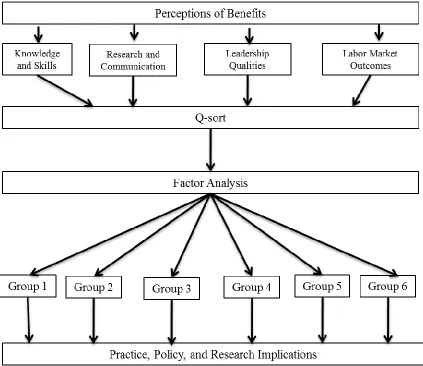
importance of studying program selection and subsequent goals for employment. Examples of the specific perceptions include perceptions of academic knowledge and skills gained, of research and communication abilities gained, of personal growth, self-reflection, and the development of leadership qualities, and of post-graduation labor market outcomes. Figure 1 illustrates the conceptual framework utilized in this study. In general, this study seeks to understand how different groups of current students perceive the benefits of their Ed.D. programs through the use of Q methodology. As explained in Chapter Three, Q methodology utilized factor analysis to define distinct groups of viewpoints on the chosen topic. For this study, six unique groups emerged, as shown in the conceptual framework (Figure 1). Integrating the opinions and viewpoints of these groups helps to inform practice, policy, and research by discerning any direct or indirect influence that these perceptions may have on program selection and/or satisfaction.
Research Questions
The following research questions frame this study about students’ perceptions of their CPED-affiliated Ed.D. programs and their perceptions of their program benefits:
Q1. What are the perceptions among students in CPED programs towards their program benefits and why?
a. What are the highest and lowest ranked statements by group?
b. What are the distinguishing characteristics between groups of students in their perceptions of their program benefits?
Figure 1. Conceptual framework. Significance of Study
This study expects to contribute to the field of doctoral education, with an emphasis on Ed.D. programs, by providing new knowledge on doctorate of education degrees and program benefits. Considering the recent call by stakeholders and funding sources for increased
of Education offering the Ed.D. degrees by providing data-driven research for faculty and administrators to utilize to address the need for accountability of outcomes.
Similarly, considering the recent efforts led by CPED to redesign the Ed.D. as a
distinctive and meaningful doctoral degree of practice (“About Us,” 2016), institutions offering
these programs need to further articulate and promote the degree in the consumer and
employment marketplace. This study seeks to help program leaders in distinguishing the Ed.D. degree within the field of education as the more practitioner-focused degree (Scott, 2016) by producing research on Ed.D. students and their experiences in their programs. This information will allow programs to appropriately design their curricula to meet the academic and career needs of this group of students, as opposed to simply mirroring the programs based on the needs and interests of research-oriented Ph.D. students. Furthermore, this study’s emphasis on
employment needs and labor market outcomes of Ed.D. graduates will allow both students and employers to make better informed career-focused decisions. Overall, this study adds to the existing, albeit limited, research on doctoral education while simultaneously increasing the understanding of Ed.D. degrees as distinct and practical degrees within the field of education. Limitations
introduces the potential for biased responses. The methodology section describes in detail how the error inherent in Q research is addressed in this study.
Additionally, Q methodology focuses on obtaining data from a small P set, or structured sample of participants, limiting the generalizability of the research conclusions to the specific participant group. Similarly, participant demographics may be lacking in diversity, based on the population of students in programs. Finally, given that the targeted P set is doctoral students in Ed.D. programs, and the majority of Ed.D. students are working professionals, the study is limited to the amount of time and attention each participant took in completing the Q sort. Delimitations
This study has several delimitations. First, only CPED-affiliated programs were included in the study, even though the CPED consortium represents only a portion of all current Ed.D. programs. Including only CPED-affiliated programs has the potential to cause self-selection bias among participants, but given that CPED institutions are leading the efforts to intentionally redesign the Ed.D. degree and that the programs studied offer rigorous academic preparation for practitioners and focus on creating leaders prepared for 21st century demands (“About Us,” 2016), it makes logical sense to examine characteristics of these programs specifically. Within these programs, this study largely examines the opinions and perspectives of current students of CPED-affiliated programs. Individuals who started programs but are not currently enrolled were not included. Graduates of programs were also not targeted as programs evolve over time and universities lack strong alumni tracking systems for doctoral students (June, 2016).
degrees vary widely across the world. Thus, emphasizing degrees and literature in the United States will frame the study and the meaningful addition to the literature within the field.
Lastly, this study is limited to the statements on program characteristics and labor market outcomes/employability the researcher included in the Q sort.
Definition of Terms
Carnegie Project on the Education Doctorate (CPED). CPED is a consortium of colleges and universities leading the efforts to examine the Ed.D. degree. This group is examining the degree in an effort to reestablish this degree as a unique and credible doctoral degree for scholar-practitioners (“About Us,” 2016).
Concourse. “A list of items serving as candidates for inclusion in the Q sort. It can take the form of questions, statements, pictures, etc.” (Brown, 2004, p. 18).
Condition of Instruction. Instructions provided by the researcher to participants that “sets the context for the consideration of the Q sample” and describes how to complete the Q sort (Barbosa, Willoughby, Rosenberg, & Mrtek, 1998, p. 1036).
Doctorate of Education (Ed.D.). The Ed.D. degree is a doctoral degree in education designed to educate practitioners interested in jobs outside of the professorate (Deering, 1998; Dill & Morrison, 1985). According to CPED, “the professional doctorate in education prepares educators for the application of appropriate and specific practices, the generation of new knowledge, and for the stewardship of the profession” (“About Us,” 2016).
Factor. “Cluster of respondents whose Q sorts were statistically similar” (Brown, 2004,
p. 18).
Human Capital Theory. Human capital theory is an economic theory that focuses on the development of individuals and the economic benefits that results from individuals investing in education (Baptiste, 2001; Becker, 1992; Olaniyan & Okemakinde, 2008; Sweetland, 1996).
Labor Market Outcomes. The labor market outcomes described in this study include job trajectories and lifetime earnings (Becker, 1960).
Life-Span, Life-Space Theory. Life-span, life-space theory is a career theory that examines how individuals determine and pursue careers, as well as how they view their jobs (Smart & Peterson, 1997; Super, 1990).
P set or Sample. “It is a structured sample of respondents who are theoretically relevant to the program under consideration” (van Exel & de Graaf, 2005, p. 6).
Professional Doctorate. Typically, professional doctorates are doctoral degrees designed for practitioners in the fields of business, education, and engineering (Wellington & Sikes, 2006).
Q Methodology. “A hybrid of qualitative and quantitative principles used to analyze subjective data and group individuals according to their resources” (Barbosa et al, 1998, p. 1032).
Q Set or Sample. “The collection of ‘heterogeneous items’ which the participants will sort” (Watts & Stenner, 2005, p. 74).
Q Sort. “Each respondent’s rank ordered set of perceptions” (Brown, 2004, p. 18).
Summary
CHAPTER TWO: REVIEW OF THE LITERATURE Introduction
The purpose of this mixed methods study is to identify perceptions of current students in Carnegie Project on the Education Doctorate (CPED)-affiliated Ed.D. programs towards their program outcomes (e.g., knowledge, skills, personal growth, employment outcomes). An understanding of these perceptions will help institutions understand the interests and needs of students electing to pursue professional doctorates within education, how students select their respective programs, and will add to the limited research base on doctoral students within the literature. So, this chapter provides an overview of the existing literature related to doctoral degrees in education and discusses the theories used to frame this study.
pertinent literature related to program outcomes and the need for continued research on Ed.D. programs. This section illustrates the necessity of this study and ties the salient themes together.
Section One: Human Capital Theory and Super’s Life-Span, Life-Space Theory This section describes the basic tenets of both human capital theory and Super’s life-span,
life-space theory, which provide the theoretically underpinnings for this study. The backgrounds of the theories are described, including the ways these theories relate to the field of education. The utility of these theories when examining doctoral education and student perceptions of their programs is included.
Human Capital Theory
Human capital theory is an economic theory that links individuals’ knowledge, skills, and abilities to productivity in the workplace (Baptiste, 2001; Becker, 1962). Within the field of education, human capital theory is commonly utilized as a mechanism to describe the benefits individuals receive from investing in themselves and pursing higher education and advanced degrees (Paulsen & Toutkoushian, 2008; Perna, 2003). Economists espousing this theory assume students make rational decisions about pursuing higher education based on the expected utility they will gain from degree attainment (DesJardins & Toutkoushian, 2005; Paulsen & Toutkoushian, 2008) – a link pertinent to the experiences and intended outcomes of graduate students (Hearn, 1987).
Background
Human capital theory, coined as a theory in the early 1960s, represents the economic aspect of functionalist theory (Walters, 2004). Functionalism focuses on the impact that
tasks (Walters, 2004). Likewise, it follows that additional education and schooling is likely required to perform these new, often more advanced functions (Walters, 2004).
As a theory, human capital theory was formalized based on Becker’s (1960, 1964) examination of education expenditures and Schultz’s (1961) analyses in the field of agricultural
economics (Sweetland, 1996). Both perspectives served to explain the rapid growth in the United States’ economy in the 1960s that was not explained by the expanding labor force or growth in physical capital (Sweetland, 1996). More specifically, Becker (1960) examined an
underinvestment in education and asserted that schooling is an individual investment of capital that ultimately leads to increased earnings (Becker, 1992). Becker (1960) targeted his research on personal income differentials between college graduates and high school graduates, using mathematical equations to generate a rate of return on the investment in a college education to between seven and nine percent (p. 348). His methodology further posited that investing in education was equally as lucrative as business capital (Sweetland, 1996).
Meanwhile, Schultz (1961) examined the issue from the macro-level, illustrating that the national income in the United States had grown substantially from 1900 to 1956, with human investments growing at a higher rate than other forms of capital (Nafukho, Hairston, & Brooks, 2004; Sweetland, 1996). Schultz (1961) focused on the need to consider the skills and knowledge individuals acquire as a “deliberate investment” on the part of individuals (p.1), arguing that these endeavors needed to be considered on the national level when accounting for growth in the national income. He further described spending on education as both a form of personal
study programs, such as agricultural extension programs (Sweetland, 1996). All activities he mentioned focused on yielding a positive rate of return for individuals (Nafukho et al., 2004). Links to Education
With the focus on increased productivity and efficiency within the larger community, the role of education is emphasized as a key mechanism to foster an increase in human capital in developed and developing nations alike (Olaniyan & Okemakinde, 2008). Even though developed and developing nations typically have different issues and concerns around the availability of education, the desire for education exists across populations (Olaniyan & Okemakinde, 2008). Thus, the importance of human capital theory cannot be understated.
In fact, it supports investing in education, both on the macro- and micro-level, to produce economic growth (Olaniyan & Okemakinde, 2008). On the macro-level, attaining higher levels of education has been shown to increase the overall earning potential within societies, even after factoring in the costs of education (Becker, 1992). Within organizations, human capital is often viewed as an integral part of intellectual capital, along with structural and relational capital (Bontis, 1996). Within intellectual capital, human capital is critical because it addresses the human personnel aspect of education and training (Bontis, 1996).
The emphasis on training and developing employees links human capital theory to the broader field of human resource development. Human resource development supports
organizational training and development to foster employee productivity and satisfaction (Nafukho et al., 2004; Swanson & Holton, 2009). Thus, employees and employers
On the micro-level, research consistently illustrates that individuals with higher levels of education are more successful in their careers over the course of their lifetimes. In fact, studies indicate that college graduates consistently earn significantly more than high school graduates, even in times of recession (Carnevale, Rose, & Cheah, 2013; Murphy & Welch, 1989). When this assertion was tested qualitatively, van der Merwe (2010) found that individuals do generally related their expected earning potential to the market, thus acting rationally when decided if and when to pursue further education. Interestingly, general education programs have been shown to yield the same economic benefits as more vocationally-focused programs over the totality of individuals’ careers (Psacharopoulos, 1985). While certain majors and skills may offer additional
lifetime earnings potential for individuals regardless of educational attainment, over a lifetime the benefits of educational attainment are evident (Carnevale, Rose, & Cheah, 2013).
Additionally, given the rapid influx of technological advancements in the modern
workplace, job demands constantly change and evolve (Mincer, 1989). Consistent education and training help individuals meet new demands and requirements in their jobs (Mincer, 1989). Thus, education not only helps individuals receive strong job opportunities, it helps them remain relevant and appropriately compensated in the workplace throughout their careers (Mincer, 1989).
Critiques of Human Capital Theory
networking in the case of well-connected families or the high salaries customary for certain occupations in fields such as medicine and engineering. Given these considerations, does education increase earnings on its own or do these other factors significantly impact lifelong earnings? The impact of human capital theory hinges on the answer.
Additionally, the screening hypothesis is frequently highlighted by critics (Blaug, 1976). The screening hypothesis is based on the concept that employers choose to hire individuals with more schooling because of their credentials and trainability, not their knowledge and current skills (Blaug, 1976). Interestingly, the behaviors emphasized by the screening hypothesis still yield the same results proposed by human capital theory – higher lifetime earnings – just following a different rationale (Blaug, 1976).
Overall, despite the critiques of human capital theory, its underlying premise that
investing in individuals enhances economic wealth and capital within societies is still supported by many economists (Becker, 1993; Manuelli & Seshadri, 2014; Murphy & Welch, 1989). The theory has been extensively studied empirically, most commonly within the field of education (Sweetland, 1996). It has continuously illustrated the positive role education plays in improving the standard of living for individuals and creating a well-informed citizenry (Olaniyan &
Okemakinde, 2008; Sweetland, 1996). Human Capital Theory and Doctoral Education
in coursework and research, are more aligned with occupations and particular career pathways (Carnevale, Cheah, & Strohl, 2013). Jepsen and Montgomery (2012), in their study of mature workers, emphasize the critical role of opportunity costs related to returning to school at various stages of life when age may hinder future earnings in relation to cost of attendance. This finding, albeit indirectly, supports Ed.D. programs, and other programs targeting working professionals, because doctoral students often consider additional factors when determining enrollment, including location of program, family implications, and their age and stage of life (Jepsen & Montgomery, 2012).
Collectively, when analyzing the cost of attendance, doctoral students, consider the internal and external benefits gained from their degrees based on knowledge gained, personal development, and increased credentials – a holistic approach derived from the underpinnings of human capital (Ampaw, 2010; Becker, 1962; Paulsen & Toutkoushian, 2008; van de Merwe, 2010; Wellington & Sikes, 2006). Within the field of education, this decision can be even more nuanced when considering the various type of degrees offered and potential academic and non-academic pathways available upon graduation (Scott, 2016). Therefore, human capital theory is the framework utilized for this study as it is used extensively to explain cost-benefit analyses of investing in higher education (Becker, 1993; Manuelli & Seshadri, 2014; Mincer, 1989; Murphy & Welch, 1989; Perna, 2003; Sweetland, 1996).
Super’s Life-Span, Life-Space Theory
selection as students weigh the costs and benefits of attending school (Harvey, 2000; Kallio, 1995; Millett, 2003; Wellington & Sikes, 2006). For professional doctoral students within colleges of education, the majority of whom pursue doctoral degrees while simultaneously working to advance their careers, fitting the program into their existing life routine is critical (Kallio, 1995). Thus, from the theoretical perspective, Super’s (1990) life-span, life-space theory is the most applicable model for this population because it takes a holistic approach to career development. Not only does Super’s (1990) theory consider stage of career and thoughts about job responsibilities, but it includes personal life-stage as well (Smart & Peterson, 1997). Thus, creating a holistic blending of occupational self and personal self that mirrors the desire of Ed.D. students to become scholar-practitioners (“About Us,” 2016; Smart & Peterson, 1997).
Background
Donald Super’s (1990) life-span, life-space theory represents decades of his research and refinement of his views on career development (Smart & Peterson, 1997). Starting in the 1950s, Super developed a career theory designed to supplement the trait-and-factor theories popular at the time (Savickas, 1997). Essentially, the shifting of Super’s theory from the career
Career Choices
While many factors contribute to individuals’ career choices, including training, interests, money, and prestige, occupational choices often develop over time (Patton & Lokan, 2001). In general, more mature students have greater levels of career decidedness and are thus more confident in their occupational decisions (Patton & Lokan, 2001). The rationale for this heightened career certainty stems from the importance of career exploration throughout one’s career and the intentional linking of identity development and career development (Blustein, 1997; Blustein, Devenis, & Kidney, 1989).
Super’s (1990) life-span, life-space theory incorporates career exploration as a stage
within the theory, a stage characterized by the need of individuals to simultaneously consider both personal identity development and various occupations/positions (Blustein et al., 1989). Making career choices after planning and exploring options leads to greater individual-job congruence (Savickas, 1997). Super’s (1990) theory, in particular, emphasizes the need for flexibility in career planning (Kosine & Lewis, 2008). Career recycling, as the term is coined, refers to the flexibility individuals employ when they strive to “match their ever changing career goals to the realities of the world of work” (Smart & Peterson, 1997, p. 359).
The career concepts described by Super (1990), collectively and during the exploration phase, support other well-known theories of career development as well. In particular,
Overall, Gottfredson’s (1981) theory of circumscription and compromise addresses the link between career goals and employment opportunities. Circumscription addresses the
narrowing of career choices, while compromise, as defined by Gottfredson (1981), describes the process of individuals choosing between career preferences and actual employment realities in their selected fields. In particular, Gottfredson (1981) posited that gender roles were more
important than prestige or interests in individuals’ career decisions. However, additional research has indicated that field of work is actually the most salient factor in career choices (Betz, 1994; Hesketh, Elmslie, & Kaldor, 1997). These new assertions ties directly with Super’s (1990) viewpoint about the importance of interests in career choice and job opportunities (Betz, 1994; Imel, 2002; Patton & Lokan, 2001; Savickas, 1997).
Link to Education
In summary, these theories are utilized throughout this study to frame, from the
theoretical perspective, why individuals select Ed.D. programs. The following sections further describe graduate school choice in general and at the doctoral level, emphasizing doctorates in education. Links to theory are discussed in each subsequent section, focusing on any links to perceived program outcomes.
Section Two: Graduate School Choice and Doctoral Education
This section provides an overview of existing literature on graduate school choice across disciplines. There is a particular focus on doctoral education. Links to the theoretical frameworks are also discussed.
Although the research base on graduate school choice processes is limited, particularly in comparison to research on undergraduate school choice models (English, 2012), the field of study has grown over the last several decades. Similar to the demographic and socioeconomic characteristics considered in undergraduate school choice models (e.g., Perna, 2006), these factors also influence program selections at the graduate level (Kallio, 1995; Perna, 2004; Zhang & Thomas, 2005). According to Ingram, Cope, Harju, and Wuensch’s (2000) analysis of
graduate school selection based on the theory of planned behavior, overall opinions about graduate school and career outcomes are critical factors in the decision-making process.
for doctoral degrees, with the majority of recipients being white males (Perna, 2004), although the emergence of non-traditional students is increasing (Wendler et al., 2010). Nevertheless, regardless of variance in graduate school attendance based on demographic characteristics or field of study, the impact of post-graduate career opportunities on graduate program selection spans all fields (Bedard & Herman, 2006; Millett, 2003; Wendler et al., 2010; Zhang, 2005; Zhang & Thomas, 2005).
Following the tenets of human capital theory espoused above, students consider the benefits of attending a program against foregone income they would have received by remaining engaged in the workforce (Heller, 2001; Millett, 2003; Zhang, 2005). By selecting programs based on gaining work skills that increase employability and provide future income
advancement, attending graduate school operationalizes financial returns and provides gained utility for the workplace (Zhang, 2005). For doctoral students, based on the typical length of time for completion and the inherent specialization, these decisions are magnified.
Research on doctoral degrees, albeit more limited than research on graduate degrees collectively, illustrates the same patterns of decision-making processes for degree selection. Credentialing is a key factor in degree selection (Kolman, Gallagher, Hossler, & Catania, 1987), as are program flexibility, location, recommendations, and program reputation (Cawthon, McClellan, Dunn, & Grandpre, 2001; Fleming, 1998/1999). Additionally, it is more common at the doctoral level for students to consider departmental culture in their decisions as doctoral experiences are typically departmentally focused (Gardner, 2009).
traction throughout the world as a way to address student needs, albeit with reservations (Kot & Hendel, 2012). For example, in Australia, a shift away from government funding for doctoral students impacted program selection and completion (Neumann, 2007), perhaps influenced by national debates about the purpose of research degrees when recipients work in industry and not academia (Barnacle, 2004). Similarly, in the United Kingdom, where the same philosophical debates existed, the professional doctorate emerging as a new take on a Ph.D., focusing on a market-driven approach to doctoral education (Bourner, Bowden, & Laing, 2001; Hoddell, Street, & Wildblood, 2002).
Nevertheless, in the United States, despite efforts by the Council of Graduate Schools and the Carnegie Foundation to heighten awareness of doctoral completion rates, no systematic changes have occurred (Grasso, Garry, & Valentine, 2009). Currently, outside of relatively stable and high completion rates for science and engineering fields (National Science Foundation, 2015), completion rates for Ph.D. programs in the arts, humanities, and social sciences in the United States remain at just over 50 percent (Grasso et al., 2009). This rate compares to a 59 percent completion rate across all baccalaureate degrees in the United States, with some variation based on school selectivity (McFarland, et al., 2017). While initiatives such as the Graduate Education Initiative did show improvements in completion rates and satisfaction from doctoral students in the humanities, the results were modest (Groen et al., 2008).
Despite these apparent challenges, not all academic disciplines are interested in actively exploring changes to doctoral education (Grasso et al., 2009; Kot & Hendel, 2012; Winter, Griffiths, & Green, 2000). With the majority of faculty in the United States today being
efforts slow to gain momentum (Grasso et al., 2009; Kot & Hendel, 2012; Winter, Griffiths, & Green, 2000). Yet, with most doctoral recipients in the United States working in industry, not academia, upon graduation, ideas including ways to share knowledge and research outside of academia need to be considered because a lack of clear career outcomes certainly impacts student completion (Wendler et al., 2010).
Mismatch of Perceived Student Outcomes
In 2001, Chris Golde and Timothy Dore conducted seminal research for the Pew Charitable Trusts, resulting in a report titled At Cross Purposes: What the Experiences of Today’s Doctoral Students Reveal about Doctoral Education. Through survey research focused
on research-intensive degrees and Ph.D. programs, the authors illustrated a disconnect between current doctoral degree preparation and the needs of students and employers (Golde & Dore, 2001). Overall, not only did doctoral students in 11 fields within the arts and sciences feel unprepared by their degree programs for future professions, but they remained unsure about the overall purpose of their degrees (Golde & Dore, 2001; Golde & Walker, 2006). Essentially, programs do not successfully prepare students for the types of jobs available in the job market nor do they adapt to meet the varied career interests of students (McCarty & Ortloff, 2004).
Around the same time as this report, the Carnegie Foundation for the Advancement of Teaching (CFAT), under the leadership of Lee Shulman, implemented the Carnegie Initiative on the Doctorate (CID), an action/research group designed to re-examine Ph.D. degrees and
The book, a compilation of essays on doctoral education in different fields, included degrees offered by Colleges of Education as degrees in need of examination and revision. Considering the field of education grants more professional doctorates than any other field of inquiry, the need for an examination should not be understated (Kot & Hendel, 2012; McCarty & Ortloff, 2004).
Additionally, from the theoretical frameworks of human capital theory and Super’s life-span, life-space model, it is clear that a change is necessary. Students need to understand from an economic perspective why an investment in education is beneficial, including the ability to feel confident about future career outcomes. For example, Colleges of Education, along with the Carnegie Foundation, are actively working to address the economic and career concerns of doctoral students (“About Us,” 2016). More specifically, an initiative to distinguish the Ed.D. as a market-driven, career-enhancing doctoral degree in education in the United States is currently underway (“About Us,” 2016). The following section further describes how doctorates in education are striving to more successfully meet the needs of students.
Section Three: Doctoral Degrees within Colleges of Education
This section provides a background of doctoral programs within Colleges of Education in the United States. It emphasizes the histories of the Ph.D. and Ed.D. degrees, including recent efforts to distinguish the Ed.D. as a distinct degree within the field. CPED as an organization is introduced and described.
Golde, Bueschel, & Garabedian, 2006). In the decades that followed, institutions added either one or both of the degrees, with Ed.D. programs serving as the degree of choice until the 1960s (Brown & Slater, 1960; Deering, 1998; Shulman et al., 2006). In fact, Ed.D. degrees were awarded at twice the rate of Ph.D. degrees during the 1950s (Brown & Slater, 1960; Ludlow, 1964). After that time, growth of Ed.D. programs slowed significantly and eventually started to decline (Andersen, 1983; Brown, 1990). Eventually, Ph.D. programs reclaimed the spot as the doctoral degree of choice within the field of education – a status maintained today (Brown, 1990; Shulman et al., 2006). Regardless of this shift, both degrees continue to attract students, with the number of non-profit institutions offering these degrees recently equaling 290 (Levine, 2007). Therefore, despite perennially consistent concern over two degree offerings within Colleges of Education at the doctoral level (Andersen, 1983; Brown & Slater, 1960; Deering, 1998), both program types are currently viable options for students (Levine, 2007; Shulman et al., 2006; Toma, 2002).
Institutional Type
Both Ph.D. and Ed.D. offerings are dispersed across Carnegie institutional types, with an average of 39% of Colleges of Education offering both types of doctoral degrees (Levine, 2007). While doctoral-extensive universities offer the largest percentage of degrees overall (68%), among the institutions that only offer one of the degrees, some variance exists. More specifically, doctoral-extensive universities, classified as the most research-intensive institutions, offer the largest percentage of Ph.D. degrees while a larger number of master-level institutions offer only the Ed.D. degree (Levine, 2007). This distinction is not surprising based on the mission
emphasis on research activity, 68% of doctoral-extensive universities, as noted above, still offer both types of doctoral degrees (Levine, 2007). Based on these percentages and the impact that this “blurring” of missions can cause (Levine, 2007), the importance of clearly articulating the value of each type of degree to students and employers cannot be overstated.
Distinguishing the Ed.D.
From inception, the Ed.D. degree was designed to educate practitioners interested in jobs outside of the professorate, whereas the Ph.D. emphasized conducting and disseminating
research (Deering, 1998; Dill & Morrison, 1985). While this distinction exists in all disciplines that offer professional doctorates, including nursing and business, the field of education has struggled to clearly articulate the distinctions between its two degree offerings (Shulman et al., 2006; Wellington & Sikes, 2006; Yam, 2005; Zusman, 2013). In fact, the purpose and utility of the Ed.D. degree as a distinct degree from the Ph.D. in Education has been questioned virtually since the first Ed.D. was awarded at Harvard University in the early 1920s (Brown, 1990; Clifford & Guthrie, 1988; Shulman et al., 2006). While Brown and Slater, in their 1960 study on doctoral degrees in education, found that Ed.D. degree programs were largely supporting the intended mission of preparing practitioners, they noted some evidence of mission creep in degree programs located at institutions where only one degree was offered. For example, there are college professors who hold Ed.D. degrees and practitioners with Ph.D. degrees based on the institutions they attended (Levine, 2007).
requirements, or employment patterns of graduates (Andersen, 1983), in actuality the degrees are more similar than different at many institutions (Andersen, 1983; Deering, 1998; Dill &
Morrison, 1985; Levine, 2007). Many programs share faculty, have similar courses offerings, and require the same types of dissertation research (Dill & Morrison, 1985).
This lack of clarity has created confusion in the educational marketplace for both programs and students alike. Although, based on mission, both degrees add value to the field of education for researchers and practitioners, a power struggle exists between the degrees
(Anderson, 2010; Townsend, 2002). Typically, individuals considered careers in academia are directed to focus on the Ph.D. degree as the more suitable degree for future faculty members (McCarty & Ortloff, 2004; Underwood & Cawthon, 1999) whereas practitioners may be directed to the Ed.D. However, colleges of education do employ Ed.D. graduates in faculty roles and many practitioners hold Ph.D. degrees because, as noted previously, doctoral students often consider institutional location and cost as key components when making decisions (Cawthon, et al., 2001). In fact, this lack of substantive distinction has led many researchers to suggest the elimination of the Ed.D. degree altogether (Andersen, 1983; Brown, 1990; Brown & Slater, 1960; Deering, 1998; Dill & Morrison, 1985; Osguthorpe & Wong, 1993). While some
researchers emphasize the redundancy of the degrees, others question the quality and prestige of Ed.D degrees (Maxwell & Shanahan, 1997), calling the Ed.D. degree inferior (Deering, 1998) or a Ph.D. lite (Shulman et al., 2006). Luckily, despite these critiques, recent efforts have been made to re-establish the Ed.D. as a distinct and credible degree (Perry, 2013).
Re-establishing the Ed.D.
results of the CID initiative, described above, as it highlighted great disparity in doctoral degrees in education (Anderson, 2010; McCarty & Ortloff, 2004; Shulman et al., 2006). As early
adopters in the reform movement, Vanderbilt University’s Peabody College and University of Southern California’s Rossier School of Education, both redesigned their Ed.D. programs in the
early 2000s to better meet the needs of students and continue to positively impact the field of education (Caboni & Proper, 2009; Gallagher, 2013; Loss, 2009). However, as is common with innovative ideas, widespread reform among Ed.D. programs did not occur as a result of these early reform initiatives.
Then, in 2006, as a result of the CID study, Lee Shulman and Chris Golde, along with colleagues, published a critique of Ed.D. programs, titled “Reclaiming Education’s Doctorates: A Critique and a Proposal.” In this article, these scholars called for more systematic reform, even to the degree of proposing the creation of a new professional practice doctorate in
education, a P.P.D., to propel change (Shulman et al., 2006). An earlier article by Lester (2004) mirrored this suggestion, calling to rename “practical” degrees, such as the Ed.D., DBA, and MD, to “practitioner doctorates” to shift common thinking about these programs from researchers studying to solve a problem of practice to practitioners utilizing coursework and research to solve real-world problems.
As of result of this call to action, a re-evaluation of the degree to emphasize the importance of doctoral training for scholar-practitioners is starting to create degree programs within the United States that more fully meet the needs of practitioners within the educational marketplace (“Carnegie Project,” 2013; Carnegie Project, 2014; Perry, 2013; Wergin, 2011). Shulman, in his role at the helm of CFAT, pushed the need for change within Ed.D. programs to the next level by playing an integral role in the establishment of CPED – the Carnegie Project on the Education Doctorate (“History of the Initiative,” 2016).
Carnegie Project on the Education Doctorate (CPED)
As noted above, Lee Shulman and Chris Golde, both established researchers of graduate education, published works highlighting the need for reform in doctoral education, including the Ed.D. degree. These efforts led to the creation of CPED in 2007, a grassroots approach to formally examining the Ed.D. degree, starting at the institutional level (“History of the
Initiative,” 2016; Zambo, R., Zambo, Buss, Perry, & Williams, 2014). Since its inception, over 80 institutions have participated in the CPED organization’s efforts to redefine the Ed.D. as a
distinct degree and formidable degree that meets the needs of working professionals seeking to become scholar practitioners within the field of education (Carnegie Project, 2014; Zambo et al., 2014). Early research studies have indicated that students selecting CPED-affiliated Ed.D. programs fit the “working professional” title, as they are typically older and more experienced than traditional Ph.D. students and desire an advanced degree to truly become
According to Jill Perry, the Executive Director of CPED, this organization is tasked with settling the 80 year-old debate over the roles of the Ph.D. and Ed.D. in Education (Perry, 2013). In her role as Executive Director, Perry has been instrumental in publishing research on CPED and spearheading the organization’s efforts to further define and refine Ed.D. programs in the
United States and internationally (Perry, 2013). In fact, a special 2013 issue of Planning and Changing featured various CPED members sharing their experiences in transforming their respective Ed.D. programs (“Carnegie Project,” 2013). The issue shared perspectives from deans to faculty to students and discussed changes to curriculum and the dissertation process – all steps taken in an effort to differentiate the Ed.D. degree (“Carnegie Project,” 2013).
More specifically, the literature illustrates ways the design concepts espoused by CPED have been enacted across institutions. Overall, the theme of helping students solve real-world problems of practice is common across programs. When further examining ways to institute practical application to historically theoretical, research-based programs, the importance of supportive leaders and faculty was highlighted as a way to promote buy-in at the institutional level (Aiken & Gerstl-Pepin, 2013; Mayer, LeChasseur, Donaldson, & Cobb, 2013; Welch, 2013). Similarly, linking coursework to the knowledge and skills students need to implement change within their workplaces/organizations and providing student mentors increased students’ buy-in for the degree (Belzer & Ryan, 2013; De Lisi, 2013; Hochbein & Perry, 2013; Sawyer, 2013; Zambo, 2011; Zambo, 2013). The importance of showing an impact and creating scholar-practitioners prepared to make values-driven decisions was evident throughout the CPED institutions (Hovannesian, 2013; Reardon, 2013).
employers simultaneously, provides another avenue to distinguish the Ed.D. from the more traditional Ph.D. (Andrews & Grogran, 2005). Numerous institutions have successfully implemented this new approach, including Arizona State University (Zambo, 2011), Rutgers University (Belzer & Ryan, 2013; De Lisi, 2013), University of Nebraska-Lincoln (Chan, Heaton, Swidler, & Wunder, 2013), University of Southern California (Rueda, Sundt, & Picus, 2013) and Virginia Commonwealth University (Stacy, 2013). While most of these changes have occurred relatively recently, early indications would show that both students and employers are happy with the innovations made (Rueda et al., 2013). Propelled by this momentum, progress towards distinguishing the Ed.D. degree is starting to occur.
Section Four: Advancing the Research
As noted throughout this review of literature, until recently, no real distinctions were made between Ph.D. and Ed.D. programs within Colleges of Education. Even the standards for accrediting bodies do not appear to seek a differentiation of the degrees (Southern Association, 2017). While the offering of two seemingly similar degrees has not always been appreciated by faculty (Aiken & Gerstl-Pepin, 2013; Shulman et al., 2006), it poses more of a challenge for students. Not only does the lack of differentiation makes it difficult for prospective students to select their best-fit programs, but it causes confusion among employers when trying to hire graduates with particular interests and skills (Guthrie, 2009; Levine, 2007).
Torres, 2008; Servage, 2009). More specifically, through intentionally directing academic rigor and goals for these programs to the needs of professional practitioners, students are finding programs increasingly relevant to the workplace and are successfully leveraging programs for career opportunities (De Lisi, 2013; Kumar, 2014; Rueda et al., 2013). This study fills a gap within that literature base because despite the recent increase in research on Ed.D. programs, minimal research exists on students’ perceptions of their intended program outcomes.
Program Outcomes
From a practical standpoint, a key component of understanding student perceptions of outcomes relates to employability and career outcomes. Yet, with such a limited number of studies targeting labor market outcomes of doctoral students in general (e.g., Allum, Kent, & McCarthy, 2014; Nerad, 2004; Webber, 2013), it is not surprising that this aspect of Ed.D. programs is missing from the literature. Even when labor market outcomes are mentioned as the impetus for starting and/or expanding professional doctoral programs (Leonard, Becker, & Coate, 2004; Zusman, 2013), the research does not include actual results. For example,
professional doctorates have been praised in the literature as a way to solve industry problems, a way to create human capital for employers, and a place to gain skills to acquire jobs within industry (Brennan, Kenway, Thomson, & Zipin, 2002; Gemme, 2005; Halse & Mowbray, 2011; Lester & Costley, 2010; Neumann & Tan, 2011). Yet, tangible results are needed to strengthen the support of these claims.
Moreover, because students typically select doctoral programs based on a combination of factors related to personal and professional growth, alignment should exist between their