University of Windsor University of Windsor
Scholarship at UWindsor
Scholarship at UWindsor
Electronic Theses and Dissertations Theses, Dissertations, and Major Papers
1-1-1966
An investigation into the synthesis of an optically active trityl
An investigation into the synthesis of an optically active trityl
system.
system.
Paul L. Fitzgerald University of Windsor
Follow this and additional works at: https://scholar.uwindsor.ca/etd
Recommended Citation Recommended Citation
Fitzgerald, Paul L., "An investigation into the synthesis of an optically active trityl system." (1966). Electronic Theses and Dissertations. 6424.
https://scholar.uwindsor.ca/etd/6424
AN INVESTIGATION INTO THE SYNTHESIS OF AN OPTICALLY ACTIVE TRITYL SYSTEM
PY
PAUL L. FITZGERALD
A Thesis
{Submitted to the Faculty of Graduate Studies through the Department of Chemistry in Partial Fulfillment
of the Requirements for the Degree of Master of Science at the
University of Windsor
Windsor, Ontario
UMI N um ber: E C 5 2 6 0 5
INFORMATION TO USERS
The quality of this reproduction is dependent upon the quality of the copy
submitted. Broken or indistinct print, colored or poor quality illustrations and
photographs, print bleed-through, substandard margins, and improper
alignment can adversely affect reproduction.
In the unlikely event that the author did not send a complete manuscript
and there are missing pages, these will be noted. Also, if unauthorized
copyright material had to be removed, a note will indicate the deletion.
®
UMI
UMI Microform EC52605Copyright 2008 by ProQuest LLC.
All rights reserved. This microform edition is protected against
unauthorized copying under Title 17, United States Code.
ProQuest LLC 789 E. Eisenhower Parkway
ABSTRACT
Several possible routes to obtain an optically active
trityl system have been studied. Model systems, using triphenylcarbinol and 4-bromo-^1-chlorotriphenylcarbinol,
were employed. Several routes to break down the glycolic acid derivatives of these alcohols were studied. These
involve the preparation of the silver salt of the acid and
its reaction with bromine; the reaction of the acid with
mercuric oxide and bromine and the thermal decomposition of the silver salts of the acids.
ACKNOWLEDGEMENTS
I
The author would like to express his most sincere gratitude to Dr. K. G. Rutherford for his patience and guidance during the course of this work.
Appreciation is also shown to the University of
Windsor for a Graduate Teaching Assistantship which was held for each of the years during which these studies were
undertaken.
TABLE OF CONTENTS
Page
ABSTRACT... il
ACKNOWLEDGEMENTS... iii
LIST OF FIGURES... v
Chapter I. INTRODUCTION... 1
Resolution of Alcohols... 2
Resolution of Triarylcarbinols... 6
Summary... 1^
II. DISCUSSION OF EXPERIMENTAL RESULTS... 16
Conclusions... 18
III. EXPERIMENTAL PROCEDURE... 19
BIBLIOGRAPHY... 38
VITA AUCTORIS... kO
LIST OF FIGURES
Figure Page
1 Preparation and Use of Diazomethane ... 26
CHAPTER I
Introduction
Optically active systems arise from the fact that
molecules which have the same constitution may still differ,
as isomers, in the way in which their atoms are arranged in
space. The one main condition for this type of isomerism to
take place is met when a molecule is not superimposable on its mirror image. Such a molecule is called dissymmetric and the simplest way a molecule can attain dissymmetry is to contain a carbon atom to which are attached four different atoms or groups. There are other ways in which dissymmetry can be attained but this work only concerns itself with this
type of molecule. Compounds of the general formula RR^RgC-X are of this type. These compounds, in general exist as a
racemic mixture of optical antipodes which can be separated by mechanical means. Each optical antipode is identical to the other as regards chemical properties but rotates the plane of polarized light in opposite directions. The separation of optical isomers usually involves the formation of a
dlastereomeric pair by reaction with an optically active
compound. The diastereomers usually differ in physical properties to the extent that they can be separated by fractional crystallization. Regeneration of the optically active antipode is usually effected easily with mineral
Resolution of Alcohols
Satisfactory methods of resolution have been reported for all types of alkyl and arylalkyl secondary alcohols.*
These methods of resolution, however, do not apply to all cases and it is left up to the individual researcher to
determine the best method for the resolution of the compound
in question. Of the three methods that are outlined by Ingersoll it will be found that only one of them has any
practical importance.
The first method involves the separation of the enant- lomers by means of crystallization. This method must
necessarily involve a solid racemic mixture which upon
crystallization deposits crystals of each of the active
components. These crystals may then be separated by
sorting them out mechanically or by partial crystallization. Separating the enantiomers by this means has proved
practical only in a few cases and for that reason is not
generally used.
The formation of diastereomers and the subsequent
fractional crystallization of the diastereomeric derivatives
is the second method of resolution mentioned by Ingersoll. It has been shown to be the most useful and practical of all
the methods. The first step involves the formation of a
semi-permanent linkage between the optically active
1 A.W. Ingersoll, Organic Reactions. Vol. II, John
resolving agent sand the two enantiomers of the substance to
be resolved. This linkage must be strong enough to remain
Intact during the fractional crystallization but also must be capable of being readily broken so that the desired optically active substance may be regenerated. Esterification of an alcohol (or phenol) with an acid or acid derivative usually
provides the linkage that meets these requirements. The alcohol can be esterified with an optically active acid and
separated with the recovery of the alcohol and the resolving
agent by alkaline hydrolysis. This method is limited in that the esters formed must be crystalline.
Phthalic acid or succinic acid are two of the most common substances with which derivatives of alcohols have
been formed. Resolution of the alcohol is effected through
the salt of the acid ester. The ester is resolved through the acid portion using an alkaloid, usually brucine or
strychnine, as the resolving agent. When the optically active salts have been purified they are hydrolysed and the acid ester is saponified or reduced (in the case where racemization of the alcohol might take place with base) to
(±) E-OH + fyridlne „ (±) B- O - O - 0 Brucine
I V 0=C'OH
0
R-O-C-/ \ Brucine*H+ ( D fractionation >
(2) HC1
o=c.0-fractionation
NaOH
NaOOC^^v.
R-OH +
T
I]
(actiye)
(active)
R-OH +
(active)
LiAlHi
Ingersoll's third method involves the reaction of the
racemic substance with an optically active agent under different conditions. The enantiomers might be found to
react with the reagent at different rates and thus partial resolution may be obtained. Fractional reaction with an
optically active agent, fractional decomposition by an optically active catalyst or fractional absorption on an
optically active surface could all lead to partial resolution. In following with the same principle, optically active
practicality.
Although many alcohols have been resolved by these
methods the fractionation of the diastereomeric derivative has proved to be the most useful. In fact nearly all types
of secondary alcohols have been resolved using this method.
2
In 1950 Green and Kenyon reported the preparation and the resolution of an aryl carbinol, ^-chlorobenzhydrol. Their method involved the use of the hydrogen phthalate
derivative and the subsequent resolution and regeneration of the alcohol. 2 Dimethylhexan-^4— ol^ and 2-phenyl-2-
butanol are two examples of aliphatic or mixed aliphatic- aromatic tertiary alcohols that have been reported to have
been resolved. The resolutions were effected by preparing the potassium salt of the alcohol, then adding phthalic anhydride to the mixture and resolving the resultant
hydrogen phthalate ester. In general, derivatives of the tertiary alcohols are hard to form and although several
derivatives of tertiary alcohols have been formed,^ ^ those
of a purely aromatic nature have been reported in only a few cases in the literature.
2 G. H. Green and J. Kenyon, J. Chem. Soc.. 751 (1950).
3 W. von E. Doering and H. H. Zeiss, J. Am. Chem. Soc.,
2 2 ,
W
( 1 9 5 0 ) .4 H.H. Zeiss, J. Am. Chem. Soc.. 73, 2391 ( 1 9 5 D .
5 J. Hickman and J. Kenyon, J. Chem. Soc.. 2051 ( 1 9 5 5 ) *
Resolution of Trlarylcarblnols
The optically active trityl system is most attractive
for studies of the stereochemistry of substitution processes
involving ion pairs since the system does not suffer from side reactions (Sjj2 type processes and elimination reactions
Again, kinetic and sterochemical studies on the solvolysis of optically active trityl systems should provide
information concerning the mechanism of substitution of
trityl compounds. Certainly interest in stereochemical
studies has been heightened by recent studies of Swain^®,
11 12
Smith and Streitweiser . Thus attempts to find synthetic
routes to optically active trityl systems are desirable.
7 E. D. Hughes, C. K. Ingold, S. F. Mok, S. Patai Y. Pocker, J, Chem., Soc.. 1220 (1957)*
8 S. Winstein and G. C. Robinson, J. Am. Chem. Soc.. 80, 169 (1958).
9 C. G. Swain and E. E. Pegues, J. Am. Chem. Soc.. 80 812(1958).
10 C. G. Swain and G. Tsuchihashi, J. Am. Chem. Soc..
8
£,
2021(
1962).
11 S. G. Smith, Tetrahedron Letters. No. 21, 979
(
1962).
Hydrogen phthalate ester derivatives of trityl systems 13
can be prepared ' by using a strong base, triphenylmethyl sodium, and adding phthalic anhydride to the system. After
stirring the system, the solid derivative is obtained. Having now obtained a hydrogen phthalate ester derivative,
it would now be conceivable that resolution of the alcohol
might be possible.
1 h.
More recently Thaker and Dave have report-ed the preparation of hydrogen phthalate esters. The alcohols ethylphenyl p-tolylmethanol and a-napthylphenyl
p-tolyl-methanol were studied. They reacted each of these with
phthalic anhydride in the presence of triethylamine at 90 -96° for a period of sixteen to eighteen hours. Their method of preparing these derivatives was contrary to the claims
15
of Balfe and Kenyon . Attempts in this laboratory to repeat the work of Thaker and Dave has also failed to give the reported results under a variety of conditions.
In our research the problem of finding a synthetic
route to optically active trityl systems was approached 1A
from another point of view. Wallis,LD had reported the
13 K, G. Rutherford, J. M. Prokipcak and D. P.O. Fung, J. Org. Chem.. 28, 582 (1963)*
14 K. A. Thaker and N. S. Dave, J. Scl. Industr. Res.. 21B, 374 (1962).
15 M. P. Balfe, J. Kenyon, and E. M. Thain, J. Chem. Soc.. 386 (195D.
8
resolution of phenylbiphenyl-a-napthylmethylthioglycolic 17
acid and the subsequent resolution of phenylbiphenyl-a-1 8
napthylcarbinol. In a later paper he reported the res
olution of 12-phenyl-12-p-benzoxanthenethioglycolic acid, which was prepared by reacting the chloride with thiogly- colic acid and resolving the acid with brucine from acetone solution. Attempts to break down the resolved thioglycollc
acid derivative to the alcohol with mineral acids caused
racemization. Wallis and Adams also tried to resolve the
thioglycollc acid derivative of methylphenylbiphenylcarbinol
in the same manner but it was found that the brucine salt decomposed into unsaturated hydrocarbons and alkaloid
thioglycolates• This method of resolution seemed reasonable
as the acid functional group was present for resolution and the conversion of the acid derivative to the alcohol
seemed possible.
In our laboratory similar work was done on the glycolic 19
acid derivative • Triphenylcarbinol and also 4-bromo-41-
chlorotriphenylcarbinol were used in these studies. The study was carried out according to the following reaction schemes:
17 E. S. Wallis, J. Am. C h e m . Soc., J4, 1695 (1932).
18 E. S. Wallis and F. H. Adams, J. Am. Chem..Soc., 55. 3838 (1933).
R= triphenylmethyl or the substituted derivative,
CHoCOCI H O C H pCOOH
R-OH --- > R-Ci ► R-OCH COOH Pyridine
(1) Resolution with brucine SOClg (2) LiAlH^
*• r-o c h2c h2o h --- =->
Mg
R-OCH^CH Cl --- ► R-OMgCl + CH0 : . J CH2
2 2 25 C *
and
Pyridine
R-Cl + HOCH CH COOH ► R-0CHoCH„C00H
2 2 2 2
(1) Resolution (C H j C"*Na+ R-OCH_CH_COOCH --- ►
(2) CH2N2 2 2 3 Reverse Michael
R-$.CH2-CH-C-0CH_ R-ONa
v II — * optically + C H _ =
CH-C-OCH-0 active II
0
At least in principle the above methods show a feasible
10
20
Murr recently has reported a successful synthesis
for an optically active trityl system. His work was done
on the gjycolic acid derivative of phenylbiphenyl-a- napthyl-
carblnol and the reaction scheme that he used is outlined below:
R= phenylbiphenyl- a- napthylmethyl.
acetyl pyridine-benzene
R-OH --- » R-Cl ---> R-0CH-C00CH
chloride HOCHgCOOCH^ 2 3
(1) Brucine
KOH (2) Resolution
> R-0CH9C00H --- » 1-R-0CH9C00H 65% MeOH-HgO 2 (3) HgSO^, ether. 2
CH N ? NH_
1-R-OCH C00CH„ --- 2--- > l-R-OCHoCONH-2 J 50% MeOH-THF
(1) t-butyl hypochlorite
--- =---> d-R-OH (2) MeOH, MeO in benzene
The overall yield of the alcohol obtained from the glycolic acid derivative was approximately j6% and the yield of alcohol obtained from the optically active acid was 60%.
Murr's reaction scheme appeared to have all the characteristics favorable to the resolution of trityl alcohols. The yields were fairly good and except for the
last step the reactions appeared simple. The last step
11
involved the procedure of Baumgarten2^ using tertiary butyl
hypochlorite in the Hofmann rearrangement.
The method of Murr indeed looked excellent and it was decided to carry out the reaction sequence using 4-bromo-4'-chlorotriphenylcarbinol although it was decided to
investigate other methods as well.
The glycolic acid derivative of a triarylcarbinol
seemed inviting as regards other possible synthetic routes to optically active trityl systems. Thus it was thought that
if the silver salt of the optically active acid was prepared
22
and a Hunsdieker reaction were performed then facile breakdown of the alcohol could take place. The Hunsdieker
reaction involves the action of halogens with dry metal
salts, particularly silver salts of carboxylic acids, and 23 24
it has been reviewed in the literature. It is possible to obtain from these silver salts organic halides containing one less carbon atom than the original acid, and it requires
reaction conditions in which the ratio of the silver salt to the halogen is one to one. The initial product of this reaction is an acyl hypohalite which is then thermally cleaved to form an alkyl halide and carbon dioxide as follows:
21 H. E. Baumgarten, J. E. Dirks, J. M. Petersen and D. C. Wolf, J. Am. Chem. Soc.. 82. 4422 (i960).
22 C. V. Wilson, Organic Reactions. Vol IX, John Wiley and Sons, Inc., London 1957, p. 332.
23 J. Kleinberg, Chem. Rev.. 40, JQ1 (1947).
12
R-C-OAg + X~ --- > R-C-OX + AgX
ll 2 ii
0 0
R-C-OX --- » R-X + CO/j
II
0
The reaction is believed to proceed via a free radical mechanism by studies on optically salts and on model
compounds that rearranged due to the formation of free
radicals and through other experiments reported by Wilson.22 Wilson also reports that substituents in the aliphatic
chain, other than the a-position do not interfere with the
reaction. Also any aryl substituents such as phenyl or
deactivated phenyl do not interfere, but with an activated phenyl group present the aromatic ring is easily halogenated and carbon dioxide is not liberated. Usually these
Hunsdieker reactions are run in boiling carbon tetrachloride with the silver salt forming a slurry and the bromine is
added dropwise. Then the whole mixture is heated at reflux for a period of about two-three hours.
The silver salt of the glycolic acid derivative could
possibly decarboxylate and form the a-halo ether in the Hunsdieker manner. This a-halo ether could then be hydrol- ysedin a basic solution and yield the desired alcohol,
formaldehyde, and halide, according to the following reaction
13
R-O-CHgCOAg
Br2/CCl^
♦ R-0-CH2-Br + C02
II 0
OH"
R-O-CHg-Br ♦ R-OH + CHgO + Br
The Hunsdieker reaction could be modified In another manner. Hunsdieker2-* reported in 1942 that the mercuric
salts of acids treated in the same manner as silver salts
could decarboxylate in the same manner and possibly through the same intermediate when treated with halogens. This
method still involved the preparation of these salts followed by a scrupulous drying process since any water present would decrease yields in the reaction.
In 1961 Cristol and Firth reported a much simpler
procedure for carrying out the Hunsdieker reaction. They treated a refluxing solution of stearic acid in carbon-tetrachloride, containing a slurry of excess red mercuric
oxide, with approximately an equivalent of bromine. The reaction was carried out in the dark and a 93# yield of the crude heptadecyl bromide was obtained. Their work was
27
repeated by Davis and coworkers and the results were the
25 H. Hunsdieker, and C. Hunsdieker, Ber.,\75, 291 (1942).
26 S. J. Cristol and W. C. Firth, Jr., J. Org. Chem..
26
,
280(
1961).
14
same. Davis and workers also tried other metal oxides and
solvents but reported that the best yields were obtained with red mercuric oxide and carbontetrachloride or tetra-
chloroethane as solvents. Their reactions were not carried
out in the dark and yet their results were comparable. The proposed stoiohiometric equation for Cristol and Firth's modification of the Hunsdieker reaction is given as:
2 RCOOH + HgO + 2 Br2 ►
2 RBr + HgBr2 + HgO + 2 C02
Since water is formed in the reaction products it would seem that the acyl hypohalite (RCOOBr) proposed as the
intermediate would break down. Cristol and Firth say that
this formation of water does not propose any difficulty. Therefore, it would seem that their reaction would not
proceed in a manner similar to that of Hunsdieker. This
reaction also would be very useful in the synthesis of an optically active trityl alcohol. The alkyl halide formed could be hydrolysed by base and the desired alcohol obtained.
Summary
Although synthetic routes to optically active trityl systems have been studied such as hydrogen phthalate,
glycolic acid, and hydracrylic acid derivatives and several 8 1 1 1 4
mentioned above could all provide routes to optically
active systems and could all prove very useful. It was, however, thought that the Hunsdieker method of preparing
alkyl halides followed by basic hydrolysis could lead to an optically active trityl system in a more facile manner.
This method should be easy to carry out and because of its relative simplicity (it involves fewer steps) should give
better yields. This method is of concern in this work and
16
CHAPTER II
Discussion of Experimental Results
1
In view of Murr's successful synthesis of optically active phenylbiphenyl-cC- napthylcarbinol, a concerted effort
was made to find new general routes which would involve shorter reaction sequences and better yields for the synthesis of optically active trityl systems. Murr's reaction sequence was however applied to both triphenyl-
carbinol and 4-bromo-4'-chlorotriphenylcarbinol. In the case of triphenylcarbinol, the method proved feasible with the exception of the Hofmann Rearrangement which proceeded in only yield. With 4-bromo-^'-chlorotriphenylcarbinol,
the Hofmann Rearrangement step could not be effected under
the conditions employed.
Since the glycolic acid derivative of both trityl- carbinols under investigation was quite simple to prepare it was decided to investigate possible methods of degradation of this intermediate. One of the methods employed involved
the use of the Hunsdiecker Reaction, the sequence of which
was shown in Chapter I. The preparation of the silver salt of triphenylcarbinol proceeded quite smoothly to give near quantitative yields. The subsequent reaction with bromine in boiling carbon tetrachloride followed by base hydrolysis
17
gave only kk% yield of triphenylcarbinol. It was decided
then to abandon the silver salt method.
The modification of the Hunsdiecker Reaction as
2
reported by Cristol and Firth proved quite promising
in the case of the glycolic acid derivative of triphenyl carbinol. A 67% yield of carbinol was obtained from the reaction of the corresponding glycolic acid derivative with
mercuric oxide and bromine in carbon tetrachloride.
Similarily a 50% yield of ^-bromo-^’-chlorotriphenylcarbinol
was obtained from the corresponding glycolic acid derivative. Thus it would appear that this modification of the
Hunsdiecker Reaction will be useful for future work in the synthesis of optically active trityl systems.
Another method which may eventually prove to be even more useful and practical than the Hunsdiecker modification
for the synthesis of optically active trityl systems resulted from the observation that the silver salts of both glycolic acid derivatives of the carbinols investigated decomposed below 200°C. Thus silver-triphenylmethoxyacetate decomposed
at I65-I690 while silver-^-bromo-^'-chlorotriphenylmethoxy- acetate decomposed within the range 150-15^°. The addition of water to the residue in both cases followed by extraction with chloroform gave a k7% yield of triphenylcarbinol in the one case and a 75% yield of 4-bromo-4'-chlorotriphenyl- carbinol in the other. The Isolation and semiquantitative
2 S. J. Cristol and W. C. Firth, Jr., J. Org. Chem..
determination of the inorganic residue indicated elemental
silver as one of the products of decomposition. The gases which resulted from the decomposition were not determined. The mechanism of this decomposition would prove an
interesting study.
Another method which did not prove fruitful involved the reaction of the glycolic acid derivatives with boiling potassium hydroxide (3%). It was hoped that neighbouring group participation of carboxylate anion would occut in
the following manner and result in recovery of the carbinols.
Two new methods have been found which maypprove useful as general syntheses for optically active tritylcarbinols.
No attempt was made to study the stereochemistry of either method, but this area would be a required study for future work •
0
(r)3-c-o-c h2-c=o
HO-CH_-C-OH
* II
0
However, only starting acid materials were isolated.
19
CHAPTER III
EXPERIMENTAL PROCEDURE
All starting materials for the initial compounds were certified reagents obtained from the Fisher Scientific
Company. All melting points and decomposition points were taken on the Fisher-Johns melting point apparatus. The
infrared absorption spectra were all taken on the Beckman
Midek IR-10 infrared spectrophotometer.
4-Bromo-^*-Chlorobenzophenone. - This compound was prepared according to the method of Gomberg and Bailer.^- 4-Chloro-
benzoyl chloride (100 g., 0.57 mole) and bromobenzene (89.7 g., 0.57 mole) were placed in a one-litre, three necked flask which was equipped with a mechanical stirrer,
a condenser (drying tube attached), and a flask from which to
introduce a solid powder. Anhydrous aluminum chloride
(87 g., O.65 mole) was added in 5-10 gram portions. The reaction mixture was placed on a steam bath and stirred until the mixture turned solid. The solid was broken into small pieces and cracked ice was added to the flask. When the solid was completely hydrolysed the resultant precipitate was recovered by filtration, washed with 5% sodium carbonate, distilled water and air dried. The crude product was
recrystallized from a chloroform-petroleum ether (b.p.30-60°)
1 M.Gomberg and J. C. Bailer Jr., J. Am. Chem. Soc..
20
solvent pair and 4-bromo-4'chlorobenzophenone, m.p.
1^8-149.5°» was recovered as a white flakey precipitate
(110.1 g., 66%). This melting point corresponds closely
1
to that obtained by Gomberg and Bailer. The infrared absorption spectrum showed a carbonyl absorption band at
1660 cm.”^ and aromatic ring skeletal absorption bands at 1485 and 1590 cm.“*.
4-Bromo-4*-Chlorotrlphenyloarbinol. - Into a one-litre,
three necked, round bottomed flask were placed magnesium turnings ( 20 g., O.87 mole), and anhydrous ether (400 ml.). The flask was equipped with a reflux condenser, dropping funnel and a powder flask. A solution of bromobenzene
(75 S»» 0.48 mole) in anhydrous ether (200 ml.) was added from the dropping funnel so that a steady reflux was
maintained. When all the bromobenzene had been added the
phenyl magnesium bromide that was formed was heated at reflux for a period of an hour. The phenyl magnesium
bromide solution was cooled to room temperature and by means of a powder flask the solid 4-bromo-4l-chlorobenzophenone
21
was subjected to steam distillation to remove any biphenyl
formed as a by-product. A small amount of the oil was dissolved in chloroform after the water had been decanted.
The chloroform solution was dried over anhydrous sodium
sulphate and the latter was removed by filtration.
Petroleum ether (b.p. 30-60°) was added to form a solvent pair and the solution was allowed to crystallize at room temperature. A white powder came out of solution so
slowly that crystallization of the remaining oil would not
have been practical. The powder melted at 102-103° which
2
agrees with previous work . The infrared absorption
spectrum showed a free -OH stretching band at 36OO cm.-1,
aromatic skeletal absorption bands at 1482 cm. and 1595
— 1 — 1
cm , and a C-0 stretching band at 1016 cm.- .
4-Bromo-41-Chlorotriphenylmethylchloride. - Into a 500 ml., single-necked, round bottomed flask, fitted with a reflux condenser, were placed 4-bromo-4'-chlorotriphenylcarbinol
(139 g»» 0.37 mole) as an oil and anhydrous chloroform (100 ml.). The solution was! heated and acetyl chloride 26.5 ml., 0.37 mole) was added slowly. Upon completion of the addition the mixture was heated at reflux temperature for four hours. The solvent was then removed in vacuo
22
and ^-bromo-Vchlorotriphenylmethylchloride was recovered
(131*8 g., 90$) as a heavy oil. Repeated attempts to
recrystallize the Jj— bromo-lf'-chlorotriphenylmethylchloride did not yield any crystals. The infrared absorption
spectrum showed an absence of free -OH or C-0 stretching
bands.
Triphenylmethoxyaoetic Acid. - Triphenylmethyl chloride
(55*5 g»» 0.20 mole) was placed in a one-litre, single necked, round bottomed flask containing anhydrous pyridine
(300 ml.). The flask was fitted with a reflux condenser (drying tube attached) and warmed while glycolic acid
(16.7 g«, 0.22 mole) was added. The reaction mixture was heated at reflux temperature for approximately seventeen hours, cooled, and poured into a mixture of cracked ice
and concentrated hydrochloric acid. The resultant oil was
extracted with two portions of ether (200 mis. each) and
the ether extracts were combined. The ether was made concentrated by evaporation at atmospheric pressure and was washed successively with 5% sodium hydroxide (100 mis.) and water. The aqueous layer was poured into a mixture of ice and concentrated hydrochloric acid and the resultant
precipitate was filtered and dried in air. The
23
a m.p. 152-1530 in agreement with other workers.^ The
Infrared absorption spectrum showed a very broad hydrogen
_ *1
bonded 0-H stretching band beginning at 36OO cm.” and
<1
merging with the C-H stretching band at 3060 cm. . The
carbonyl stretching band was observed at 1730 cm.*^, and aromatic ring skeletal absorption bands at 1595» 1488, and 14*1-5 cm.”'*'.
4-Bromo-4 -Chlorotrlphenylmethoxyacetic Acid. - In a manner
similar to the above, 4-bromo-41-chlorotrlphenylmethoxyacetic acid was prepared. 4-bromo-4l-chlorotriphenylmethyl
chloride (49.7 g«* 0.13 mole) was reacted with glycolic acid (10.0 g., 0.13 mole) to yield the crude product (23.9 g«» 42$). Difficulty was encountered in extracting the acid
from the ether with sodium hydroxide. This was overcome by pouring the ether on ice and concentrated hydrochloric
acid and by evaporating the ether at atmospheric pressure. The crude product was recrystallized from a chloroform-petroleum ether (b.p. 30-60°) solvent pair. A white powder
(m.p. 15^-155°) was obtained which closely agreed with 4
previous work. The infrared absorption spectrum showed a
very broad hydrogen bonded 0-H stretching band beginning
_ 1
at 3550 cm. and merging with the C-H stretching band at
3 J. M. Prokipcak, Ph. D. Thesis, Faculty of Graduate Studies, University of Windsor, 1964, p. 88.
2b
3100 cm. ”1. The carbonyl stretching band was observed
— A
at 174-0 cm. ” , and aromatic ring skeletal absorption bands at 1580, 14-92, and 14-50 cm.-1.
Resolution of(-) 4—
Bromo-4*-Chlorotrlphenylmethoxyacetlc-Acid. - Into a 500 ml. Erlenmeyer flask were placed the acid (4-2.0 g., 0.097 mole) and acetone (200 ml.). To this
mixture was added anhydrous brucine (37 g.» 0.094- mole) in
acetone (200 ml.). The solution was heated to boiling
temperature. When the flask had cooled to room temperature the brucine salt of the acid was recovered as crystals,
m.p. 133-136°, (74- g., 96#). The brucine salt (74- g.), representing the sum of the two diastereoisomers, was
dissolved in acetone (1.5 1») and after leaving this sit at zero degrees for two days the brucine salt, m.p. 135
-137°, (23 g») was recovered. This salt was recrystallized 2 5
twice from acetone and gave[a]jj - 14-.2° (1, 2; c, 5*28 in chloroform) which was unchanged on further recrystallization.
The resolved acid was regenerated by dissolving the brucine salt (9»2 g., 0.011 mole) in acetone (300 ml.) and
this solution was poured over cracked ice and concentrated hydrochloric acid. The solution was made concentrated by evaporating the acetone at atmospheric pressure and
a white precipitate formed. This precipitate was recovered by filtration and was recrystallized from a chloroform- petroleum ether (b.p. 30-60°) solvent pair and optically pure 4-bromo-4-*-chlorotrlphenylmethoxyacetic acid (3*81 g.,
c 14.35 In chloroform). These results agree closely with previous work.^
6
N-Nltrosomethyl Area. - Arndt’s method was used In the preparation of N-nitrosomethyl urea. Into a weighed one-
litre flask was placed a solution of 24# aqueous methyl-
amine (200 g., 1.5 mole). Concentrated hydrochloric acid was added until the solution was acid to methyl red and water was added to bring the total weight to 500 grams.
Urea (300 g., 5 mole) was added to the solution which was boiled gently at reflux temperature for two and three- quarter, hours and then vigorously for one-quarter hour.
The solution was then cooled to room temperature and 95%
sodium nitrite (110 g.) was dissolved in it. The whole
solution was then cooled to zero degrees.
A mixture of ice (600 g.) and concentrated hydrochloric acid (100 g., 1 mole) was placed in a three-litre beaker
which was immersed in a dry ice-acetone bath. The cold reaction mixture was siphoned into the ice-acid bath over
a period of an hour. A foamy pink precipitate floated to the surface and this was filtered, washed once with water and pressed dry. The N-nitrosomethyl urea prepared was
5 J. M. Prokipcak, Ph. D. Thesis, Faculty of Graduate Studies, University of Windsor, 1964, p. 102
6 F. Arndt, Organic Syntheses. Coll. Vol. II, John Wiley and Sons, Ino., London (19^3) P» 461.
recovered (112 g., 73$) with m.p. 114-116°, (reported?
m.p. 123-124-°) accompanied by the evolution of gas.
Methyl-(Trlphenylmethoxy)-Acetate. - The method of Bachman Q
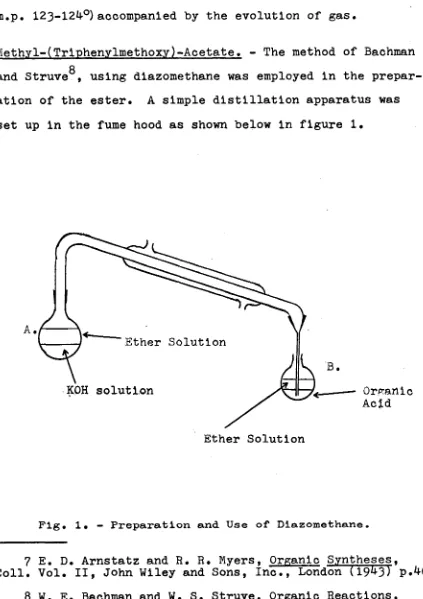
and Struve , using diazomethane was employed in the prepar ation of the ester. A simple distillation apparatus was
set up in the fume hood as shown below in figure 1.
A.
Ether Solution
KOH solution
Ether Solution
Organic Acid
Fig. 1. - P r e p a r a t i o n a n d U s e of D i a z o m e t h a n e .
7 E. D. Arnstatz and R. R. Myers, Organic Syntheses.
Coll. Vol. II, John Wiley and Sons, Inc., London (194-3) p.4-62. 8 W. E. Bachman and W. S. Struve, Organic Reactions,
Into a 100 ml. round-bottomed, flask (B) were placed
triphenylmethoxacetic acid (1.33 £•» 0.0042 mole) and ether (25 ml.). Into the 50 ml. round bottomed flask (A)
were placed potassium hydroxide (50% solution, 4 ml.) and
ether (15 ml.). N-nitrosomethyl urea (2-3?*)was added in excess to flask (A) and a vigorous reaction took place.
The diazomethane that was formed caused the ether layer to turn yellow and this solution was distilled into flask (B) by warming with warm water when necessary. When the
solution in flask (B) had a persistant yellow color, due to the excess diazomethane, the reaction was halted and the excess diazomethane was destroyed by changing flask (B)
with one containing benzoic acid in ether. The ether
solution of the methyl ester was left to stand in the fume
hood for a period of an hour. The solution was then dried over anhydrous sodium sulphate and the ether was removed in vacuo. The desired product was recrystallized from a chloroform-petroleum ether (b.p. 30-60°) solvent pair. The
methyl-(triphenylmethoxy)-acetate was dried in air and had a melting point 93-96° and was recovered in almost quant
itative yield. The infrared absorption spectrum showed no
acid hydroxyl absorption band, and a carbonyl stretching
-1 -1
band shift to 1755 cm. from the 1740 cm. band shown in the acid. This shows that the compound is the desired ester.
Methyl-(4-Bromo-41-Chlorotrlphenylmethoxy)-Acetate. - In a
28
(3»^ g»» 0.0079 mole),[a]^ + 0.42 (1.2; c, 9*52 in chloroform.) was reacted with potassium hydroxide and excess N-nitrosomethyl urea. When the ether had been stripped off the oil that was recovered (2.8 g., 80$) was
put into solution and repeated attempts to recrystallize it failed. The infrared spectrum showed no acid hydroxyl
absorption band. It did show a carbonyl stretching shift to
1750 cm."^ from the acid band of 1725 cm."*. This indicated that the methyl-(4-bromo-4*-chlorotriphenylinethoxy)-acetate had been obtained. The specific rotation of the ester was
[a]2^ - 0,195 (1»2; c, 11.2 in chloroform).
Triphenylmethoxyacetamlde. - Into a 125 ml. Erlenmeyer flask
was placed 100 ml. of 50$ ammonium hydroxide solution. Methyl-(triphenylmethoxy)-acetate (O.56 g., 0.0017 mole) was added and the solution was stirred for a period of
approximately three hours. A white solid precipitated from solution and this was recovered by filtration. The precip
itate was washed with water and dried. Triphenylmethoxy- acetamide (0.26 g., 49$) was recovered (m.p. 176-179°) • The infrared spectrum exhibited a carbonyl stretching band at 1790 cm. free N-H stretching band at 3530 cm."*, bonded N-H stretching at 3410 cm."*, and aromatic ring skeletal absorption bands at 1565 cm.”* and 1490 cm.”*' Bromo-4 * -Chlorotrlnhenylmethoxyacetamlde. - Methyl-(
4-1
bromo-4* chlorotriphenylmethoxy)-acetate (2.0 g., 0.0045 25
mole),[a] D - 0.195 (1.2; c, 11.2 in chloroform) was dissolved
29
This solution was added to concentrated ammonium hydroxide
(100 ml.) and the mixture immediately turned cloudy. The solution was stirred for approximately two hours when it
turned clear and a white precipitate formed. The precipit ate was recovered by filtration, washed with water and dried. Upon recrystallization from a chloroform-petroleum ether
(b. p. 30-60°) solvent pair white crystals (m.p. 184 - 187°)
were recovered (1.3 g»* 67.5$); [ a ] + 0.478 (1,2; c,5«33 D
in chloroform)•
Analysis! Calcd. for C2iHi-pBrCIN02 ! C, 58.55* H, 3»95* N, 3.26.
Found; C, 58.11; H, 4.01; N, 3.08.
The infrared spectrum showed a carbonyl stretching band at 1692 cm.”1 , free N-H stretching band at 3530 cm.”1 ,
A
bonded N-H stretching at 3410 cm. , and aromatic ring
skeletal bands at 1565 an(* 1^85 cm.”1 .
Tertlary-Butyl Hypochlorite. - Tertiary-butyl hypochlorite
9
was prepared according to the method of Teeter and Bell. The reaction was carried out in a fume hood using all
ground glass connections. Into a two-litre, round-bottomed three-necked flask equipped with a gas inlet tube extend ing to the bottom of the vessel, a gas outlet tube, and a
30
mechanical stirrer) was placed sodium hydroxide (5»0g.,
0,25 mole) in lvOO ml. of water. The reaction vessel was
placed in a cold water bath (15-20°) and tertiary-butyl
alcohol (9•25 g., 0.125 mole) in 75 ml. of water was added to form a homogeneous solution. The solution was stirred
constantly while chlorine gas was passed through at a rate of approximately one litre per minute for the first thirty
minutes and then about half that for the next thirty minutes. The upper layer was a yellow oil and this was separated and washed twice with 10$ sodium carbonate and
twice with water. The oil was then dried over anhydrous calcium chloride and distilled. The t-butyl hypochlorite,
b.p. 77-79°» ^ = 1.4019 (11.0 g., 81$) was recovered, (reported^ b.p. 77-78°; ^ = 1.403). The infrared
M 1
spectrum showed an 0-C1 stretching band at 685 cm." , a band at 839 cm.“* attributed to t-butyl and an absence of a free 0-H stretching band. This was in agreement with
10
previous workers.
Reaction of t-Butyl Hypochlorite with
Trluhenylmethoxy-acetamlde. - This reaction was run according to the preced-
11
ure of Murr. Triphenylmethoxyacetamide (0.5 g»* 0.0016
mole) was dissolved in 200 ml. of anhydrous benzene and
10 L. Denivelle, R. Fort, and J. Fpvre, Compt. rend.. 237. 722-24 (1953).
placed in a 500 ml.-round bottom flask equipped with a
condenser, drying tube attached. To this solution was added
t-butylhypochlorite (0.35 g*» 0.0032 mole) and the mixture was heated at 65°. Methanolic sodium methoxide (0.005 g«- atoms of sodium in 20 ml. of methanol) was added to the
mixture and it was heated at reflux temperature for two hours.
The sodium chloride was removed by filtration and upon con centrating the solvent crystals formed. Triphenylcarbinol (0.06 g., l4.*l$) was obtained and from the infrared spectrum
it appeared that some unreacted triphenylmethoxacetamide was still in solution.
Reaction of 4-Bromo-4^Chlorotriphenylmethoxyacetamide with Tertiary-Butyl Hypochlorite. - In the same manner as that described above, k-bromo-4’Mchlorotriphenylmethoxy-
acetamide was reacted with t-butyl hypochlorite. The amide (0.80 g., 0.0018 mole) was placed in 200 ml. of
benzene. t-Butyl hypochlorite (0.29 g., 0.0027 mole) was added to the benzene solution and also methanolic sodium
methoxide (0.0055 g.-atoms of sodium in 20 mis. of methanol). The reaction mixture was heated for two hours at reflux
temperature. The product was recovered in a similar manner to that described above. 4-Bromo-4*-chlorotriphenyl-
methoxyacetamide (0.7 g») was recovered as shown by the infrared spectrum which was identical with that of pure
32
SIlver (Trlphenylroethoxy)-Acetate.- The method described
12
by Barnes and Prochaska was followed in this preparation.
Into a 500-ml. Erlenmeyer flask was placed 250 ml. of a 1#
sodium hydroxide (2.51 g., 0.0628 mole) solution. To this solution was added the triphenylmethoxyacetic acid (20.0 g.,
0.0628 mole). When all the acid had been dissolved 100 ml.
of silver nitrate (11.71 g., O.O69 mole) solution was
added very slowly with constant stirring. A white cloudiness immediately appeared and upon continued addition of silver
nitrate a white slurry was obtained. The solution was filtered and the white fluffy precipitate was washed twice
with water and twice with ethanol. It was then pressed dry and allowed to dry in air for one day and dried in
vacuo for a day. The white silver-(triphenylmethoxy)-acetate
was recovered (26.4 g., 98.5#) and this showed a softening
at 132-134° and decomposed at 165-169°.
Analysis: Calcd. for Cg^H^^AgO^l C, 59*5* H, 4.0;
Ag, 25.35.
Found: c, 57.20; H,. 4.05; Ag, 27.44.
Silver (4-Bromo-41-Chlorotrlphenylmethoxy)-Acetate.- In a manner similar to that described, silver (4-bromo-4'-chloro-
triphenylmethoxy)-acetate was prepared. Potassium hydroxide (0.78 g., 0.0139 mole, 1# solution),
33
triphenylmethoxyacetic acid (6.0 g., 0.0139 mole) and
silver nitrate (2.71 g., 0.016 mole) were reacted to give
the silver salt (6.2 g., 84$) which had a m. p. 134-139° and decomposed at 150-154°.
Analysis: Calcd. for C^H^AgBrClO^: C, 46.8; H, 2.78; Ag, 20.02.
Found: G, 47.32; H, 2.97; Ag, 19.70.
Reaction of Silver (Trlphenylmethoxy)-Acetate with
Bromine.-This reaction was carried out according to the method of
12
Barnes and Prochaska. The silver salt (10.0 g., 0.023
mole) was added to form a slurry in dry carbon tetrachloride
(300 ml.) in a 500-ml., three-necked, round-bottomed flask.
The flask was fitted with a condenser (drying tube attached)
and a syringe. Bromine (3*7^ g.» 0.023 mole) was added
dropwise from the syringe at room temperature. The suspension
of silver salt immediately became dark red. This dark red solution was heated very slowly with constant stirring and
maintained at reflux temperature for a period of three hours. The hot solution was filtered and a solid (4.5 g*), probably silver bromide, was recovered. The solution was allowed to cool to room temperature and a 1% solution of sodium
hydroxide (2.8 g., 0.07 mole) was added dropwise to the cooled reaction mixture. The resultant solution was heated
at reflux overnight. The colour changed from a dark red to
a pale yellow.
layer was separated, washed with water and dried over anhydrous calcium chloride. The carbontetrachloride was then removed in vacuo and the oil was recrystallized from a
chloroform-petroleum ether (b.p. J0-60°) solvent pair. White
crystals, m.p. 158-I6O0 , were recovered (2.7 g., . The
infrared spectrum of these crystals was the same as that of
triphenylcarbinol.
Pyrolysis of Silver (Triphenylmethoxy)-Acetate.- Silver
(triphenylmethoxy)-acetate (10.2 g., 0.02^ mole) was placed in a large test tube and immersed in an oil bath. The
temperature of the bath was raised slowly until a maximum of 200° was reached. Gases were observed to escape from
the tube and condensation was observed on the walls when the temperature was above 170°. The test tube was removed
from the flask and allowed to cool and then the contents were taken up in a chloroform-petroleum ether (b.p. 30-60°)
solvent pair. An insoluble residue (2.55 &•) was recovered by filtration. This was determined to be a silver compound by dissolving it in hot concentrated nitric acid and
precipitating the silver as silver chloride by the addition
of concentrated hydrochloric acid. A rough analysis of this residue showed it to contain 9 6 .7% silver.
Crystallization of the chloroform soluble product yielded triphenylcarbinol (3*05 g«» ^7%)» m. p. 161-163° with an infrared spectrum identical to that of the pure
35
Pyrolysis of
Sllver-(4-Bromo-4'-Chlorotrlphen.ylmethoxy)-Acetate.- In a manner similar to the preceding silver —
(4-bromo-4'-chlorotriphenylmethoxy)-acetate (1.9 g*» 0.0035 mole) was decomposed. Condensation on the side of the test
tube and escaping gases were again observed. The test tube and contents were weighed both before and after pyrolysis and it was observed that 0.1 gram was lost as gases. The residue was taken up in chloroform and an insoluble precip
itate was recovered (0.24 g.). This precipitate was shown to contain silver in a manner similar to before. The
chloroform solution was evaporated in vacuo. The remaining oil (1.40 g.) was then purified by chromatography using a column of alumina (50 g.). The 4-bromo-4,-chlorotriphenyl-
carbinol (0.99 g*» 75*0$) was recovered as an oil as shown by the similarities in the infrared spectra of the product
and the pure compound.
Reaction of Triphenylmethoxyacetic Acid with Mercuric
Oxide and Bromine.- This reaction was carried out follow ing the procedure used by Davis and coworkers.^ a 500-ml., three-necked, round bottomed flask was fitted with a reflux condenser and a dropping funnel. Into the flask was placed
dry carbon tetrachloride (150 ml.), red mercuric oxide (3*65 6*» 0*0157 mole) and triphenylmethoxyacetic acid
(2.5 g., 0.0078 mole). The mixture was warmed and stirred
constantly while a solution of one equivalent of bromine (1.25 g«i 0.0078 mole) in carbontetrachloride (50 ml.) was added dropwise from the dropping funnel. After the addition
of the bromine was completed the reaction mixture was
heated at reflux temperature for a period of an hour. The
reaction mixture was then cooled and filtered. The carbon tetrachloride layer was heated at reflux temperature with a
5% sodium hydroxide (7*5 S»» O.I87 mole) solution for a period of twelve hours. The organic layer was then separated,
washed with water and dried over anhydrous sodium sulphate. The carbon tetrachloride solution was evaporated in vacuo
and the resultant oil was recrystallized from a chloroform- petroleum ether (b. p. 30-60°) solvent pair and crystals, m. p. I6O-I630 , were obtained. These crystals (1.40 g., 68%)
had an identical infrared spectrum to that of triphenyl carbinol.
Reaction of 4- Bromo-41 -Chlorotrlphenylmethoxyacetic Acid with Mercuric Oxide and Bromine.- In a manner similar to the above, 4-bromo-4'-chlorotrlphenylmethoxyacetic acid (2.8 g.,
O.OO65 mole) was reacted with red mercuric oxide (3*0 g»>
0.0104 mole) and bromine (1.035 S»* O.OO65 mole). The
reaction mixture was heated at reflux temperature for a period of an hour, filtered and the carbon tetrachloride was
37
was stirred at room temperature for a period of a day and
then the organic layer was separated and concentrated. The resultant oil was crystallized from methanol and crystals,
m. p. 87 -90 °, were obtained. The infrared absorption spectrum was identical to that of pure ^-bromo-^'-chloro-
triphenylcarbinol. The crystals obtained were a small
38
BI BLIOGRAPHY
Arndt, F., Organlo Syntheses. Coll. Vol. II, John Wiley and Sons, Inc., London (1943) P« 461.
Arnstatz, E. D., and R. R. Myers, Organic Syntheses.
Coll. Vol. II, John Wiley and Sons, Inc., London (1943) p. 462.
Bachman, W. E., and W. S. Struve, Organic Reactions, Vol. II, John Wiley and Sons, Inc., New York, N.Y. (19^2)
p. 469-509.
Balfe, M. P., J. Kenyon, and E. M. Thain, J. Chem. Soc.,
386 (1951).
Barnes, R. A. and R. J. Prochaska, J. Am. Chem. Soc.. 72. 3188 (1950).
Baumgarten, H. E., J. E. Dirks, J. M. Petersen and D. C. Wolf, J. Am. Chem. Soc., 82, 4422 (i960).
Cristol, S. J.. and W. C. Firth, Jr., J. Org. Chem.. 26,
280
(
1961).
Davis, J. A., J. Herynk, S. Carroll, J. Bunds, and D. Johnson, J. Org. Chem.. 30, 4i5 (1965).
Denivelle, L., R. Fort, and J. F*vre, Compt. rend., 237. 722-24 (1953).
Doering, W. von E., and H. H. Zeiss, J. Am. Chem. Soc., £2 147(1950).
Gomberg, M., and J. C. Bailer Jr., J. Am. Chem. Soc., £1 2233 (1929).
Green, G. H., and J. Kenyon, J. Chem. Soc.. 751 (1950).
Hickman, J., and J. Kenyon, J. Chem. Soc., 2051 (1955).
Hughes, E. D., C. K. Ingold, S. F. Mok, S. Patai, Y. Pocker,
J. C h e m . Soc., 1 2 2 0 ( 1 9 57). '
Hunsdieker, H., and C. Hunsdieker, Ber.. 75» 291 (1942). Ingersoll, A. W., Organic Reactions. Vol. II, John Wiley
and Sons, Inc., New York, N.Y., 1944, p. 376.
39
Kenyon, J., A. G. Davies and K. Thaker, J. Chem. Soc.. 3396 (1956).
Kleinberg, J., Chem. Rev.. 40, 381 (194?).
Murr, B. L., J. Am. Chem. Soc., 85, 2867 (1963).
Prokipcak, J. M., Ph. D. Thesis, Faculty of Graduate Studies, University of Windsor, 1964, pp. 50-102.
Rutherford, K. G., J. M. prokipcak and D.P.C. Fung, J. Org. Chem., 28, 582 (1963).
Smith, S. G., Tetrahedron Letters. No. 21, 979 (1962).
Streitweiser, A. Jr., and T. D. Walsh, Tetrahedron Letters. No. 1, 27 (1963).
Swain,; C.G., and E. E. Pegues, J. Am. Chem. Soc.. 80. 812 (1958).
Swain, C. G., and G. Tsuchihashi, J. Am. Chem. Soc., 84.
2021 (1962).
Teeter, H. M., and E. W. Bell, Organic Syntheses. Coll. Vol. IV, John Wiley and Sons, Inc., New York, N.Y. (1963) p. 125.
Thaker, K. A., and N. S. Dave, J. Scl. Irdustr. Res., 21B, 374 (1962).
Wallis, E.S., Proc. Nat. Acad. Scl.. 16, 215 (1930).
Wallis, E. S., J. Am* Chem Soc.. ^4, 1695 (1932).
Wallis, E.S. and F. H. Adams, J. Am. Chem. Soc., £1, 3838
(1933).
Wilson, C.V., Organic Reactions. Vol. IXy John Wiley and Sons, Inc., London, 1957* P« 332.
Winstein, S. and G. C. Robinson, J. Am. Chem. Soc.. 80. 169
(1958).
VITA AUCTORIS
Born:
November 10, 19^1; Saint John, New Brunswick,
Canada. Son of Mr. Edmund and Mrs. Helen Fitzgerald
Primary School:
St. Peter's Boys', Saint John, New Brunswick, Canada
1947-1956.
Secondary School:
St. Mary's College, Brockville, Ontario, Canada. 1956-1960.
University:
St. Francis Xavier, Antigonish, Nova Scotia, Canada. I96O-I963. Degree: B. Sc., (cum laude) 1963*