1762
Looking For Value In Garbage: Intervention In
Domestic Solid Waste Management
Mónica Elisa Meneses La Riva, Josefina Amanda Suyo Vega, Jorge Luis Aníbal Baldárrago Baldárrago, Victor Hugo Fernandez Bedoya
Abstract: The objective was to determine the effects of the intervention in the management of domestic solid waste for reuse, with the aim of reducing the environmental impact in the district of Los Olivos. The approach was quantitative, descriptive, quasi-experimental design. The population consisted of 40 families from a condominium in the north of Lima who were trained with 12 educational sessions on solid waste management. The participatory mechanism used was the intervention of a program that managed the reuse of domestic solid waste, which involved citizen participation in the municipal waste management process in order to reduce environmental impact and improve citizen awareness. The instrument used was an 11 question questionnaire on the level of knowledge about solid waste that it categorizes as adequate, moderately adequate and inadequate. Likewise, for the collection indicators, information from the SIGERSOL 2017 system was used, based on current regulations (paper, plastics, glass, and organic waste). The data collection techniques were direct observation and survey, respecting ethical considerations. The results demonstrated the effects of educational intervention in the management of domestic solid waste, and serves as a sustainable cooperation strategy within municipal environmental policies. It is concluded that the educational intervention plays a predominant role in the creation of responsibility, conscience and commitment of the citizens, thus developing a culture of care of the environment in the community. Hence the importance of educating and promoting good practices in the management of domestic solid waste to preserve the environment and improve the quality of life of the community.
Index Terms: waste, domestic, recycling, waste, reuse, solids, value.
—————————— ——————————
1. INTRODUCTION
omestic solid waste management is a challenge to preserve the quality of life of the human species and the environment; according to World Bank estimates, solid waste generation at the municipal level is expected to double by 2025[1]. The main causes of urban pollution from solid waste generation are population growth, economic growth, rapid urbanization and improved quality of life in communities [2][3]. Triggering factors are rising per capita income and high urbanization, which accelerates the accumulation of solid waste. In the early 1990s, some 2.9 billion people lived in cities, generating 0.64 kg. of municipal solid waste per person per day (680 million tons per year). In 2012, 1.2 kg. of waste per person was generated (equivalent to 1.3 billion tons per year) and these quantities are expected to double by 2025, as the number of urban residents is expected to be 4.3 billion, producing an average of 1.42 billion tons of waste per capita per day, equivalent to 2.2 billion tons per year [4]. In the specific context of Peru, per capita generation is 0.75 kg of urban solid waste per day. At the national level, the coverage of waste collection services reached 71.9% in 2010 (PAHO, 2010). The collected waste has a final disposal of 43.5% in sanitary landfills, 10.6% in controlled landfills, 45.3% in open-air landfills, 0.6% are incinerated in the open open-air, and a percentage close to 0% has another disposal (bodies of water, feed, etc.)[5]. Solid waste management is a challenge for urban managers in developing countries due to increased waste generation. The burden associated with waste management in the municipal budget is a reflection of high management costs, but above all the misunderstanding of the diversity of factors affecting the different stages of waste management and the interaction between them, which is necessary for the proper management of the functioning of the entire system [6]. On the other hand, the very conception of solid urban waste management mechanisms applied in Peru is deficient and reduced because it does not include all the actors involved in this process. If we take into account that the generation of a healthy environment is a common good, it is not possible to delegate its production to a single actor in the process, as is the case in most cases where the State, through the municipal governments where they manage the
1763
management services were found, resulting in a Pearson correlation of 0.103 [8]. The experience developed in the Czech Republic, solid waste management is based on the selection of household waste, in which each family deposits its waste in containers assigned to each type of segregation within the municipality. The collection involves the application of established schedules and citizens are trained in the selection of waste and in the use of containers. Depending on the municipal budget, some cities use disposable bags for the collection of each family's waste, instead of containers, as this system requires less investment for both operation and maintenance. Information on waste volumes is managed by CENIA (Czech Environmental Information Agency). Mechanisms to encourage the selection of household waste include the application of reverse PAYT and standard PAYT and the differentiation of taxes according to the degree of recycling. The application of incentives increases the selection at source by 9.3% with respect to municipalities that do not apply incentives [9]. In this context, in Ghana, the willingness of households to participate in economic incentives for solid waste sorting is proportional to income level (ρ=0.9280). Empirical results from the Owusu study (2013) indicate that willingness to participate in such mechanisms is influenced by gender (female) and about 80% of households were willing to participate in exchange for economic incentives (US$ 1,6347 per h-h per month). With respect to the solid waste management system present in this country, we found a prevalence of open-air landfills in which waste is not treated for final disposal, as in most sub-Saharan African countries. Accra, the capital of Ghana, and Kumasi, the second city with a combined population of 4 million, generate a total of 3,000 tonnes of solid waste per day. Kumasi has one of the best solid waste management systems, as 70% of the waste is transported to a recycling centre on the outskirts of the city. This study also points out the advantages of promoting the selection of solid waste at source, which facilitates recycling and the valuation of it’s by products in the market [10]. At the national level, Rentería and Zeballos proposed an improvement proposal for the strategic management of the Segregation Programme at the source and selective collection of solid residential waste in the district of Los Olivos. In this research, they emphasize that the management of domestic solid waste lies in the reduction of solid waste that is taken to sanitary landfills so that, instead, it can be reused for environmental, social, and economic purposes. The program comprised two of the proposed four stages, i.e. generation and source segregation [11].
2 METHODOLOGY
The study was of applied type, [12], non-experimental transectional design and descriptive [13, 14]. According to the 2014 census, the population of the Los Olivos district was 365,900 (INEI) [15]. The sample consisted of 40 families who received training in door-to-door selective collection. The families participated in the training program on a voluntary basis. The training took place in the home on the management of domestic solid waste, so the criteria for selecting the participants was their permanent residence in the district of Los Olivos, within a condominium and that the members be minimum 4, maximum 6, during the period 2018. The data collection techniques were direct observation and the survey on a weekly basis, for which 12 results were obtained. Direct observation for the quantification of some indicators related to
technical feasibility, i.e. if this intervention works from department to department or if it should be a mandatory program issued by the municipality or a government regulation to minimize the generation of solid waste, and the economic viability within the family environment, accompanied by a bibliographic analysis of the theoretical and practical background, in order to know the state of the art. The instrument used was an inventory of collection indicators used by the Peruvian Ministry of Environment (MINAM) to measure the reduction and reuse of volumes of paper, cardboard, glass, metal, plastics, and organic waste. And these indicators are those required in the Intervention Program proposed by the researchers. They also meet the requirements of the Peruvian system's solid waste information system. This instrument responds to the needs of SIGERSOL 2017, based on current regulations. The Integral Solid Waste Management Law (Legislative Decree No. 1278) and its Regulations (approved by Supreme Decree No. 014 - 2017 - MINAM) require provincial and district municipalities to provide information on solid waste management and management at the Los Olivos municipal level [16] For the application of the instrument, each family received informed consent to participate in the research. The application of the survey was carried out house by house following the principles of Álvarez and the application of the instrument lasted approximately 30 minutes per family [17]. The data were entered into a database designed in Excel, the results were analyzed in the statistical program SPSS version 26, to describe the amount of domestic solid waste
3
RESULTS
1764
were rated with 2 points each of which was established a rating between less or equal to 8 inadequate, 10 to 14, moderately adequate and 16 to 22 adequate, the results are detailed in three subsequent tables.
Table 1: Households' level of knowledge about domestic solid waste
Table 1 shows that families after having received the 4 educational sessions reached adequate levels of knowledge from 30% to 42.5%. Likewise, those who started with 40% in the inadequate level lowered the percentage to 30%, which indicates that there are improvement changes after the first 4 sessions developed in the month. It highlights the position of the families that have the moderately adequate level, who are maintained as a percentage in this first stage.
Table 2: Households' level of knowledge about domestic solid waste
Table 2 shows that families after having received the 4 educational sessions, in a second month (5°, 6°, 7°, 8°), reached adequate levels of knowledge from 50% to 52.5%. Likewise, those who started with 25% in the inadequate level lowered the percentage to 12.5%, which indicates that there are improvement changes after receiving 8 sessions developed in the second month. It stands out the position of the families that have the moderately adequate level, who increased from 25% to 35%.
Table 3: Households' level of knowledge about domestic solid waste
Table 3 shows that families after having received the 12 educational sessions, in a third month (9th, 10th, and 11th, 12th), reached adequate levels of knowledge from 53% to 70%. Likewise, those who started with 10% in the inadequate level lowered the percentage to 5%, which indicates that there are improvement changes after receiving 12 sessions developed in the third month. It highlights the position of the families that have the moderately adequate level, who from 38% went down to 25%.
In the investigation, the families that received training selected papers, cartons, glass, plastics and organic waste, obtaining
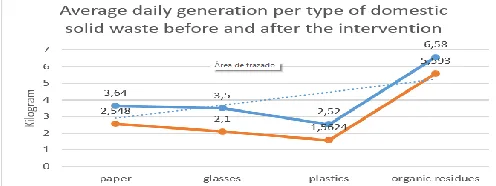
the following results: The collection of papers and cartons 0.13 kg. /day, glass 0.125 kg. /day, plastics 0.09 kg. /day and organic waste 0.235 kg. /day on average, during the period of three months, which were reduced by 30%, 40, 38% and 15% respectively, as shown in Figure 1.
Figure 1 shows that the average generation of solid waste in the condominiums of the district of Los Olivos, there is some variation before and after the intervention. It is observed that the greatest variation is found between plastic from 1.5624% to 2.52% and glass from 2.1% to 3.5%. And the minimum variation is found in organic waste from 5.593% to 6.58%.
1765
component of sustainable development, confirming that the implementation of programs with their respective training increases the capacity of good practices in solid waste management in the population [24]. These statements coincide with those of Reyes, Pellegrini and Reyes, who emphasize the need to propose recycling as a reuse program that includes the process of collecting and separating solid waste, the transportation system and the sale of waste [25]. In relation to the families after having received the first training, they reached 30% with adequate and moderately adequate knowledge. Subsequently, in the fourth intervention, 42.5% had adequate knowledge and 27.5% had moderately adequate knowledge. This conclusion coincides with that of Guzmán y Macías, who pointed out that environmental education generates changes in solid waste management and plays a decisive role in the final disposal of solid waste [26]. Similarly, Gonzaga states that the transformations achieved at the individual and group levels in the training showed a greater level of development of critical awareness and appropriation of a system of knowledge, skills, attitudes and values that reflect a formed environmental culture [27]. However, Niño, Trujillo and Niño (2017) evidenced that 88% of the Community expressed their willingness to participate and cooperate recognizing their fundamental role, and evidenced the need to improve current guidelines so that future projects or programs with their active participation are viable to a great extent [28]. In the Peruvian context, the instrument known as the inventory of collection indicators used by the Peruvian Ministry of Environment (MINAM) showed that the measurement of domestic solid waste management in families increases as the amount obtained per week and the economic costs of domestic recycling are reported[29][30]. On the other hand, in the Vassanadumrongdee & Kittipongvises study, the average generation of domestic solid waste per capita was 1.14 kg in the Thai capital, 55.6% more than in the Los Olivos district. On the other hand, solid waste management in the city of Bangkok does not emphasize source segregation for the implementation of an effective selective recycling program. Even the most common methods are landfills and open field landfills as final disposal, reaching a recycling rate of only 21%. Unlike Los Olivos district, the recycling rate is around 35% and is largely due to 100% coverage of the municipal solid waste collection and disposal service [8]. In the investigation, the families that received training selected papers, cartons, glass, plastics and organic waste, obtaining the following results: The collection of papers and cartons 0.13 kg. /day, glass 0.125 kg./day, plastics 0.09 kg./day and organic waste 0.235 kg./day on average, during the measurement period, coinciding with Rojas, who established the favoring of the incorporation of waste separation actions. On the other hand, the experience of the Czech Republic [32] according to Struk's study, there is a mechanism that is applied at the national level [9]. For the reduction it was due to the reuse of the residues, this was observed in 30% in plastics and glasses that were used in house, as flowerpots and as troughs of parakeets since in the condominiums there are no spaces for gardens, for the paper, only the confection of block of notes was obtained and use of both faces for copies and/or notes, when there is the presence of minors, the older ones do not carry out the activity since it is easier to buy it. With regard to organic waste, the intervention has not been significantly successful, since they do not have the necessary implements and they are only thrown into the daily bin. This generates a
proposal to municipal institutions to create a directive for companies to take charge of specialized recycling. However, it is necessary a legal conformity of triangulated efforts between the organs of the public administration, the private initiative and the society, in the implantation of a solid waste management, capable of reducing the environmental degradation and the social inequalities. Despite some progress, there are still many socio-environmental challenges to be overcome, both by public managers and by contemporary society. [31][32].
4
CONCLUSIONS
1. The effectiveness of the educational intervention made it possible to increase the capacity for good practices in solid waste management, being applied as a domestic cooperative strategy that ensures the sustainability of a municipal environmental policy.
2. Therefore, it is essential to implement educational programs to strengthen the capacities of families to improve the management processes of domestic solid waste and their respective reuse.
3. The measurement of the volume of solid waste by type generates in the families attitudes of responsibility, conscience, commitment and behavior of good practices in the management of domestic solid waste for the benefit of the district. This is observed in the percentage decrease in 3 months of intervention.
4. It is necessary to have basic inputs and materials in the management process for the management of domestic solid waste.
ACKNOWLEDGMENT
We thank destiny for bringing together valuable people for the accomplishment of this research.
REFERENCES
[1] Bunco Mundial. (2011). Urban solid waste management. Retrieved from http://web.worldbank.org/WBSITE/EXTERNAL/TOPICS/E XTURBANDEVELOPMENT/EXTUSWM/0,,menuPK:4638 47~pagePK:149018~piPK:149093~theSitePK:463841,00. html
[2] Erasmus+ Programme of the European Union. (2017). Guidelines for Universities Engaging in Social Responsibility. Retrieved from http://www.postgraduatecenter.at/unibility
[3] Minghua, Z., Xiumin, F., Rovetta, A. Q., Vicentini, F., Bingkai, L., Giusti, A., & Yi, L. (2009). Municipal solid waste management in Pudong New Area, China. Journal of Waste Management, 29, 1227-1233. DOI: http://10.1016/j.wasman.2008.07.016
[4] Hoornweg, D., & Bhada-Tata, P. (Marzo de 2012). What a waste: A global Review of Solid Waste Management. Retrieved from http://siteresources.worldbank.org/INTURBANDEVELOP
MENT/Resources/336387-1334852610766/What_a_Waste2012_Final.pdf
[5] Kawai, K., & Tasaki, T. (2015). Revisiting estimates of municipal solid waste generation per capita and their reliability. Journal of Material Cycles and Waste Management, 18(1), 13. DOI: http://10.1007/s10163-015-0355-1
1766
management challenges for cities in developing countries. Waste Management 1(33), 220-232. DOI: http://10.1016/j.wasman.2012.09.008
[7] Olivos, M. D. (2017). Plan Distrital de manejo y gestión de residuos sólidos municipales: 2017-2020. Lima. [8] Vassanadumrongdee, S., & Kittipongvises, S. (2018).
Factors influencing source separation intention and willingness to pay for improving waste management in Bangkok, Thailand. Sustainable Environnement Research, 36. DOI: http://10.1016/j.serj.2017.11.003. [9] Struk, M. (2017). Distance and incentives matter: The
separation of recyclable municipal waste. Resources, Conservation and Recycling, 122, 155-162. DOI: http://10.1016/j.resconrec.2017.01.023
[10] Owusu, V., Adjei-Addo, E., & Sundberg, C. (2013). Do economic incentives affect attitudes to solid waste source separation? Evidence from Ghana. Resources, Conservation and Recycling, 78(1), 115-123. DOI: http://10.1016/j.resconrec.2013.07.002
[11] Renteria J. y Zeballos M. (2014) Propuesta de mejora para la gestión estratégica del programa de segregación en la fuente y recolección selectiva de residuos sólidos domiciliarios en el distrito de Los Olivos.
[12] Consejo Nacional de Ciencia, Tecnología e Innovación Tecnológica. (2017). Reglamento de calificación y registro de investigadores en ciencia y tecnología del sistema nacional de ciencia, tecnología e innovación tecnológica - SINACYT. CONCYTEC. Lima: Editora Perú.
[13] Hernández S., R., Fernandez C., C., & Baptista L., P. (2014). Metodología de la Investigación. México: McGraw-Hill.
[14] Maletta, H. (2009). Epistemología Aplicada: Metodología y técnica de la producción científica. (A. B. Petit, Ed.) [15] Instituto Nacional de Estadística e Informática. (2014).
Día mundial de la población. Lima: Instituto Nacional de Estadística e Informática.
[16] Decreto Legislativo N° 1278 y su Reglamento (aprobado mediante Decreto Supremo N° 014 - 2017- MINAM [17] Álvarez L., Aymení A., Codina E., Coll E., Colomer J.,
Gijón R., Salvans C. (2010). Manual de Recogida Selectiva Puerta a Puerta (1 Ed.). Barcelona: Associació de Municipis Catalans per a la recollida selectiva porta a porta.
[18] Mateo, L. (2016), Nivel de conocimientos y prácticas del manejo de residuos sólidos intradomiciliarios en pobladores del asentamiento humano señor de los Milagros. Chincha.2016.
[19] Organismo de evaluación y fiscalización (2015) provinciales a nivel nacional índice de cumplimiento de los municipios. Retrieved from https://www.oefa.gob.pe/?wpfb_dl=16983
[20] Organización para la Cooperación y el Desarrollo Económicos. (2010). Economic, Environmental and Social Statistics. DOI: http://10.1787/factbook-2010-64-en [21] Jiménez R. (2015). La Evaluación en la Educación para la
Sostenibilidad desde el Paradigma de la Complejidad. [22] Edelman D. y Garrido P. (2016) La Gestión Ambiental
Urbana De Lima, Perú. Escuela de Planificación, Departamento de Diseño, Arquitectura, Arte y Planificación, Universidad de Cincinnati, Cincinnati, Ohio, EE. UU. DOI: http://10.19044/esj.2019.v15n5p78
[23] Rodríguez S. (2017). ¿Cuáles son las consecuencias de
no reciclar? La agencia de la ONU para los refugiados comité español. Retrieved from https://eacnur.org/blog/cuales-las-consecuencias-no-reciclar/
[24] López (2014), "Programa Alternativo para el Manejo y Gestión Integral - Participativa Eficiente de los Residuos Sólidos en la Ciudad de Tarma"
[25] Reyes, A., Pellegrini, N., y Reyes, R. (2015), El reciclaje como alternativa de manejo de los residuos sólidos en el sector minas de Baruta, Estado Miranda, Venezuela Revista de Investigación, 39(86), 157-170. Retrieved from http://www.redalyc.org/pdf/3761/376144131008.pdf [26] Guzmán, M. Macías, C. (2011). El manejo de los residuos
sólidos municipales: un enfoque antropológico. El caso de San Luis Potosí, México. Estudios Sociales, 20(39), 235-261. Retrieved from http://www.redalyc.org/pdf/417/41723281009.pdf
[27] Gonzaga A. (2018) Formación de Gestores Ambientales Comunitarios para Mitigar la Contaminación de la Microcuenca Jipiro. Revista Científica Hallazgos 21(3). Retrieved from
http://revistas.pucese.edu.ec/hallazgos21/article/view/241 [28] Niño A, Trujillo J. y Niño A. (2016), Gestión de residuos sólidos domiciliarios en la ciudad de Villavicencio. Una mirada desde los grupos de interés: empresa, estado y comunidad. DOI: http://10.17151/luaz.2017.44.11
[29] Ministerio del Ambiente del Perú (MINAM). Manual de gestión de residuos sólidos. Retrieved from http://www.minam.gob.pe/gestion-ambiental/
[30] Frosch, R. A., & Gallopoulos, N. E. (1989). Strategies for Manufacturing. Scientific American, 261(3), 144-152. [31] Comisión Europea - Dirección General del Ambiente.
(2015). Final Report Assessment of separate collection schemes in the 28 capitals of the EU.
[32] Rojas C. (2003). El desarrollo sustentable: Nuevo paradigma para la administración pública.