University of South Carolina
Scholar Commons
Theses and Dissertations
1-1-2013
The Effects of Mean Sea Level and Tidal Amplitude
On Ground Water Discharge and Pore-Water
Salinity Distribution Along A Forest/Marsh
Boundary, North Inlet, SC
John Bradley Peurifoy
University of South Carolina - Columbia
Follow this and additional works at:https://scholarcommons.sc.edu/etd Part of theEarth Sciences Commons
This Open Access Thesis is brought to you by Scholar Commons. It has been accepted for inclusion in Theses and Dissertations by an authorized administrator of Scholar Commons. For more information, please [email protected].
Recommended Citation
THE EFFECTS OF MEAN SEA LEVEL AND TIDAL AMPLITUDE ON GROUND WATER
DISCHARGE AND PORE-WATER SALINITY DISTRIBUTION ALONG A FOREST/MARSH
BOUNDARY,NORTH INLET,SC
by
John B. Peurifoy
Bachelor of Science University of South Carolina, 2007
Submitted in Partial Fulfillment of the Requirements
For the Degree of Master of Science in
Geological Sciences
College of Arts and Sciences
University of South Carolina
2013
Accepted by:
Alicia M. Wilson, Director of Thesis
Scott M. White, Reader
James Morris, Reader
ii
iii
DEDICATION
This thesis and graduate degree are dedicated to my daughter Madelyn Grae
iv
ACKNOWLEDGEMENTS
I would like to sincerely thank Alicia Wilson for allowing me to complete my
Master’s degree under her guidance. Thank you for being patient with me throughout this
process and for imparting your knowledge of groundwater processes and numerical
modeling to me. You have been and will continue to be an exceptional teacher, advisor
and friend. Many thanks are also due to my lab mates Andrea Hughes and Tyler Evans.
Both of you have provided me with valuable insights into my research and countless
hours of enjoyable conversation. It has been a pleasure getting to know you both, and I
v
ABSTRACT
Advective groundwater flow in salt marshes is an important mechanism through
which nutrients are exported to adjacent coastal waters. Groundwater flow also influences
the distribution of pore-water salinity in the subsurface marsh, which affects botanical
zonation, nutrient transport, and primary productivity. Recent idealized marsh island
simulations have suggested that increases in tidal amplitude result in increased
groundwater discharge, and that the elevation of MWL relative to the marsh platform is
inversely related to groundwater discharge. These simulations were only representative of
marsh islands (as opposed to forest-marsh boundaries) and considered simple, idealized
tides only. The results were not confirmed in a real field setting. This study utilized tidal
records and hydraulic head records to calculate and compare groundwater discharge
along two marsh environments: 1) a fringing marsh boundary that was influenced by a
large freshwater lens and 2) a marsh island with a much smaller freshwater lens.
Electrical resistivity surveys were conducted to image seasonal pore-water salinity
distribution. The discharge trends were then correlated to trends in MWL and subsurface
salinity. Our results indicated that discharge from the marsh to Crabhaul Creek was
dependent on the position of MWL. Observations showed increases in groundwater
vi
high marsh root zone, the occurrence and magnitude of discharge or recharge depended
on precipitation, tidal amplitude and MWL. The electrical resistivity surveys depicted
two distinct salinity zones, neither of which displayed any correlation to MWL or tidal
amplitude. The first was a shallow tidally-influenced zone containing saline to brackish
pore-water, and the second was a deeper freshwater flow zone. These results
demonstrated the importance of MWL and tidal amplitude on discharge and hence
nutrient export from salt marshes. It can be inferred that long-term sea level rise (at a rate
that exceeds sediment accretion) will significantly decrease nutrient export from salt
vii
TABLE OF CONTENTS
DEDICATION ... iii
ACKNOWLEDGEMENTS ... iv
ABSTRACT ...v
LIST OF TABLES ... viii
LIST OF FIGURES ... ix
LIST OF ABBREVIATIONS ... xi
CHAPTER 1 INTRODUCTION ...1
CHAPTER 2 SITE LOCATION ...5
CHAPTER 3 METHODOLOGY ...9
CHAPTER 4 RESULTS ...15
CHAPTER 5 DISCUSSION ...31
CHAPTER 6 CONCLUSION ...38
REFERENCES ...41
APPENDIX A ELECTRICAL RESISTIVITY PARAMETERS ...43
viii
LIST OF TABLES
Table 3.1 Volumetric flux calculation parameters ...10
Table 3.2 Hydraulic head data records for wells located along Transect D ...11
Table 4.1 Volumetric flux statistics for periods of record ...16
Table 4.2 Statistical analysis of resistivity and salinity results ...27
ix
LIST OF FIGURES
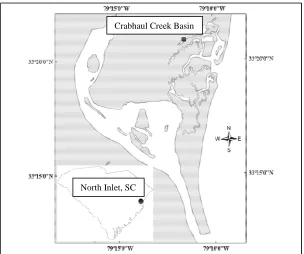
Figure 2.1 Geographic locations of North Inlet, SC and the Crabhaul
Creek Basin ...5
Figure 2.2 Cross-section of Transect D showing well nest locations,
geology, and groundwater flow directions...8
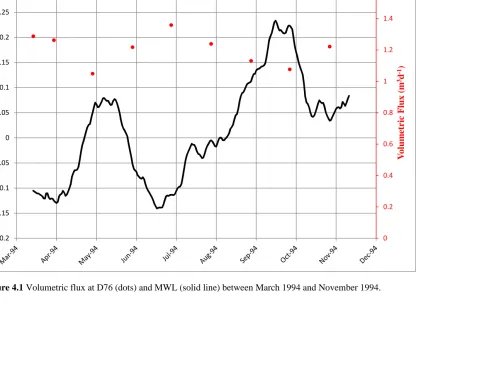
Figure 4.1 Volumetric flux at D76 (dots) and MWL (solid line)
between March 1994 and November 1994 ... 17
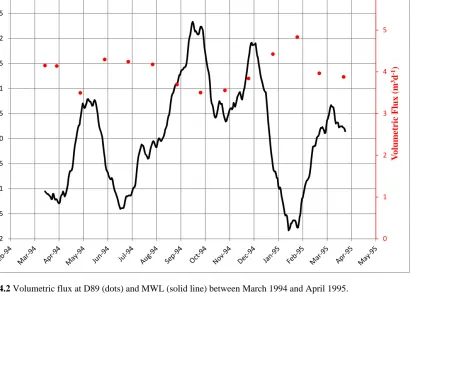
Figure 4.2 Volumetric flux at D89 (dots) and MWL (solid line)
between March 1994 and April 1995...18
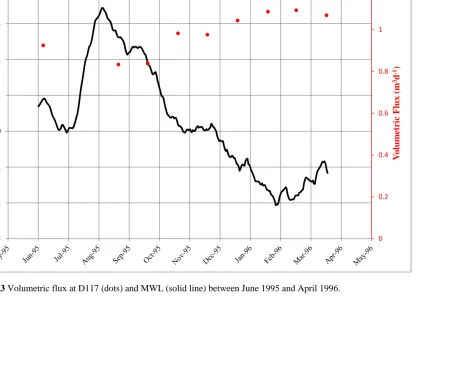
Figure 4.3 Volumetric flux at D117 (dots) and MWL (solid line)
between June 1995 and April 1996 ...19
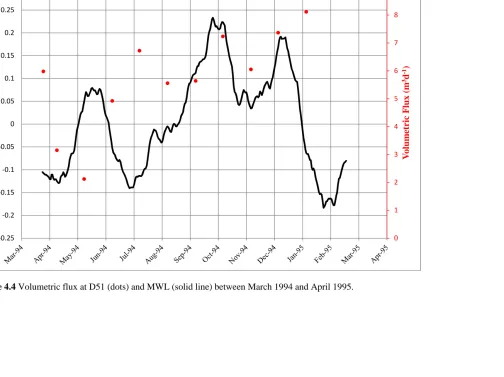
Figure 4.4 Volumetric flux at D51 (dots) and MWL (solid line)
between March 1994 and April 1995...21
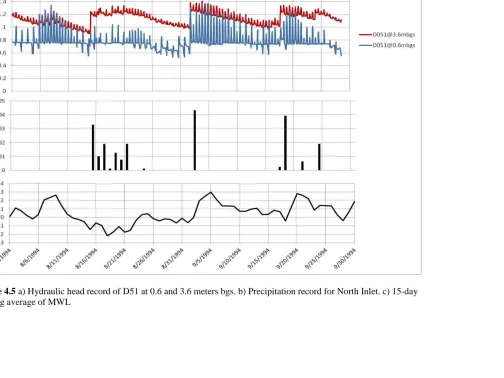
Figure 4.5 a) Hydraulic head record of D51 at 0.6 and 3.6 meters bgs b) Precipitation record for North Inlet c) 15-day running
average of MWL ...22
Figure 4.6 Total discharge and total recharge response to tidal amplitude
in D89 (January 1995) ... 24
Figure 4.7 Elevation of high tide versus total recharge in D89 (April
1994 to April 1995) ... 25
Figure 4.8 Electrical resistivity inversions from June 30, 2012, August 1, 2012, January 11, 2013, and May 22, 2013. Dashed lines represent
x
Figure 4.9 Percent difference plots (%) between a) June and August 2012 b) August 2012 and January 2013 and c) January and
May 2013. ... 29
Figure 4.10 Salinity and resistivity plotted against distance along Transect D at a depth of 3 meters for a) June 30, 2012, b) August 1, 2012,
c) January 11, 2013 and d) May 22, 2013 ... 30
Figure 5.1 Electrical resistivity surveys a) June 30, 2012, b) August 1, 2012, c) January 11, 2013, and d) May 22, 2013 and e) 29-day running
average of MWL position ...37
Figure 5.2 Daily precipitation totals for a) June 1 to 30, 2012 b) July 2 to August 1, 2012 c) December 12 to 27, 2012 d) April 23 to
xi
LIST OF ABBREVIATIONS
AGI ... Advanced Geosciences Incorporated
bgs ... Below Ground Surface
ET ... Evapotranspiration
IP ... Induced Polarization
LTER... Long-Term Ecological Research
MWL ...Mean Water Level
NERR ... National Estuarine Research Reserve
NOAA ... National Oceanic and Atmospheric Administration
NSF ... National Science Foundation
1
CHAPTER 1
INTRODUCTION
Forest-marsh boundaries are transitional environments between forested uplands
and low-lying salt marshes that are typically located within the intertidal zone. Salt
marshes in forest-marsh boundaries have the potential to regulate groundwater flow and
nutrient fluxes between the terrestrial and marine systems. In coastal settings, maximum
groundwater discharge occurs in intertidal and near-shore subtidal zones (Reilly and
Goodman, 1985). Groundwater that is discharged from salt marshes is highly enriched
with dissolved carbon, nutrients, metals, and radio-nuclides (Nixon, 1980). The
nutrient-rich groundwater discharged by salt marshes can impact the fertility of adjacent coastal
waters (Wilson and Morris, 2012), drive primary productivity (Morris, 1995) and can
potentially cause phytoplankton blooms (Kelly and Moran, 2002).
The distribution of salinity in sediment pore-water is also an important factor in
nutrient export and ecology. Subsurface salinity governs the ability of groundwater to
transport nutrients. Nutrients tend to sorb to sediments if the salinity of the pore-water is
less than 10 parts per thousand (ppt). Pore-water salinity also influences primary
productivity (Morris, 1995) and has been determined to be influential in the botanical
zonation of plant species that reside in salt marsh ecosystems (Thibodeau et al. 1997).
Groundwater flow is the primary mechanism through which salts and nutrients are
2
Several processes govern advective groundwater flow in coastal salt marshes.
These processes include evapotranspiration (ET), precipitation, input of groundwater
from neighboring uplands, and variations in mean water level (MWL) and tidal amplitude
(Wilson and Morris, 2012). There has been a recent interest in determining the rates at
which groundwater discharges from subsurface marshes and which of the aforementioned
processes are most influential in controlling the magnitude of that discharge.
Several studies have attempted to quantify discharge rates from salt marshes.
Radium-isotope tracer (De Meneses, 1990; Krest et al. 2000), seepage meter (Whiting
and Childers, 1989) and salt and water balance studies (Morris, 1995) have been used to
determine the groundwater discharge rates for several coastal settings. These discharge
values are variable and range from 0.15-15 L m-2d-1 (De Meneses, 1990) in the
Pettaquamscutt River estuary to 7.8-40 L m-2d-1 in the North Inlet estuary (Whiting and
Childers, 1989; Morris, 1995; Krest et al. 2000; and Wilson and Gardner, 2006).
Other studies have observed and attempted to explain variations in discharge on
tidal, seasonal, and inter-annual scales (Tobias et al. 2001; Kelly and Moran, 2002; and
Wilson and Morris, 2012). Tobias et al. (2001) and Kelly and Moran (2002) observed
discharge rates over the course of one year for the Pettaquamscutt estuary and a fringing
marsh located in southeastern Virginia, respectively. These studies showed that
groundwater discharge in coastal areas is seasonally and inter-annually variable and
concluded that variability was most likely related to variations in precipitation and ET.
The observed precipitation and ET records did not wholly support this interpretation
(Kelly and Moran, 2002). Furthermore, recent numerical simulations of idealized salt
3
MWL relative to the marsh surface and the amplitude of tidal cycles, with periods of high
MWL decreasing discharge and larger tidal amplitudes generating more discharge
(Wilson and Morris, 2012). These models were representative of marsh islands rather
than forest-marsh boundaries where groundwater flow is thought to be influenced by
large inputs of fresh terrestrial groundwater from the upland. Variations in discharge can
lead to pulses of nutrient-rich groundwater being introduced into adjacent coastal waters
and could be responsible for the occasional flushing of salts and nutrients from marsh
sediments (Tobias et al. 2001). As of yet, no single process or combination of processes
has been definitively identified as a control on these variations in groundwater discharge.
Seasonal salinity variations in salt marsh sediments have also been identified
North Inlet, SC and have been attributed to precipitation, ET, infiltration of seawater
during periods of inundation, and drainage (Morris, 1995). Carter et al. (2007) used
electrical resistivity surveys to image the upper four meters of the subsurface marsh. The
surveys revealed a fresh water plume at a depth of one to three meters below the marsh
surface. The lateral extent of this plume migrated throughout the year. Carter et al. (2007)
were unable to temporally correlate precipitation and ET data to changes in pore-water
salinity. Similar variations in pore-water salinity were observed during a salinity
sampling study conducted in a high marsh at North Inlet by Morris (1995). This study
collected pore-water salinity samples from the shallow (one to 19 centimeters) subsurface
marsh and produced monthly averages for a period ranging from 1987 to 1992.
Significant inter-annual variability in pore-water salinity was observed and ranged from
23 to 43 parts per thousand (ppt). Morris (1995) proposed that salinity variations were
4
could impact the salinity values, and stated that future increases in MWL had the
potential to greatly affect pore-water salinity (Morris, 1995).
The purpose of this study is to identify controls on groundwater discharge and
subsurface salinity patterns across a forest/marsh boundary in North Inlet. We also aim to
compare the magnitude of groundwater discharge in a forest/marsh system with those in a
marsh island system. We hypothesize that groundwater discharge rates are directly
related to the position of MWL and tidal amplitude and that groundwater discharge is the
primary control on the distribution of salinity in the subsurface marsh. We further
hypothesize that the groundwater discharge magnitudes associated with the forest/marsh
environment are much greater than those associated with the marsh island environment.
Monthly average discharge is calculated between four marsh locations and Crabhaul
Creek using hydraulic head data from 1994 to 1995. Comparisons are made between
average monthly discharge and the position of MWL, tidal amplitude, and precipitation.
The calculated groundwater discharge values are compared with one another based on
their location relative to Crabhaul Creek and the marsh system with which they were
associated. Electrical resistivity surveys are also completed to image salinity distributions
in the subsurface on June 30, 2012, August 1, 2012, January 11, 2012, and May 22, 2013.
The electrical resistivity surveys are also compared to the position of MWL and
The study site is located within the North Inlet Basin
approximately 11 miles east of Georg
National Oceanic and Atmospheric Association (NOAA) National Estuarine Research
Reserve (NERR) site and was
Long-Term Ecological Research (LTER) site
designations, long term tidal, meteorological, and
for the site.
Figure 2.1 Geographic l
Basin.
5
CHAPTER 2
SITE LOCATION
The study site is located within the North Inlet Basin (Figure 2.
miles east of Georgetown, SC. The North Inlet Basin is designated as a
National Oceanic and Atmospheric Association (NOAA) National Estuarine Research
was also designated as a National Science Foundation (NSF)
Term Ecological Research (LTER) site from 1981 to 1993. As a result of these
designations, long term tidal, meteorological, and hydrogeological data has been record
Geographic locations of North Inlet, SC and the Crabhaul Creek
Crabhaul Creek Basin
North Inlet, SC
(Figure 2.1), which is
town, SC. The North Inlet Basin is designated as a
National Oceanic and Atmospheric Association (NOAA) National Estuarine Research
designated as a National Science Foundation (NSF)
. As a result of these
data has been recorded
6
The North Inlet Basin is a tidally-influenced, lagoonal estuary that is bordered to
the south by Winyah Bay, to the east by the Atlantic Ocean, and to the north and west by
low-lying forested uplands. The 32 km2 basin experiences a semi-diurnal tide that has a
period of 12.24 hours and a mean range of 1.5 meters (Gardner and Porter, 2001). The
basin is hydraulically connected to the Atlantic Ocean through North Inlet and to a 75
km2 terrestrial watershed across a 10 km forest-marsh boundary.
Our study focused on Transect D of Keenan (1994) and Thibodeau (1997), which
is positioned along the forest-marsh boundary in the Crabhaul Creek Basin in the
northwestern portion of the North Inlet Basin. The transect trends northwest to southeast
across relict swale and is positioned orthogonal to the forest-marsh boundary and to
Crabhaul Creek. Elevation along the transect ranges from 1.75 meters above MWL in the
forested upland to -0.15 meters below MWL in the center of Crabhaul Creek. The
transect extends 263 meters and contains a total of 29 groundwater monitoring well nests.
Each nest contains three to five monitoring wells that range in depth from 0.6 to 4.88
meters below ground surface (bgs). The well nests are labeled alphanumerically based on
their distance from the northwestern terminus of the transect.
The stratigraphy along Transect D (Figure 2.2) was logged during the installation
of the monitoring wells by Keenan (1994) and Thibodeau (1997). A basal clay layer
exists at a depth of three meters bgs in the upland and shallows to approximately 2.5
meters bgs near Crabhaul Creek. The basal clay unit shown in Figure 2.2 has been
extrapolated based on stratigraphic data obtained with vibracores. The northwestern
extent of the clay unit is a projection based on the available data. Fine to medium
7
50 centimeters of marsh mud in the low- to high-marsh (Thibodeau, 1997). The sand
unit, which is vertically bound by low permeability marsh mud and clay, forms a
confined aquifer. Crabhaul Creek has incised a channel through the marsh mud and into
the sands, which has created a conduit for fluid exchange between the confined aquifer of
8
9
CHAPTER 3
METHODOLOGY
3.1 Volumetric Flux, Net Flux, and Recharge
Darcy’s Law can be written
Q = -KA ( ௗ
ௗ௫ሻ (eq. 1)
where Q is the volumetric flux (m3d-1), -K is the hydraulic conductivity (md-1), A is the
cross-sectional area through which flow occurs (m2), dh is the difference between the
total hydraulic head between two points of interest (m), and dx is the lateral distance
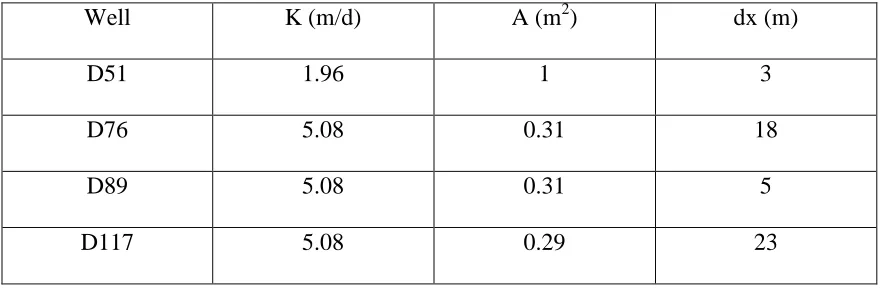
between those two points (m). The values used in the calculations are provided in Table
3.1. We used eq. 1 to calculate volumetric flux using data from monitoring wells D76,
D89, and D117 and Crabhaul Creek. We also used the equation to calculate the
volumetric flux between two monitoring wells located at D51 that are screened at 0.6 and
3.6 meters bgs. These monitoring wells were chosen for the study because of the
availability of historical data for the wells and their topographic location in the marsh (i.e.
high, mid, and low-lying marsh). Semi-continuous, historical hydraulic head data is
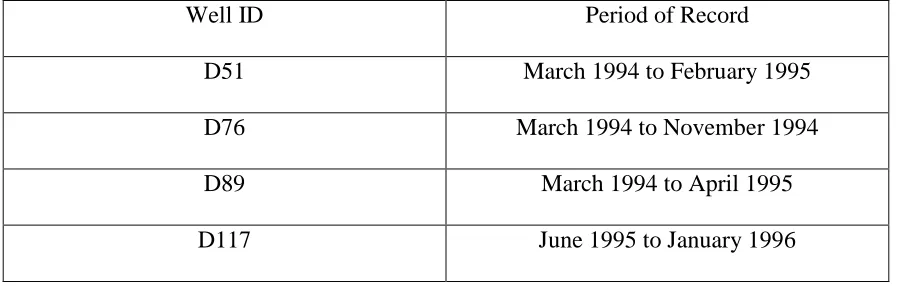
available for monitoring wells D51, D76, D89, and D117 from March 1, 1994 to May 1,
1996 (Thibodeau, 1997). The periods of record are not the same for each monitoring
well, as indicated in Table 3.1. Verified historical tidal data from the Charleston, SC
(station # 8665530) harbor has been obtained from the NOAA website at
10
In the mid and low-marsh, experimentally determined hydraulic conductivity
values are available for the sediments of the confined aquifer that immediately surround
the screened intervals of D76, D89, and D117 (Thibodeau, 1997). The screened intervals
of these wells are all located within the same confined aquifer, so we calculated the
geometric mean of each of the experimental values to obtain one comprehensive value
(5.08 md-1) representative of the aquifer. In the high marsh, experimentally determined
hydraulic conductivities are also available for the two screened intervals at D51
(Thibodeau, 1997). The geometric mean of these two values was also calculated to obtain
one representative hydraulic conductivity value (1.96 md-1). Using the aforementioned
data and equation 1, volumetric fluxes are calculated between the two screened intervals
of D51 and between D76, D89, and D117 and Crabhaul Creek.
Table 3.1 Volumetric flux calculation parameters
Well K (m/d) A (m2) dx (m)
D51 1.96 1 3
D76 5.08 0.31 18
D89 5.08 0.31 5
D117 5.08 0.29 23
On average, the volumetric flux values that we calculate for the mid-marsh at D76
are expected to be much lower than those that we calculate for the low-lying marsh at
D89. This is a result of the propagation of tidal energy through the confined aquifer. Carr
and van der Kamp (1969) showed that energy from fluctuating tides will propagate
11
periods of high tide, the hydraulic head immediately adjacent to the creek bank is higher
and is gradually damped with distance. The opposite is seen at periods of low tide.
Hydraulic head is lower next to the creek bank and gradually rises to a higher hydraulic
head as you approach the inland. This has impacted our discharge calculations by
producing a greater range of values with larger magnitudes at the creek bank when
compared with the mid-marsh. Thus, the fluxes reported for D76 and D117 do not
represent discharge from the creek bank. They were chosen because, at comparable
distances from the creek and with similar stratigraphy and permeability, they allowed us
to compare fluxes on opposite sides of the creek.
Table 3.2 Hydraulic head data record for wells located along Transect D
Well ID Period of Record
D51 March 1994 to February 1995
D76 March 1994 to November 1994
D89 March 1994 to April 1995
D117 June 1995 to January 1996
The net flux, total relative discharge and recharge are calculated between D89
and the center of Crabhaul Creek. In equation 1, K and dx are constant. A is also constant
since the cross-sectional area that groundwater is being discharged from remains fully
saturated even during periods of low tide. After assigning these constants, Q is
proportional to dh. Thus, the sum of dh over tidal cycles yields relative flux per tidal
cycle. A positive value denotes discharging groundwater and a negative value denotes
recharging groundwater. The total discharge is calculated by summing the positive
12
positive and negative discharge values. Recharge is the difference between total
discharge and the net flux. Total discharge and net flux are calculated for each tidal cycle
and then binned by month. We further bin the data according to the tidal amplitude.
3.2 Electrical Resistivity
Electrical resistivity surveys were completed along the northwestern portion of
Transect D on June 30, 2012, August 1, 2012, January 11, 2013, and May 22, 2013. The
survey lines begin at the northwestern end of Transect D at D00 and extend laterally to
D117. The surveys were collected using an Advanced Geosciences, Inc. (AGI) Super
Sting earth resistivity and induced polarization (IP) instrument. The electrodes were
arranged in a 27 by four meter spread. The “roll along” method was employed during the
surveys. The “roll along” method merges data from multiple surveys that are completed
along the same line. At the beginning of each new survey, the initial electrode is moved
progressively farther down the survey line allowing data points to overlap and data gaps
to be filled. This is used when the lateral distance of interest is too large to be
characterized by just one survey.
Electrical resistivity surveys provide a cross-section of the resistivity of the
subsurface material. In this study, we employed a Wenner array. The Wenner array
measures subsurface changes in resistivity by moving an equally spaced pair of potential
and current electrodes down the spread. A known electrical current is injected into the
subsurface and the potential difference between two receivers is measured. Ohm’s Law is
used to calculate resistance from the current and potential difference data. The resistance,
combined with a known electrode geometry, allows the instrument to convert the data to
13
The apparent resistivity data is then imported into AGI’s 2D Earth Imager
software for post-processing and inversion. The field data is debugged by removing any
noisy data. The model parameters are optimized to produce the best possible inversion
(Appendix A). The software then utilizes finite element modeling techniques (forward
modeling) to create an inversion of the subsurface resistivity structure that is based on the
apparent resistivity field data. The goal of the inversion is to create a model of the
resistivity structure of the field site as it would have had existed to generate the observed
field data. Each time the model iterates, it produces an inverted section of subsurface
resistivity and a pseudo-section of calculated apparent resistivity. The calculated apparent
resistivity pseudo-section is compared to the field data, an error is assigned to the
iteration, and if the error criterion is not met, the model continues to iterate. The final
product is an inverted section of subsurface resistivity whose calculated apparent
resistivity pseudo-section closely resembles that of the field data. The surveyed patterns
of subsurface electrical resistivity were then correlated to pore-water salinity by
comparing resistivity to groundwater salinity sampling results (Section 3.3).
Plots showing percent difference in resistivity between surveys were also created
to better visualize the location of large changes in resistivity. This was done by exporting
the x- and y-coordinates for each node in the inverted resistivity section and its associated
resistivity value. This data was exported for each of the four surveys. The percent
difference in resistivity was then calculated at each node across the sections from two
consecutive surveys. The percent difference values were assigned to the appropriate node
14
3.3 Salinity Sampling
Groundwater salinity samples were collected from each monitoring well along the
northwestern portion of Transect D to aid in the interpretation of the results from the
electrical resistivity surveys. Salinity samples were collected on May 31, 2012, August 1,
2012, January 11, 2013, and May 23, 2013 from monitoring wells nests D21, D31, D51,
D57, D76 and D89. The monitoring wells were purged of at least three well volumes of
water using a Solinst peristaltic pump. After purging the wells, a small amount of
groundwater was pumped into a rinsed plastic container and analyzed for salinity with a
calibrated YSI EC300 probe. The probe was not allowed to come into contact with the
sides of the sampling container while the measurement was being made, since this causes
erroneous measurements to be reported.
3.4 Mean Water Level
Verified historical tidal data from the Charleston, SC (station # 8665530) harbor
were obtained from the NOAA website at http://tidesandcurrents.noaa.govfor the years
1994 to 1996 and 2012 to 2013. The data reports water levels at one hour time intervals,
15
CHAPTER 4
RESULTS
4.1 Volumetric Flux and Net Flux
The calculated monthly average volumetric flux between Crabhaul Creek and
monitoring wells D76, D89, and D117 vary in magnitude but all display an inverse
relationship to the position of MWL (Figure 4.1, Figure 4.2, and Figure 4.3, respectively).
The volumetric flux values range from 0.83 to 4.83 m3d-1. The inverse relationship
between volumetric flux and MWL is evident in the period of record for each monitoring
well nest. Seasonal highs in the position of MWL lead to decreased volumetric flux
magnitudes while seasonal lows in the position of MWL lead to increased volumetric
flux magnitudes. As the position of MWL transitions from a trough to a peak (e.g. Figure
4.1 between mid-June and mid-September), the volumetric flux responds by decreasing
gradually from 1.36 to 1.08 m3d-1. Volumetric flux in these three locations is primarily
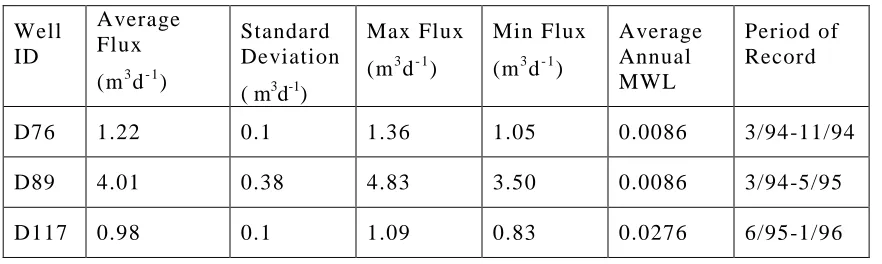
controlled by the position of MWL. Table 4-1 statistically summarizes the results of the
16
Table 4.1 Volumetric flux statistics for periods of record
Well ID
Average Flux
(m3d- 1)
Standard Deviation
( m3d-1)
Max Flux
(m3d- 1)
Min Flux
(m3d- 1)
Average Annual MWL
Period of Record
D76 1.22 0.1 1.36 1.05 0.0086 3/94-11/94
D89 4.01 0.38 4.83 3.50 0.0086 3/94-5/95
1
7
Figure 4.1 Volumetric flux at D76 (dots) and MWL (solid line) between March 1994 and November 1994.
1
8
Figure 4.2 Volumetric flux at D89 (dots) and MWL (solid line) between March 1994 and April 1995.
1
9
Figure 4.3 Volumetric flux at D117 (dots) and MWL (solid line) between June 1995 and April 1996.
20
The calculated monthly average volumetric flux values in the high-marsh at D51
range from 2.16 to 8.28 m3d-1 and do not display the same inverse relationship to the
position of MWL that is seen in the mid and low-lying marsh wells (Figure 4.4). Here,
volumetric flux is controlled by precipitation, tidal amplitude, and MWL. This site is
closer than D76 to the terrestrial watershed that exists in the forested upland. The
hydraulic head records from 0.6 meters bgs and 3.6 meters bgs exhibit two unique
hydraulic head signatures. The shallow well (0.6 meters bgs) generally has lower
hydraulic head values than the deeper well (3.6 meters bgs) in the same location. The
shallow well is also more responsive to the position of MWL and monthly tidal cycles.
This is particularly clear on August 6, 1994, when hydraulic head rises sharply during
inundating high tides. The deeper well is sensitive to precipitation events, and spikes in
the hydraulic head record correlate well with large precipitation events. Rainfall causes
rapid increases in the hydraulic head in the deeper part of the confined aquifer, followed
by a gradual decrease. The frequency of precipitation events determines the hydraulic
head in the deep well. The interaction of these factors control whether or not groundwater
2
1
Figure 4.4 Volumetric flux at D51 (dots) and MWL (solid line) between March 1994 and April 1995.
2
2
Figure 4.5 a) Hydraulic head record of D51 at 0.6 and 3.6 meters bgs. b) Precipitation record for North Inlet. c) 15-day running average of MWL
a)
b)
23
The difference between total discharge and net flux represents the total recharge
that occurs along the surface of the Crabhaul Creek bank and increases with increasing
tidal amplitude (Figure 4.6). During tidal cycles that had small amplitudes (0.44 m-0.56
m), very little recharge occurred. As tidal amplitude increased above 0.56 meters, total
recharge became greater. Total recharge continued to increase with each increase in tidal
amplitude from 0.56 meters to the maximum amplitude of 1.19 meters. The positive
correlation of total recharge and total discharge to tidal amplitude is evident for each
month in the D89 period of record.
A graph of total recharge plotted against the elevation of high tide (Figure 4.7)
shows a positive correlation between the two data sets. Increases in the elevation of high
tide drive increases in recharge magnitude. The plot also shows that a threshold exists, so
that certain high tide elevations must be met to produce certain recharge magnitudes. For
example, in order to achieve a total recharge of 0.5 meters per tidal cycle, the elevation of
2
4
Figure 4.6 Total discharge and total recharge response to tidal amplitude in D89 (January 1995).
-0.1 0.1 0.3 0.5 0.7 0.9 1.1 1.3 1.5 0 1 2 3 4 5 6 7 8 9 10
0.00 0.20 0.40 0.60 0.80 1.00 1.20 1.40
T ot al R ec h ar ge ( m /t id e) T ot al D is ch ar ge ( m /t id e)
2
5
Figure 4.7 Elevation of high tide versus total recharge in D89 (April 1994 to April 1995) 0
0.2 0.4 0.6 0.8 1 1.2 1.4
-0.5 0 0.5 1 1.5 2
H
igh
T
id
e E
le
vat
ion
(
m
)
26
4.2 Electrical Resistivity
All electrical resistivity surveys show two distinct zones (Figure 4.8). A zone of
low resistivity extends from 21 meters to 94 meters relative to the NW end of Transect D.
This zone extends from the surface to a maximum depth of 5 meters bgs. Resistivity
values in this zone ranged from 28.4 to 1.4 Ohm-m and were indicative of marsh mud
saturated by saline to brackish pore-water. A zone of higher resistivity originates in the
forested upland and extends into the subsurface marsh beneath the confining clay unit
and reaches a maximum depth of 20 meters bgs. The resistivity values in this zone range
from 6.4 to 40 Ohm-m, which we interpret to represent sand saturated with brackish to
fresh pore-water.
The plots of percent difference in resistivity show variability both zones
throughout the course of the year (Figure 4.9). Between June 30, 2012 and August 1,
2012, there is an increase in resistivity throughout the shallow zone with the exception of
an area between D45 and D50 that experienced a decrease in resistivity. The deeper zone
exhibited an increase in resistivity between D15 and D55 but a decrease in resistivity
from D55 to D89. Between August 1, 2012 and January 11, 2012, there was a general
increase in resistivity in the shallow and deep zones. There were decreases in resistivity
observed in the shallow zone between D85 and D105 and between D10 and D30 in the
deeper zone. The percent difference plot between January 11, 2013 and May 22, 2013
displayed a general increase in resistivity in the shallow subsurface except for a decrease
exhibited between D95 and D105. The deeper zone depicts an increase in resistivity
27
Each of the resistivity surveys was supplemented with in-situ salinity samples.
The salinity samples were collected from monitoring wells along Transect D that were
screened at a depth of approximately three meters bgs. The results were compared to the
corresponding electrical resistivity surveys (Figure 4.10). The standard deviation of the
resistivity and salinity data were calculated for each of the sampling dates (Table 4.2).
Data misfit cross-plots and data misfit pseudo-sections were generated and are included
as Appendix B. The resistivity results from each of the surveys show a steep decrease in
resistivity between the forested upland at D21 (average resistivity equals16.7 Ohm-m)
and the high marsh at D40 (average resistivity equals 3.5 Ohm-m). The resistivity values
then level out at values ranging from 1.4 to 4.2 Ohm-m between the high marsh at D40
and the low-lying marsh at D89. The salinity samples show more variability between
sampling events but generally salinity decreases from the upland at D21 to the high
marsh at D40, then increases between D40 and Crabhaul Creek at D89. The maximum
well depth along Transect D is 3.6 meters bgs, so it was not possible to obtain in-situ
samples from below the confining unit.
Table 4.2 Statistical analysis of resistivity and salinity results.
Sampling Date 6/30/2012 8/1/2012 1/11/2013 5/22/2013
Resistivity Mean (Ohm-m)
4.97 4.47 4.86 7.46
Resistivity Standard Deviation (Ohm-m)
4.42 4.16 2.98 9.35
Salinity Mean (ppt) 8.57 5.42 6.43 5.43
Salinity Standard Deviation (ppt)
Figure 4.8 Electrical resistivity inversions
January11, 2013, and d) May 22, represent mud layers.
a)
b)
c)
d)
28
Electrical resistivity inversions from a) June 30, 2012, b) August 1, 2012, 22, 2013. Dashed lines represent the clay unit. Solid lines
Figure 4.9 Percent difference plots (%) between a) June and August 2012 b) August
2012 and January 2013 and c) January and May 2013.
29
Percent difference plots (%) between a) June and August 2012 b) August 2012 and January 2013 and c) January and May 2013.
3
0
Figure 4.10 Salinity and resistivity plotted against distance along Transect D at a depth of 3 meters for a) June 30, 2012 b) August 1, 2012 c) January 11, 2013, and d) May 22, 2013
a) b)
31
CHAPTER 5
DISCUSSION
The results from this study show that groundwater discharge and recharge along
Transect D are controlled by a combination of MWL, tidal amplitude, and precipitation.
The factors that control advective groundwater flow transition from the forested upland to
Crabhaul Creek. In the low marsh adjacent to Crabhaul Creek and in the mid-marsh at
D76, the magnitude of tidally influenced groundwater discharge and recharge is
predominately controlled by the position of MWL. In the high-marsh at D51, vertical
groundwater flow is controlled by a complex interaction between MWL, tidal amplitude,
and precipitation.
The elevation of MWL can vary by as much as 0.5 meters over the course of a
year and strongly affects the magnitude of groundwater discharge in the mid- and low
marsh. Groundwater discharge displays an inverse relationship with the position of MWL
in the mid and low-lying marsh. This means that periods of low MWL produce higher
rates of groundwater discharge and higher MWL produces lower rates of groundwater
discharge. The range of tidal amplitude values is fairly constant throughout the year in
the North Inlet, but seasonal changes in MWL influence these tidal amplitudes by
increasing or decreasing their vertical reach across the marsh platform. This in turn
affects the area of the marsh platform that is inundated during high tides, the area of the
creek bank that is exposed during low tide, and the hydraulic gradient between the
32
marsh platform are inundated at high tide but a small area of the creek bank is exposed at
low tide. During periods of low MWL, smaller areas of the marsh platform are inundated
but more of the creek bank is exposed at low tide. More groundwater is discharged
through the creek bank at periods of low tide and low MWL because there is a larger
hydraulic gradient between the marsh groundwater and the surface water in Crabhaul
Creek. At periods of high MWL, there is a smaller hydraulic gradient and lower
groundwater discharge magnitudes. These results are consistent with the results of
Wilson and Morris (2012), who suggested an inverse relationship between MWL and
groundwater discharge. It appears that this relationship holds for forest-marsh boundaries
as well as for salt marsh islands.
Groundwater flow in the high marsh along Transect D is influenced by the
terrestrial watershed to the northwest, precipitation events, MWL position, and tidal
amplitude. The hydraulic head in the 3.6 meters bgs well at the D51 location is
influenced by precipitation and tidal cycles. The hydraulic head variations caused by the
precipitation events are much greater than the variations caused by tidal cycles. The
shallow well at D51, which is screened at 0.6 meters bgs, is much more responsive to
daily and monthly tidal cycles and is not influenced by precipitation. The ranges in
hydraulic head associated with the tidal cycles are much larger in the shallow well than in
the deep well. The increases and decreases in hydraulic head in this well correspond
nicely to the fluctuations in MWL due to spring and neap tidal cycles. The interaction
between these factors determines if discharge or recharge is occurring between the two
screened intervals. For example, consider a large precipitation even that occurs during a
33
the deep interval driven by the rain event and a low hydraulic head in the shallow well
due to the reduced amplitudes associated with the neap tidal cycles and the low position
MWL. This would create a discharge zone in the high marsh with a magnitude
proportional to the difference in hydraulic head between the deep and shallow wells.
Volumetric flux values calculated for the mid-marsh on the northwestern side of
the transect (D76) are 23 % larger than discharge calculated for the mid-marsh on the
southeastern side of the transect (D117). This was a surprising result, as we hypothesized
that groundwater discharge would be significantly greater on the northwestern side of the
transect due to the fact that a 75 square kilometerterrestrial watershed exists directly
up-gradient. Based on these results, the presence of a large freshwater lens in the upland
does not seem to significantly impact discharge. It appears that discharge from the large
upland bypasses the marsh, discharging at D51 or traveling through the fresher aquifer
below the confining unit.
Volumetric fluxes through the creek bank were converted to a flux per unit area of
the marsh via the creek density so that our fluxes could be compared to other estimates.
Creek density is the ratio of the length of creek bank to the area of marsh. The creek
density in the Crabhaul Creek Basin is 0.01 m-1, which is the same as the creek density
calculated for North Inlet by Novakowski et al (2004). We report volumetric flux and
flux per unit area to be consistent with both the groundwater and salt marsh literature.
The magnitude of groundwater discharge that we calculated based on data from D89 and
converted using the creek density term is slightly higher than previous values that have
been calculated for the North Inlet Basin (Table 5-2). The minimum value calculated in
34
Lm-2d-1. Based on previous studies, a maximum value of 40 Lm-2d-1 was calculated for
North Inlet by Krest et al. (2000) using radium isotope groundwater tracers. The larger
values can be attributed to the continuous nature of our monitoring and the seasonal
variations in groundwater discharge that emerged. The former studies from North Inlet
only achieved temporal “snap shots” of groundwater discharge which cannot be
considered representative of the system due to the variable tendencies that we observed.
Krest et al. (2000) also noted that significant groundwater discharged through the creek
bottom, which raised the question of whether the discharging groundwater originated in
the marsh or in a deeper aquifer. Our results suggest that tidal fluctuations in the marsh
are adequate to explain the fluxes observed by Krest et al (2000).
Table 5.1 Results of current and former groundwater studies in North Inlet
Study Author(s) Location Method Discharge
(Lm-2d-1)
Whiting and Childers (1989)
North Inlet, SC Seepage meter 7.8-28
Morris (1995) North Inlet, SC Salt and water balance 9.4-16.6
Krest et al (2000) North Inlet, SC Radium tracers 20-40
Wilson and Gardner (2006)
North Inlet, SC Numerical simulations 10-14
This study North Inlet, SC Darcy flux
calculations
36.01-49.77
Groundwater recharge also occurs at the creek bank along Transect D and
displays a positive correlation with high tide elevation. At lower high tide elevations, the
total recharge that occurs is non-existent or minimal. This is due to the fact that the height
of the surface water in the creek is not large enough to reverse the hydraulic gradient.
35
higher MWL. As the elevation of high tide gradually increases from 0.3 meters to 1.2
meters, more and more seawater begins to infiltrate at the creek bank. Higher MWL
combined with larger tidal amplitudes create surface water heights in the creek capable of
reversing the component of flow during the peaks of each tidal cycle. This leads to
substantial groundwater exchange along the creek bank.
We hypothesized that salinity in the shallow subsurface (up to four meters bgs)
would display seasonal variations that were related to seasonal variations in discharge,
but the electrical resistivity surveys and in-situ salinity sampling data contradict this
hypothesis. Tobias et al. (2001) suggested that “groundwater mediated” flushing
associated with seasonal variations in groundwater discharge flushed the subsurface
marsh of salts and nutrients. Carter et al. (2007) also showed that a freshwater/saltwater
interface existed along Transect C in North Inlet and that the lateral extent of this
interface migrated on a monthly timescale. Our results suggest that the saline to brackish
zone that exists in the shallow subsurface experiences temporal and spatial variability that
is not easily correlated to precipitation or the position of MWL (Figure 5.1).
Variation in electrical resistivity was much more apparent in the deeper zone
between the clay confining unit and approximately 20 meters bgs. The percent difference
plot presented in Figure 4.9 shows two areas in the deep subsurface that alternate
between increasing and decreasing resistivity over the course of a year. The first area is
located at a depth of five to 15 meters bgs and laterally between 10 and 30 meters from
the NW end of Transect D. The second area is located between five and 15 meters bgs
and laterally between 65 and 100 meters from the NW end of Transect D. These
36
MWL. It is clear that lithologic changes do not occur on this time scale, so the resistivity
variations must be due to groundwater processes. We believe that the deeper, higher
resistivity zone (freshwater zone) is hydraulically disconnected from the upper saline to
brackish zone and could be part of a larger flow path that connects the forested upland to
some discharge point to the southeast of Transect D. The relationship between rainfall
and changes in resistivity in the deeper zone needs further investigation.
Figure 5.1 Electrical resistivity surveys
c) January11, 2013, and d) May 22, 2013 MWL position.
a)
b)
c)
d)
e)
37
Electrical resistivity surveys a) June 30, 2012, b) August 1, 2012, c) January11, 2013, and d) May 22, 2013 and e) 29-day running average of
3
8
Figure 5.2 Daily precipitation totals for d) April 23 to May 7, 2013.
a)
c)
Daily precipitation totals for a) June 1 to 30, 2012 b) July 2 to August 1, 2012 c) December 12 to 27, 2012 b)
d)
39
CHAPTER 6
CONCLUSION
This study quantitatively shows that discharge from a fringing marsh is variable
on a seasonal basis and the factors that control the flow of groundwater through the
marsh are determined by the location within the system. Groundwater discharge at the
low-lying and mid-marsh locations is predominantly controlled by the elevation of MWL.
There is an inverse relationship that exists at these locations between the position of
MWL and the magnitude of groundwater discharge. In the high-marsh, groundwater
discharge is influenced by MWL, tidal amplitude, and precipitation. The interactions of
these factors determine whether groundwater discharges or recharges and the magnitude
of this flow.
There are two primary zones that occur in the subsurface along Transect D which
are separated by a confining clay unit. The top zone has a pore-water salinity that is
saline to brackish. In this zone, freshwater that makes it past the high-marsh location is
mixed with seawater that infiltrates through the creek bank and the marsh mud. The
brackish and saline water is transported slowly through the subsurface and eventually
discharges at the creek bank of Crabhaul Creek. The deeper zone displays resistivity
signatures indicative of freshwater. There are two flow paths that the freshwater in the
upland can take. First, it can be transported above the confining clay unit, where it is
40
flow under the confining clay unit where it is isolated from the saline water above and
discharged further to the east.
The variable magnitude of groundwater discharge along the transect and the
mixing that occurs in the upper zone are important when considering nutrient export.
Groundwater must have a salinity concentration of greater than ten ppt to transport
nutrients. This implies that along Transect D all of the nutrients are being exported from
the shallow, saline to brackish zone. Nutrient export is proportional to groundwater
discharge. The seasonal variation that we see in discharge can potentially introduce
pulses of nutrient enriched groundwater into the adjacent coastal water. Also, long term
sea level rise that occurs at a rate that is faster than sediment accretion would decrease
41
R
EFERENCESCarr, P.A. and V.D. Kamp, Determining aquifer characteristics by the tidal method, Water Resources Research, 5(5), 1023-1031, 1969
Carter, E.S., S.M. White, and A.M. Wilson, Variation in groundwater salinity in a tidal salt marsh basin, North Inlet Estuary, South Carolina, Estuarine, Coastal and Shelf Science, 76, 543-552, 2008.
Dame, R.F., and L.R. Gardner, Nutrient processing and the development of tidal creek ecosystems, Marine Chemistry, 43, 175-183, 1993.
De Meneses, J.G.A., Modeling the fresh water inflow to the Pettaquamscutt River. Ph.D. thesis, University of Rhode Island.
Gardner, L.R., and D.E. Porter, Stratigraphy and geologic history of a southeastern salt marsh basin, North Inlet, South Carolina, USA, Wetlands Ecology and
Management, 9, 371-385, 2001.
Harvey, J.W. and W.K. Nuttle, Fluxes of water and solute in a coastal wetland sediment. Journal of Hydrology, 164, 109-125, 1995.
Kelly, R.P., and S.B. Moran, Seasonal changes in groundwater input to a well-mixed estuary estimated using radium isotopes and implications for coastal nutrient budgets, Limnology and Oceanography, 47(6), 1796-1807, 2002.
Keenan, R.S., An investigation of the dynamics of groundwater flow and salinity distribution along a forest-marsh transect. Ph.D. thesis, Columbia: University of South Carolina
Krest, J.M., W.S. Moore, L.R. Gardner, and J.T. Morris, Marsh nutrient export supplied by groundwater discharge, Global Biogeochemical Cycles, 14(1), 167-176, 2000.
Morris, J.T., The mass balance of salt and water in intertidal sediments: results from North Inlet, South Carolina, Estuaries, 18(4), 556-567, 1995.
42
Novakowski, K.I., R. Torres, L.R. Gardner, and G. Voulgaris, Geomorphic analysis of tidal creek networks, Water Resources Res., 40, W05401,
doi:10.1029/2003WR002722, 2004.
Reilly, T.E., and A.S. Goodman, Quantitative analysis of saltwater-freshwater relationships in groundwater systems-a historical perspective, Journal of Hydrology, 80, 125-160, 1985.
Thibodeau, P.M., Groundwater flow dynamics across the forest-salt marsh interface: North Inlet, SC. Ph.D. thesis, Columbia: University of South Carolina
Tobias, C.R., J.W. Harvey, and I.C. Anderson, Quantifying groundwater discharge through fringing wetlands to estuaries: seasonal variability, methods comparison, and implications for wetland-estuary exchange, Limnology and Oceanography, 46(3), 604-615, 2001.
U.S. Geological Survey, Water resources data reports for South Carolina, Columbia, SC, 1983-1993.
Whiting, G.J., and D.L. Childers, Subtidal advective water flux as a potentially important nutrient input to southeastern U.S.A. saltmarsh estuaries, Estuarine Coastal Shelf Science, 28(4), 417-431, 1989.
Wilson, A.M., and J.T. Morris, The influence of tidal forcing on groundwater flow and nutrient exchange in a salt marsh-dominated estuary, Biogeochemistry, 108, 27-38, 2012.
Wilson, A.M., and L.R. Gardner, Tidally driven groundwater flow and solute exchange in a marsh: numerical simulations, Water Resources Research, 42, W01405,
43
APPENDIX A
ELECTRICAL RESISTIVITY PARAMETERS
June 30, 2012 Survey Parameters
Advanced Geosciences Inc. (AGI) Sting/SuperSting measured data (*.stg) Type: XYZ A trimmed data set by AGI EarthImager 2D. Version: 2.4.0 (Build 617). Records: 279 Raw data file: C:\Documents and Settings\jpeurifoy\Desktop\Thesis
Information\Research
Data\Resistivity\6.30.12\TRAND1_Reversed\trial3\TRAND1_Reversed_trial3.stg Terrain file: C:\Documents and Settings\jpeurifoy\Desktop\Thesis Information\Research Data\Resistivity\6.30.12\TRAND1\TranD12.trn
Number of Data = 279 Number of Electrodes = 28
Number of Surface Electrodes = 28 Number of IP Data = 0
Processing starts at 2012-09-13 12:30:13
;--- SETTINGS ---
Minimum Voltage (mv) = -1 Minimum V/I (ohm) = 0.0002
Minimum apparent resistivity (ohm-m) = 0.1 Maximum apparent resistivity (ohm-m) = 10000 Maximum repeat error (%) = 7
Maximum reciprocal error (%) = 10
Remove negative apparent resistivity in ERT data: Yes Keep All Data (no data removal): No
Inversion Method: Smooth model inversion Vertical axis: Positive Upward
Y Coordinate = Depth
Min electrode spacing X (m) = 0.003 Min electrode spacing Z (m) = 0.003
Forward Modeling Method: Finite element method Forward system solver: Cholesky decomposition method Boundary condition type: Dirichlet
44 Max number of iteration of nonlinear inversion = 10 Stop RMS error = 3%
Mininum error reduction between two iterations = 5% Stop at Max number of iterations: Yes
Stop when RMS is small enough: No Stop when RMS can not be reduced: No Res Data reweighting: No
Use Reciprocal Error: No
Stop when L2 norm is small enough: No Initial smoothness factor = 1000.0 Roughness conditioner = 0.2 Starting model: Avg AppRes.
Start halfspace resistivity = 7.08 ohm-m Minimum resistivity = 1.0 ohm-m Maximum resistivity = 100000.0 ohm-m Number of elements combined horizontally = 1 Number of elements combined verically = 1 Vertical / Horizontal roughness ratio = 0.2 Estimated noise of resistivity data = 3% Initial damping factor of resistivity = 1000.0 Starting iteration of quasi Newton method = 20 IP inversion method: No IP Inversion
Terrain mesh transform method: Damped transform.
;--- ELECTRODE LOCATIONS ---
45
19, 76.000, 0.000, 76.000, -1.367 20, 80.000, 0.000, 80.000, -1.413 21, 84.000, 0.000, 84.000, -1.457 22, 88.000, 0.000, 88.000, -1.502 23, 92.000, 0.000, 92.000, -1.454 24, 96.000, 0.000, 96.000, -1.393 25, 100.000, 0.000, 100.000, -1.347 26, 104.000, 0.000, 104.000, -1.394 27, 108.000, 0.000, 108.000, -1.440
August 1, 2012 Survey Parameters
Advanced Geosciences Inc. (AGI) Sting/SuperSting measured data (*.stg) Type: XYZ A trimmed data set by AGI EarthImager 2D. Version: 2.4.0 (Build 617). Records: 292 Raw data file: C:\Documents and Settings\jpeurifoy\Desktop\Thesis
Information\Research Data\Resistivity\8.1.12\4m MRT Poster 8.1.12\11TRAND_Reversed\trial3\11TRAND_Reversed_trial3.stg
Terrain file: C:\Documents and Settings\jpeurifoy\Desktop\Thesis Information\Research Data\Resistivity\8.1.12\4m MRT Poster 8.1.12\TranD12.trn
Number of Data = 292 Number of Electrodes = 28
Number of Surface Electrodes = 28 Number of IP Data = 0
Processing starts at 2013-09-23 10:33:07
;--- SETTINGS ---
Minimum Voltage (mv) = 1 Minimum V/I (ohm) = 0.0005
Minimum apparent resistivity (ohm-m) = 0.01 Maximum apparent resistivity (ohm-m) = 10000 Maximum repeat error (%) = 7
Maximum reciprocal error (%) = 10
Remove negative apparent resistivity in ERT data: Yes Keep All Data (no data removal): No
Inversion Method: Smooth model inversion Vertical axis: Positive Upward
Y Coordinate = Depth
Min electrode spacing X (m) = 0.003 Min electrode spacing Z (m) = 0.003
Forward Modeling Method: Finite element method Forward system solver: Cholesky decomposition method Boundary condition type: Dirichlet
46
Lower-layer-thickness / Upper-layer-thickness = 1.1 Depth of Inverted Model / Depth of Pseudosection = 1.1 Max number of iteration of nonlinear inversion = 15 Stop RMS error = 5%
Mininum error reduction between two iterations = 3% Stop at Max number of iterations: No
Stop when RMS is small enough: No Stop when RMS can not be reduced: No Res Data reweighting: Yes
Use Reciprocal Error: No
Stop when L2 norm is small enough: Yes Initial smoothness factor = 100
Roughness conditioner = 0.1 Starting model: Avg AppRes.
Start halfspace resistivity = 7.01 ohm-m Minimum resistivity = 1.0 ohm-m Maximum resistivity = 100000.0 ohm-m Number of elements combined horizontally = 1 Number of elements combined verically = 1 Vertical / Horizontal roughness ratio = 0.2 Estimated noise of resistivity data = 5% Initial damping factor of resistivity = 100 Starting iteration of quasi Newton method = 20 IP inversion method: No IP Inversion
Terrain mesh transform method: Damped transform.
;--- ELECTRODE LOCATIONS ---
47
17, 68.000, 0.000, 68.000, -1.262 18, 72.000, 0.000, 72.000, -1.315 19, 76.000, 0.000, 76.000, -1.367 20, 80.000, 0.000, 80.000, -1.413 21, 84.000, 0.000, 84.000, -1.457 22, 88.000, 0.000, 88.000, -1.502 23, 92.000, 0.000, 92.000, -1.454 24, 96.000, 0.000, 96.000, -1.393 25, 100.000, 0.000, 100.000, -1.347 26, 104.000, 0.000, 104.000, -1.394 27, 108.000, 0.000, 108.000, -1.440
January 11, 2013 Survey Parameters
Advanced Geosciences Inc. (AGI) Sting/SuperSting measured data (*.stg) Type: XYZ A trimmed data set by AGI EarthImager 2D. Version: 2.4.0 (Build 617). Records: 301 Raw data file: C:\Documents and Settings\jpeurifoy\Desktop\Thesis
Information\Research Data\Resistivity\1.11.13\4m MRT 1.11.13\110133_Reversed\trial1\110133_Reversed_trial1.stg
Terrain file: C:\Documents and Settings\jpeurifoy\Desktop\Thesis Information\Research Data\Resistivity\1.11.13\4m MRT 1.11.13\TRAND4m.trn
Number of Data = 301 Number of Electrodes = 28
Number of Surface Electrodes = 28 Number of IP Data = 0
Processing starts at 2013-05-29 13:48:55
;--- SETTINGS ---
Minimum Voltage (mv) = 1 Minimum V/I (ohm) = 0.0005
Minimum apparent resistivity (ohm-m) = 1 Maximum apparent resistivity (ohm-m) = 100000 Maximum repeat error (%) = 7
Maximum reciprocal error (%) = 10
Remove negative apparent resistivity in ERT data: Yes Keep All Data (no data removal): No
Inversion Method: Smooth model inversion Vertical axis: Positive Upward
Y Coordinate = Depth
Min electrode spacing X (m) = 0.003 Min electrode spacing Z (m) = 0.003
48 Boundary condition type: Dirichlet
Number cells or elements betwenn two electrodes = 2 Lower-layer-thickness / Upper-layer-thickness = 1.1 Depth of Inverted Model / Depth of Pseudosection = 1.1 Max number of iteration of nonlinear inversion = 15 Stop RMS error = 5%
Mininum error reduction between two iterations = 3% Stop at Max number of iterations: No
Stop when RMS is small enough: No Stop when RMS can not be reduced: Yes Res Data reweighting: No
Use Reciprocal Error: No
Stop when L2 norm is small enough: No Initial smoothness factor = 100
Roughness conditioner = 0.1 Starting model: Avg AppRes.
Start halfspace resistivity = 8.06 ohm-m Minimum resistivity = 1.0 ohm-m Maximum resistivity = 100000.0 ohm-m Number of elements combined horizontally = 1 Number of elements combined verically = 1 Vertical / Horizontal roughness ratio = 0.2 Estimated noise of resistivity data = 5% Initial damping factor of resistivity = 100 Starting iteration of quasi Newton method = 20 IP inversion method: No IP Inversion
Terrain mesh transform method: Damped transform.
;--- ELECTRODE LOCATIONS ---
49
15, 60.000, 0.000, 60.000, -1.157 16, 64.000, 0.000, 64.000, -1.210 17, 68.000, 0.000, 68.000, -1.262 18, 72.000, 0.000, 72.000, -1.315 19, 76.000, 0.000, 76.000, -1.367 20, 80.000, 0.000, 80.000, -1.413 21, 84.000, 0.000, 84.000, -1.457 22, 88.000, 0.000, 88.000, -1.502 23, 92.000, 0.000, 92.000, -1.454 24, 96.000, 0.000, 96.000, -1.393 25, 100.000, 0.000, 100.000, -1.347 26, 104.000, 0.000, 104.000, -1.394 27, 108.000, 0.000, 108.000, -1.440
May 22, 2013 Survey Parameters
Advanced Geosciences Inc. (AGI) Sting/SuperSting measured data (*.stg) Type: XYZ A trimmed data set by AGI EarthImager 2D. Version: 2.4.0 (Build 617). Records: 284 Raw data file: C:\Documents and Settings\jpeurifoy\Desktop\Thesis
Information\Research Data\Resistivity\5.22.13\4m MRT
5.22.13\BRAD4M_Reversed_Scaled\trial6\BRAD4M_Reversed_Scaled_trial6.st g
Terrain file: C:\Documents and Settings\jpeurifoy\Desktop\Thesis Information\Research Data\Resistivity\5.22.13\4m MRT 5.22.13\TranD12.trn
Number of Data = 284 Number of Electrodes = 28
Number of Surface Electrodes = 28 Number of IP Data = 0
Processing starts at 2013-09-23 09:38:33
;--- SETTINGS ---
Minimum Voltage (mv) = 1 Minimum V/I (ohm) = 0.0005
Minimum apparent resistivity (ohm-m) = 0.1 Maximum apparent resistivity (ohm-m) = 10000 Maximum repeat error (%) = 7
Maximum reciprocal error (%) = 10
Remove negative apparent resistivity in ERT data: Yes Keep All Data (no data removal): No
Inversion Method: Smooth model inversion Vertical axis: Positive Upward
Y Coordinate = Depth
50 Min electrode spacing Z (m) = 0.003
Forward Modeling Method: Finite element method Forward system solver: Cholesky decomposition method Boundary condition type: Dirichlet
Number cells or elements betwenn two electrodes = 2 Lower-layer-thickness / Upper-layer-thickness = 1.1 Depth of Inverted Model / Depth of Pseudosection = 1.1 Max number of iteration of nonlinear inversion = 15 Stop RMS error = 5%
Mininum error reduction between two iterations = 3% Stop at Max number of iterations: No
Stop when RMS is small enough: No Stop when RMS can not be reduced: No Res Data reweighting: Yes
Use Reciprocal Error: No
Stop when L2 norm is small enough: Yes Initial smoothness factor = 100
Roughness conditioner = 0.1 Starting model: Avg AppRes.
Start halfspace resistivity = 8.26 ohm-m Minimum resistivity = 1.0 ohm-m Maximum resistivity = 100000.0 ohm-m Number of elements combined horizontally = 1 Number of elements combined verically = 1 Vertical / Horizontal roughness ratio = 0.2 Estimated noise of resistivity data = 5% Initial damping factor of resistivity = 100 Starting iteration of quasi Newton method = 20 IP inversion method: No IP Inversion
Terrain mesh transform method: Damped transform.
;--- ELECTRODE LOCATIONS ---
51
52
APPENDIX B
DATA MISFIT CROSSPLOTS AND DATA MISFIT PSEUDOSECTIONS
53
August 1, 2012
54