Workplace Happiness: A Conceptual Framework
Rituparna Roy, Dr. Juthika Konwar
Abstract : Have you ever heard the word ―Arbedjsglæde‖? What does it mean? In Denmark, Arbedjsglæde is the most common term which signifies happiness at work. Arbedjsglæde means the happiness that human beings derive on or after doing something. We can say it is a human emotion, a sense of well-being that turns on when one experiences positive about the work they perform and when they feel involved in the professional commitment. When all's said and done ‗Happiness‘ is a highly subjective experience. Happiness and satisfaction are subjective concepts and are not the same. While for some people monetary assistance can be equated with job satisfaction, on the other hand, some might strive for recognition of their hard-work and lose motivation on failing to achieve so. As well as for some people having a friendly work environment is an indispensable requisite for deriving pleasure. In this article, researchers will capture an in-depth glance into the components of happiness at work and tries to understand why workplace happiness is so imperative to maintaining work motivation.
Keywords: Components of Workplace Happiness, Employee happiness, Organizations contributon, Workplace Happiness Workplace Happiness Matrix
————————————————————
1.
WORKPLACE HAPPINESS
Ingrained in both ancient and modern cultural ethnicities, the pursuit of happiness is a well-liked fixation around the world (Diener, 2000). ―Happiness‖ is universal to all human beings in every culture and everybody searches for happiness (Fisher. 2010, Aydin, 2012). Anyone can be happy at work, not only you could, you should. Happiness is perhaps one of the utmost striking of human pursuits (Diener, Sapyta, & Suh, 1998). Humans are treated as capital and employer‘s focal point on employee‘s faults and failings rather than their strengths. In a post-crash world, such approaches are unsustainable, and positive psychology endows with a new-fangled way of managing that will revolutionize the workplace. Work is one of the essential aspects of people‘s lives (Dulk, Groeneveld, Ollier-Malaterre, & Valcour, 2013). Inspiring happiness and optimistic emotions in the workplace may escalate performance, magnify innovation and ensure organizational effectiveness. Employee happiness is a more and more relevant and indispensable deliberation in the modern workplace. These days an organization spends huge money on happiness coaches and consultants. Now the organization has even appointed a Chief Happiness Officer in charge of maintaining high morale among employees and monitoring and analyzing the happiness levels in your organization. Happiness at work is realized when an individual employs his talents and abilities. (Dutton & Endmun 2007). When one spent more time at work it should be something that makes one‘s happy something they enjoy. Happiness at job happens after a triumph in doing a task which makes the individual be the pride of what he had done when staffs believe they have an important job, find the task valuable, accept the responsibility, learn and develop at work; feel motivated and energized and find the job enjoyable. (Kjerulf, 2007).
The important things in the workplace are not only the salary; of course, one may get a fair salary but may not be happy. According to The Career Bliss Team, ―while salary and perks are important contributors to employee happiness, what really makes employees rank their company well is the type of work they do, how well they are managed, and how well they are recognized for their work.‖ Being happy at work is important and the organization also recognizes the importance of human resources. According to Tseng (2009), happy at work and a virtuous attitude to the organization is imperative because it may lead to efficiency and organizational goals can be attained. Moreover being ‗okay‘ at work is not actually okay, it missing a huge happiness dividend if one only settles with ‗okay‘. According to Maenapothi (2007), happiness at work means the situation at work when human resources happy working, resourceful and achieve the targeted goals, both at the level of employees and organizational level. The purpose of the study addresses is the relevance of workplace happiness and implication to individual and organizational functioning and effectiveness in creating workplace happiness.
2.SIGNIFICANCE OF THE STUDY
The concept of workplace happiness was not there until a few decades ago, and there is a reason for that. In the last few years, we have seen drastic changes in the industrial sector; now work in positions that did not exist twenty years ago. Due to the intensification of work caused by economic uncertainty and an increase in competition, maintaining a level of happiness at work has become more significant and relevant. Happiness has gained increased traction in corporate circles. Workplace happiness is more than a subjective experience. It is not a by-product of external factors like appreciation or incentives; it comes from the way one chooses to manage their thoughts, actions, and reactions on an everyday basis. The extensive literature review examines various inscriptions on the topic of individual happiness, workplace happiness or happiness at the workplace. According to philosophy or theory, descriptions of happiness in the workplace in the literature vary. We all find the countless mission and vision statements nearly in every organization that ―our people are our greatest asset‖. But in many research surveys, it has been found that job satisfaction is not only the key predictor of turnover rates. Employees may be satisfied with their job but not necessary be
_________________________
Rituparna Roy, Research Scholar, Department of Business Administration, Assam University, Pin code: 788011.Email id: [email protected].
happy at work. It is very much important being happy at work and not just satisfied. Satisfaction is what we think on the other hand happiness is a feeling when we love what we do. Research has also revealed that the unprecedented level of unhappiness at organizations and the direct link between the employees‘ happiness and business outcomes. Therefore, to promote happiness at the workplace the contributions of human resource and organizations is significant.
3.RESEARCH
GAP
AND
RESEARCH
PROBLEM
The question comes out what happens after a successful recruitment and selection process? How many times employers have thought of employee happiness at the workplace and whether they actually did something to make employees happy? Many findings depict the way of initiatives that can be carried out by organizations to foster workplace happiness that are inexpensive to implement. But the picture is still blurred to comprehend what an organization in reality, can do anything to elevate the happiness level of an employee.
4. RESEARCH METHODOLOGY
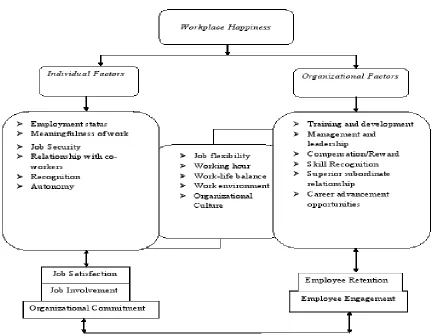
Based on the literature review parameters of workplace happiness are identified. Happiness at the workplace is hypothesized to be influenced by these parameters and according to this; we divided these parameters as individual factors and organizations factors to foster happiness at the workplace.
5. Parameters of Workplace Happiness
Happiness in the workplace is important to both individuals and organizations (Fisher, 2010; Simmons, 2014). The senior lecturer in organizational psychology at Alliance Manchester Business School, Mark Batey said: ―This is the human era of the workplace. The best places to work are those in which people can flourish and be their best selves – instead of pretending to be someone else five days a week. The perfect workplace also gives people flexibility and autonomy as to where and how they work, built on a culture of growth and trust.Fig 1: Parameters of Workplace Happiness
Source: Authors Compilation
5.1 Employee Happiness: Individual Perspectives It is not just feeling happy all the time something called employee happiness. It is feeling positive about one‘s work.
Employment Status
(Frey & Stutzer, 2000b; Ha and Kim, 2013). In compare to temporary employees, permanent employees seem to be more satisfied with their jobs (Ong & Shah, 2012; Scherer, 2009). Employees are happy when they experience stable employment (Scherer, 2009). Unstable employment not only makes employees feel unhappy but also affects the rate of employee turnover and organizational performance (Dike, 2011).
Meaningfulness of Work
Chalofsky (2003) stated meaningful work as ―which gives essence to what we do and what brings a sense of fulfillment to our lives‖. When people have a sense of meaning in their work, they become more committed to the organization People feel happy when they pursue meaningful activities (Martin, 2008).If employees perceive the worth and meaning of work, they may be happy to do their work (Dimitrov, 2012; MacMillan, 2009). Meaningful work connected employees with their workplace and experience a high level of job satisfaction.
Job Security
To determine whether employees feel happiness at work job security is one of the key factors. Fundamental needs for happiness in life including safety, decent work environment, fair salary, allowances and security (Kjerulf, 2007). A worker with a solid sense of job security efficiently does their work to stay employed and plans to work for the organization for the foreseeable future. Job security and is essential and crucial in order to retain employees in an organization and allow them to work productively and comfortable (Shanti & Mah, 2008).
Relationship with co-workers/Friendship
Co-workers are a distinct part of the working environment, and employees are expected to work harmoniously with other employees (Iqbal, 2010). Co-workers have a crucial effect on the happiness we feel at work (Ojanen (2009, 172). Employees who have meaningful friendship are happier than those who are alone (Snow, 2013). Harmonious interactions with co-workers have been found to have a positive influence on an individual's level of job satisfaction (Ladebo, Awotunde & AbdulSalaam-Saghir, 2008).
Recognition
The key to keeping employees happy in their jobs is to recognize them for their hard work. According to Barton (2002), to increase the level of job satisfaction among employees, recognition is considered the most significant aspect among non-financial rewards. Recognition can be provided a number of ways so managers have to find out what their employees‘ value most and customize recognition accordingly. Recognitions can be any forms such as; involving employees in decision making, by
increasing their responsibility, by showing empathy towards them and provide them with succession planning and different opportunities to get high designation (Yaseen, 2013).
Autonomy
Autonomy ―can be seen to be characterized by the ability to choose how to do one‘s work; having influence over one‘s work; flexibility in workload decisions‖ (Christeen, 2015).It is quite obvious that employee with more autonomy experienced greater feelings of happiness Autonomy on the job influences employee decision to stay in the organization (Spence et al.2009). When employees perceive themselves as having discretionary power in performing their organizational roles, they are more likely to remain in their current organizations because of enhanced ownership in work (Parker & Wall, 1998).
When an employee is being happy at work, they are prepared to fix problems rather than complaining; it is about accepting constructive criticism and persistently trying to enliven oneself without feeling pressurized.
5.2 Employer Contribution: Making a Happy Workplace It is quite difficult to analyze what makes employees happy, but it is easier said than done to transform the structure of one‘s daily work pattern and prioritize employee happiness. It has been said that people don't quit their jobs, they quit their bosses. Therefore, instead of struggling to drastically alteration on the whole work environment, an organizations can initially recognize the following factors to be associated with happiness at work.
Training and Development
To keep up with changes in the workplace, it is indispensable for employees to get training and develop new skills throughout their work life. It is one of the key human resource management practices which lead to skills, aptitudes, superior knowledge, optimistic attitude and behavior of employees resulting in the organization in profit (Tangthong, et al., 2014). Every organization needs to be aware of the aspiration for workers to shine. On-the-job training progresses work proficiency, develops an interest in work, gives gratification and reinforces the obligation towards the organization leading to employee retention (Hanif, 2013). In addition, off-the-job training causes employees to pay more attention to the particular training activities, learn new skills and knowledge without distractions paying the complete focus on the training (Elnaga, & Imran, 2013). When employers are given opportunities to develop and train, the employee will be more productive and contented.
Management and Leadership
Management plays an important role in an employee's job satisfaction and happiness (Jackson et.al 2014). The most vital aspect of management is leadership. Guiding, encouraging and participation by the management are detected to pursuit a positive environment (Varila & Viholainen 2000, 74). Warr (2007) defines a positive leader behavior as one that includes willingness to listen employees, showing support respect and concern for employee welfare, and a tendency to show appreciation for employees and their work well done.
Compensations and Rewards
amongst employees (Terera & Ngirande, 2014).
Skill Recognition
The moment new employees start on with the organization the process of skills recognition begins that helps an employer to identify the capacities of the employee. Individual skill recognition is delimited by age and encourages positive behavior, ethics, teamwork, self-confidence, and growth in all employees (Redington, 2007). Skills Recognition endow with people with formal recognition of the competencies that employee have already achieve through formal or informal training, work or life experience.
Superior-Subordinate Relationship
The relationship of superior-subordinate is undoubtedly one of the most important relationships that impact your workplace happiness. Any operative program must have strong support from people in senior management positions, and these people must also serve as positive role models to subordinates (Zenger, Ulrich,Smallwood, 2000). Greenhaus (2004) suggested that employees‘ views regarding organization are strongly concerned with their relationship with the supervisor. Happy workplaces are those where an employer is given the chance to their employee to nurture.
Career Advancement Opportunities
Career development is one of the main human resources characteristics that provide the opportunity for employees to continuously be a part of the diverse activities in the organization that develops employees (SHRM, 2012). If employees in their current organization cannot foresee their pathway of career development than there are probabilities that employees will leave the organization the moment, they get an opportunity (Bratton & Gold, 2003). Therefore, to gain and sustain competitive advantage organizations required talented and productive employees and these employees need career development to enhance and cultivate their competencies, (Prince, 2005). 5.2 Common Components: Both Individual and Organizational
Job Flexibility
The importance of employment flexibility such as scheduling variations that better accommodate individual work times, workloads, responsibilities, and locations around family responsibilities (Cunningham, 2002; Pleffer, 2007). The report also uncovered that according to 35% of women and 32% of men job flexibility is preferred as the most essential aspect of workplace happiness. Male and female employees have a similar level of desire for flexible working. It helps to increased productivity; reduced employee turnover and absenteeism have been identified as advantages of flexible working for employers (Anon, 2008).
Work EnvironmentWhen it comes to maintaining a positive outcome in a stressful atmosphere, a hale and hearty workplace environment is superlative. People strive to work and to stay in those organizations that provide a good and positive work environment, where employees feel that they are valued and making a difference (Ramlall, 2003). Spence et al. (2009) stated that a favorable working environment contributes to
employee retention. People want to work for an organization that appreciates work performance, has opportunities to grow, a friendly and cooperative environment and a feeling that the organization is a second home to the employee (Ontario, 2004). The most vital thing that persuades employee motivation and happiness, in addition to how resourceful and productive human resource can be, all goes down to their working environment.
Work-Life Balance
In today‘s unpredictable and fast-paced business world, it is not so easy task to achieve work-life balance. But now the work-life balance is the center of attention of every employer especially when an organization considers how difficult it can be to attract and retain the in-house talent. Work-life balance is a state where an individual manages real or potential conflict between different demands on his or her time and energy in a way that satisfies his or her needs for well-being and self-fulfillment (Clutterbuck, 2003). A poor work-life balance can lead to a variety of symptoms which can affect employee‘s happiness. So, encouraging work-life balance will help employers draw a valuable talent-pool for new recruits and boost retention rates. A balance makes an employee happy at work as well as in personal life.
Working HoursResearch proves that a four-day working week enhances happiness and very often leads to better outcomes as well (Ojanen (2009, 162). People may be unsatisfied with their jobs if they have long working hours (Georgellis, Lange, & Tabvuma, 2012).
Organizational Culture
Beyond a superlative salary package and job satisfaction, today‘s job seekers hunt for a good organizational culture, where employee happiness is just as important as increasing profits. Organizational culture is an important recipe for the encouragement or discouragement of behaviors in an organization (Dell and Kumasey, 2013). A well-built organizational culture can be imperative in helping productivity and creating a happy workforce. If employees are excited about the culture of an organization, they tend to become emotionally and psychologically attached to that organization (Sathe, 1983). Robbins and Coulter (2008) describe organizational culture as a set of shared beliefs between members of an organization who are operating as a group.Engender a happier workplace will lead to a more gratifying work environment, better output, and eventually, reduced turnover. Changing current systems and cultivate a culture that helps the workforce sustain wellbeing, happiness, and balance can be strenuous, but it‘s a worthwhile effort.
6. Workplace Happiness Matrix
workplace happiness. It means one can easily be identified whether employees are happy at their workplace, employees‘ expectations are met as well as how much contributions organization are giving to make a happy workplace. This matrix is classified into
4(four) quadrants and it goes like:
Optimistic
Grinning
Frowning
Neutral
Fig:2 WORKPLACE HAPPINESS MATRIX
Source: Authors Compilation
Quadrant 1: Optimistic - High employee happiness at the workplace + Low employer contribution to increase workplace happiness
Quadrant 2: Grinning- High employee happiness at the workplace +High employer contribution to increase workplace happiness
Quadrant 3: Frowning- Low employee happiness at the workplace + Low employer contribution to increase workplace happiness
Quadrant 4: Neutral- Low employee happiness at the workplace + High employer contribution to increase workplace happiness
Quadrant1: Optimistic: The employees remain happy in spite of low employer contributions. Through employe rs are not showing much effort to make employees happy on the other hand, what employee‘s wants from their job are fulfilled so they are positive and hopeful for the future.
Quadrant2: Grinning: The employees are happy in the
Quadrant3: Frowning: The employees are neither happy in their workplace nor employer trying to keep their employees. Employees are unhappy, dissatisfied with their job and feel negative in their workplace on the flip side employers are not showing any effort to encourage happiness in the workplace and also not giving proper support to employees which will negatively impact workplace happiness.
Quadrant4: Neutral: These employees are less happy in their workplace. The basic need for employees forms the job is not achieved but on the other side, an employer is trying to increase workplace happiness to keep their employees happy.
CONCLUSION:
Going to the workplace, mechanically performing all the duties assigned, and coming home to splurge the rest of the time setting inactive is an ideal picture of an unhappy life. People will work out of love, not out of compulsion. Employees sometimes feel unhappy as their work is not demanding or they are continually asked to do the same assignments. A happy employee will enjoy what they doing and perform all the daily assignments with zeal because they loving their job. Without challenging work, it is hard for an employee to become involved, engaged or optimistic about their work, making it difficult to uphold high performance over time. Successful are those employers who put their employees first or else this may result in the most talented employee who is unhappy leaving an organization. The dark horse is those employers who are successful in creating an immense employee experience where employees actually want to not just need to be
REFERENCES:
[1] Anon. (2008). Flexible Working as Human Resource Strategy: Benefits to the Organization and its Personnel. Strategic Direction, Vol. 24, No. 8, pp. 9-11
[2] Aydin, N. (2012). A grand theory of human nature and happiness. Humanomics, 28(1), 42-63.
[3] Aguenza, B. B., & Mat Som, A. (2012). Motivational Factors of Employee Retention and Engagement in Organizations. International Journal of Advances in Management and Economics, 1(6), 88-95.
[4] Barton, G. M. (2002). Recognition at work. Scottsdale: World at Work.
[5] Bratton, J., & Gold, J. (2003), Human Resource Management, Theory and Practice, New York: Palgrave Macmillan.
[6] Clutterbuck, D (2003). Managing the Work-Life Balance. UK: Chartered Institute of Personnel and Development, p. 8-9.
[7] Cunningham, S. (2002). Attracting and retaining employees in a competitive world. Retrieved from:
http://www.insurancejournal.com/magazines/sou thcentra1l2002/09/16/features
[8] Christeen, G. (2015). Retaining Professional
Workers: What Makes Them Stay? Employee Relations, 37,102-121.
[9] Chalofsky, N. (2003). An emerging construct for meaningful work. Human Resource Development International, Vol. 6, No.1, pp. 69-83.
[10]Dell, E., & Kumasey, A. S. (2013). To stay or not to stay: Can organizational culture provide the staying power? Evidence from Ghanaian banking sector. Research on Humanities and Social Science,13(19), 46-52.
[11]Diener, E., Sapyta, J. J., & Suh, E. (1998). Subjective well-being is essential to well-being. Psychological Inquiry, 9, 33–37.
[12]Dutton.M.V and Edmund.D.L(2007).A model of workplace happiness . Journal of selection and development review,23,9-14.
[13]Dulk, L. D., Groeneveld, S., Ollier-Malaterre, A., & Valcour, M. (2013). National context in work-life research: A multi-level cross-national analysis of the adoption of workplace work-life arrangements in Europe. European Management Journal, 31, 478-494.
[14]Dike, D. (2011). Quantitative correlational study of organizational culture perception, employment length, and employee turnover in fast-food restaurants. Unpublished doctoral dissertation. University of Phoenix, United States.
[15]Dimitrov, D. (2012). Sources of meaningfulness in the workplace: A study in the US hospitality sector.
[16]European Journal of Training and Development, 36(2/3), 351-371.
[17]Elnaga, A., & Imran, A. (2013). The effect of training on employee performance. European Journal of Business and Management, 5(4), 137-147.
[18]Fisher, C.D. (2010). ‗Happiness at work‘. International Journal of Management Reviews, 12, 348-412.
[19]Frey, B. S., & Stutzer, A. (2000b). ―Happiness, economy and institutions‖. The Economic Journal, 110(466),918-938.
[20]Foroutan, Y. (2011). Multiculturalism and women‘s employment: A sociological perspective. New Zealand Sociology, 26(1), 122-142.
[21]Greenhaus, J.H. (2004), Breaking all the rules for recruitment and retention. Journal of career planning and employment.61(3): 6-8.
[22]Georgellis, Y., Lange, T., & Tabvuma, V. (2012). The impact of life events on job satisfaction. Journal of Vocational Behavior, 80, 464-473. [23]Ha, S. E., & Kim, S. (2013). ―Personality and
subjective well-being: Evidence from South Korea‖. Social Indicators Research, 111, 341-359
[24]Hanif, F. (2013). Impact of training on employee's development and performance in hotel industry of lahore, pakistan. Journal of business studies quarterly, 4(4), 68-82.
organisational commitment. International Journal of Business andManagement,5(3):16-27. [26]Jackson, Ardala R.; Alberti, Jennifer L.; Snipes,
Robin L. (2014). An examination of the impact of gender on leadership style and employee job satisfaction in the modern workplace. Journal of Organizational Culture. 18: 141–152.
[27]Jerome, Smail. (2018, 1st November). Flexibility is the key to workplace happiness for 33% of employees. Retrieved from: https://www.employeebenefits.co.uk/flexibility-workplace-happiness/.
[28]Kjerulf.A.(2007).Happy hour is 9 to 5, book(online)
http://positivesharing.com/category/happy at work/
[29]Ladebo, O.J., Awotunde, J.M. &AbdulSalaam-Saghir, P. (2008). Coworkers‘ andsupervisor interactional justice: correlates of extension personnel‘s jobsatisfaction, distress, and aggressive behaviour. Institute of Behavioral &Applied Management, 9(2):206-225.
[30]Martin, M. W. (2008). Paradoxes of happiness. Journal of Happiness Studies, 9(2), 171-184. [31]MacMillan, S. (2009). Towards an existential
approach to the meaning of work. Unpublished PhD‘s thesis. Saint Mary‘s University, Canada. [32]Maenapothi, R. (2007). Happiness in the
Workplace Indicator, Master‘s Thesis. Human Resource Development, National Institute of Development Administration.
[33]Ontario, R.N. (2004). Human resource management and firm performance. Journal of Management,21 (71):1-738.
[34]Ong, R., & Shah, S. (2012). Job security satisfaction in Australia: Do migrant characteristics and gender matter?
[35]Ojanen, M. 2009. Hyvinvoinnin käsikirja. Helsinki: Kirjapaja.
[36]Parker, S. K., & Wall, T. D. (1998). Enhancing role breadth self-efficacy: The roles of job enrichment and other organizational interventions. Journal of Applied Psychology, 83, 835-852.
[37]Prince, B.J. (2005). Career-focused employee transfer processes. Career Development International, 10(4), 293-309.
[38]Pleffer, A. (2007). Work-Life Balance: The Number 1 Retention Factor. Retrieved from: http://www.mccrindle.com.
[39]Ramlall, Sunil. (2003). Managing Employee Retention as a strategy for increasing organizational competitive; Applied HRM Research, Vol.8, No.2, pags 63-72
[40]Robbins, S., & Coulter, M. (2008). Management (10th ed.). New Jersey: Prentice Hall.
[41]Redington, K. (2007). Motivating employees: Is money or recognition more appreciated?
Retrieved from:
http://www.helium.comlitemsI1113809-recognition?pag.
[42]SHRM (2012). Employee Job Satisfaction and Engagement. How Employees Are Dealing with
Uncertainty, pp.1-88. Retreived from https://www.shrm.org/resourcesandtools/tools-and- samples/policies/documents/12-0537%202018_jobsatisfaction_fnl_online.pdf [43]Spence Laschinger, H.K., Leiter, M., Day, A. and
Gilin, D. (2009). Workplace Empowerment, Incivility, and Burnout: Impact on Staff Nurse Recruitment and Retention Outcomes. Journal of Nursing Management, 17, 302-311.
[44]Sathe, V. (1983). Implications of corporate culture: A manager‘s organizational dynamics. 12 (2), 5 –23.
[45]Simmons, B. L. (2014). Organizational characteristics of happy organizations. In P. Y. Chen, & C. L. Cooper (Eds.), Work and wellbeing (pp. 1-18). Hoboken: John Wiley & Sons, Inc.
[46]Scherer, S. (2009). The social consequences of insecure jobs. Social Indicators Research, 93, 527-547. Shanti, S. & Mah, B.K. 2008. Pengajian Perniagaan 1. Selangor: Arah Pendidikan Sdn Bhd.
[47]Snow, E. L. (2013). The impact of attachment on friendship satisfaction and correlates of well-being of older adult females. Unpublished master‘s thesis. California State University Long Beach, United States.
[48]Spence Laschinger, H.K., Leiter, M., Day, A. and Gilin, D. (2009). Workplace Empowerment, Incivility, and Burnout: Impact on Staff Nurse Recruitment and Retention Outcomes. Journal of Nursing Management, 17, 302-311.
[49]Tangthong, S., Trimetsoontorn, J., & Rojniruntikul, N. (2014). HRM Practices and Employee Retention in Thailand—A Literature Review. International Journal of Trade, Economics and Finance, 5(2), pp. p 162- 166. [50]Terera, S. R., & Ngirande, H. (2014). The Impact
of Rewards on Job Satisfaction and Employee Retention.Mediterranean Journal of Social Sciences, 5(1), 481-487.
[51]The Career Bliss Team. (2012, December 9). Career Bliss 50 Happiest Companies in America for 2013. Retrieved from CareerBliss.com (http://www.careerbliss.com/facts-andfigures/ careerbliss-50-happiest- companies-in-america-for-2013/).
[52]Tseng, M.L. (2009). Application of ANP and DEMATEL to evaluate the decision-making of municipal solid waste management in Metro Manila. Environmental monitoring and assessment 156 (1-4), 181-197.
[53]Varila, J. & Viholainen, T. (2000). Työnilo tutkimuksen kohteeksi. Mitä uusia tuulia ja virikkeitä työnilon kokemukset tarjoavat henkilöstön tai organisaation kehittämiseen.‖ Joensuun yliopisto, kasvatustieteiden tiedekunnan tutkimuksia, N:o 79.
[54]Warr, P. (2007). Searching for happiness at work. The Psychologist, 20 (12), 726-729. [55]Yaseen, A. (2013). Effect of compensation
2162-3058 2013, Vol. 3, No.1