1351
Developing A Product Design Educational
Program For The Post-Globalization’s Designers
Dr., Tarek Ismail Mohamed
Abstract: After the widespread of the term globalization in the 21st century, companies and educational institutions have realized the strategic value of design and the urgent need to prepare a new generation of designers to meet the new requirements of post-globalization, and this paper discusses the modern impact of globalization in modifying and developing the educational programs of the product designers everywhere, to reach a multicultural educational program in different institutes of design in the world, in order to prepare a new generation of international product designers who have different nationality but can speak one design language, work together, communicate and understand each other in the different countries of the world especially when they are working in overseas companies.
Index Terms: Product Design - Post-Globalization -– New educational program.
—————————— ——————————
1.
INTRODUCTION
Human has interacted over long distances for thousands of years, the Old Trade Road (Silk Road) that connected Asia, Africa, and Europe was a good example of the exchange powers that existed in the old world. Philosophy, Religion, Language, Art, and other aspects of culture spread and mixed when nations exchanged products and ideas (12). In the 15th and 16th centuries, Europeans made important discoveries in their exploration of the oceans, including the start of transatlantic travel to the new world of the Americas. Global movements of people, goods, and ideas expanded significantly in the early 19th century with the development of new forms of transportation such as the steamships, railroads, telecommunications ...etc.(1),that compressed time, space and allowed for the increasingly rapid rates of the global interchange. In the 21st century the exchange between peoples has multiplied faces and became faster, the inventions of electronic communication such as Mobile Phones, Internet and different social media programs and sites...etc., have connected billions of people in new ways by the year 2010 (16). So, we can say Globalization is the process of international integration arising from the interchange of world views, products, ideas, and other aspects of culture.(14) Developments in the design of different products in many ways as transportation, telecommunication, domestics products, infrastructure…etc., are major factors in the formation of globalization which generated further interdependence of economic and cultural activities,(3) the International Monetary Fund (IMF) identified four basic aspects of globalization: -
1. Trade and transactions, capital and investment movements.
2. Migration and movement of people. 3. The dissemination of knowledge.
4. Environmental challenges such as climate change, cross-boundary water, air pollution, and over-fishing of the ocean.
Globalizing Processes affected and are affected by business and work organization, economics, socio-cultural resources, and the natural environment. Nowadays, people live the resulted stage after the globalization spreading which called
(Post Globalization), it seems clear in the lifestyle with similar products, and design educations and so on (10). So this paper aims to reach a multicultural educational program in different institutes of design in the world, in order to prepare a new generation of international product designers who have different nationality but can speak one design language.
THE SOCIO-CULTURAL DIVERSITY BETWEEN
USERS
Culture is shaped by values, beliefs, norms, and practices that are shared by members of the same cultural group, it guides our thinking, doing, being and becomes patterned expressions of who we are. These patterned expressions are passed down from one generation to the next, and the product design is the cultural message which will be sold by a business to the customers (9). Due to the socio-cultural differences between users, corporations and institutions opened different contact offices in Europe, which act as probes in their respective markets. This is verified by various examples where agencies in Europe and the United States are commissioned by Asian corporations to develop products that will be marketed in those regions, some major design agencies such as Design Continuum, Frog Design, and IDEO opened their own branches in Asia in order to cooperate more directly with clients, thereby having staff on the spot, global networking allowed the design and development projects themselves to be handled in the European and American offices (7).
European corporations particularly in the electronics and automotive industries opened offices in USA especially in Californiain order to follow current lifestyle trends more closely and to integrate the results of foreign studies more quickly into product development at home, for example the Audi TT car was born on the drawing boards of a Californian agency and enjoyed equally spectacular success in America and Europe (19).
From the previous, the socio-cultural differences between users over the world can be summarized as follow: -
- Differences in the political and economic systems. - Differences in social and family relations.
- Differences in culture, language and religion, and art .... etc.
- Variations in the environment, weather, general climate, Geographical location, and historical background.
- Differences in ways of thinking and perception of things, values and methods of their use (15).
———————————————— Professor of Product Design, College of Mass Communication,
GLOBAL DESIGN ANDMULTINATIONAL CORPORATIONS The world is shrinking, markets are expanding and manufacturing industries have decentralized, newly industrialized nations have risen, global economies are changing the playing field and technology continues to speed forward, the impact of this hit is as recent as the mid-1990s and has turned design and its practitioner, the designer, from a beneficial luxury within the process of getting new products to market to an absolute necessity (5).The role of the product and the designer has evolved with the shifting tides of global economic development. From purveyor of function and eye-catching aesthetics to cultural ambassador whose design unifies consumers worldwide through their desire to consume-buy-own-use-or just have the latest products and the same products that we all share in the developed nations and increasingly so in developing countries, an example of the Multinational corporations is Unilever which once sold the same product they developed for consumers in their home market and launched it in the global marketplace, now enlists designers to develop new products that will appeal to all the multicultural consumers of the world, as shown in figure (1).
Figure (1) shows some Global products of Unilever Multinational Corporation
And about the global strategy of Unilever to Co-create 3 new global product concepts in just 5 weeks, the first part to this 3-stages project involved designing and facilitating two co-creation sessions, one in the UK and one in Brazil. Consumers worked for hand in hand with the brand team to develop new concepts that had traction across global markets. In stage two, they introduced women from the Philippines, Thailand, and Argentina to their online communities, and to understand better their motivations and barriers around liquid laundry products. The final stage involved online concepts testing and optimization in 3 markets, the result was in just 5 weeks 3 strong global concepts were created for each of the three brands (14). Another form of globalization involves utilizing differences in manufacturing conditions, the design is conducted centrally, while production is decentralized, for example, Braun shaver machine, the design based on the German town Kornberg, some of its electric shavers are assembled in Shanghai, and the motors are actually Chinese, while the rechargeable batteries come from Japan, and the heads for the high-quality blades are from Germany (11). It was a major impact of globalization on design in the countries of Europe and in America, Canada, Japan, that since the mid- 1980s, followed by rapid growth of many Asian countries, which have become a similarity in increasing design expertise in those countries, it was followed by the spread of many brands and to go beyond the level of local to global, this has happened not only for the American ones like McDonalds,
Starbucks and Gap, but also European brands like IKEA, NOKIA, and in the long run featured many different fashions brands such as Burberry in England, Hermes and Louis Vuitton in France, Prada and Gucci in Italy (19). These brands markets are now in many cities and countries in the world such as Dubai, Singapore, Los Angeles, etc., figure (2) shows the opening of IKEA sales center in the city of Chengdu-China in 2006.
Figure (2) shows the opening of IKEA sales center in the city of Chengdu-China in 2006
CHANGES
ASSOCIATED
WITH
GLOBALIZATION AND ITS IMPACT ON THE
DESIGN
1353 countries, the English language also has become more widely
used in the early stages of education (11). There are many of design schools has emerged as centers of global design, for example, the Academy of Domus in Milan, the Royal College of Art in London, later was the Design Academy Eindhoven in the Netherlands and the University of Lausanne of Art and Design in Switzerland (18).
Figure (3) shows some of the famous Spanish brands in Clothes design and fashion
Changes in technology
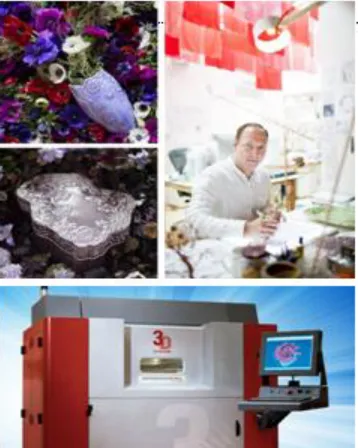
With the new technologies in computer and manufacturing, designers have changed their creation methods and adapted themselves according to these changes, in 1990Ron Arad changed his job from studio artist to industrial designer, while the Dutch designer Tord Boontje depended on the computer in achieving many of his works, which were done manually before and gave it different decorative influences, figure (4)shows the designer in his studio and some of his works and C.N.C machine.
Figure (4) Shows tordboontje,the Designer in his Studio and some of his Works
Changes in the design leadership
The leadership of design has moved from Germany, England ...etc., to another countries, Where Italy occupied a prominent place in the leadership of design in Europe, Milan city, for example, became the capital of design with the international annual exhibition of design in Milan, where are a large number of offices and design firms hold the Italian design of a lot of products in Europe and beyond, as shown in figure (5)
Figure (5) shows some of the Italian Design in Europe
Changes in the public perception of design
With the global information age, the media has the ability to formulate and guide the design profession and focus on certain aspects and hide some others, the entry of many design firms in the field of advertising & media has had sometimes a negative impact on the design profession, because it represents a pressure on young designers who are trying to attract attention, even if by deception instead of giving themselves an adequate opportunity to learn and integrate into the design profession, media also looking for what's new and what is related to fashion and quick fame and profit, regardless of many of the social and ethical considerations as well (17).THE MAIN FEATURES OF THE CURRENT
EDUCATIONAL PRODUCT DESIGN PROGRAM
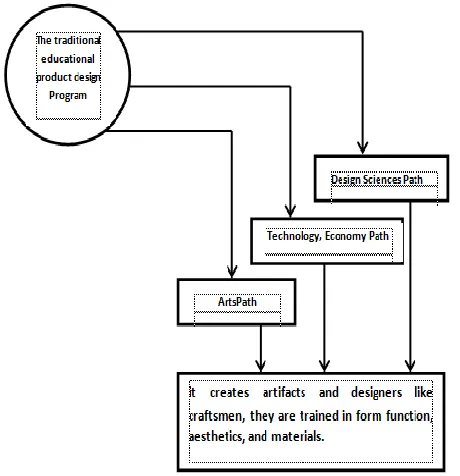
The main featuresof any local educational design program anywhere and whatever the design field architectural, graphic, industrial design…etc., it contains different subjects and syllabus (6), it is distributed in the following three paths: -Design Sciences Path
This path focuses on subjects such as design basics, design theories, projects, design history, environmental design, design methods…etc. (13).
Technology, Economy Sciences Path
This path focuses on subjects such as design technology, production technology, materials, economic, marketing...etc. (4).
This path focuses on subjects such as art history, modern art trends, drawing, model making, languages …etc., figure (8) shows the hierarchy of the current design program.
Figure (8) Shows the Main Features of Local educational Design Program
By analyzing the main axes of the previous program, it is noted that it is devoid of materials that qualify designers to deal with the multicultural and social diversity of product users in any country of the world, which makes this kind of programs unfit for teaching to design students after the spread of the idea of globalization and beyond (11).
THE
SUGGESTED
FEATURES
OF
THE
MULTICULTURAL
EDUCATIONAL
PRODUCT
DESIGN PROGRAM
So the multicultural or global educational product design Program features can be determined as follows: -
1-The main content of the previous design program was the Design Sciences path, Technology, Economy path, and Arts path, with the new concept of the global program, it is possible to develop the path of arts to be titled (arts and multi-culture) which will include the cultural global subjects such as literature, arts, philosophy, Peoples habits …etc., they all expose to different kinds of arts and cultures in the world with the following studies: -
1-1- A comprehensive study of ancient art civilizations in the world, such as the Roman civilization, Egyptian civilization, Indian and Chinese civilization in East Asia…etc.
1-2- Study the modern movements and trends of art in Europe, USA and analyze some case studies of the success of top global designers in the world, such as Karim Rashid, Philippe Starck…etc.
1-3- Geographical, political, Literature and Languages studies in the world.
2 - Create a flexible education system among the various schools of design in the world to allow the exchange of students between east and west, north and south …etc.
3- Mixing between different areas of design, for example, industrial design, architecture, visual communication …etc., so each student can choose and be majored in two different fields of design, One basic and one sub.
4-Teaching teams have to be composed of renowned authors, executives, investors, developers, policymakers, government officials…etc.
5-The exchange of experts in the global design education programmust be from various countries around the world, so they can exchange ideas and different visions which severely affect the education of young designers.
Figure (9) shows the multicultural Program features of product design which can be applied in any of design institutes in the world for the post-globalization designers.
Figure (9) Shows the Suggested Features of the Multicultural Educational Program of Product Design
CONCLUSION
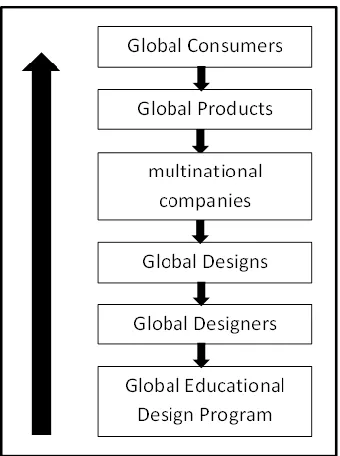
1355 Figure (10) Shows the Sequence of Globalization from the
Consumer to the Products, Companies, and Designers to the Final Global Educational Program
REFERENCES
[1] Berman, D., 2009, Do Good, How Designers Can Change the World, Peach pit Press, San Francisco, USA.
[2] Bernhard E. Bürdek, Design, History, Theory and practice of product design, 2005, Publishers for Architecture- Berlin – Germany
[3] Birkhäuser Basel, Design and Globalization, 2005, Switzerland 4-Bradley Q., 2011, Design Futures, Merrell publishers, New York, USA.
[4] Bruce Hannah,Becoming a Product Designer: A Guide to Careers in Design, 2003, John Wiley & Sons, Ltd, Hoboken, New Jersey, USA.
[5] Connor, Christopher John, and Mark Beckwith. 2014. ―Product Design Education: Different Perspectives.‖ Proceedings of the 16th International Conference on Engineering and Product Design, University of Twente, The Netherlands, September 4–5.
[6] Dominique Hes, Chrisna Du Plessis, Designing for hope, 2015. Routledge, British.
[7] Erik Bohemia, Arthur Eger, WouterEggink, Ahmed Kovacevic, 2014, Design Education & Human Technology Relations, Proceedings of the 16th International Conference on Engineering and Product Design, University of Twente, The Netherlands, September 4–5.
[8] Facchinetti, R. 2012, English dictionaries as cultural mines, Cambridge Scholars Publ, New Castle upon Tyne, Germany.
[9] Grete Rusten, Industrial design, competition and globalization, 2009, Palgrave Macmilla, United Kingdom.
[10] Hazel Clark, David Brody, Design Studies : A Reader, 2009, Berg Publishers, London, United Kingdom. [11] Hes D., Du Plessis C-, 2015, Designing for hope,
British, Routledge.
[12] IDEO.org, 2015, The Field Guide to Human-Centered Design, San Francisco, U.S.A.
[13] Jim Sheffield, Andrey Korotayev, Leonid Grinin, Globalization, 2013, Emergent Publication, USA. [14] Karim Rashid, Design Your Life, Work, Love and Play,
2006, Harper Collins, New York.
[15] Kjetil Fallan, Grace Lees-Maffei,Designing Worlds, National Design Histories in an Age of Globalization, 2016, Berghahn publications, New York, USA.
[16] MacKenzie, Andrew, Karin Oerlemans, and MilicaMuminovic. 2017. ―The Intentional Use of Learning Management Systems (LMS) to Improve Outcomes in Studio.‖ Journal of Problem Based Learning in Higher Education 5 (1).
[17] Maureen Molloy Wendy Larner, Fashioning Globalization, 2013, John Wiley & Sons, Ltd, Hoboken, New Jersey, USA.
[18] R. Craig Miller- Penny Sparke – Catherine McDermott, European Design Shaping the New Century, 2008, Merrell,London, New York.
[19] Richard Morris, The Fundamentals of Product Design, 2009, AVA Publishing, London, UK.