
R E S E A R C H
Open Access
Computationally efficient near-field source
localization using third-order moments
Jian Chen
*, Guohong Liu
*and Xiaoying Sun
Abstract
In this paper, a third-order moment-based estimation of signal parametersviarotational invariance techniques (ESPRIT) algorithm is proposed for passive localization of near-field sources. By properly choosing sensor outputs of the symmetric uniform linear array, two special third-order moment matrices are constructed, in which the steering matrix is the function of electric angleγ, while the rotational factor is the function of electric anglesγandφ. With the singular value decomposition (SVD) operation, all direction-of-arrivals (DOAs) are estimated from a polynomial rooting version. After substituting the DOA information into the steering matrix, the rotational factor is determined
viathe total least squares (TLS) version, and the related range estimations are performed. Compared with the high-order ESPRIT method, the proposed algorithm requires a lower computational burden, and it avoids the parameter-match procedure. Computer simulations are carried out to demonstrate the performance of the proposed algorithm.
Keywords: Third-order moment; ESPRIT; Near-field source localization
1 Introduction
In the last decades, low-complexity parameter estima-tion has become an important topic required for radar, sonar, as well as communication [1,2]. Various efficient solutions have been developed to cope with this issue. However, most of these algorithms mainly focused on the far-field source localization, such as the multiple signal classification (MUSIC) method [3], estimation of signal parametersviarotational invariance techniques (ESPRIT) method [4], and their derivatives [5,6]. In order to locate the near-field sources [7], several effective methods have also been derived, which can be sorted as the follow-ing two versions. The first version is named as spec-tral searching methods, in which the two-dimensional (2-D) MUSIC [8] was the original solution to the near-field source localization problem. To cope with the computationally inefficient 2-D searching procedure, a symmetric uniform linear array-based method [9] was proposed. Based on [9], resorting to the polynomial root-ing, an improved method [10] was developed, which
*Correspondence: [email protected]; [email protected] College of Communication Engineering, Jilin University, Changchun, Jilin 130025, China
has further avoided the one-dimensional (1-D) searching procedure.
The other version, based on the rotational invariance of the underlying signal subspace induced by the trans-lational invariance of the sensor array, is named as the closed-form solutions. In this version, the high-order ESPRIT method [11,12] is especially noteworthy. This method was based on the cumulant domain data and adopted the total least squares (TLS) solution to obtain the direction-of-arrival (DOA) and range estimations, which avoided the computationally inefficient 2-D spec-tral search. However, two slight disadvantages of the high-order ESPRIT method are that (1) the construc-tion of four cumulant matrices leads to an addiconstruc-tional computational burden and (2) a parameter-pairing pro-cedure is required for avoiding the estimation failure problem.
In this paper, we present a computationally more effi-cient ESPRIT algorithm to locate near-field sources. The main task in the first step is to estimate the electric angle γ, whereas in the second step, φ related to γ
is estimated for each near-field source. For the sake of reducing the computational load, we compute the third-order moments of sensor outputs and construct only two special(N×N)-dimensional matricesM1andM2.
Since the steering matrix is the function of only elec-tric angleγ, we can adopt the polynomial rooting solu-tion to obtain the DOA estimasolu-tions for all near-field sources. Instead of estimating two rotational factors from different eigenvalue-decompositions (EVDs) encountered in [11,12], the proposed algorithm estimates the only one rotational factor from the TLS version, which can avoid the unknown permutation ambiguity accompanied by EVD, that is, the auto-pairing for DOA and range can be realized.
The remainder of this paper is organized as follows: Section 2 describes the near-field source localization model. In Section 3, an efficient third-order moment-based ESPRIT algorithm is proposed to deal with the near-field source localization problem, and the performance analysis of the proposed algorithm is also addressed. Section 4 shows the simulation results. Section 5 presents the conclusion of the whole paper.
2 Near-field signal model
Suppose thatMnear-field signals impinge on a symmet-ric uniform linear array (ULA) introduced by Liang and Yang [13]. This sensor array consists ofL= 2N+1 sen-sors with element spacing d, and its array center is the phase reference point. With a proper rate that satisfies the Nyquist rate, the sampled signal received by thelth sensor can be written as
xl(t)=
noise, andτlmis the delay associated with themth source signal propagation time from 0th tolth sensor. After being approximated by the Fresnel approximation,τlm has the following form [11,12]:
τlm=lγm+l2φm, (2)
whereγmandφmare called electric angles and given by
γm= −2π
where λ represents the wavelength of the source signal andθmandrmdenote azimuth DOA and range of themth
near-field source signal, respectively. For the rest of this paper, the following assumptions are required to hold:
1) The source signals are statistically independent, zero-mean narrowband stationary processes with nonzero kurtosis;
2) The sensor noise is zero-mean Gaussian process, and independent of the source signals;
3) The sensor array is a symmetric ULA with element spacingd≤λ/4, and the source numberM is not more than the half of the sensor numberL, which meansM<N.
3 The proposed algorithm
In this section, we firstly review the definition of the third-order moment introduced in [14]. Then, by prop-erly choosing the array outputs, two special third-order moment matrices are constructed, and a joint MUSIC-and ESPRIT-based solution is derived for the near-field source localization. Finally, the theoretical analysis includ-ing computational complexity and parameter match is carried out, which further evaluates the performance of the proposed algorithm.
3.1 Construction of third-order moment matrix
The proposed algorithm exploits the richness of the third-order moment of array outputs, which is defined as [14]
m3,x(0,n,−n)= lim gate operation, andTrepresents the number of snapshots. Converging in the mean-square sense, the estimation of (5) is expressed as [14]
m3,x(0,n,−n)=
With the given signal model (1), we further obtain
m3,x(0,n,−n)=
Based on (7), we can construct two spatial third-order moment matricesM1andM2, in which the(k,q)th
ele-ments are respectively given by
M1(k,q)=m3,x(0,k−q,q−k)
In matrix form, we have
M1=AM3,s(τ )AH (10)
M2=AM3,s(τ )AH (11)
where the superscript H is conjugate transpose operation,
M3,s(τ )is the third-order moment matrix of source
sig-nals, A = [a1,a2,. . .,aM] is the (N ×M)-dimensional
steering matrix, am = 1,ej2γm,. . .,ej2(N−1)γmT is the
steering vector, and is the (M × M)-dimensional rotational factor and satisfies
=diage−jγ1,e−jγ2,. . .,e−jγM (12)
=diagejφ1,ejφ2,. . .,ejφM. (13)
Considering the third-order moment matrices in (10) and (11), one can form the(2N×N)-dimensional matrix
3.2 DOAs estimation for near-field sources
In this paper, assume that the value ofMis known or cor-rectly estimated by the Akaike information criterion (AIC) of the minimum description length (MDL) detection cri-terion [15]. Implementing a singular value decomposition (SVD) operation toMyields
UT= U1
whereU ∈ C2N×M is composed of the left singular vec-tors related to non-zero singular values, which spans the signal subspace ofM, U1 ∈ CN×M, and U2 ∈ CN×M
span the signal subspaces of M1 and M2, respectively,
and the matrix T ∈ CM×M is the unique non-singular one.
Note that the azimuth DOAs for all the incoming sources can be estimated by finding theMpeaks from the following 1-D MUSIC spectral function
P(θ )=
whereIdenotes the identity matrix.
In order to reduce the computational burden and improve the estimation accuracy, we obtain search-free estimator of DOAs based on polynomial rooting.
Denotez=ej2γ, we have
a(z)=1,z,z2,· · ·,zNT. (17)
The spectral function (16) can be rewritten in the follow-ing polynomial [16,17]
P(z)=aT(1/z)I−U1UH1
a(z) (18)
and the DOAs of all the incoming sources can be esti-mated from theMclosest to the unit circle roots of (18).
3.3 Range estimation for near-field sources
With the obtained azimuth DOA information, we can eas-ily obtain the estimations (denoted byA˜ and¯) ofAand . Consider the total least squares (TLS) solution of the relationU1T = A, letVbe the(2M×2M)-dimensional
matrix of the right singular vectors of
U1 A˜
, if the matrix is divided into four(M×M)-dimensional parti-tions as [11,12]
V= V11 V12 V21 V22
, (19)
then the solution for the TLS problem is given by
˜
TTLS= −V12V−221. (20)
A similar approach will lead to the solution of
where E12 and E22 are the corresponding partitions of
Therefore, the estimationφ˜mrelated toγ˜mcan be
deter-mined as follows:
˜
φm=angle
˜
˜
TLS(m,m)
−angle¯(m,m). (22)
Finally, the range estimation of near-field sources is given by
˜
rm=π d2 λφ˜m
cos2θ˜m. (23)
3.4 Theoretical analysis of the proposed algorithm The proposed algorithm is based on a symmetric ULA with odd-numbered sensors, but the high-order ESPRIT method [11,12] requires even ones. For the sake of sim-plicity, we assume that the two algorithms adopt an array of 2N+2 sensors and that of 2N+1 ones in the rest of this paper. In this section, we assess the performance of the proposed method from two ways, i.e, computational complexity and parameter match.
1) Computational complexity: Regarding the computational complexity, we compare the major multiplications involved in statistical matrix construction, EVD or SVD implementation, and MUSIC spectrum search. The high-order ESPRIT method constructs four(N+1)×(N+1) -dimensional cumulant matrices, and performs the EVD of one(3N+3)×(3N+3)-dimensional matrix, so the resulting multiplications are in order of
O36(N+1)2T+4/3(3N+3)3 (24)
whereT is the snapshot number. The proposed algorithm constructs two(N×N)-dimensional third-order moment matricesM1andM2,
implements the SVD of one(2N×N)-dimensional matrixM, as well as executes once root-polynomial construction and solution for DOA estimation, the resulting multiplications are in order of
O2N2T+8/3N3+2MN. (25)
−5
0
5
10
15
20
10
−210
−110
010
110
2SNR(dB)
RMSE(degree)
source 1 the proposed method
source 2 the proposed method
source 1 the high−order ESPRIT method
source 2 the high−order ESPRIT method
source 1 the near−field CRB
source 2 the near−field CRB
It is obvious that the proposed method is
computationally more efficient than the high-order ESPRIT method.
2) Parameter match : The high-order ESPRIT method implements the EVDs of two matrices to separately estimate DOA and range of near-field sources. Although the eigenvectors related to non-zero eigenvalues from one EVD are equivalent to those of another EVD, the order may be different from each other. Therefore, an additional procedure is required to pairing them in a sense (see [7], section 2.4 for details). The proposed method firstly estimates DOAs using (16) and substitutes them intoAand to obtain the estimationsA˜ and, respectively.¯ Based on this, the estimation ofcan be obtained from the TLS version shown in (19). Since there are no EVD operations for estimating the only one rotational factor, the unknown permutation ambiguity accompanied by EVD can be avoided, and the diagonal elements of˜˜ are in one-to-one
correspondence with those of. That is, the¯ auto-pairing for DOA and range is realized.
4 Computer simulation results
In this section, we explicit some simulation results to evaluate the performance of the proposed algorithm. For all examples, a symmetric ULA with 15 sensors and ele-ment spacing 0.25λ is displayed. According to the def-inition in [13], the Fresnel region of the above array is r ∈ (0.16λ, 25λ). The source signals are set as the zero-mean exponentially distributed ones. The sensor noise is assumed to be spatial white complex Gaussian, and the signal-to-noise ratio(SNR) is defined relative to each signal. For comparison, we simultaneously exe-cute the high-order ESPRIT method [11,12] and the near-field Cramer-Rao bound (CRB) [18]. Note that the high-order ESPRIT method is based on a ULA with even-numbered sensors, so we adopt 16 sensors for it in the following experiments. The presented results are evalu-ated by the estimevalu-ated root mean square error (RMSE)
−5
0
5
10
15
20
10
−510
−410
−310
−210
−110
010
110
2SNR(dB)
RMSE(wavelength)
source 1 the proposed method
source 2 the proposed method
source 1 the high−order ESPRIT method
source 2 the high−order ESPRIT method
source 1 the near−field CRB
source 2 the near−field CRB
from the average results of 500 independent Monte Carlo simulations.
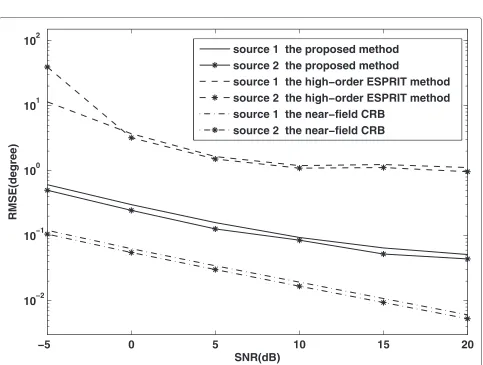
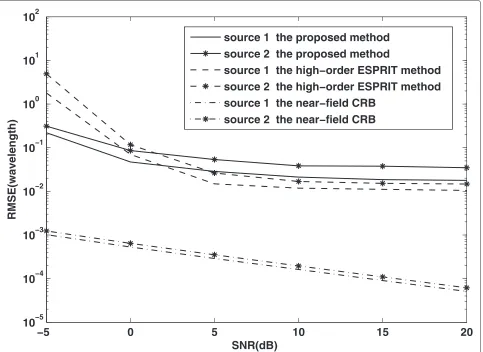
In the first example, we examine the estimation accu-racy of the proposed algorithm versus the SNRs. The localization parameters for two near-field sources are (35°, 0.3λ) and (20°, 0.5λ), respectively. The third-order moment matrices are constructed using estimates
(T=1, 024,τ=0). When the SNR varies from −5 to 20 dB, Figures 1 and 2 show the RMSEs of DOA and range estimations using the proposed algorithm, respectively.
For comparison, both the high-order ESPRIT method and the near-field CRB are also presented. It can be seen from Figure 1 that the proposed algorithm out-performs the high-order ESPRIT solution in estimating DOAs of two near-field sources, and the RMSEs are rea-sonably close to the near-field CRB. However, for the range estimation, the proposed algorithm slightly under-performs the high-order ESPRIT method. Note that the
high-order ESPRIT method requires more computations than the proposed method, and it requires an additional parameter-pairing procedure.
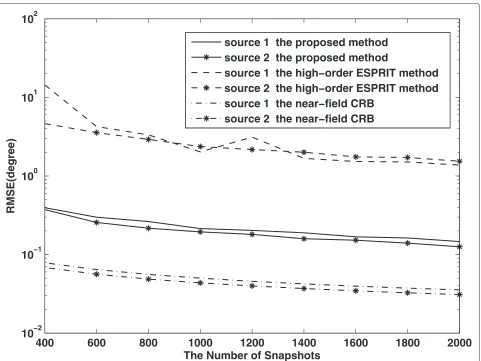
In the second example, we assess the performance of the proposed algorithm versus the number of snapshots. The other simulation conditions are similar to the first example except that the SNR is set at 2 dB, and the num-ber of snapshots is varied fromT = 400 toT = 2, 000. The RMSEs of DOA and range estimations for the pro-posed method are displayed in Figure 3, and compared with the high-order ESPRIT method and the near-field CRB. We can see from this figure that the results are similar to those of the first example. The RMSEs of the proposed algorithm decrease monotonically with the number of snapshots. For the DOA estimations of both near-field signals, the proposed method shows a more satisfactory performance than the high-order ESPRIT method, and the related RMSEs are reasonably close to the near-field CRB.
400
600
800
1000
1200
1400
1600
1800
2000
10
−210
−110
010
110
2The Number of Snapshots
RMSE(degree)
source 1 the proposed method
source 2 the proposed method
source 1 the high−order ESPRIT method
source 2 the high−order ESPRIT method
source 1 the near−field CRB
source 2 the near−field CRB
0
200
400
600
800
1000
1200
1400
1600
1800
2000
0
2
4
6
8
10
12
x 10
5
The Number of Snapshots
Computational Complexity
the high−order ESPRIT method
the proposed method
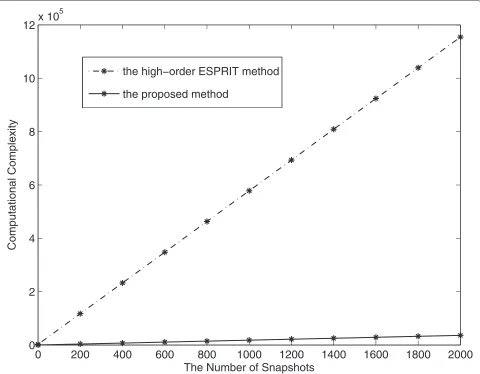
Figure 4Computational complexity of the proposed algorithm and the high-order ESPRIT method versus the number of snapshots.
In the last example, the computational burden of the proposed algorithm is compared with the high-order ESPRIT method. The number of sensors is 2N+2= 10. When the number of snapshots is varied fromT = 0 to T = 2, 000, Figure 4 shows the computational complex-ity of the proposed algorithm and that of the high-order ESPRIT method.
It can be seen from this figure that the proposed algo-rithm is computationally less complex than the high-order ESPRIT method.
5 Conclusion
This paper has presented a third-order moment-based ESPRIT method to cope with the near-field source local-ization problem. Our investigation has shown that the proposed method is capable of yielding reasonably good estimation of azimuth DOAs of near-field sources. Com-pared with the high-order ESPRIT method, the proposed method is efficient in the sense that it requires a lower
computational burden, as well as realizes the auto-pairing for DOA and range.
Competing interests
The authors declare that they have no competing interests.
Acknowledgements
This work is supported by the National Nature Science Foundation of China (Grant 61171137) and 2009 New Century Excellent Talents in University (NCET) in China.
Received: 8 March 2014 Accepted: 14 June 2014 Published: 25 June 2014
References
1. C Qian, L Huang, Improved unitary root-MUSIC for DOA estimation based on pseudo-noise resampling. IEEE Signal Process. Lett.21(2), 140–144 (2014)
2. F Liu, J Wang, C Sun, R Du, Spatial differencing method for DOA estimation under the coexistence of both uncorrelated and coherent signals. IEEE Trans. Antennas Propagation60(4), 2052–2062 (2012) 3. RO Schmidt, Multiple emitter location and signal parameter estimation.
4. R Rot, T Kailath, ESPRIT-estimation of signal parameters via rotational invariance techniques. IEEE Trans. Acoustics Speech Signal Process.
37(7), 984–995 (1989)
5. ML MeCloud, LL Scharf, A new subspace identification algorithm for high-resolution DOA estimation. IEEE Trans. Antennas Propagation
50(10), 1382–1390 (2002)
6. B Liao, SC Chan, Direction finding with partly calibrated uniform linear arrays. IEEE Trans. Antennas Propagation60(2), 922–929 (2012) 7. S Li, BLF Daku, Optimal amplitude weighting for near-field passive source
localization. IEEE Trans. Signal Process.59(12), 6175–6185 (2011) 8. H Yung-Dar, M Barkat, Near-field multiple sources localization by passive
sensor array. IEEE Trans. Antennas Propagation39(7), 968–975 (1991) 9. W Zhi, MY-W Chia, Near-field source localization via symmetrix subarrays.
IEEE Signal Process. Lett.14(4), 409–412 (2007)
10. J-J Jiang, F-J Duan, J Chen, Y-C Li, Mixed far-field and near-field source localization using the uniform linear sensor array. IEEE Sensor J.
13(8), 3136–3143 (2013)
11. RN Challa, S Shamsunder, Higher order subspace based algorithm for passive localization of near-field sources, inThe 1995 Conference Record of the Twenty-Ninth Asilomar Conference on Signals, Systems and Computers
(Pacific Grove, CA, 30 Oct–2 Nov 1995), pp. 777–781
12. N Yuen, B Friedlander, Performance analysis of higher-order ESPRIT for localization of near-field sources. IEEE Trans. Signal Process.
46(3), 709–719 (1998)
13. J Liang, X Zeng, B Ji, J Zhang, F Zhao, A computationally efficient algorithm for joint range-doa-frequency estimation of near-field sources. Digit Signal Process.19, 596–611 (2009)
14. AV Dandawate, GB Giannaks, Asymptotic theory of mixed time averages and kth-order cyclic-moment and cumulant statistics. IEEE Trans. Inf. Theory41(1), 216–238 (1995)
15. M Wax, T Kailath, Detection of signals by information theoretic criteria. IEEE Trans. Signal Process.ASSP-33, 387–392 (1985)
16. BD Rao, KVS Hari, Performance analysis of root-MUSIC. IEEE Trans. Acoustic Speech Signal Process.37(12), 1939–1949 (1989)
17. QS Ren, AJ Wills, Fast root MUSIC algorithm. Electron. Lett.33(6), 450–451 (1997)
18. MNE Korso, R Boyer, A Renaux, S Marcos, Conditional and unconditional Cramér-Rao bounds for near-field source localization. IEEE Trans. Signal Process.58(5), 2901–2907 (2010)
doi:10.1186/1687-6180-2014-98
Cite this article as:Chenet al.:Computationally efficient near-field source localization using third-order moments.EURASIP Journal on Advances in Signal Processing20142014:98.
Submit your manuscript to a
journal and benefi t from:
7Convenient online submission 7Rigorous peer review
7Immediate publication on acceptance 7Open access: articles freely available online 7High visibility within the fi eld
7Retaining the copyright to your article
![The effect of web based depression interventions on self reported help seeking: randomised controlled trial [ISRCTN77824516]](data:image/gif;base64,R0lGODlhAQABAIAAAP///wAAACH5BAEAAAAALAAAAAABAAEAAAICRAEAOw==)