Multimode Communication Protocols Enabling
Reconfigurable Radios
Lars Berlemann
Chair of Communication Networks, RWTH Aachen University, Kopernikusstraße 16, D-52074 Aachen, Germany Email:[email protected]
Ralf Pabst
Chair of Communication Networks, RWTH Aachen University, Kopernikusstraße 16, D-52074 Aachen, Germany Email:[email protected]
Bernhard Walke
Chair of Communication Networks, RWTH Aachen University, Kopernikusstraße 16, D-52074 Aachen, Germany Email:[email protected]
Received 24 September 2004; Revised 21 February 2005
This paper focuses on the realization and application of a generic protocol stack for reconfigurable wireless communication sys-tems. This focus extends the field of software-defined radios which usually concentrates on the physical layer. The generic protocol stack comprises common protocol functionality and behavior which are extended through specific parts of the targeted radio access technology. This paper considers parameterizable modules of basic protocol functions residing in the data link layer of the ISO/OSI model. System-specific functionality of the protocol software is realized through adequate parameterization and com-position of the generic modules. The generic protocol stack allows an efficient realization of reconfigurable protocol software and enables a completely reconfigurable wireless communication system. It is a first step from side-by-side realized, preinstalled modes in a terminal towards a dynamic reconfigurable anymode terminal. The presented modules of the generic protocol stack can also be regarded as a toolbox for the accelerated and cost-efficient development of future communication protocols.
Keywords and phrases:generic protocol stack, link layer functions, modular layer composition, reconfigurability, software-defined radio.
1. INTRODUCTION
The radio access of future ubiquitous communication net-works will be released from the constrains of cellular wireless
networks, as for instanceuniversal mobile telecommunication
system (UMTS), or wireless local area networks (WLANs). Wireless mobile broadband systems, providing a patchy cov-erage in densely populated urban areas, will play an im-portant role. For details on such a fixed and planned
relay-based radio network, see [1,2]. The addressed future wireless
network will have to combine several radio access
technolo-gies(RATs). Consequently, multimode capable terminals and
base stations are required to enable the seamless interwork-ing between these RATs. Multimode architectures can already
be found in existing systems, like IEEE 802.16 [3] with diff
er-ent modes of thephysical layer(PHY).
This is an open access article distributed under the Creative Commons Attribution License, which permits unrestricted use, distribution, and reproduction in any medium, provided the original work is properly cited.
Software-defined radios(SDRs) [4,5] are a promising ap-proach towards these multimode devices. The recent tech-nological progress allows an extension of the key issues in research of SDRs from the signal processing of the physical layer on the complete communication chain used for
wire-less communication. The current research efforts are
target-ing at the realization of cognitive radios [4,6,7]: self-aware,
frequency-agile radio systems that are able to identify un-used radio spectrum. These cognitive radios require proto-col reconfigurability to unfold their advantage of dynamic spectrum usage. Therefore, this paper extends the focus of SDRs on the protocol software used for reliable
commu-nication over the air. Especially, the data link layer (DLL)
and network layer corresponding to the ISO/OSI reference
model [8] are considered. This work supplements the
re-search of the integrated project E2R [9] dealing with
end-to-end reconfigurability. The approach taken in this work aims at maximizing flexibility by providing a framework that is both general enough to accommodate a wide range of
Reconfiguration
Different Protocol
functions
Figure1: UML diagram of the generic protocol stack in the context of protocol reconfigurability.
Similar goals have been formulated and followed in the
soft-ware engineering domain. The x-Kernel [10] architecture
composes a protocol graph of protocol components together into a system, but the approach does not permit dynamic re-configuration of the protocol graph and does not specifically target wireless communications. The DARPA active
network-ing program [11] tries to answer the key question of
loca-tion (and nature) of programmability with the perspective to build a flexible distributed computing system, again with a focus on fixed networks.
This paper consolidates previous publications [12, 13]
and deduces summarizing conclusions. After introducing the
idea of a generic protocol stack inSection 2, its application
for protocol reconfigurability in the context of a multimode capable protocol architecture is outlined thereafter. The re-alization of a generic protocol stack, based on fundamental protocol functions that can be parameterized, is summarized inSection 3. The composition of specific protocol layers of
adequately parameterized modules is shown in Section 4.
Section 5introduces the composition of system-specific
lay-ers at the example of the UMTSradio link control(RLC) layer,
thetransmission control protocol(TCP), and the IEEE 802.11 medium access control (MAC) layer, which differ in their development history as well as in their layer classification corresponding to the ISO/OSI reference model. A
segmen-tation/reassembly module and an automatic repeat request
(ARQ) protocol module are validated and evaluated
analyt-ically and through simulations inSection 4. These modules
are used with different parameterization for composing the
above-mentioned three specific protocol layers.
2. THE GENERIC PROTOCOL STACK
The rationale for approaching a generic protocol stack is that all communication protocols have common functions. These
commonalities can be exploited to build an efficient
mul-timode capable wireless system. The aim is to gather these common parts in a single generic stack and specialize this generic part. Thereby, the particular requirements of the
tar-geted RAT are considered, as depicted in Figure 1. The
tar-geted advantages of this concept are runtime
reconfigurabil-ity and maintainabilreconfigurabil-ity, code/resource sharing, protocol de-velopment acceleration through reusability, and continuous
performance evaluation in the context of quality-of-service
(QoS) dimensioning.
The initial step towards a generic stack is a detailed, layer-by-layer analysis of communication protocols to iden-tify their similarities. The realization of generic parts is cru-cial for the success of the proposed concept in the face of a
tradeoffbetween genericity, that is, general usability, and
im-plementation effort. As depicted inFigure 1, the generic
pro-tocol stack comprises
(i) fundamental protocol functions; (ii) a protocol architecture;
(iii) data structures; (iv) a protocol framework;
(v) protocol management.
They form, together with RAT specific parts, a
system-specific protocol stack. An efficient multimode
capa-ble reconfiguracapa-ble stack is realized in adding cross-stack management-related functions. The cross-stack manage-ment of the generic protocol stack for enabling protocol
re-configurability is introduced in detail inSection 3.
2.1. Two complementing approaches for realization
There are in general two possibilities from the software en-gineering perspective for approaching the generic protocol stack: (1) parameterizable functional modules and/or (2) in-heritance, depending on the abstraction level of the identified protocol commonalities. As introduced above, this paper fo-cuses more on the modular approach while the
inheritance-based approach is considered in [14,15]. Additionally, [16]
takes up the idea of a generic protocol stack in focusing on a
generic link layer for the cooperation of different access
Full
Figure2: A reconfigurable protocol stack based on generic func-tional modules in the context of a completely reconfigurable termi-nal.
2.2. Identifying commonalities
The evolution of the digital cellular mobile radio networks
originated in the global system for mobile communication
(GSM) toward systems of the third generation, as for exam-ple UMTS, has shown that in their standardization, devel-opers have fallen back on well-proven functions and mecha-nisms which are adopted to the specific requirements of their
application. The approach towards an efficient multimode
protocol stack, introduced in this paper, is based on these protocol commonalities.
As the architecture of modern communication protocols cannot be forced into the classical layered architecture of the
ISO/OSI reference model, it is rather difficult to identify
sim-ilarities and attribute these to specific layers. Therefore, this paper deepens the level of examination and considers fun-damental protocol functions as introduced above as one
ba-sis for a generic protocol stack, contrary to [14,15] where
complete protocols are analyzed for genericity. The identified protocol functions correspond mainly to the DLL as speci-fied in the ISO/OSI reference model. Nevertheless, they can be found in multiple layers of today’s protocol stacks. The functions of segmentation/reassembly or an ARQ protocol used for error correction are an example for this. They are located in the RLC as well as in the transport layer, namely in the TCP.
3. ENABLING RECONFIGURABILITY
The generic protocol stack, with its pool of generic functions
as introduced above, enables an efficient as well as flexible
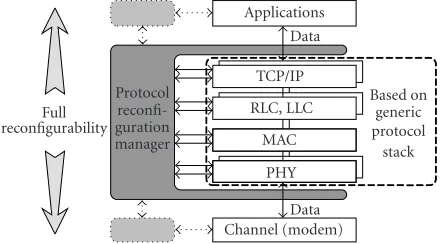
realization of reconfigurable protocol stack. Full, end-to-end reconfigurability from the modem part up to the applications requires a layer overlapping management and additional re-configuration functions. Therefore, as this paper considers communication protocols implemented in software, a
proto-col reconfiguration manager is introduced inFigure 2, which
accomplishes all reconfigurability-related tasks of the PHY, MAC, RLC/DLL, and transport layer. These system-specific layers are based on the pool of generic protocol functions and mechanisms.
3.1. Protocol reconfiguration manager
The protocol reconfiguration manager has thereby the fol-lowing tasks:
(i) management of the (permanently or temporally) par-allel existing protocols and protocol stacks;
(ii) creation, destruction and/or reconfiguration of a sin-gle protocol or complete protocol stack;
(iii) administration of the user data flow during the recon-figuration process, as for instance the redirection of the user data from the old to the reconfigured protocol stack;
(iv) cross-layer optimization through protocol conver-gence, as introduced in the next section. This implies for example the transfer of protocol or user data from the old stack to the new one;
(v) support and enabling of reconfiguration functions of the network, as for instance the support of a network-initiated reconfiguration or an update of the network information about the status of the terminal.
The reconfiguration of the protocol stack, administrated through the protocol reconfiguration manager, has two char-acteristics: (1) the creation of a new stack/layer consisting of adequate parameterized modules of the generic stack and de-struction of the existing one and (2) the reconfiguration of the existing protocol stack in exchanging the parameteriza-tion of the corresponding modules.
3.2. Protocol convergence in future wireless networks
The generic protocol stack enables the protocol convergence in future wireless networks. The convergence of such multi-mode protocol stacks has two dimensions: on the one hand the convergence between two adjacent layers, in the following
referred to asvertical convergence, and on the other hand, the
convergence between layers located in the different modes of
the protocol stack which have the same functions, in the
fol-lowing referred to ashorizontal convergence. The generic
pro-tocol stack, as introduced above, enables both the horizontal as well as the vertical protocol convergence.
Figure 3 depicts the transition between two protocol
stacks of different-air interface modes of a wireless network.
The different PHY options of IEEE 802.16 could serve as an
example, see [3]. Presently, these PHY options are not
en-visaged to coexist in terminal or access equipment, although they share a common MAC protocol with very little option-specific extensions. The protocol stack is separated into the user and control plane (u- and c-plane) on the one hand and the management plane (m-plane) on the other hand. The split between common and specific parts of the pro-tocol is here exemplary depicted for the MAC layer, as ex-plained above. This split may be also necessary in the PHY, RLC, or higher layers, depending on the targeted protocol architecture and functional flexibility of the common part. A cross-stack management logically connects the protocol
stacks of the different modes on the m-plane.
Protocol stack u-plane + c-planem-plane
Protocol status information
Transition Cross-stack management including modes convergence protocol
Figure3: A multimode capable protocol architecture under consideration of an optimized protocol convergence. Protocol information is transferred between two modes, here exemplary depicted on the level of the MAC layer. This reflects, for instance, the case of IEEE 802.16 [3].
Layer or
Figure4: Composition of a protocol specific layer or sublayer on the basis of generic and system-specific functional modules.
cross-stack management. The protocol data, as for instance the protocol status information of the existing connections, has to be transferred between the two modes. This horizon-tal convergence is performed by a mode convergence proto-col. Therefore, protocol functions of the c-plane, common
to the different modes, are necessary to access u-plane status
information. These common functions rely on a well-defined interface towards the mode-specific part of the layer. For fur-ther details on the proposed protocol architecture and
corre-sponding infrastructure, see [17].
4. MODULAR APPROACH—THE GENERIC PROTOCOL
STACK AS TOOLBOX OF PROTOCOL FUNCTIONS
Again, the generic protocol stack is the realization of the
common parts, as illustrated in Figure 1, and implements
its common functions on the basis of modules. These com-mon protocol functions get their system-specific behavior based on parameterization. Once specified, these modules
Toolbox of functional
Figure5: Toolbox of functional modules as part of the generic pro-tocol stack.
can be repeatedly used with a different set of parameters
cor-responding to the specific communication system. The mod-ules of generic protocol functions form together with system-specific modules a complete protocol layer, as depicted in Figure 4. The communication inside the layer is performed with the help of generic data structures, that is, generic
ser-vice primitives and genericprotocol data units(PDUs), which
are also considered as being a part of the generic stack, see
again Figure 1. The functional modules form a toolbox of
protocol functions as illustrated inFigure 5.
A unique manager as well as interfaces for theservice
ac-cess points (SAPs) to the adjacent layers complete the fully
functional protocol layer as depicted in Figure 4. In detail,
the mentioned components have the following tasks.
(i) Functional module(generic or RAT specific): realizes a certain fundamental functionality as black box. In case of a generic module, a list of parameters for charac-terizing the functionality is given and the underlying functionality is hidden. The comprehensiveness of the fulfilled function is limited to fit straightforward into a single module.
SAP
Segmentation unit To RRC
Interface
Manager
To RRC/ PDCP/ BMC (radio bearers) SAP Interface
Multiplexer
Acknow-ledged mode
Transpa-rent mode
Unacknow-ledged
mode
Segmentation unit ARQ unit PDU factory PDU factory
Multiplexer
Interface
SAP To MAC (logical channels)
Figure6: UMTS RLC layer based on the functional modules of the generic protocol stack.
of the protocol reconfiguration manager as introduced
above inFigure 2and it realizes the reconfigurability
of the layer.
(iii) Interface: translates the generic service primitives with
specific protocol information as payload to system-specific ones and enables thus the vertical as well as horizontal integration of the system-specific parts of the layer.
(iv) Service access point (SAP): here, services of the layer are performed for the adjacent layers. The layer may com-municate via generic primitives without a translation interface to an adjacent layer if the said layer has the same modular composition. The interface is needed if it is demanded that the layer appears as a classic layer fitting into an ordinary protocol stack.
(v) PDU factory(as functional module, later depicted in
Figures6,7, and8): composes layer-specific protocol
frames and places them as payload in generic PDUs.
This approach enables the simulation and performance evaluation on several levels. A single (sub-) layer as well as a complete protocol stack can be composed out of the intro-duced modules. To facilitate understanding, the parameteri-zation itself is introduced later.
4.1. Generic protocol functions of the data link layer
Taking Section 2.2into account, the following functions of
the DLL are considered as being part of the generic protocol stack:
(i) error handling with the help of forward error correc-tion (FEC) or ARQ protocols as for instance
Send-and-Wait ARQ, Go-back-N ARQ∗, or Selective-Reject
ARQ;
(ii) flow control∗;
(iii) segmentation, concatenation, and padding of protocol
data units (PDUs)∗;
(iv) discarding of several-times received segments∗;
(v) reordering of PDUs∗;
(vi) multiplexing/demultiplexing of the data flow, as for
in-stance the mapping of different channels∗;
(vii) dynamic scheduling; (viii) ciphering;
(ix) header compression.
The asterisk ∗ marked functions are considered in
this paper while the other functions are target of the au-thors’ongoing work.
4.2. Parameterization of functional modules
Parameterization implies not only specific values, as for in-stance the datagram size of a segmentation module, but also a configuration of behavior and characteristics of a module, as for example the concretion of an ARQ module as a Go-back-N ARQ protocol with specified window sizes for trans-mission and reception. This implies as well a configuration of the modules’ interface to the outside. Thus, the parameteri-zation of functional modules may mean (1) a specification of
certain variables, (2) the switching on/offof certain
function-ality/behavior, and (3) an extension of the module’s interface to the outside.
Taking the example of the segmentation/reassembly module, the parameterization may imply among other things:
(i) use of concatenation;
(ii) use of padding, that is, filling up of the PDU to reach a certain size;
(iii) transmitter or/and receiver role;
(iv) buffer size for SDUs concatenated in a single PDU;
(v) size of PDU after handling;
To higher layer
Manager
Interface
Multiplexer
ARQ ARQ ARQ ARQ
IP address
Multiplexer Multiplexer
TCP port UDP port
TCP PDU factory UDP PDU factory Multiplexer
Segmentation unit IP PDU factory
Interface
To data link layer
Figure7: TCP, IP, and UDP layers based on the functional modules of the generic protocol stack. The TCP layer (gray dash-dotted line) is considered here.
At the example of the ARQ module, the parameterization means the specification of
(i) ARQ protocol characteristic, for instance Go-Back-N ARQ or Selective-Reject ARQ;
(ii) transmitter or/and receiver role; (iii) receive and transmission window sizes;
(iv) fixed, variable (TCP) window length or open/shut mechanism (LLC);
(v) timer value, after a packet is assumed to be lost; (vi) connection service: inexistent (UMTS RLC),
sepa-rated for each direction (802.11—CSMA/CA with RTS/CTS), 2-way handshake (GSM LLC), or 3-way handshake (TCP);
(vii) use ofnegative acknowledgments(NACKs).
5. COMPOSITION OF SYSTEM-SPECIFIC LAYERS
As introduced above, the link layer functions are not limited in their appearance to the DLL. To illustrate the applicability of the modular approach based on the toolbox of protocol
functions ofFigure 5, a composition of three exemplary
pro-tocol layers, all differently localized in a protocol stack
cor-responding to the ISO/OSI reference model, is introduced in
the following: (1) a UMTS RLC layer inFigure 6, (2) a TCP,
IP, and UDP layers inFigure 7, and (3) an IEEE 802.11 MAC
layer in Figure 8. The consideration of Figure 7 is limited
in the following to the TCP layer, marked through the gray
dash-dotted rectangle. The medium access of thedistributed
coordination function (DCF) of 802.11 may be regarded as a Send-and-Wait ARQ, simply realized in the ARQ module
by a Go-Back-N ARQ with a window length of 1. The per-formance of these three layers is evaluated in the subsequent section.
6. SIMULATIVE EVALUATION AND VALIDATION OF THE FUNCTIONAL MODULES
The parameterizable modules are implemented in the
specifi-cation and description language(SDL), and evaluated with the
help of amodular object-oriented software and environment
for protocol simulation (MOSEPS) that provides basic traf-fic generators, a model of an erroneous transmission chan-nel and statistical evaluation methods. This section intro-duces the modular approach to protocol functions in focus-ing on the segmentation in UMTS and the error correction through ARQ protocols in TCP and 802.11. The adequate-ness of the modules for being used in a multimode capable protocol stack is shown. The modules are parameterized cor-responding to a specific protocol layer and their simulative behavior is compared to analytical models known from the literature.
6.1. UMTS radio link control layer
In general, segmentation is needed in all cases where higher
layer PDUs, referred to asservice data units(SDUs), need to
be separated into multiple PDUs to be further handled by lower layers. This restriction concerning the size of a PDU may result for instance from reasonable limitations of a PDU transmitted with error correction in an ARQ protocol. It may also be motivated through the capacity of a transport channel
To LLC SAP
Figure8: 802.11 MAC layer based on the functional modules of the generic protocol stack.
In case of multiple users sharing a common channel, the
segmentation can increase the channels efficiency in
hav-ing a multiplexhav-ing gain. Concatenation increases thereby the
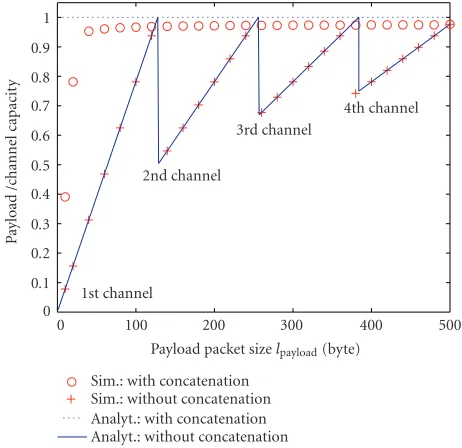
channel utilization as it is outlined inFigure 9. The channel
utilization as quotient of userpayloadand availablechannel
capacityis given through
payload
channel capacity =
lpayload
lpayload/packet size
·packet size (1)
in the case of no concatenation. The packet size of the
physical channel is assumed to be fixed and the packet
length of the user datalpayload determines if the segmented
higher layer SDU(s) fit(s) into a single PDU. We assume that an additional physical channel is established if the user data requires it. Thus, additional channel capacity is pro-vided and the available capacity is increased. In case of no concatenation, the fixed-sized packet is transmitted partly empty over the physical channel. Consequently, the
chan-nels’ overall utilization, that is, the effectively used
capac-ity compared to the amount of provided capaccapac-ity, is de-creased and follows a “zigzag” behavior when an additional physical channel is used as illustrated by the solid line in Figure 9.
The introduced example ofFigure 9focuses on the
seg-mentation aspects of the UMTS RLC in theunacknowledged
mode(UM). The UM of the RLC has the responsibility to
concatenate SDUs to a PDU of a predefined length, here 128 bytes. The simulative results with and without concate-nation are given by the markers. The payload packet size, that is, the user data, is increased up to 500 bytes and the channel utilization as introduced above is evaluated.
In applying the segmentation in a communication proto-col, the protocol overhead comes into play. Due to this over-head, more capacity than transmitted user data is required as
observable inFigure 9forlpayload=384 bytes in the case of no
1st channel
2nd channel
3rd channel
4th channel
0 100 200 300 400 500
Payload packet sizelpayload(byte)
0
Figure9: Utilization of channels with a fixed packet segmentation size of 128 bytes.
concatenation. The same stands for the usage of concatena-tion, as the observed channel utilization does not match the ideal one. The number of SDUs prepared for transmission in
a single PDU is here limited so that for smalllpayloadvalues, a
PDU is not completely filled. In summary, the parameteriz-able segmentation/reassembly module adequately reflects the expected behavior and can be validly used in a multimode capable protocol stack.
6.2. Transmission control protocol layer
As introduced above in Figure 7, a TCP layer can be
0 1000 2000 3000 4000 5000 Payload data frame length (byte)
0
0 1000 2000 3000 4000 5000
Size of data per packet (byte) 0
Figure10: TCP layer Go-back-N ARQ validation and evaluation. The protocol overhead to payload ration in dependency on the frame length of the payload data is depicted. The lines are analytic results corresponding to (2), while the markers indicate simulative evaluation. (a) Varied BER=10−5or 10−6and window lengthw=8. (b) Varied window lengthw=8 or 64 and BER=10−6.
part of the generic protocol stack. To validate the Go-Back-N mechanisms of the TCP layer’s ARQ module, we measure the protocol overhead in dependency on the payload packet size in the case of erroneous transmissions. The focus is thereby
on the influence of two effects: the bit error ratio (BER) of
the radio channel, that is, the wireless medium, and the size
of the send and receive windoww.
With a packet length oflpacket = lheader+lpayload, where
TCP has fixed header length oflheader =40 bytes, the packet
error ratio (PER) can be calculated to
PER=1−(1−BER)lpacket·8. (2)
Based hereon the overhead to payload quotient for the
Go-Back-N ARQ can be derived and approximated [12] to
overhead
where w is the length of the transmission window leading
to the analytical results as depicted inFigure 10. This figure
illustrates the overhead to payload ratio in dependency on
the frame length of the payload data for (a) a BER of 10−5
and 10−6 on the one hand and (b) window length of 8 and
64 on the other hand. Figure 10a shows the expected
per-formance corresponding to the Go-Back-N ARQ. The over-head to payload ratio increases with increasing bit error ra-tio and an optimal frame length for the payload data to minimize the said ratio can be determined. From the cross-protocol optimization perspective, this frame length may be used as a dimensioning rule for segmentation. The same
stands for Figure 10b: there the overhead-to-payload ratio
increases with increasing window length, as the amount of data which has to be retransmitted, in the case of an error
corresponding to the Go-Back-N ARQ, increases. The diff
er-ence between analysis and simulation for large payload data
frames in Figures10aand10bis reasoned by the send/receive
buffers of the implemented TCP layers. Data packets in these
buffers have to be discarded when an error is detected and are
neglected in the approximation (3). In summary, the ARQ
module of the generic protocol stack fulfils adequately its in-tended purpose.
6.3. IEEE 802.11 medium access control layer
In this section, the modular composition of an IEEE 802.11
MAC layer as illustrated in Figure 8is validated and
evalu-ated. Therefore, the average throughput of thecarrier sensing
10 20 30 40 50 60 70 80 90 100
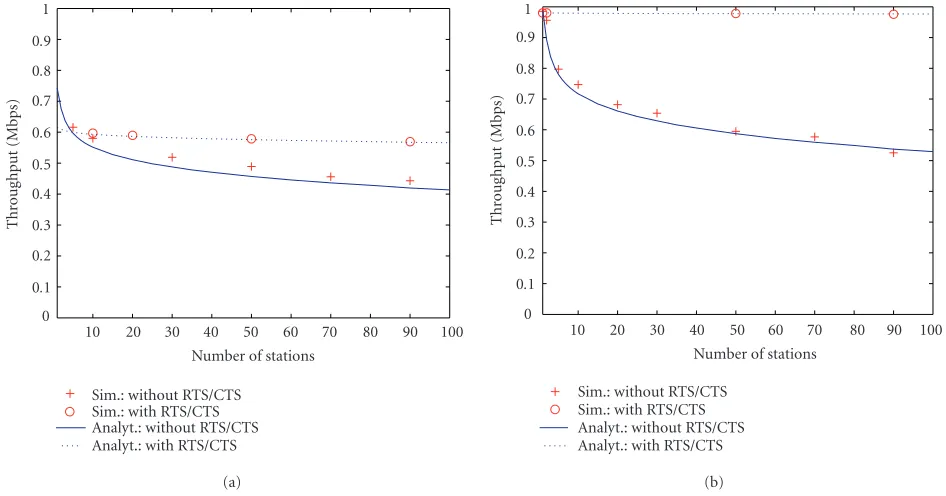
Figure11: 802.11 MAC layer evaluation of the DCF-based medium access under utilization of the ARQ module. The total system throughput depending on the number of transmitting stations is depicted. The lines are analytic results corresponding to (5), while the markers indicate the simulative evaluation. Throughput evaluation-channel capacity=1Mbps; (a) packet size=128 bytes, (b) packet size=4096 bytes.
Table1: Time slot durations in microseconds and probabilities that the medium is empty (e), successfully (s) allocated, or a collision (c) occurs [18,19]. The fixed values result from the time length of an RTS/CTS sequence.
Probability Duration with Duration without
RTS/CTS RTS/CTS
pe=(1−τ)n Te=1 Te=1 ps=nτ(1−τ)n−1 Ts=636 + 8lpayload Te=636 + 8lpayload
pc=1−pe−ps Te=170 Ts=234 + 8lpayload
The channel capacity is mainly wasted by two effects:
MAC header sending and collisions. One way to an analytical approach for determination of the throughput is to calculate
the collision probability pand the access probabilityτ with
the help of a two-dimensional Markov chain for the
mod-eling of the backoffwindow of the DCF [18,19] resulting
where n is the number of stations and W0 the minimum
backoff window size, here we chose W0 = 8. With the
help of the average time slot length Taverage on the basis of
Table 1, the average total system throughputtsaturationcan be
calculated to
tsaturation=
PsLpayload Taverage
, Taverage=PeTe+PsTs+PcTc. (5)
We assume a channel rate of 1 Mbps. The slot length, short interframe space (SIFS) and distributed coordination function IFS(DIFS) are 1, 6, and 10 microseconds resulting
into the analytical as well as simulative results ofFigure 11.
There, the overall system throughput, with and without RTS/CTS, in dependency on the number of stations is
de-picted. For small packets, Lpayload = 128 bytes, Figure 11a,
the headers are the main cause for an inefficient use of the
medium. For larger frames,Lpayload=4096 bytes,Figure 11b,
a collision wastes more time, as a transmitting station is only able to notice an interfered frame after its ending. Therefore, the RTS/CTS mechanism is introduced, to have just a small RTS frame lost in case of a collision. The simulation agrees mainly with the analytic determination of the throughput
of (5) and illustrates the superiority of the RTS/CTS-based
solution. As the ARQ module of the generic protocol stack
reflects the expected behavior of RTS/CTS mechanism [19],
this module can be legitimately used in an 802.11 MAC layer.
7. CONCLUSION
functions, takes up the usual advance of software engineering in the field of protocol development and evaluation: it has fallen back on well-proven and known protocol functions and behavior from the portfolio of the engineers’ experience. A generic realization of these functions in the form of inde-pendent modules results in a toolbox of protocol functions as a construction kit for protocol development. Dimensioning rules for an adequate support of QoS in wireless communica-tion from the perspective of the protocols can be derived. In
taking the tradeoffof genericity into account, these
thought-ful realized modules stimulate efficiency through
reusabil-ity and maintainabilreusabil-ity as well as accelerate the development process itself. However, the consideration of common pro-tocol functions and propro-tocol convergence during the devel-opment of future protocols will increase by itself the grade
of genericity and advantage of this approach. The efficiency
of protocol reconfigurability benefits from the introduced
generic approach and implies a clearly identified effort of
protocol management. Thus, the introduced approach is a first step to an end-to-end reconfigurable wireless system.
ACKNOWLEDGMENTS
The authors would like to thank the German Research Foun-dation (DFG) for funding the work contributed to this paper in the form of a Research College (Graduiertenkolleg). This work has been continously funded from third parties’ grants.
REFERENCES
[1] B. Walke, R. Pabst, and D. Schultz, “A mobile broadband sys-tem based on fixed wireless routers,” inProc. International Conference on Communication Technology (ICCT ’03), vol. 2, pp. 1310–1317, Beijing, China, April 2003.
[2] R. Pabst, B. Walke, D. Schultz, et al., “Relay-based deploy-ment concepts for wireless and mobile broadband radio,” IEEE Commun. Mag., vol. 42, no. 9, pp. 80–89, 2004. [3] IEEE, “Standard for Local and metropolitan area networks,
Part 16: Air Interface for fixed Broadband Wireless Access Systems—Amendment 2: Medium Access Control Modifica-tions and Additional Physical Layer SpecificaModifica-tions for 2-11 GHz,” April 2003.
[4] J. Mitola, “The software radio architecture,”IEEE Commun. Mag., vol. 33, no. 5, pp. 26–38, 1995.
[5] W. Tuttlebee,Software Defined Radio: Enabling Technologies, Wiley Series in Software Radio, John Wiley & Sons, New York, NY, USA, 2002.
[6] J. Mitola, Cognitive Radio, Ph.D. thesis, KTH, Stockholm, Sweden, 2000, pp. 45–90.
[7] P. M¨ah¨onen, “Cognitive trends in making: future of net-works,” inProc. IEEE 15th International Symposium on Per-sonal, Indoor and Mobile Radio Communications (PIMRC ’04), Barcelona, Spain, September 2004, invited paper.
[8] ITU-T Recommendation X.200, “Information Technology— Open System Interconnection—Basic Reference Model: The Basic Model,” International Telecommunication Union (ITU), Geneva, Switzerland, 1994.
[9] End-to-End Reconfigurability (E2R), IST-2003-507995 E2R, http://www.e2r.motlabs.com.
[10] N. C. Hutchinson and L. L. Peterson, “The X-Kernel: An ar-chitecture for implementing network protocols,”IEEE Trans. Software Eng., vol. 17, no. 1, pp. 64–76, 1991.
[11] J. M. Smith and S. M. Nettles, “Active networking: one view of the past, present, and future,”IEEE Trans. Syst., Man, Cybern. C, vol. 34, no. 1, pp. 4–18, 2004.
[12] L. Berlemann, A. Cassaigne, and B. Walke, “Generic protocol functions for design and simulative performance evaluation of the link-layer for reconfigurable wireless systems,” inProc. 7th International Symposium on Wireless Personal Multimedia Communications (WPMC ’04), pp. 5–5, Abano Terme, Italy, September 2004.
[13] L. Berlemann, A. Cassaigne, R. Pabst, and B. Walke, “Modu-lar link layer functions of a generic protocol stack for future wireless networks,” inProc. Software Defined Radio Technical Conference (SDR ’04), pp. 6–6, Phoenix, Ariz, USA, November 2004.
[14] M. Siebert and B. Walke, “Design of generic and adaptive pro-tocol software (DGAPS),” in Proc. International Conference on 3rd Generation Wireless and Beyond (3Gwireless ’01), San Francisco, Calif, USA, June 2001.
[15] L. Berlemann, M. Siebert, and B. Walke, “Software defined protocols based on generic protocol functions for wired and wireless networks,” inProc. Software Defined Radio Technical Conference (SDR ’03), Orlando, Fla, USA, November 2003. [16] J. Sachs, “A generic link layer for future generation wireless
networking,” inProc. IEEE International Conference on Com-munications (ICC ’03), Anchorage, Alaska, USA, May 2003. [17] L. Berlemann, R. Pabst, M. Schinnenburg, and B. Walke, “A
reconfigurable multi-mode protocol reference model facilitat-ing modes convergence,” inProc. 11th European Wireless Con-ference (EW ’05), Nicosia, Cyprus, April 2005.
[18] G. Bianchi, “Throughput evaluation of the IEEE 802.11 dis-tributed coordination function,” inProc. 5th Workshop on Mo-bile Multimedia Communications (MoMuc ’98), Berlin, Ger-many, October 1998.
[19] A. Hettich, “Leistungsbewertung der Standards HIPERLAN/2 und IEEE 802.11 f¨ur drahtlose lokale Netze,” Ph.D. disser-tation, RWTH Aachen University, Aachen, Germany, 2001, ABMT 23,http://www.comnets.rwth-aachen.de.
Lars Berlemannwas born in Aachen, Ger-many, in 1977. After having absolved a stu-dent internship at Infineon Technologies, San Jose, he received his Diploma degrees in electrical engineering and economics from Aachen University in 2002 and 2003, re-spectively. Since 2002, he served as a Re-search Assistant at the Chair of Communi-cation Networks (with Professor B. Walke) of RWTH Aachen University, where he is
Ralf Pabstwas born in Cologne, Germany, in 1974. After having absolved a student internships at SIEMENS ICN and Voda-fone Germany, he received his Diploma in electrical engineering from Aachen Univer-sity in 2001 and served since then as a Re-search Assistant at the Chair of Communi-cation Networks (with Professor B. Walke) of Aachen University, where he is work-ing towards his Ph.D. degree. He has been
working on various national and European Union funded research projects, such as the German National Project Multifunk, and the EU FP5 IST projects; Wireless Strategic Initiative (WSI), Wire-less World Research Initiative (WWRI), Network of Excellence in Wireless Applications and Technology (NEXWAY), and Aca-demic Network for Wireless Internet Research in Europe (AN-WIRE). He has been actively involved in the organization of the WG4 in the Wireless World Research Forum (WWRF). His cur-rent research activities are focused on the Wireless World Initia-tive New Radio (WINNER) Project under the 6th Framework Pro-gram (FP6) of the European Union. His research interests include the performance evaluation of relay-based deployment concepts for next-generation wireless networks, associated resource man-agement protocols, and spectral coexistence of wireless standards. He is the author/coauthor of 19 scientific publications, including 2 journal articles and 2 textbook chapters.
Bernhard Walkefor the last 13 years is run-ning the Chair for Communication Net-works, RWTH Aachen University, Ger-many, where about 35 researchers work un-der his guidance on topics like air-interface design, formal specification of protocols, fixed network planning, development of tools for stochastic event-driven simulation, and analytical performance evaluation of services and protocols of XG wireless