Volume 2007, Article ID 52492,16pages doi:10.1155/2007/52492
Research Article
TCP Traffic Control Evaluation and Reduction over Wireless
Networks Using Parallel Sequential Decoding Mechanism
Khalid Darabkh1and Ramazan Ayg ¨un2
1Electrical and Computer Engineering Department, University of Alabama in Huntsville, Huntsville, AL 35899, USA 2Computer Science Department, University of Alabama in Huntsville, Huntsville, AL 35899, USA
Received 12 April 2007; Accepted 9 October 2007 Recommended by Sayandev Mukherjee
The assumption of TCP-based protocols that packet error (lost or damaged) is due to network congestion is not true for wireless
networks. For wireless networks, it is important to reduce the number of retransmissions to improve the effectiveness of TCP-based
protocols. In this paper, we consider improvement at the data link layer for systems that use stop-and-wait ARQ as in IEEE 802.11
standard. We show that increasing the buffer size will not solve the actual problem and moreover it is likely to degrade the quality
of delivery (QoD). We firstly study a wireless router system model with a sequential convolutional decoder for error detection and correction in order to investigate QoD of flow and error control. To overcome the problems along with high packet error rate, we propose a wireless router system with parallel sequential decoders. We simulate our systems and provide performance in terms
of average buffer occupancy, blocking probability, probability of decoding failure, system throughput, and channel throughput.
We have studied these performance metrics for different channel conditions, packet arrival rates, decoding time-out limits, system
capacities, and the number of sequential decoders. Our results show that parallel sequential decoders have great impact on the system performance and increase QoD significantly.
Copyright © 2007 K. Darabkh and R. Ayg¨un. This is an open access article distributed under the Creative Commons Attribution License, which permits unrestricted use, distribution, and reproduction in any medium, provided the original work is properly cited.
1. INTRODUCTION
One of the major advantages of wireless networks over wired networks is the ability to collect data from locations where it is very costly or almost impossible to set up a wired net-work. Some applications of remote data collection have re-search interests in wild life monitoring, ecology, astronomy, geophysics, meteorology, oceanography, and structural engi-neering. In these systems, the data are usually collected by wireless end points (WEPs) having sensors. As the technol-ogy improves, WEPs maintain new types of data collection through new sensors. However, the capacity of the wireless system may fail to satisfy the transmission rate from these WEPs. Moreover, the transmission rate is not stable for WEPs in case of interesting events when multiple sensors are ac-tivated and the size of data to be transmitted increases sig-nificantly. Increasing the transmission rate may aggravate the system and channel throughput because of the signifi-cant number of retransmissions due to the high number of packets having errors and getting lost. The traditional TCP-based protocols cannot deal with the bandwidth errors since TCP assumes that packet loss occurs due to network
conges-tion [1]. Whenever a packet is lost, TCP systems decrease the sending rate to half [1,2] worsening the quality of de-livery (QoD). Moreover, the use of stop-and-wait ARQ in IEEE 802.11 [3] standard reduces the throughput for TCP-based protocols. Stop-and-wait ARQ is preferred because of the high error rate and low bandwidth in wireless channels. The TCP is usually improved in two ways, that is, by split-ting or end-to-end improvement [1]. In splitting, the hop that connects the wireless network to the wired network es-tablishes TCP from sender to itself and from itself to the re-ceiver. However, this type of splitting is against the semantics of end-to-end TCP [1]. In the alternate end-to-end adjust-ment, the sender adjusts its sending rate based on error rates and network congestion by probing the network or receiving messages from the receiver.
1.1. Quality of delivery
is improved. Thecomplete deliveryof email messages, docu-ment files, or any arbitrary filewith no errorsandas fast as possibleis a challenging objective of QoD that needs to be achieved. We define the QoD as the best effort strategy to in-crease the integrity of service using available bandwidth by customizing data link layer without promising or preallocat-ing resources for the sender (i.e., traffic contract) as in qual-ity of service (QoS). The major goal in QoD is to maximize the quality under given specific resources without any ded-ication for the sender. Therefore, our strategies enhance the quality of service (or quality of data) obtained at the receiver. When looking into the network architecture or delivery path (source, intermediate hops, channels, and destination), the intermediate hops (like routers) play critical role in achieving the best optimistic QoD. In general, the intermediate hops mainly consist of (a) a queue or buffer to store packets that arrive from the channel and (b) a server to process the ar-riving packets and deliver them to the next hop. TCP/IP is a connection-oriented suite that consists of communication protocols [4] that offer end-to-endreliability, in-order deliv-ery, and traffic control. Consequently, the in-time delivery is not an accomplished goal. Thus, deliverywith very low num-ber of retransmissionsis so important to overcome in-time de-livery problem. It becomes one of the major targets for good QoD. Therefore, the traffic control by reducing the number of retransmissions should be achieved in a way to accomplish the necessary QoD.
1.2. TCP traffic control
Flow, congestion, and error controls [5] are the parts of the traffic control. It is known that flow control protects the re-cipient from being overwhelmed, while congestion control protects the network from being overwhelmed. Flow control and network congestion affect each other. High system flow may lead to possible network congestion. Consequently, net-work congestion causes longer delivery time. The automatic repeat request (ARQ) [6] refers to error control that utilizes error detection techniques (e.g., parity bits or cyclic redun-dancy check (CRC) code), acknowledgments, timers, and re-transmissions. In this paper, we focus on stop-and-wait ARQ since it is employed in IEEE 802.11 protocol. This method needs lower system requirements than other protocols (like sliding window) since there is just one packet coming at a time from the transmitter side (i.e., it needs less system ca-pacity since less data need to be retransmitted in case of error as no packets are transmitted until ACK has been received). Actually, the major purpose of using stop-and-wait ARQ is to prevent possible network congestion since multiple simul-taneous packets sending (like sliding window approach) over noisy channels may clearly cause network congestion. To re-duce the number of retransmissions, error correction is a necessary step to be accomplished at the data link layer espe-cially in wireless networks. Convolutional decoding [7] us-ing sequential decodus-ing [8,9] algorithms is an error detec-tion and correcdetec-tion technique. In fact, it is widely used in telecommunication environments. Sequential decoding has variable decoding time and is highly adaptive to the channel parameters such as channel signal-to-noise ratio (SNR). This
is so important in wireless environments since the packet er-ror rate (PER) is a function of weather conditions, urban ob-stacles, multipath interference, mobility of end stations, and large moving objects [1]. It is very powerful decoding mech-anism since it is able to detect and correct errors extensively. Furthermore, it has a great impact on the router system flow and network congestion since it is able to increase the de-livery time by decreasing the unnecessary router system flow and network congestion accordingly.
The finite buffer of router system buffer (system capac-ity) is used to absorb the variable decoding rate. The size of that finite buffer has an impact on the system through-put and clearly it cannot be chosen arbitrarily. When the size is too small, the probability of dropping (discarding) pack-ets increases. Therefore, the incoming flow increases due to retransmission of lost packets. Consequently, the congestion over the network increases. When the buffer size is not sat-isfactory, a quick (but ephemeral) remedy is to increase the buffer size. However, large buffer sizes promote the delay for getting service (waiting time) since more packets are in the queue to be served. This may also increase the flow rate and congestion over the network because of the unnecessary re-transmissions due to the time-out of sender. Increasing the buffer size may not correspond to more than paying more for worse QoD. Therefore, the buffer size has a significant impact on the flow and congestion controls. The expected advan-tage of using sliding window approach is its higher system throughput and faster delivery. Unfortunately, it may signifi-cantly increase the network congestion and decrease the QoD accordingly if it is employed with sequential decoding. Ac-tually, our results show that we cannot get a high system throughput even for stop-and-wait ARQ when the network is congested. In wireless networks, the damage (packet error rate (PER)) is much larger than in wired networks. There-fore, the decoding time is much larger. Consequently, the sys-tem buffer is utilized too fast and early.
1.3. Our approach
To resolve these issues, we propose a router system that ef-fectively works for stop-and-wait ARQ at the link layer while decreasing number of retransmissions using sequential de-coding. We propose that if this router system is used as wire-less router, access point, or even end point, the number of retransmissions can be reduced significantly, thus increasing the effectiveness of TCP protocols. Our system targets the low bandwidth and high error rate for wireless channels. In this sense, our system is hop-to-hop rather than end-to-end. We claim that the data transmitted from the WEPs should be cor-rected as early as possible.
environment. Our system can be considered as type-I hybrid ARQ with sequential decoding. Type-I hybrid ARQ is widely implemented with forward error correction (FEC) [10–13]. Our experiments show that our router system with parallel sequential decoders reacts better to noisy channels and high system flow. Our router system with parallel sequential de-coders has yielded low packet waiting time, low loss proba-bility, low network congestion, low packet error rate (PER), and high system throughput. Our simulator for router sys-tem having parallel sequential decoders is implemented us-ing Pthreads API package under a symmetric multiproces-sors (SMPs) system with 8 procesmultiproces-sors. Our both simula-tors are based on stochastic modeling by using discrete-time Markov chain.
The contributions of this paper are as follows:
(1) introduction of a novel wireless router system with
parallel sequential decodingmechanism that works ef-ficiently with
(i) finite reasonable system capacity; (ii) hop-to-hop system;
(iii) stop-and-wait ARQ;
(iv) especiallywireless environments;
(2) simulation for (singular) sequential decoding algo-rithms forfinitebuffer systems;
(3) evaluating the average buffer occupancy, blocking probability, system throughput, probability of failure decoding, and channel throughput that represent the major impacts on the number of retransmissions and complete delivery time;
(4) showing the problems caused by large buffer size when operating a sequential decoder;
(5) simulation of novel parallel sequential decoding sys-tem for finite buffer systems;
(6) mitigating the congestion and increasing the QoD with
high system and channel throughputsusing parallel se-quential decoding system.
This paper is organized as follows. The following section describes the background on channel coding.Section 3 de-scribes the system for a sequential decoder with a finite buffer system. The simulation results for a sequential decoder are discussed inSection 4.Section 5explains the parallel sequen-tial decoder system and simulation results. The last section concludes our paper.
2. CHANNEL CODING
Channel coding [14,15] is a process to add redundant bits to the original data bits to immune the system against noise. The most common coding techniques that are used in chan-nel coding are linear block code, CRC codes, and convolu-tional codes. Figure 1 shows the block diagram of coding. In linear block code, the data stream is divided into several blocks of fixed lengthk, where each block is encoded into a code word of lengthn > k. This method presents very high code rates,k/n(the overall data rate isRoverall=(n/k)Rsource), usually above 0.95. This leads to high information content in code words. It has a limitation on error correction
capabil-Source coding
Channel coding
Source
Compressor
Encoder
Destination
Decompressor
Decoder
Noisy channel
Figure1: Block diagram of coding.
C1
Code word=C1C2C3· · ·CN
K-bit N-bit
S1 S2 S3 · · · SL
C2
C3
Figure2: Encoder block (shift register) using convolutional codes.
ities. It is useful for channels with low raw error rate prob-abilities and less bandwidth. CRC code is one of the most common coding schemes used in digital communications. It is very easy to be implemented in electronic hardware and ef-ficient encoding and decoding schemes, but it supports only error detection. Therefore, it must be concatenated with an-other code for error correction capabilities.
2.1. Convolutional code
Convolutional code [16] is an advanced coding technique that is designed to mitigate the probability of erroneous transmission over noisy channel. In this method, the entire data stream is encoded into one code word. It presents code rates usually below 0.90, but with very powerful error correc-tion capabilities. It is useful for channels with high raw error rate probabilities, but it needs more bandwidth to achieve similar transmission rate.
A convolutional coder consists of anL-stage shift regis-ter andncode word blocks’ (seeFigure 2) modulo-2 adders (XOR gates). Therefore, it has a constraint lengthL.Figure 2
2.2. Maximum likelihood decoding and sequential decoding
There are two important decoding algorithms for convolu-tional codes: the maximum likelihood decoding (Viterbi’s al-gorithm) and sequential decoding. Viterbi decoding [17,18] was developed by Andrew J. Viterbi, a founder of Qualcomm Corporation. It has a fixed decoding time. It is well suited to hardware decoder implementations. Its computational and storage requirements grow exponentially as a function (2L) of the constraint length, and they are very attractive for con-straint length L < 10. To achieve very low error probabili-ties, longer constraint lengths are required. Thus, Viterbi de-coding becomes infeasible for high constraint lengths (there-fore, sequential decoding becomes more attractive). Con-volutional coding with Viterbi decoding has been the pre-dominant forward error correction (FEC) technique used in space communications, particularly in satellite communica-tion networks such as very small aperture terminal (VSAT) networks.
Sequential decoding was first introduced by Wozencraft for the decoding of convolutional codes [16,19–21]. There-after, Fano developed the sequential decoding algorithm with a milestone improvement in decoding efficiency [7,22,23]. The sequential decoding complexity increases linearly rather than exponentially. It has a variable decoding time. A sequen-tial decoder acts much like a driver who occasionally makes a wrong choice at a fork of a road then quickly discovers the er-ror (because of the road signs), goes back, and tries the other path. In contrast to the limitation of the Viterbi algorithm, sequential decoding [24–26] is well known for its computa-tional complexity being independent of the code constraint length. Sequential decoding can achieve a desired bit er-ror probability when a sufficiently large constraint length is taken for the convolutional code. The decoding complexity of a sequential decoder becomes dependent on the noise level [14,23]. These specific characteristics make the sequential decoding very useful.
The sequential decoder receives a possible code word. According to its state diagram, it compares the received se-quence with the possible code word allowed by the decoder. Each sequence consists of groups and each group consists of
ndigits. It chooses the path whose sequence is at the shortest Hamming distance (HD) from the firstnreceived digits (first group), then it goes to the second group of thenreceived dig-its and chooses the path whose sequence is the closest to these received digits. It progresses this way. If it is unlucky enough to have a large number of (cumulative) errors in a certain re-ceived group ofndigits, it means that it took the wrong way. It goes back and tries another path.
3. DISCRETE-TIME MARKOV CHAIN MODEL
We simulate the router system with sequential decoding as a service mechanism using discrete-time Markov model. In this model, the time axis is portioned into slots of equal length. This slot time is precisely the time to transmit a packet over the channel (i.e., propagation time plus trans-mission time). We assume that all incoming packets have the
same size. This is the case if we send Internet packets (typi-cally of size 1 KB) over a wireless link (where packets have the size of around 300 bytes) or over the so-called ATM networks (in which cells have the size of 52 bytes). Thus, the router sys-tem can receive at most one new packet during a slot. In this paper, we use practical assumption that the buffer is of finite length to be close to real environment. Hence, any packet loss happens during transmission due to lack of buffer space; a packet retransmission will occur from the sender side if time-out occurs or negative ACK arrives. This retransmission is based on stop-and-wait ARQ. However, the new packets ar-rive at the decoder from the channel according to Bernoulli process. A slot carries an arriving packet with probabilityλ
and it is idle (no transmission) with probability 1−λ. SNR increases as the signal power gets larger than noise power. This indicates that the channel is getting better (not noisy). Thus, low decoding time may suffice. On the other side, if SNR decreases, this represents that the noise power gets larger than signal power. Therefore, the channel is get-ting worse (noisy). Consequently, larger decoding time is re-quired. To demonstrate that variable decoding time, we need a distribution with a dominant parameter to represent SNR of the channel such that when it gets higher and higher, the probability density function of that distribution goes to zero earlier and earlier accordingly. On the other hand, when it gets lower and lower, the chance of going to zero is lower and lower. In fact, it can also go to infinity. Thus, there should be a limit employed to prevent that case. Moreover, we need a parameter that determines the minimum value that a ran-dom variable can take to represent the minimum decoding time. Actually, the Pareto (heavy-tailed) distribution [27,28] is the best fit to demonstrate this variable decoding time. Thus, the decoding time follows the Pareto distribution with a parameterβ, which is a function of SNR. The buffer size is assumed to be at least one. We make another assumption that the decoding time of a packet is in chunks of equal length to the slot size. That is, the decoder can start and stop decod-ing only at the end of a slot. This assumption replaces the continuous distribution function of the decoding time by a staircase function that is a pessimistic approximation of the decoding time. This approximation yields an upper bound on the number of packets in the queue [27,29,30]. In or-der to make this protocol consistent with our assumptions, we assume that each slot corresponds to exactly the time to transmit a packet over the channel (propagation time plus transmission time).
(1−λ)μ1 (1−λ)μ1 (1−λ)μ
Figure3: Probability state transitions of the router system with a buffer and a sequential decoder.
ARQ. Therefore, if a decoding failure occurs, the packet is retransmitted at the following slot, while the decoder starts at that slot decoding another packet if there is any in the buffer. Therefore, the channel carries a retransmitted packet during the slot that follows decoding failures. Consequently, new packets cannot arrive in those slots but can be transmit-ted during all the other slots.
The state of the system with just a sequential decoder can be represented [27,30] by (n,t,w), wherenis the number of packets in the buffer including the packet being decoded,t
is the number of slots the decoder has already spent on the packet that is currently being decoded, andwis the number of packets to be retransmitted. Since the system has a finite system capacity, the value ofnmust be limited between 0 and the maximum permitted system capacity (0≤n≤N). If the decoder needs more thantslots to be completely decoded, then decoding failure occurs. Therefore, it has to be retrans-mitted.Figure 3shows the probability state transitions of the router system with a buffer and a sequential decoder.Pn,t,w is the probability that the decoder’s buffer containsn pack-ets including the one being decoded, the decoder is in thetth slot of decoding, and there arewpackets that need to be re-transmitted. The summation of all the outgoing links (prob-abilities) from each state must be equal to one.
We use the notations that are mentioned in prior re-searches [29,30,32,34].ck denotes the probability of de-coding being completed in exactlykslots, andμkdenotes the conditional probability that decoding is completed inkslots
given that the decoding is longer thank−1 slots. Then, the conditional probabilityμkis given by
μj=
i=1ciis the cumulative distribution function (CDF) of the decoding time. It can be shown that
j
The decoding time of sequential decoders has the Pareto dis-tribution
whereτ0 is the decoding time for which the probability is 1, that is, the minimum time the decoder takes to decode a packet, andβis called the Pareto parameter and it is a func-tion of the SNR of the channel.
4. SIMULATION OF A ROUTER SYSTEM WITH A SEQUENTIAL DECODER
Channel
for the succeeding slot
Signal to transmitter
Figure4: A router system with a sequential decoder using stop-and-wait ARQ. Packet arriving probability (λ)
β=1.5,T=100
β=1.5,T=10
Figure5: Average buffer size versus packet arriving probability (β=
1.5).
4.1. Simulation setup
The simulation of the sequential decoding system is done in MATLAB. The goal of this simulation is to measure the av-erage buffer size, channel throughput, system throughput, blocking probability, and decoding failure probability. The sequential decoding system is simulated using stop-and-wait ARQ model. Therefore, the time axis is portioned into slots of equal length where each slot corresponds to exactly the time to transmit a packet over the channel (i.e., propaga-tion time plus transmission time).Figure 4shows the typical structure of a router system that works on the data link layer (specifically in the logical link control sublayer) since we are working hop-to-hop not end-to-end. We assume that all the incoming packets have equal lengths (e.g., ATM networks or wireless links). Accordingly, the decoder can receive at most one new packet during a slot.
The primary steps in our simulation are as follows. A ran-dom number generator for Bernoulli distribution is invoked at the beginning of every time slot to demonstrate the arrival of packets. A random number generator for Pareto distribu-tion is invoked at the beginning of any time slot as long as there are packets in the queue waiting for service to demon-strate the heavy tailed service times. The minimum service
10−1 Packet arriving probability (λ)
β=1,T=100
β=1,T=10
Figure6: Average buffer size versus packet arriving probability (β=
1.0).
time is assumed to be one. The decoding time-out slots (T) and system capacity are taken as inputs of the simulation.
4.2. Simulation results
Figure 5shows the average buffer size versus packet arriving probability (λ) for fixed channel condition (β = 1.5), sys-tem capacity of 900, and different decoding time-out slots (10 and 100). The simulation time is 4×10⁵slots. For fixed decoding time-out slotsTandβ, the average buffer size in-creases as packet arriving probability inin-creases and it reaches the system capacity accordingly. This is expected since in-creasingλmeans increasing the probability of arriving pack-ets to the router system. For fixedλandβ, it is also seen that the average buffer size increases as the decoding time-out slots (T) increase. This is expected since increasing the de-coding time-out limit means getting low probability to serve more packets and high probability for the buffer to be filled up early accordingly.
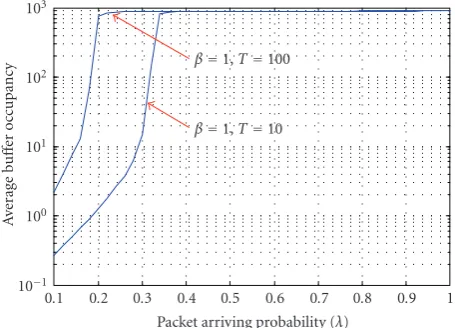
Figure 6represents the average buffer size versus λ for
β=1.0. The simulation time is 4×10⁵slots, system capacity is 900, and decoding time-out slots are 10 and 100. From Fig-ures5and6, it is noticed that the average buffer size increases as channel conditionβdecreases of course for fixedTandλ. This is expected since decreasingβmeans that the channel gets worse (i.e., noisy). Thus, high decoding slots are gener-ated from Pareto random number generator. Consequently, the buffer inFigure 6is filled up earlier than that inFigure 5. It is also interesting to see that the buffer is filled up too early in terms of packet arriving probability. For example, forβ = 1.0, the system reaches its capacity around packet arriving probabilitiesλ=0.35 andλ=0.25 forT=10 and
T=100, respectively. While inFigure 5, forβ=1.5, the sys-tem reaches its capacity around packet arriving probabilities
λ=0.52 andλ=0.44 forT=10 andT=100, respectively.
0.4 Incoming packet probability (λ)
β=0.8,T=100
β=1,T=100
β=1,T=10
Figure7: Blocking probability versus incoming packet probability
(β=0.8, 1.0). Incoming packet probability (λ)
β=1,T=10
β=1,T=100
Figure8: System throughput versus incoming packet probability
(β=1.0).
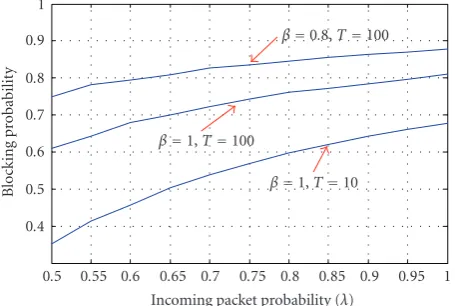
incoming packet probability increases. This is expected since there is higher flow rate. For fixed channel condition and incoming packet probability, the blocking probability in-creases as decoding time-out limit inin-creases. This is also ex-pected since increasingT means getting low probability for the buffer to have available space. For fixed incoming packet probability and decoding time-out limit, the blocking prob-ability increases as channel condition decreases. When the channel condition decreases, the SNR decreases leading to a high noise power (i.e., there is high distortion). Conse-quently, largeT is generated from Pareto random number generators trying to detect and correct the errors in currently noisy served packet.
Figure 8illustrates the system throughput versus packet arriving probability given the channel conditionβ=1.0. The system throughput can be explained as the average number of packets that get served (decoded) per time slot. One im-portant observation we can notice from this figure is that the system throughput goes firstly linear and then the sys-tem cannot respond to increasing incoming packet proba-bility leading to a nonincreasing system throughput. Thus,
we have two trends of system throughput. It is so interesting to see that when system throughput is linear, the slope be-comes equal to the incoming packet probability (λ). In fact, this indicates that all the incoming packets are being served without any packet loss. The other trend is when the system throughput does not respond to the increase in the incoming packet probability. Actually, there are two interesting expla-nations for this drastic change. The first one is that change is due to starting discarding (dropping) packets. Therefore, the system throughput is getting lower than the incoming packet probability. Why does the system throughput almost get constant although there is noticed increasing in the in-coming packet probability? It is because the blocking prob-ability is not constant when the incoming packet probabil-ity is increasing, but instead it is increasing.Figure 7 veri-fies this explanation. Therefore, it is true that as the packet arrival rate increases, the total number of discarded packets also increases. Thus, the system throughput almost reacts in the same way and does not change significantly. Actually, this is a very good indication that the congestion over the net-work is obvious since there is not that much gain in the sys-tem throughput while increasing the incoming packet prob-ability. The effect of increasing the decoding time-out limit for fixed channel condition and packet arriving probability is shown inFigure 8. In fact, increasing the decoding time-out limit leads to increasing the blocking probability and de-creasing the system throughput.
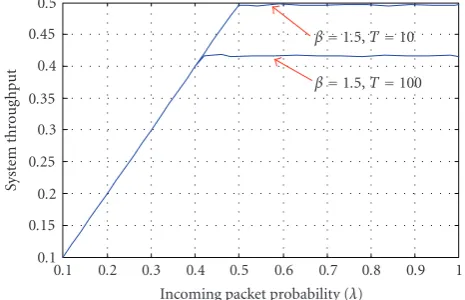
Figure 9illustrates the system throughput versus packet arriving probability for a different channel condition (β = 1.5). Figures8 and9 show the effects of employing diff er-ent values of channel condition. Therefore, for a fixed value of packet arriving probability and decoding time-out limit, the system throughput increases as the channel condition in-creases. This is expected since increasing the channel condi-tion means that the channel gets better (i.e., flipping of the transmitted bits of packets is being reduced).
5. WIRELESS ROUTER SYSTEM WITH PARALLEL SEQUENTIAL DECODERS
0.1 Incoming packet probability (λ)
β=1.5,T=10
β=1.5,T=100
Figure 9: System throughput versus packet arriving probability
(β=1.5).
5.1. Stochastic simulation details and flowcharts
This program (simulator) is designed to simulate a router system with more than one sequential decoder with a shared buffer.Figure 10shows this system. It is seen that all the se-quential decoders share the same finite buffer. In fact, we manage the traffic over the router system by using sequen-tial decoding to reduce the packet error rate (PER) and this clearly refers to a type of error control. Moreover, we add parallel sequential decoders to mitigate the congestion over the router system due to having finite available buffer space. We see inSection 4that the average buffer occupancy reaches the system capacity too early leading to an increase in the blocking probability as the incoming packet probability in-creases when using a sequential decoder with a system ca-pacity of 900 (which is practically very large). In fact, this may be the major drawback of using the sequential decod-ing. However, we can overcome this drawback and further-more reduce a clearly possible congestion over the network by implementing parallel sequential decoding environments. There is also one more interesting improvement with this simulator. In fact, it is the ability to extend (increase) the de-coding time-out limit in case of noisy channels. We are so worried in a router system model with just a sequential de-coder about this limit since it is affecting the buffer badly (as seen inSection 4). This simulator has been performed using Pthreads API that is defined in the ANSI/IEEE POSIX 1003.1, which is a standard defined only for the C language. This pro-gram has been executed on a Sun E4500 SMPs (symmetric multiprocessors) system with eight processors. In this sys-tem, all the processors have access to a pool of shared mem-ory. Actually, this system is known as uniform memory access (UMA) since each processor has uniform access to memory (i.e., single address space).
The main problem of SMP is synchronization [35,36]. Actually, synchronization is very important in SMP and needs to be accomplished since all processors share the same memory structure. It can be achieved by using mutual exclu-sion, which permits at most one processor to execute the crit-ical section at any point. It is known that the enforcement of
mutual exclusion may create deadlock and starvation control problems. Thus, the programmer/developer must be careful when designing and implementing the environment. There are a lot of methods for controlling access to critical regions. For example, there are lock variables, semaphores (binary or general semaphores), and monitors. Pthreads API uses mu-texes; mutex is a class of functions that deal with synchro-nization. Mutex is an abbreviation for “mutual exclusion.” Mutex functions provide creation, destruction, locking, and unlocking mutexes. Mutex variables are one of the primary means of implementing thread synchronization and protect-ing shared data when multiple writes occur.
5.2. Structures, constants, declarations, and initializations
The key structures and entities that are required for the sim-ulation are buffer status structures, threads structure, tar-get structure,corrupted packets structure,Bernoulli random number generator (BRNG) structure, constants entity, and POSIX critical sections entity.
Buffer status is represented with five attributes:current slot (the current slot of the simulation),Sys curr state(the number of available packets in the system), arrival lost packet (the accumulative number of the packets being lost due to full buffer),total arriving packets(the total number of arriving packets to the router system), and time history
(history or record of the total number of the packets in the system for every slot time). Threadsstructure refers to se-quential decoder (leader or slave decoder). It has two im-portant attributes: leader thread (set when it is in decod-ing process) andthreads counter (the number of jobs wait-ing for a slave decoder). The threads and mutex are ini-tialized inside main thread initialization. In our simula-tions, there is one leader sequential decoder, and the rest are considered as slave sequential decoders. Target struc-ture is used for simulator statistics and has two impor-tant attributes: mean buffer size (the average buffer occu-pancy at stationary conditions) andblocking prob(the prob-ability of packets being dropped (discarded) due to lim-ited system capacity). Corrupted packetsstructure has two at-tributes used for the management of corrupted packet pool:
packet failure(the number of packets facing decoding fail-ure) andcorrupted pcts counter(the number of packets that cannot be decoded even with retransmission). Bernoulli ran-dom number generator (BRNG) represents the probability of arrival packets for a certain slot time. Constants entitymain-tains the six input attributes: num threads (the maximum number of threads in the simulation),sim time(the simula-tion time),system cap(the maximum buffer size),beta(the channel condition),min serv slots(the minimum decoding time in terms of time slots), andT(the maximum time-out decoding slots limit). POSIX critical sections entity declares the mutex for three necessary critical sections (shown in Fig-ures11–14) for synchronization.
5.3. System behavior
Channel
for the succeeding slot Signal to transmitter
Figure10: Router system with parallel sequential environment and single address space structure.
Starting of Leader decoder Thread termination and
deletion (killing)
No Yes
thread par.leader thread=0; // ON Ending of
Leader decoder
buffpar.current slot
<=sim time Call Pareto RNG for decoding: (Decoding time slots) Yes
pct corr.corrupted pcts counter
>=1
No Yes
Call Bernoulli RNG: Packet arr
pthread mutex lock (&count mutex2); buffpar.current slot +=1; // next slot buffpar.total arriving packets +=num arr1; buffpar.Sys curr state +=num arr1;
Packet arr=1
No Yes
buffpar.Sys curr state-system cap>0
max=0;
max=buffpar.Sys curr state -system cap; buffpar.Sys curr state=system cap;
For loop
Fori=1 to Decoding time slots
No Yes
pthread mutex lock (&count mutex1); pct corr.Packet failure +=1;
pct corr.corrupted pcts counter +=1; pthread mutex unlock (&count mutex1);
buffpar.arrival lost packet +=max;
buffpar. time history [buffpar.current slot]=buffpar.Sys curr state; pthread mutex unlock(&count mutex2);
Exit from the loop Loop expired thread par.leader thread=1; // one means off
Ending of Leader decoder Thread termination and deletion (killing)
Main thread simulation
fin par.Mean buffer size[j]=sum
/ buffpar.current slot;
fin par.Blocking prob[j]=
buffpar.arrival lost packet /
buffpar.total arriving packets;
fin par.Decoding failure prob[j]=
pct corr.Packet failure /
buffpar.total arriving packets;
pct corr.Packet failure=0;
pct corr.corrupted pcts counter=0;
buffpar.current slot=1;
buffpar.Sys curr state=0;
buffpar.arrival lost packet=0;
buffpar.total arriving packets=0;
berno in.prob=berno in.prob + 0.02;
j=j+ 1; // for next probability
Call Bernoulli RNG: Packet arr
ALL done
Initialized sum by zero Thread
buffpar.current slot
Sum=sum +
buffpar.time history[i];
buffpar.Sys curr state
<1 && thread par.leader thread
==1 (OFF)
pct corr.corrupted pcts counter
>0
Call Bernoulli RNG: Packet arr
buffpar.Sys curr state=Packet arr
+ buffpar.Sys curr state;
buffpar.time history [buffpar.current slot]=
buffpar.Sys curr state;
buffpar.Sys curr state
>=1 && pct corr.corrupted pcts counter
>=1
Packet arr=1
Corrupted packets block
buffpar.total arriving packets=Packet arr
+ buffpar.total arriving packets
buffpar.Sys curr state=Packet arr
+ buffpar.Sys curr state;
buffpar.time history [buffpar.current slot]=
buffpar.Sys curr state;
While loop
berno in.prob<=1
Loop done While loop
buffpar.current slot
<=sim time
tempcheck=buffpar.current slot;
buffpar.Sys curr state>=1 && pct corr.corrupted pcts counter
==0
Uncorrupted packets block
pthread mutex lock (&count mutex1);
pct corr.corrupted pcts counter=
pct corr.corrupted pcts counter−1;
pthread mutex unlock (&count mutex1);
buffpar.current slot=buffpar.current slot+1;
buffpar.total arriving packets=Packet arr
+ buffpar.total arriving packets
Figure12: Major decoding steps for main thread.
and responsibilities of these components in our simulator. In this section, we use the terms thread, processor, and decoder interchangeably.
In our simulation environment, each thread represents asequential decoderexcept the main thread (processor). We assume that there is just one packet that may arrive for any arbitrary slot time to be fully compatible with stop-and-wait handshaking mechanism. All the attributes of thebuffer sta-tus structure are required to be updated accordingly. Dur-ing the decodDur-ing slots, there may be arrivals to the system. We need to use sequential decoders to demonstrate the ar-riving process during decoding slots. Unfortunately, we can-not attach the arriving process to every decoder since one packet may arrive during any decoding slot. Therefore, we have defined (classified) two types of decoders: leader and slave. There is only one leader decoder but there might be many slave decoders. In our model, the main thread gives the highest priority for decoding for the leader decoder. But, in other cases, we cannot attach the arriving process to those slaves (since there are many) when the leader processor is not busy (decoding). Thus, in our model, this arriving process at such cases is handled by the main thread especially the first slot of our simulation. Furthermore, the leader and slave de-coders have common responsibilities that are packet decod-ing and management of corrupted packet pool.
Before the leader processor starts decoding, it modifies theleader threadattribute ofthreads structureto 0 indicat-ing that it is currently busy and then it starts decodindicat-ing. Af-ter finishing its decoding, it increments this attribute to 1 indicating that it is currently free waiting to serve another packet. On the other hand, slave processors start decoding af-ter decrementing thethreads counterattribute of thethreads structure.In fact, this attribute represents the level of utiliz-ing the slave decoders. Whenever they finish decodutiliz-ing, they increment this attribute. Since all slave processors may access this attribute at the same time, it is synchronized by the third critical section inside thePOSIX critical sectionsentity. Each decoder before decoding calls Pareto random number gen-erator (PRNG) to get the number of decoding slots needed for that packet. The inputs for that PRNG aremin serv slots
andbeta.Figure 11shows the flowchart that shows the du-ties of the leader decoder. The leader and slave processors are responsible forcorrupted packet pool. Whenever a packet de-coding exceeds the given dede-coding time-out limit, a partial decoding occurs and the corrupted packet pool is updated. In our simulation, this process can be managed through the
corrupted packetsstructure. These attributes are shared (i.e., all parallel decoders may need to use these simultaneously).
buffpar.Sys curr state==1 && thread par.leader thread==0 &&
thread par.threads counter>=1
NO Yes
Enter the critical section (2): pthread mutex lock (&count mutex2);
buffpar.Sys curr state=buffpar.Sys curr state
−1;
buffpar.time history [buffpar.current slot]=
buffpar.Sys curr state;
Exit the critical section (2): pthread mutex unlock (&count mutex2);
A slave processor creation
No buffpar.Sys curr state>= Yes
NUM THREADS
Block continues (next figure)
BLOCK O/P
No Yes
buffpar.current slot>
tempcheck
No buffpar.Sys curr state==1 Yes
&& thread par.leader thread==1
Enter the critical section (2): pthread mutex lock (&count mutex2);
buffpar.Sys curr state=buffpar.Sys curr state
- thread par.leader thread;
buffpar.time history [buffpar.current slot]=
buffpar.Sys curr state;
Exit the critical section (2): pthread mutex unlock (&count mutex2);
Leader processor creation
BLOCK O/P
Uncorrupted packets block
BLOCK I/P
thread par.leader thread
==1
Call Bernoulli RNG: Packet arr
Enter the critical section (2) pthread mutex lock (&count mutex2);
buffpar.current slot=buffpar.current slot +1
buffpar.total arriving packets=Packet arr
+ buffpar.total arriving packets
buffpar.Sys curr state=Packet arr
+ buffpar.Sys curr state;
No buffpar.Sys curr state Yes
- system cap>0
max=buffpar.Sys curr state - system cap;
buffpar.Sys curr state=system cap;
max=0;
buffpar.arrival lost packet=buffpar.arrival lost packet + max;
buffpar. time history [buffpar.current slot]=buffpar.Sys curr state;
No Yes
Exit the critical section (2): pthread mutex unlock (&count mutex2);
Figure13: Major simulation steps for uncorrupted packets block shown inFigure 12.
slot has an arriving packet. The buffer status structure is required to be updated. Furthermore, thesys curr state at-tribute is required to be checked every slot time in order to ensure that it will not exceed the system capacity. Therefore, if a loss occurs, thearrival lost packetattribute must be im-mediately updated. The system current state must be main-tained to be equal to the system capacity accordingly. More-over, thetotal arriving packetsattribute must be incremented if there is an arrival regardless of whether loss happens or not. In our approach, controlling the arriving process is done once either by the buffer controller or by the leader decoder. For every slot time, the system current state becomes less than one and leader decoder is not busy; the buffer controller calls BRNG if corrupted pcts counter attribute (defined in
corrupted packetsstructure) is zero. Otherwise, there is a re-transmitted packet. The corrupted pcts counter attribute is required to be decremented accordingly. It is possible that in those cases the slave decoders are performing decoding. Therefore, they may update this attribute simultaneously with the buffer controller.
Thebuffer controlleris responsible for dispatching decod-ing for a packet if there is any in the buffer waiting for ser-vice and there are available (not busy) sequential decoders.
It may dispatch decoding for every slot time except the first slot since we started from that slot (i.e., system current state is zero at that slot). Whenever it dispatches decoding, it updates the system current state by decrementing a number referring to the total number of dispatched decoders. It also updates the time history vector of the buffer status structure with current number of waiting packets. Actually, the dispatch-ing process depends onsys curr state attribute, leader pro-cessor, and slave processors. For example, if thesys curr state
is zero, the buffer controller cannot dispatch decoding. If the
Yes thread par.threads counter &&buffpar.Sys curr state<= NO
thread par.leader thread==0
Enter the critical section (2):
buffpar.Sys curr state=buffpar.Sys curr state
- thread par.threads counter
buffpar.time history[buffpar.current slot]
=buffpar.Sys curr state
Exit of the critical section (2):
Slaves threads creation
Uncorrupted packets block (continuous)
No thread par.threads counter &&buffpar.Sys curr state<= Yes
thread par.leader thread==1
temp=buffpar.Sys curr state-1
Enter the critical section (2):
buffpar.Sys curr state=buffpar.Sys curr state
-temp
buffpar.Sys curr state=buffpar.Sys curr state
- thread par.leader thread
buffpar.time history[buffpar.current slot]=
buffpar.Sys curr state
Exit of the critical section (2): Loop done
BLOCK O/P
(For loops) From 1 to thread par.leader thread
From 1 to temp
buffpar.Sys curr state>=
NUM THREADS
Enter the critical section (2):
buffpar.Sys curr state=
buffpar.Sys curr state-thread par.threads counter;
buffpar.Sys curr state=
buffpar.Sys curr state- thread par.leader thread;
buffpar.time history [buffpar.current slot]=
buffpar.Sys curr state;
(For loops) From 1 to thread par.leader thread
From 1 to thread par.threads counter
Exit of the critical section (2):
Loops done Processors creation
BLOCK O/P
Loops done Threads (processors)
creation
No Yes
(For loop) From 1 to thread par.threads counter
Figure14: Major steps of uncorrupted packets block simulation (extension forFigure 13).
time history attributes handled at the times when arriving process is handled by the leader decoder? Basically, the buffer controller may access system current state and time history attributes simultaneously with the leader decoder in case of decoding dispatch.
Main thread (processor) manages buffer controller, packet’s filter, and simulator statistics. The buffer controller keeps monitoring (or tracking) on every slot time until the end of the simulation time since every slot time may have an arriving packet and completion of packet decoding. There-fore, it checks for every slot time the status of every sequen-tial decoder so that it dispatches decoding for any sequensequen-tial decoder to become free and available for decoding. The main processor isolates the management of corrupted and uncor-rupted packets.Figure 12illustrates the steps implemented in the main thread through the flowchart. The simulation goes forcorrupted packetsblock when thecorrupted pcts counter
is equal to or greater than one. In fact, this block is very sim-ilar touncorrupted packetsblock explained in Figures13and
14that show the major simulation steps. There are two major differences. The first one is that there is no need to call BRNG since the probability at this slot is one. The other one is that
corrupted pcts counterattribute is decremented once enter-ing the execution of that block. Definitely, a lock is required to decrement this attribute since the decoders may update it
simultaneously. In our simulation, themean buffer size per-formance metric in target structure is estimated by adding up all the numbers at the time history array attribute (in the buffer status structure) and dividing them by the sim-ulation time. The blocking prob is measured by dividing thearrival lost packet attribute bytotal arriving packets at-tribute.
5.4. Parallel simulation results
0
Figure15: Average buffer occupancy versus incoming packet
prob-ability (T=10, 100).
Figure16: Blocking probability versus incoming packet probability
(T=10, 100).
and even values lower than those which are employed with just one decoder to see the behavior of our wireless router system using parallel sequential decoding even under noisier channel conditions.
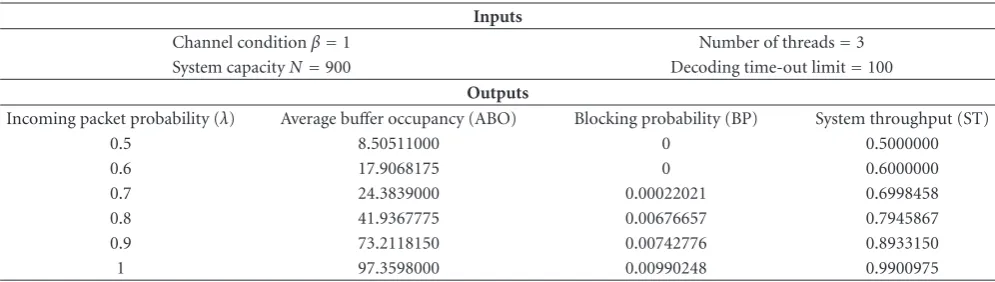
Table 1shows the results of ABO, BP, and ST for different incoming packet probabilities. It also contains the simulation inputs. The increase in the average buffer occupancy as the incoming packet probability increases is noticed.
It is interesting to see the drastic difference between the average buffer occupancies when considering three proces-sors and just one processor as inFigure 6. Also notice the big difference between blocking probabilities when employ-ing three processors and just one processor as inFigure 7for the same inputs. Moreover, notice the impressive linear trend of system throughput withλusing parallel sequential decod-ing over a constant trend inFigure 8. In fact, when employing a decoder (processor), the system may not be stable since it can reach the system capacity too early at a relative low packet arrival rate. Thus, high traffic, low system throughput, and
0
Figure17: System throughput versus incoming packet probability
(T=10, 100).
Figure18: Average buffer occupancy versus incoming packet
prob-ability for different number of sequential decoders.
worse QoD are obtained. On the other hand, employing par-allel decoding environment leads to stable system, low traffic, and good QoD. Briefly, through parallel sequential decoding, we have adaptive decoding of the channel condition instead of fixed one that is used typically nowadays. We reduce the system flow due to low blocking probability. Consequently, we reduce the congestion over the network. Therefore, we have high system throughput. Thus, better QoD is attainable.
Table 2shows the average buffer occupancy and block-ing probability for different decoding time-out limit (T = 100). The blocking probability increases as the packet arriv-ing probability increases. It is seen that the average buffer occupancy increases as packet arriving probability increases. From the comparison betweenTable 2andTable 1, it is no-ticed that the average buffer occupancy and blocking proba-bility increase as the decoding time-out limit increases.
Table1: ABO, blocking probability, and system throughput (β=1.0,T=10). Inputs
Channel conditionβ=1 Number of threads=3
System capacityN=900 Decoding time-out limit=10
Outputs
Incoming packet probability (λ) Average buffer occupancy (ABO) Blocking probability (BP) System throughput (ST)
0.5 6.984940 0 0.50000
0.6 8.000000 0 0.60000
0.7 9.481100 0 0.70000
0.8 10.96340 0 0.80000
0.9 12.71200 0 0.90000
1 15.58585 0 1
Table2: Average buffer occupancy, blocking probability, and system throughput (β=1.0,T=100). Inputs
Channel conditionβ=1 Number of threads=3
System capacityN=900 Decoding time-out limit=100
Outputs
Incoming packet probability (λ) Average buffer occupancy (ABO) Blocking probability (BP) System throughput (ST)
0.5 8.50511000 0 0.5000000
0.6 17.9068175 0 0.6000000
0.7 24.3839000 0.00022021 0.6998458
0.8 41.9367775 0.00676657 0.7945867
0.9 73.2118150 0.00742776 0.8933150
1 97.3598000 0.00990248 0.9900975
sequential decoders to be compared with ABO, BP, and ST in Figures6,7, and8, respectively, when operating just one sequential decoder.
One important observation which can be noticed from
Figure 17is that the system throughput is almost the same when using 10 and 100 for different values of T. Further-more, the system throughput value is equal to the slope that represents the incoming packet probability. In fact, this indicates that every packet arrival is served. On the other side, consider the behavior of system throughput inFigure 8. Firstly, the system throughput forT=10 is much larger than inT =100 for single sequential decoder. Secondly, the val-ues of the system throughout are almost constant regardless of significant increase in the incoming packet probability for single sequential decoder. This fixed value is about 0.325 for the case ofT=10 and about 0.185 for the case ofT=100.
One more interesting observation which can be extracted from both Figures16and17is that choosing larger value of
T may not accordingly affect the blocking probability and system that much as in the case of one sequential decoder. Basically, this is a wonderful gain that leads to better QoD. Actually, in the case of a single decoder, we are so worried about employing large value ofT (although it is important to do that in case of noisy channels) since it affects the block-ing probability (see Figure 7) and system throughput (see
Figure 8) negatively. Consequently, we get a worse QoD.
Table 3 shows the average buffer occupancy, blocking probability, and system throughput for a different channel condition (0.4). It is shown that the average buffer occupancy and blocking probability increase as the packet arriving prob-ability increases. From the comparison betweenTable 3and
Table 2, it is seen that the average occupancy and blocking probability increase as the channel condition decreases. It is also interesting to see that even for the worst conditions (like
β=0.4), the router system with parallel sequential decoder is stable and reacts much better than that with a sequential decoder having higher values of channel conditions (better conditions); for comparison, see Figures5,6,7, and8.
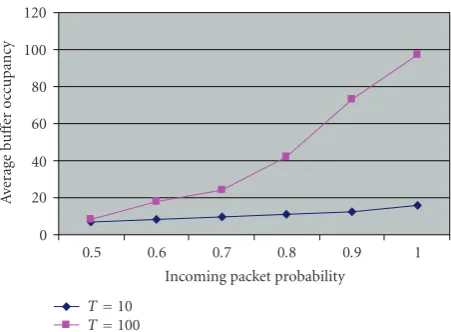
Figure 18illustrates the average buffer occupancy versus incoming packet probability when employing different num-ber of sequential decoders (3 and 5). The inputs for this fig-ure are the system capacity of 900, decoding time-out limit of 100, and channel conditionβ=0.6. It is obvious that the average buffer occupancy decreases as the number of sequen-tial decoders increases. Also the average buffer occupancy in-creases as incoming packet probability inin-creases.
Table3: ABO, blocking probability, and system throughput (β=0.4,T=100). Inputs
Channel conditionβ=0.4 Number of threads=3
System capacityN=900 Decoding time-out limit=100
Outputs
Incoming packet probability (λ) Average buffer occupancy (ABO) Blocking probability (BP) System throughput (ST)
0.5 72.8308000 0.0030000 0.4985000
0.6 127.053160 0.0142560 0.5914464
0.7 177.936585 0.0518800 0.6636840
0.8 245.082800 0.0530000 0.7576000
0.9 357.098457 0.0848193 0.8236086
1 512.467600 0.1065770 0.8934230
0 0.005 0.01 0.015 0.02 0.025 0.03 0.035
Bloc
king
pr
obabilit
y
0.6 0.7 0.8 0.9 1
Incoming packet probability (3) decoders
(5) decoders
Figure19: Blocking probability versus incoming packet probability
for different number of sequential decoders.
We use different value of channel condition (β = 0.6) for further parallel system validation. Therefore, it is seen from Figures18and19 andTable 3that the average buffer occupancy and blocking probability decrease as channel con-dition increases for fixed number of sequential decoders and decoding time-out limit. On the other hand, from Figures
15,16,18, and19, the average buffer occupancy and block-ing probability increase for fixed decodblock-ing time-out limit and number of sequential decoders when the channel condition decreases.
6. CONCLUSION
In this paper, we use different discrete time Markov simu-lation environments to study the QoD of a router system with a finite buffer for wireless network systems that employ stop-and-wait ARQ. The packet errors depend on the chan-nel condition. In other words, if packet error rate is high, this means that the channel is noisy. To make a packet decoding adaptive with a channel condition instead of affording fixed decoding, we use sequential decoding. Since we have finite buffer size, it is clearly noticed that choosing it too small or too large leads to high system flow and congestion over the
network. Thus, worse QoD is inevitable. We make our first simulation with just one sequential decoder with very large buffer. Our results show the instability in the router system with bad QoD. Consequently, we have designed a parallel sequential decoding system to mitigate the traffic, and thus getting better QoD. The parallel sequential decoding system has significant improvements on blocking probability, aver-age buffer occupancy, decoding failure probability, system throughput, and channel throughput. We explain extensively through detailed flowchart both simulation environments. We can conclude that increasing buffer size, when the buffer gets full, is just a temporary solution and it is likely to yield severe problems on the network congestion. Rather than in-vesting money on buffers to get worse QoD, the use of par-allel sequential decoding systems provides more stable and reliable environment for network congestion.
REFERENCES
[1] Y. Tian, K. Xu, and N. Ansari, “TCP in wireless
environ-ments: problems and solutions,”IEEE Communications
Maga-zine, vol. 43, no. 3, pp. S27–S32, 2005.
[2] K. Fall and S. Floyd, “Simulation-based comparisons of Tahoe,
Reno, and SACK TCP,” Computer Communication Review,
vol. 26, no. 3, pp. 5–21, 1996.
[3] M. S. Gast,802.11 Wireless Networks: The Definitive Guide,
O’Reilly Media, Sebastopol, Calif, USA, 2nd edition, 2005.
[4] L. L. Peterson and B. S. Davie,Computer Networks: A
Sys-tems Approach, Morgan Kaufmann, San Francisco, Calif, USA, 3rd edition, 2003.
[5] W. Stallings,High Speed Networks and Internets: Performance
and Quality of Service, Prentice-Hall, Upper Saddle River, NJ, USA, 2nd edition, 2001.
[6] N. Olifer and V. Olifer,Computer Networks: Principles,
Tech-nologies and Protocols for Network Design, John Wiley & Sons, New York, NY, USA, 2006.
[7] S. Lin and D. J. Costello Jr.,Error Control Coding:
Funda-mentals and Applications, Prentice-Hall, Englewood Cliffs, NJ, USA, 2nd edition, 2004.
[8] R. Sundaresan and S. Verd ´u, “Sequential decoding for the
ex-ponential server timing channel,”IEEE Transactions on
Infor-mation Theory, vol. 46, no. 2, pp. 705–709, 2000.
decoder implemented with QDI templates,” inProceedings of the 10th International Symposium on Asynchronous Circuits and Systems (ASYNC ’04), pp. 187–197, Crete, Greece, April 2004.
[10] D. G. Sachs, I. Kozintsev, M. Yeung, and D. L. Jones, “Hybrid
ARQ for robust video streaming over wireless LANs,” in
Pro-ceedings of the International Conference on Information Tech-nology: Coding and Computing (ITCC ’01), pp. 317–321, Las Vegas, Nev, USA, April 2001.
[11] S. Y. Chang, A. Anastasopoulos, and W. E. Stark, “Energy and
delay analysis of wireless networks with ARQ,” inProceedings
of the 61st IEEE Vehicular Technology Conference (VTC ’05), vol. 4, pp. 2601–2605, Stockholm, Sweden, May-June 2005. [12] L.-J. Chen, T. Sun, and Y.-C. Chen, “Improving bluetooth EDR
data throughput using FEC and interleaving,” inProceedings of
the 2nd International Conference on Mobile Ad-hoc and Sensor Networks (MSN ’06), vol. 4325 ofLecture Notes in Computer Science, pp. 724–735, Hong Kong, December 2006.
[13] E. Ferro and F. Potorti, “Bluetooth and Wi-Fi wireless
proto-cols: a survey and a comparison,”IEEE Wireless
Communica-tions, vol. 12, no. 1, pp. 12–26, 2005.
[14] G. Kabatiansky, E. Krouk, and S. Semenov,Error Correcting
Coding and Security for Data Networks: Analysis of the Super-channel Concept, John Wiley & Sons, New York, NY, USA, 2005.
[15] R. Togneri and C. J. S. deSilva, Fundamentals of
Informa-tion Theory and Coding Design, Discrete Mathematics and Its Applications, Chapman & Hall/CRC, Boca Raton, Fla, USA, 2003.
[16] R. Johannesson and K. Sh. Zigangirov,Fundamentals of
Con-volutional Coding, Wiley-IEEE, Piscataway, NJ, USA, 1999. [17] Y. S. Han, P.-N. Chen, and H.-B. Wu, “A maximum-likelihood
soft-decision sequential decoding algorithm for binary
convo-lutional codes,”IEEE Transactions on Communications, vol. 50,
no. 2, pp. 173–178, 2002.
[18] J. B. Anderson and S. Mohan, “Sequential coding algorithms:
a survey and cost analysis,”IEEE Transactions on
Communica-tions, vol. 32, no. 2, pp. 169–176, 1984.
[19] S. Kallel and D. Haccoun, “Sequential decoding with an effi
-cient partial retransmission ARQ strategy,”IEEE Transactions
on Communications, vol. 39, no. 2, pp. 208–213, 1991. [20] S. Kallel and D. Haccoun, “Sequential decoding with ARQ
and code combining: a robust hybrid FEC/ARQ system,”IEEE
Transactions on Communications, vol. 36, no. 7, pp. 773–780, 1988.
[21] P. Orten and A. Svensson, “Sequential decoding in future
mo-bile communications,” inProceedings of the 8th IEEE
Interna-tional Symposium on Personal, Indoor and Mobile Radio Com-munications (PIMRC ’97), vol. 3, pp. 1186–1190, Helsinki, Finland, September 1997.
[22] W. D. Pan and A. Ortega, “Buffer control for variable
complex-ity Fano decoders,” inProceedings of the IEEE Global
Telecom-munications Conference (GLOBECOM ’01), vol. 1, pp. 176– 180, San Antonio, Tex, USA, November 2001.
[23] Y. S. Han and P.-N. Chen, “Sequential decoding of
convo-lutional codes,” in Encyclopedia of Telecommunications, pp.
2140–2146, John Wiley & Sons, New York, NY, USA, 2002, Book chapter.
[24] P. Y. Pau and D. Haccoun, “An analysis of sequential decoding with retransmission procedures,” Tech. Rep. EMP/RT-85-19, Ecole Polytechnique of Montreal, PQ, Canada, 1985. [25] A. Drukarev and D. J. Costello Jr., “Hybrid ARQ error control
using sequential decoding,”IEEE Transactions on Information
Theory, vol. 29, no. 4, pp. 521–535, 1983.
[26] J. C. Moreira and P. G. Farrell,Essentials of Error-Control
Cod-ing, John Wiley & Sons, New York, NY, USA, 2006.
[27] K. Darabkh and R. Ayg¨un, “Quality of delivery evaluation of error control for TCP/IP-based systems in packet switching
ATM networks,” inProceedings of the International Conference
on Internet Computing (ICOMP ’06), Las Vegas, Nev, USA, June 2006.
[28] T. Hashimoto, “Bounds on a probability for the heavy tailed distribution and the probability of deficient decoding in
se-quential decoding,”IEEE Transactions on Information Theory,
vol. 51, no. 3, pp. 990–1002, 2005.
[29] W. D. Pan, “Queuing analysis of sequential decoders with
buffers,” inProceedings of the Huntsville Simulation Conference
(HSC ’04), Huntsville, Ala, USA, November 2004.
[30] N. Shacham, “ARQ with sequential decoding of packetized
data: queueing analysis,”IEEE Transactions on
Communica-tions, vol. 32, no. 10, pp. 1118–1127, 1984.
[31] K. Darabkh and R. Ayg¨un, “Performance evaluation of se-quential decoding system for UDP-based systems for wireless
multimedia networks,” inProceedings of the International
Con-ference on Wireless Networks (ICWN ’06), Las Vegas, Nev, USA, June 2006.
[32] K. Darabkh and W. D. Pan, “Stationary queue-size distribu-tion for variable complexity sequential decoders with large
timeout,” inProceedings of the 44th Annual Southeast Regional
Conference (ACMSE ’06), pp. 331–336, Melbourne, Fla, USA, March 2006.
[33] K. Darabkh and R. Ayg¨un, “Simulation of performance eval-uation of error control for packet-to-packet
acknowledg-ment based systems in ATM networks,” in Proceedings of
SCS International Conference on Modeling and Simulation— Methodology, Tools, Software Applications (M&S-MTSA ’06), Calgary, Canada, July-August 2006.
[34] K. Darabkh and W. D. Pan, “Queue-size distribution for Fano
decoders,” inProceedings of the Huntsville Simulation
Confer-ence (HSC ’05), Huntsville, Ala, USA, November 2005.
[35] A. Grama, A. Gupta, G. Karypis, and V. Kumar,Introduction
to Parallel Computing, Addison-Wesley, Reading, Mass, USA, 2003.
[36] B. Wilkinson and M. Allen,Parallel Programming: Techniques