R E S E A R C H
Open Access
A new energy-aware wireless sensor
network evolution model based on
complex network
Shujuan Cui
*, Yuan Cao, Gengxin Sun and Sheng Bin
Abstract
For solving the problem of heterogeneous node energy and low energy efficiency in wireless sensor networks (WSNs), an effective and dynamic self-organization evolution model by introducing a complex network model is proposed in this paper. In the process of the evolution of WSN topology, it is considered that the nodes and links in the network are dynamic behaviors with increasing and decreasing, and combined this behavior with energy-awareness mechanism. The preferred attached mechanism and the anti-preferred deleted mechanism is closely related to the remaining node energy. The statistical characteristics of this network model are analyzed by theoretical calculation and mathematical simulation under different energy distribution functions. Through the simulation experiment, it can be proven that the proposed evolution model will cause the energy consumption of the whole wireless sensor network to be more balanced; at the same time, it would have an excellent performance of random node error tolerance.
Keywords:Wireless sensor networks, Complex network, Energy-balanced, Evolution model, Performance optimization
1 Introduction
Since the end of the twentieth century, the discovery of small-world network characteristics and scale-free network characteristics has aroused the interest of researchers to explore various evolving mechanisms of complex networks
and dynamic behaviors [1]. Complex network theory has
become an important analytical tool and research method in many fields. The complex network theory aims to study the large-scale network in the objective real world based on the viewpoint of systematic science, such as the
inter-national Internet, e-mail network, power network [2],
aviation network, food chain network, metabolism network, research cooperation network [3], language network, social network [4], protein network [5], World Wide Web [6], software engineering network, and wireless network [7]. Any typical complex network can be abstracted as the con-nection between thousands of nodes and edges between two nodes, where nodes represent individuals (objects) in an actual complex network system, while edges represent relationships between individuals (objects).
Small-world network model and scale-free network model provide a new perspective for the research of the real complex network system, but these two basic models still show some limitations in simulating the complex network in the real world. For example, in the world trade relations network, a node in the network means a country; the existence of edges between the two nodes indicates the existence of trade relations between the two countries. The evolution rule of complex net-works in the actual world will be affected by many different complex factors.
Due to its complexity and dynamics, the wireless sen-sor network (WSN) can be used to study its inherent characteristics by complex network theory. The topology of network has important influence on WSN in the term of the energy efficiency and data transmission perform-ance. The current classic model of network is different from the actual WSN. The complex network theory pro-vides a new method to build a robust and efficient dynamic topology of WSN. Many researchers have used complex network theory to analyze the topology of WSN, for example. The reliability of network and the capacity of nodes are considered, and the dynamic evo-lution of wireless network is analyzed. The change of
* Correspondence:[email protected]
School of Data Science and Software Engineering, Qingdao University, Qingdao 266071, China
power law index is considered. A random deployment model is proposed, and the degree of the node evolves with the power law ofk2/(α−1).
Although the scale-free model depicts the two basic prin-ciples of “growth” and “preferential” connection of power law distribution, it still has some limitations. Researchers explored the more complex formation mechanism and actual characteristics in the real system and established a related dynamic network evolution model to simulate the self-organization evolution process of real networks and set up a more accurate network evolution model for the complex networks of different types of real world.
There had been a lot of topological structure evolution models based on energy balance and energy awareness for WSNs in the past years. In WSNs, the node energy consumption directly affects the life cycle of WSNs. Mohite [8] further proposed the combinatorial evolution
model based on the scale-free model. Huang et al. [9]
proposed a new evolving model of networks and pointed out that, in a certain parameter range, the network gen-erated by the new model still has the distribution charac-teristics of power law distribution. The nonlinear priority connection strategy is considered. Kumar and Ahlawat [10] proposed a new evolving model of networks, which used the node degree parameter with power index (0~1) to replace the linear relationship in the BA scale-free network model. Wang et al. [11] proposed a new model by selecting the superior and eliminating the inferior mechanism. Miyao et al. [12] proposed a weighted evolving model of networks. Gao and Yang [13] proposed a competitive weighted evolv-ing model of networks, which introduced the mechanism of the fittest rich. However, almost all existing studies do not research the energy efficiency for wireless sensor networks from the angle of complex network topology evo-lution and degree distribution.
Based on the above analysis, a new topology self-organization evolution model based on energy awareness for WSNs is proposed. And the dynamic behaviors of nodes and links in WSNs are considered. On the one hand, it re-flects the evolution of sensor network. On the other hand, it can optimize the topology structure of WSN by adjusting some parameters. By means of the research method of complex network theory, the topology characteristics of WSNs are introduced into the dynamic evolution mechan-ism of complex network. The topology evolution of WSNs is analyzed in depth; the dynamic evolution in WSN closely related to the node energy is considered.
The method is given in Section 2. We propose the
evolution model based on energy awareness of node and energy balance throughout the network in Section 3. In Section4, the simulation analysis is given to verify the topological features of the network generated by the proposed model. At last, conclusion is given in Section5.
2 Method
Node energy is an important factor. It has an effect on the topology of WSN. In the network, the node energy is different from each other. It is very important to study how to consume energy more efficiently in the network environment in which the node energy is heterogeneous and extends the life cycle of sensor network. There are many studies that have been conducted in the network evolution of energy factors, for example, consider the heterogeneous characteristics of the network, a topology model of WSN cluster based on random walk is pro-posed by applying the complex network evolving theory. Other researchers analyzed the topology control of WSNs from the perspective of network evolution. The effectiveness of the energy consumption of WSN node on the basis of pure growth characteristics of complex networks is considered. The researchers believed that the probability of choosing the new link is not only re-lated to the degree of the node, but also rere-lated to the residual energy of the node. But these documents are only considered the evolution of pure growth in sensor networks; they do not consider the dynamic behavior of nodes and links in WSNs.
Many complex networks in the real world can be described by evolutionary models. As a typical complex network, WSN has its own unique characteristics. Due to the finite energy and power of the sensor nodes, the sen-sor nodes only communicate with their neighbor node, which shows that the evolution of the wireless sensor net-work conforms to the concept of local-word connectivity.
A new topology evolution model by selecting the superior and eliminating the inferior mechanism based on energy awareness for WSNs is proposed and studied. According to the reality of the WSN, by using mean-field theory, a scale-free network model is derived. Among them, the new node selected in the new link should meet the optimal probability of node energy, while the old node selected in the deleted link should meet the anti-choice probability of the node energy. A simulation experiment is designed. By analyzing the complex network characteristic parameters of sensor network, the validity of the model is verified. We proposed our energy-balanced technique and evaluated by simulation using R studio software. Simulation results were obtained in the same experimental conditions.
rate of the node energy heterogeneous environment must be taken into consideration to extend the life cycle of the entire network. On the other hand, the topology of wireless sensor networks is a dynamically changing process. This paper considers from the following two perspectives: (1) new nodes and new links are added and (2) node due to depletion of node energy and link fail-ure. Therefore, this paper further discusses the accurate modeling of sensor networks based on the scale-free BA network model and proposes that not only the new node and the new link are added to the approximate BA network model but also the old node and the old link are deleted.
The BA model is a random network model which is used to demonstrate a preferential attachment or a“ rich--get-richer” effect. In the model, an edge is most likely to attach to nodes with higher degrees.
The network model shows a dynamic evolution process with increase and decrease. Combined with the D. Shi model, the characteristics of the WSN itself, namely, the preferential growth and anti-preferential deletion in the topology evolution of the WSN, are closely related to the residual energy of the node. The effectiveness of node en-ergy consumption in WSNs is considered, and a topology evolution model by selecting the superior and eliminating the inferior mechanism is proposed.
For clearance, we list the main parameters of the pro-posed evolution model (Table1).
The network initially has n0 sink nodes, m0common
nodes, and e0 edges, and the network evolves at every
time steptaccording to following algorithm:
(1) Growth: Adding a new node at every time steptis
repeated, andmexisting old nodes are connected. When
choosing to establish a link with an existing old node, new joining node adopts preferred preference probabil-ity. Assume that the probability of a node establishing an edge with an old nodeiis∏(ki);kirepresents the
de-gree of node, andErepresents current remaining energy
of node. In this paper, we define a function f(E) to ex-press the relationship between remaining energy of node
and relationship between these nodes selected to estab-lish a connection with the newly added node. The following results are obtained:
Y ki
ð Þ ¼Pf Eð Þki jf Ej kj
In practical applications of WSNs, the more energy the remaining node has connected to other nodes, the more energy will be consumed per unit of time. After a period of time, all nodes in the entire network reach equilibrium, and the network’s life cycle is extended. This rule is followed in this chapter; the greater the node energy, the more likely it is to connect to the newly added node. Then, we introduce thatf(E) is an
increas-ing function with the arguments E, such as βEi, βE2
i ,
where β is an adjustment factor. General principles are
taken into account, assuming β= 1 and f(Ei) = Ei, then
the probability ∏(ki) that the new node selection is
linked to the old nodeiis subject to the following rules:
Y ki
ð Þ ¼PEiki jEjkj
(2) Delete link: Ifm links are deleted with probability
pat every time stept, themplink was deleted. First, the anti-primary probability ∏∗(ki) is used in the node with at least one link. That is, the smaller the remaining en-ergy of sensor node, the probability of being selected to delete the link is more.
Y
ki
ð Þ ¼ ðkiEiÞ−1
P
iðkiEiÞ−1
Secondly, for those nodes connected with nodei, nodej
would be selected with anti-preferential probability. That is, the node j is selected from the neighborhood (Oi) of nodei(o.r) with probability K−i1QðkjÞ, where Ki¼
P j∈Oi Qð
kjÞ. Then, delete the links of nodesiandjand repeat this stepmptimes. The anti-preferential deletion is con-sistent with the topological dynamic changes caused by node and link failure in WSN. When remaining energy of node in the network is consumed to a certain threshold after a period of time, the link with which it is connected will fail and be deleted. The anti-preferred deletion mech-anism exists in many practical networks. For example, in a user’s e-mail network, a user’s address book is used as a node, and an address in the address book is used as a link. When the address in the address book has not been used for a long time, the link represented by this address will be deleted in the e-mail network that has evolved. Simi-larly, in the language network, when some old expressions and sentences are no longer used, some languages will be isolated and deleted. In this paper, isolated nodes with a
Table 1Main parameters of the model
Parameters Definition in evolution model
M0 Initial amount of sensors n0 Initial amount of sink sensors m Edges were deleted per time step
ki Degree of nodei
E Residual energy of each node
∏iki Probability of a new node β An adjustment factor
f(E) Amount of sensors in each new adding sensor’s range
degree of 0 will also be permanently deleted from the network.
According to the continuous field theory, ki(t) meets the demand of following dynamic formula:
∂ki
The first item in the formula expresses the link added by the preferred connection of the newly added node; the second item expresses the link that has been reduced by anti-preferred deletion. By using the mean field the-ory, the following formula can be introduced:
X
jEjkj¼N tð Þ Ehkð Þti ð2Þ
where N(t) represents the amount of nodes in WSN which evolved to the time step t. E represents the expectation of node energy in the network. 〈k(t)〉 repre-sents average degree of sensor node at the time stept.
Assuming that sensor network has evolved over a lon-ger time step to obtain a larlon-ger scale,N(t)−1 = n0+ t≈t, the following formula can be obtained:
k ∏∗(ki)≈1/N(t)≈1/t, the following formula can be obtained:
∂ki ger grows; this situation does not apply to the evolution of the sensor network and will not be analyzed here. For further analysis of the impact of the deletion probability
p on the network evolution, this paper discusses two
cases ofp= 0 and 0 < p< 1. Case A:p= 0
In this case, there is only a simple growth process of nodes and links in the network evolution process, and there is no deletion of nodes and links. This situation is suitable when the nodes in the WSN are in full energy, and in the ideal wireless data transmission and receiving environment, the topology discovery stage, the network simply grows without node and link deletion. Then,ki(t) satisfied
The probability which a sensor node satisfies ki(t) <k at time steptis:
In this paper, one of the most common types of node addition methods in engineering, namely equal time intervals, is considered. Therefore, ti has an equal prob-ability densityP(ti) = 1/n0+t; substituting Eq. (7) can get
The node probability density function with energyE
Pð Þ ¼kE ∂P kð ið Þ∂t <kÞ
The overall degree distribution probability density function is
where, ρ(E) represents the probability density distribu-tion of node energy in the entire network,EminandEmax
represent their minimum and maximum values, respect-ively, and γrepresents a power law index. The network degree distribution shows a power-law formless scale characteristic.
Case B: 0 < p < 1
In this case, the general situation of the WSN is con-sidered. In the evolution process, the network is not simply growing. That is, there is not only the increase of links and nodes, but also the deletion of nodes and links.
Equation (1) can be written as follows:
∂ki
The first-order linear partial differential equation is solved; according to the initial condition ki(ti) =m, the
β¼βðm;pÞ ¼ mEi
In this paper, the most common way to increase the number of nodes in a project is considered. Assume that the nodes join the WSN at equal time steps; therefore,ti has an equal probability density P(ti) = 1/n0+t; we can
The node probability density function with energyEis
P kð Þ ¼E ∂P kð ið Þ∂t <kÞ
The probability density function of the network is
Pð Þ ¼k of node energy in the whole network. Emin and Emax
are their minimum and maximum values, respectively. It can be seen that the degree distribution index is closely related to [ Emin, Emax] and the deletion probabilities
pandEi, but not to the node energy distribution.
4 Simulation and discussions
For verifying the effectiveness of the proposed network evolution model, some simulation experiments were performed. By simulating and analyzing various statistical characteristics of topology, the complex dynamics of the proposed model can be better understood, and the influ-ence of node energy distribution function ρ(E) on top-ology structure can be deeply understood. In this section, the simulation results of various statistical parameters such as the degree of network topology distribution, the
relationship between the node degree and energy, the cor-relation degree, and the network energy efficiency, under different evolution parameters will be given. These charac-teristics are the statistical feature parameters that re-searchers pay attention to in their studies of complex network models and also important indicators for evaluat-ing the performance of sensor networks.
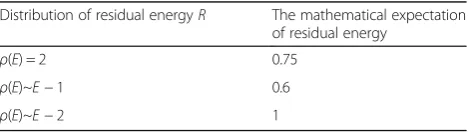
In the simulation experiment in this paper, we used the energy distribution of the nodes in the network to be between 0.6 and 1 J and considered the following three different node energy distribution functions ρ(E): (1) all nodes in the network have the same energy, all of them are 0.5 J, and their energy value variance is 0; (2) uniform distribution and their energy variance is 1/12; and (3) exponential distribution (exp(−E)), its variance is 1. According to the physical meaning of the variance in probability statistics, the variance value can be used to indicate the heterogeneity of node energy. The larger the variance, the greater the heterogeneity of the energy in the nodes are. In the above three cases, the node energy distribution with exponential distribution in the third case has the greatest heterogeneity. In the first case, the node energy has isomorphism.
The distribution functions and corresponding mathemat-ical expectation of remaining energy are shown in Table2.
The degree distribution is considered as the most im-portant factor to distinguish the characteristics of real networks. In order to calculate its value, an empirical research method was adopted. The evolution model by selecting the superior and eliminating the inferior mechanism was used. Through programming, specific network models are generated. Then, the frequency of
the node with degree k is counted, repeated several
times, and its average value is taken, and then, an
approximate value of the probability P(k) is
repre-sented by the frequency, that is, the proportion of the
amount of nodes whose degree is k is probability P.
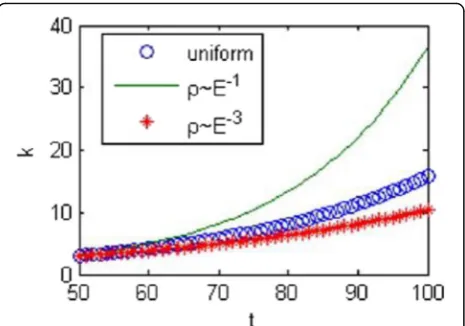
The influence of energy distribution of sensor nodes
is shown as Fig. 1. With various degree distributions,
various mathematical expectations will get different growing speeds.
From Fig. 2 and Fig.3, it can be known that the rela-tionships are between the range of adding node and the degree distribution.
Figure 2 shows that the coming sensors will choose
different quantity of nodes based on the scope. It can be
Table 2Various distributions of residual energy
Distribution of residual energyR The mathematical expectation of residual energy
ρ(E) = 2 0.75
seen that the more theSis small, the more the probabil-ity of sensoriconnected is big.
For a clearer illustration of the influence of the node en-ergy distribution function on the internal connection of the network and to reveal the complexity of the internal con-nection of the network topology, the correlation between the node degree and its energy and the degree correlation are simulated and analyzed. Figure4shows the influence of a new node on the connectivity growth. It can be seen that the elder nodes had more possibility of being chosen for connecting to the coming nodes; it implies that connectiv-ity of the elder will increase faster than those of new coming.
The degree distributions generated by the proposed model with various energy distributions are shown in Fig.4.
From Fig. 4, we can see that the degree distribution
follows power law. It implies that scale-free wireless sensor networks in any condition all can be gotten by our evolution model. So we do not need to consider the residual energy while constructing networks.
In experiments, we do not take the limitation of max connectivity ki into consideration; when actual influence factors are put into the modified model, the degree dis-tribution with different energy disdis-tributions are shown individually in Fig.5and Fig.6.
Figure 5 shows that degree distribution of networks
which are generated from the modified model when the residual energy distribution is unifying. Those sensors with large connectivity would raise their degree slowly because of the limitation of the max degree. Our modi-fied model prevents the sensors from consuming their power, and then, the energy of the overall network would be balanced.
Characteristic path length and network energy efficiency are usually used to analyze the ability to communicate be-tween nodes in a network. These two indicators are de-fined. Small feature path lengths and large network energy efficiency mean that fewer hops are required for data transmission. Energy consumption for data transmission
Fig. 2Degree of evolution network with different local-scope
Fig. 3Degree of evolution network with various node incoming time
Fig. 4The degree distribution with various energy distributions
is saved. The comparison of connectivity evolution with various sizes of scope is shown as Fig.6.
The connectivity evolution by various time of a
sen-sor added to the network is shown in Fig. 7. From
Fig. 6 and Fig. 7, it can be seen that the increment of the connectivity is much slower because of the max connectivity limitations.
5 Conclusions
This paper firstly introduced the origin and development history of small-world networks and then analyzed the ap-plication and research of small-world effects in wireless sensor networks. The sensor network is a dynamic net-work with a constantly changing topology. Based on the study on the evolution model by selecting the superior and eliminating the inferior mechanism, the energy per-ception mechanism is introduced, combined with the fact that the preferential growth and anti-preferential were deleted in the WSN topology which are closely related to the residual energy of the node. A new topology evolution model by selecting the superior and eliminating the infer-ior mechanism based on energy awareness for WSNs is
proposed. The model takes into account the evolution process of wireless sensor networks considering the node energy-aware priority connection mechanism and the node and link of the sensor network. Through simulation results, it was verified that the proposed model can well reflect the evolution of wireless sensor networks under different node energy distribution scenarios.
Abbreviations
WSANs:Wireless sensor and actuator networks; WSNs: Wireless sensor networks
Funding
This work is supported by the Shandong Provincial Natural Science Foundation, China, under Grant No. ZR2017MG011.
Authors’contributions
SJC, YC, and GXS contributed to the conception and evolution model of the study. GXS and SB contributed to the acquisition of simulation. SJC, GXS contributed to the analysis of simulation data. All authors read and approved the final manuscript.
Author’s information
Shujuan Cui received a M.S. degree from Qingdao University, in 2004. She is an assistant professor in Qingdao University. Her research interests lie in wireless sensor networks (e-mail: [email protected]).
Gengxin Sun received a Ph.D. degree from Qingdao University, in 2013. He is an associate professor in Qingdao University, China. His research interests lie in complex network (e-mail: [email protected]).
Sheng Bin received a Ph.D. degree from Shandong University of Science and Technology, in 2014. She is an associate professor in Qingdao University, China. Her research interests lie in complex network (e-mail: [email protected]).
Competing interests
The authors declare that they have no competing interests.
Publisher’s Note
Springer Nature remains neutral with regard to jurisdictional claims in published maps and institutional affiliations.
Received: 12 June 2018 Accepted: 30 August 2018
References
1. C. Zhang, Cluster-based routing algorithms using spatial data correlation for wireless sensor networks. J. Commun.5(3), 232–238 (2010).https://doi.org/ 10.4304/jcm.5.3.232-238
Fig. 6Degree of network with different local-scope by modified model
2. J. Wang, J. Kim, L. Shu, A distance-based energy aware routing algorithm for wireless sensor networks. Sensors.10(10), 9493–9511 (2010).https://doi.org/ 10.3390/s101009493
3. S. Cai, P. Zhou, Z. Liu, Synchronization analysis of directed complex networks with time-delayed dynamical nodes and impulsive effects. Nonlinear. Dynamics.76(3), 1677–1691 (2014).https://doi.org/10.1007/ s11071-014-1238-z
4. G. Sun, S. Bin, Router-level internet topology evolution model based on multi-subnet composited complex network model. J. Internet. Technol. 18(6), 1275–1283 (2017).https://doi.org/10.6138/JIT.2017.18.6.20140617. 5. N. Chua, K. Ning, D. Zueco, Using indirect protein-protein interactions for
protein complex prediction. Comput. Syst. Bioinforma.6(3), 97–109 (2011). https://doi.org/10.1142/9781860948732_0014.
6. G. Paparo, M. Müller, F. Comellas, Quantum Google in a complex network. Sci. Rep.2773(3), 127–132 (2013).https://doi.org/10.1038/srep02773. 7. W. Berry, P. Chartier, Identifying influential edges in a directed network: big
events, upsets and non-transitivity. J. Complex. Netw.2(2), 87–109 (2012). https://doi.org/10.1093/comnet/cnt018.
8. P. Mohite, Adaptive data fusion for energy efficient routing in wireless sensor network. Int. J. Energy. Optim. Eng.17(4), 1–17 (2015).https://doi. org/10.4018/ijeoe.2015010101.
9. P. Huang, J. Chen, C. Wang, Compressed sensing algorithm based on data fusion tree in wireless sensor networks. J. Electron. Inf. Technol.36(10), 2364–2369 (2014).https://doi.org/10.3724/SP.J.1146.2013.01621. 10. L. Kumar, M. Ahlawat, Evolution techniques for reliability of wireless sensor
network, international journal of advances in engineering. Sciences.2(4), 77–87 (2012).https://doi.org/10.1109/CEC.2011.5949636.
11. Q. Wang, J. Chen, H. Fang, Fault-tolerant topology control algorithm for mobile robotic networks. Int. J. Control. Autom. Syst.12(3), 582–589 (2014). https://doi.org/10.1007/s12555-013-0195-5
12. K. Miyao, H. Nakayama, N. Ansari, LTRT: an efficient and reliable topology control algorithm for ad-hoc networks. Wirel. Commun. IEEE. Trans.8(12), 6050–6058 (2009).https://doi.org/10.1109/TWC.2009.12.090073