R E S E A R C H
Open Access
Gaussian mixture probability hypothesis
density filter for multipath multitarget
tracking in over-the-horizon radar
Yong Qin
1*, Hong Ma
1, Jinfeng Chen
1and Li Cheng
1,2Abstract
Conventional multitarget tracking systems presume that each target can produce at most one measurement per scan. Due to the multiple ionospheric propagation paths in over-the-horizon radar (OTHR), this assumption is not valid. To solve this problem, this paper proposes a novel tracking algorithm based on the theory of finite set statistics (FISST) called the multipath probability hypothesis density (MP-PHD) filter in cluttered environments. First, the FISST is used to derive the update equation, and then Gaussian mixture (GM) is introduced to derive the closed-form solution of the MP-PHD filter. Moreover, the extended Kalman filter (EKF) is presented to deal with the nonlinear problem of the measurement model in OTHR. Eventually, the simulation results are provided to demonstrate the effectiveness of the proposed filter.
Keywords:Over-the-horizon radar (OTHR), Multipath multitarget tracking, Probability hypothesis density filter, Finite set statistics (FISST)
1 Introduction
Over-the-horizon radar (OTHR) exploits skywave propa-gation of high-frequency signals to detect and track tar-gets, which are different from the conventional radar. It has received wide attention because of its wide area sur-veillance, long detection range, strong anti-stealth ability, the capability of the long early warning time, and so on. In OTHR, a significant problem is the effect of multi-path propagation, which causes multiple detections via different propagation paths for a target with missed de-tections and false alarms at the receiver [1–6]. Neverthe-less, the conventional tracking algorithms, such as probabilistic data association (PDA) [7–9], presume that a single-measurement per target, it may consider the other measurements of the same target as clutter, and multiple tracks are produced when a single target is present. Therefore, these methods cannot effectively solve the multipath propagation problem.
In order to solve the multipath propagation problem of OTHR, lots of algorithms have been proposed. Such
as the multipath viterbi data association (MVDA) [10] and modified probabilistic data association (MPDA) [11]. However, these conventional algorithms involve data association problem and the complexity of the computation. In addition, it is noted that most of the existing algorithms in OTHR focus on a single target. Therefore, the multitarget tracking algorithm in OTHR is still an open problem.
Most of the conventional algorithms about multitarget tracking, such as multiple hypothesis tracker (MHT) [12], joint probabilistic data association (JPDA) [13, 14], and probability hypothesis density (PHD) filter [15], as-sume the following measurement model: (1) every target produces at most one measurement and (2) any meas-urement is produced by a target or clutter. In this paper, we consider the measurement model which satisfies these assumptions as standard measurement model. However, many measurement models in real-life target tracking scenarios do not satisfy these prerequisite of assumption, which are treated as nonstandard measure-ment model. Recently, the multiple detection joint prob-abilistic data association (MD-JPDA) filter [16] based on the JPDA framework was proposed to deal with the multiple detection targets, which can apply to OTHR. * Correspondence:[email protected]
1School of Electronic Information and Communications, Huazhong University of
Science and Technology, Wuhan 430074, China
Full list of author information is available at the end of the article
However, this algorithm involves complexity data associ-ation. To solve this problem of multitarget tracking, more effective methods should be taken into account to implement in OTHR.
In 2009, Mahler derived a series of“second-generation” PHD/cardinalized probability hypothesis density (CPHD) filters [17] which addressed the tracking problems for nonstandard multitarget measurement model, such as extended targets [18–21], unresolved target [22], un-known clutter [23], and superpositional sensors [24]. As for the multipath propagation in OTHR, the re-ceiver can obtain more than one measurement from the same target, which means that it violates the second assumption of the standard measurement model. There-fore, the multipath tracking model in OTHR is one of the nonstandard measurement models, such that conventional multitarget tracking algorithms would no longer be applicable.
To solve the multipath propagation problem of multi-target, we propose a novel tracking algorithm based on the theory of finite set statistics (FISST) called the multi-path probability hypothesis density (MP-PHD) filter in OTHR. First, inspired by Mahler’s work in [17], the FISST is used to derive the update equation of the MP-PHD filter. Then, a method of Gaussian mixture (GM) is introduced to derive the closed-form solution of the MP-PHD filter. In addition, the extended Kalman filter (EKF) is presented to deal with the nonlinear problem of the measurement model in OTHR. The simulation results demonstrate that the MP-PHD filter can accur-ately estimate the target state and the target number for low detection probability under the multitarget tracking circumstance.
This paper is organized as follows. Section 2 presents the problem formulation for OTHR. Section 3 then for-mulates the random finite set (RFS) measurement model
for the OTHR tracking problem and derives the MP-PHD filter in OTHR based on the FISST. A closed-form implementation of MP-PHD filter is presented in Section 4. In Section 5, the simulation results are presented. Finally, some conclusions and future works are discussed in Section 6.
2 Problem formulation
2.1 Dynamic model
The geometry of the target and OTHR system is depicted in Fig. 1. The target state vector of OTHR at time kis defined by xk¼½ρð Þk ; :ρð Þk ;b kð Þ; :b kð Þ′;xk∈ℑ, whereρ(k) =ρ1(k), :ρð Þk , b(k), and :b kð Þ are the ground range, range rate, bearing, and bearing rate and ℑ is the space of the ground coordinates, the dash denotes transposition.
Since the distance between the receiver and the targets is large, we usually assume that the state equation of OTHR is linear and discrete-time. It could be modeled as
xk¼Fxk−1þuk−1 ð1Þ
where uk−1 is a zero mean, white Gaussian noise with covariance Qk−1, and the state transition matrix F is given by
F¼
1 T 0 0
0 1 0 0
0 0 1 T
0 0 0 1
2 6 6 4
3 7 7
5 ð2Þ
whereTis the sampling period.
2.2 Measurement model of OTHR
OTHR achieves beyond the line-of-sight horizon target tracking by exploiting skywave propagation of high-frequency signals via the ionospheric, and depending on
the particular ionospheric propagation conditions, there may be several propagation paths. As shown in Fig. 1, the OTHR signal reflects from the transmitter to the target by an ionospheric at heightht, then the signal re-flects from the target to the receiver by an ionospheric at height hr. As is well known, there are many iono-spheric layers present in the atmosphere, and we sup-pose that there are two ionospheric layers E and F for simplicity, with constant heightshEandhF(this suppose is the same as other algorithms in OTHR). Therefore, there are four propagation modes: mode EE (transmit on E and receive on E); mode EF (transmit on E and re-ceive on F); mode FE (transmit on F and rere-ceive on E); and mode FF (transmit on F and receive on F). It means that the receiver can obtain more than one measurement from the same target at one time.
The OTHR measurements consist of a slant range Rg =r1+r2, Dopplerfd, and Az =π/2‐θ(θis the azimuth as shown in Fig. 1) of the formzk= [Rg(k),fd(k), Az(k)]′, zk∈G, whereGis the space of the slant coordinates.
The measurement model of OTHR involves the map-ping from the ground coordinates ðρ; :ρ;b; :b:Þ to the slant coordinates (Rg,fd, Az). From Fig. 1, it can be shown that the mapping is expressed as [2]
Rg¼r1þr2
fd¼ :
ρ
4
ρ r1
þ η
r2
Az¼ sin−1fρsinð Þb =ð2r1Þg 8
> > < > >
: ð3Þ
where
r1¼
ffiffiffiffiffiffiffiffiffiffiffiffiffiffiffiffiffiffiffiffiffiffiffiffi
ρ=2
ð Þ2þ h2r q
ð4Þ
r2¼
ffiffiffiffiffiffiffiffiffiffiffiffiffiffiffiffiffiffiffiffiffiffiffiffiffiffiffiffiffiffiffiffiffiffiffiffiffiffiffiffiffiffiffiffiffiffiffiffiffiffiffiffiffiffiffiffiffiffiffiffiffiffiffiffiffiffiffiffi
ρ=2
ð Þ2−
dρsinð Þb =2þðd=2Þ2þh2t q
ð5Þ
η¼ρ−dsinð Þb ð6Þ
Then, the measurement model of OTHR can be expressed as [11]
zk¼
h1ðxkÞ þwk;1 if mode EE h2ðxkÞ þwk;2 if mode EF
h3ðxkÞ þwk;3 if mode FE h4ðxkÞ þwk;4 if mode FF
clutter otherwise
8 > > > > > > < > > > > > > :
ð7Þ
wherexkis the state variable;wk,iis the zero mean, white Gaussian noise with known covariance Rk,i, and hi(⋅) is the nonlinear measurement function of ith propagation mode,i= 1, 2, 3, 4.
hið Þ ¼x
ffiffiffiffiffiffiffiffiffiffiffiffiffiffiffiffiffiffiffiffiffiffiffiffi
ρ=2
ð Þ2þ h2r
q
þ ffiffiffiffiffiffiffiffiffiffiffiffiffiffiffiffiffiffiffiffiffiffiffiffiffiffiffiffiffiffiffiffiffiffiffiffiffiffiffiffiffiffiffiffiffiffiffiffiffiðρ=2Þ2−dρsinð Þb=2þh2t
q
: ρ 4
ρ
ffiffiffiffiffiffiffiffiffiffiffiffiffiffiffiffiffiffiffiffiffiffiffiffi
ρ=2
ð Þ2þ h2r
q þ ffiffiffiffiffiffiffiffiffiffiffiffiffiffiffiffiffiffiffiffiffiffiffiffiffiffiffiffiffiffiffiffiffiffiffiffiffiffiffiffiffiffiffiffiffiffiffiffiffiρ−dsinð Þb
ρ=2
ð Þ2
−dρsinð Þb=2þh2t
q 0
B @
1 C A
sin−1 ρsinð Þb= 2 ffiffiffiffiffiffiffiffiffiffiffiffiffiffiffiffiffiffiffiffiffiffiffiffiðρ=2Þ2þ h2t
q
2 6 6 6 6 6 6 6 6 4
3 7 7 7 7 7 7 7 7 5
ð8Þ
where, for a given propagation mode i, ht and hr must be replaced by the virtual ionosphere heights, where the details can be found in [11].
3 The RFS model and PHD filter implementation in OTHR
In the standard PHD filter, it is presumed that a target produces at most one measurement. Due to the multi-path effect of OTHR, a single target may generate sev-eral measurements. Therefore, the measurement model of the MP-PHD filter proposed in this paper is different from the standard PHD filter. In this section, we first introduce the RFS measurement model for OTHR and then derive the update equation of the MP-PHD filter based on the theory of FISST.
3.1 The RFS measurement model for OTHR
At each timek, a finite set of measurements of OTHR, denoted by Zk¼ zk;1;zk;2;⋯zk;Nk
, where zk;1;zk;2;⋯ zk;Nk are the received measurements at timekandNkis
the number of measurements. Since the measurements include several detections from targets and clutter, the collection of measurements of OTHR can be modeled by RFS
Zk ¼Θk;1ð Þxk ∪Θk;2ð Þxk ∪Θk;3ð Þxk ∪Θk;4ð Þxk ∪Γk ð9Þ
whereΘk,i(xk),i= 1,⋯, 4 denotes the measurement orig-inated from theith propagation path andΓkdenotes the RFS of clutter. It is presumed that conditional on xk,
Θk,i(xk),i= 1,⋯, 4 andΓkare independent RFSs.
3.2 The update equation of MP-PHD filter in OTHR
Note that both the MP-PHD filter and the standard PHD filter recursion require two steps: prediction and update. In the following subsection, we only derive the update equation according to the above RFS measure-ment model since the prediction step of the MP-PHD filter is identical to the standard PHD filter.
Gkjk½ ¼h bution,fk(Z|X) is the multitarget likelihood function and hX is defined by hX= 1 when X=∅ and hX=∏x∈Xh(x) otherwise. The update PHD filter can be given by
Dkjkð Þ ¼x
δGkjk
δx ½ 1 ð13Þ
Therefore, the update equation for MP-PHD filter can be derived by the following procedures:
1) Derive the PGFLGk[g|X] by using the OTHR
measurements and exploiting Eq. (11) to derive a closed form ofF[g,h]
2) Derive the derivatives ofF[g,h] by using Eq. (10) to derive a closed form ofGk|k[h]
3) According to Eq. (11), derive a closed-form update for the MP-PHD filter in OTHR
In the following part of this subsection, we will present the details of the derivation. First, we derive the PGFL Gk[g|X] according to the OTHR measurements in Eq. Eq. (11) can be summarized as follows:
F g½ ;h ¼eλc g½ −λ⋅G
To derive a closed-form update equation for the multi-path multitarget PHD filter, we assume that the predicted multitarget distribution is a Poisson process:
Gkjk−1½ ¼h eμs h½ −μ ð16Þ
where s[h] =μ−1∫h(x)Dk|k−1(x)dx and μ=∫Dk|k−1(x)dx. Thus, Eq. (15) can be written as
F g½ ;h ¼exp ðλc g½ −λþμs hq4
Next, we deduce the formula for δF
δZ½0;h. Note that we
setg= 0 because the formula for δF
δZ½g;h is very
cumber-some without setting it.
and where
See Appendix 1 for the proof of Lemma 1.
where
and dW[0,h]is the Eq. (19).
See Appendix 2 for the proof of Lemma 2.
where
According to Lemmas 1 and 2, we can obtain the MP-PHD filter update equation in Proposition 1 as follows:
Proposition 1.The update equation for the MP-PHD filter is
where
See Appendix 3 for the proof of Proposition 1.
4 Gaussian mixture implementation of the MP-PHD filter
According to the GM implemented in the standard PHD fil-ter in [25], a GM-PHD filfil-ter recursion can be derived for the multipath target tracking. Due to the MP-PHD filter pre-diction equation for the OTHR are identical to the standard PHD filter, the GM prediction equation of MP-PHD filter are the same as the standard GM-PHD filter, where the de-tails can be found in [25]. Therefore, in this section, we only consider the GM update equation of the MP-PHD filter.
4.1 Gaussian mixture MP-PHD
To derive a closed-form solution to the update equation of the MP-PHD filter, we assume that each target follows a linear-Gaussian transition and measurement model, i.e.,
fkjk−1ð Þ ¼xjζ N x;Fkjk−1xkjk−1;Qkjk−1 mand covarianceP. Fis the state transition matrix,Qis the process noise covariance, Hk,i is the observation matrix, andRk,iis the observation noise covariance. The survival and detection probability are assumed as a con-stant, i.e., pS,k(x) =pS,k,pD,k(x) =pD,k. To facilitate the derivation of the closed-form solution, we define an intermediate operatorGik;z by
Gik;zaϕ
Gik;zaϕ
We suppose that the predicted PHD filter at timek−1 has the following GM representation:
Dkjk−1ð Þ ¼x is the predicted number of the components. Then, the up-date equation at timekcan be expressed as a GM of
Dkjkð Þ ¼x DN Dkjkð Þ þx tions cases, are given by
DN Dkjkð Þ ¼x X
The GM components DD
kjkðx;WÞ, handling detected target cases, are given by
where∘denotes a composition.
4.2 Implementation issues
1)Nonlinear measurement model: The above Gaussian mixture MP-PHD filter can be extended to a nonlin-ear measurement model using the EKF. Due to that the dynamic model in the OTHR is linear, we only apply EKF to deal with the nonlinear measurement model in the update step of MP-PHD filter. Use the approximations (55) and (56) in place of the originals (32) and (33), and use the linearizations in (57) to calculate (36) and (37)
ξkjk−1;i¼hk;imϕ;0 ð55Þ
Skjk−1;i¼Uk;iRk;iUTk;iþHk;iPϕHTk;i ð56Þ
where
Hk;i¼∂
hk;iðx;0Þ
∂x x¼mϕ ð57Þ
2)Managing mixture components: Similar to the standard GM-PHD filter, the techniques of merging and pruning must be used to reduce the exponential growth of the number of Gaussian components, which the merging and pruning methods specific to Gaussian components can be found in [25]. 3)Computational complexity: As is shown in Eq. (24),
the MP-PHD filter requires all partitions of the current measurements for updating,℘∠Zkdenotes
that℘is one partition of the measurement setZkand W∈℘denotes thatWis one cell of℘. Note thatW
does not include null set. For instance,Zk= {z1,z2,z3}
can be partitioned as follows [19–21]
℘1¼ff gz1 ;f gz2 ;f gz3 g; ℘2¼ffz1;z2g;f gz3 g; ℘3¼ff gz1 ;fz2;z3gg;
℘4¼ffz1;z3g;f gz2 g; ℘5¼ffz1;z2;z3gg;
whereas with the number of measurements growing, the number of partitions grows very large, which is compu-tationally infeasible.
From the above analysis, we can see that the computa-tional load required by the proposed MP-PHD filter is similar to that of the extended targets PHD filter [18–22]. Note that some methods, such as K-means++ method [19] and spectral clustering [20], have been suggested for the implementation of the extended targets PHD filter to reduce the number of partitions. However, these methods that applied in the extended targets are measurement dependent. Since the measurement function of each measurement mode can be very different in OTHR. These methods may fail with the multipath tracking problem in OTHR. To limit the number of partitions in the MP-PHD filter, some approximations are necessary in this paper. First, we can use the gating technology with multiple val-idation gates to reduce the number of measurements for each propagation model before the update step at each time [11], and then we can use the similar method of“ ef-fective binary partition” that was implemented in [26] to reduce the number of partitions. For space considerations
dW ¼
pD;k4
λc zð Þ1 λc zð Þ2 λc zð Þ3 λc zð Þ4 X Jkjk−1
l¼1 ωð Þl
kjk−1 X
i¼1 X
j¼2 X
m¼3 X
n¼4 X4
a¼1 X4
b¼1 a≠b
X4
c¼1 a≠c b≠c
X4
d¼1 a≠d b≠d c≠d
Gik;za∘Gjk;zb∘Gmk;zc∘Gnk;zdϕð Þkljk−1
x
ð Þ ð53Þ
bW dW ð Þl
¼
X
i¼1 X
j¼2 X
m¼3 X
n¼4 X4
a¼1 X4
b¼1 a≠b
X4
c¼1 a≠c b≠c
X4
d¼1 a≠d b≠d c≠d
Gik;za∘Gjk;zb∘Gmk;zc∘Gnk;zdϕð Þkljk−1
x
ð Þ
X Jkjk−1
r¼1 ωð Þr
kjk−1 X
i¼1 X
j¼2 X
m¼3 X
n¼4 X4
a¼1 X4
b¼1 a≠b
X4
c¼1 a≠c b≠c
X4
d¼1 a≠d b≠d c≠d
Gik;za∘Gjk;z b∘G
m k;zc∘G
n k;zdϕ
r ð Þ kjk−1
x
ð Þ
which are not the focus of this paper, we omit the details. Note that we used only a simple partition technique in our implementation, and the development of more effi-cient implementations will be a future task.
5 Numerical simulations
The performance of the proposed MP-PHD filter will be evaluated through two numerical examples, including the single target and multitarget tracking in this section. And we use the optimal subpattern assignment (OSPA) metric to evaluate the performance of the proposed algorithm [27].
5.1 Experiment 1
In this subsection, we have designed an experiment to com-pare the MP-PHD filter with the standard single-path PHD filter in a single target tracking scenario. Note here that the standard single-path PHD filter uses one specific mode (mode EE used in this experiment) to track the targets, and we use the gating technology to reduce the number of mea-surements for propagation model EE before the update step at each time. The two filters are simulated with the same
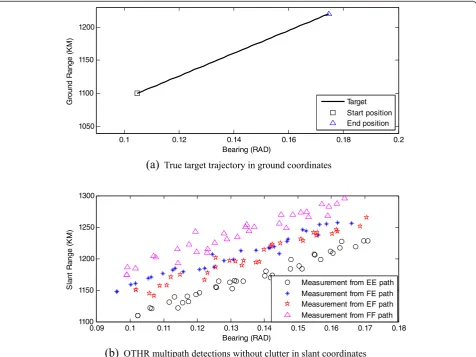
environment in OTHR. It is assumed that a single non-maneuvering target is in the presence of clutter. Clutter is generally modeled as a Poisson RFS with the intensity func-tionκk(y) =λVu(y), whereu(⋅) indicates the uniform density over the region [1000, 1400]km × [0.069813, 0.17453]rad, V= 41.8868 km⋅rad is the“volume”of this surveillance re-gion, and λ= 4.7743(km⋅rad)−1is the average number of the clutter returns per unit volume. This translates to 200 clutter measurements per scan. And each propagation model has the same detection probability and target survive probability that are set topD,k= 0.6 andpS,k= 0.95. To keep computations tractable, the Gaussian component pruning is applied in this numerical example with a pruning thresh-oldτ= 10−5, a merging thresholdU= 20, and a maximum number of Gaussian componentsJmax= 100. It is assumed that a single target moving in the surveillance region with the initial target state x0 = (1100 km, 0.15 km/s, 0.10472 rad, 8.72665e−05 rad/s). Other simulation parame-ters are defined as the same as [11]. The true target trajec-tory and OTHR multipath detections without clutter under pD,k= 0.6 are shown in Fig. 2. It is shown that the receiver
can obtain more than one measurement from the same tar-get at one scan.
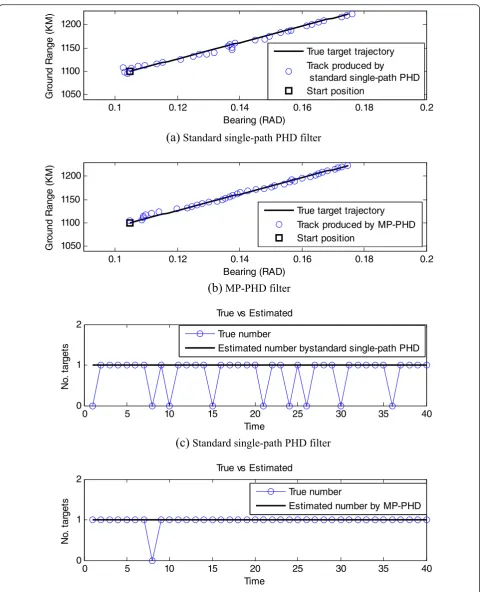
The target tracking results of the MP-PHD filter and the standard single-path PHD filter for one simulation are shown in Fig. 3. As the position esti-mates are shown in (a) and (b), we can see that the MP-PHD filter provides more accurate position esti-mates for almost all the time. Moreover, for the simulation results, shown in (c) and (d), using the MP-PHD, there is only one false estimated number at time 8.
5.2 Experiment 2
In this scenario, we assumed that the number of targets is constant. The performance of the GM-MP-PHD filter is compared with the MD-JPDA filter. Two filters are simulated with the same environment in OTHR tracking system, and we also use the gating technology with mul-tiple validation gates to reduce the number of measure-ments in the MD-JPDA filter. The experiment goes on for 600 s (sampling period T= 20 s), and we assumed that two targets appear with initial state target 1 x1 = (1130 km, 0.12 km/s, 0.10472 rad, 8.72665e−05 rad/s) and target 2 x2 =(1125 km, −0.1 km/s, 0.11472 rad, 7.92665e−05 rad/s), respectively. And each propagation model has the same target survive probability and detection probability that are set to pS,k= 0.95 and pD,k= 0.6. Other parameters are adopted as the same as the experiment 1.
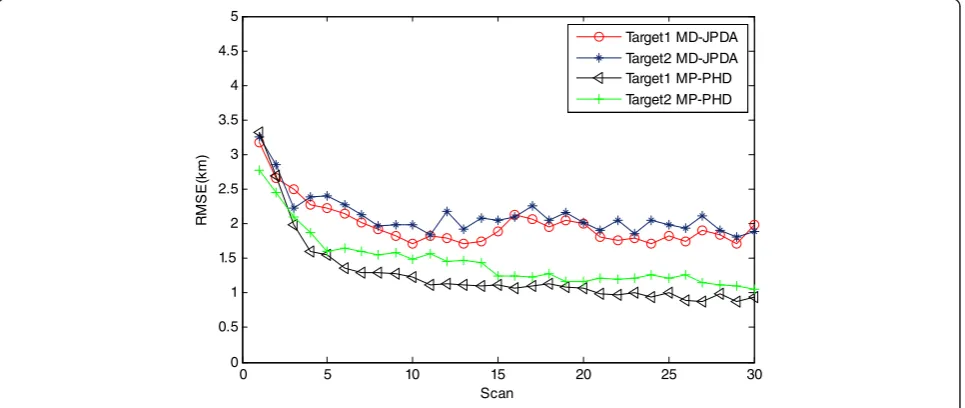
The position root mean squared error (RMSE) of the two filters are shown in Fig. 4. It is shown that the pro-posed MP-PHD filter has a notable performance gain over the MD-JPDA filter. This is due to the fact that the proposed MP-PHD filter encapsulates all the infor-mation about the targets by enumerating all of the
association between propagation paths and measure-ments. However, only a subset of the associations (not all the permutations of the propagation paths) is used in the MD-JPDA filter, this is the reason degrades the performance of MD-JPDA filter.
To evaluate the computational time of the proposed al-gorithm, the averaged time is computed in MATLAB7.1 on an Intel CORE i5 CPU computer with 2 GB of RAM. The proposed GM-MP-PHD consumed approximately 8.6 s per MC run and the MD-JPDA consumed approxi-mately 1.1 s. Although the proposed MP-PHD filter has high computational time, it has better performance than the MD-JPDA filter.
5.3 Experiment 3
To validate the tracking performance of MP-PHD filter in multipath multitarget tracking, in this experiment, we have designed a multiple track scenario including three non-maneuvering targets where the target number is changing in OTHR. The experiment goes on for 800 s with the sam-pling periodT= 20 s, and it is assumed that target 1 and target 2 appear in the course of the whole experiment with initial state x1= (1100 km, 0.15 km/s, 0.10472 rad, 8.72665e−05 rad/s) and x2= (1170 km, −0.14 km/s, 0.11472 rad, 7.72665e−05 rad/s), respectively, target 3 appears att= 180 s and disappears att= 480 s with the initial states x3= (1170 km, −0.05 km/s, 0.15701 rad,
−8.72665e−05 rad/s). In this experiment, there are no spawning targets for simplification. Other simulation con-ditions are the same as the experiment 1.
1) One simulation: The true target trajectory is shown in Fig.5, and the position estimates of the MP-PHD filter for one simulation compared with the standard
single-path PHD filter are shown in Fig.6, the estimation of target number is shown in Fig.7. As shown in Figs.6
and7, the MP-PHD filter can accurately estimate the target state and the target number of the multipath multitarget tracking in OTHR. In comparison, the simulation result shows that the MP-PHD filter provides more accurate position estimates for almost all the times.
2)100 Monte Carlo simulations: We compare the MP-PHD filter with the standard single-path MP-PHD filter
over 100 Monte Carlo simulations with different detection probabilitypD,k= 0.6 andpD,k= 0.99,
respectively. We use the OSPA metric to evaluate the performance, the parameters of OSPA distance are set to the cutoff parameterc= 15 km and the order parameterp= 2 (see [27] for more details).
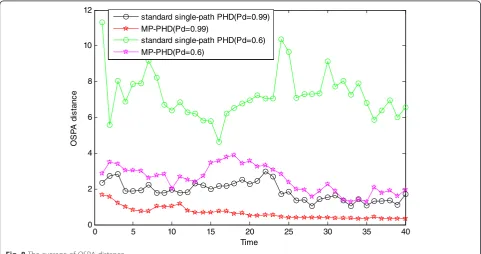
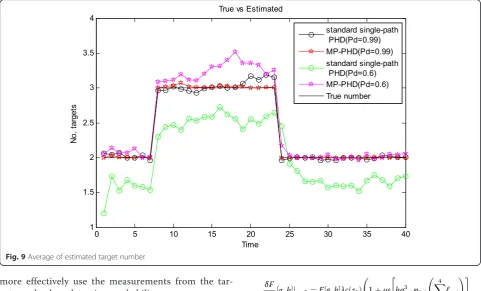
Figure 8 shows the average of OSPA distance com-parison between the MP-PHD filter and the standard single-path PHD filter, and the average of estimated
Fig. 6The true and estimation target trajectory (pD,k= 0.6)
number is shown in Fig. 9. The simulation results demonstrate that the tracking performance of the MP-PHD filter surpasses the performance of the standard single-path PHD filter. Moreover, it can ac-curately estimate the target state and the target number with low detection probability under the
multitarget tracking circumstance. As shown in Figs. 8 and 9, the standard single-path PHD filter cannot deal with the multitarget tracking problem effectively under low detection probability. This is due to the fact that the MP-PHD filter use four path measurements to track the targets, and then, it can
Fig. 8The average of OSPA distance
more effectively use the measurements from the tar-gets under low detection probability.
6 Conclusions
In this paper, the MP-PHD filter, which tracks the multipath multitarget in OTHR, has been proposed. The MP-PHD filter is based on the theory of FISST, the FISST is employed to derive the update equation, and then a closed-form solution of MP-PHD filter in the form of GM has been proposed. The EKF is used to deal with the nonlinear problem of the measure-ment model. Simulation results show that the pro-posed MP-PHD filter has a notable performance gain over the MD-JPDA filter.
Similar to the standard PHD filter, the MP-PHD filter should be improved for some problems. For example, as the number of targets in the surveillance region is large, the estimated target number is unreliable. To solve this problem, a modified PHD filter name, cardinalized PHD filter, is proposed by Mahlar [28, 29]. Our future work could derive a CPHD filter which can be applied to the multitarget tracking in OTHR.
7 Appendices
7.1 Appendix 1: Proof of Lemma 1
This lemma is proved by mathematical induction. For the initial induction step, assume Z= {z1}. In this case there is only one partition, ℘= {{z1}}, and we get
δF δz1
g;h
½ jg¼0¼F g½ ;hλc zð Þ1 1þμs hq3D;kpD;k
X4
i¼1
ℓz1;i !
" #
þμs hq2D;kp
2
D;k
X3
i¼1
X4
j¼iþ1
ℓz1;ipg;jþpg;iℓz1;j !
" #
þμs
"
hqD;kp3D;k
X2
i¼1
X3
j¼iþ1
X4
m¼jþ1
ðℓz1;ipg;jpg;m
þpg;iℓz1;jpg;mþpg;ipg;jℓz1;mÞ !#!
þμs
"
hp4
D;k ℓz1;1pg;2pg;3pg;4þpg;1ℓz1;2pg;3pg;4
þpg;1pg;2ℓz1;3pg;4þpg;1pg;2pg;3ℓz1;4 !#!
jg¼0
¼F½0;hλc zð Þ1 1þμs hq3D;kpD;k
X4
i¼1
ℓz1;i !
" #!
¼F½0;hλc zð Þ1 df gz1 ½0;h
ð58Þ
Now, assume that we have established Eq. (18) for Z= {z1,⋯,zm} with |Z| =m> 1. We are to establish Eq. (18) for Z= {z1,⋯,zm,zm+ 1} and |Z| =m+ 1. Using the prod-uct rule for functional derivatives, we get
δ2 F
δZδzmþ1½g;hjg¼0 ¼ δF
δzmþ1½g;hjg¼0⋅
Y
Z⋅
X
℘∠Z
Y
W∈℘
dW½0;h
!
þF½0;h⋅Y Z⋅
X
℘∠Z δ δzmþ1
Y
W∈℘
dW½g;h
!
g¼0
ð59Þ
On the one hand,
δF δzmþ1
g;h
½ g¼0¼F½0;hλc zð mþ1Þdfzmþ1g½0;h ð60Þ
On the other hand,
δ simplicity. And it is easy to find that δF
δzmþ1½g;h g¼0¼λc zð mþ1ÞdW∪fzmþ1g½0;h
. Putting this all together,
Eq. (59) can be written as
δ2 forms. First, take a partition℘of the setZand add the cell {zm+ 1} to obtain a new partition℘1(zm+ 1) =℘∪{{zm+ 1}} of
Z∪{zm+ 1}. This action is what is denoted mathematically in the first line of Eq. (63). Secondly, remove a cellWfrom the partition℘and replace it withW∪{zm+ 1} of a new partition
℘2(zm+ 1,W) = {W∪{zm+ 1}}∪ ∪V∈℘−{W}{V} of Z∪{zm+ 1}. This action is what is denoted by the product
Y
in the second line of Eq. (63). Consequently, Eq. (63) becomes
and this ends the inductive step.
7.2 Appendix 2: Proof of Lemma 2
Gkjk½ ¼h
7.3 Appendix 3: Proof of proposition 1
The posterior multipath PHD filter can be calculated as
Dkjkð Þ ¼x
δGkjk
δx ½ hjh¼1 ð67Þ
Thus, from Eq. (21), we must first determine
δGkjk
On the other hand,
δ
where from Eq. (19), we have
Substituting Eqs. (69) and (71) into Eq. (68) yields
δGkjk
Settingh= 1 in the above equation then yields
Competing interests
The authors declare that they have no competing interests.
Author details
1School of Electronic Information and Communications, Huazhong University of
Science and Technology, Wuhan 430074, China.2School of Electrical and
Information Engineering, Wuhan Institute of Technology, Wuhan 430073, China.
Received: 10 March 2015 Accepted: 2 December 2015
References
1. DJ Percival and KAB White, Multipath track fusion for over-the-horizon radar, in: Proceedings of SPIE Signal Data Process of Small Targets, San Diego, CA, United States, July 27, 1997, pp. 363-374.
2. DJ Percival and KAB White, Multihypothesis fusion of multipath over-the-horizon radar tracks, in: Proceedings of SPIE Signal Data Process of Small Targets, Orlando, FL, April 13, 1998, pp. 440-451.
3. MG Rutten and D J Percival, Joint Ionospheric and Target State Estimation for Multipath OTHR Track Fusion, in: Proceedings of SPIE Signal Data Process of Small Targets, vol. 4473, San Diego, CA, USA , July 29, 2001, pp. 118-129. 4. GW Pulford, OTHR multipath tracking with uncertain coordinate registration.
IEEE Transactions on Aerospace and Electronic Systems40(41), 38–56 (2004) 5. H Liu, Q Pan, Y Liang, Y Cheng, M Cheng, Comments on“multipath data
association tracker for over-the-horizon radar”. IEEE Transactions on Aerospace and Electronic Systems41(3), 1147–1148 (2005)
6. MG Rutten, S Maskell, M Briers and NJ Gordon, Multipath track association for over-the-horizon radar using Lagrangian relaxation, in: Proceedings of SPIE Signal Data Process of Small Targets, Orlando, FL, April 12, 2004, pp. 452-463.
7. Y Bar-Shalom, E Tse, Tracking in a cluttered environment with probabilistic data association. Automatica11(5), 451–460 (1975)
8. SB Colegrove, AW Davis, JK Ayliffe, Track initiation and nearest neighbours incorporated into probabilistic data association. Journal Elect. Electronics Eng6(3), 191–198 (1986)
9. T Kirubarajan, Y Bar-Shalom, Probabilistic data association techniques for target tracking in clutter. Proceedings of the IEEE92(3), 536–557 (2004) 10. H Liu, Y Liang, Q Pan and Y Cheng, A multipath viterbi data association
algorithm for OTHR, in: Proceedings of International Conference on Radar, Shanghai, China, 2006, pp. 1–4
11. GW Pulford, RJ Evans, A multipath data association tracker for over-the-horizon radar. IEEE Transactions on Aerospace and Electronic Systems
34(4), 1165–1183 (1998)
12. SS Blackman, Multiple hypothesis tracking for multiple target tracking. IEEE Aerospace and Electronic Systems Magazine19(1), 5–18 (2004) 13. HAP Blom, EA Bloem, Interacting multiplemodel joint probabilistic data
association, avoiding track coalescence, inProceedings of the 41th IEEE Conference on Decision Control, vol. 3, 2002, pp. 3408–3415
14. D Musicki, R Evans, Joint integrated probabilistic data association: JIPDA. IEEE Transactions on Aerospace and Electronic Systems40(3), 1093–1099 (2004) 15. R Mahler, Multi-target Bayes filtering via first-order multi-target moments.
IEEE Transactions on Aerospace and Electronic Systems39(4), 1152–1178 (2003)
16. B Habtemariam, R Tharmarasa, T Thayaparan et al., A multiple-detection joint probabilistic data association filter. IEEE Journal Selected Topics Signal Processing7(3), 461–471 (2013)
17. R Mahler,“Second-generation”PHD/CPHD filters and multitarget calculus, in: Proceedings of SPIE Signal Data Process of Small Targets, San Diego, CA, August 02 , 2009.
18. R Mahler, PHD filters for nonstandard target, I: extended targets, in: Proceedings of the 12th International Conference on Information Fusion, Seattle, WA, July 2009, pp. 915–921
19. K Granstrom, C Lundquist, U Orguner, A Gaussian mixture PHD filter for extended target tracking, in: Proceedings of the 13th International Conference on Information Fusion, Edinburgh, UKL, July 2010, pp. 1–8 20. Yang J, Liu F, Ge H, et al., Multiple extended target tracking algorithm based
on GM-PHD filter and spectral clustering, EURASIP Journal on Advances in Signal Processing 2014:117
21. Y Zhang, H Ji, Gaussian mixture reduction based on fuzzy ART for extended target tracking. Signal Process97, 232–241 (2014)
22. R Mahler, PHD filters for nonstandard targets, II: unresolved targets, in: Proceedings of the 12th International Conference on Information Fusion, Seattle, WA, USA, July 2009 pp. 922–929
23. R Mahler, A El-Fallah, CPHD and PHD filters for unknown backgrounds, III: tractable multitarget filtering in dynamic clutter, inProceedings of SPIE, vol. 7698, 2010
24. R Mahler, CPHD filters for superpositional sensors, inProceedings of SPIE, vol. 7445, 2009
25. B-N Vo, W-K Ma, The Gaussian mixture probability hypothesis density filter. IEEE Transactions on Signal Processing54(11), 4091–4104 (2006)
26. J Xu, F Huang, Z Huang, The multi-sensor PHD filter Analytic implementation via Gaussian mixture and effective binary partition, in: Proceedings of the 16th International Conference on Information Fusion, Istanbul, TUR, July 2013 pp. 945–952
27. D Schuhmacher, B-T Vo, B-N Vo, A consistent metric for performance evaluation of multi-object filters. IEEE Transactions on Signal Processing
56(8), 3447–3457 (2008)
28. B-T Vo, B-N Vo, A Cantoni, Analytic implementations of the cardinalized probability hypothesis density filter. IEEE Transactions on Signal Processing
55(7), 3553–3567 (2007)
29. R Mahler, PHD filters of higher order in target number. IEEE Transactions on Aerospace and Electronic Systems43(4), 1523–1543 (2007)
Submit your manuscript to a
journal and benefi t from:
7Convenient online submission
7Rigorous peer review
7Immediate publication on acceptance
7Open access: articles freely available online
7High visibility within the fi eld
7Retaining the copyright to your article