CLARIN-EL Web-based Annotation Tool
Ioannis Manousos Katakis, Georgios Petasis, Vangelis Karkaletsis
Institute of Informatics and TelecommunicationsNational Centre for Scientific Research (N.C.S.R.) “Demokritos” GR-153 10, P.O. BOX 60228, Aghia Paraskevi, Athens, Greece
{gkatakis, petasis, vangelis}@iit.demokritos.gr
Abstract
This paper presents a new Web-based annotation tool, the “CLARIN-EL Web-based Annotation Tool”. Based on an existing annotation infrastructure offered by the “Ellogon” language enginneering platform, this new tool transfers a large part of Ellogon’s features and functionalities to a Web environment, by exploiting the capabilities of cloud computing. This new annotation tool is able to support a wide range of annotation tasks, through user provided annotation schemas in XML. The new annotation tool has already been employed in several annotation tasks, including the anotation of arguments, which is presented as a use case. The CLARIN-EL annotation tool is compared to existing solutions along several dimensions and features. Finally, future work includes the improvement of integration with the CLARIN-EL infrastructure, and the inclusion of features not currently supported, such as the annotation of aligned documents.
Keywords:Annotation tools, collaborative annotation, adaptable annotation schemas, Web-based annotation tools
1.
Introduction
The large volumes of data that are being published on the Web every day, create the need for powerful systems able to discover information contained in them. Usually, such kind of systems exploit supervised machine-learning tech-niques, requiring some form of guidance through examples, which are quite often extracted from manually annotated corpora. Although the production of this kind of corpora is a demanding and time-consuming process, it can be signif-icantly facilitated by the use of user-friendly and intuitive annotation tools.
In this paper, we present a new Web-based annotation tool which can cover a wide range of annotation tasks, through its support to end-user provided annotation schemas, defin-ing the graphical elements, the tags, and the restrictions that can be used to manually annotate a corpus. The pro-posed annotation solution is based on the relevant desktop, cross-platform annotation tool and the annotation engine provided by the Ellogon language engineering platform1 (Petasis et al., 2002), and attempts to transfer many of its features in a Web environment by exploiting the capabili-ties of cloud computing.
Ellogon’s annotation engine is a framework that supports the creation of a wide range of annotation tools, either desk-top applications such as (Fragkou et al., 2008) or collabora-tive tools like (Petasis, 2012a) and (Petasis, 2014) that dis-tribute annotation through a centralised server. The range of annotation tasks that can be implemented include any an-notation task that can be modelled through the selection of multiples text ranges, and group such ranges in annotations, along with user provided information. Under such a model, a wide range of annotation tasks can be accomplished, from morphological annotation (i.e. part-of-speech annotation), to phrase annotation (from syntactic annotation to named entities, sentiment, co-reference, etc.), and up to semantic annotation, where documents can be annotated with a se-mantic model (such as an OWL ontology) (Fragkou et al.,
1http://www.ellogon.org
2008). The infrastructure presented in this paper aims to port this annotation engine in a Web environment, while retaining the ability to customise the generated annotation tools to a wide range of annotation tasks, through annota-tion schemas described in XML.
The rest of the paper is organised as follows: Section 2 presents relevant work in area of Web-based annotation tools, while section 3 presents the annotation tool in de-tail, including its architecture and novel aspects. Section 4 presents a comparison of the CLARIN-EL Web-based an-notation tool with existing approaches, while section 5 presents a use case, which involves the annotation of a cor-pus with arguments. Finally, section 6 concludes this paper and presents some future directions.
2.
Related Work
During the last decade, a large number of annotation tools has been developed. Each one of them, is built upon it’s own logic and provides a different set of features, while some of them exploit previous experience acquired from their equivalent desktop versions. GATE Teamware2is an
annotation solution which aims to facilitate the annotation process among teams, by leveraging its distributed archi-tecture (Bontcheva et al., 2013). It offers a desktop appli-cation which enables users to add annotations, as well as a Web-based user interface from which the users are able to manage their projects and monitor their statistics.
Another popular annotation solution is BRAT3, a
Web-based tool for NLP-assisted text annotation. Its users are able to access and annotate their collections through their browsers, without the need of installing any additional soft-ware (Stenetorp et al., 2012). BRAT also offers collabora-tion features, meaning that two or more users have the abil-ity to add and modify annotations in the same document, simultaneously. The changes take place in real time and everyone have access to the latest version of the document.
2
https://gate.ac.uk/teamware
WebAnno4 follows the design philosophy of BRAT but it differentiates in multiple ways. It is a Web-based annota-tion soluannota-tion which combines BRAT’s visualisaannota-tions with a fully-fledged back-end and delivers features like user and quality management, monitoring tools as well as an inter-face to crowd-sourcing (de Castilho et al., 2014). More-over, offers a library of predefined schemas for various an-notation tasks, and it supports different corpora formats en-abling the cooperation with various existing platforms and infrastructures.
Inforex5is a Web-based system which facilitates the
man-agement and creation of annotated corpora. Its users are able to browse and edit the content of the annotated docu-ments as well as to pre-process them. In addition, it inte-grates an advanced versioning system allowing users to re-vert every document of their collections in a previous state. Regarding the annotation process, it offers a number of pre-defined annotation schemas which can be customised ac-cording to the needs of each annotation task.
The Ellogon language engineering platform6(Petasis et al.,
2002) provides an all-in-one desktop solution and an anno-tation engine, which allows the annoanno-tation of a wide range of information, ranging from information about words to complex annotation schemas involving links between aligned segments in bilingual texts (Petasis and Tsoumari, 2012b). In addition it supports collaborative/distributed annotation, where the annotation process can be shared among different annotators at different locations. Last but not least, it is an open source software which can be cus-tomised according to the requirements of each annotation task, exploiting a customisable engine for generating differ-ent layouts and user interfaces, driven by XML annotation schemas (Petasis, 2014). It has been applied to a wide range of tasks, ranging from annotation of part-of-speech tags and named entities (Petasis et al., 2003), prosodic features (Spiliotopoulos et al., 2005), semantic graphs (Fragkou et al., 2008), document sections (Petasis et al., 2008; Peta-sis and Tsoumari, 2012a), co-reference on aligned corpora (Tsoumari and Petasis, 2011), events (Petasis, 2012b), and arguments (Petasis, 2014).
The tool presented in this paper, is an attempt to move a number of features introduced by the Ellogon’s annotation engine and tools in an intuitive and user-friendly Web envi-ronment, focusing on the improvement of the user experi-ence during the annotation process.
3.
The CLARIN-EL Annotation Tool
3.1.
Architecture
In order to provide a rich and unobstructed user experience, we combined state-of-art technologies along with powerful services built upon the Ellogon language engineering plat-form, which expose various aspects of its annotation en-gine. The proposed annotation tool exploits the power of cloud computing in order to allow users to perform annota-tion tasks without the need of any kind of software. On top of that, it guarantees the consistency and synchronisation
4
https://webanno.github.io/webanno
5
http://nlp.pwr.wroc.pl/inforex
6http://www.ellogon.org
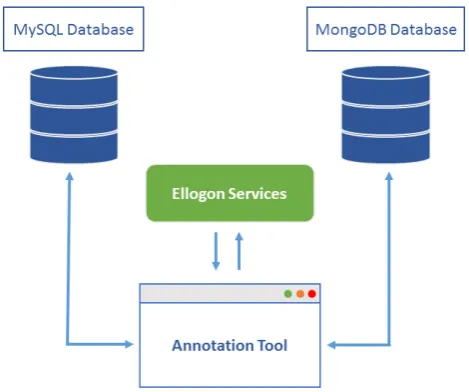
of user data across multiple devices. Even if the internet connectivity is lost, the user is able to continue the anno-tation task without losing the annoanno-tation progress. The ar-chitecture of the CLARIN-EL annotation tool is shown in Figure 1.
Figure 1: The architecture of CLARIN-EL annotation tool.
The annotation tool is written in JavaScript using the An-guarJS Framework7, and the Laravel PHP Framework8 as
its backend. The core component of the CLARIN-EL an-notation tool is a set of REST Web services developed on top of the Ellogon language engineering platform. These services are being used from the annotation tool in order to access the information of the stored annotation schemas, to derive a graphical user interface from the annotation schema, to validate user-uploaded schemas, and to inter-face the annotation tool with other existing infrastructures through suitable data import/export facilities. When a user selects an annotation schema, a template with all the in-cluded graphical components is served in HTML format. The generated HTML template corresponds to the user in-terface defined by the selected annotation schema. After-wards, AngularJS transforms the HTML template into an interactive user interface and provides all the needed func-tionality for performing the annotation process.
The data of the Web application are stored in two different databases. A MySQL database is used to store the data of the users along with their collections of documents, while a MongoDB database is used to store the annotations which are being added by the users on documents. Considering the large amount of annotation-related data, we decided to store them in a NoSQL database in order to achieve bet-ter performance as well as more effective load balancing. Finally, the annotation tool supports recent versions of all major Web browsers9.
7https://angularjs.org/ 8https://laravel.com/
9Recent versions of Google Chrome, Mozilla Firefox,
Figure 2: Collection management user interface.
3.2.
CLARIN-EL Annotation Tool UI
The annotation tool is organised in a series of “pages”, with each “page” concerning specific functionality. The cur-rent implementation offers two “pages”, or sections: The first section concerns corpora management, which contains tools that enable users to manage their collections of docu-ments, while the second section contains the elements that relate to the actual annotation process.
Figure 2 depicts the first section of the annotation tool. In this section, users are able to create and edit their own col-lections, from documents they upload through their Web browser. After a user uploads a new collection of docu-ments, has the ability to rename it, modify the number of its documents, as well as to remove it entirely. In addition, the owner of a collection is able to share it with other users by supplying their email addresses. The invitation is being sent through email and includes a link for the invited user to confirm his or her acceptance. When a collection is shared among different users, it is eligible for collaborative anno-tation, meaning that multiple users can annotate the same documents simultaneously. If the owner of the collection wants to make it private again, can revoke the access of the invited users at any time, even if they annotate the selected collection at that time.
Users also have the option to export the annotations per-formed on a specific document in a format which is fully compatible with the Ellogon language engineering plat-form, along with all the formats supported by Ellogon for exporting data. The import of annotations performed from the Ellogon’s annotation tool is also supported.
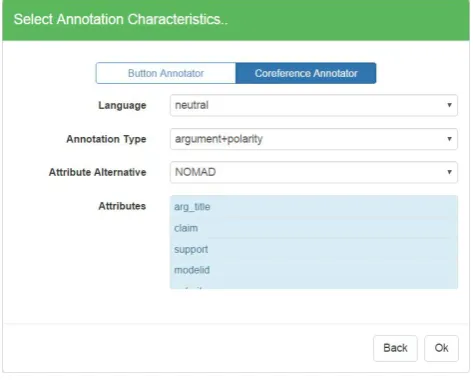
When the user has created or managed his/her corpora, he/she can switch to the “Annotation” page, in order to an-notate documents from the available corpora. Once in the annotation page, the user is asked to select an annotation schema, from the pool of annotation schemas uploaded by the user, or public schemas uploaded by other users. Ad-ditionally, the user is asked to select the document which intends to annotate. The selection is performed by an inter-face similar to the one shown in Figure 3. Afterwards, the graphical user interface for performing the annotation pro-cess is being rendered, based on the guidelines embedded in the selected XML annotation schema. The set of available
annotation schemas can be extended through user-provided annotated schemas in XML, conforming to Ellogon’s anno-tation schemas guidelines10.
Figure 3: Annotation schema selection.
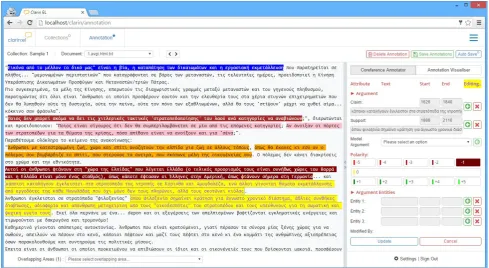
The graphical interface of the annotation page is divided into main three parts, as shown in Figure 4. The component that visualises the selected document along with the anno-tations that have been added to it, is placed on the left side of the screen. Users can select one of the pre-existing anno-tations in order to edit it, or get more information about it from the panel on the right. In addition, they are able to se-lect a new text segment by using the available mouse short-cuts (e.g. middle mouse button click wraps whole words at once).
On the right side of the annotation tool, the user has the ability to switch between two tabs. The first contains the user interface (UI) components defined by the selected an-notation schema, while the second contains information
10The CLARIN-EL Web-annotation tool shares the same
Figure 4: CLARIN-EL Annotation tool UI for annotating a document.
about the annotation that has been selected, if any. When a user has selected a text segment, the user is able to annotate it with an attribute by clicking on the desired component. In case that a user has selected an existing annotation and clicks on a different attribute, the annotation is being up-dated with the new value.
On the upper side of the annotation tool, there is a tool-bar which allows users to navigate between the different docu-ments of the selected collection, save the current progress, as well as to delete an existing annotation, if any selected. In addition, the users are able to enable the auto-save fea-ture, which monitors when the document changes and saves automatically the current progress.
3.3.
Novel aspects of CLARIN-EL Annotation
Tool
Being based on the annotation infrastructure provided by Ellogon and its associated annotation tools, the CLARIN-EL annotation tool tries to maintain some of requirements and novel aspects of Ellogon family of tools, such as data integrity, off-line annotation, robustness, etc. (Petasis, 2014). In order to ensure robustness and integrity of the annotation data, in cases such as internet connectivity fail-ures or Web browser crashes, the annotation tool is able to recover the annotation status just before the connection fail-ure or the crash: When a user begins an annotation session on a document, the current annotated statues of the docu-ment is also maintained on the server automatically, even between saves of the document (on a separate, “shadow” cache of the document). As a result, the server always maintains the last saved state of the document, but also the current state, shared among all annotators currently anno-tating the document. If a sudden failure occurs and the user
needs to re-open the annotation tool, a dialog box with three options appears: The user is able to choose between contin-uing the annotation process, saving the current progress, or reverting the document to its last saved state.
The CLARIN-EL annotation tool also provides support for collaborative annotation. Users are able to share collections among each other and annotate the same document simulta-neously. With the help Server-sent events (SSE), a technol-ogy standardised as part of HTML511 by the World Wide
Web Consortium (W3C)12, actions performed on each
doc-ument are shared among all the users that annotate the spe-cific document. If an annotator creates, modifies or deletes an annotation, the change is immediately propagated to all annotators, and it is visible in real-time to all users that an-notate the same document.
Last but not least, the CLARIN-EL annotation tool is con-figurable through annotation schemas in XML, and users are able to upload their own annotation schemas. The an-notation schemas must be in XML format and must follow the requirements of the Ellogon language engineering plat-form. With this feature, users can create custom annotation schemas, and thus different layouts and UIs, which meet the requirements of their annotation task. Moreover, the tool supports the export of the custom annotation schemas in XML, so as to be used as examples of how existing annotation schemas have been configured. For the var-ious graphical elements available through the annotation schemas, please refer to section 5.1 of (Petasis, 2014).
11
http://www.w3.org/TR/html5/
4.
Comparison with existing solutions
During the development of the proposed annotation tool, multiple existing annotation solutions have been examined. Each one of them, offers a different set of features and in-tends to cover a broad range of user defined requirements. Although the number of available annotation tools seems to constantly increase, an all-in-one tool has not been de-veloped yet. In that manner, users have to choose the one that fits best their requirements and meets the needs of their specific annotation task.Following the evolution of Web 2.0, most annotation tools are built upon a client/server architecture. Users tend to prefer plug and play solutions which require minimum ef-fort to operate and are accessible through their favourite Web browsers. For this reason, the majority of annota-tion tools that have been developed during the last years are Web-based (BRAT, Inforex, WebAnno, Clarin-EL etc.). While all of these tools successfully meet the aforemen-tioned requirement, such kind of approaches are usually limited in terms of functionality due to the limitations and inconsistencies of Web browsers. On the other hand, desk-top annotation tools such as Ellogon or hybrid approaches (Desktop-Web), such as GATE Teamware, are more cus-tomisable and deliver a wider range of features to the end users.
A common feature among all the aforementioned anno-tation solutions, is the ability to configure the annoanno-tation schemas, according to the requirements of each annotation task. More specifically, users are able to either reuse one of the preconfigured annotation schemas that every tool comes with, or create a new schema that will satisfy their needs. Most of the tools presented in this paper support three basic annotation types. The first one refers to a label/tag (Part of Speech tag, Name Entity tag, etc.) which is being assigned to a segment of the annotated document. The second type of annotations, describes a relation between two or more annotated segments while the third one defines additional attributes, which can be added to a specific annotation. A potential difference of the reviewed approaches lies within the flexibility that is offered to the users with respect to the level of customisation of the annotation schemas.
The annotation tasks usually involve a significant number of people who are working on the same collections of doc-uments. When a corpus is being annotated by multiple an-notators, a more robust and accurate result is potentially be-ing generated. In these terms, the existence of collaborative features inside the annotation tools is a necessity. The col-laborative text annotation is quite a complex task, requiring a sophisticated approach in order to address the issues that arise from the simultaneous editing of the documents. A flexible, yet powerful implementation is needed in order to handle the multiple interactions between the different ac-tors of an annotation task, as well as an efficient, shared storage system. Each of the annotation solutions compared in this section follow a different approach in order to fulfill this requirement.
In order to make the collaborative text annotation more ef-ficient, GATE Teamware and WebAnno provide support for multiple user roles. GATE Teamware, distinguishes three user roles: “Administrators”, “Project Managers” and
“Annotators”. Based on the role of each user, a different user interface is provided, while different access levels are assigned. WebAnno follows a quite similar approach by defining the roles of “Project Manager”, “Annotator” and “Curator”. The main difference between these annotation tools, is that WebAnno separates the role “Curator” as the user who reviews, merges the annotations of the different users and produces the final result. On the other hand, BRAT, Clarin-EL and Inforex do not provide a clear sep-aration of user roles. The users are distinguished in two categories. The first type of users can share a collection of documents with other users and annotate documents, while the second type of users have only annotation rights. Fi-nally, Ellogon does not provide support for different user roles.
In addition to the collaborative text annotation, some an-notation tools such as BRAT and Clarin-EL offer real-time updates of the document’s annotations. This feature allows multiple users that have access on the same document to interact with each other (create, edit or delete annotations) and view the changes at the same time. In contrast to this approach, annotation solutions such as GATE Teamware and WebAnno create a separate view of the annotated doc-ument for each annotator and only the curator of the an-notation task is able to review the results of the anan-notation process.
inte-BRAT Clarin-EL Ellogon GATE
Teamware Inforex WebAnno
Open Source Yes Yes Yes Yes Yes Yes
Core Lanuage(s)
Python, HTML, JavaScript
PHP, HTML, JavaScript
C, C++,Tcl Java
Python, HTML, Javascript
Java
Application Type Web Web Desktop Desktop,
Web Web Web
Collaborative Annotation Yes Yes Yes Yes Yes Yes
Real-time Collaborative
Annotation Yes Yes No No No No
Role Management Basic Basic No Advanced Basic Advanced
Progress Monitoring No No No Yes Yes Yes
Annotation Statistics No No Yes Yes Yes Yes
Automatic Annotation Yes No Yes Yes Yes Yes
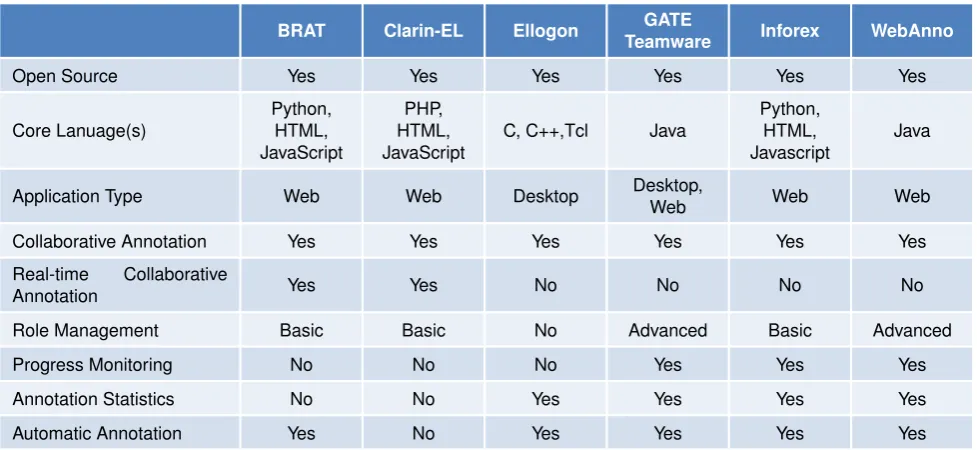
Table 1: Feature comparison of existing annotation solutions.
grated automatic annotation features. This kind of features may reduce significantly the cost and the time required for the creation of a manually annotated corpus. Although this approach can be very helpful, sometimes it may have dis-advantages, if the service in use for the automatic annota-tion is trained on a different domain from the one that the annotation task refers to. BRAT enables users to either im-port the results of external automatic annotation systems into the annotation tool, or invoke external automatic an-notation services through the interface of BRAT. The auto-matic annotation feature which is integrated in Inforex, al-low users to run external modules for named entity recogni-tion. After the completion of the pre-annotation phase, the curator of the project has the ability to review the inserted annotations and decide which of them are correct or need editing. WebAnno uses its built in machine learning capa-bilities to suggest possible annotations. The annotator can either accept or reject the suggestions of the system, which at the same time learns from the annotations of the user. The flexible architecture of Ellogon and GATE Teamware allow uses to create pipelines with custom machine learn-ing services, which can be applied on the documents of a corpus in order to partially pre-annotate them. Similar to Inforex, a human annotator has to validate the generated result in Ellogon and GATE Teamware. A summary of the comparison of the aforementioned existing solutions can be found in Table 1.
5.
Use case: Annotating arguments
Argumentation is a branch of philosophy that studies the act or process of forming reasons and of drawing conclusions in the context of a discussion, dialogue, or conversation. Being an important element of human communication, its use is very frequent in texts, as a means to convey meaning to the reader. As a result, argumentation has attracted sig-nificant research focus from many disciplines, ranging from philosophy to artificial intelligence. Central toargumenta-tion is the noargumenta-tion of argument, which according to (Besnard and Hunter, 2008) is “a set of assumptions (i.e. information from which conclusions can be drawn), together with a con-clusion that can be obtained by one or more reasoning steps (i.e. steps of deduction)”. The conclusion of the argument is often called the claim, or equivalently the consequent or the conclusion of the argument, while the assumptions are called the support, or equivalently the premises of the ar-gument, which provide the reason (or equivalently the jus-tification) for the claim of the argument. The process of extracting conclusions/claims along with their supporting premises, both of which compose an argument, is known as argument mining (Goudas et al., 2015; Goudas et al., 2014) and constitutes an emerging research field. More in-formation about argument mining can be found in the series of relevant workshops, such as (Green et al., 2014; Cardie, 2015).
author. The following example (example 1) illustrates an argument which consists of a claim “The sea level is ris-ing” and a premise “greenhouse gases are causing the at-mosphere to warm at a rapid rate” which supports the afore-mentioned statement. It should be noted that argument ele-ments can be represented by phrases, segele-ments smaller than sentences.
Example 1. The sea level is rising because greenhouse gases are causing the atmosphere to warm at a rapid rate.
Such kind of argumentative structures can be easily identi-fied because of the cue words and cue phrases that they in-clude. Cue words are defined as the connective expressions that link spans of discourse, and signal semantic relations in a text (e.g. “because”, “in order to”, “but”, etc.). Argu-ments can also be expressed without the existence of cue words. Example 2 shows a more complex argumentative structure.
Example 2. Good nutrition can help prevent disease and promote health. Consumption of important fruits and veg-etables ensures lower level of mortality and reduces various degenerative diseases.
In the above example the author justifies the benefits of good nutrition by the fact that the consumption of impor-tant fruits and vegetables increases the expected life span and reduces the risk of chronic diseases. These types of arguments are more difficult to be identified by the annota-tors, as sentences may not be successive in the text of the article. This suggests that an annotation tool that displays the document as a whole must be used, instead for example, annotation tools that specialise in annotating at the sentence level.
The annotation schema, beyond the “claim” and “support” components, also supports the annotation of polarity, and up to three entities that are involved in the argument. The corpus was uploaded to the CLARIN-EL annotation tool as two separate corpora, along with the annotation schema. Each annotator had access only to his private ver-sion of the corpus, so as each annotator to annotate the corpus in isolation. Once each annotator has finished an-notating all 300 documents, the two versions of the cor-pus were exported as Ellogon collections, and transfered to Ellogon platform for calculating the agreement. It should be noted that the current release of the CLARIN-EL an-notation tool does not support monitoring of the annota-tion progress, inter-annotaannota-tion agreement calculaannota-tion, and merging/resolution of annotated information.
6.
Conclusions and Future Work
In this paper presents a new Web-based annotation tool which attempts to eliminate the need of installing addi-tional software during the annotation process. The pre-sented annotation tool leverages a number of services built upon the Ellogon language engineering platform in order to exploit its annotation engine, and provides a robust an-notation solution for the users, accessible from anywhere through a Web browser. Finally, the annotation tool has been developed in the context of CLARIN-EL project, andis distributed under an open license (LGPL), while it is publicly accessible fromhttp://clarin.ellogon. org/, with sources available on Github13.
As future work, we aim to provide support for even more annotation schemas, supporting for example annotation of bi-lingual, aligned documents, thus offering support for more features already offered from Ellogon’s annotation engine. In addition, the integration with the CLARIN-EL infrastructure and processing services must be enhanced, so as to better integrate the annotation tool with the rest of the CLARIN infrastructure. Finally, we intend to add features that will allow users to have a more personalised user expe-rience inside the environment of the annotation tool, mainly through the addition of roles and the ability to monitor their progress withing a collaborative annotation task.
Acknowledgements
The research leading to these results has received funding from the European Regional Development Fund of the Eu-ropean Union and from national funds in the context of the research project “Construction of repository and inter-face with internet linguistic services” (MIS 441451), of the action “CLARIN ATTICA Support and development of greek partners for the participation in the Consortia of the European Research Infrastructures in the context of the ESFRI/2006” under the Regional Operational Programme “Attica” (Priority Axis 3 “Improving competitiveness, in-novation and digital convergence”).
References
Besnard, P. and Hunter, A. (2008). Elements of Argumen-tation. MIT Press.
Bontcheva, K., Cunningham, H., Roberts, I., Roberts, A., Tablan, V., Aswani, N., and Gorrell, G. (2013). Gate teamware: a web-based, collaborative text anno-tation framework. Language Resources and Evaluation, 47(4):1007–1029.
Claire Cardie, editor. (2015). Proceedings of the 2nd Work-shop on Argumentation Mining. Association for Compu-tational Linguistics, Denver, CO, June.
de Castilho, R. E., Biemann, C., Gurevych, I., and Yimam, S. M. (2014). Webanno: a flexible, web-based annota-tion tool for clarin. Proceedings of the CLARIN Annual Conference (CAC) 2014, October.
Fragkou, P., Petasis, G., Theodorakos, A., Karkaletsis, V., and Spyropoulos, C. D. (2008). BOEMIE ontology-based text annotation tool. InProceedings of the Inter-national Conference on Language Resources and Eval-uation, LREC 2008, 26 May - 1 June 2008, Marrakech, Morocco. European Language Resources Association. Goudas, T., Louizos, C., Petasis, G., and Karkaletsis,
V. (2014). Argument extraction from news, blogs, and social media. In A. Likas and K. Blekas and D. Kalles (Eds.): SETN 2014, LNCS 8445, pages 287–299. Springer International Publishing Switzerland.
Goudas, T., Louizos, C., Petasis, G., and Karkaletsis, V. (2015). Argument extraction from news, blogs, and the
13
social web. International Journal on Artificial Intelli-gence Tools, 24(05):1540024.
Nancy Green, et al., editors. (2014). Proceedings of the First Workshop on Argumentation Mining. Association for Computational Linguistics, Baltimore, Maryland, June.
Petasis, G. and Tsoumari, M. (2012a). A New Annotation Tool for Aligned Bilingual Corpora. In Petr Sojka, et al., editors,Text, Speech and Dialogue, volume 7499 of Lec-ture Notes in Computer Science, pages 95–104. Springer Berlin Heidelberg, Brno, Czech Republic, September 3–7.
Petasis, G. and Tsoumari, M. (2012b). A new annotation tool for aligned bilingual corpora. InText, Speech and Dialogue, pages 95–104. Springer.
Petasis, G., Karkaletsis, V., Paliouras, G., Androutsopou-los, I., and SpyropouAndroutsopou-los, C. D. (2002). Ellogon: A new text engineering platform. In Proceedings of the Third International Conference on Language Resources and Evaluation, LREC 2002, May 29-31, 2002, Las Palmas, Canary Islands, Spain. European Language Resources Association.
Petasis, G., Karkaletsis, V., Paliouras, G., and Spy-ropoulos, C. D. (2003). Using the Ellogon Natu-ral Language Engineering Infrastructure. In Proceed-ings of the Workshop on Balkan Language Resources and Tools, 1st Balkan Conference in Informatics (BCI 2003), Thessaloniki, Greece, November 21. http://labs-repos.iit.demokritos.gr/skel/bci03 workshop/.
Petasis, G., Fragkou, P., Theodorakos, A., Karkaletsis, V., and Spyropoulos, C. D. (2008). Segmenting HTML pages using visual and semantic information. In Pro-ceedings of the 4th Web as a Corpus Workshop (WAC-4), 6th Language Resources and Evaluation Conference (LREC 2008), pages 18–24, Marrakech, Morocco, June 1. Proceedings: The 4th Web as Corpus: Can we do better than Google? http://www.lrec-conf.org/proceed-ings/lrec2008/workshops/W19 Proceedings.pdf. Petasis, G. (2012a). The SYNC3 collaborative annotation
tool. In Nicoletta Calzolari, et al., editors,Proceedings of the Eighth International Conference on Language Re-sources and Evaluation (LREC-2012), Istanbul, Turkey, May 23-25, 2012, pages 363–370. European Language Resources Association (ELRA).
Petasis, G. (2012b). The SYNC3 Collaborative Annota-tion Tool. InProceedings of the 8th International Con-ference on Language Resources and Evaluation, LREC 2012, pages 363–370, Istanbul, Turkey, May. European Language Resources Association.
Petasis, G. (2014). Annotating arguments: The NO-MAD collaborative annotation tool. In Nicoletta Cal-zolari, et al., editors, Proceedings of the Ninth Inter-national Conference on Language Resources and Eval-uation (LREC-2014), Reykjavik, Iceland, May 26-31, 2014., pages 1930–1937. European Language Resources Association (ELRA).
Spiliotopoulos, D., Petasis, G., and Kouroupetroglou, G. (2005). Prosodically Enriched Text Annotation for High Quality Speech Synthesis. InProceedings of the
10th International Conference on Speech and Computer (SPECOM-2005), pages 313–316, Patras, Greece, Octo-ber 17–19.
Stenetorp, P., Pyysalo, S., Topi´c, G., Ohta, T., Ananiadou, S., and Tsujii, J. (2012). Brat: a web-based tool for nlp-assisted text annotation. In Proceedings of the Demon-strations at the 13th Conference of the European Chapter of the Association for Computational Linguistics, pages 102–107. Association for Computational Linguistics. Tsoumari, M. and Petasis, G. (2011). Coreference