A Comparative Evaluation Methodology for NLG in Interactive Systems
Helen Hastie, Anja Belz
Heriot Watt University, University of Brighton[email protected], [email protected]
Abstract
Interactive systems have become an increasingly important type of application for deployment of NLG technology over recent years. At present, we do not yet have commonly agreed terminology or methodology for evaluating NLG within interactive systems. In this paper, we take steps towards addressing this gap by presenting a set of principles for designing new evaluations in our comparative evaluation methodology. We start with presenting a categorisation framework, giving an overview of different categories of evaluation measures, in order to provide standard terminology for categorising existing and new evaluation techniques. Background on existing evaluation methodologies for NLG and interactive systems is presented. The comparative evaluation methodology is presented. Finally, a methodology for comparative evaluation of NLG components embedded within interactive systems is presented in terms of the comparative evaluation methodology, using a specific task for illustrative purposes.
Keywords:Natural Language Generation, Evaluation Methodologies, Interactive Systems
1.
Introduction
NLG (natural language generation) can sometimes look like the poor cousin of NLA (natural language analysis), es-pecially because two sizeable NLP subfields that once com-prised NLG as a subtask (MT and summarisation) for the most part no longer do, and are no longer even seen as over-lapping with NLG. The advent of comparative and com-petitive evaluation has the potential to change the status of NLG, and the next five years will be crucial in this respect. Important trends are likely to be towards reusable plug-and-play system components, and towards applications. Next to data-to-text applications, NLG components embedded in interactive systems are likely to provide some of the most important opportunities for technological advance.
Our aim in this paper is to take a look at existing evalu-ation methods and shared tasks in NLG and interactive sys-tems, and to use this as the basis for a discussion of how to evaluate NLG within interactive systems, outlining require-ments and sketching possible future shared tasks. We begin by presenting an overview of different types of evaluation in acategorisation frameworkthat is particularly suited to NLG in the context of interactive systems and that will pro-vide us with a standard terminology to describe specific ex-amples of evaluations in the rest of the paper. We then sur-vey evaluation in NLG for components in isolation, end-to-end NLG systems and NLG components as embedded in interactive systems. Finally, we discuss requirements and methods for evaluating NLG embedded in interactive systems, providing a set of principles for designing new evaluations in acomparative evaluation methodologyand providing a concrete example of a shared task using this methodology.
2.
Categorising different types of
evaluations of automatically generated
language
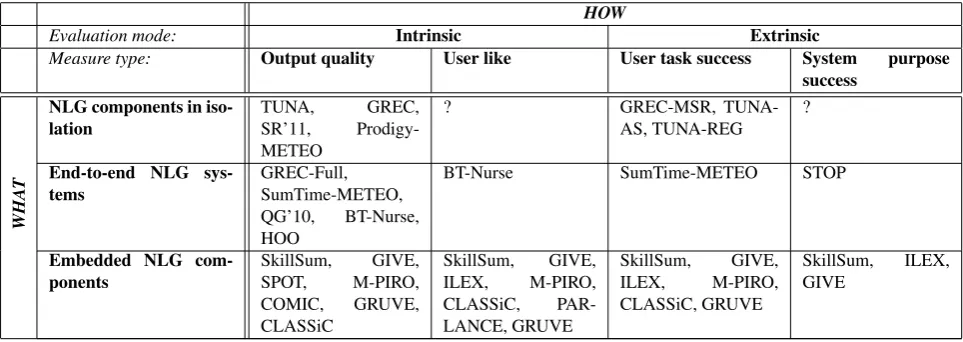
Table 1 shows acategorisation framework for evaluations of automatically generated language, incorporating the evaluation types we discuss in this paper, and populated
with the systems and shared tasks we survey. The cate-gories reflectwhatis being evaluated (indexing the rows), andhowit is being evaluated (indexing the columns).
The taxonomy of evaluation measures represented by the columns in Table 1 is a generic one, and the idea is that any given evaluation method can, independently of the context in which it is developed/applied, be assigned to one of the columns. For example, a measure which computes the percentage of times users play a game to completion is an extrinsic measure – more specifically it is a task-success measure – regardless of the type of system that is being evaluated or the purpose of the evaluation.
Designers of evaluation experiments often talk about assessing higher-levelquality criteriasuch as dialogue per-formance, dialogue quality, system usability, user satisfac-tion, efficiency, etc. It does not make sense to pair up in-dividual evaluation measures with single abstract, higher-level quality criteria. Rather, the decision about which measure(s) to use to assess a given quality criterion is part and parcel of the design of evaluations and is very much context-dependent. There is an important distinction be-tween generic types of evaluation measures (columns in Ta-ble 1) and evaluation criteria (what the evaluation measures are used as a surrogate measure for).
For comprehensive comparative evaluation of systems or components, multiple evaluation methods, moreover in more than one of the categories of evaluation methods in Table 1 tend to be applied. This has been the case of all NLG shared task evaluations to date, and also of the NIST-run MT and Summarisation evaluations. This approach yields a set of evaluation scores and corresponding rank-ing of systems for each evaluation measure that is applied, and it frequently happens that different systems come top of the ranking table for different measures.
HOW
Evaluation mode: Intrinsic Extrinsic
Measure type: Output quality User like User task success System purpose success
WHA
T
NLG components in iso-lation
TUNA, GREC,
SR’11, Prodigy-METEO
? GREC-MSR,
TUNA-AS, TUNA-REG
?
End-to-end NLG sys-tems
GREC-Full, SumTime-METEO, QG’10, BT-Nurse, HOO
BT-Nurse SumTime-METEO STOP
Embedded NLG com-ponents
SkillSum, GIVE, SPOT, M-PIRO, COMIC, GRUVE, CLASSiC
SkillSum, GIVE, ILEX, M-PIRO, CLASSiC, PAR-LANCE, GRUVE
SkillSum, GIVE, ILEX, M-PIRO, CLASSiC, GRUVE
SkillSum, ILEX, GIVE
Table 1: Overview of the system evaluations (represented by name of project or shared task) we survey in this paper, categorised according towhatis being evaluated (components in isolation, end-to-end systems and embedded components), andhowit is evaluated (evaluation mode and type of measure).
than system developers (end users, funding bodies seeking to accelerate technological progress, companies that will turn systems into marketable products, etc.) play a role. Here,evaluation frameworksoffer a solution by comput-ing a scomput-ingle overall score on the basis of the separate scores produced by multiple individual measures.
For example, the overall goal of a dialogue system uation may be to assess ‘Dialogue Performance’. The eval-uation designers may decide that Dialogue Performance is comprised of the quality criteria Dialogue Quality, User Satisfaction and Usability. They select several intrinsic out-put quality measures to capture Dialogue Quality, several user-like measures in exit questionnaires to capture User Satisfaction, and several task-success measures to capture Usability. Finally, a method is chosen for computing a sin-gle score from the measures; this could be as simple as computing the (weighted) average of the measures, or more complex, involving e.g. methods from decision theory.
3.
Evaluation and Shared Tasks in NLG
Present day NLG is a very different field from what it was seven years ago before the advent of the first NLG shared task. One of the most important changes over the past seven years has been the introduction of systematic comparative evaluation methodologies.In this section, we provide a survey of evaluation in NLG, grouped into three categories (as indicated in the rows in Table 1): (a) NLG system components (which implement an NLG subtask) that are evaluated in isola-tion, e.g. the REG, TUNA, GREC, and Surface Realisa-tion shared tasks; (b) end-to-end NLG systems evaluated as a black box, e.g. the METEO data and task, the HOO and Question Generation Shared Tasks; and (c) NLG tems that are components in an embedding interactive sys-tem and where evaluation is at the level of the embedding system, e.g. COMIC, ILEX, M-PIRO, SPOT, SkillSum, CLASSIC, PARLANCE and GIVE.
3.1.
NLG Components in Isolation
NLG today is a very different field from what it was in 2005. One of the most important changes over the past
few years has been the introduction of systematic compar-ative evaluation methodologies. Competetivecomparative evaluation soon followed: the 2007-09 Referring Expres-sion Generation (REG) competitions were the first NLG shared tasks and were organised against a background of growing interest in empirically evaluating REG algorithms, which had hitherto often been justified on the basis of the-oretical and psycholinguistic principles, but lacked a sound empirical grounding. Early empirical evaluations of REG algorithms either used existing corpora such as COCONUT (Jordan and Walker, 2005, Gupta and Stent, 2005), or con-structed new datasets based on human experiments (Vi-ethen and Dale, 2006, Gatt et al., 2007, van der Sluis et al., 2007). These evaluations focused on classic approaches to the REG problem, such as Dale’s Full Brevity and Greedy algorithms (Dale, 1989), and Dale and Reiter’s Incremen-tal Algorithm (Dale and Reiter, 1995). In studies by Gupta and Stent (2005) and Jordan and Walker (2005), these al-gorithms were evaluated in a dialogue context and were ex-tended with novel features to handle dialogue and/or com-pared to new frameworks such as Jordan’s Intentional In-fluencesmodel (Jordan, 2000).
The TUNA shared tasks were run between 2007 and 2009 and focused on referring expressions genera-tion (REG). They were based on the TUNA Corpus (van Deemter et al., 2012), and focused on the generation of full, identifying, definite noun phrases in visual domains where the entities are either furniture items or people. There were three TUNA shared tasks: TUNA-AS (focusing on attribute selection), TUNA-R (focusing on referring expression re-alisation), and TUNA-REG (combining attribute selection and realisation).
ob-jective was to select one of the REs in a given list, for each mention in each text in the test sets; in GREC-MSR, sys-tems generated REs for a single referent (the main sub-ject), and a set of grammatically correct possible choices was provided for each mention; in GREC-NEG, systems generated REs for all people in a text, and a single list of possible REs was provided for each person. Finally, the task in GREC-NER was a straightforward combined Named-Entity Recognition and coreference resolution task, restricted to people entities. Systems inserted RE tags and coreference IDs around recognised mentions. The aim was to match the “gold-standard” tags in the GREC-People data.
Another NLG subtask for which a shared-task com-petition has been run is Surface Realisation; the aim of the SR’11 Shared Task was to enable a direct comparison of independently developed surface realisers by develop-ing a “common-ground” input representation, which could be used to generate realisations by all participating systems (Belz et al., 2011). In fact, the organisers created two differ-ent input represdiffer-entations, one shallow, one deep, in order to enable more teams to participate. SR’11 systems mapped from the shallow (or deep) inputs to word strings that are readable, clear and as similar as possible in meaning to the original corpus sentences.
3.2.
End-to-end NLG systems
End-to-end NLG systems that have been evaluated through shared tasks fall into two categories: “Data-to-Text” and “Text-to-Text” Generation. For data-to-text evaluation, the METEO data is, as far as we aware, the only resource that has been used by multiple research groups to de-velop directly comparable systems outside the context of NLG shared tasks (Reiter et al., 2005, Belz, 2007, Re-iter and Belz, 2009, Angeli et al., 2010, Langner, 2010). The Prodigy-METEO corpus (Belz, 2007) contains just a.m. wind forecasts and corresponding input data vectors, whereas the original SumTime-METEO corpus (Sripada et al., 2002) contains complete weather forecasts and the complete original weather data files.
With regard to text-to-text applications, these include machine translation, summarisation, paraphrasing and text improvement. All of these involve (possibly shallow) anal-ysis of the input text followed by (possibly shallow) syn-thesis of the output text. Many approaches do not com-prise a clearly identifiable NLG subtask. Three text-to-text shared tasks have so far been organised by the NLG community: the GREC-Full shared task, Helping Our Own (HOO) and the Question Generation (QG) Task. The im-mediate motivating application context for the GREC-Full Task is the improvement of referential clarity and coherence in extractive summaries and multiple edited texts (such as Wikipedia articles) by regeneration of Referring Expres-sions contained in them. The HOO Task is an automated text correction task focused on correcting mistakes by non-native speakers of English in English academic papers in the NLP domain. A pilot version of this task was run in 2011 (Dale and Kilgarriff, 2011), followed by the HOO Prepositions and Determiners Task in 2012. Rus et al. (2011) report on the QG task which included two tasks:
Question Generation from sentences and Question Gener-ation from paragraphs. Input data sources for both tasks were Wikipedia, OpenLearn, and Yahoo!Answer.
3.3.
NLG as an Embedded Component
In this section we discuss evaluations from several different projects (part of) whose aim was to develop and evaluate NLG components as part of wider system. These include COMIC (Foster and White, 2005), ILEX (Cox et al., 1999), M-PIRO (Androutsopoulos et al., 2005), SPOT (Rambow et al., 2001), SkillSum (Williams and Reiter, 2008), CLAS-SiC (Janarthanam et al., 2011) and PARLANCE (Dethlefs et al., 2013). All of these applications are interactive to some degree, and some of the NLG components take as-pects of the interaction into account when generating out-puts. For example, the ILEX system varies descriptions depending on browsing history and descriptions can refer back to previously viewed items (Cox et al., 1999).
Evaluations are at the system level comparing systems that differ only in the NLG module, so they count as embed-ded module evaluations in the terminology of Table 1. For example in the CLASSiC project, two end-to-end systems were compared where only the NLG modules differed. It was found that the NLG module using a trained information presentation strategy significantly improved dialogue task success for real users, over using a system with an NLG module which uses conventional, hand-coded presentation methods (Rieser et al., 2014). Where this is an example of improvement observed inextrinsic user task success mea-suresanother study in the same project showed similar re-sults for perceived task success but also an improvement in intrinsic user like quality measures by showing that User Satisfaction was significantly increased using a data-driven approach to Temporal Expression Generation compared to a rule-based system, again as an embedded module in an interactive system (Janarthanam et al., 2011).
3.3.1. Shared Tasks for Embedded NLG Components
The main shared task for this category is GIVE where par-ticipants implement NLG modules that generate instruc-tions to guide a human user in solving a treasure-hunt task in a virtual 3D world in real time. In evaluations, the NLG modules are plugged into the same interactive virtual en-vironment, and the performance and experience of users is evaluated.
The first edition of the GIVE Task was limited in that only discrete steps of the same size, and rotation in one of four directions, were possible in the virtual environments. As a result, the NLG task was easier than intended (as noted in the results report (Koller et al., 2010), one of the best systems generated instructions of the typeMove three steps forward). In the second edition of the task, users were able to navigate the virtual environment freely, turning at any angle and moving any distance at a time. In this subsection, we provide an overview of this second version of GIVE.
functions, including opening the treasure safe, triggering an alarm, and no function), and floor tiles that trigger an alarm. The possible outcomes of a single game are “suc-cess” (treasure found), “alarm” and “user leaves”.
From the point of view of the NLG system, the interac-tion between it and the embedding GIVE-2 system looks as follows: The NLG system receives a message every 200ms containing the position and orientation of the user and the list of currently visible objects. Furthermore, the NLG sys-tem receives a message every time the user manipulates an object. The NLG system can, at any point, request from the GIVE-2 system a plan of actions to get the user from his/her current position to the treasure. It is up to the NLG system to decide when to request plans. So for any single instance of generating an instruction, the NLG module has the following available to it as input:
• A representation of the world the user is in; • Object manipulations by the user so far; • Current position and orientation of the user; • Current list of visible objects; and
• Current plan of actions to reach treasure.
Certain properties of the embedding GIVE-2 system affect the kind of instructions that the NLG system should generate. For example, the GIVE-2 system displays the in-structions for a fixed length of time, so if an instruction is too long, the user cannot read all of it. Furthermore, as the user is free to move at any point (including while the next instruction is being generated), it is possible for the next in-struction to be out of date by the time it reaches the user, and they may therefore not be able to understand it (e.g. if objects which the NLG system assumes are visible, are no longer visible from the user’s new position).
Non-NLG tasks that the NLG system needs to perform include deciding when to request a new plan of actions and what to do with the information about objects manipulated by the user. Content-selection tasks performed by the sys-tem include deciding which subset of actions to select to be covered by the next instruction, and selecting objects from the list of visible objects (or even the world representation) to refer to as landmarks. Most participating NLG systems perform discourse-planning tasks such as aggregating ac-tions and objects. Other typical NLG tasks participating systems could (but do not have to) perform include refer-ring expression generation, lexicalisation, and surface real-isation.
Participating NLG systems were evaluated in terms of the followingextrinsic user-task success measuresand in-trinsic, automatic output-quality measuresthat were com-puted by the GIVE-2 organisers (apart from the first measure, these were computed on successfully completed games only):
• Task success rate: percentage of games in which user found trophy;
• Task duration: mean number of seconds from start of game to trophy retrieval;
• Distance covered by user: mean number of distance units of the virtual environment covered between start of game and retrieval of trophy;
• Actions required: mean number of object manipula-tion acmanipula-tions in games;
• Instructions required: mean number of instructions produced by the NLG module in games; and
• Instruction length: mean number of words in instruc-tions.
The GIVE-2 organisers also obtained ratings for a further twenty-two intrinsic user-like measures from players via an exit questionnaire filled in at the end of each game. Questions ranged from the perceived clarity and readabil-ity of instructions to how enjoyable the game was. If one deemed entertainment the purpose of the GIVE-2 environ-ment, some of these measures could be classified as system-purpose success measures. Some measures aim to assess the quality of part of the system output (the instructions), while most of the measures are more obviously user like measures.
While NLG module developers receive feedback (in the form of exit questionnaires filled in after test games) on how highly users rate the performance of their module, they do not receive any feedback about how to improve their instructions. Such feedback could be provided in the form of model instructions. Human-authored model instructions could conceivably be created, perhaps for a set of specific individual game situations, against which modules could be automatically measured, or which could be used to train modules.
The status of some of the automatic measures men-tioned above is unclear. To count as output quality mea-sures, it would have to be clear which end of a scale corre-sponds to higher quality, which is not the case for instruc-tion length, and possibly some of the other measures.
While GIVE-2 is an interactive system, it is not lin-guistically interactive like the dialogue systems we focus on in the next section. The system outputs (a) continu-ously updated visualisations of the world the user is moving through, and (b) verbal instructions to the user, at points de-termined by the NLG module. The user does not directly input any information, but can move through a given vir-tual world and manipulate some of the objects in it, both of which can affect system behaviour. The input can be as-sumed to be reliable and the NLG task can be viewed as data-to-text generation, except that strategies have to be de-veloped for what to do if the user strays from the intended path. All in all, this is a relatively simple interactive set-up, making the GIVE tasks ideal first shared tasks on NLG embedded within an interactive system.
4.
Evaluation and Shared Tasks for
Interactive Systems
Comparative evaluations of end-to-end interactive systems have typically been in the form of task-based experiments where paid participants perform a task in the laboratory and then fill out a questionnaire, yielding a range of in-trinsic user like measures. However, it can be argued that lab-based evaluations are inefficient, and involve unrealistic scenarios and user goals. Studies have shown that dialogue quality measures vary significantly depending on whether the pool of callers are real users or paid subjects (Ai et al., 2008).
Here, we discuss spoken dialogue system evaluations in terms of realism and level of environment control. The sce-nario with the least control but perhaps the most realism is where the evaluation is ‘in the wild’, for example, booking real flights for the DARPA challenge (Walker et al., 2002) and the Let’s Go! shared task (Black et al., 2011). The lat-ter involves real users with real goals, which in the case of Let’s Go is to get bus information.
Moving the same type of experiment out of the real world and into the lab comes with a further decrease in re-alism but an increase in control.
Crowdsourcing platforms such as Amazon Mechani-cal Turk (AMT) provide an alternative environment to tra-ditional lab-based evaluation. With AMT, participants are paid a small amount of money to perform short tasks. The key advantage of crowdsourcing is the ease of recruitment. With regard to evaluating NLG systems that are embedded, task based experiments have been shown to be effectively evaluated using AMT. For example, Jur˘ci˘cek et al. (2011) describe a telephone infrastructure for interacting with the system and a web interface for feedback collection. Crowd sourcing platforms provide a simple and cost effective way of evaluating interactive systems and in particular output of NLG systems. The main drawback is that it is hard to mon-itor the cooperativeness and accuracy of the participants, although initial results from evaluations of participant ac-curacy are encouraging (Yang et al., 2010, Jur˘ci˘cek et al., 2011).
Changing the experiment from one in which the user interacts directly with the interactive system to an “overhearer-style” method in which the user observes (part of) an interaction (Stent et al., 2004, Dethlefs et al., 2014) gives even greater control, but less realism as well as higher costs.
Wizard of Oz (WoZ) experiments, where a human gen-erates system responses, provide a powerful mechanism for testing certain NLG strategies, such as different referring expression generation (Janarthanam and Lemon, 2010) and Information Presentation strategies (Liu et al., 2009). The major drawback of WoZ experiments is that WoZ envi-ronments are costly to build, and running experiments and training the wizards is very time-consuming. In addition, there may be discrepancies between the different styles of wizards; this is particularly prevalent in NLG WoZ studies. Despite these drawbacks, an important benefit of WoZ ex-periments is that the human-generated system turns can be treated as model outputs, and having model outputs that
fa-cilitate NLG strategy optimisation (Liu et al., 2009, Rieser and Lemon, 2008) is very valuable.
Finally, user simulations are an important component of fine-tuning statistical systems where one can explore a large variety of user responses to different NLG generated utterances (Rieser and Lemon, 2010). However, evalua-tions using user simulaevalua-tions must be combined with eval-uations with real human users.
In order to leverage a greater variety of testbeds, such as evaluations in the wild, some mechanism for system com-parison is necessary. Evaluation frameworks for interac-tive systems go some way towards providing these com-parative measures. These frameworks include PARADISE (Walker et al., 2000), M¨oller and Ward (M¨oller and Ward, 2008), SERVQUAL (Hartikainen et al., 2004) and Con-tender (Suendermann et al., 2010) and enable systems to be compared and ranked using single system-level scores derived from multiple evaluation measures that, in combi-nation, capture relevant aspects of system quality.
5.
A Methodology for Comparative
Evaluation of NLG Components in
Interactive Systems
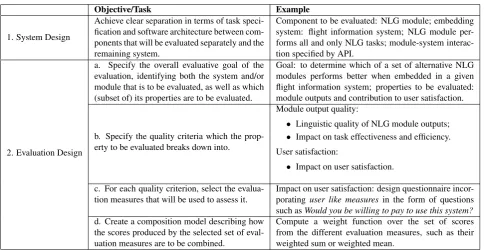
In Table 2, we provide a generic overview of the steps in-volved in designing anevaluation model, i.e. a complete specification of the goals and implementation of a specific evaluation. Note that the evaluation frameworks mentioned above could all be described in these terms.
Point 1 in the table expresses that in order to be able to evaluate multiple versions of a component, its task specifi-cation has to be clear enough for developers to work from, and it has to be architecturally separate enough to be plug-and-playable (so that different components can be plugged in and evaluated under the same conditions). Overall eval-uative goals (2a) tend to be too abstract to be directly as-sessed by a set of measures, and it is often found helpful to break goals down into more fine-grained quality criteria (2b). This process could result in a hierarchical structure of more than two levels, with some of the quality criteria de-composed into further quality criteria. For example, in the PARADISE model (Walker et al., 2000), the overall eval-uative goal of user satisfaction is taken to be composed of quality criteria of low cost and task success, with low cost further composed of efficiency and quality.
However this is done, at the leaves of the resulting (pos-sibly flat) tree, evaluation criteria have to be paired with individual evaluation measures which return a single score for each system (2c). If multiple measures are used, then a composition model can be created, defining how to com-bine them into a single score and/or to reflect their relative importance (2d), corresponding e.g. to the value model in SERVQUAL.
6.
A Specific Evaluation Model for
Comparative Evaluation of NLG Modules
in Interactive Systems
Objective/Task Example
1. System Design
Achieve clear separation in terms of task speci-fication and software architecture between com-ponents that will be evaluated separately and the remaining system.
Component to be evaluated: NLG module; embedding system: flight information system; NLG module per-forms all and only NLG tasks; module-system interac-tion specified by API.
2. Evaluation Design
a. Specify the overall evaluative goal of the evaluation, identifying both the system and/or module that is to be evaluated, as well as which (subset of) its properties are to be evaluated.
Goal: to determine which of a set of alternative NLG modules performs better when embedded in a given flight information system; properties to be evaluated: module outputs and contribution to user satisfaction.
b. Specify the quality criteria which the prop-erty to be evaluated breaks down into.
Module output quality:
• Linguistic quality of NLG module outputs; • Impact on task effectiveness and efficiency.
User satisfaction:
• Impact on user satisfaction.
c. For each quality criterion, select the evalua-tion measures that will be used to assess it.
Impact on user satisfaction: design questionnaire incor-poratinguser like measures in the form of questions such asWould you be willing to pay to use this system? d. Create a composition model describing how
the scores produced by the selected set of eval-uation measures are to be combined.
Compute a weight function over the set of scores from the different evaluation measures, such as their weighted sum or weighted mean.
Table 2: Steps in designing an evaluation model: a specification of the goals and implementation of a specific evaluation.
goal (2a) depends on who the stakeholders in the evaluation are, and on how the results will be used. In the present con-text, we are assuming a developers’ perspective, and that we wish to evaluate (just) the NLG component, not the rest of the system. For this last reason, a small number of frozen versions of the embedding system suffice (although it can-not be ruled out that using other versions may produce dif-ferent results).
To achieve encapsulation of NLG tasks, the embed-ding system should make available all the required input information, including some or all of the following types, depending on how tasks have been divided between NLG module and embedding system:
• Representations of the user’s interaction with the sys-tem so far (including e.g. user actions so far, previous dialogue turns, common ground, etc.);
• Representation of the virtual or real environment the user is in if any;
• Representation of current user state (including e.g. most recent user dialogue act, current position and ori-entation of user, etc.);
• Representation of current and/or remaining options (plans) for how to achieve goal of interaction (e.g. booking a ticket, locating an item, etc.); and
• User model.
The system should send requests to the module to produce a system turn, i.e. unlike in the GIVE-2 Task, all interaction management is performed outside of the NLG module.
A good general-purpose evaluative goal that embod-ies the developers’ perspective is to assess NLG module performance. The following quality criteria can be seen as contributing to this property (also given are the evaluation measuretypesthat can be used to assess the criteria):
1. Context-independent intrinsic quality of NLG module outputs: intrinsic output-quality measures, both auto-matic and human-assessed, e.g. measures of grammat-icality, fluency and clarity;
2. Context-dependent intrinsic quality of NLG module outputs: intrinsic output-quality measures, both auto-matic and human-assessed, e.g. measures of appropri-ateness, clarity and efficiency;
3. Contribution to user satisfaction with system:intrinsic user-like measures, e.g. asking users questions;
4. Contribution to task effectiveness and efficiency: ex-trinsic user task success measures, e.g. average num-ber of system and user turns in successful interactions, percentage of interactions with a successful task out-come, distance travelled in a virtual world, number of restarts, etc.; and
5. Contribution to system purpose success: extrinsic system purpose-success measures; highly system-dependent, but tends to involve both quantitative mea-sures and asking users in some way whether they feel that the system accomplishes its purpose.
7.
Conclusion
In this paper, we started with an overview of different cat-egories of evaluation measures, in order to provide a stan-dard terminology for categorising existing and new evalua-tion techniques. This was followed with some background on existing evaluation methodologies in the NLG and in-teractive systems fields separately, after which we moved on to presenting a methodology for the evaluation of NLG components embedded within interactive systems, using a specific task as an example.
commonly agreed terminology or methodology for evaluat-ing NLG within interactive systems. We have attempted to take a step towards addressing this shortfall in this paper.
8.
Acknowledgements
The research leading to this work was funded by the EP-SRC (UK) under grants F059760, G03995X, and H032886, and by the EC FP7 programme FP7/2011-14 under grant agreement no. 287615 (PARLANCE).
References
Ai, H., Raux, A., Bohus, D., Eskenzai, M., and Litman, D. (2008). Comparing spoken dialog corpora collected with recruited subjects versus real users. InProceedings of the SIGdial Workshop on Discourse and Dialogue (SIG-DIAL).
Androutsopoulos, I., Kallonis, S., and Karkaletsis, V. (2005). Exploiting OWL ontologies in the multilingual generation of object description. InProceedings of the European Workshop on Natural Language Generation (ENLG).
Angeli, G., Liang, P., and Klein, D. (2010). A simple domain-independent probabilistic approach to genera-tion. In Proceedings of the Conference on Empirical Methods in Natural Language Processing (EMNLP).
Belz, A. (2007). Probabilistic generation of weather fore-cast texts. In Proceedings of Human Language Tech-nologies: The Meeting of the North American Chapter of the Association for Computational Linguistics (HLT-NAACL).
Belz, A., Kow, E., Viethen, J., and Gatt, A. (2009). The GREC main subject reference generation challenge 2009: overview and evaluation results. InProceedings of the Workshop on Language Generation and Summari-sation.
Belz, A., White, M., Espinosa, D., Kow, E., Hogan, D., and Stent, A. (2011). The first surface realisation shared task: Overview and evaluation results. InProceedings of the European Workshop on Natural Language Gener-ation (ENLG).
Black, A. W., Burger, S., Conkie, A., Hastie, H., Keizer, S., Lemon, O., Merigaud, N., Parent, G., Schubiner, G., Thomson, B., Williams, J. D., Yu, K., Young, S., and Es-kenazi, M. (2011). Spoken dialog challenge 2010: com-parison of live and control test results. InProceedings of the SIGdial Workshop on Discourse and Dialogue (SIG-DIAL).
Cox, R., O’Donnell, M., and Oberlander, J. (1999). Dy-namic versus static hypermedia in museum education: An evaluation of ILEX, the intelligent labelling explorer. In Proceedings of the Conference on Artificial Intelli-gence in Education (AIED).
Dale, R. (1989). Cooking up referring expressions. In Pro-ceedings of the Annual Meeting of the Association for Computational Linguistics (ACL).
Dale, R. and Kilgarriff, A. (2011). Helping our own: The HOO 2011 pilot shared task. In Proceedings of the European Workshop on Natural Language Generation (ENLG).
Dale, R. and Reiter, E. (1995). Computational interpreta-tion of the Gricean maxims in the generainterpreta-tion of referring expressions. Cognitive Science, 19(2):233–263.
Dethlefs, N., Cuayahuitl, H., Hastie, H., Rieser, V., and Lemon, O. (2014). Cluster-based prediction of user rat-ings for stylistic surface realisation. In Proceedings of the Meeting of the European Chapter of the Association for Computational Linguistics (EACL).
Dethlefs, N., Hastie, H., Cuay´ahuitl, H., and Lemon, O. (2013). Conditional random fields for responsive sur-face realisation using global features. InProceedings of the Annual Meeting of the Association for Computational Linguistics (ACL).
Foster, M. E. and White, M. (2005). Assessing the impact of adaptive generation in the COMIC multimodal dia-logue system. InProceedings of the Workshop on Knowl-edge and Reasoning in Practical Dialogue Systems (KR-PDS).
Gatt, A., van der Sluis, I., and van Deemter, K. (2007). Evaluating algorithms for the generation of referring ex-pressions using a balanced corpus. In Proceedings of the European Workshop on Natural Language Genera-tion (ENLG).
Gupta, S. and Stent, A. (2005). Automatic evaluation of referring expression generation using corpora. In Pro-ceedings of the Workshop on Using Corpora for Natural Language Generation.
Hartikainen, M., Salonen, E.-P., and Turunen, M. (2004). Subjective evaluation of spoken dialogue systems using SERVQUAL method. In Proceedings of the Interna-tional Conference on Spoken Language Processing (IC-SLP).
Janarthanam, S., Hastie, H., Lemon, O., and Liu, X. (2011). The day after the day after tomorrow? a machine learn-ing approach to adaptive temporal expression generation: training and evaluation with real users. InProceedings of the SIGdial Workshop on Discourse and Dialogue (SIG-DIAL).
Janarthanam, S. and Lemon, O. (2010). Learning to adapt to unknown users: referring expression generation in spoken dialogue systems. InProceedings of the Annual Meeting of the Association for Computational Linguis-tics (ACL).
Janarthanam, S. and Lemon, O. (2012). A web-based eval-uation framework for spatial instruction-giving systems. InProceedings of the Annual Meeting of the Association for Computational Linguistics (ACL).
the Annual Meeting of the Association for Computational Linguistics (ACL).
Jordan, P. W. and Walker, M. A. (2005). Learning con-tent selection rules for generating object descriptions in dialogue. Journal of Artificial Intelligence Research, 24(1):157–194.
Jur˘ci˘cek, F., Keizer, S., Ga˘si´c, M., Mairesse, F., Thomson, B., Yu, K., and Young, S. (2011). Real user evaluation of spoken dialogue systems using Amazon mechanical turk. InProceedings of the International Conference on Spoken Language Processing (ICSLP).
Koller, A., Striegnitz, K., Gargett, A., Byron, D., Cassell, J., Dale, R., Moore, J., and Oberlander, J. (2010). Report on the second NLG challenge on generating instructions in virtual environments (GIVE-2). InProceedings of the International Workshop on Natural Language Genera-tion (INLG).
Langner, B. (2010). Data-driven natural language gener-ation: Making machines talk like humans using natural corpora. PhD thesis, Language Technologies Institute, School of Computer Science, Carnegie Mellon Univer-sity.
Liu, X., Rieser, V., and Lemon, O. (2009). A Wizard-of-Oz interface to study information presentation strategies for spoken dialogue systems. InProceedings of the Europe-Asia Spoken Dialogue Systems Technology Workshop.
M¨oller, S. and Ward, N. G. (2008). A framework for model-based evaluation of spoken dialog systems. In Proceed-ings of the SIGdial Workshop on Discourse and Dialogue (SIGDIAL).
Rambow, O., Rogati, M., and Walker, M. A. (2001). Eval-uating a trainable sentence planner for a spoken dialogue system. InProceedings of the Annual Meeting of the As-sociation for Computational Linguistics (ACL).
Reiter, E. and Belz, A. (2009). An investigation into the va-lidity of some metrics for automatically evaluating NLG systems. Computational Linguistics, 35(4):529–558. Reiter, E., Sripada, S., Hunter, J., and Davy, I. (2005).
Choosing words in computer-generated weather fore-casts.Artificial Intelligence, 167:137–169.
Rieser, V. and Lemon, O. (2008). Learning effective multimodal dialogue strategies from Wizard-of-Oz data: Bootstrapping and evaluation. InProceedings of the An-nual Meeting of the Association for Computational Lin-guistics: Human Language Technologies (ACL-HLT).
Rieser, V. and Lemon, O. (2010). Natural language gener-ation as planning under uncertainty for spoken dialogue systems. In Krahmer, E. and Theune, M., editors, Em-pirical methods in natural language generation, pages 105–120. Springer-Verlag, Berlin, Heidelberg.
Rieser, V., Lemon, O., and Keizer, S. (2014). Natural lan-guage generation as incremental planning under uncer-tainty: Adaptive information presentation for statistical
dialogue systems. ACM Transactions on Speech and Language Processing. In press.
Rus, V., Piwek, P., Stoyanchev, S., Wyse, B., Lintean, M., and Moldovan, C. (2011). Question generation shared task and evaluation challenge: Status report. In Proceed-ings of the European Workshop on Natural Language Generation (ENLG).
Sripada, S. G., Reiter, E., Hunter, J., and Yu, J. (2002). SUMTIME-METEO: A parallel corpus of naturally oc-curring forecast texts and weather data. Technical Report AUCS/TR0201, Computing Science Department, Uni-versity of Aberdeen.
Stent, A., Prasad, R., and Walker, M. A. (2004). Trainable sentence planning for complex information presentation in spoken dialog systems. InProceedings of the Annual Meeting of the Association for Computational Linguis-tics (ACL).
Suendermann, D., Liscombe, J., and Pieraccini, R. (2010). Contender. InProceedings of the Spoken Language Tech-nology Conference (SLT).
van Deemter, K., Gatt, A., van der Sluis, I., and Power, R. (2012). Generation of referring expressions: Assessing the incremental algorithm. Cognitive Science, 36(5):99– 836.
van der Sluis, I., Gatt, A., and van Deemter, K. (2007). Evaluating algorithms for the generation of referring ex-pressions: Going beyond toy domains. In Proceedings of the International Conference on Recent Advances in Natural Language Processing (RANLP).
Viethen, J. and Dale, R. (2006). Algorithms for generating referring expressions: do they do what people do? In Proceedings of the International Workshop on Natural Language Generation (INLG).
Walker, M., Rudnicky, A. I., Aberdeen, J., Bratt, E. O., Garofolo, J., Hastie, H., Le, A., Pellom, B., Potamianos, A., Passonneau, R., Prasad, R., Roukos, S., Sanders, G., Seneff, S., and Stallard, D. (2002). Darpa Communi-cator evaluation: Progress from 2000 to 2001. In Pro-ceedings of the International Conference on Spoken Lan-guage Processing (ICSLP).
Walker, M. A., Kamm, C., and Litman, D. (2000). Towards developing general models of usability with PARADISE. Natural Language Engineering, 6(3–4):363–377.
Williams, S. and Reiter, E. (2008). Generating basic skills reports for low-skilled readers. Natural Language Engi-neering, 14(4):495–525.