On the Statistically Optimal Divide and
Conquer Correlation Attack on the Shrinking
Generator
Shahram Khazaei
∗, Mahmood Salmasizadeh
∗∗, Javad Mohajeri
∗∗*Department of Electrical Engineering
Sharif University of Technology, Iran
[email protected]
**Electronic Research Center
Sharif University of Technology, Iran
(salmasi, mohajer)@sharif.edu
Abstract
The shrinking generator is a well-known key stream generator com-posed of two LFSR’s, LFSRxand LFSRc, where LFSRxis clock-controlled
according to the regularly clocked LFSRc. In this paper we investigate
the minimum required length of the output sequence for successful recon-struction of the LFSRxinitial state in an optimal probabilistic divide and
conquer correlation attack. We extract an exact expression for the joint probability of the prefix of lengthmof the output sequence of LFSRxand
prefix of lengthn of the output sequence of the generator. Then we use computer simulation to compare our probability measure and two other probability measures proposed in [5] and [3] in the sense of minimum required output length. Our simulation results show that our measure reduces the required output length.
Keywords. stream ciphers, clock-controlled generators, shrinking generator, divide and conquer attack, optimal correlation attacks, deletion channel, joint probability.
1
Introduction
information about the key, the initial state, the structure or even the unseen key stream bits, faster than exhaustive search over all possible keys.
The shrinking generator [1] is a well-known stream cipher composed of two linear feedback shift registers (LFSR’s), LFSRx and LFSRc. We denote the
length of these LFSR’s byrx andrc, and denote their regular output sequences
by X = {xt}∞
t=1 and C = {ct}∞t=1, respectively. The output sequence of the
generator,Y ={yt}∞
t=1, is the sequence obtained fromX, by removing allxt’s
for whichct= 0.
A basic divide and conquer correlation attack on the unknown LFSRcinitial
state based on the linear consistency test [8] is successful if the observed output sequence is sufficiently long. The time complexity of this attack isO(r3
x2rc). On
the other hand, in a probabilistic model whereX andCare considered as purely random and independent binary sequences, the probabilistic correlation attack is applied by targeting LFSRx. The statistically optimal correlation attack [5],
which minimizes the required output length, is based on MAP decoding in a communication channel with independent deletion synchronization errors. The MAP decoding is applied by efficient computing the joint probability ofXmand
Yn, whereXmandYnare prefixes of lengthmandnofX andY, respectively.
The channel capacity argument in [5] shows that for successful reconstruction of the LFSRx initial state, the required output length of the output sequence,
n, is linear in rx; and it has been conjectured that n ≈ 4rx is sufficient for
successful reconstruction of LFSRx initial state. Also, an efficient method for
computing the joint probability ofXmandYn has been introduced. However,
what has been introduced in [5] is not exactly the joint probability of Xm
andYn, simulation results in [7] show that it is a good measure for successful
reconstruction of the LFSRxinitial state.
The exact value of the joint probability of Xn and Yn has been computed
in [3] and it has been suggested to compare this measure with the measure proposed in [5] with respect to the minimum required output sequence length. In this paper we extract an exact expression for the joint probability of Xm
and Yn. Then we use computer simulation to compare our measure and the two measures proposed in [5] and [3] with respect to minimum required output length for successful reconstruction of the LFSRx initial state.
Correlation attack using all three measures requires exhaustive search over all LFSRx possible initial states. Reduced complexity methods which instead
2
De
fi
nition of the Three Measures and Their
Usage in a Divide and Conquer Correlation
Attack
Let first introduce some notations. The notation A = {at}∞t=1 is used for a
general binary sequence,Ak={at}∞t=kfor its subsequence,An={at}nt=1for its
prefix of lengthnandAnk ={at}nt=k for a segment of it. The number of ones in
An is denoted byw(An).
LetX,C,Y denote the output sequence of LFSRx, LFSRc, and the shrinking
generator itself, respectively. We assume a probabilistic model whereX andC
are independent and purely random binary sequences. It then follows that the output sequence Y is also purely random. In this model the act of shrinking generator is equivalent to obtainingY by sendingX in a deletion channel which deletes the bits of X independently with probability equal to one half. Given an observed output sequenceYnthe MAP decoding, which is optimal decoding, finds an input sequence X that maximizes the joint probability Pr{X, Yn}or
equivalently the conditional probabilityPr{Yn|X}. The prefixYn is obtained
from prefixXmwith a probability that can be arbitrarily close to 1 by increasing
m. As this probability is more than 0.99 form=b2n+ 3√nc, for this choice of
m,Pr{Yn|Xm}is a very good approximation forPr{Yn|X}. Thus for practical respects, we use the joint Pr{Xm, Yn} probability for MAP decoding where
m=b2n+ 3√nc.
2.1
Three Measures
In the following, we restate the measure which proposed in [5] as the joint probability ofXm andYn, the exact expression for the joint probability ofXn
andYnwhich proposed in [3], and our exact expression for the joint probability
ofXm andYn. To this end we use the following partial probability which has been defined in [3] for prefixes ofX and Y
Q(e, s) = Pr{Ys, w(Ce+s) =s|Xe+s}. (1)
The above partial probability can be recursively computed using the follow-ing lemma which has been proved in [3].
Lemma 1 The partial probabilitiesQ(e, s)is recursively determined by1
Q(e, s) = 1
2Q(e−1, s) + 1
2δ(xe+s, ys)Q(e, s−1) (2)
for 0 6 s 6 n, 0 6e 6 m−s, and (e, s) 6= (0,0), from the initial value
Q(0,0) = 1 [3]. (The terms corresponding to impermissible value ofe or sare assumed to be equal to zero.)
1δ(i, j)is the Kronecker function, i.e.,δ
The measure proposed in [5] in terms ofQis2−nQ(m−n, n)which is equal to2m−nPr{Xm, Yn, w(Cm) =n}and obviously is not the joint probability of
Xm andYn. The exact value of the joint probability ofXn andYn, proposed
in [3], is computed using the following theorem.
Theorem 1 For any givenYn andXn, we have
Pr{Xn, Yn}= 2−n n X
e=0
2−eQ(e, n−e) (3)
where the partial probabilityQ(e, s) is determined by Lemma 1 [3].
Our exact and efficient expression for computing the joint probability ofXm
andYn is given by the following theorem which is proved in appendix. Theorem 2 For any givenYn andXm, wherem > n, we have
Pr{Xm, Yn}= 2−m−1 m−Xn−1
e=0
Q(e, n) + 2−n m X
e=m−n
2−eQ(e, m−e) (4)
where the partial probabilityQ(e, s) is determined by Lemma 1.
2.2
Hypotheses Testing
Tofind the correct initial state of the LFSRx, we consider two hypothesis; H1
correspond to an incorrect guess for the initial state, and H0correspond to the
correct guess for the initial state. In a probabilistic model we suppose that under the hypothesis H1, X andYn are purely random and independent, and under
the hypothesis H0 we assume thatX is purely random andYn is the prefix of
lengthnof the sequence obtained fromXaccording to the deletion channel. We need a decision measure,Z(n), which its distribution under two hypotheses are distinguishable. The variablen, is entered as an argument to show the available length of the output sequence. In hypothesis testing we deal with two error probabilities,pmisandpf a, whichpmisis the error probability of deciding H1is
true while H0 is indeed true, and pf a is is the error probability of deciding H0
is true while H1 is indeed true. Ideally, we like to minimize both thepmisand
pf a but normally there is a trade-off. Using Neyman-Pearson lemma [2], pf a
andpmis are jointly minimized by considering a threshold T and choosing H0
if and only if Pr{Z(n)|H0}
Pr{Z(n)|H1} > T. In most situation, the importance of two error probabilities are not equal. In our case, that isfinding the correct initial state of LFSRx, fixing pmis to a value which need not to be very small (e.g. 0.1),
pf a must be around 2−rx for approximately unique reconstruction of LFSRx
initial state. Given the decision measureZ(n), corresponding pf a determines
the required output length for successful reconstruction of the LFSRx initial
A theoretical analysis of the separation between two probability distributions using each one of the three probability measures introduced in section 2.1 as a decision measure, seems to be very difficult. If there was such a theoretical analysis, it would be more reliable than the channel capacity argument discussed in [5]. Instead, we employ experimental computer simulation similar to [7]. The results are given in the following section.
3
Simulation Results
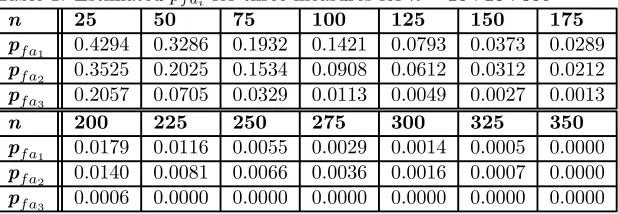
In this section wefirst use the computer simulation for estimatingpf abyfixing
pmis= 0.1for all three measures introduced in section 2.1; that is
Z1(n) = 2m−nPr{Xm, Yn, w(Cm) =n}= 2−nQ(m−n, n) (5)
Z2(n) = Pr{Xn, Yn} (6)
Z3(n) = Pr{Xm, Yn} (7)
wherem=b2n+ 3√nc.
To this end, for each probability measure Zi(1 ≤i ≤3), we choose 10000 purely random and independent pairs Xm and Cm(Xn and Cn for Z2) and
compute the corresponding output sequence in deletion channel model. If the output length is more than n, we consider the first n bits as Yn, and if the
output length is less thann, we pad it with some random bits to increase its length to n. This simulates the hypothesis H0. Then for each pair Xm and
Yn(Xn and Yn for Z
2), we compute the decision measure Zi. After that in
accordance with pmis = 0.1, we compute a threshold thi such that 9000 out
of 10000 pairs have decision measure greater than thi. To estimate pf ai, we
choose 10000 purely random and independent pairsXm and Yn(Xn and Yn
forZ2) and compute the probability measureZi for each pair. The estimated
pf ai is percent of pairs which have probability measure greater thanthi. Table
1 contains our simulation results.
Table 1: Estimatedpf ai for three measures forn= 25 : 25 : 350
n 25 50 75 100 125 150 175
pf a1 0.4294 0.3286 0.1932 0.1421 0.0793 0.0373 0.0289
pf a2 0.3525 0.2025 0.1534 0.0908 0.0612 0.0312 0.0212
pf a3 0.2057 0.0705 0.0329 0.0113 0.0049 0.0027 0.0013
n 200 225 250 275 300 325 350
pf a1 0.0179 0.0116 0.0055 0.0029 0.0014 0.0005 0.0000
pf a2 0.0140 0.0081 0.0066 0.0036 0.0016 0.0007 0.0000
Now, we approximate each pf ai by a curve ai2−bin, where ai and bi are
positive values. For beingpf ai around 2−rx, the required output length must
be approximatelyni 'rx/bi. From table 1 it follows that2
pf a1 ≈ 1.10×2−
0.0314n
→n1≈32rx
pf a1 ≈ 0.68×2−
0.0283n
→n2≈35rx
pf a1 ≈ 0.34×2−
0.0475n
→n3≈21rx
As we see our measure leads to less required output length to successful reconstruction of LFSRxinitial state. Decreasingpmis, increases the coefficients
ai’s and does not lead to significant changes on coefficient bi’s. This is the
reason that we fixpmis to 0.1 and claim it is small enough, see [7] and [4] for
similar cases. In [7] Success of correlation attack on a shrinking generator with special parameters using probability measure Z1 has been confirmed. We do
not follow this method using the other measures. Instead, we try to guess the distribution ofZi under hypotheses H0 and H1. The values of Zi are spread
on a wide range. For a similar situation in [4], it has been noted that their measure, that is measure in [4] for another generator according to insertion channel, does not have normal distribution. However, in our case Zi does not
have normal distribution, the distribution oflog( Zi)can be approximated by
normal distribution very well. Figure 1 shows estimated distribution ofZ3 for
n= 200. As just the shape of distributions are important, we have not shown the axes number. Also, we have plotted the normal distribution with the same mean and variance for comparison. As we see, the approximation is very good.
4
Conclusion
We derived the exact expression for the joint probability of the prefix of length
mof the output sequence of LFSRxand prefix of lengthnof the output sequence
of the shrinking generator. Computer simulation shows that the required output length for successful reconstruction of the LFSRxinitial state using this
expres-sion as a measure of correlation is less than two probability measures proposed in [5] and [3]. In the cryptographic point of view this improvement is not very important. However in coding point of view, justification of the gap between4rx
and21rx, which respectively come from channel capacity argument [5] and our
simulation results, seems to be more important. The reason is obvious, the com-munication channel with independent deletion synchronization errors is such a bad channel that arandom coding can not provide near capacity performance on it.
2Simulations in [7] shows that n
Figure 1: Figure 1: Estimated distributions oflog(Z3)for n=200
Appendix
Proof of Theorem 2.
As X is purely random we have Pr{Xm, Yn}= 2−mPr{Yn|Xm}, so wefirst
computePr{Yn|Xm}. Using Total probability Theorem, we have
Pr{Yn|Xm}= m X
e=0
Pr{Yn, w(Cm) =e|Xm}. (8)
To simplify Pr{Yn, w(Cm) = e|Xm} where 0 ≤ e ≤ m, we consider two situations,0≤e≤nandn+ 1≤e≤m.
a)0≤e≤n
In this case by separating Yn, we have
Pr{Yn, w(Cm) =e|Xm} = Pr{Ye, Yn
e+1, w(Cm) =e|Xm} (9)
= Pr{Ye, w(Cm) =e|Xm}Pr{Yen+1|Ye, w(Cm) =e, X(10)m}
=Q(m−e, e)2−(n−e) (11) (10) follows from (9) according to the Chain Rule. Conditioned onw(Cm) =
e, the stringYn
Cm+1 are still mutually independent and purely random, even when
condi-tioned on Xm and Ye. Therefore, Yn
e+1 is purely random on the conditions
Ye, w(Cm) =eandXm. So (10) simplifies as (11).
b)n+ 1≤e≤m
In this case we can not partitionYn as (9). We partition the set of allCm
where w(Cm) = e to some subsets which satisfy the conditions w(Ck) = n,
ck+1 = 1 and w(Ckm+2) = e−n−1 over all allowed values for k, that is the
overlap of three setsn≤kandm−k−1≤e−n−1and0≤k≤m−1. Using Total Probability Theorem, we have have
Pr{Yn, w(Cm) =e|Xm}= mX+n−e
k=n
Pr{Yn, w(Ck) =n, ck+1= 1, w(Ckm+2) =e−n−1|Xm}.
(12) Using Chain Rule, we have
Pr{Yn, w(Ck) =n, ck+1= 1, w(Ckm+2) =e−n−1|Xm}=
Pr{ck+1= 1, w(Ckm+2) =e−n−1|Xm} ×
Pr{Yn, w(Ck) =n|Xm, ck+1= 1, w(Ckm+2) =e−n−1} (13)
AsX andCare mutually independent and purely random, the second term of (13) is equal to
Pr{ck+1= 1, w(Ckm+2) =e−n−1}=
1 2 µ
m−k−1
e−n−1 
. (14)
Asw(Ck)is independent ofX andc
k+1, and conditioned onw(Ck) =n,Yn
is independent ofXk+1 andCk+1, the last term of (13) is simplified as
Pr{Yn, w(Ck) =n|Xk}=Q(k−n, n) (15) Using (14) and (15), for case (b) we have
Pr{Yn, w(Cm) =e|Xm}= m+Xn−e
k=n 1
2Q(k−n, n) µ
m−k−1
e−n−1 
(16)
Combining the results of (a) and (b), and using some arithmetic relations, we have
Pr{Yn|Xm} = n X
e=0
Q(m−e, e)2−(n−e)+ m X
e=n+1
mX+n−e
k=n 1
2Q(k−n, n) µ
m−k−1
e−n−1 
= m X
e=m−n
Q(e, m−e)2m−n−e+1 2
m−Xn−1
e=0
(4) immediately follows from (17).
References
1. D. Coppersmith, H. Krawczyk, and Y. Mansour, "The shrinking genera-tor," Advances in Cryptology - CRYPTO’93, Lecture Notes in Computer Science, vol. 773, pp. 22-39, 1993.
2. T. Cover and J.A. Thomas, "Elements of information Theory," Wiley series in Telecomunication, Wiley, 1991
3. J. Dj. Golic, "Correlation analysis of the Shrinking Generator," Advances in Cryptology— CRYPTO 2001, LNCS vol 2139, Springer-Verlag, 2001, pp. 440-457.
4. J. Dj. Golic and R. Menicocci, "Edit probability correlation attack on the alternating step generator," Sequences and their Applications - SETA ’98, Discrete Mathematics and Theoretical Computer Science, C. Ding, T. Helleseth, and H.Niederreiter eds., Springer-Verlag, pp. 213-227, 1999.
5. J. Dj. Golic and L. O’Connor, "Embedding and probabilistic correla-tion attacks on clock-controlled shift registers," Advances in Cryptology - EUROCRYPT ’94, Lecture Notes in Computer Science, vol. 950, pp. 230-243, 1995.
6. T. Johansson, "Reduced complexity correlation attacks on two clock-controlled generators," Advances in Cryptology - ASIACRYPT ’98, Lec-ture Notes in Computer Science, vol. 1514, pp. 342-357, 1998.
7. L. Simpson, J. Dj. Golic, and E. Dawson, "A probabilistic correlation attack on the shrinking generator," Information Security and Privacy -Brisbane ’98, Lecture Notes in Computer Science, vol. 1438, pp. 147-158, 1998.